
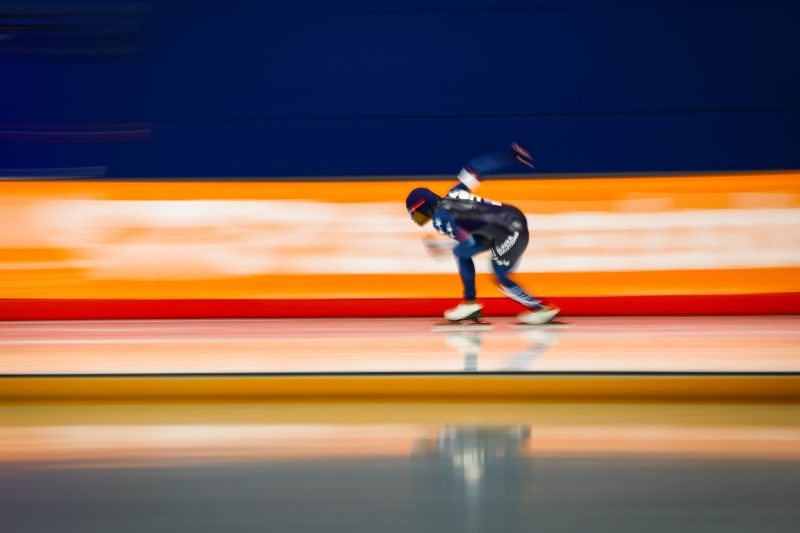
U.S. Olympians Erin Jackson and Alysa Liu are both contenders for gold medals at the 2026 Winter Olympics.
The athletes demonstrate that different personality traits and cognitive styles can lead to elite athletic success.
Figure skater Alysa Liu is described as a free-spirited artist who thrives on spontaneity and fun.
Speedskater Erin Jackson is known for her analytical and academic approach to her sport.
NEW YORK — Erin Jackson, the pragmatic speedskater, missed practices in high school while she was building a robot.
This pair of U.S. Olympians, each with her own winding journey, demonstrate how different personality traits and cognitive styles — how their brains work — can lead to athletic greatness.
“Different athletes may arrive at excellence via very different mixes of focus, creativity, emotional control, risk tolerance and social engagement,’ Paul McCarthy, a psychologist in Great Britain who has worked with athletes, told USA TODAY Sports. “The sport sets the constraints; the brain finds its own solution.’
And some brains are built better for Olympic success.
Jackson, 33, won the women’s 500-meter speed skating event at the 2022 Beijing Games and became the first Black woman to win a gold medal in an individual event at the Winter Olympics. She also graduated cum laude from the University of Florida Honors Program with a Bachelor of Science in Materials Science & Engineering.
Liu, 20, became the youngest U.S. women’s figure skating champion at age 13. She spent a year studying at UCLA before ending her two-year hiatus from skating in 2024 and becoming a world champion in 2025.
Their approaches are as different as their disciplines, but both women are expected to contend for gold medals at the 2026 Winter Olympics.
Alysa Liu can’t live without fun
In October, Liu was one of about 60 athletes to attend the Team USA media summit in New York ahead of these winter games in Milano Cortina. She was the only athlete to modify a standard blue United States Olympic and Paralympic Committee T-shirt to create an off-the-shoulder look.
“… I was like, I can’t change the color, but I can change the shape and I have haircutting scissors with me,’ she explained.
Viola!
Get Olympics updates in your texts! Join USA TODAY Sports’ WhatsApp Channel
As singular as her remixed T-shirt, Liu said she seeks fun that has included late-night karaoke and a trip to a video game café near her home in Northern California that kept her out until 4 a.m.
“I just can’t live without fun,’ she said. ‘ … Some days I oversleep my training and I wake up and I’m like, ‘Now what?’ And then some days I’ll be like, ‘Hmm, now I want to go to (Lake) Tahoe and swim.’ And so we’ll do that.’
She also talked of hiking in Nepal with a friend and her friend’s mother. “We were fighting over the silliest things, like, would you rather be a cow or a chicken? … But trust it was deep and meaningful.”
Of figure skating, Liu said, “It’s definitely an art form. I view it very much as that. But it satisfies me on a technical side, like spins and jumps and running the program itself, those are really hard. Those are difficult. And I like being an athlete.
“And then this sport, it’s also artistic. You get to pick music, design your dresses, do choreography, like dancing, but it’s very limited … you can’t do hip hop on ice. That does not look good. A lot of dance styles are awkward on the ice and you’re not able to portray. I have a lot of concepts in my head. I’m not able to do them in skating, and that’s fine. So I’ll just have to find another outlet for that part of my brain, I guess.”
‘An artist, above all’
Liu’s father, Arthur, said he was unaware of the T-shirt his daughter transformed at the media summit in New York. But he didn’t sound surprised.
“I think she calls herself an artist, above all,’ he told USA TODAY Sports. “The way she interprets the music, the way she moves, it’s very artistic.’
At the U.S. figure skating championships in January, Liu debuted a new, edgy free skate set to the music of Lady Gaga. She also sported alternating stripes of platinum blond in her naturally dark hair.
Brian Boitano, the retired figure skater who won an Olympic gold medal in 1988, said the decision was “in Alysa Liu fashion.’
“For a skater to change their program a month before the Olympic is just unheard of,’ Boitano said on USA TODAY’s Milan Magic podcast.
It oozed the kind of fun Liu seems to look for, and the kind of fun her father said Alysa experienced when she started skating at 5 years old.
“She just took off on the ice,’ he said. “She was just chasing adults, hockey players, and making friends and with adults and girls of her own age, boys of her own age. She was just having so much fun on the ice.’
Laura Lipetsky, who was Alysa’s first coach and worked with her for about 10 years, said, “I helped her see performances as just another way to have fun. … We did role-playing pretending it was the Olympics, and kept everything fun, so pressure felt exciting instead of intimidating.’
The fun she craves and savors — the kind she showed as a youngster on the ice — was harder to come by during the pandemic, her interactions with other skaters at the rink restricted. Arthur Liu said he traces his daughter walking away from the sport in 2022 to exactly that. But on a ski trip in 2024 during her hiatus, he said Alysa rediscovered that sense of fun. Holding on to is has been a priority since her return.
There’s another distinguished aspect of Liu’s mind. Arthur Liu said Alysa was doing puzzles at age 2, completed first and second grade in the same year, and is a fast learner on the ice. As Arthur recently heard Boitano say, as soon as Alysa learns a move, she’s “competition ready.”
Erin Jackson’s ‘good relationshp with loss’
Jackson greeted reporters at the Team USA media summit wearing Olympics attire, unmodified by haircutting scissors. While Liu’s media session at times felt like a theme-park ride, Jackson’s felt like an escalator ride – smooth, without any loop-de-loops.
Jackson acknowledged feeling some pressure defending her Olympic title in the 500-meters, but said she doesn’t attach herself to the outcome of her performances.
“I don’t think with sports it was ever that way for me just because I didn’t grow up really as an athlete,’ she said. “I grew up as more of an academic or a student and then got into focusing on sports much later in my life. … So I feel like that also helped me with my approach to athletics and performance.
Get our Chasing Gold Olympics newsletter in your inbox for coverage of your favorite Team USA athletes
“I think I came in with that mindset of kind of having a good relationship with loss.’
Because a loss is something Jackson can learn from. When asked about her hope to compete beyond these Winter Games despite recurring back issues, she said: “I feel like I still have so much to learn.’
And when asked about Special Forces: World’s Toughest Test, a grueling reality show Jackson won in 2023, Jackson said: “It’s not fun, but you’ll learn a lot.’
Although Jackson took up speedskating in 2017, she started another form of skating five years before that – roller derby. Jackson joined the New Jax City Rollers — a travel team based Jacksonville, Florida, about 100 miles north of where she grew up — in 2012.
“I just think it’s so fun,’ Jackson said. “It’s the only team sport I’ve done, so it’s just amazing to have that community and just have like people to share the track with. …
“If you haven’t seen a roller derby event, I really recommend it.’
‘We’d have to drag her out’
Renee Hildebrand started coaching Jackson before Jackson transitioned to speed skating from inline skating.
“She asked more questions than probably any skater I ever had,’ Hildebrand said. “Always very analytical. While she was in high school, she did the engineers’ program there. And they built a robot and did things like that, and I used to get mad because she missed so much skating.’
Although Jackson did not sacrifice academics for skating, she approached the sport with the same focus as she did building that robot.
Said Hildebrand, “If you tell her something, she can apply that right away to her skating. You only got to tell her once and she’ll go out there and figure out how to do it.’
Hildebrand said two of her top skaters struggled with starts when they transitioned to speedskating from inline skating. But not Jackson, who began working with a new coach.
“She definitely has the curiosity of how things work and why they work,’ she said. ‘But she also has the ability to put it all together and understand it, which is amazing that she’s just that smart that she can figure out things like that.’
Stephanie Gentz, one of Jackson’s roller derby teammates, said the Olympic speedskater is ultra focused on the track. But Gentz also said Jackson is witty, will laugh at herself and can be pushed beyond her comfort zone.
“After games, after tournaments, they always have an afterparty and we’d make her dance with us,’ Gentz said. “We’d have to drag her out. But when we did, we would all have fun.’
Olympians shaping ‘how intelligence is expressed’
Taylor, the psychologist from Great Britain, shared his thoughts on the athletes’ brains – in particular the ones that belong to Jackson and Liu.
“From what we know, personality traits and cognitive styles do reflect differences in how the brain functions, but not in a simple ‘smart vs. not smart’ way,’ he said. “Traits like openness, conscientiousness, novelty-seeking, and emotional regulation map onto different neural networks and neurotransmitter systems. Those differences influence how someone learns, stays motivated, tolerates risk, and responds to structure – rather than raw intelligence alone.’
Taylor said Liu and Jackson strike him as good illustrations of this distinction.
“Alysa’s curiosity, spontaneity, and willingness to step away from a rigid system suggest high openness and intrinsic motivation,’ Taylor said. “That kind of mind can be deeply intelligent, but it thrives on exploration rather than routine.
“Erin’s background in engineering, combined with her athletic success, points to strong executive function, planning, and analytical thinking – yet her roller derby experience and dry humor show flexibility and playfulness that do not fit a ‘serious’ stereotype.’
What’s especially interesting, Taylor said, is elite sport seems to allow multiple cognitive and personality pathways to success, sometimes even within the same discipline.
“Different athletes may arrive at excellence via very different mixes of focus, creativity, emotional control, risk tolerance, and social engagement,’ he said. “The sport sets the constraints; the brain finds its own solution. We also cannot forget the social and environmental influences in this admixture.
‘So, yes — personality traits are tied to the brain and how it functions, but they don’t sit in opposition to intelligence. They shape how intelligence is expressed, sustained, and translated into performance. That diversity may be one of the reasons elite sport is such a rich lens into human cognition.’