Archive

2026

Browsing

With the Olympics underway, the power balance in NCAA women’s hockey stayed largely unaltered.

Wisconsin and Ohio State traded blows, and teams missing their national team stars fought through adversity to pick up important wins.

This week, UConn slid into the top 10, while Minnesota-Duluth, a ranked program since the season started, continued its slide and dropped out of the rankings.

The women’s hockey event at the Olympics runs until Feb. 19. Team USA, whose seven players from college include Caroline Harvey, Laila Edwards and Abbey Murphy, is undefeated after three games.

Here’s a look at the top 10 NCAA women’s hockey programs this week:

Women’s college hockey power rankings

1. University of Wisconsin (WCHA)

Wisconsin barely held on to the top spot. Ohio State beat Wisconsin 4-1, but the Badgers answered with a 4-1 win of their own to split the weekend. The teams were missing a combined nine Olympians who were in action in Italy. Team USA snub Lacey Eden continued to lead the Badgers, with three points in the win. Eden is making good use of her time as Wisconsin’s top player.

2. Ohio State University (WCHA)

All Ohio State needed to do was repeat Saturday’s 4-1 win, but third-period penalty problems squashed any hope it had as Wisconsin scored a pair of power-play goals. The good news for the Buckeyes is they don’t need to beat Wisconsin twice in the WCHA final or national championship tournament. They only need to beat them once.

3. University of Minnesota (WCHA)

It wasn’t a great weekend for Minnesota, which was outshot in back-to-back games by St. Thomas. They still managed a regulation win and a shootout win, but Minnesota wasn’t dominant. Like other big programs, they’re missing stars, including national scoring leader Abbey Murphy. The wins didn’t come easy, but the Gophers faced adversity and continued moving forward.

4. Penn State (AHA)

Without Tessa Janecke, Nicole Hall and Matilde Fantin, who are at the Olympics, Penn State showed its scoring depth, notching 11 goals in a two-game series sweep over Lindenwood. Penn State won’t see another serious challenge before the national championships open, with only RIT left on its schedule.

5. Northeastern (Hockey East)

Stryker Zablocki will receive some serious consideration for national rookie of the year honors. She’s evolved into Northeastern’s top player, with 14 goals and 23 assists for 37 points in 30 games. The back-to-back Hockey East Rookie of the Month had another four-point weekend as Northeastern beat Maine and Vermont. They face Boston University, Boston College, UConn and Providence before the Hockey East quarterfinal.

6. Quinnipiac (ECAC)

Felicia Frank was named a semifinalist for national goaltender of the year. She followed that recognition by stopping 33 of 34 shots in a 1-1 tie against Harvard and a 3-0 shutout win over Dartmouth. The tie and shootout loss against Harvard is nothing to hang their head about, considering Harvard also beat Princeton this weekend and Cornell a week ago.

7. Yale (ECAC)

Yale keeps getting better. They beat St. Lawrence and Clarkson this weekend, using what has become the team’s best asset: scoring depth. Carina DiAntonio, Jordan Ray and Naomi Boucher, a trio of seniors, have found ways to consistently contribute up front. On the blueline, senior Gracie Gilkyson may be one of the most underrated blueliners in the nation. With Princeton and Quinnipiac remaining, Yale will face two strong tests ahead of the playoffs.

8. Princeton (ECAC)

Princeton lost to a red-hot Harvard program, falling victim to Ainsley Tuffy’s netminding. To take the next step, Princeton needs to find regular secondary scoring beyond Issy Wunder and Mackenzie Alexander. Seniors Jane Kuehl and Emerson O’Leary are important to this, and they’ve been good. But for Princeton to upset a top-five program, they need to be more than good.

9. Cornell (ECAC)

Annelies Bergmann posted back-to-back shutouts against Union and RPI. Their top players, such as Avi Adam, Mckenna Van Gelder and Karel Prefontaine up front, all contributed offensively as well. This team has been a shutdown program since Day 1. Even though it was against weaker competition, the combination of that shutdown style and getting offensive contributions, with eight goals on the weekend, was a positive sign.

10. UConn (Hockey East)

Taking Minnesota-Duluth’s spot in the top 10, UConn beat Providence and Boston College this past weekend. Netminder Tia Chan might be the best in the nation right now, and she’s been the difference-maker time and again for the Huskies. They don’t have a singular offensive power, but they do have a pair of balanced lines that have kept UConn on the winning side.

This post appeared first on USA TODAY

MILAN — Short-track speed skating is taking off at the 2026 Winter Olympics, and it was a mixed start for Team USA.

The first day of competition in the thrilling event began on Tuesday, Feb. 10 with the women’s 500m, and with three skaters in the heats, the U.S. only advanced two.

Milano Cortina is all about capturing what just slipped away for Santos-Griswold. She was positioned to win her first Olympic medal in 2022, but a crash on the final lap spoiled her hopes with a finish off the podium. Now Santos-Griswold returns with hardware in her sights.

Corrine Stoddard was another contender for the U.S., but her run ended in disaster. It was a close battle in heat alongside Xinran Wang (China), Rika Kanai (Japan) and Aurelie Leveque (France), but on the third lap, Stoddard fell and caused several skaters to also hit the ground. She had a chance to recover, but she stumbled again to essentially take herself out of the race. Wang and Kanai advanced out of the heat while Stoddard finished in last with a time of 1:11.651.

Despite a third-place finish in her heat, Team USA’s Julie Letai advanced to the next round of races.

This post appeared first on USA TODAY

MILAN — Madison Chock and Evan Bates, the four-time Olympians, seven-time U.S. champions and three-time reigning world champions, found themselves in an usual position Monday night after the rhythm dance portion of the ice dance competition at the 2026 Winter Olympics.

Not first. 

After sweeping to victories in both portions of the team competition to help lead the Americans to the gold medal, Chock and Bates finished in second place, albeit by less than half a point, to the new French team of Laurence Fournier Beaudry and Guillaume Cizeron. 

There is much more to come Wednesday in the free dance, but it was natural to wonder if the busy schedule they’ve been keeping is taking a bit of a toll on them. 

Watch Olympic figure skating on Peacock

While the U.S. relied on them for both dance team event programs Friday and Saturday, the entire French team missed the cut, meaning Fournier Beaudry and Cizeron had the weekend off from competing. And even though Chock and Bates didn’t have to skate Sunday, they did come to the arena to cheer on their U.S. teammates and then receive their gold medals, putting in another long day at the office. 

Chock said they finally got to sleep at 2 a.m., and slept in, getting “a nice, solid 10 hours.” But there is no doubt they and Ilia Malinin have been the hardest working gold-medal favorites in the figure skating venue.

“Of course doing competitions and putting out our best performances, it’s an energy exertion,” Chock said. “We prepared for it, we’re ready, we’ve trained and we knew what to expect getting into this.”

Said Bates: “We felt really strong. We felt like it was even better than the team event. It’s the feeling of accomplishment that you did your best on the ice and the rest isn’t necessarily all up to us.”

Coming back after just missing a medal with a fourth-place finish at the 2022 Beijing Olympics, the married couple has been talking about only one thing as they’ve focused on the Milan Games: the gold medal. Being behind the French by .46 of a point — 90.18 points to 89.72 points — doesn’t mean they won’t win, but it’s clear they face some very significant competition. 

Being just behind “doesn’t change anything for us,” Chock said. “It’s business as usual.”

This will almost certainly be their last Olympic Games, so they don’t want to miss a thing.

“This week has just been a whirlwind and a dream and we’ve savored every moment,” Chock said. “We’re really looking to just not miss a second of it and enjoy every last drop this Olympic Games has to give us.” 

On Tuesday, it’s giving them something they will gladly accept.

A day off. 

This post appeared first on USA TODAY
The Republican-led House Committee on Ways and Means is set to hold a hearing on Tuesday morning digging into foreign influence in American nonprofits, with several NGOs and far-left funding networks expected to be on the hot seat. 

At 10 a.m. on Tuesday, House Committee on Ways and Means Chair Jason Smith will oversee a hearing, ‘Foreign Influence in American Non-profits: Unmasking Threats from Beijing and Beyond.’ The hearing will be broadcast online at the committee’s website.

Witnesses at the hearing will include Capital Research Center president Scott Walter, Americans for Public Trust Executive director Caitlin Sutherland, Narravance CEO Adam Sohn, Dubinsky Consulting founder Bruce Dubinsky and Public Citizen co-founder Robert Weissman.

In a press release, the committee said the hearing will focus on the ‘ways foreign actors have funneled millions of dollars through networks of tax-exempt organizations to create, support, and fuel disruption and illegal activity across the country.’

The hearing is expected to examine a network of nonprofits, including organizations funded by Neville Roy Singham, an American-born tech tycoon and self-styled Marxist-Leninist, living in Shanghai. Singham has funded nonprofit groups, including the People’s Forum, CodePink, BreakThrough BT Media, the ANSWER Coalition and the Party for Socialism and Liberation, which have worked closely with Democratic Socialists of America in dispatching socialist, Marxist-Leninist and communist foot soldiers into the streets to disrupt federal immigration law enforcement agents and stoke chaos.

‘For too long, foreign actors have gotten away with abusing our tax-exempt sector to [sow] division and chaos in our country,’ Smith posted on X on Tuesday morning. ‘Today, we’re putting them on notice. Going to be a late night in China for Shanghai Singham!’

Over the past year, Fox News Digital has documented a pattern of coordinated protests by socialist, communist and Marxist groups, revealing a synchronized ecosystem of funding, media amplification, ideological framing and street-level mobilization that aligns with the strategic interests of hostile foreign governments, including the People’s Republic of China.

‘Tax-exempt status is a privilege not a right,’ Smith told Fox News Digital. ‘Nonprofits must remain accountable and refuse to act as instruments of hostile foreign governments.’

The Ways and Means Committee ‘continues to investigate how foreign money and foreign-linked networks are funneled through tax-exempt entities to sow discord and unrest in our society,’ he said. ‘That’s why we’re demanding answers from Tricontinental and BreakThrough about their funding streams, activities and communications with CCP-linked individuals, including Neville Roy Singham.’

Hours before the hearing, Fox News Digital reported that Smith escalated his investigation into Singham, who has allegedly been ‘sowing chaos and spreading Chinese propaganda, possibly in coordination with a foreign government.’

In separate letters, Smith demanded records from BreakThrough and Tricontinental, warning that both tax-exempt organizations may be operating outside their lawful purpose as possible unregistered foreign agents, while helping to fuel domestic unrest under the guise of journalism and academic research.

Congressional investigators say the Singham network sits at the center of a malign foreign influence operation that allegedly exploits U.S. nonprofit laws to inject anti-American propaganda into domestic protest movements and sow discord from within the United States.

The letters describe a full-spectrum operation, with funding aligned with foreign interests flowing into tax-exempt nonprofits that produce ideological research, media narratives and social media messaging, which are then deployed onto U.S. streets through tightly choreographed protests.

‘If the evidence shows these groups are acting as conduits for CCP-aligned propaganda or functioning like foreign agents while enjoying U.S. tax benefits, their tax-exempt status should be revoked immediately,’ Smith said. ‘We’re going to follow the money and demand accountability to put a stop to Beijing’s exploitation of our tax-exempt sector.’

This post appeared first on FOX NEWS

A Tuesday Senate hearing is set to expose billions in fraud in Minnesota as well as foreign backing for anti-ICE agitators across the country, Sen. Josh Hawley’s office told Fox News Digital.

The hearing before the Homeland Security Subcommittee on Disaster Management, which Hawley chairs, will feature testimony from a Minnesota state senator and representatives of third-party watchdog groups. Systemic fraud backed by transnational groups has stolen billions from child nutrition, FEMA assistance, housing, Medicaid and substance abuse services, the testimony is expected to say.

‘American taxpayers are getting robbed blind—billions stolen in Minnesota, and hundreds of billions siphoned out of the country by transnational criminals every year—all while foreign actors coordinate chaos on our streets,’ Hawley told Fox News in a statement.

‘Enough is enough. It’s time to root out the dark money and shut down the foreign influence,’ he added.

Minnesota State Sen. Mark Koran’s testimony will highlight the role Minnesota Gov. Tim Walz and Attorney General Keith Ellison played in allowing fraud to fester and spread across the state in what he calls the ‘largest expansion and fastest acceleration of fraud this country has ever seen.’

Witnesses are expected to say that senior officials were not only aware of the fraud but have also taken steps to hide it from public scrutiny by backdating audit records and cracking down on whistleblowers.

A Minnesota Department of Human Services (DHS) whistleblower told Fox News that she was the victim of a ‘smear campaign’ after raising red flags about fraud in the state since 2019.

Federal prosecutors estimate that up to $9 billion was stolen through a network of fraudulent fronts posing as daycare centers, food programs and health clinics. The majority of those charged, so far, in the ongoing investigation are part of Minnesota’s Somali population.

In addition to Koran, lawmakers will hear testimony from Seamus Bruner, the vice president of the Government Accountability Institute; Dylan Hedtler-Gaudette, the acting vice president of Policy & Government Affairs for the Project on Government Oversight, and Haywood Talcove, the CEO of LexisNexis Risk Solutions, Government.

Talcove’s testimony will focus on transnational groups that he says are exploiting federal assistance programs and using stolen funds support ‘organized crime, drug trafficking, human exploitation, and, in some cases, terrorist-affiliated or hostile foreign actors.’

Bruner’s testimony will also focus on foreign influence, linking the funding streams to foreign actors, including individuals with ties to the Chinese Communist Party.

This post appeared first on FOX NEWS

President Donald Trump’s administration is poised to walk back an Obama-era greenhouse gas finding that serves as a lynchpin for justifying climate regulations across the country on Wednesday.

The 2009 ‘endangerment finding’ identifies six greenhouse gases that the Obama administration said pose ‘a threat to public health and welfare.’ That harm finding was then used to justify sweeping climate regulations from the Environmental Protection Agency (EPA), such as raising fuel economy standards and limiting power plant emissions, The Wall Street Journal reported Monday.

EPA Administrator Lee Zeldin hailed the move as cutting through government red tape in an interview with the Journal.

‘This amounts to the largest act of deregulation in the history of the United States,’ Zeldin said.

The Journal reports that the final rule will be made public later this week and is set to eliminate requirements to measure, report, certify and comply with federal greenhouse-gas emission standards for motor vehicles. The rollback does not yet affect power plants or oil and gas facilities.

‘More energy drives human flourishing,’ Interior Secretary Doug Burgum told the outlet. ‘Energy abundance is the thing that we have to focus on, not regulating certain forms of energy out.’

Trump is reportedly expected to hold an event at the White House on Wednesday with Zeldin and Energy Secretary Chris Wright. There they will announce a new initiative for the Department of War to purchase electricity from coal-powered plants.

The Washington Coal Club is also set to name Trump the ‘Undisputed Champion of Coal’ during the event, according to the Journal.

Trump has been consistently critical of global warming claims and climate regulation throughout both of his terms in office, famously withdrawing from the Paris climate agreement when he first took office in 2017.

Trump more recently used the wall of winter storms across the U.S. as a talking point against ‘climate insurrectionists.’

‘Record Cold Wave expected to hit 40 States. Rarely seen anything like it before,’ Trump wrote on social media last month. ‘Could the Environmental Insurrectionists please explain — WHATEVER HAPPENED TO GLOBAL WARMING???’

This post appeared first on FOX NEWS

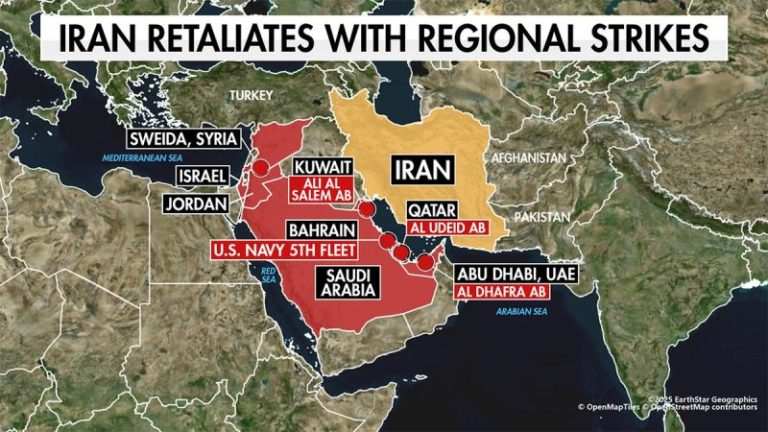
Iranian Foreign Minister Abbas Araghchi said his country would not negotiate on its ballistic missile program, rejecting a core U.S. demand and further dimming prospects for a breakthrough deal.

He again warned in an interview with Al Jazeera that Tehran, Iran, would target U.S. bases in the Middle East if provoked, calling Iran’s missile program ‘never negotiable.’

The warnings came as U.S. and Iranian negotiators met in early February in Oman, even as Washington continued to build up military forces across the region — a posture U.S. officials say is meant to deter further escalation but which analysts argue also underscores how far apart the two sides remain.

Despite the imbalance in military power, analysts say Iran believes it can withstand U.S. pressure by signaling greater resolve — and by betting that Washington’s appetite for war is limited.

While the U.S. possesses overwhelming military capabilities, Defense Priorities analyst Rosemary Kelanic said Iran is relying on the logic of asymmetric conflict.

‘One country is much stronger, but the weaker country cares more,’ Kelanic said. ‘And historically, the country that cares more often wins by outlasting the stronger one.’

‘Iran is trying to signal resolve as strongly as it can, but it likely doubts U.S. resolve — because from Tehran’s perspective, the stakes for Iran are existential, while the stakes for the United States are not,’ she added.

Behnam Taleblu, a senior fellow at the Foundation for Defense of Democracies, said Tehran’s primary leverage is its ability to threaten wider regional instability, even if it cannot win a prolonged conflict.

‘The Islamic Republic’s leverage is the threat of a region-wide war,’ Taleblu said, noting that while U.S. and Israeli defenses could intercept most attacks, ‘something will get hit.’

Iran buying time

Analysts across the spectrum agree that Iran is using negotiations less as a path to compromise than as a way to delay decisive action.

Oren Kessler, analyst at global consulting firm Wikistrat, said Iran is using talks to stabilize its position internally while avoiding concessions on core security issues.

‘Both sides want a deal, but their red lines are very hard for the other side to overcome,’ Kesler said. ‘The talks are going well in the sense that they’re happening, but they’re not really going anywhere.’

Taleblu echoed that assessment, arguing that Tehran is treating diplomacy as a shield rather than a solution.

‘The regime is treating negotiations as a lifeline rather than a way to resolve the core problem,’ he said.

Taleblu added that Iran’s leadership sees talks as a way to deter a strike in the short term, weaken domestic opposition in the medium term, and eventually secure sanctions relief to stabilize its economy.

Secretary of State Marco Rubio has insisted that limits on Iran’s ballistic missiles must be part of any agreement to avoid military action.

‘At the end of the day, the United States is prepared to engage, and has always been prepared to engage with Iran,’ Rubio said in early February. ‘In order for talks to actually lead to something meaningful, they will have to include certain things, and that includes the range of their ballistic missiles. That includes their sponsorship of terrorist organizations across the region. That includes the nuclear program. And that includes the treatment of their own people.’

Anti-government protests beginning at the start of 2026 led to a brutal crackdown in Iran. The regime has admitted to 3,117 deaths linked to the demonstrations, though human rights groups and Iranian resistance organizations peg the death toll as much higher. 

The U.S. also has demanded that Iran give up all enriched uranium stockpiles, which can be used for civilian energy at low levels but for nuclear weapons at higher concentrations.

Araghchi told Al Jazeera that Iran is willing to negotiate on nuclear issues but insisted enrichment is an ‘inalienable right’ that ‘must continue.’

‘We are ready to reach a reassuring agreement on enrichment,’ he said. ‘The Iranian nuclear case will only be resolved through negotiations.’

Iran’s atomic chief said Monday that Tehran would consider diluting its 60% enriched uranium — a level close to weapons-grade — but only in exchange for the lifting of all sanctions.

As negotiations unfolded, the U.S. continued to expand its military footprint in the Middle East.

In late January, the U.S. dispatched a carrier strike group centered on the USS Abraham Lincoln to the North Arabian Sea, accompanied by multiple destroyers and other naval assets. Additional F-15E strike aircraft and air defense systems have also been repositioned at bases across the region, alongside thousands of U.S. troops.

Taleblu said the administration may be using diplomacy to buy time of its own.

‘The charitable interpretation is that the president is buying time — moving assets, strengthening missile defense, and preparing military options,’ he said. ‘The less charitable interpretation is that the United States is taking Iran’s threats as highly credible and still chasing the optics of a deal.’

In 2025, five rounds of talks similarly stalled over U.S. demands that Iran abandon enrichment entirely — talks that ultimately collapsed into Operation Midnight Hammer, a U.S.-led bombing campaign against Iranian nuclear facilities.

This post appeared first on FOX NEWS

The Senate is scrambling to avoid a third government shutdown under President Donald Trump, and after negotiations seemingly appeared to hit a brick wall, lawmakers are cautiously optimistic that a deal could be made. 

Senate Republicans received Senate Democrats’ ‘partisan wishlist’ of demands over the weekend, sources familiar with negotiations told Fox News Digital. The White House sent over its own counter-proposal, but several lawmakers weren’t clear what was in package as of Monday night. 

Some, including Senate Majority Leader John Thune, R-S.D., wouldn’t say, but noted that congressional Democrats and the White House were ‘trading papers,’ and signaled that the back and forth activity was a good sign of negotiations moving forward. 

But lawmakers aren’t out of the woods yet, a reality that Thune warned of since Senate Democrats demanded a two-week funding extension for the Department of Homeland Security (DHS). Congress has until Friday to avert a shutdown and little time to actually move a short-term patch from one side of the building to the other. 

Republicans are mulling another short-term extension, known as a continuing resolution (CR), to avert a partial shutdown. Thune said whether Democrats would sign off depended on how well background negotiations were going, but hinted that so far, things were moving toward a solution. 

‘I think, based on what I’m familiar with about the discussion so far, I think there is, but we’ll know more when the proposal comes back,’ Thune said. ‘Let’s have a chance to evaluate it.’ 

Thune later said that he planned to tee up another CR on Tuesday, but noted that the length would ‘have to be negotiated. But let’s see what the next day brings and we’ll go from there.’

Democrats’ prime objective is reining in Immigration and Customs Enforcement (ICE), following the fatal shootings of Alex Pretti and Renee Nicole Good. 

The proposal they submitted included items that are a bridge too far for Republicans, including requiring ICE agents to get judicial warrants, de-mask and have identification ready — some in the GOP warn doing so would lead to more agents being doxxed, or when a person’s private information is made public, like their address. 

Senate Minority Leader Chuck Schumer, D-N.Y., warned that the ‘clock is ticking’ for Republicans to respond. 

‘We have sent you our proposals, and they are exceedingly reasonable,’ Schumer said on the Senate floor. ‘I hope our colleagues on the other side, many of whom, at least here in the Senate, recognize that things need to change, show they’re ready to act in a meaningful way.’

Prior to Democrats finally handing over the legislative version of their demands on Saturday, Republicans publicly questioned if they actually wanted to have serious negotiations. That changed over the weekend. 

A White House official told Fox News that ‘President Trump has been consistent, he wants the government open and the Administration has been working with both parties to ensure the American people don’t have to endure another drawn-out, senseless, and hurtful shutdown.’

Meanwhile, the scope and scale of a possible third closure would be limited to just the DHS, but would really only have an effect on FEMA, TSA, the Coast Guard and other priorities under the agency’s umbrella. That’s because ICE and immigration operations are flush with billions from Trump’s ‘big, beautiful bill.’ 

‘To say that the security of Americans is not paramount, I think, would be a huge mistake for the Democrats, and I certainly hope that they’ll continue to operate in good faith,’ Sen. Katie Britt, R-Ala., and the chair of the Homeland Security spending panel, said.

‘Because you do realize, ICE and [Customs and Border Patrol] would continue to be funded,’ she continued. 

Things are also about to get complicated quickly in the upper chamber. Lawmakers are set to leave Washington, D.C., for a weeklong recess this Thursday, and many are headed overseas to the Munich Security Conference. 

That starts on the day of the deadline and lasts through the weekend. Thune warned that it was possible he would cancel the upcoming recess, especially if there was little progress toward avoiding a DHS shutdown. 

Still, Senate Democrats believe that the ball is in the GOP’s court and are waiting for their counterparts to act. 

‘I mean, I think they’re pretty reasonable,’ Sen. Chris Murphy, D-Conn., and the top Democrat on the Senate Homeland Security Appropriations panel, said.

‘I mean, we did not ask for the moon,’ he continued. ‘We asked for targeted but impactful changes in the way that ICE is terrorizing American cities. So obviously we’re willing to negotiate.’

This post appeared first on FOX NEWS

President Donald Trump vowed to impose ‘very severe consequences’ on Russia in 2025 if it didn’t commit to a deal to end its war on Ukraine.

As the war nears its four-year anniversary in late February, national security experts tell Fox News Digital that Russia is facing tangible consequences for the war. Those are through its network of proxy countries that have directly endured the might of the U.S. military and subsequently left Russia with fewer streams of revenue and resources, they say. 

‘The President’s moves as it pertains to Russia are really strategic,’ Morgan Murphy, who previously served as the senior public diplomacy advisor to the president’s special envoy to Ukraine in 2025, told Fox News Digital. ‘So if you look at what he’s done with Iran and with Venezuela, these are two Russian proxies, right? Iran is a close ally of Russia.’

‘They sell a lot of drones to Russia,’ Murphy, who is running as a GOP Senate candidate to represent Alabama, continued. ‘Venezuela was again a proxy of Russia here in our hemisphere, and Trump is in the process of taking Iran off the table. He’s certainly taken Venezuela off the chessboard, and that that has to change Putin’s calculus, because he sees in President Trump a president who follows what he says he’s going to do.’ 

Russia’s war on Ukraine has persisted since Feb. 24, 2022, about a year after Trump’s first administration ended and during President Joe Biden’s presidency. Trump campaigned on ending the war upon his second inauguration in 2025, but ending the war has proven more difficult than anticipated as the U.S. continues negotiations. 

A White House official who spoke to Fox Digital said Trump is driven by humanitarian concerns and wants the conflict ended to stop the needless loss of life. The official added that in recent months his team has made major headway toward a settlement, pointing to Trump’s own remarks that ‘very good things’ are developing between Ukraine and Russia.

According to the official, recent negotiations in Abu Dhabi, United Arab Emirates, were substantive and constructive, with U.S., Ukrainian and Russian delegations agreeing to a 314-person prisoner exchange — the first in five months. While more work is ahead, the official argued that breakthroughs like this show sustained diplomacy is producing real, measurable progress toward ending the war.

Trump launched a series of strikes on Iran in June 2025 that hobbled the country’s covert nuclear program. Massive protests swept Iran in December 2025 as citizens spoke out against the government and its cratering economy. 

Iran violently cracked down on the nationwide protests, with thousands of citizens reportedly killed and the Trump administration warning Iran that it would face U.S. military action if the executions and killings continued. 

The U.S. and Iran held discussions in Oman Friday as Tehran, Iran, continues to obscure its nuclear ambitions, with military intervention on the table as the U.S. seeks to prevent Iran from having nuclear weapons capabilities. 

Iran and Russia have grown into a tighter wartime partnership in recent years, with U.S. and allied officials citing Iran’s supply of armed drones and other defense cooperation that has helped power Russia’s attacks in Ukraine — drawing the two heavily sanctioned regimes closer economically and militarily.

Ret. Air Force Gen. Bruce Carlson pointed to the Trump administration’s actions on Iran and Venezuela as evidence of how Trump is strategically pressuring Russia via its proxies to end the war in Ukraine. 

‘In any campaign, you don’t just target command centers — you cut supply lines and logistics,’ Carlson said. ‘Pressuring Russian proxies does exactly that. Venezuela, Iran, and the shadow fleet are key arteries feeding Russia’s war in Ukraine. Additionally, by pressing Europe to increase NATO spending and move off Russian oil and gas, we are directly altering Moscow’s decision-making.’

Carlson argued that, strategically, the trend lines are moving against Moscow as the U.S. ramps up pressure on Russia’s partners — leaving Putin with fewer backers, tighter resources and less flexibility, and undermining any assumption that dragging out the war comes without a cost. 

The retired Air Force general added that Putin and his proxies operate as a single ecosystem: Russia’s campaign relies on outside suppliers and sanctions-busting networks, so hitting any link in that chain can weaken Russia’s revenue and its ability to sustain attacks on Ukrainian civilians.

‘But ensuring a lasting and fair peace is not solely about pressuring Russia. As the cold winter continues in Ukraine, there are increasing concerns on Ukraine’s energy needs and air defense systems. U.S. and European support remain vital,’ he added. 

As tensions with Iran heighten, the Trump administration successfully captured Venezuelan dictator Nicolás Maduro on sweeping narco-trafficking charges in January. 

Venezuela is another Russian ally, publicly backing Moscow and maintaining high-level diplomatic ties, while giving Russia a Western Hemisphere foothold through military-technical cooperation and deep dependence on Russian arms — a relationship that has triggered U.S. sanctions actions tied to Venezuela’s oil sector and Russian-linked firms.

‘The removal of Maduro stripped Moscow of a key client in our hemisphere, and the increased pressure on Iran threatens the weapons and drone supply chain that Russia uses against Ukrainian civilians,’ Carrie Filipetti, executive director of foreign policy group the Vandenberg Coalition, told Fox News Digital. ‘This is how we have to change Putin’s long-term calculus.’

‘For the first time, the United States has used the power of American diplomacy to bring Ukraine and Russia into trilateral diplomatic talks,’ Filipetti added. ‘Combined with the threat of additional sanctions reliance and increased pressure on the countries that buy Russian energy, these steps are critical to shaking Russia’s assumption that time is on its side.’ 

Ret. Air Force Lt. Gen. Richard Newton told Fox News Digital that when Trump warned Russia of severe consequences in 2025 if Moscow did not end the war, the threat was followed by tangible consequences that reverberated through the Kremlin. 

‘Deterrence and leverage requires our adversaries (to) believe we will act,’ Newton said. ‘President Trump is doing just that by disrupting the systems that fund and sustain Putin’s war. The capture of Maduro and the just announced trade deal with India’s Prime Minister Modi — that forces India off of Russian oil — is a major blow to Russia’s war machine.’

The White House said in February that it struck with India to increase U.S. energy imports and stop buying Russian oil. The U.S. tops the world in daily oil production, with Saudi Arabia and Russia following behind. 

Filipetti argued that peace in Ukraine is only obtained by forcing Russia to face ‘real consequences.’

‘Vladimir Putin is responsible for a war of aggression marked by atrocities against Ukrainian civilians, and any lasting peace must impose real consequences on Russia itself. And weakening Russia’s proxies and isolating Putin is one of the most effective ways to reduce his ability to wage war,’ Filipetti said.

‘When it comes to China, North Korea, and Iran — without question these authoritarians are facing a very different calculus than just a few months ago,’ she said. 

While Newton pointed to a shadow-fleet sanctions package and another sanctions package that are moving through Congress, along with higher NATO spending and a tougher allied military posture, as key pressure points he says could help drive a peace deal.

Republican South Carolina Sen. Lindsey Graham is promoting a sweeping Russia sanctions bill that would tighten the screws on Moscow by punishing countries and companies that keep buying Russian energy with secondary sanctions and tariffs, while a separate bipartisan ‘shadow fleet’ package would target the tankers, insurers and shell networks Russia uses to move oil and evade sanctions.

Murphy argued that Trump already has sketched what he sees as a realistic off-ramp for Moscow — one he says even some Democrats would recognize as the best deal Putin is likely to get — including restoring Russia’s seat at the top diplomatic table, reopening some Western commercial access, and acknowledging Russia’s current occupation of Ukrainian territory without formally recognizing sovereignty. 

Murphy likened that offer to a ‘golden bridge’ for Putin to exit the war, but said the Kremlin has so far declined it, making the next move ultimately Russia’s choice — and raising the question of how many more casualties Moscow is willing to absorb with no clear endpoint in sight.

The war underscores a Russian worldview U.S. negotiators often misread through a Western lens, Murphy said, explaining Russia is shaped by catastrophic losses in World War I and World War II and a deep-seated suspicion that invasion is a recurring threat. He said that unpredictability is why the U.S. military has long used the ‘Crazy Ivan’ moniker for Russian behavior. 

Trump is meanwhile putting himself in the Russians’ shoes, Murphy argued, and meeting the moment with a clearer-eyed read of Moscow’s mindset and history. 

‘It is a decision that the Russians are going to have to make. How many more lives do they want to feed into this meat grinder? How many more deaths are they willing to endure?’ Murphy said. 

Ukrainian President Volodymyr Zelenskyy told reporters in February that the U.S. set a June deadline for Moscow and Kyiv to strike an agreement to end the war, teeing up heightened tensions ahead of the U.S. midterms in November. 

This post appeared first on FOX NEWS

MILANO — Lindsey Vonn’s long list of injuries got even longer.

Vonn was airlifted off the mountain and taken to a hospital after crashing 13 seconds into her Olympic downhill run on Sunday, Feb. 8. Vonn revealed on Feb. 9 that she has a complex fracture in her tibia that will require multiple surgeries. She shared the updated in an Instagram post, saying that she knew the risks involved.

This nine days after another crash left Vonn with a torn ACL, bone bruising and meniscus damage in her left knee. Which is not to be confused with the partial replacement she had of her right knee in April 2024.

‘While yesterday did not end the way I had hoped, and despite the intense physical pain it caused, I have no regrets,” Vonn said. ‘Standing in the starting gate yesterday was an incredible feeling that I will never forget. Knowing I stood there having a chance to win was a victory in and of itself.

“I also knew that racing was a risk. It always was and always will be an incredibly dangerous sport.”

Lindsey Vonn injury history

February 2026: A complex fracture in her tibia that will require multiple surgeries.
January 2026: Torn ACL, bone bruising and meniscus damage in her left knee after crash during World Cup downhill in Crans-Montana, Switzerland.
January 2019: Impact injury to peroneal nerve.
November 2018: Torn lateral collateral ligament and meniscus in left knee, three tibial plateau fractures from crash during training at Copper Mountain, Colorado.
November 2016: Fractured humerus in right arm from crash during training at Copper Mountain, Colorado.
August 2015: Broken ankle from crash during training in New Zealand.
February 2016: Multiple fractures in left knee from crash during World Cup super-G in Andorra.
December 2013: MCL sprain in right knee.
November 2013: Torn right ACL from crash in training at Copper Mountain, Colorado.
February 2013: Torn ACL and MCL in right knee and tibial plateau fracture in right leg following crash in super-G at world championships.
February 2010: Broken right pinkie from crash in giant slalom at Vancouver Olympics. (Where she’d previously won the downhill gold.)
December 2009: Microfractures in left forearm after crash during giant slalom in Lienz, Austria.
February 2009: Severed tendon in right thumb cutting open champagne bottle at world championships in Val d’Isère, France.
February 2007: Sprained right ACL after crash during training at the world championships in Åre, Sweden.

What is a complex tibia fracture?

A tibia fracture is a break in the shin bone that is an emergency needing immediate treatment.

‘Your tibias are some of the strongest bones in your body. It usually takes a lot of force to break one,’ according to the Cleveland Clinic. ‘You probably won’t be able to stand, walk or put weight on your leg if you have a broken shin bone.’

A complex fracture involves multiple breaks in a bone and damaged soft tissue, according Yale Medicine. Symptoms include extreme pain, numbness and, sometimes, a bone that protrudes through the skin. Treatment involves stabilization and surgery.

The 2026 Milano Cortina Winter Olympics are here! Sign up for our Chasing Gold newsletter.

This post appeared first on USA TODAY