Archive

2026

Browsing

The march toward solidifying the NFL playoff picture tends to define Week 18 annually. But for most fan bases, the turning of the calendar means flipping attention to mock draft season rather than the postseason.

Sunday mark an important step in the pre-draft process, as the top 18 spots in the first-round order – occupied by all the franchises that failed to make the playoffs – are now set. And with a flurry of coaching staff and front-office shake-ups looming this week as the College Football Playoff continues, more clarity could be ahead in the coming weeks.

With Week 18’s games now complete and more than half of the first-round order in place, here’s our latest NFL mock draft projection:

2026 NFL mock draft

1. Las Vegas Raiders – Fernando Mendoza, QB, Indiana

The Heisman Trophy winner isn’t the elite improvisor or creator that recent No. 1 picks have been, but he’s composed and clean in almost any scenario you could throw at him. Mendoza also does seem capable of enacting a significant cultural shift, which is more than needed for a Raiders organization that has severely whiffed in a series of resets.

2. New York Jets – Dante Moore, QB, Oregon

Moore is no mere consolation prize, and he’s proven himself to be a highly composed and accurate distributor despite a limited body of work. Returning to school and vying for the No. 1 pick in 2027 remains an option, but Moore should be highly in demand if he does declare.

3. Arizona Cardinals – Arvell Reese, LB/DE, Ohio State

Reese would pair with Josh Sweat to give the kind of fearsome pairing off the edge that Arizona could build its defense around for the foreseeable future.

4. Tennessee Titans – Keldric Faulk, DE, Auburn

An absolute force at 6-foot-6 and 285 pounds, Faulk is a work in progress as a pass rusher, but he’s the kind of project any defensive line coach would gladly take on.

5. New York Giants – Carnell Tate, WR, Ohio State

Could a receiver who’s never been WR1 on his own team end up the first pass catcher selected in an entire draft class? Tate will likely face plenty of scrutiny for the role he operated in with the Buckeyes, but his route-running and body control are that of a target who can make a massive difference to ease the burden on his future quarterback.

6. Cleveland Browns – Jordyn Tyson, WR, Arizona State

A fairly extensive injury history will surely loom over Tyson’s stock, and he could slide if teams have concerns. When healthy, however, he’s a smooth target who can threaten defenses all over the field.

7. Washington Commanders – Rueben Bain Jr., DE, Miami (Fla.)

As questions about his arm length and fit at the next level have amplified, Bain has continued to bulldoze all comers, leading the charge for the Hurricanes’ defense in the unit’s College Football Playoff run.

8. New Orleans Saints – Jeremiyah Love, RB, Notre Dame

For all the legitimate concerns of the positional value and limitations of running backs, the all-purpose RB shapes up as the kind of consistent big-play threat for whom teams will pay a significant premium. He’d be a fitting successor to Alvin Kamara and someone who could help Tyler Shough continue to ascend in Year 2.

9. Kansas City Chiefs – David Bailey, DE/OLB, Texas Tech

No one made life more difficult for quarterbacks this season than Bailey, the Stanford transfer who tied for the Football Bowl Subdivision lead in sacks (14½). His skill set is enough to make teams that prefer more prototypically built edge rushers reconsider.

10. Cincinnati Bengals – Caleb Downs, S, Ohio State

A two-time unanimous All-American and Thorpe Award winner, Downs accomplished nearly everything imaginable for a collegiate defensive back. While some franchises might be reticent to take a safety in the top 10, the do-everything defender shouldn’t be reduced to his positional label.

11. Miami Dolphins – Mansoor Delane, CB, LSU

Essentially a lockdown presence in his final season after transferring from Virginia Tech, Delane gave teams plenty of reasons to look past his pedestrian physical tools to his overall coverage prowess.

12. Dallas Cowboys – Sonny Styles, LB, Ohio State

Long known for his rare athleticism, Styles has come into his own as a linebacker by developing an advanced feel for the position, particularly in his work against the run. At 6-foot-4 and 243 pounds with outstanding speed, he also has all the physical traits to match up with tight ends and transcend a typical role at the second level.

13. Los Angeles Rams (from Atlanta Falcons) – Spencer Fano, OT, Utah

The unanimous All-American’s fleet feet set him apart from his peers in this class, making him the clear front-runner to be the first offensive tackle off the board.

14. Baltimore Ravens – Jermod McCoy, CB, Tennessee

McCoy missed all of the 2025 season after suffering a torn anterior cruciate ligament in January, but a clean bill of health at the combine could enable him to compete to be the first cornerback taken. Along with 2024 first-rounder Nate Wiggins, he could give Baltimore a formidable cornerback tandem as the team reflects on whether there’s a reasonable way to bring back Marlon Humphrey at a lower price.

15. Tampa Bay Buccaneers – Peter Woods, DT, Clemson

Woods never flourished into the top-five talent it seemed he was on track to become entering this season, but his high-end flashes as a disruptor still seem likely to entice a team in the early first round.

16. Jets (from Indianapolis Colts) – Makai Lemon, WR, USC

The Biletnikoff Award winner is uniquely positioned to thrive in this era of football, as he consistently frees himself up from coverage in the short-to-intermediate area and piles up yards after the catch with ease.

17. Detroit Lions – Francis Mauigoa, OT/G, Miami (Fla.)

Solid to the core in pass protection and a true punisher in the run game, Mauigoa will up the physicality of whatever front he joins. That’s something that Dan Campbell would covet as he tries to re-establish Detroit’s ability to set the tone up front with a stronger interior.

18. Minnesota Vikings – Avieon Terrell, CB, Clemson

Aggressive yet composed, Terrell would enable the Vikings to sort out a secondary that needs to turn the page on a challenging 2025 season.

19. Carolina Panthers – Kenyon Sadiq, TE, Oregon

His main selling point will be how he can expand a passing attack as a seam threat and mismatch creator, but Sadiq will also elevate the run game of whatever team he joins thanks to his relentless approach.

20. Cowboys (from Green Bay Packers) – Brandon Cisse, CB, South Carolina

It’s difficult to find cornerbacks who can match Cisse in smothering receivers at the line of scrimmage or catch point while staying composed in between. Any team looking for a dose of physicality in the secondary will be drawn to him.

21. Pittsburgh Steelers – Ty Simpson, QB, Alabama

Simpson’s hardly enjoyed the late-season trajectory of a surefire first-rounder, and he lacks the high-end tools to help teams overlook his flagging production. Still, Simpson could stand to benefit from a shallow quarterback class if he chooses to declare, as coaching staffs might see a passer worth developing thanks to his quick processing and pocket awareness.

22. Los Angeles Chargers – Olaivavega Ioane, G, Penn State

Ioane demonstrated outstanding resilience in the face of a disastrous season for the Nittany Lions, which helped push him to the front of the pack to be the first interior lineman taken.

23. Philadelphia Eagles – Emmanuel Pregnon, G, Oregon

A two-time transfer from Wyoming and USC, Pregnon has elevated his game at every stop and should be a stout presence at the next level.

24. Buffalo Bills – Denzel Boston, WR, Washington

Boston sizes up as exactly the kind of jump-ball winner and red-zone threat you’d expect of a 6-foot-4, 210-pound target, but he’s also more fluid than one might expect given his build.

25. Chicago Bears – Caleb Banks, DT, Florida

A foot injury that robbed him of most of his final season at Florida is the biggest knock on Banks’ draft stock, as the 6-foot-6, 330-pounder combines rare quickness and athleticism to disrupt along the interior.

26. San Francisco 49ers – KC Concepcion, WR, Texas A&M

As the Paul Hornung Award winner for the most versatile player in college football, the receiver and return specialist can ignite explosive plays in a variety of different forms for his next team.

27. Houston Texans – Kayden McDonald, DT, Ohio State

The 6-foot-3, 330-pounder figures to be a force multiplier at the next level, commanding double teams and collapsing the pocket while also making his mark as a run stuffer.

28. Browns (from Jacksonville Jaguars) – Kadyn Proctor, OT, Alabama

Proctor’s singular size (6-foot-7, 366 pounds) and uneven play could make him a polarizing prospect, but there’s no denying his ability to erase defenders when he properly locks in.

29. Rams – Colton Hood, CB, Tennessee

Los Angeles could clearly stand to add a little more bulk and reliability in the secondary, and Hood could help significantly on both fronts.

30. New England Patriots – Cashius Howell, OLB, Texas A&M

While Howell might get dinged for his arm length, he’s demonstrated a number of different ways to compensate for the shortcoming to become a highly efficient pass rusher.

31. Denver Broncos – CJ Allen, LB, Georgia

Allen’s hardly the biggest linebacker at 6-foot-1 and 235 pounds, but his well-rounded athleticism should allow him to make plays in a variety of different ways at the next level.

32. Seattle Seahawks – Kelley Jones, CB, Mississippi State

If he declares, the 6-foot-4, 195-pound Jones has the make-up of a player who could rise significantly throughout the pre-draft process. He’d be a fitting potential replacement for Tariq Woolen in a Seahawks cornerback group that could undergo a major shift in 2026.

This post appeared first on USA TODAY

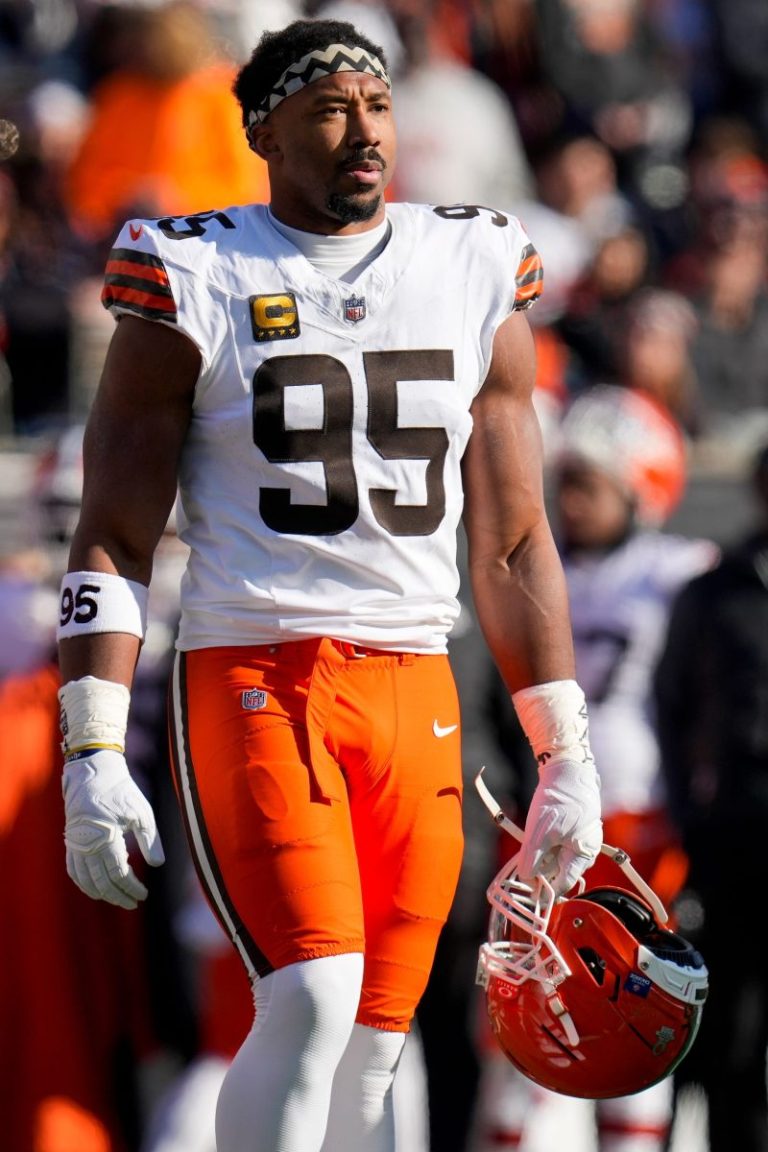
Myles Garrett set the new single-season sack record with 23 sacks in the 2025 season.
Garrett achieved the record in a 17-game season, which has sparked debate about its legitimacy compared to previous records.
The article notes other records, like Reggie White’s 21 sacks in 12 games, that require context when discussing all-time bests.
Sacks only became an official NFL statistic in 1982, further complicating historical comparisons.

The Cleveland Browns defensive end set the record for most sacks in a single season with his 23rd of the 2025 campaign, a takedown of Cincinnati Bengals quarterback Joe Burrow on one of the most impressive speed rushes you’ll ever see in your life, on Sunday, Jan. 4.

But as with all records, this distinction – long as it is noted and referenced as we talk about the NFL – must come with the proper context. 

Garrett had the benefit of a 17th game. Without it, his quest for the record ends with him chasing Aaron Rodgers around. As we saw in Week 17, Rodgers released the ball quicker than anybody could utter “hot potato!” Regardless, that’s how the Pittsburgh Steelers have designed their offense.

We don’t tell the whole truth enough in our world today. But doing is important. It doesn’t take away from Garrett’s greatness – did you see that sack? How many people have you watched who are capable of moving like that? The moment deserves warranted recognition. But let’s not take the easy way out by failing to complete a proper accounting.

NFL’s single-season sack king? The context behind the numbers

The sack-king dispute was already messy and required some clean-up, even before Garrett upended the rubble. Garrett surpassed Michael Strahan and T.J. Watt, each of whom had 22.5 sacks. 

Reggie White had 21 sacks in 12 games with the Philadelphia Eagles during the strike-shortened and partially scab-played 1987 season. That’s certainly something worth further examination that feels lost to the past because, well, it was nearly four decades ago now.

Jerry Rice, who also played 12 games that season, had 22 touchdown receptions. Randy Moss’ 23 TD catches came in a 16-game season. O.J. Simpson’s 1973 season – the first 2,000-yard rushing performance – came in the era of 14-game regular seasons.

Dan Marino’s 1984 campaign has lost luster over the years. The Philadelphia Eagles’ Saquon Barkley surpassed the 2,000-yard rushing threshold in 16 games (and was the ninth to do it) and stood down in Week 18 to preserve Hall of Famer Eric Dickerson’s single-season record of 2,105 rushing yards that’s stood since 1984.

Dickerson is unabashedly transparent about not wanting his record broken, which is something he has in common with Mark Gastineau, a sack king in his own right. Strahan famously set his record via a Brett Favre dive, which broke the heart of Gastineau – the previous record-holder (22 sacks in 1984). Sacks weren’t even an official stat until 1982. Pro Football reference lists the unofficial leader as Al Baker, who had 23 sacks (unofficially) with the Detroit Lions in 1978.

Another more-recent example and more pertinent to Garrett’s record is Watt, who accomplished his single-season, record-tying feat in 15 games during the 2021 season (the first that had 17 games).

Records don’t change. But the games do, and we can recognize that

And pretty soon, we’ll be at 18 games. And we’ll be having the same discussion about why context is important when we’re talking about records. Which makes talking about it way less fun. But that’s the cost of business when you’re a sports fan. It’s a fine tradeoff. The discourse can be whacky in exchange for the spectacle Garrett provides. (Garrett is handsomely compensated for his labor. He signed a four-year, $160 million extension with the Browns that included $123.5 million in guarantees in March 2025.) 

Garrett will go down as one of the best to ever do it and have his claim to GOAT status. Garrett has now racked up 125.5 career sacks since the Browns drafted him first overall in 2017 (83 of those have come in the last five seasons). He turned 30 last week. Bruce Smith’s 200 sacks certainly could be within reach. 

Sam Fortier of the Washington Post talked about how Garrett’s chase felt “small.” I don’t agree with that at face value; I’m a sucker for narrative and excitement. But he asked the right question – does it count to break a record in 17 games that was set in 16 games? One of his theses: a lot of records feel cheapened. My colleague Nate Davis compiled a list of NFL records that could be affected by the existence of a 17-game schedule. 

Myles Garrett is the single-season sack leader. Let the record books reflect it. The same as Barry Bonds is MLB’s home-run leader. The record books should reflect such. But let’s make sure we’re saying all of the truth.

We don’t do that enough these days. 

This post appeared first on USA TODAY

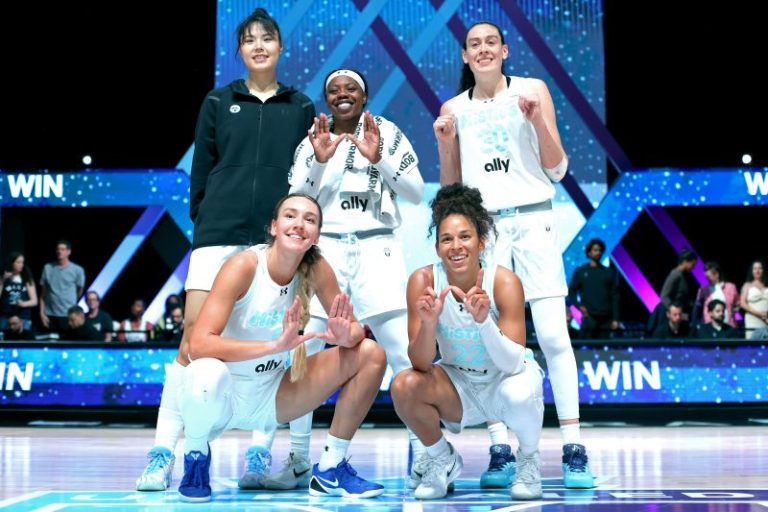
The second season of Unrivaled, a 3-on-3 women’s professional basketball league, tips off on Monday, Jan. 5, in Miami with four games.

Unrivaled expanded from six teams to eight for 2026, with 48 players and a development pool of six ready to step in if someone gets hurt. Twenty six players return from last season including co-founder Breanna Stewart. Twenty two new players join them including rookies Paige Bueckers, Sonia Citron and Kiki Iriafen.

Rose BC won the inaugural title but will be without Angel Reese, who decided not to play this season. One other notable absence is Unrivaled co-founder Napheesa Collier, who will miss the season because of surgery on both ankles.

Here’s a look at how to watch the Monday’s games and the rosters:

How to watch Unrivaled women’s basketball

The 2026 Unrivaled women’s basketball league tips off on Monday, Jan. 5, on TNT, truTV, and streaming on HBO Max. Games will air Friday, Saturday, Sunday and Monday. The season runs from January through early March.

What time in Unrivaled women’s basketball?

Monday, Jan. 5

Mist vs. Hive, 1 p.m. ET (truTV)
Vinyl vs. Laces 2:15 p.m. ET (truTV)
Lunar Owls vs. Rose 8 p.m. ET (truTV, TNT)
Phantom vs. Breeze 9:15 p.m. ET (truTV, TNT)

2026 Unrivaled club rosters

*Players making their Unrivaled debut

Breeze BC

Head coach: Noelle Quinn

*Paige Bueckers
Rickea Jackson
*Dominique Malonga
*Aari McDonald
Kate Martin
*Cameron Brink

(Cameron Brink was a member of the Lunar Owls last season, but did not play while recovering from an ACL injury. She is set to make her debut in 2026.)

Hive BC

Head coach: Rena Wakama

*Kelsey Mitchell
*Sonia Citron
*Ezi Magbegor
*Natisha Hiedeman
*Saniya Rivers
*Monique Billings

(Natisha Hiedeman was a member of Unrivaled last season as a relief player, but did not spend the entire season with one club.)

Laces BC

Head coach: Andrew Wade

Jackie Young
Brittney Sykes
Alyssa Thomas
Jordin Canada
*Maddy Siegrist
*Naz Hillmon

(Naz Hillmon was a member of Unrivaled last season as a relief player, but did not spend the entire season with one club.)

Lunar Owls BC

Head coach: DJ Sackmann

Skylar Diggins
Marina Mabrey
*Temi Fagbenle
*Rachel Banham
*Rebecca Allen
Aaliyah Edwards

(Temi Fagbenle replaces Napheesa Collier, who will miss the 2026 season following ankle surgery)

Mist BC

Head coach:  Zach O’Brien

Allisha Gray
Breanna Stewart
*Alanna Smith
*Veronica Burton
Arike Ogunbowale
*Li Yueru

Phantom BC

Head coach: Roneeka Hodges

*Kelsey Plum
Satou Sabally
Aliyah Boston
*Dana Evans
Natasha Cloud
*Kiki Iriafen

(Kelsey Plum was invited to play in Unrivaled last season, but later declined her invite, opting to return for her first full year in 2026.)

Rose BC

Head coach: Nola Henry

Chelsea Gray
Kahleah Copper
*Sug Sutton
Azurá Stevens
Lexie Hull
Shakira Austin

Vinyl BC

Head coach: Teresa Weatherspoon

Courtney Williams
Rhyne Howard
Dearica Hamby
*Erica Wheeler
Rae Burrell
Brittney Griner

Developmental Pool

Laeticia Amihere

Makayla Timpson

 Hailey Van Lith

Aziaha James

Haley Jones

Emily Engstler

This post appeared first on USA TODAY

President Donald Trump’s bold decision to capture, arrest, and bring Venezuelan strongman Nicolás Maduro to trial for drug-related offenses is far bigger than Operation Absolute Resolve itself. It resets the global chessboard. Here are ten reasons why.

First, the Venezuelan operation proves that American military and intelligence capabilities aren’t just better than anybody else’s — they operate in a wholly different dimension. 

Russian President Vladimir Putin has thrown his entire military at Ukraine in hopes of establishing Russian domination and killing President Volodymyr Zelenskyy. The bloody war has dragged on for three years, costing hundreds of thousands of lives and hundreds of billions of dollars, while draining both countries. And still, that war grinds on.

President Trump sent a small group of special forces into Caracas. Within three hours, they had captured President Maduro and his wife, transporting them to New York to face justice in a U.S. court. No Americans were killed.

Operation Absolute Resolve, like Operation Midnight Hammer, which destroyed Iran’s nuclear capabilities in a matter of hours, was carefully planned, flawlessly executed, and 100% successful. Nobody but America could do that — and leaders around the world know it.

Second, as President Trump says, if you kill Americans, you will be held accountable. Maduro and the drug cartels have killed tens of thousands of Americans with drugs. Not only have we now secured our borders and stopped the flow of fentanyl, but we are bringing drug cartel leaders — including the Maduro family — to face justice.

Third, President Trump has just reversed decades of failed American foreign policy. For years, American leaders of both parties ignored the importance of the Western Hemisphere. They dismissed the growing threats from the countries themselves and from anti-American powers seeking to establish footholds in our hemisphere. American leaders turned a blind eye to drug smuggling and human trafficking. The Biden administration, for its own political purposes, actively encouraged a mass invasion across our border by illegal aliens. 

Operation Absolute Resolve, like Operation Midnight Hammer, which destroyed Iran’s nuclear capabilities in a matter of hours, was carefully planned, flawlessly executed, and 100% successful. Nobody but America could do that — and leaders around the world know it.

While we were focused on the forever wars in the Middle East and the dogma of climate change, three groups were moving into South and Central America — the Chinese, the cartels, and the communists.

Trump’s new national security strategy puts the Western Hemisphere at the center of our foreign policy. Trump allies and reformers now govern Argentina, Chile, Paraguay, and El Salvador — and potentially Venezuela. His long-term vision is a North and South America united by similar economic and governance systems, working in harmony for peace and prosperity.

Fourth, President Trump has reestablished the Monroe Doctrine, which forbids foreign powers from operating in the Western Hemisphere. Two hundred years ago, President Monroe warned European powers against interfering in the Americas. Sixty years ago, President Kennedy used the Monroe Doctrine to keep Soviet missiles out of Cuba. Forty years ago, President Reagan used it to stop the Soviet Union from establishing military bases in the Caribbean. The Monroe Doctrine was a foundational principle of American foreign policy, establishing the Western Hemisphere as an American zone of influence.

The Obama administration abandoned the Monroe Doctrine. Secretary of State John Kerry unilaterally declared it dead. The Biden administration also abandoned the Monroe Doctrine by looking the other way while Russia, China, and Iran established footholds in several countries.

By sending the American armada into the Caribbean, President Trump reinstated the Monroe Doctrine and declared, ‘American dominance in the Western Hemisphere will never be questioned again.’

The new Monroe Doctrine is not an effort to keep our southern neighbors down; it is intended to keep malign powers out.

Fifth, President Trump uses not only military might but all aspects of American power — especially trade, finance, and technology — to influence world events. Before he dispatched special forces to capture Maduro, Trump put massive economic pressure on Venezuela. Maduro relied on a ghost fleet of unregistered tankers to illegally ship oil abroad, especially to China.

These transactions were sanctioned but never enforced. Oil sales brought Maduro about $200 million a week, which he used to bribe and blackmail Venezuelan kleptocrats and pay his military. President Trump enforced those sanctions and seized the oil tankers. By cutting off his main source of funding, it was only a matter of time before Maduro ran out of money.

Sixth, critics are quick to accuse Trump of the policies he once criticized — regime change, nation-building, and forever wars. They’re wrong. President Trump has learned from the failures of the past — he doesn’t want to repeat them. President George W. Bush overthrew the Iraqi and Afghan governments, fired government technocrats, and imposed U.S. occupations that were doomed from the beginning. He tried to impose Western-style democracies on countries that were neither suited for it nor wanted it. He got us tangled in decades of wars we couldn’t win, with massive losses in blood and treasure.

President Obama made the opposite mistake. He helped topple dictators during the Arab Spring but then walked away from the ensuing chaos, under the misguided assumption that these countries would immediately embrace democracy on their own.

President Bush tried to do too much. President Obama did too little. Both failed.

If critics had listened carefully to President Trump’s press conferences and statements, they would realize he aims to chart a different course. Trump said the U.S. would ‘run’ Venezuela until governance could be turned over to the Venezuelans. That’s a far cry from decades of occupation and nation-building.

Until Maduro and his predecessor, Hugo Chávez, seized power, Venezuela had a long tradition of democracy, with regular elections, a free press, and an independent judiciary. Trump isn’t trying to run Venezuela forever. He is already negotiating with remaining members of the Maduro government and political opposition groups for a smooth and quick transfer of power to the Venezuelan people, overseen by the U.S.

Seventh, the oil. The future, in both manufacturing and artificial intelligence, belongs to countries with technological superiority and inexpensive, abundant energy resources. Venezuela has the world’s largest known oil reserves but needs investment to modernize production. American companies have a long history of working with Venezuelan oil companies, and we can do so again. It will be a win-win for the U.S. and Venezuela.

But there is a secondary effect of increased Venezuelan oil production: over time, it will drive down global prices. Russia and Iran rely on oil sales to fund their governments. More oil worldwide means lower prices, which means less income for our enemies.

Eighth, corrupt, incompetent, America-hating dictators should take note. With American help, Maduro is now gone. If the United States and Venezuela, working together, succeed in establishing a new government that restores capitalism and democracy, it will succeed.

If so, could Venezuela be the spark that ignites other democratic reform movements? Cuba is kept alive by Maduro’s drug money. What happens when that money runs out? What happens to the pro-Maduro Colombian government once a new Venezuelan government is formed?

Ninth, the world will now see firsthand what the American legal system looks like. Maduro will be tried in the U.S., in a public courtroom, with the world watching. The Justice Department has worked for years to build a solid case against Maduro for narcoterrorism, drug trafficking, and money laundering. It will show Maduro’s personal connections to drug cartels and human trafficking. It may also shine a light on malign foreign involvement by Iran, Russia, and China.

Finally — and in some ways most importantly — President Trump has overcome the loser syndrome. For years, China has told the world that America is a nation in irreversible economic and moral decline. We fought and lost forever wars in the Middle East. Biden’s Afghanistan withdrawal was shambolic. We have been pushed around by our enemies and disrespected by our allies. Our own leaders have been corrupt, incompetent, and unresponsive.

That has now changed. Our economy is at the starting gate of significant growth. Trillions are being invested in American manufacturing. Our technology and energy sectors are unleashed. We have the most powerful and capable military in the world. Our leaders — especially President Trump — are decisive, confident, and unafraid. More and more people at home and abroad no longer see an America in decline but an America perhaps poised for a new Golden Age.

This post appeared first on FOX NEWS

For three years, the Washington foreign policy establishment has insisted that there is only one acceptable outcome in Ukraine: total victory over Russia achieved through relentless military aid, indefinite financial support and escalation readiness regardless of the risks. But strategy and morality are not always the same thing — and real leadership demands confronting reality as it exists, not as we wish it to be.

I write this not as an academic or pundit, but as someone who worked at the center of this conflict. As U.S. ambassador to the European Union during the first Trump administration, President Donald Trump tasked me with bringing Europe into alignment — truly into alignment — behind Ukraine. 

That meant ending the EU’s habitual double-game: proclaiming solidarity with Kyiv while enriching Moscow through energy purchases and dragging its feet on serious sanctions. I saw firsthand how Europe’s hesitation and transactional approach sent Moscow exactly the wrong message. It told President Vladimir Putin the West was divided, unserious and ultimately unwilling to sacrifice comfort for principle. That perception was part of his calculus.

The uncomfortable truth is that the United States is closer to strategic exhaustion than our rhetoric admits. Europe’s defense industries remain underbuilt. American stockpiles are finite. And while Russia has paid a staggering price, it has not collapsed, surrendered or reversed course. Worse, every escalation increases the probability of something unthinkable: a desperate Kremlin resorting to tactical nuclear weapons. That would not be ‘just another step’ on the escalatory ladder; it would fundamentally shatter global stability.

Against that background, the Trump administration’s instinct to seek a quasi-business resolution is not weakness. It is classic realpolitik — recognition that the job of American leadership is to maximize U.S. security, economic leverage and strategic flexibility while minimizing existential risk.

Business leaders know what Washington too often does not: the perfect deal rarely exists. The question is not whether we can achieve a morally pure resolution; it is whether we can lock in outcomes that are measurably better for American interests — and for Ukraine — than a perpetual, bleeding stalemate.

A negotiated settlement, backed by enforceable conditions and leverage, could do precisely that.

First, a settlement can provide Ukraine with a bespoke security guarantee — credible enough to deter renewed aggression but structured to avoid NATO Article 5 entanglement. This isn’t a vague promise; it is a contract with clear performance terms. The U.S. guarantee would stand as long as Russia adheres to its commitments. But if Russia violates the agreement, the snapback provisions would trigger instantly — not months later, not after diplomatic waffling — immediately unlocking full-scale U.S. and NATO support for Ukraine, including offensive weapons, advanced air defense, training and intelligence integration.

Just as important, the consequences of Russian cheating would be explicit, not theoretical.

If Moscow breaks the deal, the United States would reserve the option to openly back Ukraine in retaking every inch of territory — up to and including restoration to its pre-2014 borders. Moscow would know this going in. Deterrence works best when penalties are unmistakable.

And crucially, this would all be public. No more pretending, hedging or quiet back-channel shipments. The world — and Russia — would know that renewed aggression automatically and lawfully unleashes overwhelming Western support, with the U.S. leading confidently and unapologetically. That clarity is a deterrent in itself.

Equally important, this structure protects U.S. sovereignty in the agreement. If Ukraine violates its obligations, the American guarantee becomes void at our sole discretion. Not a bureaucratic process. Not a committee vote. The United States decides. That means Ukraine has every incentive to maintain discipline and treat the arrangement not as a blank check, but as a powerful partnership grounded in responsibility.

Second, a negotiated deal can generate tangible U.S. economic advantage. Ukraine holds minerals and rare earths essential to American industry, national security and technological supremacy. China knows this. Russia knows this. Only Washington’s old guard pretends resource control is not strategic policy. A structured agreement ensuring privileged U.S. access strengthens manufacturing, energy resilience, and economic security.

Third, a settlement can wedge open the relationship between Moscow and Beijing. Right now, the war has pushed Russia completely into China’s arms. That alignment is bad for the United States and for global balance. A disciplined settlement begins unwinding that dependency. America doesn’t need friendship with Moscow; it needs leverage over it. Realpolitik is about advantage, not affection.

Fourth, a deal can compartmentalize strategic theaters. If Russia insists on regional influence, the U.S. can demand reciprocal space in our hemisphere — particularly in Venezuela, narcotics interdiction, and energy-linked criminal networks — reducing adversarial reach in the Americas.

Critics will scream ‘Munich.’ They always do. But Adolf Hitler was leading a rising ideological empire bent on global conquest. Russia is a demographically and economically declining power seeking regional positioning. Brutal, yes — but not irrational. Mature powers negotiate with rivals when negotiations produce superior outcomes.

Others claim any deal rewards aggression. That assumes deterrence is binary — victory or failure. In reality, deterrence is layered.

A settlement that leaves Russia bloodied, sanctioned, strategically constrained and facing automatic, overwhelming Western military escalation — potentially including U.S. support for Ukraine restoring its 2013 borders — if it cheats is not a reward. It is a warning carved into treaty stone.

Meanwhile, the humanitarian and financial realities matter. Endless war means endless dead Ukrainians, shattered cities and endless U.S. taxpayer exposure with no defined victory condition. That may thrill think tanks that never fight wars, but it is not serious governance.

Most importantly, a business-style settlement introduces accountability — currently absent from Washington’s ‘as long as it takes’ mantra. Under a structured deal, compliance is measurable. Triggers are automatic. Support is not improvised — it is guaranteed. Enforcement is not theoretical — it is built in. And unlike today, America would no longer need to whisper its involvement. It would act openly, decisively and with treaty authority.

The alternative? A forever war with rising nuclear risk, continued strategic drift, and deepening alignment between Russia and China. That is not strategy. It is inertia dressed as courage.

Realpolitik does not abandon values. It protects them intelligently. A disciplined, enforceable settlement — with clear snapback provisions benefiting both the U.S. and Ukraine; explicit authority to openly arm Ukraine and potentially support full territorial restoration if Russia cheats; and a guarantee revocable at America’s sole discretion if Ukraine violates terms — is not capitulation.

It is strategic control.

In geopolitics, as in business, the strongest player is not the one who insists on endless confrontation. It is the one who knows when to fight — and when to close the deal.

This post appeared first on FOX NEWS

Tensions between Israel and Turkey are rising amid competing visions for Gaza’s reconstruction and widening strategic friction in Syria, even as both countries remain embedded in a U.S.-led diplomatic framework following the ceasefire with Hamas.

Israel has made clear it will not allow Turkish armed forces to operate inside Gaza, viewing Ankara as a destabilizing actor despite its public efforts to present itself as a reconstruction partner. Turkish sources told Fox News Digital that Ankara does not seek to deploy troops in Gaza, instead focusing on humanitarian aid, infrastructure projects and political influence. 

Dan Diker, president of the Jerusalem Center for Security and Foreign Affairs, said Israel views Turkey as a strategic threat rather than a neutral actor. 

‘From Israel’s point of view, Turkey is the arsonist behaving like the firefighter in Gaza,’ Diker told Fox News Digital. ‘If Turkey is allowed to enter Gaza with several thousand armed men, you can guarantee that this Muslim Brotherhood country will destabilize Gaza and dismantle the very 20-point plan that President Trump has bet the farm on.’

Diker said President Recep Tayyip Erdogan’s ambitions extend beyond Gaza, pointing to Turkey’s military presence in northwestern Syria and what he described as Ankara’s long-standing role enabling radical Islamist groups inside the country.

In Trump’s remarks at Mar-a-Lago on Monday at his press conference with Prime Minister Benjamin Netanyahu, he repeatedly praised Erdogan and downplayed concerns about a possible Israel-Turkey confrontation.

‘I know President Erdogan very well… he’s a very good friend of mine,’ Trump said. ‘Bibi respects him… They’re not going to have a problem. Nothing’s going to happen.’ Netanyahu smiled and didn’t comment.

At the same time, Trump aligned himself publicly with Netanyahu on Gaza’s future, issuing his strongest statement yet that Hamas must disarm.

‘They made an agreement that they were going to disarm,’ Trump said. ‘If they’re not going to disarm, those same countries will go and wipe out Hamas.’

According to Diker, the president is deliberately managing tensions with Ankara by keeping Erdogan inside the diplomatic framework rather than confronting him publicly.

‘President Trump is very, very good at keeping adversaries close, together with allies,’ Diker said. ‘That’s why he keeps saying that he likes Erdogan. He wants to keep Erdogan in the party. He wants to keep him close.’

Diker said Trump understands his own leverage in the region and believes he can coalesce Arab and Muslim states when it serves U.S. and Israeli interests, citing coordination during the first phase of the hostage deal.

Diker said Netanyahu is now walking a narrow line, trying not to undermine the framework Trump has built while ensuring Israel’s security red lines are maintained.

‘Israel will not allow Turkish Armed Forces in Gaza. It’s not going to happen,’ Diker said, adding that Israel may still be forced into limited compromises to preserve Trump’s broader support, particularly on Iran.

Beyond Gaza, Israel sees Turkey’s role in Syria as a growing point of friction. Ankara maintains influence across large swaths of northern Syria, while Israel has continued air operations aimed at Iranian targets.

Sinan Ciddi, a senior fellow at the Foundation for Defense of Democracies, warned in an analysis that Turkey views Israel-aligned regional cooperation as a direct challenge to its ambitions.

Ciddi cited a trilateral summit between Israel, Greece and Cyprus in Jerusalem as a flashpoint, arguing it signaled resistance to Turkey’s ‘Blue Homeland’ doctrine and broader maritime claims in the Eastern Mediterranean.

Following the summit, pro-Erdogan media outlets described Israel as a major threat, while Turkey increased military activity that alarmed U.S. allies, including airspace violations near Greece and reported efforts to expand radar coverage in Syria that could hinder Israeli operations against Iran.

Diker said Israel’s recognition of Somaliland adds another layer to the rivalry, particularly in the Red Sea region. ‘The Turks are working in Somalia. They are also working to control and influence what happens in the Red Sea region,’ Diker said. ‘Which is why Somaliland’s development is very, very important.’

He argued that the move gives Israel a strategic foothold along a vital maritime corridor.

‘Israel then has a strategic base, a forward base in Somaliland on the Red Sea,’ Diker said. ‘Very, very important, because it checkmates Turkey.’

Diker said the move was viewed in Ankara as a direct challenge to Turkish ambitions in the Horn of Africa, adding that the Trump administration had ‘expressed its understanding’ of Israel’s decision.

Despite Erdogan’s harsh rhetoric toward Israel and vocal support for the Palestinian cause, Turkish diplomatic sources say Ankara is acting pragmatically. While Turkey sees financial and political opportunity in Gaza’s reconstruction, those sources say Erdogan is aware there is little domestic appetite for sending Turkish troops into the enclave.

That gap between rhetoric and policy, analysts say, is likely to persist. As Diker put it, Trump is trying to keep the diplomatic structure intact while Israel works to contain what it sees as Turkey’s expanding regional footprint. ‘Trump does not want to topple the apple cart,’ Diker said. ‘He wants to try to keep everyone together so that they can move to stage two of the 20-point plan in Gaza.’

This post appeared first on FOX NEWS

The college football transfer portal opened Friday, Jan. 2, and players are flying off the shelf. The portal runs through Jan. 16, with an extra five-day window (Jan. 20-24) for teams playing in the national championship.

We’ll keep you posted with daily live updates of portal commitments.

Transfers by conference: SEC | Big Ten | ACC | Big 12

HIT REFRESH FOR UPDATE.

Today’s transfer portal commitments

QB

Alonza Barnett III: James Madison to UCF
Rocco Becht: Iowa State to Penn State
Cutter Boley: Kentucky to Arizona State
Jaden Craig: Harvard to TCU
Drew Dickey: Vanderbilt to Arkansas State
Billy Edwards Jr.: Wisconsin to North Carolina
Josh Hoover: TCU to Indiana
Katin Houser: East Carolina to Illinois
Colton Joseph: Old Dominion to Wisconsin
Lincoln Kienholz: Ohio State to Louisville
Alex Manske: Iowa State to Penn State
Mason McKenzie: Saginaw Valley State to Boston College
Kenny Minchey: Notre Dame to Nebraska
Aaron Philo: Georgia Tech to Florida
Jaylen Raynor: Arkansas State to Iowa State
Brendan Sorsby: Cincinnati to Texas Tech
Marcelis Tate: South Florida to Tennessee State

RB

David Avit: Villanova to Arizona State
Landen Chambers: Central Arkansas to UCF
Bill Davis: Louisiana to Virginia Tech
Jalen Dupree: Colorado State to Kansas
Jerrick Gibson: Texas to Purdue
Carson Hansen: Iowa State to Penn State
Caleb Hawkins: North Texas to Oklahoma State
Makhi Hughes: Oregon to Houston
Jekai Middlebrook: Middle Tennessee to Virginia
Turbo Richard: Boston College to Indiana
Abu Sama: Iowa State to Wisconsin
JaQuali Smith: Sacramento State to Colorado

WR

Karon Brookins: Iowa State to Penn State
Tychaun Chapman: Southern Miss to Memphis
Miles Coleman: North Texas to Oklahoma State
Brett Eskildsen: Iowa State to Penn State
RJ Garcia II: Bowling Green to FAU
Jayden Gibson: Oklahoma to South Carolina
Jackson Harris: Hawaii to LSU
Cody Jackson: Tarleton State to Iowa State
Marquis Johnson: Missouri to Mississippi State
Jalen Jones: Alabama State to Texas Tech
Donte Lee: Liberty to Texas Tech
Terrence Lewis: North Texas to Oklahoma State
Nick Marsh: Michigan State to Indiana
Christian Neptune: South Florida to Auburn
Kory Pettigrew: South Florida to Auburn
Jahmari Powell-Wonson: Maryland to FAU
Shamar Rigby: Oklahoma State to Wisconsin
Danny Scudero: San Jose State to Colorado
Victor Snow: Buffalo to NC State
Prince Strachan: USC to West Virginia
Raiden Vines-Bright: Washington to Arizona State
Wyatt Young: North Texas to Oklahoma State

TE

Richie Anderson: Fresno State to Texas A&M
Gabe Burkle: Iowa State to Penn State
Jayvontay Conner: East Carolina to Vanderbilt
Hayden Hansen: Florida to Oklahoma
Jacob Harris: Bowling Green to Wisconsin
Nate Kurisky: Louisville to Duke
Ryan Schwendeman: Southern Illinois to Wisconsin
Michael Smith: South Carolina to Syracuse
Mason Williams: Ohio to Ohio State

OL

Xavier Bausley: West Virginia to Marshall
Trevor Buhr: Iowa State to Penn State
Malachi Breland: Memphis to Arkansas
Nicholas Cruji: Maine to Charlotte
Johnny Dickson: North Texas to Oklahoma State
Coen Echols: LSU to Texas A&M
Valen Erickson: NC State to Liberty
Shadre Hurst: Tulane to Houston
Toriyan Johnson: UConn to Colorado State
Austin Kawecki: Oklahoma State to Wisconsin
Maasai King: Akron to Iowa State
Kuol Kuol II: Iowa State to Penn State
Desmond Magiya: North Texas to Oklahoma State
Logan Moore: UAB to Baylor
Ben Murawski: UConn to Michigan State
Braydon Nelson: North Texas to Oklahoma State
Netinho Olivieri: Penn to Pitt
Sione Perkins: Iowa State to Northern Arizona
Gavin Proudfoot: Northern Iowa to Iowa State
Connor Stroh: Texas to Kansas
Drew Terrill: Miami (Ohio) to Houston
Andrew Threatt: Charleston Southern to North Carolina
Will Tompkins: Iowa State to Penn State
Bennett Warren: Tennessee to Minnesota
Brady Wayburn: UConn to UCF
Christian Young: Emory & Henry College to Southern Miss

DL

Demetrius Ballard: Buffalo to Boston College
Justus Boone: Arkansas to Wisconsin
Ahmad Breaux: LSU to Kentucky
Josh Burnham: Notre Dame to Indiana
Blake Burris: SMU to FAU
Alijah Carnell: Iowa State to Penn State
Esean Carter: Toledo to UConn
Christian Davis: Louisiana Tech to SMU
Malachi Davis: Toledo to Rutgers
Ian Geffrard: Arkansas to Texas
Nate Henrich: Gannon to San Diego State
Carter Janki: Penn to Illinois
Daniel Jennings: Penn State to Virginia Tech
Lamont Lester Jr.: Monmouth to Colorado
Jonathan Maldonado: Nevada to Ole Miss
Dylan Manuel: Appalachian State to Colorado
Andrew Marshall: Eastern Michigan to Minnesota
Ryan McCulloch: Cal to UCLA
Antonio O’Berry: Gardner Webb to Kentucky
Tobi Osunsanmi: Kansas State to Indiana
Chidera Otutu: UTSA to Cincinnati
Khamani Potts: Grand Valley State to Colorado State
Kevin Roberts: West Florida to James Madison
Wisdom Simms: North Carolina Central to Purdue
Eamon Smalls: UAB to Kansas
Jordan Walker: Rutgers to Georgia Tech
Landyn Watson: Kentucky to Kansas
Solomon Williams: Texas A&M to Cal

LB

Caleb Bacon: Iowa State to Penn State
Cael Brezina: Iowa State to Penn State
Nylan Brown: Kent State to Washington State
Deven Bryant: Washington to USC
Ray Coney: Tulsa to Texas A&M
Kooper Ebel: Iowa State to Penn State
Jon Jon Kamara: Kansas to Wisconsin
Isaiah Patterson: UNLV to West Virginia
Austin Romaine: Kansas State to Texas Tech
Montreze Smith: Austin Peay to Iowa State
Keaton Thomas: Baylor to Ole Miss
Tavion Wallace: Arkansas to Kentucky

DB

Khalil Barnes: Clemson to Georgia
Tawfiq Byard: Colorado to Texas A&M
MJ Cannon: Bowling Green to Cincinnati
Nehemiah Chandler: South Alabama to Florida State
Tyran Chappell: UConn to Michigan State
Caleb Chester: Texas to Arizona State
DJ Coleman: Baylor to Florida
Jay Crawford: Auburn to Ole Miss
Jameel Croft Jr.: Kansas to Charlotte
Keshawn Davila: Arkansas to Kansas State
Zahmir Dawud: Villanova to Rutgers
Sharif Denson: Florida to Ole Miss
Christian Ellis: Virginia Tech to Virginia
Caleb Flagg: Missouri to UCF
Dylan Flowers: Western Kentucky to Duke
Quinton Hammonds: North Texas to Oklahoma State
Christian Harrison: Cincinnati to Arkansas
Anthony Hawkins: Villanova to Iowa
A’Mon Lane-Ganus: Auburn to South Florida
Kyon Loud: Montana to Duke
Darius Malcolm Jr.: Wofford to Memphis
Nateen Mitchell: New Mexico State to Colorado
Qua Moss: Kansas State to Tennessee
Marcus Neal: Iowa State to Penn State
Anthony Rogers: Nicholls State to Tulane
Jiquan Sanks: Cincinnati to Indiana
Hasaan Sykes: Western Carolina to Kentucky
Jaylen Thomas: San Jose State to Washington State
Devin Vaught: Maine to Michigan State
DJ Waller Jr.: Kentucky to Louisville
Keyon Washington: Bowling Green to Iowa State
Jontez Williams: Iowa State to USC
Lavon Williams: East Texas A&M Commerce to Illinois
Preston Zachman: Wisconsin to Indiana

K

Braeden McAlister: Georgia State to Arkansas
Max Gilbert: Tennessee to Arkansas
Eli Ozick: North Dakota State to Iowa
Gianni Spetic: Memphis to Texas

P

Mac Chiumento: Florida State to Texas

LS

Hudson Powell: Miami (Ohio) to Auburn
Dalton Riggs: UCF to Ohio State

College football 2026 transfer portal dates: When does transfer portal open, close?

The portal period now runs from Jan. 2-16, with an extra five-day window (Jan. 20-24) for teams playing in the national championship. The spring portal window in April is no longer a part of the schedule, so January is the only open window for teams to add via the portal in 2026.

This post appeared first on USA TODAY

As evidenced by the 2025 College Football Playoff final four, quarterback play is extremely important to win a national championship.

All four finalists ― Indiana, Oregon, Ole Miss and Miami ― used the NCAA transfer portal to find their ‘franchise quarterback’ to guide them to the semifinal round of the CFP bracket. That’s why the position will be just as important this offseason for filling out a future CFP berth.

CFP semifinalists like Indiana and Miami need a QB for the 2026 season, while Oregon could be in the market, depending on Dante Moore’s NFL draft decision. Penn State, Florida and LSU are three teams with coaching changes in need of a new signal caller.

And of course, don’t discount another Trinidad Chambliss committing to a program as a potential backup and emerging as a superstar, as Chambliss has during Ole Miss’ run to the CFP semifinal.

Here’s a look at our tracker for the top quarterbacks in the portal this season, according to the 247 Sports Transfer Portal Rankings.

1. Sam Leavitt

Old team: Arizona State
New team: TBD
Eligibility remaining: 2 years

Leavitt is the No. 1 overall player in the 2026 transfer portal rankings. He threw for 1,628 yards, 10 touchdowns and three interceptions in 2025.

2. Brendan Sorsby

Old team: Cincinnati
New team: Texas Tech
Eligibility remaining: 1 year

The Cincinnati QB is the No. 2 overall player in the portal, as well as the No. 2 QB. Sorsby is expected to be one of the most impactful players in the portal this cycle. He has totaled 5,613 passing yards, 1,027 rushing yards and 63 total touchdowns in two seasons with the Bearcats. Sorsby will take the baton from Behren Morton under center for the Red Raiders.

3. Drew Mestemaker

Old team: North Texas
New team: Oklahoma State
Eligibility remaining: 3 years

Mestermaker opted to follow his North Texas football head, Eric Morris, to Oklahoma State. He led the Mean Green to a 12-2 record during the 2025 college football season and to the American Conference Championship game.

4. Dylan Raiola

Old team: Nebraska
New team: TBD
Eligibility remaining: 2 years

Raiola suffered a season-ending broken right fibula against USC in early November, but should be ready to contribute to his next team in 2025. The former 5-star QB was originally committed to Georgia before flipping to have an opportunity to play as a freshman with the Cornhuskers.

5. Josh Hoover

Old team: TCU
New team: Indiana
Eligibility remaining: 1 year

Hoover has been entrenched as the Horned Frogs’ starting QB since his redshirt freshman season, making 31 straight starts for TCU. He has 9,629 career passing yards and 71 passing touchdowns, which lead all returning QBs in 2026. However, he needs to cut down on his turnovers, with 33 career interceptions thrown.

6. Rocco Becht

Old team: Iowa State
New team: Penn State
Eligibility remaining: 1 year

Like Mestemaker, Becht followed his former head coach, Matt Campbell, to his new destination at Penn State. He has made 39 career starts and could be someone to plug in right away in the Big Ten and play well.

7. DJ Lagway

Old team: Florida
New team: TBD
Eligibility remaining: 2 years

Lagway seemed to be the player who would save Billy Napier and the Florida program. However, following an injury-plagued 2025 season, Lagway is in the portal following Napier’s firing and the hiring of Jon Sumrall.

8. Byrum Brown

Old team: USF
New team: TBD
Eligibility remaining: 1 year

Brown could follow his head coach, Alex Golesh, from USF to Auburn. He has been the perfect fit in Golesh’s offense with an FBS-best 42 touchdowns during the regular season. With 32 career starts, Brown is one of the most experienced QBs in the portal this cycle.

9. Deuce Knight

Old team: Auburn
New team: TBD
Eligibility remaining: 3 years

Despite showing flashes of his potential for Auburn, Knight is in the portal and will play for a new team in 2026, with Alex Golesh taking over as the head coach. Knight finished 17-of-25 passing for 259 yards with two touchdowns and added 13 rushes for 178 yards and four scores as a true freshman.

10. Kenny Minchey

Old team: Notre Dame
New team: Nebraska
Eligibility remaining: 2 years

Minchey completed 20 of 26 passes for 196 yards and rushed for 84 yards and a touchdown as the backup to CJ Carr after losing the QB competition this season. The redshirt sophomore could likely step in as a starter at Nebraska, who needs to replace Dylan Raiola.

11. Aidan Chiles

Old team: Michigan State
New team: TBD
Eligibility remaining: 1 year

Chiles has never lived up to the promise he showed as a freshman with Oregon State, but he did show flashes with Michigan State under Jonathan Smith. He is in a prove-it year in his final year of eligibility and could still prove to be a good addition.

12. Beau Pribula

Old team: Missouri
New team: TBD
Eligibility remaining: 1 year

The 2025 season was a trying one for Pribula, but he showed off his talent and toughness. He led Missouri to a 5-0 start behind 1,941 and 17 total touchdowns, but suffered a dislocated left ankle. Pribula returned in less than a month from the injury and started the final two games for the Tigers.

13. Colton Joseph

Old team: Old Dominion
New team: Wisconsin
Eligibility remaining: 2 years

The Sun Belt Offensive Player of the Year committed to Wisconsin on Sunday, Jan. 4. He threw for 2,624 yards and 21 touchdowns, while adding 158 rushes for 1,007 yards and 13 touchdowns, for the Monarchs in 2025.

14. Aaron Philo

Old team: Georgia Tech
New team: Florida
Eligibility remaining: 3 years

In two seasons with the Yellow Jackets, Philo has made just eight career appearances, but has shown flashes as Haynes Kings’ backup. However, with offense coordinator Buster Faulkner leaving for the Gators, Philo will continue his career in Gainesville, Florida.

15. Austin Simmons

Old team: Ole Miss
New team: TBD
Eligibility remaining: 2 years

Simmons began the 2025 season as the starter for Ole Miss, but lost his spot not due to poor play, but because of the emergence of Trinidad Chambliss following an injury to Simmons. The left-hander is expected to stick with Ole Miss for its playoff run before heading to Missouri.

16. Ethan Grunkemeyer

Old team: Penn State
New team: TBD
Eligibility remaining: 3 years

The redshirt freshman stepped into a starting role following a season-ending injury to starter Drew Allar. He started the final seven games, which included four straight wins to end the season. Grunkemeyer finished his first year with 1,341 passing yards, nine total TDs and four interceptions.

17. Lincoln Kienholz

Old team: Ohio State
New team: Louisville
Eligibility remaining: 2 years

Kienholz competed with freshman Julian Sayin for the starting position for the Buckeyes this past season. However, with Sayin’s strong season, the path for Kienholz is closed. He committed to Louisville and playing for coach Jeff Brohm on Jan. 3.

18. Cutter Boley

Old team: Kentucky
New team: Arizona State
Eligibility remaining: 3 years

Cutter Boley committed to Arizona State on Jan. 3 and will be in line to replace Sam Leavitt. As a redshirt freshman in 2025, he threw for 2,160 passing yards with 15 touchdowns and 12 interceptions. Boley started the final 10 games for Kentucky this season.

19. Katin Houser

Old team: East Carolina
New team: Illinois
Eligibility remaining: 1 year

The former Michigan State QB threw for 3,300 yards with 28 total TDs and 10 turnovers and led ECU to an 8-4 record. With his performance with the Pirates, he will to return to the Big Ten for his final year of eligibility at Illinois, replacing Luke Altmyer.

20. Jaden Craig

Old team: Harvard
New team: TCU
Eligibility remaining: 1 year

The Harvard star threw for 2,869 yards, 25 touchdowns and seven interceptions in 2025. Over his career, he has been a 24-game starter with 6,074 career passing yards with 63 career total touchdowns and 12 interceptions. He could prove himself for the NFL with a strong performance in the Power 4 conferences. He’ll replace Josh Hoover, who entered the portal and committed to Indiana.

This post appeared first on USA TODAY

The Las Vegas Raiders are No. 1 − and former owner Al Davis would doubtless be sick about it.

But the Silver and Black’s current Commitment to Excellence unfortunately extends only to summiting the apex of the 2026 NFL draft order, the Raiders clinching − for lack of a better term − the spot Jan. 4 when the New York Giants, who cruised past Las Vegas 34-10 in Week 17, defeated the Dallas Cowboys in their regular-season finale. The Giants’ victory locked the Raiders into the league’s worst record, even though they improved to 3-14 by beating the Kansas City Chiefs on Sunday afternoon. But Las Vegas’ .538 strength of schedule, the weakest among the four 3-14 clubs, kept it in the top spot.

2026 NFL Draft first-round order

Las Vegas Raiders (3-14, .538 strength of schedule)
New York Jets (3-14, .552)
Arizona Cardinals (3-14, .571)
Tennessee Titans (3-14, .574)
New York Giants (4-13)
Cleveland Browns (5-12, .486)
Washington Commanders (5-12, .507)
New Orleans Saints (6-11, .495)
Kansas City Chiefs (6-11, .516)
Cincinnati Bengals (6-11, .521)
Miami Dolphins (7-10)
Dallas Cowboys (7-9-1)
Los Angeles Rams (from Atlanta Falcons (8-9, .495))
Baltimore Ravens (8-9, .507)
Tampa Bay Buccaneers (8-9, .529)
Jets (from Indianapolis Colts (8-9, .538))
Detroit Lions (9-8, .490)
Minnesota Vikings (9-8, .514)

(Note: Spots 19 through 32 in Round 1 will be determined by when teams exit from the playoffs, wild-card round losers slotting 19 through 24.)

Who will the Raiders draft first in 2026?

That will likely be a topic of some debate over the next four months, but Heisman Trophy-winning quarterback Fernando Mendoza from Indiana University will likely be the prohibitive choice − whether the Raiders use the pick or trade it.

Have the Raiders picked No. 1 overall before?

Yes, the then-Oakland Raiders chose QB JaMarcus Russell No. 1 overall in 2007 in one of the worst draft decisions in NFL history. Who could they have taken instead? Calvin Johnson, Joe Thomas, Adrian Peterson, Patrick Willis, Marshawn Lynch and Darrelle Revis all came off the board in the first half of Round 1.

This post appeared first on USA TODAY

SACRAMENTO, CA – The Sacramento Kings lost their fifth consecutive game as they saw the return of guard Zach LaVine but lost key pieces, forward Keegan Murray and guard Keon Ellis, on Sunday night against the Milwaukee Bucks at Golden 1 Center.

Kings guard Keon Ellis injured his left thumb in the first half and did not return. Later forward Keegan Murray left the game with a left ankle injury with 4:01 left in the third quarter after colliding with Bucks center Myles Turner on a drive to the basket and landing awkwardly. The Bucks went on to win, 115-98.

Kings head coach Doug Christie told reporters he didn’t have an update on his injured players, but was understandably deflated that they went down, especially after getting Murray back on the court from a previous injury.

‘I don’t know yet. It’s not even for me to speculate,’ Christie told reporters after the game. ‘Obviously, we’ll get everything. You guys will know as soon as we do.’

Short in his response, Christie added: ‘It’s hard man. … it’s just difficult.’

Russell Westbrook led the Kings with 21 points. and LaVine had 20 points in 35 minutes off the bench in his first game back since Dec. 18.

‘I told Doug, I think I’ll be available for today. The last couple of games they’ve been asking me if I’m thinking about it or not,’ LaVine told USA TODAY Sports. ‘He told me he had me coming off the bench today and I said ‘OK’. I haven’t done it in a while but it was fine.’

LaVine added that his ankle is fine and he’s more worried getting conditioned and back in basketball shape.

‘Tired,’ LaVine said. ‘I haven’t played full court in an NBA game in nine games. My ankle feels fine. That’s why I wanted to make sure I was 100% before I came back.’

Giannis Antetokounmpo had a game-high 37 points and 11 rebounds. Kevin Porter Jr. recorded a double-double with 25 points and 10 assists.

‘I thought our non-Giannis minutes in the first half were phenomenal and that actually opened up the game for us because it allowed us to sit Giannis a little longer,’ Bucks head coach Doc Rivers said to reporters after the game. ‘I thought that was key. And then I thought overall we just were playing the right way.’

Kings vs. Bucks highlights

Sacramento trailed after the first quarter, 28-26, despite getting eight points a piece from Keegan Murray and DeMar DeRozan.

Zach LaVine came off the bench in his first game since Dec. 18. He scored five points in five minutes of action in the first.

Bucks opened the second quarter with a 9-0 run in 1:40. The Bucks’ lead climbed to as many as 20 in the first half. Sacramento, as a team, scored 18 points in the second quarter.

The Bucks led 62-44 after 24 minutes.

Milwaukee continued to pour gasoline on the flame. As they opened the third quarter on a 11-4 in first four minutes of the period, their lead grew to 25.

Kings forward Keegan Murray went down with an injury in the third quarter with 4:01 left after colliding with Bucks center Myles Turner on a drive to the basket. Murray received help from the medical staff as he limped off the court to the locker room.

Sacramento cut the lead down to 16 at the end of the third quarter. Bucks hung on to a lead, 85-69.

Kings looked to mount a comeback in the fourth quarter, as they turned up their defensive intensity.

They opened the quarter on a 12-0 run.

They cut the deficit down to 10 following back to back three-pointers from Dennis Schroder and Zach LaVine to open the period. They trailed 85-75 with 11 minutes left.

It was cut to a single-digit game on a Westbrook block and slow-step layup on the other side. That was followed by Schroder, who fired a midrange to bring the deficit down to six with under 10 minutes in the game.

Westbrook then stole the ball from Antetokounmpo and led the breakaway to find LaVine for a double-pump two-hand slam to bring the Kings within four points.

Westbrook forced a back court violation on Bucks guard Ryan Rollins as Kings continued to take advantage of their newfound life.

Momentum was halted briefly when Schroder fouled Kevin Porter Jr. on a three-point attempt with 8:22 left in the game.

The Bucks managed to extend their lead back to 10, as Antetokounmpo continued to get whatever he wanted in the paint and Porter from the outside.

Milwaukee ran the score back up and would win the game, 115-98.

Recap: Kings keys

Ryan Rollins can score: Rollins is rolling this season. He averages a little more than 17 points per game and shoots 42% from deep. Someone will have to take on the challenge of slowing him down. Rollins was slowed down, compared his previous games. He scored 12 points.
Greek Freak presence: Giannis Antetokounmpo is going to dominate the paint, as he usually does. He leads the league with 20.1 points in the paint per game. Make it tough, play physical and force him to earn those easy buckets at the free throw line. Antetokounmpo, indeed, did dominate this game, scoring a game-high 37 points and 11 rebounds.
Get defensive stops: This team likes to score, but they will also allow other teams to score as Milwaukee allows 116 points per game. Offense shouldn’t be a question, can Sacramento get stops defensively? Kings looked good defensively for a stretch in the fourth quarter, but it was short-lived. Overall, Sacramento had 10 steals and seven blocks. Westbrook, alone, had four steals and three blocks.
Compete for 48 minutes: Going to repeat this point of emphasis because it’s usually one quarter where the Kings have a lapse or lose focus or just simply don’t compete for 12 minutes and it costs them the game. It happened again against Phoenix. They have to fix that to have a chance to win. The game was arguably lost in the second quarter when the Kings were outscored 34-18. They even fought back from a 26-point lead to bring the game within three.

Kings next five games

Jan. 6 vs. Dallas Mavericks
Jan. 9 at Golden State Warriors
Jan. 11 vs. Houston Rockets
Jan. 12 vs. Los Angeles Lakers
Jan. 14 vs. New York Knicks

This post appeared first on USA TODAY