Archive

2026

Browsing

WASHINGTON — The Supreme Court appeared sympathetic on Jan. 13 to state bans on transgender girls competing on female sports teams, one of the nation’s most high-profile and divisive cultural and political issues.

Chief Justice John Roberts, whose vote is likely to be key to the outcome, seemed skeptical about the challenges brought by transgender students to bans in Idaho and West Virginia during Tuesday’s oral arguments.

While the court’s three liberal justices focused on the fact that some transgender students may not have an athletic advantage after hormone treatments, Roberts said allowing challenges from a fairly small group of people could have broader implications.

“If we adopted that, that would have to apply across board and not simply to the area of athletics,” Roberts said near the end of debate on the first case, a challenge to Idaho’s ban.

There are only three justices on the high court appointed by Democrats, compared to six Republican-appointed justices. That means the three liberal justices need to pull over two conservatives, assuming the court largely breaks down along ideological lines.

Ahead of today’s arguments, Roberts and Justice Neil Gorsuch, two Republican-appointed members of the court, were seen as potentially crucial votes for the transgender athletes to win over.

The transgender students from Idaho and West Virginia who are challenging their states’ bans say the laws don’t take into account individual circumstances, including whether someone who takes puberty-blockers or cross-gender hormones may no longer be bigger, faster or stronger than a typical female.

The states argue that athletic advantages remain even after hormonal treatments and the bans are necessary to ensure fairness and safety in female sports.

Follow along for live coverage of the debate.

DOJ lawyer says recognizing transgender athletes would undermine Title IX

Hashim Mooppan, principal deputy solicitor general, told Justice Sonia Sotomayor that Congress approved Title IX and its regulations to protect female participation in sports because of biological differences between the sexes.

“If you purport to separate based on biological sex but then you allow some biological males to play on the female team, you’ve undermined the justification for separating in the first place,” Mooppan said.

In contrast, he said schools couldn’t prevent members of one sex from attending a class on world history.

Bart Jansen

Trump administration lawyer says biological sex is what matters

Justice Department lawyer Hashim Mooppan, who earlier defended Idaho’s ban, is now addressing the West Virginia ban. He said in his opening statement that the justices can avoid addressing questions about whether taking drugs to suppress testosterone eliminatesphysical advantage for transgender women by focusing on biological sex.

Mooppan said government regulations define separation in sports ‘based on sex, based on biology, not based on circulating testosterone levels.’

The other side’s ‘claim that they’ve eliminated the difference just doesn’t matter under the language of the regs, and that’s enough to resolve the case,’ he said.

– Aysha Bagchi

Roberts signals he views transgender sports case as different from earlier challenge

Chief Justice John Roberts signaled that he may view this case differently than one from 2020, in which he joined the court’s liberals in ruling that transgender people cannot be discriminated against at work.

That 2020 case, he said, was about whether firing someone because they’re transgender is discriminating on the basis of sex.

West Virginia Solicitor General Michael Williams took Roberts’ opportunity to say that the Supreme Court can uphold his state’s law – while staying true to 2020 ruling – by saying that laws turning on someone’s biological sex aren’t the same as defining students based on transgender status.

  Maureen Groppe

Transgender uproar comes amid a paucity of transgender athletes

The International Olympic Committee had protocols allowing the participation of transgender athletes ahead of the Summer Games in Athens in 2004, and the NCAA implemented its own rules in 2011. During that time, there were few openly transgender athletes.

There’s been one openly transgender athlete to compete at an Olympics, a weightlifter from New Zealand who went out after the first round of competition in Tokyo in 2021. NCAA president Charlie Baker said in 2024 there were “less than 10” transgender athletes out of the more than 500,000 college athletes.

Despite the dearth of trans athletes and and a lack of science proving they have a physiological advantage, sports organizations began moving to exclusion amid public pressure. Several international sports federations now have policies that either outright ban transgender athletes or prohibit anyone who went through male puberty from competing.

The IOC has changed its policy to defer to the individual sports federations and has indicated it is considering a full ban. The NCAA banned transgender women from competition after an executive order from the White House, though it still allows them to practice. 

−Nancy Armour

Barrett: Can state bans lead to discrimination against all women?

Conservative Justice Amy Coney Barrett asked Michael Williams, a lawyer defending West Virginia’s ban, if his legal defense of the ban goes too far. 

She said lawyers on the other side of the debate ‘have basically conceded’ that sex-separated sports teams are permissible, even if they don’t believe transgender women may be categorically excluded from female teams. So, she said, he doesn’t need to defend sex-separated sports. She was more curious about whether some of his arguments could be used to justify other forms of sex segregation.

‘If a state produced some studies saying, ‘Listen, you know, women’s presence in, you know calculus is holding men back,’ … seems to me like there’d be some risk on your understanding that that would be okay,’ Barrett said.

Williams responded that such a policy would be much closer to the type of sex-based exclusion that Title IX was meant to prohibit. Title IX prohibits excluding people from federally-funded educational activities based on sex.

‘That really kind of puts the lie to the position that West Virginia is somehow discriminating, because it’s advancing the very same purpose that Congress itself was trying to advance in enacting Title IX in the first place,’ he said.

– Aysha Bagchi

Transgender debate becomes chess match

Justice Elena Kagan asked whether transgender students would have a legal case if excluded from chess club.

“I think there are a lot of chess grandmasters who would tell you that women, for whatever reason, they’re not as good at this,” Kagan said.

West Virginia Solicitor General Michael Williams said a legal challenge over membership in the chess club “might fail because there’s a lack of evidence of meaningful physiological differences” cited in the athletic regulations.

Justice Brett Kavanaugh noted that the West Virginia law and regulations against transgender athletes focus on sports under federal Title IX. He said a ruling on sports “does not open the door” to challenges about the chess club.

Bart Jansen

W.Va. lawyer argues transgender athletes would upend Title IX

West Virginia Solicitor General Michael Williams said states have long assigned players to teams according to sex, and maintaining separate teams ensures that girls can fairly and safely compete.

He argued that Title IX, which Congress approved to protect access for females to sports, allows for separating teams by sex. But transgender athletes want to place students on teams based on their self-identified gender, which he said would turn Title IX into a law that denies females fair opportunities to compete in sports, he said.

“The court should not embrace that backwards logic,” Williams said.

Bart Jansen

Top Republicans voice support for bans on transgender athletes

Leading Republicans including House Speaker Mike Johnson, Rep. Lisa McClain of Michigan, Sen. Marsha Blackburn of Tennessee, and Sen. Tommy Tuberville of Alabama spoke out in support of the state bans on the steps of the Supreme Court.

Tuberville and former West Virginia Gov. Jim Justice spoke of their experiences coaching sports and said it would be unfair for their athletes to compete against transgender girls.

“Those girls on my team work really hard,” said Justice. “They don’t deserve to be disadvantaged.”

Education Secretary Linda McMahon outlined the steps the Trump administration has taken to expedite Title IX investigations and secure settlements from schools like the University of Pennsylvania, which stripped a record held by transgender swimmer Lia Thomas. McMahon said the administration is committed to an “understanding of sex based on scientific reality.”

“The cases that are being argued today, they’re not abstract legal debates they reflect a real, troubling pattern of harm inflicted by radical forces that are looking to reshape our culture,” she said. “We cannot let it happen.”

– N’dea Yancey-Bragg

Debate turns to West Virginia’s law                 

After the justices spent about two hours debating Idaho’s ban, they’re now considering West Virginia’s law.

This case has a separate legal issue. In addition to the constitutional question of equal protection that was raised in the Idaho challenge, the West Virginia case is also about whether the ban violates the section of a landmark civil rights bill barring sex discrimination in educational programs.

West Virginia is appealing the Richmond-based 4th U.S. Circuit Court of Appeals’ ruling that the law runs afoul of Title IX, in part because it excludes transgender students from girls’ teams regardless of whether they have a competitive advantage.

Becky Pepper-Jackson, the West Virginia 4th grader challenging the law, says her physical characteristics are typic of other female athletes because she receives puberty-delaying medication and estrogen.

Maureen Groppe

Barrett questions whether tests of transgender athletes are invasive

Justice Amy Coney Barrett asked the lawyer for a transgender athlete if the state could require a testosterone test for someone to participate in sports.

“Why wouldn’t that be invasive?” Barrett asked.

Kathleen Hartnett, the lawyer representing transgender athlete Lindsay Hecox, said transgender athletes get routine blood tests so requiring test results would be a minimal burden.

Hartnett said Idaho’s law required athletes to get three tests to prove their gender: a physical exam of their anatomy, a chromosomal test and a blood test that would require the athlete to stop hormone treatment.

Bart Jansen

‘Are they bigots?’ Alito asks of women who oppose transgender participation

Conservative Justice Samuel Alito raised the complaints from some female athletes who oppose transgender women being able to compete in women’s sports. He appeared to be pushing back against efforts to label them as narrow-minded, irrational, or hateful.

‘Are they bigots? Are they deluded in thinking that they are subjected to unfair competition?’ Alito asked Kathleen Hartnett, the lawyer representing the Idaho transgender student who has challenged Idaho’s ban.

‘No, your honor, I would never call anyone that,’ Hartnett responded.

Hartnett added that the relevant issue is whether the Idaho law meets constitutional standards. ‘That is not an accusation of animus,’ she said.

– Aysha Bagchi

Lawyer for transgender athlete declines to define ‘sex’

Justice Samuel Alito, asked Kathleen Hartnett, the lawyer representing the Idaho transgender student, to define the term, ‘sex.’ He asked specifically for the definition when it comes to applying a constitutional provision that guarantees equal legal protection for people.

Alito posed a similar question earlier to a lawyer from the Justice Department. That lawyer said, under Title IX – a law that restricts states from excluding people from sports based on sex – ‘sex’ is defined biologically.

‘We do not have a definition for the court,’ Hartnett said. 

Hartnett argued that the Idaho law, in practice, categorically excludes ‘birth sex males’ from women’s teams, and that doesn’t always make sense. She said it was enough for the court to know the Idaho law categorizes the transgender athlete in this case as a birth sex male and excludes her on that basis.

‘We’re taking the statute’s definitions as we find them, and we don’t dispute them,’ Hartnett said.

– Aysha Bagchi

Kavanaugh, a coach, focuses on fairness

Justice Brett Kavanaugh, who coached his daughter’s basketball team, drew attention to the female athletes who don’t make a team or lose out on a medal to a transgender athlete.

“And I think we can’t sweep that aside,” he said. “I think that’s what’s undergirding some of the concerns, big picture.”

Kavanaugh also pointed to the success of Title IX in increasing sports opportunities for girls.

Kathleen Hartnett, the attorney representing the student challenging Idaho’s law, agreed that Title IX has been a “huge triumph.”

“It’s made a huge difference in our society,” she said. “That’s not what we’re talking about here.”

Instead, Hartnett called the case an “important moment” to step back and ask whether the law is responding to a problem “in a rational manner” or whether it overreaches on the presumption that transgender women are always going to have an athletic advantage.

Maureen Groppe

Chief Justice Roberts: Transgender case could go far beyond sports

Chief Justice John Roberts asked whether the court should view the Idaho case as a challenge to the distinction between boys and girls or if the transgender athlete just wants an exception to the biological definition of girls.

Kathleen Hartnett, the lawyer representing transgender athlete Lindsay Hecox, said she wasn’t asking for a definition or an exception. She said states could regulate athletes by requiring testosterone tests, for example.

But Roberts said allowing legal challenges from a fairly small group, perhaps 1% of the population or 12 individuals, could lead to distinctions between boys and girls across a much broader field than just athletics.

“If we adopted that, that would have to apply across board and not simply to the area of athletics,” Roberts said.

Hartnett said the framework is for people to have equal protection of the law. “I think we’re not trying to invent something here,” Hartnett said.

Bart Jansen

`Not our finest hour’

Justice Neil Gorsuch, one of the key conservative votes, returned to a previous issue he’d raised about whether transgender people have been historically discriminated against.

Kathleen Hartnett, the attorney representing the Idaho transgender student challenging the state’s ban, said transgender people were not allowed to immigrate to the United States under the argument that they were psychopaths. The Supreme Court said in a 1967 decision that when Congress used the term “psychopathic personality,” lawmakers meant to include homosexuals and others considered “sex perverts.”

“Not our finest hour,” Gorsuch interjected.

“Well, it’s not your fault,” Hartnett told the justice , who was not yet born at the time of the decision, drawing rare laughter during the serious debate.

Maureen Groppe

Idaho student’s attorney emphasizes her hormone treatments

Kathleen Hartnett, the attorney representing the Idaho student challenging the ban, emphasized in her opening statement that Lindsay Hecox has suppressed her testosterone and takes estrogen.

Hecox, Hartnett said, has no “sex-based biological advantage.”

Because the law turns on whether someone is a biological male or female, she argued, it’s subject to extra scrutiny to make sure the line-drawing between genders is based on evidence.

When the state’s justification for that line-drawing doesn’t apply to some of the people affected, then it’s unconstitutional for those people, Hartnett said.

Maureen Groppe

Alito asks what ‘sex’ means

Justice Samuel Alito, a George W. Bush appointee, asked Justice Department lawyer Hashim Mooppan what the term ‘sex’ means under Title IX, one of the legal provisions at the heart of this case.

Title IX says no one may be excluded from participating in an educational program or activity that receives federal funding on the basis of sex. The transgender challenger to Idaho’s ban argued that her exclusion from women’s sports violated Title IX.

Mooppan responded that ‘sex’ should be defined traditionally, by biological sex. He referenced the time at which Title IX was enacted, and said reproductive biology is probably the ‘best way of understanding that.’

The two sides in this case have wrangled over whether discrimination on the basis of sex under Title IX includes discrimination based on transgender status.

– Aysha Bagchi

Sotomayor: `The numbers don’t talk about the human being’

Justice Sonia Sotomayor continued the liberal justices’ main push that transgender athletes should have a chance to argue that the bans aren’t appropriate to their particular circumstance.

Sotomayor asked the Justice Department attorney, Hashim Mooppan, about his argument that the laws are okay because they’re fair when applied to 99% of biological males.

“The numbers don’t talk about the human being,” she said.

If 1% isn’t a large enough share to matter, what share is? Sotomayor asked.

Mooppan said the challengers would have to show the laws are unfair against a “substantial enough percentage” of people.

Maureen Groppe

DOJ pushes a 99% solution for the question of transgender atheletes

Hashim Mooppan, principal deputy solicitor general at the Justice Department, said challenging a law regulating activity based on sex requires a significant portion of people to overturn.

Mooppan said if one-third of the people covered by a law thought it was tailored badly, courts should review it under an easier standard. But he argued that having a single person challenge a law required a higher level of scrutiny about whether the law is constitutional.

“Why does it have to be that many people? Why? Why?” Justice Ketanji Brown Jackson asked.

She said if a law is unconstitutional for one person, it shouldn’t matter whether the person is outnumbered by the rest of the people covered by the law.

But Mooppan said if the law is reasonably tailored for 99% of the population, courts should review challenges with a higher standard.

“When the numbers get as small as they are here, that claim is not viable,” Mooppan said.

Bart Jansen

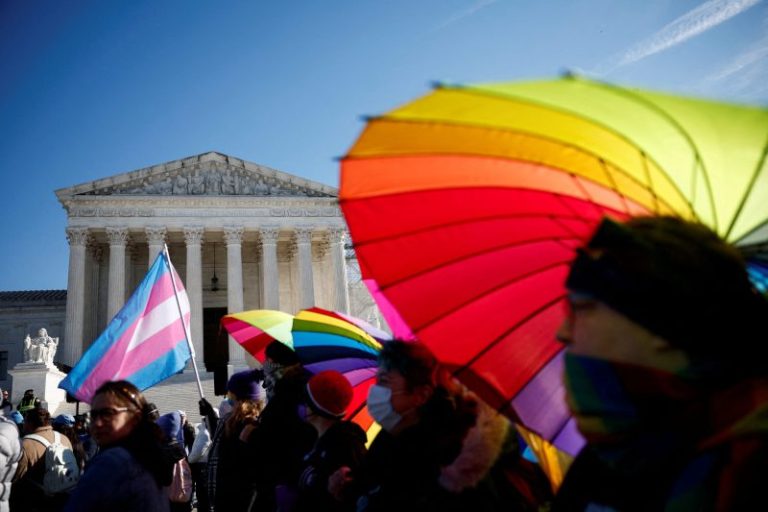
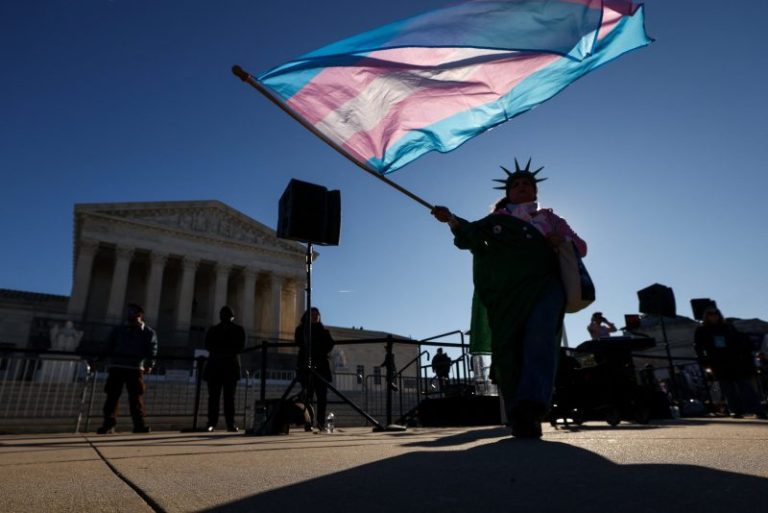
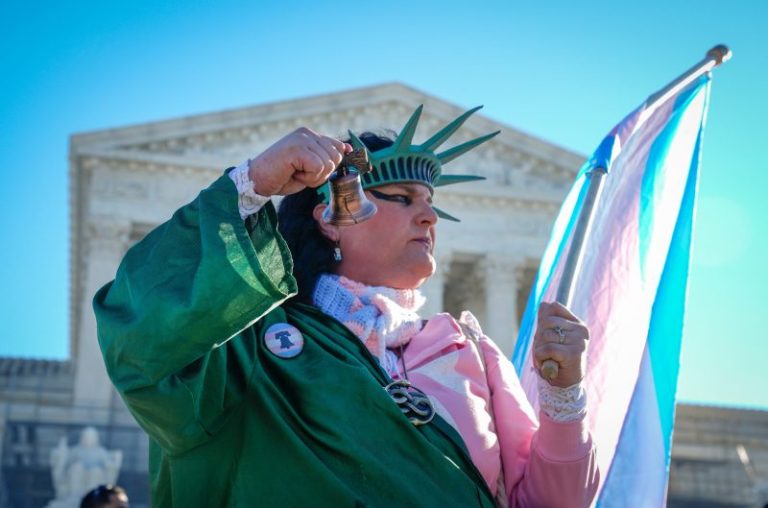
Demonstrators show support for transgender rights

As athletes supporting transgender sports bans rallied on one side of the Supreme Court steps, speakers at a rally organized by the ACLU spoke out in support, as cheerleaders holding pink and blue pompoms performed.

Parents Ali and Shyam Munshi said they felt compelled to support for their transgender daughter.

Shyam Munshi joked that while his daughter ran track in high school she probably wouldn’t consider herself an athlete. But in order for her team not to be penalized, she had to compete on the boy’s team.

“It was hard because, just like every parent, we want our kids to be safe, we want them to be happy, and so it felt risky,” said Ali Munshi. She said her daughter’s teammates were supportive, but that the proliferation of sports bans has been “disheartening.”

‘It’s really hard to quantify the value of being on a team, competing with your friends, making those decisions, to come together through adversity and support each other or celebrate together in these moments of euphoria,” said Shyam Munshi. “These are integral pieces of being a kid, and to exclude someone from that opportunity is just wrong.”

– N’dea Yancey-Bragg

Justice Department backs Idaho’s law

After Idaho’s solicitor general sat down, an attorney for the U.S. Justice Department got a turn. Under the Trump administration, the Justice Department is supporting the state bans and asked the court for time to make their case.

Hashim Mooppan, a Justice Department attorney, said Idaho’s law is “reasonably tailored,” regardless of whether it is “perfectly tailored,” as it applies to any “tiny subset of men” who may not have athletic advantages after medical treatments.

States are not required to monitor testosterone levels of athletes, he said.

He drew a comparison with laws against sexual activity with someone underage that apply differently to men than women because women faced a unique risk of pregnancy.

Taking the other side’s logic, he said, a male rapist could claim the law didn’t apply if either the rapist or the female victim were infertile. That would be ludicrous, he said.

Maureen Groppe

Conservative Justice Barrett asks about young transgender children

Justice Amy Coney Barrett, a Trump appointee, posed a hypothetical to Idaho’s solicitor general, Alan Hurst, that seemed aimed at considering if there are situations in which science does and doesn’t support banning transgender girls and women from women’s sports.

Barrett asked how Hurst’s argument would do if it was applied to a hypothetical ban on transgender six-year-old girls competing on a girl’s team. She said Hurst’s argument is based on testosterone levels and differences in athletic capability, which made her wonder how it would apply in an age group that’s prepubescent. 

Hurst responded that the court record in the Idaho case supports the idea that even at such a young age, males have about a 5% athletic advantage over girls in most situations.

‘Now, if this is not a level of competition where anybody cares about that, the simple solution is the solution you see in most places, which is you have co-ed sports,’ Hurst said. ‘Idaho’s law does nothing to interfere with that.’

– Aysha Bagchi

Idaho argues states shouldn’t be forced to tailor laws for individuals

Idaho Solicitor General Alan Hurst told Justice Elena Kagan it would be unworkable for courts to order exceptions to laws based on a class of litigants any time judges thought they didn’t make sense.

Hurst argued litigants could keep moving the goal lines. For example, he said, if a law was based on taking testosterone, a transgender athlete could argue they are taking so little it provides no advantage.

“It’s going to be enormously burdensome and the state can never win,” Hurst said. “You’d have to make as many exceptions as courts thought you needed to make.”

Bart Jansen

Kavanaugh probes if the constitution requires the state bans

The challenges before the court are about whether states can, under the law, ban transgender girls and women from participating in female athletics.

Justice Brett Kavanaugh, one of the court’s conservatives, raised the question of whether the Constitution’s guarantee of equal protection requires states to draw that line.

Alan Hurst, Idaho’s solicitor general, said he’s not persuaded by a constitutional theory that would let Idaho impose its policy on other states.

Twenty-seven states bar transgender girls and women from joining female sports teams. Other states either prohibit such bans or have not taken a position.

Maureen Groppe

Sotomayor asks why the court should rule on Idaho ban at all

Justice Sonia Sotomayor suggested the court consider dismissing the Idaho case as ‘moot’ – a legal term that means there is no longer a live issue to rule on. 

The plaintiff in the Idaho case, Lindsay Hecox, originally sued because Idaho’s ban blocked her from trying out for the Boise State Universitytrack and cross-country teams. But she has stopped playing women’s sports, and now says that means she no longer has a personal stake in the case. As a result, she argues, her case is moot.

Sotomayor said it’s clear Hecox wasn’t trying to prevent the court from ruling on the legality of state bans on transgender women competing in women’s sports, because the justices are also reviewing a similar ban in West Virginia.

‘So we don’t have a subterfuge in attempting to stop the court from reaching an important legal question,’ Sotomayor said.

Alan Hurst, Idaho’s solicitor general, responded that a lower court in the case had concluded Hecox’s plans had changed before and could change again, so she shouldn’t be able to get the case dropped that way.

– Aysha Bagchi

Do transgender people merit extra protection?

Justice Neil Gorsuch, one of the pivotal votes in the case, directed his first question to whether there’s been a history of discrimination against transgender people. That’s relevant to whether transgender status – similar to sex and race – triggers a higher level of scrutiny for laws affecting them.

Idaho’s solicitor general, Alan Hurst, said there’s no history of laws targeted transgender people the way there is for laws targeted African Americans or women.

“These things don’t compare,” he said.

Hurst also brought up comments Justice Amy Coney Barrett made in last year’s ruling upholding Tennessee’s ban on gender affirming care for transgender minors. Barrett argued that transgender status does not appear to merit heightened protection.

Maureen Groppe

Idaho lawyer says case is about whether law is applied equally

Justice Elena Kagan asked how the court should review the case. She said one approach would resolve the dispute about whether a transgender athlete held an advantage. Another approach would resolve whether everyone is treated the same under the law.

“I don’t really know what you’re suggesting,” Kagan said. “Which way should we think about this case?

Idaho Solicitor General Alan Hurst said the court should resolve whether the classification of athletes is justified generally, not necessarily in each particular case.

“We think that’s the right approach: is the classification justified, not is it justified in each individual instance,” Hurst said.

Bart Jansen

Idaho says student shouldn’t get to drop her challenge

Lindsay Hecox, the senior at Boise State University who is challenging Idaho’s law, in September asked the court to let her dismiss her case, writing that she was no longer playing sports and is afraid she will be harassed and have trouble graduating if the high-profile case continues. The court said it would wait until after oral arguments to decide.

Idaho’s solicitor general, Alan Hurst, argued on Jan. 13 that it was too late for Hecox to drop out.

Hecoz initially said she intended to play throughout college, he told the court.

Maureen Groppe

Liberal Justice Sotomayor suggests tougher test for trans athlete ban

Justice Sonia Sotomayor, an Obama appointee, came out scrutinizing an argument from Alan Hurst, Idaho’s solicitor general, who is defending the state’s ban on transgender women participating in women’s sports. Hurst said the justices should apply a low level of scrutiny – known as ‘rational basis review’ – to analyzing whether the Idaho ban is constitutional.

‘That makes no sense to me,’ Sotomayor responded. She said Idaho’s ban classified athletes based on sex, and the Supreme Court has historically applied a higher level of scrutiny – known as ‘intermediate scrutiny’ – to that kind of law.

– Aysha Bagchi

Idaho makes plea for fairness

Idaho’s solicitor general, Alan Hurst, began his case with an appeal for fairness.

Someone’s sex correlates with “countless athletic advantages,” including muscle mass, bone mass, and heart and lung capacity, he said.

“If women don’t have their own competitions, they won’t be able to compete,” he said.

Hurst said the student challenging the law – Lindsay Hecox — is seeking “special treatment for males who allegedly lack an unfair advantage.” (Hecox, a senior at Boise State University, says her testosterone levels are typical of non-transgender women and her muscle mass and size have decreased because of her hormone treatments.)

Idaho’s law easily applies to 99% of males, he said, and “a perfect fit is not required.”

Maureen Groppe

Debate begins with challenge to Idaho law

The debate, which could last several hours, has begun.

First up is the case from Idaho, which was the first state to pass a ban.

Defending the law is Idaho’s solicitor general, Alan Hurst.

His side goes first because Idaho is appealing the San Francisco-based 9th U.S. Circuit Court of Appeals decision that Idaho’s law likely violates the Constitution’s guarantee of equal protection, which requires the government to have valid reasons for treating people differently.

Idaho’s law is being challenged by Lindsay Hecox, a senior at Boise State University, who says her testosterone levels are typical of non-transgender women and her muscle mass and size have decreased because of her hormone treatments.

Maureen Groppe

Demonstrators show support for sports ban

Dozens of demonstrators gathered outside the Supreme Court on Jan. 13 to show their support for state bans barring transgender women and girls from participating in female sports teams. Many in the crowd held up signs that said “save women’s sports,” “our sports our spaces” and “gender ideology harms kids,” as former Georgia state Rep. Alveda King led the crowd in singing “This Little Light of Mine.”

“The implications are clear, the court’s ruling will provide national guidance on Title IX that will resolve or reshape dozens of lawsuits around the country involving women and girls in athletics,” Stacey Schieffelin, the Women’s Initiative Chair at America First Policy Initiative, told the crowd. “This is a pivotal moment in the fight to preserve fairness, safety and the truth in women’s sports.”

Alexa Anderson, a 19-year-old track and field athlete, said she traveled all the way from Oregon to be in Washington, DC, for oral arguments. Anderson said the issue before the court has affected her personally: She and another athlete stepped off the podium in protest after competing against a transgender athlete in a high jump event during her senior year of high school and filed an ongoing Title IX lawsuit against state officials.

“I want other girls, all future generations, to have that same ability and to be able to feel that safety, that protection, and just the happiness overall that I felt growing up in the world of sports,” she said. “And not to worry about stepping on the field and thinking that there’s a biological man and that their risk of injury might be higher, and that all their hard work didn’t matter because they’re just going to be outperformed because of biology.”

N’dea Yancey-Bragg

An ‘uphill fight’

Lawyers for the transgender students challenging Idaho’s and West Virginia’s bans aren’t boasting about their chances.

“We know we have an uphill fight,” Josh Block, an American Civil Liberties Union lawyer, told reporters last week.

Block pointed to the Supreme Court’s 2025 decision upholding Tennessee’s ban on gender-affirming care for transgender minors. And since then, the court has allowed two of President Trump’s policies targeting transgender people to go into effect as they’re being challenged: Trump’s ban on transgender military troops and his requirement that passports identify someone by their biological sex at birth.

“It’s no secret that the past two years have been a really tough time to be transgender in this country,” Block said.

But he also noted that the court’s 2025 decision for Tennessee in U.S. v. Skrmetti avoided larger issues that would have extended its reach beyond health care.

“The court really went out of its way in Skrmetti to write a narrow decision instead of a broad one,” he said. “So we’re hopeful that the court will continue to be very sensitive to these issues.”

Maureen Groppe

Protesters who’ve competed against trans athletes speak out

Several protesters , including Riley Gaines and others who have competed against transgender girls in the past, spoke out in support of the bans ahead of oral arguments, saying they believe that competing against transgender girls was unsafe, unfair and cost them opportunities in some cases.

“We want to win, we work to win, and we deserve a fair chance at victory,” Madison Kenyon, who competed on Idaho State University’s track and cross-country teams, said at a news conference on Jan. 12. ‘I’ll happily compete against challenging odds, but nobody should lose before the start of the race.’

Mary Marshall, who also competed on the track and cross-country teams at Idaho State University, shared with reporters the effort that goes into athletic training. She said losing to a transgender competitor left her wondering “whether my hard work is even worth that effort.’

Jennifer Sey, former All-Around Gymnastics National Champion and CEO of clothing brand XX-XY, said that even if the challenges to Idaho and West Virginia’s laws are defeated at the Supreme Court, their work won’t be done. She noted that 23 states and Washington, D.C. still wouldn’t have laws explicitly preventing transgender girls from participating in female sports.

“We need to change the cultural conversation,” she said.

– N’dea Yancey-Bragg

More at stake than trans participation in sports

If the Supreme Court decides that West Virginia’s ban doesn’t violate the Title IX civil rights statute barring sex discrimination in school programs, that ruling could affect more than sports.

Josh Block, an American Civil Liberties Union attorney representing the West Virginia student challenging the ban, said sports is just a “tiny part” of Title IX. If the court says that law doesn’t protect transgender students from discrimination, he said, then transgender students could be excluded from using restrooms that match their gender identity and a principal could expel a student for being trans.

“Title IX protects against sex discrimination in all parts of education,” he told reporters last week. “And whatever someone thinks about whether it’s okay to exclude transgender people from sports, I would hope that that ruling isn’t then used to exclude them from all other parts of school life, which would completely be on the table if West Virginia’s arguments prevail in their widest form.”

West Virginia AG says he expects a landslide victory

One day before oral arguments began, West Virginia Attorney General J.B. McCuskey expressed confidence that the states fighting challenges to laws that prevent transgender girls from competing on female sports teams would prevail. Losing the case would have “monumental” consequences, he said at a news conference Jan. 12 alongside several other Republican attorneys general and current and former female athletes.

“We all fully expect that this is going to be a 9-0 decision,” McCuskey said. “We are right on the facts, we’re right on the Constitution, we are right in public opinion, but importantly, we’re right on common sense.”

McCuskey’s Idahoan counterpart, Attorney General Raúl Labrador, however, said he was not as optimistic. Labrador said he expected many of the arguments would revolve around “legal technicalities” rather than the “common sense issues” at the heart of the case.

“And I think some of the justices of the court are going to have some issues with that,” Labrador said.

N’dea Yancey-Bragg

Will Justice Gorsuch speak?

During last year’s oral arguments in a challenge to Tennessee’s ban on gender-affirming care for minors, all eyes were on Justice Neil Gorsuch. That’s because the conservative justice, a Trump appointee, surprised many people in 2020 by authoring a 6-3 ruling that gay and transgender people are protected by a law barring sex discrimination in the workplace.

Last year, however, Gorsuch voted with the 6-3 majority to uphold Tennessee’s ban after not asking any questions during the oral arguments.

A big question going into today’s arguments is whether Gorsuch will stay mum or if he’ll offer any clues about whether the reasoning of the 2020 decision about workplace discrimination helps the transgender students’ challenge.

Maureen Groppe

Is the Trump administration involved in the case?

Although the challenges are based on state laws, the Justice Department has also gotten involved. At the department’s request, Justice Department attorney Hashim M. Mooppan will get time during oral arguments to support the state bans.

President Donald Trump, who campaigned on the issue, has moved to cut off federal funding to schools that allow transgender females to participate in girls’ and women’s sports.

“The whole thing is ridiculous … and it’s so demeaning to women,” Trump said when he mocked transgender athletes during a recent speech to House Republicans.

Maureen Groppe

This post appeared first on USA TODAY

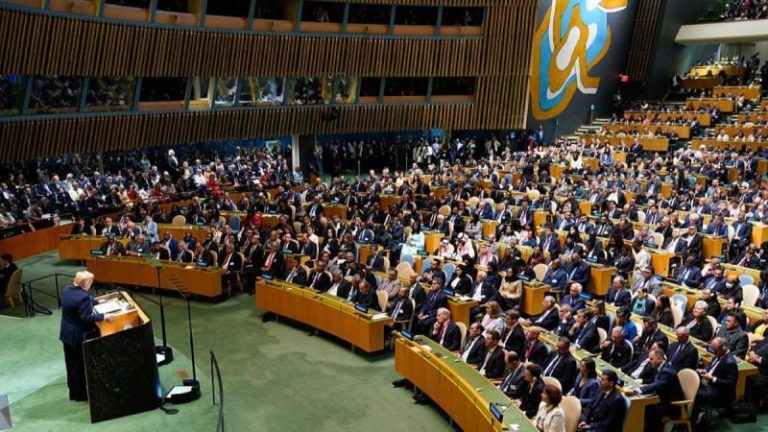
After the Trump administration’s decision to withdraw from dozens of United Nations and other international organizations, experts say more international bodies could soon find themselves on the chopping block.

The announcement that the U.S. wouldexit 66 international organizationswas in response to President Donald Trump’s February 2025 executive order calling for a review of U.S. support to ‘all international organizations.

Secretary of State Marco Rubio said in reaction to the announcement that the U.S. is ‘rejecting an outdated model of multilateralism — one that treats the American taxpayer as the world’s underwriter for a sprawling architecture of global governance.’ Rubio warned the State Department continues to review international organizations, and that those subject to the January cuts ‘are by no means the only offenders.’

Rubio said that the U.S. was not turning its back on the world but was looking to review the ‘international system,’ which he said, ‘is now overrun with hundreds of opaque international organizations, many with overlapping mandates, duplicative actions, ineffective outputs and poor financial and ethical governance.’

Hugh Dugan, former Senior Director for International Organization Affairs at the National Security Council during President Trump’s first term, told Fox News Digital that U.N. Secretary General Antonio Guterres ‘always misread’ the prior executive order ‘as a cost-cutting directive.’ In trying to ‘cut his way to growth’ through the UN80 initiative, 

Dugan said that Guterres ‘meat-cleavered budgets, hitting bone and flesh as much as fat, but at base it was business as usual: no focus on the U.N.’s pitiful return on investment.  Instead of only cutting the bottom line, also he should have grown the top line by working smarter for new efficiencies.’   

Launched in March 2025, the UN80 initiative was designed to identify inefficiencies inside the U.N. system and cut costs across an expansive bureaucracy. In response to Trump’s withdrawal from U.N. entities, Guterres’ spokesperson Stéphane Dujarric said in a statement that the secretary general, ‘regrets the announcement by the White House,’ and stated that ‘assessed contributions to the United Nations’ regular budget and peacekeeping budget…are a legal obligation under the U.N. Charter for all Member States, including the United States.’

Brett Schaefer, a senior fellow at the American Enterprise Institute, told Fox News Digital that impacted organizations external to the U.N. ‘don’t receive very much money,’ and ‘don’t necessarily merit U.S. funding or support.’ Withdrawing from those organizations is ‘more pruning around the margins than a fundamental reassessment of U.S. relationships with international organizations,’ he said.

For the 31 U.N.-affiliated groups on the list, Schaefer said that the withdrawal order is ‘an opportunity to signal to the U.N. where the United States would like to see consolidation or elimination of duplication, which is rather rife within the U.N. system.’

Schaefer said that withdrawing from the U.N. Population Fund and U.N. Framework Convention on Climate Change was ‘very consistent with the Trump administration’s policy.’ Schaefer also indicated that withdrawing from the U.N. Council on Trade and Development (UNCTAD) was a formalization of policy shift that occurred in 2018 when UNCTAD admitted ‘Palestinians as a full member state’ and U.S. law ‘prohibit[ed] U.S. funding’ for the organization.

Other choices, like departing from the U.N. Department for Economic and Social Affairs, ‘didn’t quite make sense,’ Schaefer said. He noted that the department is funded through the regular U.N. budget, which makes the move ‘more of a signal than it is really an effective policy.’

Future rounds of cutting

Schaefer noted several organizations, including the World Meteorological Organization, World Intellectual Property Organization, U.N. Office for the Coordination of Humanitarian Affairs (UNOCHA), Food and Agricultural Organization (FAO), and U.N. Development Programme, that could be subject to future cuts.

While smaller nations utilize the UNDP to administer their humanitarian donations, the U.S. does not need ‘a middleman’ to fund non-governmental organizations and provide aid, Schaefer said. He also noted that the organization ‘has had a problem with corruption’ that included concealing North Korean counterfeit money and providing the country with dual-use technology.

Schaefer said that the U.S. can ‘promote agricultural development in developing countries’ through entities outside the FAO, which he said is ‘currently led by a Chinese national’ who is ‘using that organization to promote Chinese policies and Chinese commercial interests in developing countries.’

On Dec. 31, UNOCHA was a signatory to a memo ‘which was sharply critical of Israel,’ Schaefer said. Schaefer believes the memo constituted ‘a violation of their neutrality’ that should result in reprimand. Schaefer said that Under-Secretary-General for Humanitarian Affairs and Emergency Relief Coordinator Tom Fletcher ‘has made repeated statements echoing false accusations of Israel causing famine and hunger and other humanitarian suffering in Gaza that has since been proved to be false and without basis.’

The WIPO, WMO, and FAO declined to comment about whether they might be a target of future cuts.

A UNDP spokesperson said that the U.S. ‘has been a steadfast partner’ and that the it maintains its commitment to working alongside the U.S. to ‘address urgent humanitarian needs, promote stability, and advance prosperity worldwide.’ The spokesperson noted that ‘UNDP projects are subject to strict oversight and accountability policies and mechanisms,’ with the UNDP ‘consistently rank[ing] amongst the most transparent organizations included in the [Aid Transparency Index.] 

According to the UNDP spokesperson, ‘no evidence of systematic fraud or diversion of funds was found’ when concerns involving the Democratic People’s Republic of Korea were investigated in 2006. The spokesperson said that the DPRK project ‘concluded in 2020. Any future engagement would require consensus from UNDP’s Executive Board and clear directives from Member States.’

A UNOCHA spokesperson noted that the U.S. had just signed an agreement with UNOCHA ‘reinforcing our partnership.’

The U.S. pledged to allocate $2 billion to UNOCHA at the end of December for global humanitarian needs.[iii] In recent years, officials previously told Fox News Digital that the U.S. had contributed between $8 and $10 billion to UNOCHA

This post appeared first on FOX NEWS

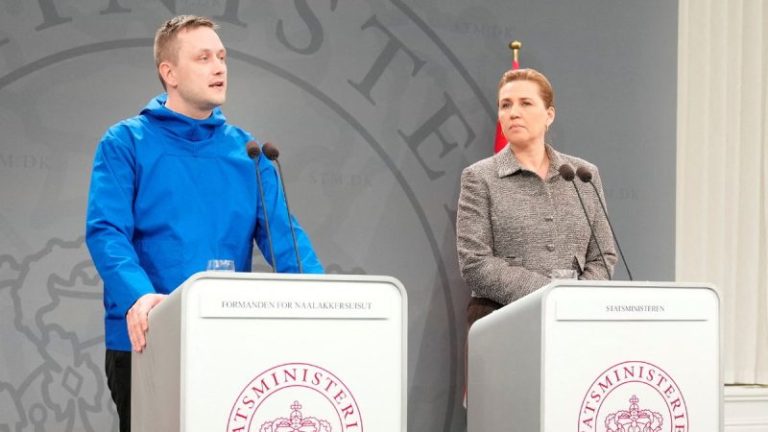
Greenland’s prime minister declared Tuesday that, ‘we choose Denmark,’ if it had to decide between remaining a Danish territory or becoming part of the United States, a report said. 

Jens-Frederik Nielsen made the remark while appearing alongside Danish Prime Minister Mette Frederiksen during a joint press conference in Copenhagen, according to Reuters. 

‘We face a geopolitical crisis, and if we have to choose between the U.S. and Denmark here and now then we choose Denmark,’ Nielsen reportedly said. ‘We stand united in the Kingdom of Denmark.’ 

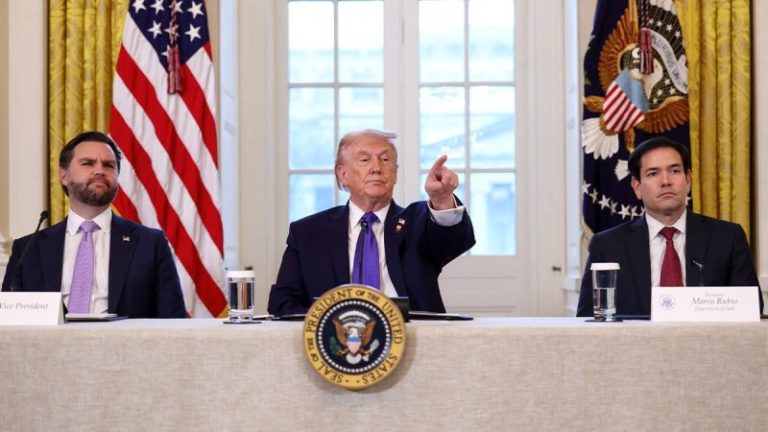
The comment comes as Denmark’s Foreign Minister Lars Lokke Rasmussen said he and his Greenlandic counterpart Vivian Motzfeldt are set to meet with Secretary of State Marco Rubio and Vice President JD Vance on Wednesday at the White House, Reuters reported.

‘Our reason for seeking the meeting we have now been given was to move this whole discussion, which has not become less tense since we last met, into a meeting room where we can look each other in the eye and talk about these things,’ Rasmussen said. 

A source familiar with the matter confirmed to Fox News that Rasmussen will be visiting the White House. 

President Donald Trump said on Sunday that the U.S. must acquire Greenland — not lease it — arguing the Arctic territory lacks defenses and warning that Russia or China would move in if Washington does not act, a move he said is critical to U.S. and NATO security.

While speaking with reporters on Air Force One on Sunday night, Trump was asked about Greenland and whether the U.S. had made an offer to acquire the territory from Denmark. 

‘I haven’t done that. Greenland should make the deal because Greenland does not want to see Russia or China take over,’ he said. ‘Basically, their defense is two dog sleds. You know that? You know what their defense is? Two dog sleds.’

The president was also clear that his administration is not talking about leasing Greenland short term, but only about acquiring the Danish territory. 

‘If we don’t do it, Russia or China will, and that’s not going to happen when I’m president,’ Trump said. 

Fox News’ Patrick Ward and Greg Wehner contributed to this report. 

This post appeared first on FOX NEWS

The House GOP’s largest caucus released a plan for a second ‘big, beautiful bill’ on Tuesday morning, which the group says could cut the federal deficit by over $1 trillion.

Republican Study Committee Chairman August Pfluger, R-Texas, unveiled the roadmap for what’s likely to be a massive piece of legislation during a press conference alongside House Budget Committee Chairman Jodey Arrington, R-Texas, whose panel would play a central role in advancing any budget reconciliation bill.

Budget reconciliation allows the majority parties in the House and Senate to pass significant policy reforms by lowering the Senate’s threshold to advance a bill to a simple majority rather than 60 votes, provided its measures adhere to a specific set of guardrails.

It comes as House Republicans wrestle with a razor-thin majority, which just got slimmer after the abrupt resignation of former Rep. Marjorie Taylor Greene, R-Ga., and the sudden death of Rep. Doug LaMalfa, R-Calif.

Republicans’ first reconciliation legislation, which President Donald Trump dubbed his ‘big, beautiful bill,’ was passed after months of tense intraparty negotiations with all but two GOP lawmakers’ support.

At the time, the threat of Trump’s first-term tax cuts in the Tax Cuts and Jobs Act (TCJA) expiring at the end of 2025 was critical to getting the ideologically diverse GOP conference on board with the bill — while Republicans have no such anchor this year.

Asked about those dynamics by Fox News Digital, Pfluger said, ‘That’s why this framework is so important.’

‘We spent a lot of time looking at what the theme of a reconciliation bill should be, what is the overlapping area that we all care about. And I would also submit to you that Democrats care about this as well,’ Pfluger said. ‘The details of exactly which bills will be included that’s the hard work that we now will embark upon.’

Affordability appears to be the cornerstone of the legislation, according to an 11-page document obtained by Fox News Digital.

Republicans are seeking to lower healthcare costs by changing the existing Obamacare subsidy structure to route dollars directly to taxpayers through Health Savings Accounts (HSAs) rather than money going to insurance companies, and codifying the Trump administration’s executive actions on most favored nation drug pricing, that is aimed at lowering the costs of popular prescription drugs.

The bill would also include measures codifying Trump’s energy deregulation policies in order to lower costs for U.S. oil and natural gas. 

A provision in the framework on taxing ‘third-party litigation to discourage frivolous lawsuits that undermine economic growth’ regarding U.S. energy, and a series of other fees associated with lawsuits, are expected to raise federal revenues by at least $27 billion.

‘I’m just talking about the affordability issue — I do think it’s the most important issue for November,’ Arrington said. ‘I think it’s the most important issue for the American people.’

Rep. Stephanie Bice, R-Okla., among the Republicans who spoke at the press conference, honed in on the deregulatory aspect as a pathway to lowering costs.

‘We must do this second package to continue to codify President Trump’s agenda and to enact a pro-growth and pro-America agenda. Affordability starts with energy and deregulation,’ she said.

The framework also includes a host of other priorities floated by Republicans this year, including limiting ‘federal transportation funding to states and cities granting driver’s licenses to illegal aliens, and to sanctuary jurisdictions violating federal law and undermining the President’s effort to secure the border,’ which the document said would save $76.3 billion federal dollars.

It would also impose new restrictions on illegal immigrants being able to use federal programs like the Low-Income Housing Tax Credit and block federal funds for states that allow illegal immigrants to get government healthcare benefits.

The framework also aims to make home buying more affordable for Americans with new ‘Home Savings Accounts,’ which would allow them to pull from other tax-advantaged savings accounts if that money went toward buying a home.

Speaker Mike Johnson, R-La., has said on multiple occasions that he hopes for a second reconciliation bill, but has not endorsed a specific piece of legislation yet.

This post appeared first on FOX NEWS

The U.S. has designated three branches of the Muslim Brotherhood as terrorist organizations, in a move that could impact Washington’s relationships with Qatar and Turkey.

The Treasury and State departments announced the moves against the Lebanese, Jordanian and Egyptian chapters of the group, which the Trump administration asserts pose risks to the U.S.

The State Department gave the Lebanese branch of the Muslim Brotherhood the most severe of its labels, designating it a foreign terrorist organization, which makes it illegal to provide material support to the group, The Associated Press reported. Additionally, the Treasury Department labeled the Jordanian and Egyptian branches as specially designated global terrorists for providing support to Hamas. The Lebanese chapter of the Muslim Brotherhood was also given a special designation by the Treasury Department.

‘These designations reflect the opening actions of an ongoing, sustained effort to thwart Muslim Brotherhood chapters’ violence and destabilization wherever it occurs,’ Secretary of State Marco Rubio said in a statement, according to the AP. ‘The United States will use all available tools to deprive these Muslim Brotherhood chapters of the resources to engage in or support terrorism.’

The labeling of the Jordanian chapter as a specially designated global terrorists comes months after Amman announced a sweeping ban on the organization. The AP noted that while the Jordanian monarchy had previously banned the Muslim Brotherhood a decade ago, it officially licensed a splinter group and continued to tolerate the Islamic Action Front while restricting some of its activities. The Islamic Action Front, a political party linked to the Muslim Brotherhood, won several seats in the 2024 parliamentary elections.

In November, President Donald Trump issued an executive order calling for ‘certain chapters or other subdivisions of the Muslim Brotherhood’ to be considered for designation as foreign terrorist organizations and specially designated global terror organizations.

The Muslim Brotherhood’s ‘chapters in Lebanon, Jordan, and Egypt engage in or facilitate and support violence and destabilization campaigns that harm their own regions, United States citizens, and United States interests,’ the executive order reads.

The order goes on to state that after the Oct. 7, 2023, attacks on Israel, ‘the military wing of the Lebanese chapter of the Muslim Brotherhood joined Hamas, Hezbollah, and Palestinian factions to launch multiple rocket attacks against both civilian and military targets within Israel.’ It also adds that the Egyptian chapter of the Muslim Brotherhood ‘called for violent attacks’ against U.S. partners and interests on Oct. 7, 2023. Additionally, the order states that the Jordanian chapter’s leaders ‘have long provided material support to the militant wing of Hamas.’

Both Florida and Texas have designated the Muslim Brotherhood as a terrorist organization, something Trump contemplated doing in 2019 during his first term in office.

The Associated Press contributed to this report.

This post appeared first on FOX NEWS

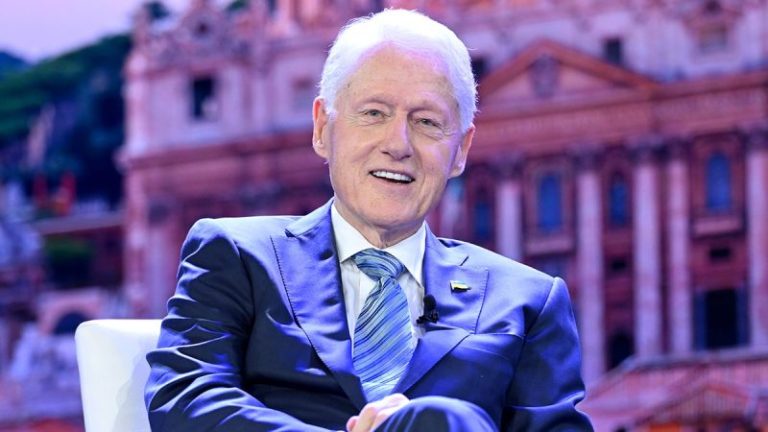
Former President Bill Clinton appears to have defied a congressional subpoena to appear before the House Oversight Committee on Tuesday morning.

Clinton was compelled to sit for a sworn closed-door deposition in the House’s bipartisan probe into Jeffrey Epstein, but Fox News Digital did not see him before or after the scheduled 10 a.m. grilling.

House Oversight Committee Chairman James Comer, R-Ky., had threatened to begin contempt of Congress proceedings against Clinton if he did not appear Tuesday.

Comer said Tuesday morning, ‘We will move next week in the House Oversight Committee … to hold Bill Clinton in contempt of Congress.’

‘I think everyone knows by now Bill Clinton did not show up. And I think it’s important to note that this subpoena was voted on in a bipartisan manner by this committee,’ Comer told reporters after formally ending the deposition.

‘No one’s accusing Bill Clinton of any wrongdoing. We just have questions. And that’s why the Democrats voted, along with Republicans, to subpoena Bill Clinton.’

He said ‘not a single Democrat’ showed up to the deposition on Tuesday.

Other lawmakers seen going into the committee room include Reps. Lauren Boebert, R-Colo., Andy Biggs, R-Ariz., Michael Cloud, R-Texas, Tim Burchett, R-Tenn., and Scott Perry, R-Pa.

Hillary Clinton had also been subpoenaed to appear on Wednesday but likely will not show up.

The Clintons’ attorney sent Comer a letter confirming they’re challenging the legality of the subpoenas issued against them.

‘[T]he Subpoenas issued to President and Secretary Clinton are invalid and legally unenforceable. Mindful of these defects, we trust you will engage in good faith to de-escalate this dispute,’ reads the letter, obtained by Fox News Digital.

The Clintons’ attorneys tore into Comer’s leadership of the investigation, accusing him of violating the Constitution’s separation of powers and trying to obfuscate the search for real information.

‘President and Secretary Clinton have already provided the limited information they possess about Jeffrey Epstein and Ghislaine Maxwell to the Committee. They did so proactively and voluntarily, and despite the fact that the Subpoenas are invalid and legally unenforceable, untethered to a valid legislative purpose, unwarranted because they do not seek pertinent information, and an unprecedented infringement on the separation of powers,’ the letter said.

‘Your continued insistence that the former President and Secretary of State can be compelled to appear before the Committee under these circumstances, however, brings us toward a protracted and unnecessary legal confrontation that distracts from the principal work of the Congress with respect to this matter, which, if conducted sincerely, could help ensure the victims of Mr. Epstein and Ms. Maxwell are afforded some measure of justice for the crimes perpetrated against them, however late. But perhaps distraction is the point.’

Fox News Digital asked Comer if he would also move to hold Hillary Clinton in contempt next week if she defies the subpoena, to which he said, ‘We’ll see. We’ll talk about it.’

If the contempt resolution advances through committee next week, it will then be on the entire House to vote on whether to refer the former president for criminal charges.

A criminal contempt of Congress charge is a misdemeanor that carries a punishment of up to one year in jail and a maximum $100,000 fine if convicted.

Burchett, however, told reporters he was not confident that the Department of Justice (DOJ) would pursue such a referral.

‘I’ve been really disappointed in our Justice Department, so I would hope that maybe they’re making some changes over there,’ Burchett said.

The former first couple were two of 10 people who Comer initially subpoenaed in the House’s Epstein investigation after a unanimous bipartisan vote directed him to do so last year. Fox News Digital was first to report on the subpoenas in August.

Clinton was known to be friendly with the late pedophile before his federal charges but was never implicated in any wrongdoing related to him.

This post appeared first on FOX NEWS

The Supreme Court can issue rulings in a million cases, and it won’t make transgender people disappear.

That’s what this is about. Not who gets to participate in sports or protecting women or preserving Title IX.

Erasure. Permanently removing transgender women from every social space so bigots and people who don’t care to be educated no longer have to look at or think about a group of people they don’t understand or who make them uncomfortable, while making all women adhere to a prescribed idea of femininity.

That’s abundantly clear in the rabid pushback in the two cases before the Supreme Court on Jan. 13 that challenge bans of transgender athletes in Idaho and West Virginia.

In fact, the West Virginia ban applies to one athlete, who was 11 when the ban took effect in 2021.  

Yet the Trump administration, the right-wing legal machine and celebrity transphobes have all weighed in, hoping to use the cases as a means of pushing transgender women and girls even farther out of public view. While each case centers on an individual athlete’s appeal of one state’s ban, their defeat could be used to uphold participation bans in 25 other states and call other protections for transgender people into question.

“Our hope is certainly that we prevail,” said Joshua Block, who as senior counsel for the ACLU’s LGBTQ and HIV Projects will argue in the West Virginia case.

“But we also hope that, regardless of what happens, this case isn’t successfully used as a tool to undermine the rights of transgender folks more generally. In areas far beyond athletics,” Block added.

But that is the goal. It’s always been the goal.

Transgender people have always existed

Transgender people have existed since time began and will continue to do so regardless of what the Supreme Court decides. So, too, non-binary people. And women with differences of sex development. Women with Swyer Syndrome. Women with hormonal imbalances. And so on and so on. Gender does not and never has fit neatly into two boxes, as any biologist or geneticist worth their salt will tell you.

For much of the 21st Century, the International Olympic Committee and NCAA recognized that. They had protocols allowing athletes to participate as their identified gender, and no one raised a fuss. Cisgender women — those born with XX chromosomes — weren’t crowded off the podium or the playing field. Locker rooms remained safe spaces — except from predatory coaches, the overwhelming majority of whom are cisgender men.

The transgender girls and women who participated in sports were doing so for the very same reasons as other girls and women: To have fun, to play with their friends and to benefit from the life lessons sports provide.

“All I’ve ever wanted was the same opportunities as my peers,” Becky Pepper-Jackson, a shot putter and the plaintiff in the West Virginia case, said.

Yet after Americans realized that attempts to paint gays and lesbians as predators and threats to the moral order were nonsense (and hypocritical), the right wing shifted its twisted obsession to the transgender community.

Transgender people a miniscule part of population

According to the Williams Institute at the UCLA School of Law, just 1% of the U.S. population is transgender. That means most Americans don’t know someone who is transgender and, thus, don’t have personal knowledge to counter the narrative that transgender women are a threat to other girls and women, be it in bathrooms or athletics. The anti-trans mob has doubled down on this by playing fast and loose with science, extrapolating the athletic results of cisgender men for those of transgender women when that is akin to comparing apples and oranges.

Worst of all, they’ve been able to make the transgender community into a bogeyman for people unsettled by a changing world and looking for someone to blame.

They are not, of course.

No one is forcing kids to transition. Transgender people aren’t lurking in bathrooms, waiting to assault people. Transgender women athletes aren’t stealing trophies and opportunities from other women en masse.

All they want to do is exist.

“This is unfair to me and every transgender kid who just wants the freedom to be themselves,’ Pepper-Johnson said. “I’ve had my rights and my life debated by politicians who’ve never even met me.”

Other women harmed by transgender athlete bans

You know who else it’s unfair to? Any girl or woman who doesn’t look or act like the stereotype pushed by the right wing and transphobes. In states with bans, there are already cases of girls with short hair or who are tomboys having their gender questioned or being asked to “prove” they were born female.

This “defense” of women’s sports also undermines them, making the implicit argument that women’s sports are less worthy because those who play them are inferior to male athletes. (This is also why no one ever makes a peep about transgender male athletes.)

And don’t get me started on those who are fixated on the small number of transgender athletes but have nothing to say about actual Title IX violations and the disproportionate investment in women’s sports.

Even if the Supreme Court upholds the bans, even if it provides cover for bigotry, transgender people will continue to exist. It might take years or even decades, but their humanity will eventually be recognized and these bans will join other legalized discrimination in the dark corner of history where they belong.

The Supreme Court can set that in motion by striking down these bans. Or the Court, like those who would see transgender people marginalized out of existence, can keep denying reality. 

Follow USA TODAY Sports columnist Nancy Armour on social media @nrarmour.

This post appeared first on USA TODAY

NFL teams are always looking for talent at the quarterback position. It won’t necessarily be easy to find during the 2026 NFL offseason.

The NFL’s free agent class isn’t much better. There are plenty of solid backup-caliber players on the market, but those hoping to find a starter won’t have many options from which to choose.

Perhaps the overall market will get a boost from roster cuts ahead of free agency. The Arizona Cardinals, Atlanta Falcons and Miami Dolphins all have to make decisions about the respective futures of Kyler Murray, Kirk Cousins and Tua Tagovailoa, and if any is released, they would instantly jump close to the top of the free-agent quarterback pecking order.

But for now, here’s a look at the NFL’s top free agent quarterbacks for the 2026 offseason:

NFL free agency: Top 8 quarterbacks, ranked

1. Daniel Jones (2025 team: Indianapolis Colts)

Jones enjoyed a breakout year in his first season under the tutelage of Shane Steichen. The 28-year-old completed a career-high 68% of his passes and 100.2 passer rating while looking more comfortable than ever in the pocket. The downside: Jones suffered a season-ending Achilles tear in the Colts’ Week 14 loss to the Jaguars, throwing into question his availability for Week 1 of the 2026 NFL season.

2. Aaron Rodgers (2025 team: Pittsburgh Steelers)

Rodgers may not be the player he once was, but the 42-year-old was still a passable starting quarterback in 2025. His ability to get the ball out of his hands quickly – his 2.46-second time to throw ranked third-fastest in among quarterbacks to log at least 100 plays, per Sumer Sports – was a great equalizer against pressure and helped cover up his dwindling arm strength.

Even without above-average downfield passing ability, Rodgers possesses the veteran savvy needed to remain a decent starting quarterback should he return to the NFL for a 22nd season.

3. Malik Willis (2025 team: Green Bay Packers)

Willis has done wonders for his stock during his two seasons with the Packers. The 26-year-old started just three games in place of Jordan Love but comported himself well, completing 78.7% of his passes for 972 yards and six touchdowns without an interception. The Liberty product’s combination of downfield accuracy – he completed all seven of his passes of 20-plus yards for 230 yards and two touchdowns, per Pro Football Focus – and mobility make him an intriguing gamble for teams seeking young upside at the quarterback position.

4. Russell Wilson (2025 team: New York Giants)

The highlight of Wilson’s season was the Giants quarterback throwing for 450 yards, three touchdowns and an interception in the team’s Week 2 overtime loss to the Dallas Cowboys. Everything else went poorly, as Wilson completed a career-low 58% of his passes and was demoted to third string in what figures to be his lone season with the Giants.

Wilson, 37, may still get looks as a potential backup, but it’s clear his days as an NFL starter are over.

5. Marcus Mariota (2025 team: Washington Commanders)

Mariota made his first starts since 2022 in place of the injured Jayden Daniels this season. The No. 2 pick from the 2015 NFL Draft showed why he’s widely considered one of the league’s top backups by completing 61.2% of his passes for 1,695 yards, 10 touchdowns and seven interceptions while leading a banged-up Washington team.

Mariota still showed solid mobility during his age-32 season, rushing for 297 yards on 50 carries. That will make him one of the top, dual-threat backups on the market.

6. Joe Flacco (2025 team: Cincinnati Bengals)

Flacco turns 41 on Jan. 16, but showed his gunslinging capabilities across 10 starts with the Cleveland Browns and Bengals this past season. He particularly shone with the Bengals, completing 61.7% of his passes for 1,664 yards, 13 touchdowns and four interceptions after coming to the team in a midseason trade.

Flacco remains a statuesque pocket passer but isn’t afraid to uncork deep passes. His big time throw percentage (BTT%) of 29.5% on passes of 20-plus yards ranked 13th among players to attempt at least 10 passes of 20-plus yards during the 2025 NFL season, per Pro Football Focus. Expect teams to show interest in the veteran as a backup who can keep a contender afloat in a short-term starting stint.

7. Kenny Pickett (2025 team: Las Vegas Raiders)

Pickett didn’t look great across two starts with the Raiders in 2025, completing 62.2% of his passes for 188 yards, one touchdown and two interceptions. Granted, his supporting cast was one of the NFL’s worst and he did lead the team to a Week 18 win over the Kansas City Chiefs, but it was hardly an inspiring season for the 27-year-old, who was traded out of the Browns’ quarterback room before the campaign began.

Still, Pickett is young and has upside after being the lone, first-round quarterback selected in 2022. Expect a team to sign him as a solid backup with the goal of developing him into something more.

8. Trey Lance (2025 team: Los Angeles Chargers)

Lance had a chance for a showcase game at the end of the 2025 NFL season. The result? He completed 20 of 44 passes (45.5%) for 136 yards and an interception against the Broncos. He also added 69 rushing yards on nine carries, continuing to flash his dual-threat upside.

Those results seem more like stagnation than progression from Lance, but he was playing an elite Broncos defense behind a shoddy offensive line. He also won’t turn 26 until May, so plenty of NFL teams will still view him as a solid developmental backup given his raw athletic talent.

Best of the rest

Teddy Bridgewater
Jimmy Garoppolo
Tyrod Taylor
Mitch Trubisky
Carson Wentz
Zach Wilson

This post appeared first on USA TODAY

WASHINGTON − After years of national debate over transgender girls and women on female sports teams, the Supreme Court is stepping in.

The court is debating on Jan. 13 whether restrictions passed by more than half the states violate either the Constitution or a federal civil rights law barring sex discrimination in school programs.

The transgender students from Idaho and West Virginia who are challenging their states’ bans say the laws don’t take into account individual circumstances, including whether someone who takes puberty-blockers or cross-gender hormones may no longer be bigger, faster or stronger than a typical female.

The states argue that athletic advantages remain even after hormonal treatments and the bans are necessary to ensure fairness and safety in female sports.

Follow along for live coverage of the debate.

Conservative Justice Barrett asks about young transgender children

Justice Amy Coney Barrett, a Trump appointee, posed a hypothetical to Idaho’s solicitor general, Alan Hurst, that seemed aimed at considering if there are situations in which science does and doesn’t support banning transgender girls and women from women’s sports.

Barrett asked how Hurst’s argument would do if it was applied to a hypothetical ban on transgender six-year-old girls competing on a girl’s team. She said Hurst’s argument is based on testosterone levels and differences in athletic capability, which made her wonder how it would apply in an age group that’s prepubescent. 

Hurst responded that the court record in the Idaho case supports the idea that even at such a young age, males have about a 5% athletic advantage over girls in most situations.

‘Now, if this is not a level of competition where anybody cares about that, the simple solution is the solution you see in most places, which is you have co-ed sports,’ Hurst said. ‘Idaho’s law does nothing to interfere with that.’

– Aysha Bagchi

Idaho argues states shouldn’t be forced to tailor laws for individuals

Idaho Solicitor General Alan Hurst told Justice Elena Kagan it would be unworkable for courts to order exceptions to laws based on a class of litigants any time judges thought they didn’t make sense.

Hurst argued litigants could keep moving the goal lines. For example, he said, if a law was based on taking testosterone, a transgender athlete could argue they are taking so little it provides no advantage.

“It’s going to be enormously burdensome and the state can never win,” Hurst said. “You’d have to make as many exceptions as courts thought you needed to make.”

Bart Jansen

Kavanaugh probes if the constitution requires the state bans

The challenges before the court are about whether states can, under the law, ban transgender girls and women from participating in female athletics.

Justice Brett Kavanaugh, one of the court’s conservatives, raised the question of whether the Constitution’s guarantee of equal protection requires states to draw that line.

Alan Hurst, Idaho’s solicitor general, said he’s not persuaded by a constitutional theory that would let Idaho impose its policy on other states.

Twenty-seven states bar transgender girls and women from joining female sports teams. Other states either prohibit such bans or have not taken a position.

Maureen Groppe

Sotomayor asks why the court should rule on Idaho ban at all

Justice Sonia Sotomayor suggested the court consider dismissing the Idaho case as ‘moot’ – a legal term that means there is no longer a live issue to rule on. 

The plaintiff in the Idaho case, Lindsay Hecox, originally sued because Idaho’s ban blocked her from trying out for the Boise State Universitytrack and cross-country teams. But she has stopped playing women’s sports, and now says that means she no longer has a personal stake in the case. As a result, she argues, her case is moot.

Sotomayor said it’s clear Hecox wasn’t trying to prevent the court from ruling on the legality of state bans on transgender women competing in women’s sports, because the justices are also reviewing a similar ban in West Virginia.

‘So we don’t have a subterfuge in attempting to stop the court from reaching an important legal question,’ Sotomayor said.

Alan Hurst, Idaho’s solicitor general, responded that a lower court in the case had concluded Hecox’s plans had changed before and could change again, so she shouldn’t be able to get the case dropped that way.

– Aysha Bagchi

Do transgender people merit extra protection?

Justice Neil Gorsuch, one of the pivotal votes in the case, directed his first question to whether there’s been a history of discrimination against transgender people. That’s relevant to whether transgender status – similar to sex and race – triggers a higher level of scrutiny for laws affecting them.

Idaho’s solicitor general, Alan Hurst, said there’s no history of laws targeted transgender people the way there is for laws targeted African Americans or women.

“These things don’t compare,” he said.

Hurst also brought up comments Justice Amy Coney Barrett made in last year’s ruling upholding Tennessee’s ban on gender affirming care for transgender minors. Barrett argued that transgender status does not appear to merit heightened protection.

Maureen Groppe

Idaho lawyer says case is about whether law is applied equally

Justice Elena Kagan asked how the court should review the case. She said one approach would resolve the dispute about whether a transgender athlete held an advantage. Another approach would resolve whether everyone is treated the same under the law.

“I don’t really know what you’re suggesting,” Kagan said. “Which way should we think about this case?

Idaho Solicitor General Alan Hurst said the court should resolve whether the classification of athletes is justified generally, not necessarily in each particular case.

“We think that’s the right approach: is the classification justified, not is it justified in each individual instance,” Hurst said.

Bart Jansen

Idaho says student shouldn’t get to drop her challenge

Lindsay Hecox, the senior at Boise State University who is challenging Idaho’s law, in September asked the court to let her dismiss her case, writing that she was no longer playing sports and is afraid she will be harassed and have trouble graduating if the high-profile case continues. The court said it would wait until after oral arguments to decide.

Idaho’s solicitor general, Alan Hurst, argued on Jan. 13 that it was too late for Hecox to drop out.

Hecoz initially said she intended to play throughout college, he told the court.

Maureen Groppe

Liberal Justice Sotomayor suggests tougher test for trans athlete ban

Justice Sonia Sotomayor, an Obama appointee, came out scrutinizing an argument from Alan Hurst, Idaho’s solicitor general, who is defending the state’s ban on transgender women participating in women’s sports. Hurst said the justices should apply a low level of scrutiny – known as ‘rational basis review’ – to analyzing whether the Idaho ban is constitutional.

‘That makes no sense to me,’ Sotomayor responded. She said Idaho’s ban classified athletes based on sex, and the Supreme Court has historically applied a higher level of scrutiny – known as ‘intermediate scrutiny’ – to that kind of law.

– Aysha Bagchi

Idaho makes plea for fairness

Idaho’s solicitor general, Alan Hurst, began his case with an appeal for fairness.

Someone’s sex correlates with “countless athletic advantages,” including muscle mass, bone mass, and heart and lung capacity, he said.

“If women don’t have their own competitions, they won’t be able to compete,” he said.

Hurst said the student challenging the law – Lindsay Hecox — is seeking “special treatment for males who allegedly lack an unfair advantage.” (Hecox, a senior at Boise State University, says her testosterone levels are typical of non-transgender women and her muscle mass and size have decreased because of her hormone treatments.)

Idaho’s law easily applies to 99% of males, he said, and “a perfect fit is not required.”

Maureen Groppe

Debate begins with challenge to Idaho law

The debate, which could last several hours, has begun.

First up is the case from Idaho, which was the first state to pass a ban.

Defending the law is Idaho’s solicitor general, Alan Hurst.

His side goes first because Idaho is appealing the San Francisco-based 9th U.S. Circuit Court of Appeals decision that Idaho’s law likely violates the Constitution’s guarantee of equal protection, which requires the government to have valid reasons for treating people differently.

Idaho’s law is being challenged by Lindsay Hecox, a senior at Boise State University, who says her testosterone levels are typical of non-transgender women and her muscle mass and size have decreased because of her hormone treatments.

Maureen Groppe

Demonstrators show support for sports ban

Dozens of demonstrators gathered outside the Supreme Court on Jan. 13 to show their support for state bans barring transgender women and girls from participating in female sports teams. Many in the crowd held up signs that said “save women’s sports,” “our sports our spaces” and “gender ideology harms kids,” as former Georgia state Rep. Alveda King led the crowd in singing “This Little Light of Mine.”

“The implications are clear, the court’s ruling will provide national guidance on Title IX that will resolve or reshape dozens of lawsuits around the country involving women and girls in athletics,” Stacey Schieffelin, the Women’s Initiative Chair at America First Policy Initiative, told the crowd. “This is a pivotal moment in the fight to preserve fairness, safety and the truth in women’s sports.”

Alexa Anderson, a 19-year-old track and field athlete, said she traveled all the way from Oregon to be in Washington, DC, for oral arguments. Anderson said the issue before the court has affected her personally: She and another athlete stepped off the podium in protest after competing against a transgender athlete in a high jump event during her senior year of high school and filed an ongoing Title IX lawsuit against state officials.

“I want other girls, all future generations, to have that same ability and to be able to feel that safety, that protection, and just the happiness overall that I felt growing up in the world of sports,” she said. “And not to worry about stepping on the field and thinking that there’s a biological man and that their risk of injury might be higher, and that all their hard work didn’t matter because they’re just going to be outperformed because of biology.”

N’dea Yancey-Bragg

An ‘uphill fight’

Lawyers for the transgender students challenging Idaho’s and West Virginia’s bans aren’t boasting about their chances.

“We know we have an uphill fight,” Josh Block, an American Civil Liberties Union lawyer, told reporters last week.

Block pointed to the Supreme Court’s 2025 decision upholding Tennessee’s ban on gender-affirming care for transgender minors. And since then, the court has allowed two of President Trump’s policies targeting transgender people to go into effect as they’re being challenged: Trump’s ban on transgender military troops and his requirement that passports identify someone by their biological sex at birth.

“It’s no secret that the past two years have been a really tough time to be transgender in this country,” Block said.

But he also noted that the court’s 2025 decision for Tennessee in U.S. v. Skrmetti avoided larger issues that would have extended its reach beyond health care.

“The court really went out of its way in Skrmetti to write a narrow decision instead of a broad one,” he said. “So we’re hopeful that the court will continue to be very sensitive to these issues.”

Maureen Groppe

Protesters who’ve competed against trans athletes speak out

Several protesters , including Riley Gaines and others who have competed against transgender girls in the past, spoke out in support of the bans ahead of oral arguments, saying they believe that competing against transgender girls was unsafe, unfair and cost them opportunities in some cases.

“We want to win, we work to win, and we deserve a fair chance at victory,” Madison Kenyon, who competed on Idaho State University’s track and cross-country teams, said at a news conference on Jan. 12. ‘I’ll happily compete against challenging odds, but nobody should lose before the start of the race.’

Mary Marshall, who also competed on the track and cross-country teams at Idaho State University, shared with reporters the effort that goes into athletic training. She said losing to a transgender competitor left her wondering “whether my hard work is even worth that effort.’

Jennifer Sey, former All-Around Gymnastics National Champion and CEO of clothing brand XX-XY, said that even if the challenges to Idaho and West Virginia’s laws are defeated at the Supreme Court, their work won’t be done. She noted that 23 states and Washington, D.C. still wouldn’t have laws explicitly preventing transgender girls from participating in female sports.

“We need to change the cultural conversation,” she said.

– N’dea Yancey-Bragg

More at stake than trans participation in sports

If the Supreme Court decides that West Virginia’s ban doesn’t violate the Title IX civil rights statute barring sex discrimination in school programs, that ruling could affect more than sports.

Josh Block, an American Civil Liberties Union attorney representing the West Virginia student challenging the ban, said sports is just a “tiny part” of Title IX. If the court says that law doesn’t protect transgender students from discrimination, he said, then transgender students could be excluded from using restrooms that match their gender identity and a principal could expel a student for being trans.

“Title IX protects against sex discrimination in all parts of education,” he told reporters last week. “And whatever someone thinks about whether it’s okay to exclude transgender people from sports, I would hope that that ruling isn’t then used to exclude them from all other parts of school life, which would completely be on the table if West Virginia’s arguments prevail in their widest form.”

West Virginia AG says he expects a landslide victory

One day before oral arguments began, West Virginia Attorney General J.B. McCuskey expressed confidence that the states fighting challenges to laws that prevent transgender girls from competing on female sports teams would prevail. Losing the case would have “monumental” consequences, he said at a news conference Jan. 12 alongside several other Republican attorneys general and current and former female athletes.

“We all fully expect that this is going to be a 9-0 decision,” McCuskey said. “We are right on the facts, we’re right on the Constitution, we are right in public opinion, but importantly, we’re right on common sense.”

McCuskey’s Idahoan counterpart, Attorney General Raúl Labrador, however, said he was not as optimistic. Labrador said he expected many of the arguments would revolve around “legal technicalities” rather than the “common sense issues” at the heart of the case.

“And I think some of the justices of the court are going to have some issues with that,” Labrador said.

N’dea Yancey-Bragg

Will Justice Gorsuch speak?

During last year’s oral arguments in a challenge to Tennessee’s ban on gender-affirming care for minors, all eyes were on Justice Neil Gorsuch. That’s because the conservative justice, a Trump appointee, surprised many people in 2020 by authoring a 6-3 ruling that gay and transgender people are protected by a law barring sex discrimination in the workplace.

Last year, however, Gorsuch voted with the 6-3 majority to uphold Tennessee’s ban after not asking any questions during the oral arguments.

A big question going into today’s arguments is whether Gorsuch will stay mum or if he’ll offer any clues about whether the reasoning of the 2020 decision about workplace discrimination helps the transgender students’ challenge.

Maureen Groppe

Is the Trump administration involved in the case?

Although the challenges are based on state laws, the Justice Department has also gotten involved. At the department’s request, Justice Department attorney Hashim M. Mooppan will get time during oral arguments to support the state bans.

President Donald Trump, who campaigned on the issue, has moved to cut off federal funding to schools that allow transgender females to participate in girls’ and women’s sports.

“The whole thing is ridiculous … and it’s so demeaning to women,” Trump said when he mocked transgender athletes during a recent speech to House Republicans.

Maureen Groppe

This post appeared first on USA TODAY

There is a good chance the Atlanta Falcons are going to look a lot better in 2026.

Does that have anything to do with their season-ending four-game winning streak, or the fact they wound up tied for the best record (8-9) in the NFC South? Nah. Could it be because they’re about to hire a new coach − John Harbaugh interviewed Monday − who’s going to guide them to the playoffs for the first time since 2017? Who’s to say?

Is it because they’re apparently − finally − scrapping their uninspiring uniforms this year? Yeeeesssss − at least that’s what they’ve led us to believe.

The team posted a short clip to its X account on Monday which showed someone yanking Atlanta’s current black jersey out of a locker, followed by an image of the current Falcons logo over the words ‘April 2026’ − April typically being a month when clubs tend to unveil new unis.

The Falcons switched to their current look − it features ‘ATL’ above the jersey numbers − in 2020, which included a widely panned alternate gradient red and black jersey that hasn’t been used since 2022. That was also the same year the NFL permitted secondary helmets, and the Falcons began heavily using throwbacks from the 1960s (which included a red helmet and the team’s original logo) in their uniform rotation.

The franchise switched to its current falcon logo in 2003, Michael Vick’s third season, and introduced the uniforms it primarily wore though the 2019 campaign − the ones worn during the team’s infamous meltdown against the New England Patriots in Super Bowl 51.

Since the 1960s era throwbacks returned − those include black jerseys along with the red helmet, which has gold striping down the centerlines so the team could honor the University of Georgia and Georgia Tech − large swaths of the team’s fans have implored the Falcons to switch to them on a permanent basis or revert to the red jerseys and silver pants Atlanta wore in the late 1970s and 1980s.

This post appeared first on USA TODAY