Archive

2026

Browsing

President Donald Trump threatened on Saturday that he would implement 100% tariffs on Canada if it strikes a deal to become a ‘drop off port’ for China.

‘If Governor Carney thinks he is going to make Canada a ‘drop off port’ for China to send goods and products into the United States, he is sorely mistaken. China will eat Canada alive, completely devour it, including the destruction of their businesses, social fabric, and general way of life,’ Trump wrote on Truth Social.

‘If Canada makes a deal with China, it will immediately be hit with a 100% tariff against all Canadian goods and products coming into the U.S.A.,’ the president added.

Trump referred to Canadian Prime Minister Mark Carney as a ‘governor,’ echoing comments he made while campaigning for a second term about annexing America’s northern neighbor. He previously used the same term when speaking about Carney’s predecessor, Justin Trudeau.

Carney made his first official visit to China earlier this month as he and Chinese President Xi Jinping work together to forge an improved bond between their countries. 

During the Jan. 14-17 visit, the leaders of the two nations reached an agreement that would allow up to 49,000 Chinese electric vehicles to enter the Canadian market at a lower tariff rate of 6.1%, Carney’s office announced. 

‘At its best, the Canada-China relationship has created massive opportunities for both our peoples. By leveraging our strengths and focusing on trade, energy, agri-food, and areas where we can make huge gains, we are forging a new strategic partnership that builds on the best of our past, reflects the world as it is today, and benefits the people of both our nations,’ Carney said in the statement.

Additionally, by March 1, China is expected to drop its tariff on Canadian canola seed to a combined rate of 15%. Carney’s office said that Canada expects that its canola meal, lobsters, crabs, and peas will not be subject to relevant anti-discrimination tariffs beginning March 1 ‘until at least the end of this year.’

It is unclear what deal would trigger a response from Trump in the wake of the ones made during Carney’s trip to China.

Tensions between Carney and Trump have flared in recent days, as the leaders took swipes at one another at the World Economic Forum in Davos, Switzerland — and at home after the conference.

Carney, fresh off his trip to China, delievered a speech that garnered international attention. While he did not mention Trump by name, he made a reference to the U.S., saying that ‘rules-based order is fading.’ Many, including the U.S. president, saw this as a jab at Trump.

‘Every day we’re reminded that we live in an era of great-power rivalry,’ Carney said. ‘That the rules-based order is fading. That the strong can do what they can, and the weak must suffer what they must.’ 

He admitted that there were benefits to U.S. leadership on the world stage, but painted the entire concept of a rules-based international order as a falsity that is actively failing. Additionally, in his address, Carney urged middle powers, like Canada, to assert themselves and take the opportunity to ‘build a new order that embodies our values.’

‘Middle powers must act together because if you are not at the table, you are on the menu,’ Carney said. 

When delivering his address on Wednesday, Trump did not shy away from taking aim at Carney. He said that Canada ‘should be grateful’ because the country gets ‘a lot of freebies’ from the U.S., though he did not say what he was referring to.

‘I watched your prime minister yesterday. He wasn’t so grateful,’ Trump said. ‘Canada lives because of the United States. Remember that, Mark, the next time you make your statements.’

In another apparent swipe at Carney, Trump issued an ‘open letter’ to the Canadian leader on Truth Social revoking Canada’s invitation to join the Board of Peace, a U.S.-led council tasked with managing Gaza’s post-war future.

‘Please let this Letter serve to represent that the Board of Peace is withdrawing its invitation to you regarding Canada’s joining, what will be, the most prestigious Board of Leaders ever assembled, at any time. Thank you for your attention to this matter!’ Trump wrote on Truth Social.

The inauguration of the Board of Peace took place after Carney had already departed, according to The Associated Press.

Upon his return to Canada, Carney addressed a cabinet retreat and took the opportunity to reject Trump’s claim.

‘Canada and the United States have built a remarkable partnership in the economy, in security, and in a rich cultural exchange,’ Carney said on Thursday while speaking in Plains of Abraham, Québec, during a cabinet retreat. 

‘But Canada doesn’t ‘live because of the United States’,’ he said, referencing Trump’s remark. ‘Canada thrives because we are Canadian. We are masters in our own house. This is our country. This is our future. The choice is ours.’

Fox News Digital reached out to the White House and Carney’s office for comment.

This post appeared first on FOX NEWS

President Donald Trump is waging war against a century-old tradition in the Senate that both Republicans and Democrats don’t want to touch.

Trump has ebbed and flowed in his disdain for the blue slip tradition in the upper chamber, taking out his frustrations on Senate Judiciary Chair Chuck Grassley, R-Iowa, and other Republicans who have drawn a firm line in the sand for their support of the practice.

Much of his anger stemmed from the blue slip’s role in derailing a pair of his hand-picked U.S. attorney nominees — Alina Habba and Lindsey Halligan — last year.

Trump sounded off on the practice late last year in the Oval Office, arguing that the GOP should ‘get rid of blue slips, because, as a Republican President, I am unable to put anybody in office having to do with US attorneys or having to do with judges.’

But the practice, which has been around since World War I, is likely not going anywhere, given that it’s been a valuable tool for minority parties to block nominees.

The tradition allows for home state senators to weigh in on judicial nominees, giving them a say on who does and doesn’t move forward. Returning a blue slip is the equivalent of giving a thumbs up to the nominees moving forward, while keeping the slip effectively blocks the process.

While the tradition was used to block both Halligan and Habba, both of whom served as Trump’s attorneys while in between stints in the White House, Republicans have still been successful in confirming several of the president’s judicial picks.

Grassley noted in a post on X that ‘nearly 1/5 of the 417 nominees who were confirmed this [year] went’ through his committee.

‘I’m ready to process even more in the new [year] just need materials from WH and DOJ so [committee] can continue contributing to Senate’s historic nominations progress,’ he said.

While Senate Democrats tried to block as many of Trump’s nominees throughout last year, Republicans changed the rules to ram more through. That resulted in the upper chamber confirming 36 U.S. attorneys and 26 federal judges.

Four of those were from Democratic senators with blue slips in Pennsylvania, New Hampshire, Michigan and Minnesota, where the Trump administration’s usage of the Immigration and Customs Enforcement agents has faced legal challenges.

Both of Minnesota’s Democratic Sens. Amy Klobuchar and Tina Smith, who aren’t quiet critics of Trump and his administration, returned their blue slips for U.S. Attorney Daniel Rosen last year.

‘Putting aside political differences, he is respected across the board in Minnesota, and so I thought he would be a good U.S. attorney,’ Smith said.

And notably, the blue slip tradition was used by Republicans to ensure that Trump would have 15 judges to appoint once he took office, blocking several of former President Joe Biden’s nominees in the process. There is also not a single blue slip holding up a judicial nominee currently making its way through the process.

There have also been several Senate Republicans who have pushed back against Trump’s demand to decimate the tradition, including Sens. Thom Tillis, R-N.C., and John Kennedy, R-La., both members of the Judiciary Committee.

They argued that the entire point of the blue slip was to ensure that individual senators got to have a say on the matter, and that the ‘issue cut both ways.’

‘I would urge my colleagues to respectfully tell the president that we would do damage to this institution, and we would do damage to the power of individual senators if we were to rescind the blue slip,’ Tillis said on the Senate floor last year.

Like many instances of Trump’s desire to take a sledgehammer to Senate tradition or procedure, Republicans largely aren’t biting.

And neither are members of Senate GOP leadership, including Senate Majority Leader John Thune, R-S.D., who last year argued that there was more of an ‘intense feeling about preserving the blue slip maybe even than there is the filibuster.’

Thune noted that he and fellow South Dakota Republican Sen. Mike Rounds both took advantage of the blue slip process to ensure that their state had a Republican-appointed district court judge for the first time since former President Ronald Reagan’s presidency.

‘There were two vacancies,’ Thune said. ‘They wanted one Dem, we gave them a Dem, we got a Republican person into that position in South Dakota. So it’s — there are examples of how that process, I think, works to our advantage, and that’s what most senators hang on to when it comes to a discussion about the blue slip.’

This post appeared first on FOX NEWS

Swinney called out new Ole Miss coach Pete Golding for tampering with Cal transfer linebacker Luke Ferrelli, who just joined the Tigers’ program this semester.

At his Friday, Jan. 23 news conference the two-time national championship-winning coach called out Golding and Rebels general manager Austin Thomas for contacting Ferrelli, who recently flipped his transfer to Ole Miss after he initially transferred to the Tigers following his freshman season at Cal.

‘I know you’re signed, what’s the buyout?’ Swinney said of the text Ferrelli told Clemson general manager Jordan Sorrells he received from Golding during his 8 a.m. class he was taking at Clemson. Ferrelli said he also received a photo of a $1 million check from Golding.

Ferrelli signed his financial aid agreement on Jan. 7 and moved to Clemson on Jan. 11, according to Swinney.

‘If you tamper with my players, I’m going to turn you in,’ Swinney said.

Carter also mentioned Neff said Clemson is ‘exploring’ legal options with the situation as well.

What is tampering?

Tampering in college athletics is when teams contact players who are on other teams. That is against the rules.

In many cases, teams will do that to try to get players into the transfer portal. However, accusations are rarely publicized.

‘We have a broken system, and if there are no consequences for tampering, then we have no rules and we have no governance,’ Swinney said.

Is tampering allowed in college football?

No, teams are not allowed to tamper with athletes, according to NCAA bylaw 13.1.1.4.

Here’s what the full rule says:

‘An athletics staff member or other representative of the institution’s athletics interests shall not communicate or make contact with the student-athlete of another NCAA Division I institution, or any individual associated with the student-athlete (e.g., family member, scholastic or non-scholastic coach, advisor), directly or indirectly, without first obtaining authorization through the notification of transfer process. Before making contact, directly or indirectly, with a student-athlete of an NCAA Division II or Division III institution, or an NAIA four-year collegiate institution, an athletics staff member or other representative of the institution’s athletics interests shall comply with the rule of the applicable division or the NAIA rule for making contact with a student-athlete.’

What is NCAA punishment for tampering in college football?

According to the NCAA manual, Ole Miss could receive a Level II violation if it contacted Ferrelli after he was enrolled at Clemson. The punishment could worsen if Ole Miss gave Ferrelli money to lure him to the Rebels.

One circumstance for a Level I violation, according to the manual, is ‘Cash payment or other benefits provided by a coach, administrator or representative of the institution’s athletics interests intended to secure, or which resulted in, enrollment of a prospective student-athlete.’

The Rebels could also get a Level I violation from ‘third-party involvement in recruiting violations in which institutional staff members knew or should have known about the involvement.’

A Level I violation is the NCAA’s most serious misconduct threshold.

Penalties for a Level I and Level II violations can include fines, suspensions, show-cause orders, postseason bans, scholarship reductions, recruiting restrictions and probation.

Who is Luke Ferrelli?

Ferrelli was the ACC defensive rookie of the year for 2025. He had 91 tackles, including five for loss and one sack, an interception and one pass breakup in 13 games in 2025 for Cal. He led all freshmen in tackles (87) and finished second among all ACC freshmen in tackles for loss (five).

Jaxson Dart, Trinidad Chambliss contacted Luke Ferrelli, Dabo Swinney said

According to Swinney, Ole Miss quarterback Trinidad Chambliss and former Rebels QB Jaxson Dart contacted Ferrelli before he re-entered the transfer portal.

‘Luke also mentioned to (Clemson general manager Jordan Sorrells) and to (Clemson linebackers coach Ben Bouleware) that Coach Golding had Trinidad Chambliss call him from his phone and Coach Golding was there continuing to talk on his phone to push him to re-enter the transfer portal,’ Swinney said. ‘He also said that Jaxson Dart had reached out and called him.’

This post appeared first on USA TODAY

LA QUINTA, CA — All the talk of playing in the Bahamas and private flights across the country and late-night fast-food runs faded under the brilliance of a Southern California day and the talent of Blades Brown on Friday, Jan. 23.

Brown, who made his professional debut at 17 years old last year at The American Express, fired a 12-under 60 on the Nicklaus Tournament Course at PGA West in the second round of the PGA Tour event at the La Quinta Country Club. It was the lowest round in the PGA Tour by an 18-year-old since 1983.

Brown, seeking an historic 59, parred the final three holes including a 7-foot putt on his final hole that rolled agonizingly wide right.

‘I saw my spot just a little before the hole. I got a great read off David Ford,’ Brown said of his final putt for 59. ‘He dripped it in there and it went right dead center. So I was thinking, okay, maybe just a little outside right edge. Unfortunately, it didn’t break, but it’s all right. I’m not worried about it.’

As he watched his putt sail right, Brown looked to the heavens in disappointment as a large gallery groaned, obviously aware of the moment and wanting to be a part of history. But the smile returned to his face moments later after tapping in his par, for a course record and stamping himself as a rising star in the sport.

LEADERBOARD: Full results from The American Express

‘I just really like this golf course. There’s something about the Nicklaus Course that I just really like,’ said Brown, who shot 64 on the course in 2025 including a run of six consecutive birdies. ‘Like, it’s so money. It’s so pure. Everything is just perfectly well-kempt. I love playing with no wind. So when you put all those things together it’s fun.’

He was bidding for the 16th sub-60 round in PGA Tour history and the third ever shot at the desert’s PGA event.

Brown, a member of the Korn Ferry Tour and in the field this week on a sponsor’s exemption, shares the 36-hole lead in the tournament at 17-under, with world No. 1 Scottie Scheffler. Scheffler, playing four groups ahead of Brown, fired a 64 on the Nicklaus course. Si Woo Kim fired a 65 on the Pete Dye Stadium Course, the toughest of the three courses in the rotation, and is alone in third at 16 under.

Brown wasn’t the only player to make it to the 18th hole with a shot at a 59 on Friday. Andrew Putnam, playing at La Quinta Country Club, had a 30-foot birdie putt on the 18th hole, but missed and had to settle for a fantastic 12-under 60 to tie the course record.

Brown began his day on the 10th hole at the Nicklaus course and birdied the first hole, followed by an eagle on the par-5 11th. Brown then made five consecutive birdies to reach 8 under through seven holes before making three consecutive pars.

But starting on the second hole on the front nine (his back), Brown regained his torrid scoring touch, with four birdies in his next five holes to get to 12 under for the day. He managed just a par on the par-5 seventh hole, then missed makeable birdie putts on the eighth and ninth hole which would’ve given him a magical 59.

Brown or Putnam would’ve been the third golfer shoot 59 at The American Express. David Duval shot the number in the final round of the 1999 tournament on the Palmer Course at PGA West to win the tournament. Adam Hadwin shot 59 in the third round of the 2017 event at La Quinta Country Club, but Hadwin ended up second that week behind Hudson Swafford.

Brown’s fantastic round comes just two days after he finish play in the Korn Ferry Tour event in the Bahamas, where Brown finished tied for 17th. Brown took a private jet for six hours to get to the Southern California desert late Wednesday night, hit fast-foot restaurant Panda Express, went to a grocery store and then went to sleep before his 9:58 a.m. tee time Thursday. Brown shot 5-under 67 at La Quinta Country Club to open the event.

Putnam’s round at La Quinta Country Clubs starter slower than Brown’s with just one birdie in his first three holes. But Putnam, 36 and with one PGA Tour victory, rattled off six consecutive birdies and capped that run with an eagle on the par-5 11th to get to 9-under for the day. He added two birdies at 13 and 14 and another at 17 to reach 12 under before making the long two-putt for a par on the 18th hole.

The 60 moved Putnam to 12 under for the tournament, tied for 18th in a week where low scoring seems to be at a record pace. The two 60s even overshadowed Scheffler, the No. 1 player in the world who cruised to a 64 for his second consecutive bogey-free round in his first tournament of the year. One of the players to have shot 59 in an event back in 2020, Scheffler said he wouldn’t have been too surprised had the day produced two 59s.

‘The courses are in good shape, you’ve got good weather conditions, I think that’s a recipe for some low scores when you got guys with the amount of talent that we have out here on tour,’ Scheffler said. ‘I think when you get those two things together you’re going to see some low scores.’

Both Scheffler and Brown will move to the Stadium Course for the third round Saturday. Brown was in contention to make the cut in the 2025 American Express but a third-round 74 on the Stadium Course moved him outside of the cut line in his pro debut.

‘(Saturday) obviously the Stadium Course is the more difficult of the three golf courses,’ Brown said. ‘I haven’t played it yet (this year), so I’m just going to go see where I can hit it down the fairway, hit it on the green, and try to make a putt.’

The idea of a Sunday final group including Scheffler and Brown is tantalizing. Scheffler says he only knows a little bit of Brown’s story and does not know Brown personally.

‘These kids coming out, they know they got to come out and make some birdies. I think when you’re coming out young you don’t have as much scar tissue as the guys that are a little bit more seasoned, and you just come out, and if you want to make a name for yourself you got to put up some good scores,’ Scheffler said. ‘It sounds like an 18-year-old shooting 59 is a pretty good start to his career there.’

Brown said he’d love the chance to play with the world’s No. 1.

‘I think that would be awesome, yeah. Scottie is an unbelievable golfer,’ Brown said. ‘I’d try to learn from him as much as I can the way he plays the golf course. There’s a lot of strategy in his game, and he’s obviously an unbelievable ball-striker. So it’s really cool watching him play some golf.’

The 15 sub-60 rounds in PGA history

Jake Knapp (59): 2025 Cognizant Classic (Round 1)
Hayden Springs (59): 2024 John Deere Classic (Round 1)
Cameron Young (59): 2024 Travelers Championship (Round 3)
Scottie Scheffler (59): 2020 The Northern Trust (Round 2)
Kevin Chappell (59): 2019 Military Tribute at the Greenbrier (Round 2)
Brandt Snedeker (59): 2018 Wyndam Championship (Round 1)
Adam Hadwin (59): 2017 Career Builder Challenge (Round 3)
Justin Thomas (59): 2017 Sony Open (Round 1)
Jim Furyk (58): 2016 Travelers Championship (Round 2)
Jim Furyk (59): 2013 BMW Championship (Round 2)
Stuart Appleby (59): 2010 Greenbrier Classic (Round 4)
Paul Goydos (59): 2010 John Deere Classic (Round 1)
David Duval (59): 1999 Bob Hope Chrysler Classic (Round 4)
Chip Beck (59): 1991 Las Vegas Invitational (Round 3)
Al Geiberger (59): 1977 Memphis Classic (Round 2)

This post appeared first on USA TODAY

In December, Stanford sophomore defender Sammy Smith was representing the Cardinal in the 2025 College Cup final on a grassy soccer field. By February, Smith will be on snow-capped Italian mountains representing the United States in the 2026 Milano Cortina Winter Olympics.

Smith, 20, was named to the Team USA the cross-country skiing roster on Thursday, alongside four-time Olympian Jessie Diggins, who won the nation’s first Olympic gold in cross country in team sprint in 2018 at Pyeongchang, Korea. Smith said making her Olympic debut will ‘make a lifelong dream a reality.”

“I could not be more excited to represent the U.S. at the Winter Olympics,” Smith said in a statement.

TEAM USA: Here’s the complete 2026 Winter Olympics competition schedule

The Boise, Idaho, native earned her Olympic bid following a skate sprint and classic sprint win at the U.S. Cross Country Championships in Lake Placid, New York, in January, less than a month after Stanford women’s soccer lost to Florida State in the national championship match. Smith then bolstered her resume with a 12th place sprint finish in a World Cup race in Oberhof, Germany, on Jan. 17.

Smith is one of eight women named to the U.S. cross-country skiing roster for 2026 Milano Cortina Games, joining Diggins, Rosie Brennan, Lauren Jortberg, Kendall Kramer, Julia Kern, Novie McCabe and Hailey Swirbul. She’s also one of at least four Stanford undergraduates that qualified for the games: joining Great Britain’s Zoe Atkin (freestyle skiing), China’s Eileen Gu (freestyle skiing) and USA’s Brandon Kim (short track speed skating).

This is not the first time Smith has represented her country. She represented the USA at the 2022 FIFA U-17 Women’s World Cup and played for the under-19 team at the 2023 Pan American Games.

Cross-country skiing is the oldest form of skiing at the Olympics and dates back to the first Winter Games in Chamonix, France, in 1924. The women’s events were first contested at the 1952 Oslo Winter Olympics.

The USA TODAY app gets you to the heart of the news — fastDownload for award-winning coverage, crosswords, audio storytelling, the eNewspaper and more.

This post appeared first on USA TODAY

MELBOURNE, Australia —Jannik Sinner suffered cramps in extreme heat and lost his first set since October but the Australian Open defending champion battled through to the fourth round with a gutsy 4-6, 6-3, 6-4, 6-4 win over American Eliot Spizzirri on Saturday.

In extraordinary scenes at Rod Laver Arena, the Italian limped over to his players’ box in desperation midway through the match and was told by coach Darren Cahill to walk through the rest of the third set if necessary to get to a break.

With his serve broken a point later and trailing 3-1, Sinner was reprieved as the tournament’s extreme heat policy was invoked to allow time for the stadium’s roof to close.

It proved pivotal, as when play resumed Sinner broke Spizzirri twice to take the set and again in the seventh game of the final stanza on the way to one of the most dramatic victories of his young career.

Keen to get a head start on his recovery, Sinner cut short his on-court interview after discussing the challenges he had faced during the match.

‘I struggled physically a bit today,’ the 24-year-old said. ‘I got lucky with the heat rule, I know they closed the roof.

‘I took my time, as the time passed I felt better and better.’

Sinner said the cramp had started in his leg and then he felt it in his arms.

‘So I was cramping a bit all over. This is the sport so I know this is an area I need to improve,’ he added.

‘At the end of the day, tennis is a very mental game. I just tried to play as calm as possible.’

Sinner will meet fellow Italian Luciano Darderi for a place in the quarterfinals as he continues his bid for a third consecutive title at Melbourne Park, where he struggled in serious heat last year in the fourth round against Holger Rune.

On Saturday, his run of 12 straight matches without losing a set dating back to Vienna last year was snapped as the inspired Spizzirri stormed back from 4-2 down to take the opener.

He then broke the Italian in the first game of the second set but let the momentum slip with a messy service game. Sinner claimed the next three games and fought off break points before levelling the match.

With the heat pushing past 36 degrees Celsius (97F), Sinner had a trainer work on his calf muscles but was soon reduced to limping between points.

He was warned for a time violation on serve after shuffling over to his box.

‘We just need to get through to the end of the set,’ Cahill told him.

‘Even if you walk around, don’t worry. We’ll take the break.’

Sinner lost the next point to fall 3-1 behind but the match’s suspension bought him eight precious minutes to regroup.

When play resumed, Sinner broke back at once and held firm until Spizzirri froze on break point at 4-4, dropping serve with a double fault.

Sinner served out the epic, 76-minute set to love, firing down an ace to earn an extended 10-minute break between sets under the heat policy.

Spizzirri was far from done, though.

The 24-year-old raised the pressure on Sinner’s serve and broke him in the fourth game of the fourth set with a deft drop-volley.

It was only a fleeting triumph, though, as Sinner broke back immediately with a highlight of his own, chasing down a drop-shot with a cross-court pass.

From there, the Italian was unstoppable as he raced to the finish in a barrage of incredible shot-making.

Spizzirri saved a match point on Sinner’s serve but surrendered with a forehand into the net to complete the Italian’s great escape.

This post appeared first on USA TODAY
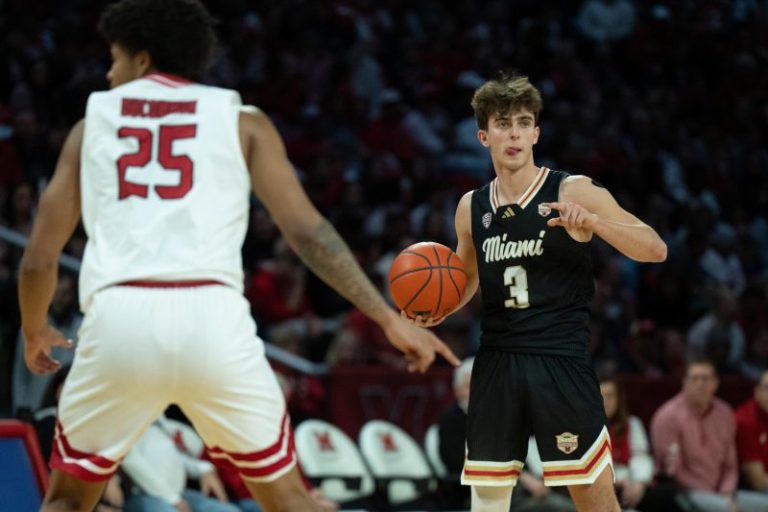
Anytime that Rick Pitino and Richard Pitino go head-to-head against each other as father and son, it’s a national storyline.

That’s once again the case on Saturday at 1:30 p.m. ET inside the Cintas Center, when No. 25 St. John’s travels to Xavier. But there’s an extra layer to it this time around, as the elder Pitino is chasing career win No. 900 against his son, a feat that would put him in sole possession of fourth place among Division I men’s basketball coaches for all-time wins.

‘I think he will do everything humanly possible to stop it,’ Rick Pitino said following the Red Storm’s 65-60 win over Seton Hall on Tuesday, Jan. 20. ‘… This is going to be a lot of fun. Great game. If we lose, I’ll leave my team in Cincinnati.’

Saturday’s game marks the first time the father-son duo will go head-to-head against each other in the Big East, after Richard Pitino was hired to lead the Musketeers this past offseason following Sean Miller leaving for Texas and the SEC. It’s the fifth overall time in their careers that they will go head-to-head.

In true father-son fashion, Richard Pitino had some fun on X (formerly Twitter) with his dad’s milestone ahead of his media availability on Friday, Jan. 23.

‘Can’t believe I’m going for my 258th win vs. my dad. What are the odds???’ Richard Pitino wrote on X on Jan. 23.

Here’s what to know about Rick Pitino’s coaching career, and the head-to-head history of the father-son duo:

Where is Rick Pitino coaching now?

Rick Pitino is in his third season at St. John’s, ‘New York’s basketball team.’ He was hired by the Johnnies in March 2023 following a three-year stint at Iona, which served as his unofficial reinsertion into college basketball after a brief stint away from it following his exit at Louisville.

Last season, Pitino led St. John’s to one of the program’s best seasons since the Lou Carnesecca era in Queens, as the Red Storm finished with a 31-5 overall record, won their first Big East tournament title since 2000 and grabbed a No. 2 seed in the NCAA Tournament.

Rick Pitino coaching career 

Here’s a stop-by-stop breakdown of Rick Pitino’s coaching career, which includes multiple college basketball programs and NBA organizations:

Head coach position unless noted otherwise

1974-1976: Hawaii (assistant)
1976-1978: Syracuse (assistant)
1978-1983: Boston University
1983-1985: New York Knicks (assistant coach) *
1985-1987: Providence
1987-1989: New York Knicks *
1989-1997: Kentucky
1997-2001: Boston Celtics *
2001-2017: Louisville
2018-2020: Panathinaikos **
2020-2023: Iona
2023-Present: St. John’s

* Denotes NBA job

** Denotes EuroLeague job

Rich Pitino coaching record

Career record: 889-316
NCAA Tournament record: 55-22
Final Four appearances: 1987, 1993, 1996, 1997, 2005, 2012*, 2013*
National championships: 1996, 2013*

* Denotes vacated by NCAA

Rick Pitino holds an 899-316 overall record across his 38 seasons as a Division I men’s basketball head coach, including a 65-23 record in three seasons at St. John’s.

The 73-year-old coach made history last season when St. John’s earned the No. 2 seed in the West Region of the NCAA Tournament, as he became the first Division I men’s basketball coach to take six different schools — the others being Boston University, Providence, Kentucky, Louisville and Iona — to March Madness.

He’s won two NCAA Tournaments in his coaching career, though his second one at Louisville was vacated by the NCAA. His first national championship came in 1996 at Kentucky.

Pitino’s 2013 NCAA Tournament ring being vacated is a major reason why he’s coaching at St. John’s today. The ex-Louisville head coach was fired for cause by the Cardinals after an FBI investigation was prompted by Adidas paying recruits to go to Louisville. Pitino, who in 2020 said he deserved to be fired at Louisville after years of saying the opposite, was charged by the NCAA with a Level II violation in 2020, citing him for ‘failing to promote an atmosphere of compliance’ during his tenure at the University of Louisville.

This was one of two scandals that the NCAA looked into during Pitino’s time with the Cardinals; the first was a sex scandal that emerged in 2015.

What is Rick Pitino’s record vs. son Richard Pitino?

Saturday’s matchup between Xavier and St. John’s will be the fifth iteration of the Pitino rivalry, with Rick holding a 3-1 lead in the all-time series.

The first head-to-head matchup between the father-son duo came in 2012, when Rick was at Louisville and Richard was at Florida International University, in which the elder Pitino’s fifth-ranked Cardinals won 79-55. The two then met two years later in 2014 during Richard’s second season at Minnesota; that game also went to Louisville.

Richard Pitino’s lone win against his father came in Rick’s final season at Iona in 2022, when New Mexico defeated the Gaels 82-77 down in Albuquerque, New Mexico, at The Pit.

The most recent Pitino clash came last season at Madison Square Garden. St. John’s RJ Luis Jr. led the Red Storm to an 85-71 win at ‘The World’s Most Famous Arena’ over Richard’s Lobos, scoring 21 points on 8-of-18 shooting and grabbing 11 rebounds.

‘It is what it is. It comes with the territory,’ Richard Pitino said during his Jan. 23 media availability. ‘There’s a lot of amazing things that come with being his son, and there’s every now-and-then 2% is a little bit annoying, but the other 98% is phenomenal.’

Here’s a game-by-game breakdown of the Pitino vs. Pitino rivarly:

2012: Louisville 79, FIU 55 (Rick Pitino leads 1-0)
2014: Louisville 81, Minnesota 68 (Rick Pitino leads 2-0)
2022: New Mexico 82, Iona 74 (Rick Pitino leads 2-1)
2024: St. John’s 85, New Mexico 71 (Rick Pitino leads 3-1)

The USA TODAY app gets you to the heart of the news — fastDownload for award-winning coverage, crosswords, audio storytelling, the eNewspaper and more.

This post appeared first on USA TODAY
The injury bug is swirling throughout the NBA and its latest victims are Phoenix Suns guards Devin Booker and Jalen Green.

Both players left during the Suns’ 110-103 loss against the Atlanta Hawks at State Farm Arena in Atlanta on Friday, Jan. 23.

The Hawks were led by Onyeka Okongwu, who tallied 25 points, while Jalen Johnson had a monster game with 23 points, 18 rebounds and was an assist shy of a triple-double.

Booker scored 31 for Phoenix. Collin Gillespie and Grayson Allen had 16 apiece.

Devin Booker injury

Booker went down with 5.4 seconds left in the third quarter as Phoenix led 91-84. He seemingly rolled his right ankle on Okongwu’s foot, which left Booker in serious pain.

He grabbed at his ankle and screamed in agony before the Suns medical staff left the bench to tend to Booker.

Booker needed assistance from Gillespie and the medical staff to get off of the floor and he limped back to the locker room and did not return to the game.

Booker finished with 31 points on 12-of-21 shooting, including 5-of-9 (55%) on 3-point field goals, in 28 minutes.

Jalen Green injury

Green has missed the majority of the Suns’ games this season due to a nagging right hamstring injury.

He’s only appeared in four games so far, most recently returning against the Los Angeles Clippers on Jan. 20 in a 116-110 victory where Green scored 12 points in 20 minutes. It was his first NBA action since Nov. 8.

Green played 4 minutes, scoring four points, in Friday’s loss at Atlanta. He left the game early in what was reported to be a precautionary move due to right hamstring tightness.

Green drove to the basket and scored a layup as the Suns trailed 23-22 with 2:21 remaining in the first quarter. He went back to the bench and eventually the locker room, following a Hawks timeout after Green’s basket.

Suns injury updates

Suns coach Jordan Ott spoke to reporters about the injuries after the game.

Per Duane Rankin of the Arizona Republic, part of the USA TODAY Network, Booker left the locker room on crutches.

This post appeared first on USA TODAY
College Football Playoff expansion isn’t about double the teams, it’s about double the money.

We’re going about this the wrong way, staring at the glam instead of the guts. 

College football doesn’t have a playoff problem. College football has a player movement problem.

Yet the solution from all involved is as daring as it is dumb: Throw more money at it. 

The Big Ten wants a 24-team College Football Playoff format, and the SEC, Big 12 and ACC want 16. The CFP officially stayed at 12 teams for 2026 Friday because the SEC and Big Ten, at this point, can’t agree the sun sets in the West.

The idea of CFP change didn’t quickly evolve because university presidents decided they like the new postseason, and want more teams to experience the sheer magnitude of it all. It’s because their athletic departments are desperate for money in the new player empowerment era.

These movers and shakers of higher education took nearly 150 years to agree on a four-team playoff, and 12 years later, are already debating moving to 24. Not because it works, but because of necessity.

A 12-team playoff earns an estimated $1.5 billion annually in media rights from ESPN. Double the teams, and you’ll more than likely double the price. 

Player salaries have not only taken $23 million annually in media rights money from a university’s bottom line, they’re on the verge of taking much more. Apparently, only the Big Ten sees this. 

There’s no other reason the Big Ten, which had to be dragged kicking and screaming into the original four-team CFP, is digging in on 24 teams. Who would take a playoff that already has obvious growth flaws just two years into moving to 12 teams, and want to double the entries? 

Buy IU championship books, prints

The same person who tried to sell 10% of the Big Ten’s media rights to capital investors for $2.4 billion. You may not like Big Ten commissioner Tony Petitti’s business chops, but at least he’s stepping into the box and taking swings. 

At least he sees the employee train barreling down the track, and knows it’s time to do something. Because once players become employees — once the only salve to free player movement is enacted and players begin working off multi-year, unbreakable contracts — universities will be sharing much more than $23 million annually. 

Call it what you want. You say 1099 individual contractors, I say collective bargaining. No matter how you swing it, you’re still negotiating with players for a significantly larger piece of the media rights pie in exchange for multi-year deals. 

The Big Ten presidents understand this, and have given Petitti leeway to find new revenue streams. So he’s taking Ruthian swings.

Do you really think Petitti believes the sixth or seventh (or more) Big Ten or SEC team in a 24-team playoff is good for the health of the game? Of course not. 

It is, however, good for the financial bottom line of every university in the Big Ten. He’s gambling — to a larger extent than the SEC, Big 12 and ACC — that college football is bulletproof. 

No matter how you change, reformat or tweak it, fans can’t get enough. More to the point: Media companies (legacy and streaming) can’t pay enough.

Indiana and Miami just played a national championship game that drew an average of 30.1 million viewers. At one point in the game, the high-water mark was 33 million.

College football is second only to the NFL in live television viewership numbers, and is wildly undervalued. The NBA in 2024 signed an 11-year deal worth $76 billion from ESPN/ABC, NBC and Amazon Prime, and its television numbers pale in comparison to college football.

The Big Ten presidents and Petitti see the fatted calf, and want it. That doesn’t mean the SEC, Big 12 and ACC don’t also, it just means they haven’t reached that point of desperation. 

Because if the Big 12 and ACC were to agree with the Big Ten and want a move to 24 teams in the playoff, the SEC would go along. The presidents of the SEC and commissioner Greg Sankey can threaten to have their own playoff, but they won’t be the single reason college football isn’t whole.

Now, the rub: The CFP actually feels right at 12 teams. But get rid of the freebies for the Group of Six, and give them the same access as Notre Dame. If you’re ranked in the top 12, you’re in.  

Moving to 16 teams eliminates the reward of a first-round bye, further diminishing the regular season. Moving to 24 teams likely means a clunky first round of eight byes, presumably the top eight teams.

It also includes four automatic bids for each of the Power conferences. In 2025, that would’ve moved USC, Virginia, SMU, Pittsburgh, BYU, Utah and Houston to the CFP. 

Woof. 

Hey, somebody has to take big swings to fix the looming player movement problem.

Even if it’s as daring as it is dumb.

This post appeared first on USA TODAY
Ryan Wedding, a former Canadian Olympic snowboarder and alleged cocaine kingpin who FBI Director Kash Patel has compared to Pablo Escobar, was arrested on Friday, Jan. 23 after a ‘massive’ international manhunt. He was wanted on multiple murder and money laundering charges introduced over the past two years in connection to drug trafficking into the United States.

Wedding was flown to the United States, according to Attorney General Pam Bondi, ‘where he will face justice.’ The 44-year-old is expected to remain in custody during the weekend before an initial court appearance Monday morning, an FBI official said during a news conference Friday at Ontario International Airport in Southern California announcing Wedding’s arrest.

Law enforcement had been searching for Wedding for years due to his alleged ties to Mexico’s Sinaloa drug cartel, and his dark turn from world-class Olympic athlete to notorious fugitive and alleged drug dealer appears to have occurred long ago.

‘He went from an Olympic snowboarder to the largest narco-trafficker in modern times,’ Patel said during the news conference.

Here’s more on Wedding’s transformation from Olympic snowboarder to international drug dealer, including the charges he’s facing from federal authorities and details on what eventually led to his capture on Jan. 23:

What charges does Ryan Wedding face?

Wedding, along with 15 co-conspirators, was charged with eight felonies in October 2024 in a superseding indictment brought by the U.S. Department of Justice for allegedly ‘running and participating in a transnational drug trafficking operation that shipped hundreds of kilograms of cocaine, from Colombia, through Mexico and Southern California, to Canada and other locations in the United States, and whose leaders orchestrated multiple murders in furtherance of these drug crimes.’

Wedding officially faced two counts of conspiracy to distribute controlled substances, one count of conspiracy to export cocaine, one count of leading a continuing criminal enterprise, three counts of murder in connection with a continuing criminal enterprise and drug crime, and one count of attempt to commit murder in connection with a continuing criminal enterprise and drug crime.

Wedding was also charged in the original indictment with running a continuing criminal enterprise, murder, and conspiring to possess, distribute and export cocaine.

Wedding and a co-conspirator are specifically charged with directing the Nov. 20, 2023 drug-related murders of two members of a family in Ontario, Canada, as well as ordering the murder of another victim in Canada on May 18, 2024, over a drug debt, according to the Justice Department. Wedding’s most recent indictment included allegedly ordering the murder of an associate in Colombia in January 2025.

‘Ryan Wedding tormented several people and several families that will never be the same,’ Akil Davis, the assistant director of the FBI’s Los Angeles Field Office, said on Friday.

Ryan Wedding FBI most wanted

Wedding was added to the FBI’s ’10 Most Wanted Fugitives’ list in March 2025. There was initially a $10 million reward for information that led to the arrest and/or conviction of Wedding offered by the U.S. Department of State’s Bureau of International Narcotics and Law Enforcement Affairs. It was subsequently increased to $15 million in November by the U.S. Department of State.

Where was Ryan Wedding arrested?

Wedding was arrested on Thursday night, Jan. 22 in Mexico City, Patel said on Friday. He did not offer further details about how Wedding was apprehended or whether anybody received the $15 million reward, citing the need to ‘maximize operational security.’

Los Angeles was considered the hub of Wedding’s drug distribution network by law enforcement officials. But Wedding was long believed to be hiding in Mexico under the protection of the Sinaloa drug cartel, the organization allegedly tied to his drug trafficking operation. Previous Department of Justice indictments referred to him as a Canadian citizen living in Mexico.

Bondi, in her social media post announcing Wedding’s arrest on Jan. 23, thanked U.S. Ambassador to Mexico Ron Johnson and Mexican authorities for assisting in the case. She also noted Wedding had been flown to the United States to face criminal charges.

Ryan Wedding motorcycles seized

Has Ryan Wedding been arrested before?

Yes.

Wedding was arrested in June 2008 and accused of conspiring to possess with the intent to distribute cocaine. An affidavit in the case detailed how Wedding and associates traveled from Canada to San Diego as part of a drug trafficking organization based in Vancouver, according to CNN. But the drug deal was a sting and FBI agents arrested Wedding and two others, while investigators found $100,000 in cash in their hotel room.

Wedding was found guilty in November 2009 and sentenced to four years in prison in 2010. He was released from prison in December 2011, CNN reported.

Ryan Wedding, the Olympic snowboarder

Wedding, a Thunder Bay, Ontario native, first appeared on the Canadian national snowboarding team in 1997 and appeared in events around the world during the next five years, culminating with his appearance at the 2002 Olympics in Salt Lake City. Wedding finished 24th in the parallel giant slalom snowboarding event at those Winter Games and his competitive career ended shortly thereafter.

Wedding then enrolled at Simon Fraser University and moved to Vancouver, according to Rolling Stone. The outlet also reported Wedding took a job as a bouncer at a club in Vancouver during that time and it eventually introduced him to the drug underworld in which he allegedly became a major player.

This post appeared first on USA TODAY