MILAN — It’s Monday, Feb. 16 at the 2026 Winter Olympics and we’re underway at the Milano Cortina Games.
Medals will be presented in pairs figure skating, short track speed skating, men’s giant slalom, women’s monobob, men’s super team ski jumping and women’s big air freestyle skiing.
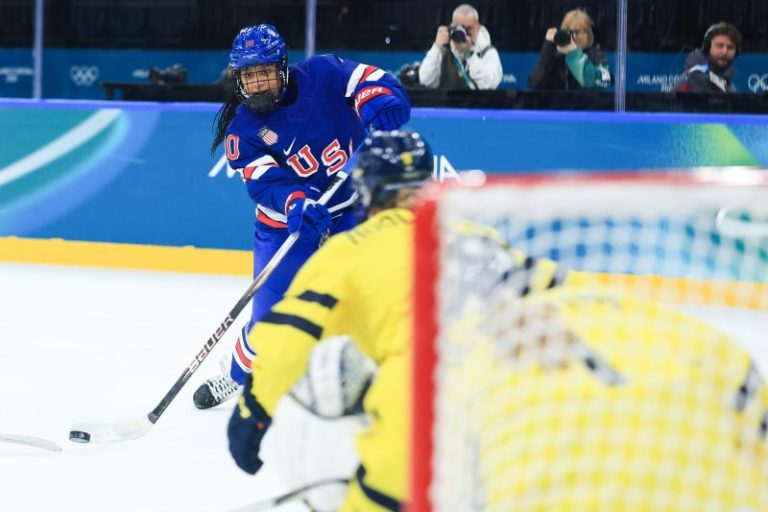
At the Milano Santagiulia Ice Hockey Arena, the women’s ice hockey competition will determine which teams will play for gold. Team USA – which has outscored opponents 26-1 through five games – plays against Sweden in the first semifinal game at 10:40 a.m. ET.
USA TODAY Sports has a team of more than a dozen journalists on the ground in Italy to bring you behind the scenes with Team USA and keep you up to date with every medal win, big moment and triumphant finish. Get our Chasing Gold newsletter in your inbox every morning and join our WhatsApp channel to get the latest updates right in your texts.
Americans win gold and bronze in monobob
CORTINA D’AMPEZZO, Italy — Elana Meyers Taylor and Kaillie Armbruster Humphries are Olympic medalists once again.
The queens of bobsled finished first and third in the women’s monobob event Monday, Feb. 16 at the Cortina Sliding Center.
It was the first gold medal in Meyers Taylor’s legendary career, and her sixth overall, tying Bonnie Blair for most medals by an American woman in Winter Olympics history. She won her first Olympic medal back in 2010 in Vancover.
Armbruster Humphries has now collected five medals from five Olympics, including the gold medal in monobob for Team USA at the 2022 Winter Games in Beijing. – Payton Titus
This double medal performance marks just the second time in these Olympics that the U.S. has put two people on the podium. The other event was on Valentine’s Day, February 14, when the United States saw Jaelin Kauf and Liz Lemley win silver and bronze in women’s dual moguls.
Eileen Gu earns silver medal in big air
All Eileen Gu does is medal.
Even if this one is not gold. Gu won her second silver medal of these Games in the women’s big air final Monday in a competition that was delayed 75 minutes due to heavy snow.
Canada’s Megan Oldham captured gold and added to her hardware showing here after she took bronze in the slopestyle contest last week. Flora Tabenelli of Italy contributed to an exciting Olympics for the host country by claiming bronze.
Gu landed her first jump but struggled on the second of three (the top two scores are combined). Her final jump moved her temporarily into second place.
Oldham’s first two jumps were good enough for gold and she still went for a massive jump on what was her victory lap. She didn’t land it but still celebrated as the big air Olympic champion. – Christopher Bumbaca
Switzerland withdraws from big air
Both of Switzerland’s skiers in the women’s big air final withdrew from injuries suffered via falls during warmups. Anouk Andraska injured her wrist, while Mathilde Gremaud – the gold-medalist in the slopestyle event last week – injured her hip, according to the Swiss Ski Association. Further medical examinations are underway, Swiss Ski said. Gremaud qualified third for finals after winning bronze in the event four years ago. Andraska was 12th (of 12).
That left 10 competitors in the final field. No Americans qualified for it. – Christopher Bumbaca
Weather delay for women’s freeski big air final
The women’s freeski big air final set to begin at 1:30 p.m. ET has been delayed due to weather conditions in Livigno, Italy at the moment. The event won’t start until 3 p.m. at the earliest, according to multiple reports.
The women’s freeski big air features American-born Eileen Gu, the defending Olympic gold medalist in this event who is representing China again at the 2026 Winter Olympics.
Bobsled: US women in medal hunt entering final run
CORTINA D’AMPEZZO, Italy — The U.S. women are in good position to win multiple medals again in monobob.
Elana Meyers Taylor and Kaillie Armbruster Humphries are both within a quarter second of Germany’s Laura Nolte heading into the final run of the women’s solo bobsled event. The Americans had identical times of 59.08 seconds in the third run, a track record.
Meyers Taylor is now 0.15 seconds behind Nolte with a combined time of 2:58.42. Armbruster Humphries is 0.24 seconds back with a combined time of 2:58.51. Kaysha Love remains in fifth place, 0.31 seconds out of third place with a time of 2:59.22.
Armbruster Humphries and Meyers Taylor went 1-2 in monobob in Beijing, when the event made its Olympic debut.
The fourth and final run is later Monday night. — Nancy Armour
Women’s hockey: Team USA advances to gold medal game
The Americans have advanced to the gold medal game in women’s ice hockey, closing out a commanding 5-0 win over Sweden in the semifinals on Monday. Team USA will play either Canada or Switzerland on Thursday for the Olympic gold medal.
It was the U.S. team’s fifth-consecutive shutout, which is an Olympic record. The Americans broke open the game late in the second period with three goals on three-consecutive shots. They’ve now out-scored their opponents, 31-1, during the Milan Cortina Games.
Team USA blows open women’s hockey semifinal vs. Sweden
The United States women’s ice hockey finally found itself locked in a tight game after the first period of its semifinal game against Sweden. But the Americans have eliminated any drama entering the final 20 minutes.
Team USA has blown open this game, taking a 5-0 lead into the third period after scoring three times in less than three minutes late in the second period. Abbey Murphy, Kendall Coyne and Hayley Scamurra netted goals in succession to secure the commanding lead and a likely spot in the Olympic gold medal game.
Taylor Heise started the Team USA scoring onslaught more than nine minutes into the second period when she scored on a 2-on-1 breakout and gave the Americans a 2-0 cushion.
Skier, skater show amazing agility crossing finish line backwards
In the Winter Olympics, athletes often must display the same skills while going forward and backward. In figure skating, ice hockey and snowboarding, for example.
But there have been times during the Milano Cortina Winter Games when athletes have gone out of control and turned completely around when they weren’t supposed to. And the moments have been magical.
Japanese freestyle skier Ikuma Horishima actually went on to win a silver medal in dual moguls on Sunday.
Also, Italian speed skater Pietro Sighel crossed the finish line in backwards in Cortina, not once but twice.
Unexpected surprises like these definitely have us looking … forward to more as the Winter Games conclude.
Brennan: Olympic superstars face increasing mental health challenges
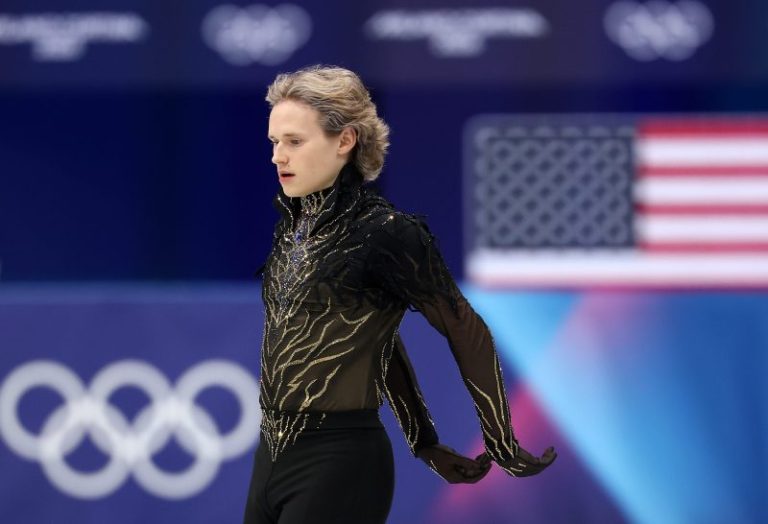
The comparisons were immediate, undeniable and haunting. When Ilia Malinin shockingly stumbled across the ice in his long program Friday night at the Winter Olympic Games, who didn’t think of Simone Biles battling the ‘twisties’ and withdrawing from the gymnastics team competition four and a half years earlier at the 2021 Tokyo Summer Olympics, especially with Biles herself in the arena watching?
Both were high-profile athletes carrying the burden of great expectations for themselves, their families, their teammates and their nation. Both then found themselves dealing with, and reeling from, the awfulness that exists on social media, even as they rely on it to tell their stories, please their sponsors and bring fans along for the ride.
With a single Instagram post Monday, Malinin has already ensured that a high-profile conversation about mental health will command center stage during the second week of these Games.
Eileen Gu calls Olympic practice schedule ‘unfair’
Normally, China’s Eileen Gu said, the International Ski Federation – the governing body that oversees Olympic free skiing and snowboarding – is an accommodating organization.
Except in this case.
As Gu looks to repeat as the Olympic gold medalist in the women’s big air event (the finals begin at 1:30 p.m. ET) and go 5-for-5 in medals at her second Olympics, she is a tad perturbed by the schedule that only she has to confront.
Making big air finals prevented Gu from practicing during the allotted three-hour training session allowed for free skiers in the halfpipe on the other side of Livigno Snow Park.
‘Which is really unfair, and difficult for me to deal with,’ Gu said after qualifying Saturday.
Gu − the only athlete in these Olympics to compete in halfpipe, slopestyle and big air − petitioned to train with snowboarders during their training last week, or to at least have an extra hour at another time. No dice, though. − Chris Bumbaca
How to watch US women’s hockey vs. Sweden in semifinals
The U.S. women’s national hockey team is one win away from the gold medal game at the 2026 Winter Olympics. Sweden stands in the way and is looking to player spoiler yet again.
If you’re unable to watch, USA TODAY Sports will follow all the action with a live blog.
If you do want to watch, here’s what you need to know:
Date: Monday, Feb. 16
Time: 10:40 a.m. ET
Location: Milano Santagiulia Ice Hockey Arena
TV channel: USA Network
Streaming options: NBCOlympics.com | NBC Olympic App | Peacock
Swiss skier wins gold in men’s slalom
Loic Meillard of Switzerland won the gold medal in the men’s slalom while Fabio Ostrein of Austria took the silver and Henrik Kristoffersen of Norway won the bronze on Monday.
Meillard’s combined time from the two runs was 1:53.61, just .35 ahead of Ostrein’s combined time 1:53.96 at Stelvio Ski Centre in Bormio.
The Alpine skiing event ended with as much disappointment as exhilaration.
Skiing last among the top 30 racers, Atle Lie McGrath of Norway was in position to win gold after posting the best time during the first run. But he straddled a gate on his second run, resulting in him being disqualified.
River Radamus, the only American in the 96-skier field, failed to complete his first run and so did not qualify for a second run. He was one of 51 skiers whose day ended after the first run with a DNF (Did Not Finish). The first run took place during a snowstorm but the conditions improved before the second run. — Josh Peter
Tkachuk brothers ‘a blast’ at Olympic hockey tournament
Described by their Olympics coach as beasts on the ice, USA hockey teammates vouch Brady and Matthew Tkachuk are an absolute hoot to be around.
‘They’re every bit as entertaining as you guys would think,’ Dylan Larkins said. ‘They’re unbelievable team guys. It’s a blast, and you got to see it at the Four Nations.’
The brothers drew headlines at the 4 Nations Face-Off tournament in 2025 for each picking a fight with a Canadian player, but they have, wisely, kept away from fisticuffs at the 2026 Winter Olympics, as fighting is illegal in international hockey.
They’ve limited their hands to handling hockey sticks, with Matthew racking up five assists through three games and Brady coming through with two goals an an assist. − Helene St. James
Top plastic surgeon fuels ‘Penisgate’ controversy
A plastic surgeon renowned for penis-enlarging procedures, including the injection of hyaluronic acid, says he provided the service last month to a ski jumper.
The assertion comes with the ski jumping competition at the 2026 Winter Olympics under an unusual spotlight.
Reports from a German media outlet prompted speculation that ski jumpers are getting genital-enlarging injections to increase the surface area of their suits, which would increase the distance of their jumps. The International Ski and Snowboard Federation called it ‘wild rumor.’
‘Regarding the news in question, I did in fact treat an athlete from that sport, whose name and nationality I will obviously not disclose, nor whether he is participating in these Olympics,’ Alessandro Littara told USA TODAY Sports in an email. ‘However, I can say that I treated him last month and used a generous dose of hyaluronic acid.’ − Josh Peter
USA men vying for podium in two-man bobsled
The U.S. men are within striking distance of the podium in two-man bobsled.
Frankie del Duca and Joshua Williamson are in fourth place after the first two runs, 1.34 seconds behind Germany’s Johannes Lochner and Georg Fleischhauer. But they’re only 0.10 seconds out of third going into the final two runs on Tuesday, Feb. 17.
Germany has the top three sleds at the halfway point, with Francesco Friedrich and Alexander Schuller second and Adam Ammour and Alexander Schaller third. ― Nancy Armour
Netherlands continues short-track speed skating dominance
The orange wave continues in short track speed skating.Dutch skater Xandra Velzeboer won gold in the women’s 1000m, now the fourth short-track gold medal in a dominant showing for the Netherlands in Milano.It was a tight race along with Canada’s Courtney Sarault and Gilli Kim of Korea, but Velzeboer fended off a late surge to keep her first place spot. Sarault took silver and Kim won bronze.It’s the second gold medal for Velzeboer after she won the women’s 500m. The other gold medal wins for her country include Jens van ‘T Wout in the men’s 1000m and 1500m. It’s a perfect four-for-four start in individual short-track events. ― Jordan Mendoza
Skiers struggling in men’s slalom
Fewer than half of the 96 skiers in the men’s slalom completed their first run in tough conditions on Monday.
American River Radamus was one of 51 skiers whose day ended with a DNF: Did Not Finish. That disqualified him and the others for a second and final run.
But some skiers navigated the course at Stelvio Ski Centre in Bormio through a snowstorm with more skill than others.
Atle Lie McGrath of Norway had the top run with a time of 56:14, and Loic Meillard of Switzerland is second and Fabio Gstreinf Austria is third headed into the second run. ― Josh Peter
Kristen Santos-Griswold doesn’t advance in 1000m
The U.S. won’t be in the semifinals of the women’s short-track speed skating 1000m after Kristen Santos-Griswold narrowly missed out on advancing.
In the third heat of the quarterfinals, Santos-Griswold held the lead for a few laps in the middle of the race and looked like she could finish first. But Netherlands’ Xandra Velzeboer overtook the lead on the sixth of eight laps, and on the next one, Gilli Kim moved in second.
Only the top two would officially advance, and Santos-Griswold couldn’t keep the pace and finished third. She had a time of 1:29:102, just .34 seconds behind Kim. ― Jordan Mendoza
Ilia Malinin makes first public statement since devastating showing
Ilia Malinin made his first public statement since his devastating finish in the men’s singles figure skating competition at the 2026 Winter Olympics.
The 21-year-old posted on Instagram on Monday, with a statement on mental health. The post was accompanied with a video of Malinin celebrating his victories and him sitting with his hands on his head.
‘On the world’s biggest stage, those who appear the strongest may still be fighting invisible battles on the inside. Even your happiest memories can end up tainted by the noise,’ he wrote. ‘Vile online hatred attacks the mind and fear lures it into the darkness, no matter how hard you try to stay sane through the endless insurmountable pressure. It all builds up as these moments flash before your eyes, resulting in an inevitable crash. This is that version of the story.’ ― Jordan Mendoza
Where to watch Olympics today
Watch all 2026 Winter Olympics events on NBC and Peacock.
Watch the Winter Olympics on Peacock
Olympics schedule today
All times Eastern and accurate as of Sunday, Feb. 15, 2026, at 6:59 p.m.
3 a.m. – Nordic Combined: Large Hill Official Training 3, Predazzo Ski Jumping Stadium (Val di Fiemme)
3:05 a.m. – Curling: Women’s Round Robin – SWE vs. SUI, Cortina Curling Olympic Stadium (Cortina d’Ampezzo)
3:05 a.m. – Curling: Women’s Round Robin – CHN vs. CAN, Cortina Curling Olympic Stadium (Cortina d’Ampezzo)
3:05 a.m. – Curling: Women’s Round Robin – DEN vs. GBR, Cortina Curling Olympic Stadium (Cortina d’Ampezzo)
4 a.m. – Alpine Skiing: Men’s Giant Slalom Run 1 & 2 – medal event, Stelvio Ski Centre (Bormio, Valtellina)
4 a.m. – Bobsleigh: 2-Man Heat 1 & 2, Cortina Sliding Centre (Cortina d’Ampezzo)
4:30 a.m. – Snowboard: Women’s Slopestyle Qualification, Livigno Snow Park (Livigno, Valtellina)
5 a.m. – Short Track: Women’s 1000m, Men’s 1500m Heats, Semifinals, Finals (Medal Events), Milano Ice Skating Arena (Milan)
8 a.m. – Snowboard: Men’s Slopestyle Qualification, Livigno Snow Park (Livigno, Valtellina)
8:05 p.m. – Curling: Men’s Round Robin – GBR vs. NOR, Cortina Curling Olympic Stadium (Cortina d’Ampezzo)
8:05 p.m. – Curling: Men’s Round Robin – CZA vs. CAN, Cortina Curling Olympic Stadium (Cortina d’Ampezzo)
8:05 p.m. – Curling: Men’s Round Robin – SWE vs. GER, Cortina Curling Olympic Stadium (Cortina d’Ampezzo)
8:05 p.m. – Curling: Men’s Round Robin – ITA vs. CHN, Cortina Curling Olympic Stadium (Cortina d’Ampezzo)
10:40 a.m. – Ice Hockey: Women’s Semifinals – USA vs. SWE, Milano Santagiulia Ice Hockey Arena
12 p.m. – Ski Jumping: Men’s Super Team – 1st Round, 2nd Round, Final – medal event, Predazzo Ski Jumping Stadium (Val di Fiemme)
1 p.m. – Bobsleigh: Women’s Monobob Heat 3 & 4 – medal event, Cortina Sliding Centre (Cortina d’Ampezzo)
1:05 p.m. – Curling: Women’s Round Robin – USA vs. ITA, Cortina Curling Olympic Stadium (Cortina d’Ampezzo)
1:05 p.m. – Curling: Women’s Round Robin – KOR vs. CHN, Cortina Curling Olympic Stadium (Cortina d’Ampezzo)
1:05 p.m. – Curling: Women’s Round Robin – JPN vs. CAN, Cortina Curling Olympic Stadium (Cortina d’Ampezzo)
1:30 p.m. – Freestyle Skiing: Women’s Freeski Big Air Final – medal event, Livigno Snow Park (Livigno, Valtellina)
2 p.m. – Figure Skating: Pair Skating – Free Skating – medal event, Milano Ice Skating Arena (Milan)
2:10 p.m. – Ice Hockey: Women’s Semifinals – CAN vs. SUI, Milano Santagiulia Ice Hockey Arena
Meet Team USA 2026: Get to know the athletes behind the games
Olympics medal count
Following competition on Sunday, Feb. 15, Norway leads the medal standings with 26 total medals (12 gold, seven silver, seven bronze). Host nation Italy has 22 medals (including eight gold), followed by Japan and the United States with 17 apiece. France and Germany have won 15 medals apiece.