Archive

2026

Browsing

CORTINA D’AMPEZZO, Italy — Elana Meyers Taylor’s boys are too young to realize that mom is an Olympic champion. Kaillie Armbruster Humphries’ son just wanted to play in the snow around the medals podium where his mom had just stood.

But every woman who’s ever tried to juggle motherhood and a career, who’s felt as if she’s giving everything she’s got and more and still coming up short, they’ll know. And Meyers Taylor and Armbruster Humphries hope they’ll see a little of themselves in the two women on that Olympic podium.

“I hope it shows that just because you’re a mom doesn’t mean you have to stop living your dreams,” said Meyers Taylor, who finally got the Olympic gold medal she has so long sought by winning the monobob on Monday, Feb. 16, finishing ahead of Germany’s Laura Nolte and Armbruster Humphries.

The standards for any woman are impossible. Add a family, in whatever fashion it is, and it gets exponentially more difficult. Add getting older, in a society that considers women over the hill before they’re eligible to run for president, and you might as well be scaling the mountain on which the Milano Cortina bobsled track is located.

Meyers Taylor and Armbruster Humphries have felt that. Have felt all that.

Two nights ago was the first time Armbruster Humphries had been apart from her son since he was born and it gutted her. She knew she needed rest – she is competing in the Olympics, after all – and she wouldn’t get it with a toddler who still wakes up in the middle of the night.

That didn’t make it any easier.

“My husband is here, my parents are here, my in-laws are here. So I knew he was in really good hands,” Armbruster Humphries said. “So for me, it’s compartmentalizing probably more than anything. Recognizing that mom guilt is a thing and it existed, but that I needed to do it in order to be my best.”

Meyers Taylor and Armbruster Humphries are the first to acknowledge they are not doing it alone. They both have husbands who are supportive and, as former bobsledders, understand the grind. They have families who pitch in.

The U.S. Olympic and Paralympic Committee provides resources, financial and otherwise, for its athletes who are mothers, which isn’t something a lot of women can say.

But no one else can quiet the voice in her head that every working mother has. No one else can weigh the conflicting choices and decide what sacrifices are acceptable. No one else can tell them it’s OK when priorities change or give them permission to put themselves first.

“This medal is also for all those moms who weren’t necessarily able to live their dreams, but their kids are now their dreams,” Meyers Taylor said. “Because those people keep me grounded. Those people kept me going. And those people are the ones who reached out to me when things got hard and encouraged me to keep going.”

And as they stood atop the medals podium with their little boys watching, Meyers Taylor and Armbruster Humphries hoped they gave other moms that same type of encouragement.

It doesn’t matter if they are chasing Olympic medals or just trying to get through the day. These two badass women understand and empathize with the struggles because they face them, too.

“I hope that it inspires other people to go out and chase their dreams, whatever it may be,” Armbruster Humphries said. “I grew up in the sport when, if you have kids, once you get to 40, it’s all downhill. And Elana and I get to be proof that that’s not true.

“It might look different then when you’re 20, but it doesn’t mean that you can’t stand on top of the podium. It doesn’t mean you can’t go out there and achieve your dreams.”

It’s not easy, this juggling act. But for everyone who does it, those Olympic medals around the necks of Meyers Taylor and Armbruster Humphries are for you, too.

Follow USA TODAY Sports columnist Nancy Armour on social media @nrarmour.

This post appeared first on USA TODAY

The playoff picture is coming into view across NCAA women’s hockey as the final week of the season approaches. 

It also means the top programs in the nation are in their final week without Olympians on their rosters. There are only two games left in Milan, Italy, with Team USA and Canada facing off in Thursday’s gold medal game, while Sweden and Switzerland face off for bronze.

This month, with many stars overseas, some players have also stepped forward individually, bolstering their 2026 PWHL Draft status.

This week, Princeton was the biggest faller, while several programs took small steps forward.

Here’s a look at the top 10 NCAA women’s hockey programs this week:

Women’s college hockey power rankings

1. Wisconsin (WCHA)

Wisconsin got an unexpected boost this weekend with the return of fifth-year forward Marianne Picard, who came back in time to finish her career with the Badgers from a leg injury that originally looked like it would end her season. She collided with a goal post and missed seven games. Lacey Eden, meanwhile, continued to climb the national scoring charts with a four-point weekend as the Badgers swept Minnesota State. Eden now sits only one point behind Abbey Murphy, who’s at the Olympics.

2. Ohio State (WCHA)

Ohio State had an impressive weekend, beating Minnesota 4-2 and 3-1. Rookie Maxine Cimoroni had two goals and two assists, while captain Jocelyn Amos had another strong weekend for the Buckeyes, helping to power their two-way game. Goaltender Hailey MacLeod has looked better facing more shots in recent weeks, but Ohio State’s crease remains its biggest question mark heading to the playoffs.

3. Minnesota (WCHA)

A pair of hard-fought losses to Ohio State were difficult for the Gophers. The return of Abbey Murphy, Nelli Laitinen, Josefin Bouveng, and Tereza Plosova from the Olympic Games can’t come soon enough for the Gophers, which managed only two goals this past weekend. Chloe Primerano scored her ninth goal and 24th point, tying her for 11th in the NCAA among defenders in scoring.

4. Quinnipiac (ECAC)

Quinnipiac beat Brown 5-2 and Yale 4-3 in overtime. As she has all season, Kahlen Lamarche continued to produce, with three goals and four points combined in those games. She now has 35 goals in 34 games this season, which has her tied for second among the NCAA’s top goal-scorers. With Team Canada looking for an influx of youth, Lamarche has thrust herself into that conversation this season.

5. Penn State (AHA)

Losing 3-2 in overtime to RIT to open its weekend won’t instill confidence in Penn State as a nationally ranked team in anyone. They remain so high because of a weak schedule. This is a significantly different team without Tessa Janecke, Matilde Fantin and Nicole Hall, who all advanced to the Olympic quarterfinals, with Janecke and Hall set to play for a medal.

5. Northeastern (Hockey East)

It was like another Beanpot weekend with Northeastern playing two other Boston schools. They beat Boston University, but were then shut out by Boston College. Northeastern’s youth have had to do a lot of lifting up front recently, and it’s come with some bumps. Defender Jules Constantinople is climbing the PWHL draft charts with her second-half play.

7. Yale (ECAC)

An overtime loss to Quinnipiac and a shutout win over Princeton made this another good weekend for Yale, which is peaking at the right time. They did squander a two-goal lead in the final 1:02 against Quinnipiac, but they carried that lead for most of the match against the Bobcats and also shut down one of the top lines in the nation with Princeton.

8. UConn (Hockey East)

UConn handled Boston University and New Hampshire with ease this weekend. With Tia Chan in net, the Huskies can beat anyone on any given night. While it could be a concern with other programs, UConn doesn’t have one player it relies on offensively. They certainly have players who score more than others and help drive possession, but this team thrives when the attack is spread out.

9. Cornell (ECAC)

Cornell beat St. Lawrence in overtime and Clarkson this past weekend. It was a good test for Cornell, which won a pair of hard-fought one-goal games. Annelies Bergmann continues to be one of the best goaltenders in college hockey, making 64 saves over the weekend. She has a 1.83 goals-against average, .931 save percentage and seven shutouts through 30 games.

10. Princeton (ECAC)

Something didn’t click for Princeton this past weekend. They opened their weekend with a shutout loss to Yale, then had Brown take them to overtime. Issy Wunder is a superstar in NCAA women’s hockey and a top prospect for the 2026 PWHL Draft, but she can’t be Princeton’s only weapon if this team wants to win.

This post appeared first on USA TODAY

LIVIGNO, Italy — When Team USA snowboarder Jess Perlmutter gets finished chasing medals in Italy, she’ll have homework to do.

A lot of homework.

“I had like 42 assignments missing, like last week,” Perlmutter said with a laugh. “Which is really bad. I’m usually a good student and only have like a few missing.”

Perlmutter and teammate Lily Dhawornvej will compete Feb. 17 in a final at the 2026 Winter Olympics. Each qualified Feb. 15 by finishing the top 12 of the women’s slopestyle qualifying at Livigno Sports Park, which was a heck of an achievement considering this fact:

Both are only 16 years old.

In snowboarding and freestyle skiing, that’s not too young to represent the United States in an Olympics. And particularly these Olympics. Some of brightest rising stars in Livigno have been high school aged kids. On the men’s side, 17-year-old Americans Ollie Martin (big air/slopestyle) and Alessandro Barbieri (halfpipe) have each impressed.

“We’re young,” Perlmutter said, “but it’s a pretty young sport.”

Indeed. Ten of the 30 riders in the women’s slopestyle qualifying, including Perlmutter and Dhawornvej, weren’t born before 2007. Sky Remans, who competed for Belgium, won’t turn 16 until October.

Obvious question: What are these kids doing for high school?

Answer: The majority are taking online classes that offer the flexibility to complete course work on their own timeframes while competing globally.

“My schedule just got pretty busy,” said Dhawornvej, of Colorado. “I wasn’t really home that much. Online is definitely the move. … It’s pretty hard. I’m not going to lie. I’m pretty behind on a lot of my schoolwork. But I do online school, so I can snowboard and just do it online whenever I have time.”

Freestyle skier Avery Krumme, 17, reached the finals of the slopestyle at this Olympics, finishing 11th. She is a native Canadian who chose to compete for the United States, and she does “online school through my local high school,” she said.

“My teachers are really kind,” Krumme said. “They sort of let me go slow, because they understand this takes up a lot of my time and effort, and just everything goes into my skiing and training for it. So they understand. I’ll hopefully graduate this June. We’re working up to that.”

Perlmutter, who’s originally from New Jersey, attends the Killington Mountain School in Vermont, a school geared toward helping winter sports athletes “pursue excellence on the slopes and in the classroom,” reads the school’s website.

“It’s not fully online,” Perlmutter said. “I can go in there whenever I want and do school, just like a normal school. But, yeah, I just do it from remote. … Especially at this level, pretty much everyone, if they are doing school, they are doing online or a special program or something.”

And about those missing assignments?

“Honestly,” Perlmutter said, “I’ll just tell my teachers that I’m at the Olympics.”

This post appeared first on USA TODAY
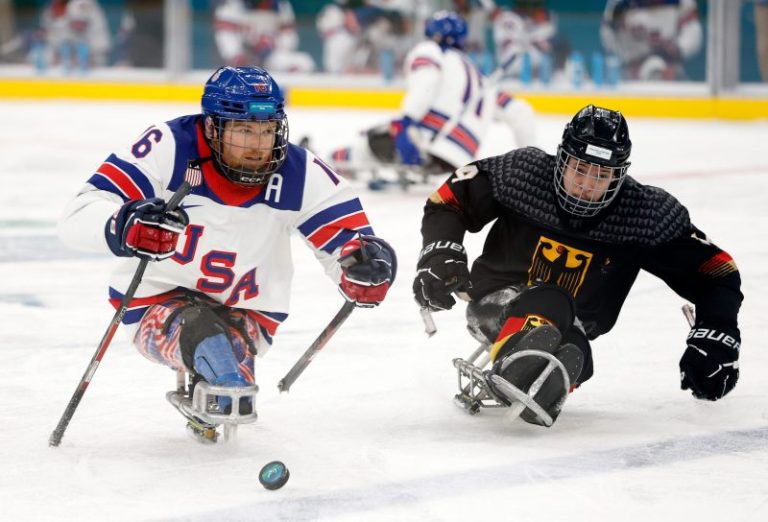
LIVIGNO, Italy — Mac Forehand’s first two jumps were so good that he could take it easy on his third and still win the evening.

Two other Americans – Troy Podmilsak and Konnor Ralph – scored well enough to advance, too, and all three are promising to come out swinging with bigger and better tricks in the final at the 2026 Winter Olympics.

Yeah, Feb. 15 was a good night for Team USA in the men’s freestyle skiing big air qualifying.

“I don’t want to jinx them,” said teammate Alex Hall, “but I think we are going to get at least one or two medals in the big air. They are riding so good. It’s so fun to watch.”

One quarter of freeski big air’s 12-man Olympic final on Feb. 17 will be comprised of Americans who’d already competed in these Games in slopestyle.

Same goes for the men’s slopestyle snowboarding qualifying final on Feb. 18. Three USA riders qualified – also on Feb. 15 – for that final. Ollie Martin, Jake Canter and Red Gerard were in the big air previously in snowboarding.

So what does slopestyle have to do with big air? That seems a popular question.

Qualifying Olympians in snowboarding and freestyle skiing are automatically added – or forced, you might also say – to compete in both slopestyle and big air. There is a systematic connection between these two events despite clear differences. Slopestyle is contested on a longer course with rails and various jumps. Big air is just one jump off an enormous ramp. It’s kind of like traditional ski jumping, except athletes perform acrobatic tricks before landing.

It is entertaining. It’s more dangerous, too.

As such, it’s generally viewed as better to have slopestyle scheduled first in an Olympics, because you aren’t risking injury as much in slopestyle, whereas an injury in big air – if it’s up first – could impact both events.

Freestyle skiing got the benefit of having slopestyle first in these Olympics, while snowboarding did not.

Hall, who won silver in freeski slopestyle earlier in these Olympics, was the lone American not to make it out of the Feb. 15 big air qualifying.

“I just love slopestyle way more, honestly,” Hall said. “… Not that one is more impressive than the other, but this is like going to war. You’ve just got to survive and do the craziest trick you can ever think of, where slopestyle is a lot about finesse and figuring out a run.”

Gerard, a former gold-medalist in snowboarding slopestyle, was critical earlier this Olympics of a format that makes him compete in both events when “I’m not a fan of big air at all,” he said. “… If I wasn’t forced to do (big air), I wouldn’t do it.”

While others haven’t voiced it as strongly, many seem to agree with Gerard and Hall. They’d lean toward a preference for slopestyle, even if they’ve performed well in big air.

“I definitely like slopestyle more,” said snowboarder Martin, who nearly medaled in big air earlier in these Olympics. “It just feels safer. You’re able to have a run going. It’s more creative.”

Canadian snowboarder Mark McMorris, a three-time bronze medalist in slopestyle, was injured during big-air training leading up to these Olympics, causing him to miss that event. He was fortunate to be able to return for slopestyle, and he has qualified for that final.

“The last two Olympics since (big air) has been added,” McMorris said, “it’s been slopestyle into big air (for snowboarding). Big air is pretty dangerous. So I definitely preferred the other way around. …

“Big air can take names. Including myself.”

With the slopestyle already out of the way in freestyle skiing, an American like Forehand said he took advantage of a bit more freedom for risks in big air.

By scoring 93.25 in his first jump and 89.75 in his second, Forehand placed first in qualifying with a 183.00 total. He is a strong contender for a medal in the big air final, and he’s not alone among Team USA.

“I’d prefer, I think, big air second, honestly,” Forehand said. “We did big air first in Beijing. I feel like you can go into big air kind of in a gung-ho attitude, like do whatever you want. You don’t have to worry about getting hurt for slopestyle.”

This post appeared first on USA TODAY
CORTINA D’AMPEZZO, Italy — Lindsey Vonn is back in the United States after she suffered a complex tibia fracture at the 2026 Winter Olympics, she announced on social media on Tuesday, Feb. 17.

‘Haven’t stood on my feet in over a week…,’ Vonn wrote in a post on X, formerly known as Twitter. ‘been in a hospital bed immobile since my race. And although I’m not yet able to stand, being back on home soil feels amazing.’

What happened to Lindsey Vonn?

Vonn hooked the fourth gate with her right arm, which sent her spinning and hurtling into the hard, packed snow. She tumbled end over end several times before coming to a stop.

‘Things just happen so quick in this sport,’ U.S. teammate Bella Wright said after the race. ‘It looked like Lindsey had incredible speed out of that turn, and she hooked her arm and it’s just over just like that.’

The three-time Olympic medalist remained prone in the snow, and she could be heard wailing in pain. The gasps and groans from fans faded into shocked silence as medics worked on her. Vonn remained on the course for approximately 13 minutes before being loaded into a helicopter.

What is Lindsey Vonn’s injury?

In an Instagram post on Feb. 9, Vonn shared the devastating news that she suffered a complex tibia fracture that will require multiple surgeries. The 41-year-old updated fans on Feb. 11 after a third surgery in Italy and included some gruseome photos of her progress. On Feb. 14, Vonn posted after her third surgery that she still has more procedures ahead of her, but was finally able to return to the United States.

‘Once I’m back I will give you more updates and info about my injury,’ Vonn wrote.

A tibia fracture is a break in the shin bone that is an emergency needing immediate treatment. ‘Your tibias are some of the strongest bones in your body. It usually takes a lot of force to break one,’ according to the Cleveland Clinic. ‘You probably won’t be able to stand, walk or put weight on your leg if you have a broken shin bone.’

A complex fracture involves multiple breaks in a bone and damaged soft tissue, according Yale Medicine. Symptoms include extreme pain, numbness and, sometimes, a bone that protrudes through the skin. Treatment involves stabilization and surgery.

Lindsey Vonn crash video

NBC broadcasts the Olympics and posted video of Vonn’s crash.

USA TODAY Sports’ Samantha Cardona-Norberg breaks down Linsdey Vonn’s crash just after it happened.

Fans went silent as soon as Vonn crash, reacting with shock, grief and later support as the helicopter lifted her into the sky. USA TODAY Sports talked to some fans after the crash .

Is Lindsey Vonn OK?

Vonn was in obvious pain after the crash, but she was moving her arms, head and neck.

About 18 minutes after the crash, the helicopter slowly began flying toward Cortina. ‘Let’s let Lindsey Vonn hear us!’ the American announcer said as the chopper flew away with her, and the crowd cheered and applauded.

Vonn’s sister Karin Kildow was at the course today for the downhill and spoke to NBC reporters during their live broadcast:

‘I mean that definitely was the last thing we wanted to see and it happened quick and when that happens, you’re just immediately hoping she’s okay. And it was scary because when you start to see the stretchers being put out, it’s not a good sign,’ Kildow said. ‘But she really … She just dared greatly and she put it all out there. So it’s really hard to see, but we just really hope she’s okay.

‘She does have all of her surgeons and her PT staff here and her doctors, so I’m sure they’ll give us a report and we’ll meet her at whatever hospital she’s at.’

Lindsey Vonn torn ACL

It was second time in as many weeks Vonn left a mountaintop on a chopper. She fully ruptured her left ACL, sustaining meniscus damage and bone bruising, in a downhill crash on Jan. 30, in the final World Cup event prior to the start of the Olympics.

Vonn is also skiing with a partial replacement of her right knee. She had dominated the sport before the crash, making the podium in all five downhill races this season and winning two of them.

Despite the latest injury, Vonn was determined to race at her fifth and final Olympics. She said her knee felt stable and strong, and she had spent the last week doing intense rehab, pool workouts, weight lifting and plyometrics. She skied both training runs, posting the third-fastest time in the second run before it was canceled because of fog and snow.

Lindsey Vonn torn ACL

Vonn is 41 and was skiing in her fifth Winter Olympics (2002, 2006, 2010, 2018, 2026). She has won three Olympic medals (1 gold, 2 bronze).

This post appeared first on USA TODAY
The Senate inched closer to striking a compromise on a Homeland Security (DHS) funding deal as the partial government shutdown entered its fourth day Tuesday.

Whether Senate Democrats and the White House can reach a deal this week while lawmakers are out of town remains an open question.

Negotiations between the Trump administration and Senate Democrats were seemingly at an impasse through much of Monday after little activity over the weekend. The White House provided a counteroffer to Democrats’ list of demands midway through last week, which they summarily rejected and, in turn, blocked attempts to fund DHS.

But that changed when Senate Minority Leader Chuck Schumer’s, D-N.Y., office announced that Senate Democrats had sent their counterproposal to the White House late Monday night. 

Senate Majority Leader John Thune, R-S.D., was wary of whether Schumer and his caucus would actually put forth a response, but remained hopeful that negotiations would continue. 

‘We’ll see if they are at all serious about actually getting a solution to this, or whether they just want to play political games with these really important agencies,’ Thune told Fox News Digital. 

He also noted that lawmakers went through the same exercise last year when Senate Democrats slow-walked negotiations during the 43-day shutdown.  

‘It’s wrong, in my view, for Democrats to use these folks as collateral in yet another harmful government shutdown,’ Thune said.

The administration wants to keep the dialogue going, a White House official told Fox News Digital.

‘The Trump administration remains interested in having good-faith conversations with Democrats,’ the White House official said.

The official noted that Senate Democrats’ refusal to extend DHS funding is affecting several key functions under the agency’s umbrella, including the Transportation Security Administration (TSA), the Federal Emergency Management Agency (FEMA), the U.S. Coast Guard and the U.S. Secret Service.

‘President Trump has been clear — he wants the government open,’ the official said.

The partial government shutdown, which went into effect over the weekend, stems from Schumer and Senate Democrats’ demands for reforms to Immigration and Customs Enforcement (ICE).

ICE operations are unlikely to be significantly affected by the lapse in DHS funding, as legislation backed by President Donald Trump allocates billions of dollars to immigration enforcement.

Both sides remain at odds over how far those changes should go. Senate Republicans have signaled willingness to cede some ground but have drawn a red line on certain demands, such as requiring ICE agents to obtain judicial warrants or prohibiting them from wearing face coverings during enforcement actions.

Senate Democrats, however, describe their 10 demands as straightforward reforms designed to ensure federal immigration agents adhere to standards similar to those governing local and state police.

‘There’s not much we need to figure out,’ Sen. Elizabeth Warren, D-Mass., told Fox News Digital. ‘Either you think ICE agents are special, and they get to own our streets with no accountability, or that ICE agents should follow the same rules as everyone else — that’s all Democrats are asking for.’

This post appeared first on FOX NEWS

The State Department’s allegation that China conducted a yield-producing nuclear test in 2020 is reigniting debate in Washington over whether the United States can continue its decades-long moratorium on nuclear weapons testing. 

U.S. officials warned that Beijing may be preparing tests in the ‘hundreds of tons’ range — a scale that underscores China’s accelerating nuclear modernization and complicates efforts to draw Beijing into arms control talks.

Under Secretary of State for Arms Control and International Security Thomas DiNanno said recently that the United States has evidence China conducted an explosive nuclear test at its Lop Nur site.

‘I can reveal that the U.S. government is aware that China has conducted nuclear explosive tests, including preparing for tests with designated yields in the hundreds of tons,’ DiNanno said during remarks at the United Nations Conference on Disarmament.

He added that ‘China conducted one such yield-producing nuclear test on June 22 of 2020.’

DiNanno also accused Beijing of using ‘decoupling’ — detonating devices in ways that dampen seismic signals — to ‘hide its activities from the world.’

China’s foreign ministry has denied the allegations, accusing Washington of politicizing nuclear issues and reiterating that Beijing maintains a voluntary moratorium on nuclear testing.

But the accusation has sharpened questions about verification, deterrence and whether the U.S. stockpile stewardship program — which relies on advanced simulations rather than live detonations — remains sufficient in an era of renewed great-power nuclear competition.

Why small nuclear tests are hard to detect

Detecting small underground nuclear tests has long been one of the thorniest problems in arms control.

Unlike the massive atmospheric detonations of the Cold War, modern nuclear tests are conducted deep underground. If a country uses so-called ‘decoupling’ techniques — detonating a device inside a large underground cavity to muffle the seismic shock — the resulting signal can be significantly reduced, making it harder to distinguish from natural seismic activity.

That vulnerability has been debated for decades in discussions over the Comprehensive Nuclear-Test-Ban Treaty, which China signed but never ratified. Even a relatively small underground detonation can provide valuable weapons data while remaining difficult to detect.

‘If you detonate a device inside a large underground cavity, you can significantly attenuate the seismic signature,’ said Chuck DeVore, chief national initiatives officer at the Texas Public Policy Foundation and a former Pentagon official. ‘That makes it much harder to detect with confidence.’

Are simulations enough?

China signed the Comprehensive Nuclear-Test-Ban Treaty in 1996 but has not ratified it, and the treaty has never entered into force. It has maintained a voluntary testing moratorium — a commitment that a yield-producing detonation would contradict.

As China expands its nuclear arsenal and major arms control frameworks falter, the Cold War principle of ‘trust but verify’ is under growing strain.

‘The arms control community should feel thoroughly discredited at this point,’ DeVore said, arguing that policymakers should not assume Western restraint will be reciprocated by Beijing.

For decades, the U.S. has relied on the Stockpile Stewardship Program — advanced computer modeling and simulations — to ensure its weapons remain reliable without explosive testing. DeVore warned that this approach may no longer be sufficient if competitors are conducting live detonations.

‘The question presupposes that we only live in a technical world,’ he told Fox News, arguing that relying solely on simulations while rivals ‘cheat at every treaty they’ve ever signed’ risks leaving the United States behind.

DeVore also pointed to what he described as a growing institutional challenge.

‘Virtually everyone who had direct experience with live testing is now retired,’ he said. ‘Rebuilding that expertise would take years.’

But not all nuclear experts agree that resuming testing is the answer.

Henry Sokolski, executive director of the Nonproliferation Policy Education Center, cautioned that a return to live detonations would be far more complex and costly than critics of the current system suggest.

‘Yield testing isn’t a magic switch,’ Sokolski said. ‘If you want meaningful reliability data, you don’t do one test — you do many.’

He noted that the United States conducted more than 1,000 nuclear tests during the Cold War, building a deep database that now underpins the program. Restarting that process, he argued, would likely require years of preparation and significant funding before yielding strategic benefits.

‘The debate isn’t pro-nuclear weapon versus anti-nuclear weapon,’ Sokolski said. ‘It’s about what’s technically necessary and what’s economical.’

A debate inside the weapons complex

Sokolski said the disagreement extends even within the U.S. nuclear weapons complex.

‘Certainly at one of our major labs that likes using calculations — that’s Livermore — they would say you’re home,’ he said, referring to confidence in advanced simulations and hydrodynamic modeling.

Others place greater weight on empirical validation and preserving the option of live testing.

The dispute, he said, is not ideological but technical — centered on confidence levels, cost and long-term strategic planning.

Allies and the credibility question

The implications extend beyond Washington and Beijing. 

Sokolski warned that the credibility of ‘extended deterrence’ — the U.S. commitment to defend allies under its nuclear umbrella — could come under strain if doubts grow about American resolve or capability.

‘Do they think you’re going to come to their defense?’ Sokolski said. ‘If they don’t, it doesn’t matter how reliable your weapons are, extended deterrence isn’t going to work very well.’

Allies such as Japan and South Korea long have relied on U.S. nuclear guarantees rather than pursuing independent arsenals. Any perception that the balance is shifting could complicate regional stability and long-standing nonproliferation efforts.

The policy crossroads

For now, U.S. lab directors continue to certify that the American arsenal remains safe, secure and reliable without explosive testing. But Heather Williams, director of the Project on Nuclear Issues at the Center for Strategic and International Studies, said sustained testing by competitors — particularly absent transparency — could alter that calculus.

‘If Russia and China continue their nuclear testing activities without providing some sort of transparency, then the technical community might make a different assessment,’ she said.

The debate confronting U.S. policymakers is not simply whether to test, but under what conditions testing would meaningfully strengthen deterrence rather than accelerate competition.

Trump previously has suggested the U.S. should ensure testing ‘on an equal basis’ with competitors, though his administration has not formally announced a policy shift.

Trump in October 2025 suggested the U.S. should consider resuming nuclear weapons testing ‘on an equal basis’ with other powers, and at one point said that if others were testing, ‘I guess we have to test.’ 

The president did not clarify whether he meant full nuclear explosive detonations, which the U.S. has not conducted since 1992,  or other forms of testing such as delivery system evaluations that do not involve nuclear explosions. Any return to explosive testing would represent a significant shift in U.S. policy.

The White House did not immediately return a request for comment. 

This post appeared first on FOX NEWS

Secretary of State Marco Rubio and New York Democrat Rep. Alexandria Ocasio-Cortez are both hopeful about becoming their party’s presidential nominee in 2028. They both have a shot. Odds-makers place the New York congresswoman second only to California Gov. Gavin Newsom in the race to be the Democratic nominee, while President Trump, asked whether Vice President JD Vance is his chosen successor, has more than once suggested that Rubio is also in the running.

Recently, both spoke at the Munich Security Conference. While Secretary of State Rubio earned well-deserved applause from policymakers at home and abroad for his speech, Rep. Ocasio-Cortez showed she was not ready for prime time — not even close.

In what may prove a preview of the presidential race two years from now, Rubio and Ocasio-Cortez squared off on geopolitics. For Rubio, the occasion was another opportunity to articulate President Trump’s foreign policy vision — one that embraces American leadership powered by a strong military, a forceful trade agenda, energy independence and a robust economy. And, as we have seen, the Trump White House is not shy about using that military.

Trump has also declined to surrender national sovereignty to global treaties such as the Paris Climate Accord or institutions such as the United Nations and the World Health Organization — bodies he has deemed anti-American. In the case of the United Nations, the recent elevation of Abbas Tajik, Iran’s representative to the United Nations, to serve as vice chair of the 65th Session of the Commission for Social Development — a group purportedly ‘tasked with promoting democracy, gender equality, tolerance and non-violence,’ as one critic described it — proves once again the debasement of the institution’s integrity. Iran, which only recently crushed protests and slaughtered tens of thousands of its own innocent, unarmed citizens, should be thrown out of the U.N., not rewarded. And certainly not congratulated by U.N. Secretary-General António Guterres on the anniversary of the 1979 Islamic Revolution — which he did even as his own Human Rights Council passed a resolution condemning the mass murders.

Rubio’s speech was challenging, calling out European allies for succumbing to climate zealotry, encouraging mass migration, exporting industrial self-sufficiency and investing ‘in massive welfare states at the cost of maintaining the ability to defend themselves.’ But it was also conciliatory, emphasizing that ‘we are connected spiritually and we are connected culturally,’ and reviewing the many bonds that link the United States and Europe. It was an inspiring call for unity and progress, assuring the appreciative audience that ‘our destiny is and will always be intertwined with yours.’

The Wall Street Journal Editorial Board described Rubio’s speech as drawn from Ronald Reagan’s playbook, arguing that Trump’s ‘greatest failure as president is that he won’t, or can’t, articulate his larger principles.’ I would argue that Trump is putting those principles into action, coherently and consistently, and that Rubio brilliantly summarized the Trump doctrine.

Meanwhile, Rep. Ocasio-Cortez delivered remarks at a forum on the sidelines of the Munich conference and reminded us why she should not be allowed anywhere near the Oval Office. Former Vice President Kamala Harris introduced Americans to the magic of word salads — the endless spewing of language that says nothing while helpfully obscuring vast pits of ignorace — but AOC has perfected the art.

Ocasio-Cortez is known as a fierce critic of Israel but otherwise is not known for her geopolitical views, having largely spent her career railing against corporations and the evil rich. But if she wants to run for president, it is important for her to demonstrate some basic foreign policy chops. Hence, the trip to Munich. Unhappily for her, the foray into the world of diplomacy did not go well. Even The New York Times had to admit that she had some ‘shaky moments.’

Asked whether the United States should come to Taiwan’s aid if China attempted to seize the island, Ocasio-Cortez hesitated for several uncomfortable minutes. Even the  description from anti-Trump left-wing Bloomberg, whose reporter had posed the question, said the response was ‘flubbed,’  and wrote: ‘Normally quick to respond, Ocasio-Cortez was at a loss for words, saying, ‘this is such a, a, you know, I think that, this is a, um, this is of course, a, ah, a very longstanding, um, policy of the United States.’’ Hilariously, the piece added that AOC regrouped with what it called a ‘cogent response,’ saying the United States should ‘avoid any such confrontation and for that question to even arise.’ That’s cogent?

The Times, too, admitted the Munich outing ‘demonstrated the relative foreign policy inexperience of Ms. Ocasio-Cortez’, and that she ‘struggled at times to formulate succinct answers’. But the Times excused her incapacity, describing the questions posed as ‘probing and specific.’ Asking her policy vis-à-vis Taiwan is hardly ‘probing’; this issue is, along with our relationship with Israel, fundamental.

Ocasio-Cortez also mixed up the trans-Atlantic partnership, referring to it as the ‘Trans-Pacific Partnership,’ and scoffed at Rubio’s claim that American cowboy culture came from Spain. (It did.) But the corker was another response she gave, enthusiastically endorsed by the Times, about President Trump’s foreign policy, ‘They are looking to withdraw the United States from the entire world so that we can turn into an age of authoritarians that can carve out a world where Donald Trump can command the Western Hemisphere and Latin America as his personal sandbox, where Putin can saber-rattle around Europe.’

Yes, AOC, Trump is withdrawing the U.S. from the ‘entire world’ by trying to end the war between Ukraine and Russia, deliver the people of Iran, Venezuela and Cuba from authoritarian regimes, confront China, protect Christians in Nigeria, strengthen Western defense capabilities and pursue peace in the Middle East. Former President Joe Biden declared that ‘America is back,’ but did nothing to protect our interests around the globe.

Under President Trump, the U.S. is not only ‘back,’ it is also in the lead and moving persuasively forward.

This post appeared first on FOX NEWS

The Rev. Jesse Jackson, a longtime civil rights leader, two-time Democratic presidential candidate and founder of the Rainbow PUSH Coalition, died Tuesday morning at the age of 84, his family said in a statement.

‘It is with profound sadness that we announce the passing of civil rights leader and founder of the Rainbow PUSH Coalition, the Honorable Reverend Jesse Louis Jackson Sr. He died peacefully on Tuesday morning, surrounded by his family,’ the statement said.

‘Our father was a servant leader — not only to our family, but to the oppressed, the voiceless, and the overlooked around the world,’ the Jackson family said. ‘We shared him with the world, and in return, the world became part of our extended family. His unwavering belief in justice, equality, and love uplifted millions.’

A cause of death was not mentioned, but Jackson had suffered from multiple health problems in recent years. In 2017, Jackson revealed that he had been diagnosed with Parkinson’s disease. He was also treated for progressive supranuclear palsy, a rare degenerative neurological disorder. Despite health setbacks that weakened his voice and mobility, he continued advocating for civil rights and was arrested twice in 2021 while protesting the Senate filibuster rule.

Born Oct. 8, 1941, in Greenville, South Carolina, Jackson grew up in a segregated community. As a teenager, he excelled academically and earned a football scholarship to the University of Illinois before transferring to North Carolina Agricultural and Technical College, where he graduated in 1964.

He became involved in civil rights activism as a teenager and was arrested at 18 for participating in a sit-in at a segregated public library. The protest marked the beginning of his rise in the student-led movement challenging segregation across the South.

After graduation, Jackson left his studies at Chicago Theological Seminary to join the Rev. Dr. Martin Luther King Jr. in Selma, Alabama, and later became a key figure in the Southern Christian Leadership Conference. With King’s support, he led Operation Breadbasket in Chicago, a campaign aimed at expanding economic opportunities for Black Americans.

Jackson was in Memphis in 1968 when King was assassinated. In the years that followed, Jackson founded what became the Rainbow/PUSH Coalition, an organization focused on civil rights, voter registration and economic empowerment. Over decades of activism, he received dozens of honorary degrees and was awarded the Presidential Medal of Freedom in 2000 by President Bill Clinton.

Jackson ran for the Democratic presidential nomination in 1984 and 1988. In 1984, he won 18% of the primary vote. His campaign faced controversy over an antisemitic remark he made about New York’s Jewish community.

In 1988, Jackson won nearly 7 million votes — about 29% of the total — and finished first or second in multiple Super Tuesday contests. Massachusetts Gov. Michael Dukakis ultimately secured the nomination.

Though he never held elected office, Jackson remained an influential political figure, advocating for expanded voter registration, lobbying for Washington, D.C., statehood, and at times serving as a diplomatic envoy, including efforts to secure the release of Americans held overseas.

In 2001, Jackson publicly acknowledged that he had fathered a daughter, Ashley, with a woman affiliated with his advocacy organization. He later apologized.

Jackson is survived by his wife of more than 60 years, Jacqueline; their children — Santita, Jesse Jr., Jonathan, Yusef and Jacqueline — daughter Ashley Jackson; and grandchildren.

Public observances will be held in Chicago with final funeral arrangements yet to be announced. 

This post appeared first on FOX NEWS

After several injury-plagued seasons, Mike Trout is motivated to prove he can still be one of baseball’s best players.
Trout has expressed his desire to return to playing center field, a position he feels most comfortable in.
Despite recent struggles and not being ranked among the game’s elite, Trout’s presence continues to command respect in the Angels’ clubhouse.

TEMPE, Ariz. — Mike Trout isn’t vowing to be the Mike Trout of old, the man who was baseball’s greatest player for nearly a decade.

The 11-time All-Star and three-time MVP winner insists he is not angry or upset that he no longer is considered one of the game’s elite players, or even listed among the top 100 players by MLB Network.

Yet ever so quietly the Los Angeles Angels say that they see Trout’s eyes smoldering, that intensity burning inside him, and the confidence to prove he can return to being one of the game’s finest players.

‘I know what I’m capable of doing,’ Trout said Monday. ‘And I feel great.’

The Angels can see it in his demeanor, hear it in his voice, and watch it in his interactions.

‘I’m excited for him, that’s my boy,’ Angels special assistant Torii Hunter, the nine-time Gold Glove winner, tells USA TODAY Sports. ‘I don’t care what nobody says, I think he’s going to have a good year, man. To hear his enthusiasm this year is way different than any other year.

‘I think he’s got a lot to prove. He’s going to prove everybody wrong, all of the naysayers.’

It’s not as if Trout is necessarily going to produce a 1.000 OPS as he did for three consecutive seasons, or hit 40 homers again, and he certainly won’t be stealing 40 bases.

But to believe he’s finished, to think that he can no longer help a team, then you don’t know Mike Trout, who for nine consecutive seasons finished in the top five in the American League MVP balloting.

‘He doesn’t need any rankings or lists to promote himself,’ Angels GM Perry Minasian says, ‘but this is a motivated person. I know the last three, four, five years haven’t been what any of us have hoped, but I believe he’s in constant competition with himself to be as he possibly can be.

‘It’s not even chasing the old Mike Trout, but it’s being as good as he can possibly be right now. You see how relaxed he is showing up, how confident he is. He can still do things that other people can’t do.’

There’s a reason Trout commands such a presence in the Angels camp, with teammates still in awe, remembering the days when he was the greatest player on the planet, drawing comparisons to Hall of Famer Mickey Mantle, and all of the great center fielders before him.

‘My kids were wanting me to retire this winter,’ 36-year-old Angels reliever Brent Suter said, ‘but one day I told them, ‘What if Mike Trout wants me to be his teammate?’ They went crazy. My (7-year-old) son started chanting Mike Trout to his friends in school. They’re so excited, as am I. I never played with a bona fide first-ballot Hall of Famer.

‘He’s given more to this game than you can imagine. He’s such a huge ambassador for our game. Really, it’s an honor playing with him.’

Trout, 34, revealed Monday that he intends to return to center field, just like old times, a position he he last played on a regular basis four years ago.

He sat down with Minasian and rookie manager Kurt Suzuki when he arrived to camp Sunday, strongly expressed his desire to play center, and they promised they’d give him every opportunity. They don’t have a true center fielder, so why not?

‘I told (Suzuki) I’d play anywhere,’ Trout said, ‘but obviously I’d prefer center. I just feel more comfortable out there. I feel like I’m at my best when I’m in center. … When I’m out there, it’s just a lot better for me than worrying about the corners.’

The Angels are fully on board, believing he can play four, perhaps even five days a week in center field with occasional games in right field and at DH.

‘He’s in a great place,’ Minasian said. ‘He’s still strong, still explosive. We’re not closing the door on anything. Kurt and I are on the same page. He’s got the ability to play all three outfield spots. He’d do whatever we need. If we wanted him to play shortstop, he’d do that too.’

Trout is cool playing anywhere, but wants no part of being a full-time DH again as he did a year ago. He opened the 2025 season as a right fielder, but after 22 games, suffered a bone bruise on his surgically-repaired left knee running the bases. He returned a month later and was the Angels’ full-time the remainder of the season. He wound up producing the worst season of his career, hitting .232 with 26 homers, 64 RBI and a career-low .797 OPS.

Perhaps it was no coincidence that Trout’s last great season was when he was a center fielder back in 2022. He hit 40 homers with 80 RBI and a .999 OPS in 119 games that season. He since has been riddled with back, knee and calf injuries, playing in only 241 games out of 486.

Trout’s injury history prevented him from being able to participate in the WBC where he was captain of the USA Team in 2023. He likely wasn’t going to be in the starting lineup, but he badly wanted to play until discovering that the WBC insurance policy wouldn’t cover him in case of injury, potentially voiding the remaining $177.25 million remaining in the last five years of his contract.

‘It’s disappointing,’ Trout said. ‘I definitely wanted to run it back, you know, with all of the guys.’

Now, staying with the Angels all spring, it gives him a chance to prove he can be an everyday center fielder again. If he didn’t believe he could pull it off, he wouldn’t be so adamant about the move. But he feels completely healthy, lost about six pounds, and for the first time in five years is coming off a normal winter of workouts.

Besides, the Angels actually are a better team with a healthy Trout in center field. The Angels could move Jo Adell back to his natural position in right field and have Josh Lowe in left with Jorge Soler as the primary DH.

‘I felt like when I was in center, it was less (stress) on my body,’ Trout said. ‘To be honest, right field felt like I was running a lot. It’s just a preference thing. Talking to some other outfielders, they feel the same way sometimes, that center is less on your legs. I just feel more confident in center.’

And, yes, there’s also the matter of pride. It’s tough for anyone to be told to give up their natural position despite being reminded constantly that Father Time is undefeated.

‘For Mike, I can only imagine that you’re a center field for so long and then they tell you to go to right or DH, that’s pride,’ said Hunter, who moved to right field in 2011 to make room for Peter Bourjos and Trout. ‘You got to swallow it.

‘But he lost a lot of weight. He was so strong at the top, it’s heavy on the legs. Now, he’s going to be able to move more efficiently. So having him play center field might be a good thing.’

Forget the physical burden of playing center, Hunter says, it’s the mental aspect that could greatly benefit Trout, knowing he can be provide value on the defensive side, too.

‘When you’re an athlete like Trout, playing center field for so long,’ Hunter said, ‘he used that defense to pump him up offensively. Defense never slumps, but it can actually pump you up. But if you’re not playing defense, and you struggle at the plate, then all you do is go and sit down and watch video.

‘That’s when the devil starts playing with your mind. Now, he can go out there and no matter what happens at the plate, he can always go out there and make something happen for the team.’

And if Trout is back, and stays healthy, well maybe the Angels can start dreaming of being a legitimate contender again.

‘At the end of the day,’ Minasian says, ‘a healthy Mike Trout obviously changes this club. I think he’s primed for a big year. We’re lucky to have him.’

Follow Bob Nightengale on X: @Bnightengale

This post appeared first on USA TODAY