
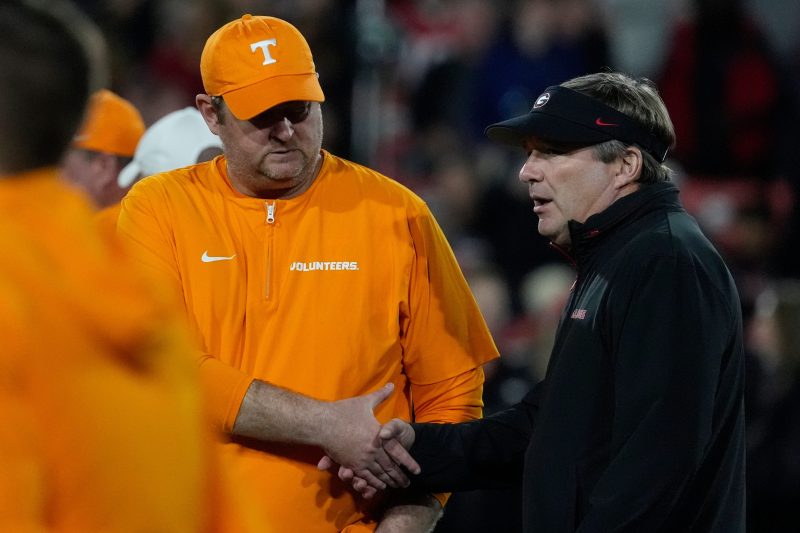
Tennessee coach Josh Heupel breaks ranks with SEC party platform and offers support for 24-team playoff.
Think a super-sized playoff would give coaches more job security? Nope.
Nobody cares about bowl games? No, nobody cares about bad playoff games.
Josh Heupel reached across the aisle. The Tennessee coach broke ranks with his party, the SEC, when he came out in support of a 24-team College Football Playoff, a size favored by the Big Ten. The SEC’s official party platform supports a 16-team playoff.
Let’s not kid ourselves, Heupel’s preference for 24 teams has nothing to do with compromise and everything to do with self-preservation.
Heupel is tasked with making the playoff. That would occur more regularly if a super-sized bracket existed. Tennessee would sporadically qualify for a 12- or 16-team playoff. At 24 teams, the Vols might aspire to become playoff fixtures.
Truth be told, Heupel isn’t the only SEC coach who’d go for 24 teams. He’s just one of the few from the SEC who admitted it out loud, on the record, revealing his preference in a recent interview with On3. Georgia’s Kirby Smart also voiced interest in 24 teams in an interview with the Atlanta Journal-Constitution.
Inside the SEC, angst is heightened after the conference stiffened its schedule by adding a ninth conference game, without the cushion of a bigger playoff. Plus, a super-sized playoff would mean more playoff revenue. It always comes back to money, doesn’t it?
Coaches always will seek out what’s best for coaches, but this mega-playoff is a honey-trap ready to lure them into a false sense of security. A 24-team playoff would not be the panacea coaches like Heupel and Smart might want to believe it would be.
Let’s dispel with a few myths that prop up support for a 24-team playoff.
Myth 1: The 12-team playoff created a playoff-or-pink-slip environment. A 24-team playoff would offer coaches more job security.
Wrong! Although this past coaching carousel was particularly active, we haven’t reached a playoff-or-buyout landscape.
In the first two years of the 12-team playoff, only one coach whose team finished in the top 25 of the final CFP rankings got fired. That was a unique situation. Michigan fired Sherrone Moore for cause, after his arrest on a felony charge.
‘Our fan bases (expect) to be in the playoffs,’ Smart told the AJC. ‘It’s playoffs or bust.’
Yes, fans want their teams to be in the playoff, but most schools aren’t firing coaches who go 9-3 and head to a bowl game.
Coaches of bad or middling teams get fired. Coaches of top-25 teams don’t.
Texas failed to live up to its preseason No. 1 ranking. It missed the playoff and finished 10-3 after a Citrus Bowl victory. Texas didn’t fire Steve Sarkisian. Nobody sane thought it should. Underwhelming season? Yes. A fireable offense? No.
That doesn’t mean a coach of a top-25 team would never be fired, but it’s an uncommon exception, not the rule.
I highly doubt a super-sized playoff would create additional job security. The opposite is probably true. Go to 24 teams, and college football could speed into an era of playoff-or-ouster, particularly for some SEC and Big Ten programs where stakes are highest. Decrease the playoff’s exclusivity so that 8-4 teams begin qualifying, and I suspect it wouldn’t be long before a playoff-qualifying coach got fired.
We already see this in college basketball. The NCAA Tournament is so big, a bid does not ensure job security. Just last year, Texas fired its basketball coach after a loss in the First Four. Buckle up for similar firings in football if the playoff swells to 24.
Myth 2: Fans will be satisfied with playoff qualification. So, grow the playoff, and you’ll have more happy fan bases.
Yeah, right. Think Alabama or Michigan or even Tennessee will celebrate a first-round loss to Iowa within a 24-team bracket? Nope, that’ll be hot-seat terrain.
I hate to be the one to tell Heupel, but Tennessee fans would be no more enthused about a first-round playoff loss in a 24-team bracket than they were about a season that ended in defeat in the Music City Bowl.
At 24 teams, a first-round playoff exit would become the equivalent to what we now know as an also-ran bowl game finish.
Come to think of it, some coaches would be better off if the playoff got smaller, not bigger.
Consider the plight of Alabama’s Kalen DeBoer. If the playoff had featured eight teams, instead of 12, Alabama would’ve narrowly missed the playoff, bemoaned being snubbed, and perhaps finished with a triumph in a top-tier bowl game, buoying the mood into the offseason.
Instead, the last we saw of DeBoer, he was walking off the field at the Rose Bowl as a 35-point playoff loser to Indiana. But, hey, he made the playoff. Congrats, eh? Not really.
Balloon the playoff to 24 teams, and more teams will finish their season like Alabama did, serving as a whipping post for a superior opponent that’s actually got a shot at the national title.
Myth 3: Nobody cares about bowl games anymore, so doubling the playoff’s size to 24 will be a boon for TV ratings and fan interest.
Lies! Nobody cares about bowl games? No, nobody cares about bad playoff games.
Four of the eight first-round playoff games the past two seasons attracted fewer eyeballs than either the Citrus Bowl or Pop-Tarts Bowl.
You know what drew paltry ratings? James Madison-Oregon, in the flippin’ playoff!
Put Vanderbilt-Virginia in a first-round playoff game within a super-sized bracket, and you’ll get ratings that would fail to match what Texas-Michigan did in the Citrus Bowl.
The upshot about ratings? They depend on matchups, brands, TV networks and time slots. Ratings for some early round games in a 24-team playoff wouldn’t outperform some of the ratings that bowl games generate.
Want evidence? Here you go: Texas’ Citrus Bowl game against Michigan on ABC this past season got a better TV audience than its first-round playoff game against Clemson generated on TNT the year before.
Myth 4: A 24-team playoff will make the postseason easier on coaches.
Nope, it’ll just become more difficult to do what Miami did, going from the 10-seed to the title game.
See, in a 12-team playoff, the 10-seed must win three games to reach the national championship. In a 24-team playoff, a 10-seed would need to win four playoff games just to reach the national title game, amid an agonizingly long journey.
Heupel and Smart won’t be the last coaches to take the bait of the 24-team playoff plan. Too bad it’s fool’s gold.
Blake Toppmeyer is the USA TODAY Network’s senior national college football columnist. Email him at BToppmeyer@gannett.com and follow him on X @btoppmeyer.