
INDIANAPOLIS – By definition, the NFL draft is inherently a young man’s game.
But while there are no literal graybeards among this year’s class of prospects, a number of players are set to become rookies despite resembling veterans in age. And they’re doing so at a moment when personnel decision-makers have reconsidered a longstanding aversion to older prospects.
‘If it’s close between players and you have a 20-year-old and a 25-year-old, obviously you’re going to take the 20-year-old,’ NFL Network draft analyst Daniel Jeremiah said this week at the scouting combine. ‘But teams are not as concerned with the age going through this process.’
With the NCAA in 2020 granting an extra year of eligibility to all players, the NFL saw a three-year spike in draftees who were 24 years or older, peaking in 2024 with 56 selected. This year’s total won’t approach that high-water mark, with a smaller group constituting the last wave of sixth-year seniors.
But with the NIL boom driving a substantial reduction in underclassmen declarations – 63 this year, less than half the number (128) from five years ago – it’s readily apparent that the latest class is continuing to skew older and more experienced. And NFL front offices, having already rethought their previous norms around age, are prepared.
‘I don’t believe a 25-year-old is old,’ Cincinnati Bengals director of player personnel Duke Tobin said. ‘I think a 25-year-old is young, still has a lot of football left in his body. It’s a data point. It’s something we’re aware of. It might affect the longevity down the road. But sometimes it can also be a benefit in a guy being more mature in his body or a little more stable in how he conducts himself in his personal life.
‘Age is a number. Guys are playing longer these days. It’s a factor, but it’s not a big factor for us.’
‘A seasoned rookie’
There’s a clear choice for the flagbearer of this year’s 24-and-up movement.
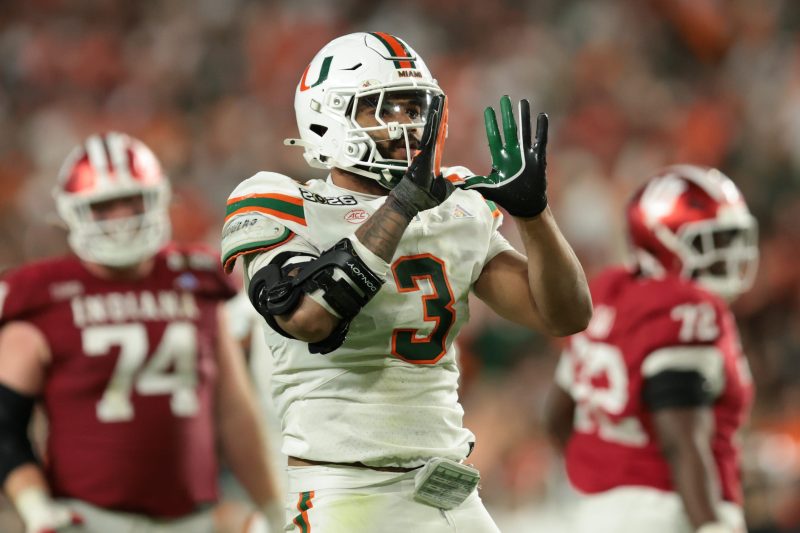
Miami defensive end Akheem Mesidor, who will turn 25 in April prior to the draft, wears his age proudly. The Ottawa native blossomed in his final season with the Hurricanes, recording 12 ½ sacks and helping lead the charge for the Hurricanes’ run to the national championship game. Now, he could join Rueben Bain Jr., his more highly hyped pass-rushing partner, in the first round.
For Mesidor, his atypical timeline for arriving in the pros is a source of strength.
‘You can call me a seasoned rookie – whatever you want to call it,’ Mesidor said with a smile at the combine. ‘I’m coming in more mature, with a different approach and a different mentality than a lot of younger guys.’
There are a handful of other 24-year-old offensive and defensive linemen joining Mesidor in this class. In recent years, the fronts have often featured the heaviest volume of similarly aged players, Green Bay Packers general manager Brian Gutekunst said.
An age outlier, however, can be found at almost any position.
The phenomenon was thrust into the spotlight in 2024 when quarterbacks Michael Penix Jr. and Bo Nix were each selected in the top 12 picks despite being sixth-year seniors who were already 24 on draft day. Tyler Shough represented an even more extreme test case for teams, as the seventh-year senior and eventual second-round pick of the New Orleans Saints turned 26 before making his first start last fall.
This year, UConn quarterback Joe Fagnano – a former Maine transfer and possible late-round pick – also was invited to the combine after staying in the collegiate ranks for eight years.
At running back, South Carolina’s Rahsul Faison turned 26 last week. He’s multiple months older than both the Dallas Cowboys’ Javonte Williams and the Los Angeles Rams’ Kyren Williams – each of whom has logged more than 800 carries in the NFL and already signed a second contract.
When it comes to positions that allow for shorter career windows, the notion of using a pick on a player who has a limited time left to remain at or near his athletic peak can be daunting. Miami cornerback Keionte Scott, who played a has a counterargument.
‘I’ve heard that going around, but I feel like this game that we play is a win-now game,’ said Scott, 24. ‘That takes a lot of the age things away.
‘These teams, some of these coaches don’t have time to waste. … When you play this game, it doesn’t matter how old you are.’
First-year Miami Dolphins general manager Jon-Eric Sullivan agrees, but with a caveat.
‘I think if you can help it, you don’t want a player close to going into a second contract around 30 years old,’ Sullivan said. ‘Having said that, with the climate of college football, there are situations where you’re going to have to consider that to get good football players.’
But Jeremiah cited a running joke in football circles: Amid all the focus on second contracts for older draft prospects, general managers are also seeking additional contracts of their own – and therefore pursue immediate assistance in whatever form it might come.
‘Let’s try to get 4-5 good years out of this player, and if he gives us that and we move on, it’s a good pick,’ Jeremiah said.
Back to the board
The reality of the current draft dynamic hit Kansas City Chiefs general manager Brett Veach in January. That’s when the league holds its annual underclassmen declaration deadline.
With so many players opting to go back to school, the Chiefs removed approximately 25 prospects from the team’s board of the overall top 75-100.
‘It really impacts the draft, and there are some older prospects as you go on,’ Veach said. ‘I don’t think that’s gonna change anytime soon, and that’s something that we have to adapt to until there are some wholesale changes on the college side. I think this is just the way things are gonna work now.’
Gutekunst, however, isn’t so sure that the draft landscape will remain this way for the foreseeable future.
‘I think for the next year or so that we’ll be in that window, and then we’ll gradually graduate out of it,’ Gutekunst said.
The biggest fallout for the league can be in its developmental pipeline. This is often reflected on Day 2, Veach said, which is frequently the landing spot for some players who have a wide gulf between their promise and their pro readiness.
‘Typically in the second or third round would be those guys who didn’t play a lot, but they’re young,’ Veach said. ‘Well, now they’re just bouncing to another school and getting paid while playing. So with these younger developmental guys, you’re getting a bit more of a finished product.’
Regardless of whether the pool of prospects changes, NFL decision-makers have already made up their minds on the issue.
In his first draft as general manager of the Las Vegas Raiders, John Spytek selected two players who had already turned 24: third-round cornerback Darien Porter and sixth-round wide receiver Tommy Mellott. With a robust roster reset at hand, Spytek didn’t want age to be a disqualifying factor.
‘Our analytics department gets mad at me anytime we put a guy up there who’s a little bit older,’ Spytek said. ‘But we’re just looking for good football players.’