
Tag. You’re it. Sorry. (Not sorry?)
The window for NFL teams to apply a franchise or transition tag to one of their pending free agents opened Feb. 17 and won’t close until 4 p.m. ET on March 3. Moving forward, many of the league’s top potential targets will be hoping to duck the restrictive one-year Band-Aids – which, by definition, provide no long-term security – though lesser-known up-and-comers sometimes appreciate the lucrative, assured balloon payment if they’ve been toiling on cheaper contracts.
Yet tags are also a choice for teams. They can be a place-holding mechanism to retain an important player until a longer-term solution can be hammered out; a precursor to a trade; a way to gauge players’ market values; or simply all they’re willing to do before finding a replacement down the line. Yet tags come with serious downsides, too, often poisoning the negotiating well, potentially sending an unwelcome message to the rest of a locker room, frequently leading to lengthy offseason absences by franchised players and/or even possibly forcing a team to release other ones in order to shoehorn a one-year, fully guaranteed tag under its salary cap.
How might – and, more importantly, should – each team proceed with their tagging decisions over the next two weeks? Our advice for approaching the 2026 tags for all 32 clubs (listed alphabetically, salary cap figures courtesy Over The Cap):
Arizona Cardinals
Their best free agent is probably DL Calais Campbell. No one’s tagging a 39-year-old … and almost certainly not anyone else here with the possible exception of S Jalen Thompson.
Atlanta Falcons
A tight end franchise tag will likely be in the neighborhood of $15-$16 million. So franchising Kyle Pitts would make sense from a financial standpoint and a production perspective in the wake of one of his best seasons. Yet it’s worth noting that new coach Kevin Stefanski rarely maximized a similarly gifted player, David Njoku, in Cleveland. It’s a compelling organizational decision for a team under new management − especially since Pitts was more productive with QB Kirk Cousins, who’s likely to be an ex-Falcon himself soon, throwing to him.
Baltimore Ravens
They declined Pro Bowl C Tyler Linderbaum’s fifth-year option a year ago but failed to lock him up with a long-term extension. If that doesn’t happen soon, then Baltimore will have to decide if it’s worth tagging Linderbaum – at roughly $25 million, left tackle-level money since all O-linemen are lumped together. The alternative is significantly weakening the already questionable protection QB Lamar Jackson had last season.
Buffalo Bills
While it would be nice to re-sign C Connor McGovern and/or G David Edwards, neither is worth left tackle-level compensation. Buffalo can’t afford a tag right now anyway, currently more than $12 million overbudget for 2026.
Carolina Panthers
C Cade Mays and RB Rico Dowdle are nice players. No reason to overcompensate either with a tag when market price should be more than sufficient.
Chicago Bears
The NFC North champs had no idea they were getting a starter, much less a Pro Bowler, when they signed CB Nahshon Wright, 27, off the scrap heap last year. A tag, approximating $20 million, might make sense here, giving the team certainty Wright isn’t a fluke while giving him easily the biggest payday of his career. However, Chicago would have to do some cost cutting in order to clear room for it.
Cincinnati Bengals
Would it really be worth doubling down on the bad blood between the team and DE Trey Hendrickson to hit him with a tag – even if the ultimate objective is to deal him? Almost certainly not, neither from the locker room messaging nor from the consequential impact it would have on the front office’s ability to otherwise spend on its beleaguered defense.
Cleveland Browns
No reason to use a tag, especially when considering their dearth of cap space.
Dallas Cowboys
Denver Broncos
It’s understandable that they might be giddy to spend as they emerge from the crushing dead cap hit from former QB Russell Wilson’s ill-advised extension. But no reason to burn any of their newly realized financial flexibility on a tag this year.
Detroit Lions
They’re nearly $10 million overspent right now. Moving on.
Green Bay Packers
They stand to lose quality starters like LT Rasheed Walker and WR Romeo Doubs – not to mention QB2 Malik Willis – but none merit a tag’s expenditure, especially for a team already tight against the cap.
Houston Texans
No legit tag candidates and no cap space.
Indianapolis Colts
GM Chris Ballard is historically averse to using the tag – employing it just once in his nine seasons – but will need to get an extension with QB Daniel Jones done soon in order to avoid a (hefty) second application. Good as WR Alec Pierce was in 2025, a tag at his position feels way too rich for a secondary target.
Jacksonville Jaguars
LB Devin Lloyd, CB Montaric Brown and RB Travis Etienne should be under consideration, though GM James Gladstone doesn’t currently have the financial bandwidth to franchise any of them. Etienne might make the most sense given tailbacks have the cheapest tag among position players. Lloyd had a star turn in 2025, but linebacker tags are priced at pass rusher rates, and he isn’t one.
Kansas City Chiefs
Hard to believe TE Travis Kelce would play anywhere other than K.C., assuming he still wants to play – meaning the Chiefs can likely keep their tag pocketed. Nearly $55 million over the cap anyway, they’re likely not accomplishing much of anything until (unless?) they restructure QB Patrick Mahomes’ pact.
Las Vegas Raiders
A rebooting team with a relatively weak roster has no business tagging any of its fairly marginal free agents.
Los Angeles Chargers
Odafe Oweh was awfully good after joining the Bolts last October. But whether a pass rush specialist is worthy of a tag likely to approach $28 million is an open question – though the Chargers can afford to bring him and fellow OLB Khalil Mack back.
Los Angeles Rams
S Kamren Curl is a sturdy, steady player, if not one who commands a $20 million annual salary. Priority One here needs to be extending WR Puka Nacua anyway in order to avoid playing the tag game with him a year from now.
Miami Dolphins
A new regime focused on slashing salaries should continue working on that front – and on an exit strategy from QB Tua Tagovailoa – ahead of what’s probably going to be a very bumpy 2026 campaign.
Minnesota Vikings
Only the Chiefs have more money to slash from their cap ahead of the new league year on March 11. Fortunately, WR3 Jalen Nailor is probably the most notable free agent here.
New England Patriots
While they’d like to keep players like OLB K’Lavon Chaisson and S Jaylinn Hawkins, they should earmark the funds in a $40+ million free agent war chest for bigger fish – especially if opportunities arise to get a premier pass rusher, interior O-lineman and/or receiver.
New Orleans Saints
While they might have to part with mainstays like DL Cam Jordan, LB Demario Davis and TE Taysom Hill, this seems like an ideal time for this organization to balance its books as it continues to assess and reset around second-year QB Tyler Shough.
New York Giants
WR Wan’dale Robinson, CB Cordale Flott and RT Jermaine Eluemunor would be nice to re-sign. None necessitate blowing the budget in Year 1 under coach John Harbaugh.
New York Jets
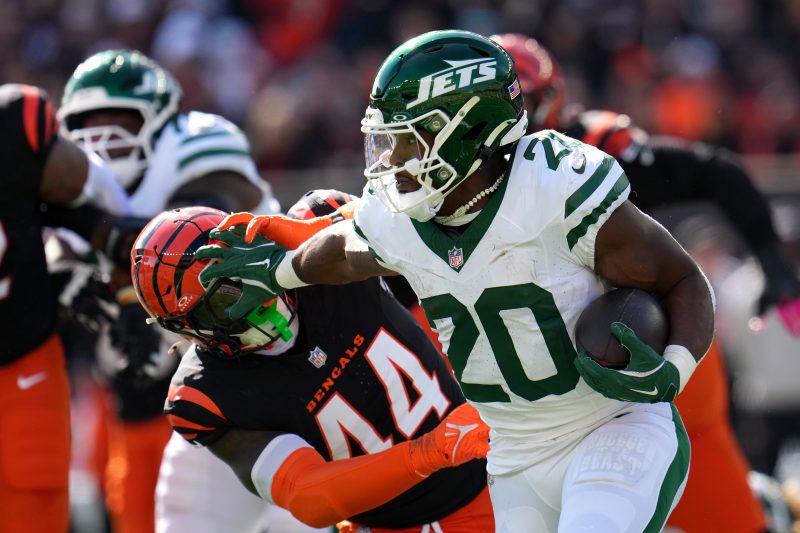
The price is probably right for RB Breece Hall, who’s earned roughly $10 million during his four-year career but would get about a 50% bump from that total for another year of service if franchised. A tag in the $14-$15 million range would make Hall, who’s only 24, one of the top-paid backs in the league on a per-year basis … if only one. Also, a team that wants – and probably needs – to be run-oriented, especially in the near term, doesn’t need to liberate one of its best players. And GM Darren Mougey has cash to burn.
Philadelphia Eagles
It would require shifting money elsewhere, but EVP/GM Howie Roseman wouldn’t have to move heaven and earth in order to franchise OLB Jaelan Phillips, who came aboard at last season’s trade deadline. Yet Roseman would likely be at least equally content to let Phillips go and collect the hefty compensatory pick he’ll eventually return while considering whether to re-sign the likes of TE Dallas Goedert and or LB Nakobe Dean to contracts that wouldn’t be as burdensome as whatever Phillips earns.
Pittsburgh Steelers
While they might want G Isaac Seumalo, RB Kenny Gainwell and, certainly, QB Aaron Rodgers, 42, to return, none are tag-adjacent – Rodgers showing last year he’s willing to play for much less than his value, even at his age.
San Francisco 49ers
They’ve sprung enough leaks, particularly on defense, that it doesn’t make sense to franchise WR2 Jauan Jennings … despite his distinctive skill set and personality. If the Niners can get him back at a more reasonable rate, more power to both parties. One player GM John Lynch might consider tagging, in large part due to a lower positional figure, is K Eddy Piñeiro, who stabilized a problem area and led the league with a 96.6% conversion rate on field goals.
Seattle Seahawks
As Super Bowl champions typically do, they have some fascinating decisions to make. GM John Schneider has roughly $60 million at his disposal for free agency and would surely like to keep players such as WR/KR Rashid Shaheed, S Coby Bryant, OLB Boye Mafe, CB Josh Jobe and, of course, Super Bowl MVP Kenneth Walker III. It would certainly help to get a few under contract early and hold the tag in reserve. But, all things being equal, Walker is probably the most logical target for a franchise or transition tag given the lower cost associated with running backs. And given RB Zach Charbonnet tore an ACL during the playoffs, retaining Walker for the 2026 season seems like a pressing priority.
Tampa Bay Buccaneers
Veteran WR Mike Evans, LB Lavonte David and CB Jamel Dean are all career Bucs − and GM Jason Licht will have to hope they want to keep it that way, because none should be in line for a tag at these advanced stages of their careers.
Tennessee Titans
Is QB Cam Ward going to be a free agent? (No.) How about DT Jeffery Simmons? (No.) Next.
Washington Commanders
They’ve got nearly two dozen unsigned guys who are at least 30 years old, rarely the types you tag. A team that obviously needs to get younger could certainly effort to keep some of its leaders but doesn’t have anyone north (or south) of 30 that warrants premium money.
What is the NFL franchise tag?
It’s a one-year, fully guaranteed tender that provides a player with a significant raise from his current team but impedes his ability to test the free agent market. A tag’s value is based on a player’s position. Per the NFL CBA:
“The Nonexclusive Franchise Tender shall be a one year NFL Player Contract for (A) the average of the five largest Prior Year Salaries for players at the position … at which the Franchise Player participated in the most plays during the prior League Year, which average shall be calculated by: (1) summing the amounts of the Franchise Tags for players at that position for the five preceding League Years; (2) dividing the resulting amount by the sum of the Salary Caps for the five preceding League Years …; and (3) multiplying the resulting percentage by the Salary Cap for the upcoming League Year … (the ‘Cap Percentage Average’) …; or (B) 120% of his Prior Year Salary, whichever is greater.”
Tag values rarely decrease year over year. Each team can use one (franchise or transition) per offseason.
Franchised players have until July 15 to reach a long-term deal with their team. Otherwise, they must play the 2026 season on the tag and cannot sign an extension before the conclusion of Week 18.
Non-exclusive franchise tag: The most common type of tag, it allows players to negotiate with other clubs. If the player signs an offer sheet with a different team, his current one has the option of matching it or letting him go and receiving two first-round draft picks as compensation – a scenario that hasn’t occurred since 1998. However, players can be franchised and traded for alternative compensation if an arrangement is reached.
Exclusive franchise tag: A player receiving this version of the tag cannot negotiate elsewhere.
Transition tag: Slightly less lucrative than a franchise tag, it returns no draft compensation to a player’s original team if it declines to match an offer sheet.
How much are NFL franchise tags worth in 2026?
The value for each tag in 2026 has not been finalized. The following are the tag values, by position, in 2025 − most likely to increase by a few million this year:
Quarterback: $40.24 million
Running back: $13.64 million
Wide receiver: $23.96 million
Tight end: $13.83 million
Offensive lineman: $23.4 million
Defensive end: $22.06 million
Defensive tackle: $25.12 million
Linebacker: $25.45 million
Cornerback: $20.19 million
Safety: $18.6 million
Kicker/punter: $6.31 million
Which NFL players received the franchise tag in 2025?
Only two players were tagged last year, both eventually signing long-term deals:
Bengals WR Tee Higgins: Eventually signed four-year, $115 million extension.
Chiefs G Trey Smith: Eventually signed four-year, $94 million extension.