
The article frames a hypothetical Indiana national championship as the most unexpected in modern college football history.
Several of these surprise champions, like 2010 Auburn and 1976 Pittsburgh, were led by Heisman Trophy-winning players.
Things we could’ve written back in August that no longer apply: Indiana’s last outright Big Ten championship came in 1945. Last nine-win season was in 1967. Last time with back-to-back bowl appearances came in 2015-16. Last time with back-to-back winning seasons came in 1987-88.
Without question, an Indiana title would be the most unexpected in modern Bowl Subdivision history given the program’s dismal history as a Big Ten and Power Four doormat.
Remade as a bulldozing juggernaut by second-year coach Curt Cignetti, the Hoosiers now enter the title game against Miami with a case for being seen as the best team of the College Football Playoff era.
While the unbeaten Hoosiers would be in a class by themselves, let’s look back at eight previous national champions who defied the odds and expectations to deliver an out-of-nowhere title:
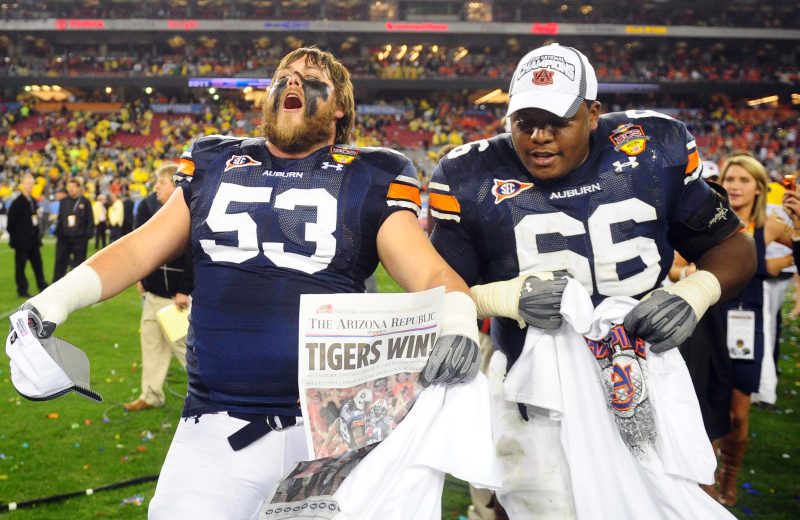
2010 Auburn
Two words: Cam Newton. After going 5-7 in Tommy Tuberville’s final season, the 2009 squad went 8-5 under new coach Gene Chizik and tied for fourth in the SEC West. Then Auburn, which was No. 23 in the preseason poll, signed Newton and went a perfect 14-0 with seven single-digit wins, including in the Iron Bowl (28-27) and the title game against Oregon (22-19). This was Auburn’s only ranked finish from 2008-12; the other four teams surrounding the title squad went a combined 24-26.
2000 Oklahoma
Maybe the most consistently successful program of the post-war era hit rock bottom in the 1990s, culminating in three losing records in a row under then-coach John Blake from 1996-98. But Blake recruited a good chunk of the roster that Bob Stoops led to the national championship in just his second season, taking a team that debuted at No. 19 in the preseason to what is by far the most unexpected of the program’s seven claimed titles. Josh Heupel, a quarterback from junior college, led the offense, while the defense was full of standouts, including LB Rocky Calmus.
1990 Georgia Tech
The Yellow Jackets shared the title with Colorado, which went 11-1 in 1989 and finished No. 4 in the Coaches Poll. In comparison, Tech went 2-9 under new coach Bobby Ross in 1987 and 3-8 in 1988 before climbing to 7-4 in 1989. The 1990 George Tech team was unranked until October, didn’t crack the top five until late December and earned the shared title after demolishing Nebraska in the Citrus Bowl. The Jackets would drop to 19-27 over the following four seasons.
1984 Brigham Young
The last team outside the current Power Four landscape to win the national title, BYU ended the 1984 season as the only unbeaten team in the country and one of just four with fewer than two losses. While this perfect-storm scenario helped the Cougars thread the needle and finish ahead of No. 2 Washington in a very close vote, the 1984 team was the fifth in six years to win at least 11 games under coach LaVell Edwards.
1983 Miami (Fla.)
Miami made its debut in 1926, had some success in the 1950s and posted just two winning seasons, both at 6-5, from 1968-78. But the program began to grow under coach Howard Schnellenberger, going 9-3 in 1980, 9-2 in 1981 and then 7-4 in 1982. The 1983 team lost its opener to Florida by 25 points, didn’t crack the Top 25 until October and was ranked No. 5 when it faced off against Nebraska in the Orange Bowl. After stopping the Cornhuskers’ two-point attempt in the final minute, Miami surged to No. 1 after losses by Texas and Illinois and close win by Auburn to christen a dynasty that dominated the sport for the following two decades.
1976 Pittsburgh
From 1964-72, Pittsburgh went 22-68-2 with four one-win seasons, including a 1-10 mark in 1972. After hiring coach Johnny Majors, the Panthers went 6-5-1 in 1973, 7-4 in 1974 and 8-4 in 1975, building momentum heading into 1976 with a late-season win against Notre Dame and a Sun Bowl victory against Kansas. Like Newton at Auburn in 2010, the 1976 Panthers were carried by a Heisman winner, running back Tony Dorsett, who ran for 1,948 yards during the regular season and another 202 yards in the Sugar Bowl win against Georgia.
1965 Michigan State
The Spartans went 35-2 from 1950-53, finished in the top three in 1955 and 1957 but then stumbled down the Big Ten ladder, going 36-24-3 overall and 23-17-2 in conference play from 1958-64. But coach Duffy Daugherty and Michigan State forged a new era in college football by integrating the roster with Black athletes in the early 1960s, building a team that went from 4-5 in 1964 to 19-1-2 the next two seasons. The 1965 team finished atop the US LBM Coaches Poll and shared the title despite losing the Rose Bowl to UCLA.
1962 Southern California
One of the dominant programs of the 1920s and ‘30s, USC had fallen on hard times in the post-war era, posting one 10-win finish and four losing seasons from 1946-1961. But the Trojans’ fortunes began to change with the arrival of future Hall of Fame coach John McKay in 1960. After going a combined 8-11-1 in his first two seasons, the 1962 squad opened the year unranked, climbed into the polls after being Duke in the opener and then secured the program’s first title since 1939 by winning a high-scoring Rose Bowl against Wisconsin.
When is CFP national championship game? Indiana vs Miami start time
Time: 7:30 p.m. ET
Date: Monday, Jan. 19
Location: Hard Rock Stadium (Miami Gardens, Florida)
The CFP national championship game between Indiana and Miami will kick off at 7:30 p.m. ET on Monday at Hard Rock Stadium in Miami Gardens, Florida.