Archive

2025

Browsing

It wasn’t the original main event scheduled for Saturday night.

But it’s hard to imagine the original being any better than the replacement.

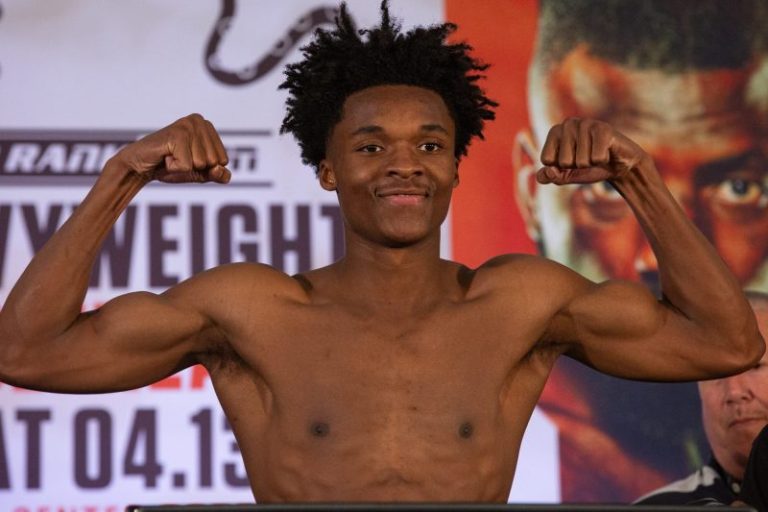
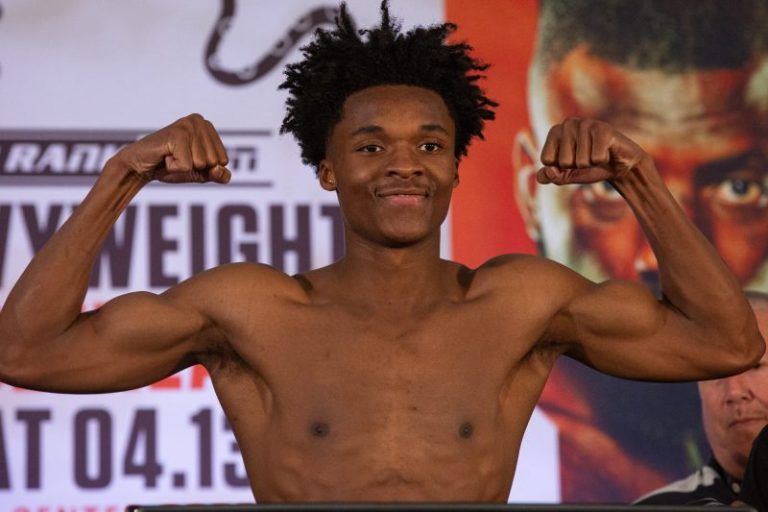
Abdullah Mason defeated Jeremia Nakathila by TKO when the fight was stopped one second into the sixth round of the lightweight fight.

The ringside physician halted the fight because Nakathila said he could not see out of his left eye because of a cut.

It was supposed to be Keyshawn Davis featured in the main event. But he weighed in at more than four pounds the maximum weight for his WBO world lightweight bout against Edwin De Los Santos.

That led to the bout being canceled and Davis being stripped of the championship belt.

But the 21-year-old Mason likely secured himself a shot at the now-vacant WBO title with his performance.

He entered the ring wearing flashy turquoise trunks and he was just as flashy as the attire. His best shots staggered Nakathila.

It was Mason’s 17th knockout in 19 victories.

Nakathila, a 35-year-old from Namibia, fell to 26-5.

Abdullah Mason fight time

Abdullah Mason vs. Jeremia Nakathila fight date: Saturday, June 7

Time: Main card starts at 10 p.m. ET. Prelims start at 6 p.m. ET

Where to watch Abdullah Mason vs. Jeremia Nakathila: ESPN+ (Main card also available on ESPN)

Nahir Albright def. Kelvin Davis by majority decision

Davis, the older brother of Keyshawn Davis, entered the ring with a five-inch height advantage. It did not prevent him from getting hit. Hard. And repeatedly in a loss to Albright by majority decision in their 10-round lightweight bout.

With Keyshawn Davis watching, Kelvin Davis (15-1) suffered the first loss of his career and at least a few times looked dazed and confused after getting hit by Albright.

The judges scored it 95-95, 97-93, 96-94 in favor of Albright, a 29-year-old from New Jersey who improved to 17-2.

Davis, 28, spent a significant amount of the fight trying to keep Albright wrapped up. But not tightly enough to avoid punishment, with Albright landing about twice as many power punches.

Delante Johnson def. Janelson Bocachica by unanimous decision

Johnson heard boos for several rounds by a crowd that was frustrated with a lack of action in a 10-round welterweight bout. But the referees saw it differently.

They scored the fight 100-90, 97-93, 98-92 for Johnson, who improved to 16-0.

Regardless of the scorecards, Johnson looked hesitant until the later rounds, when he finally showed his speed and power.

Bocachica, the 26-year-old from Cleveland, fell to 17-4-1 and is winless in his last six fights.

Troy Isley def. Etoundi William by unanimous decision

Isley overcame massive reach disadvantage against William, grinding out a victory by unanimous decision in their 10-round middleweight fight.

Early on, Isley looked befuddled by William’s 79-inch reach. But he solved the problem in time to improve to 15-0.

Midway through the fight, Isley muscled inside and began to score with body punches and a variety of other shots. It’s what he needed to shift the momentum.

The judges scored the fight 98-92, 96-94, 96-94 for Isley, the 26-year-old from Virginia.

William, a 32-year-old from Brazil, fell to 16-2.

Abdullah Mason record

Mason is 18-0 with 16 KOs. His opponent, Jeremia Nakathila, is 16-4 with 21 KOs.

Keon Davis def. Michael Velez-Garcia by KO

Davis, the younger brother of Keyshawn Davis, knocked out Velez-Garcia with a left to the body in the second round of their welterweight bout.

The fight ended with 38 seconds left in the round and Keyshawn Davis celebrating. Having failed to make weight for his own fight, Keyshawn was a spectator. Keon Davis, 23, provided compelling theater while remaining unbeaten.

The 6-foot-3 Keon Davis made good use of his reach advantage before landing the decisive blow. He improved to 4-0 with three KOs. He made his debut and was fighting for the third time in 2025.

Velez-Garcia, a 27-year-old from Puerto Rico, fell to 3-1.

Euri Cedeño def. Abel Mina by TKO

Cedeno improved to 12-0-1 in impressive fashion, punishing Mina for five rounds before Mina’s corner called the fight.

Mina showed no objection after getting knocked down midway through the fifth round and, upon absorbing more punishment, wobbling as the bell rung.

It was 11th stoppage for Cedeno, the 25-year-old from the Dominican Republic.

Mina, a 32-year-old from Ecuador, landed a fair number of solid punches. But he could not match Cedeno’s power and his record fell to 18-4-1.

Deric Davis def. Naheem Parker by KO

Davis scored his seventh knockout in seven fights, taking out Parker with the body shot in the second round of their lightweight fight.

A 22-year-old from Maryland, Davis (7-0) now has five first-round KOs and two second-round KOs. His latest knockout punch, a left hook, left Parker wincing and on a knee long after he failed to make the 10-count.

While Davis preserved his unblemished record, the 30-year-old Parker of New Jersey dropped to 5-3. 

Patrick O’Connor def. Marcus Smith by TKO

O’Connor, an accomplished amateur boxer, looked more than ready for his pro debut. He pummeled Smith from the outset and the referee stopped the fight with 57 seconds left in the second round of their cruiserweight bout.

O’Connor, a 19-year-old from Maryland, unloaded on the 31-year-old Smith with powerful combinations. He scored a knockdown in the second before finishing Smith with another onslaught.

Smith’s record dropped to 2-2.

When is Keyshawn Davis’ next fight?

Keyshawn Davis, an Olympic silver medalist at the Tokyo Games in 2021, won the WBO title in February with a fourth-round TKO of Denys Berinchyk. He said he plans to move up in weight and fight at 140 pounds. There is no set date for his next fight after the cancelation.

This post appeared first on USA TODAY

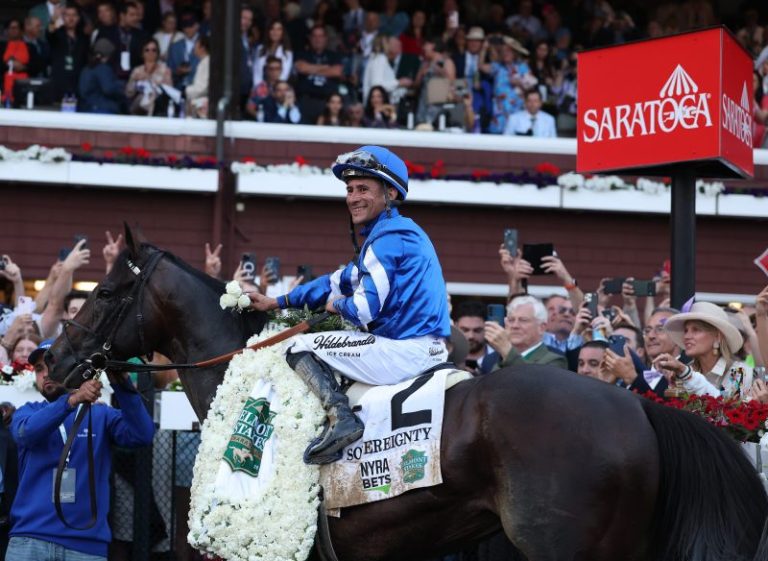
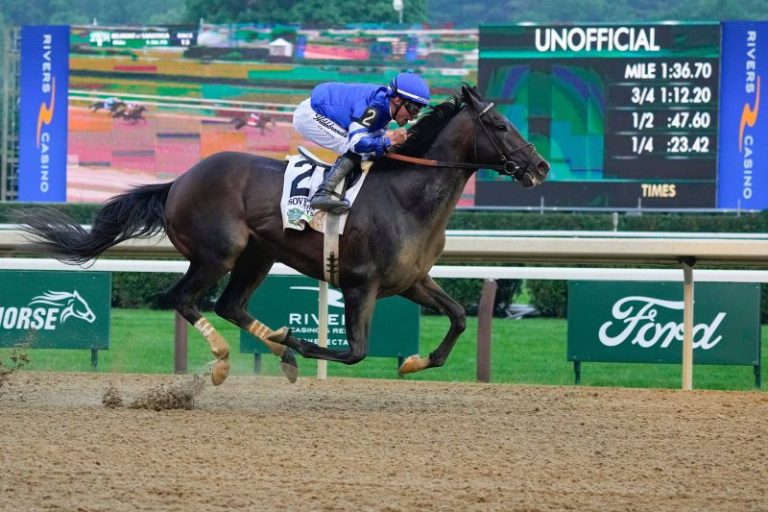
Kentucky Derby winner Sovereignty was the best horse in the field again on Saturday night, running to victory in the 2025 Belmont Stakes.

Sovereignty ran past Preakness Stakes winner Journalism and crossed the wire first at Saratoga Race Course in 2:00.69. (Sovereignty did not run the Preakness last month.)

Here’s a look at the basic payouts after the 157th Belmont Stakes, as well as the final finishing order.

Belmont payouts

Figures based on $2 bet (odds in parentheses)

Sovereignty (5/2): $7 Win; $3.20 Place; $2.30 Show
Journalism (2/1): $3.20 Place; $2.30 Show
Baeza (7/2): $2.60 Show

Bets

$1 Exacta (2-7): $6.60
$1 Trifecta (2-7-6): $13.80
$1 Superfecta (2-7-6-3): $40.50

Belmont Stakes final results

Final odds (in parentheses) and breakdown of $2 million purse

Sovereignty (5/2): $1,200,000
Journalism (2/1): $360,000
Baeza (7/2): $200,000
Rodriguez (7/1): $100,000
Hill Road (14/1): $60,000
Heart of Honor (20/1): $40,000
Uncaged (19/1): $20,000
Crudo (11/1): $20,000

This post appeared first on USA TODAY

O’Malley (18-2-0) will face UFC Bantamweight champion Merab Dvalishvili (19-4-0) in the main event at UFC 316 on Saturday, marking O’Malley’s first match in nearly nine months since he lost to Dvalishvili via unanimous decision at UFC 306. O’Malley was stripped of his UFC Bantamweight title with the loss and is out for revenge.

Dvalishvili, however, is not ready to give the title back.  

“I’m not going to give my belt to no one. This is mine and it’s staying with me. I’m going to make this guy humble again,” he said Thursday. 

Before O’Malley and Dvalishvili take the octagon, Julianna Peña (13-5-0) will defend her women’s UFC Bantamweight title against Kayla Harrison (18-1-0), a two-time Olympic gold medalist in judo (2012 London Games, 2016 Rio Olympics).

Here’s everything you need to know about UFC 316:

When does Sean O’Malley fight?

The UFC 316: Sean O’Malley vs. Merab Dvalishvili 2 fight card consists of 13 matches and will begin at 6 p.m. ET on Saturday, June 7. The main event for the O’Malley-Dvalishvili fight is expected to be around 10:30 p.m. ET. However, the duration of the undercard will impact when it actually starts.

Date: Saturday, June 7
Location: Prudential Center (Newark, New Jersey)
Main card start time: 10 p.m. ET
Main card stream: ESPN+ PPV

President Donald Trump, Mike Tyson in the building

The commander-in-chief has landed. Trump arrived at Prudential Center in Newark, New Jersey, before the UFC 316 main card kicked off. Trump clapped his hands as he made his way to his ringside seat, stopping along the way to shake hands with fans and even boxing legend Mike Tyson. Trump was accompanied by UFC President Dana White as ‘USA’ chants broke out. Trump’s son Eric Trump, his daughter Ivanka Trump and Marco Rubio, the United States Secretary of State, and rapper Ace Boogie with the Hoodie are also in attendance.

UFC 316 main card results

Merab Dvalishvil vs. Sean O’Malley: Bantamweight Title Bout
Julianna Peña vs. Kayla Harrison: Women’s Bantamweight Title Bout
Kelvin Gastelum vs. Joe Pyfer: Middleweight Bout
Mario Bautista vs. Patchy Mix: Bantamweight Bout
Kevin Holland def. Vicente Luque via submission (D’Arce choke) – Round 2, 1:03

Kevin Holland record

Holland improved to 28-13 in the MMA and 15-10 in the UFC with his defeat of Luque.

Kevin Holland def. Vicente Luque via submission (D’Arce choke)

Kevin Holland landed a devastating elbow behind Luque’s left ear, which left a visible hematoma on his head in the first round. Holland was also chirping early and continued to talk to Luque throughout the round. In the second round, Holland caught a kick from Luque and took him down. Holland got him into a D’Arce choke with his long arms and locked it in until Luque tapped.

UFC 316: Time, PPV, streaming for Dvalishvili vs. O’Malley 2

The highly anticipated rematch between Merab Dvalishvili and Sean O’Malley will take place on Saturday, June 7 and can be purchased on ESPN+ PPV.

Date: Saturday, June 7
Location: Prudential Center (Newark, New Jersey)
Early prelims start time: 6 p.m. ET
Early prelims stream: ESPN+, Disney+
Prelims card start time: 8 p.m. ET
Prelims card TV: ESPN; Prelims stream: ESPN+, Disney+
Main card start time: 10 p.m. ET
Main card stream: ESPN+ PPV

Catch UFC action with an ESPN+ subscription

UFC 316 preliminary results

Prelims:

Joshua Van def. Bruno Silva via TKO (punches) – Round 3, 4:01
Azamat Murzakanov def. Brendson Ribiero via TKO (punches) – Round 1, 3:25
Waldo Cortes Acosta def. Serghei Spivac via unanimous decision (30-27, 29-28, 29-28)
Andreas Gustafsson def. Khaos Williams via unanimous decision (30-27, 30-26, 30-26)

Early prelims:

Wang Cong def. Ariane da Silva via unanimous decision (30-27, 30-27, 30-27)
JooSang Yoo def. Jeka Saragih via KO (punch) – Round 1, 0:28
Quillan Salkilld def. Yanal Ashmouz via unanimous decision (30-27, 29-28, 29-28)
MarQuel Mederos def. Mark Choinski via unanimous decision (30-27, 30-27, 29-28)

Joshua Van def. Bruno Silva via TKO

Silva dropped Van at the beginning of the first round with a leg kick and Van returned the favor by dropping Silva with a right shot to the face. Bruno’s leg kicks were effective early on, but Van caught Silva with a right jab to the face and dropped him after Silva lunged at him. Silva survived punches on the ground and got to his feet, but he found himself back on the ground and in trouble after taking a knee to the face. Silva took multiple punches to the face on the ground before wrapping up Van to neutralize his attack. Van let Silva off the floor to end the second round. Van continued to highlight his boxing skills with punishing blows. Silva took a seat after another jab directly to the face, where he was finished off. The referee called a stop to the fight in the third round.

Joshua Van record

With his TKO of Silva, Van improved to 14-2 in MMA and a 7-1 in UFC.

What is UFC 316 PPV cost?

The highly anticipated rematch between Merab Dvalishvili and Sean O’Malley will take place on ESPN+ PPV. The main card is available for purchase for $79.99. An ESPN+ subscription is needed to purchase the UFC 316 main card PPV, which is expected to start around 10 p.m. ET.

Azamat Murzakanov def. Brendson Ribiero by TKO (punches)

Ribiero threw a bunch of kicks early on to Murzakanov’s head and body, which kept Murzakanov from moving forward. Murzakanov was able to counter a low kick with a powerful right hand. Murzakanov caught Ribiero with two consecutive left hooks with the last one hitting Ribiero in his left temple. Ribiero wobbled, fell to the ground and was mauled by a barrage of punches from Murzakanov. Referee Mike Beltran called a stop to the fight in the first round at the 3:25 mark to remain undefeated.

Waldo Cortes Acosta def. Serghei Spivac by unanimous decision

Cortes Acosta and Spivac traded blows in the first round. Cortes Acosta landed a low leg kick and continued to target the body of Spivac, who appeared to slow down in the second round due to the body shots. Spivac attempted to take Cortes Acosta down following a leg kick, but Cortes Acosta was able to slip out of it and continue pressing on his feet. Cortes Acosta had to get new shorts after his first pair was torn leading into the third round. Spivac caught Cortes Acosta with a right hook that made him wobble. It may be an attempt to play possum. Spivac continued pressing with a barrage of punches and Cortes-Acosta jabbed back as the crowd cheered, ‘Let’s go Waldo.’ Cortes Acosta won by unanimous decision, 30-27, 29-28, 29-28.

Andreas Gustafsson def. Khaos Williams by unanimous decision

Williams had Gustafsson clinched and pressed on the cage for a majority of the first round, prompting boos from the crowd in New Jersey, but anytime Gustafsson had separation, he aggressively swung for the fences and landed some punches on Williams in the process. Gustafsson continued pressing in the second round and appeared to hurt Williams with a punishing right hook. Gustafsson took down Williams several times and opened a bloody gash above Williams’ right eye with an elbow. The pressure didn’t stop in round three and Gustafsson continued to maul a worn-down Williams. Gustafsson won by unanimous decision, 30-27, 30-26, 30-26.

Wang Cong def. Ariane Da Silva by unanimous decision

Silva and Cong stayed on their feet the first round and exchanged blows and kicks. Cong landed a devastating kick to Da Silva’s left leg that left her wobbling. Da Silva’s left leg had a visible welt and continued to be a target for Cong as the fight progressed. Cong landed another low leg kick in the second round that made Da Silva loss her balance and fall to the ground. Cong ultimately won by unanimous decision, 30-27, 30-27, 30-27.

Joosang Yoo def. Jeka Saragih by KO (punch)

The featherweight bout between Joosang Yoo and Jeka Saragih didn’t last long. Yoo caught a charging Saragih right on the chin with a left hook less than 30 seconds into his debut. Saragih was knocked out with the punch and fell forward on his face.

Quillan Salkillo def. Yana Ashmouz by unanimous decision

Ashmouz came out the gate strong and landed punches early before Salkillo slammed him down to the ground. Salkillo maintained control on the ground and smothered Ashmouz, highlighting his wrestling skills. Ashmouz had a late surge in the third round and landed multiple right hooks that stunned Salkillo, but it was too little too late. Salkillo def. Yana Ashmouz in the lightweight bout by unanimous decision, 30-27, 29-28, 29-28.

Marquel Mederos def. Mark Choinski by unanimous decision

Marquel Mederos and Mark Choinski went the distance at lightweight to start off the night. Mederos dominated Choinski with his leg strikes and ultimately won by unanimous decision, 30-27, 30-27, 29-28. Mederos moves to 3-0 in the UFC following his win.

UFC 316 preliminary and main card start times

Early prelims: 6 p.m. ET (ESPN+, Disney+)
Prelims: 8 p.m. ET (ESPN, ESPN+, Disney+)
Main card: 10 p.m. ET (PPV on ESPN+)

UFC 316: Dvalishvili vs. O’Malley 2 card

Main Card:

Merab Dvalishvil vs. Sean O’Malley: Bantamweight Title Bout
Julianna Peña vs. Kayla Harrison: Women’s Bantamweight Title Bout
Kelvin Gastelum vs. Joe Pyfer: Middleweight Bout
Mario Bautista vs. Patchy Mix: Bantamweight Bout
Vicente Luque vs. Kevin Holland: Welterweight Bout

Prelims:

Bruno Silva vs. Joshua Van: Flyweight Bout
Azamat Murzakanov vs. Brendson Ribiero: Light Heavyweight Bout
Serghei Spivac vs. Waldo Cortes Acosta: Heavyweight Bout
Khaos Williams vs. Andreas Gustafsson: Welterweight Bout

Early prelims:

Quillan Salkillo vs. Yana Ashmouz: Lightweight Bout
Marquel Mederos vs. Mark Choinski: Lightweight Bout
Ariane Da Silva vs. Wang Cong: Women’s Flyweight Bout
Jeka Saragih vs. Joosang Yoo: Featherweight Bout

UFC 316 Predictions for Merab Dvalishvili vs. Sean O’Malley 2

Brady Trettenero, Sports Betting Dime: Dvalishvili grinds down O’Malley

‘Unless O’Malley lands something huge early, this fight follows the same script as the first one. I see Dvalishvili grinding out another decision, but at -310 on the moneyline, there’s zero value. Look for the fight to go the distance at -280.’

Bleacher Report: Dvalishvili by unanimous decision

Tom Taylor writes, ‘Dvalishvili dominated O’Malley the first time they met, and after hitting a new level in his recent win over Nurmagomedov, I see him doing so again. O’Malley’s precision striking and deceptive power will give him a chance for as long as this fight lasts, but there’s no reason to predict a different outcome than we got when these two first met less than a year ago. I’m forecasting another wide decision win for Dvalishvili, who I consider one of the three best fighters in the sport right now, along with Ilia Topuria and Islam Makhachev.’

UFC 316 odds: Merab Dvalishvili vs. Sean O’Malley 2

*All odds via BetMGM

Main Card:

Merab Dvalishvil (-300) vs. Sean O’Malley (+240): Bantamweight Title Bout
Julianna Peña (+500) vs. Kayla Harrison (-700): Women’s Bantamweight Title Bout
Kelvin Gastelum (+310) vs. Joe Pyfer (-400): Middleweight Bout
Mario Bautista (+145) vs. Patchy Mix (-180): Bantamweight Bout
Vicente Luque (+200) vs. Kevin Holland (-250): Welterweight Bout

Prelims:

Bruno Silva (+500) vs. Joshua Van (-700): Flyweight Bout
Azamat Murzakanov (-600) vs. Brendson Ribiero (+425): Light Heavyweight Bout
Serghei Spivac (-150) vs. Waldo Cortes Acosta (+125): Heavyweight Bout
Khaos Williams (-190) vs. Andreas Gustafsson (+155): Welterweight Bout

Early prelims:

Quillan Salkillo (-450) vs. Yana Ashmouz (+333): Lightweight Bout
Marquel Mederos (-225) vs. Mark Choinski (+185): Lightweight Bout
Ariane Da Silva (+375) vs. Wang Cong (-500): Women’s Flyweight Bout
Jeka Saragih (+360) vs. Joosang Yoo (-500): Featherweight Bout

UFC 316 live stream

The early prelims will be available to stream via ESPN+ and Disney+. The prelims follow with coverage on ESPN as well as streaming on ESPN+. The main event is available on ESPN+ PPV.

UFC 316 price

UFC events are available to ESPN+ subscribers. The cost of the service is $10.99 a month or $109.99 for the year. The PPV is available for an additional $79.99.

Merab Dvalishvili vs. Sean O’Malley 2: Tale of the tape

This post appeared first on USA TODAY

So the show will go on.

Only without Keyshawn Davis, who weighed in Friday 4.3 pounds over the 135-pound limit for his bout scheduled for Saturday. That led to the cancelation of his WBO lightweight title fight against Edwin De Los Santos – and an adjustment to the lineup for Saturday.

The new main event: Abdullah Mason vs. Jeremia Nakathila in a 10-round lightweight bout.

There will be no major championship belt at stake. What will be on the line: Mason’s perfect record.

Mason, a 21-year-old from Ohio, is 18-0 with 16 KOs. In his last fight, he knocked down Carlos Ornelas three times before the referee stopped the fight after the sixth round.

There could be more knockdowns Saturday considering Nakathila (26-4, 21 KOs) suffered back-to-back KO defeats in 2023 before winning his past three fights.

Abdullah Mason fight time

Abdullah Mason vs. Jeremia Nakathila fight date: Saturday, June 7

Time: Main card starts at 10 p.m. ET. Prelims start at 6 p.m. ET

Where to watch Abdullah Mason vs. Jeremia Nakathila: ESPN+ (Main card also available on ESPN)

Delante Johnson def. Janelson Bocachica by unanimous decision

Johnson heard boos for several rounds by a crowd that was frustrated with a lack of action in a 10-round welterweight bout. But the referees saw it differently.

They scored the fight 100-90, 97-93, 98-92 for Johnson, who improved to 16-0.

Regardless of the scorecards, Johnson looked hesitant until the later rounds, when he finally showed his speed and power.

Bocachica, the 26-year-old from Cleveland, fell to 17-4-1 and is winless in his last six fights.

Troy Isley def. Etoundi William by unanimous decision

Isley overcame massive reach disadvantage against William, grinding out a victory by unanimous decision in their 10-round middleweight fight.

Early on, Isley looked befuddled by William’s 79-inch reach. But he solved the problem in time to improve to 15-0.

Midway through the fight, Isley muscled inside and began to score with body punches and a variety of other shots. It’s what he needed to shift the momentum.

The judges scored the fight 98-92, 96-94, 96-94 for Isley, the 26-year-old from Virginia.

William, a 32-year-old from Brazil, fell to 16-2.

Abdullah Mason record

Mason is 18-0 with 16 KOs. His opponent, Jeremia Nakathila, is 16-4 with 21 KOs.

Keon Davis def. Michael Velez-Garcia by KO

Davis, the younger brother of Keyshawn Davis, knocked out Velez-Garcia with a left to the body in the second round of their welterweight bout.

The fight ended with 38 seconds left in the round and Keyshawn Davis celebrating. Having failed to make weight for his own fight, Keyshawn was a spectator. Keon Davis, 23, provided compelling theater while remaining unbeaten.

The 6-foot-3 Keon Davis made good use of his reach advantage before landing the decisive blow. He improved to 4-0 with three KOs. He made his debut and was fighting for the third time in 2025.

Velez-Garcia, a 27-year-old from Puerto Rico, fell to 3-1.

Euri Cedeño def. Abel Mina by TKO

Cedeno improved to 12-0-1 in impressive fashion, punishing Mina for five rounds before Mina’s corner called the fight.

Mina showed no objection after getting knocked down midway through the fifth round and, upon absorbing more punishment, wobbling as the bell rung.

It was 11th stoppage for Cedeno, the 25-year-old from the Dominican Republic.

Mina, a 32-year-old from Ecuador, landed a fair number of solid punches. But he could not match Cedeno’s power and his record fell to 18-4-1.

Deric Davis def. Naheem Parker by KO

Davis scored his seventh knockout in seven fights, taking out Parker with the body shot in the second round of their lightweight fight.

A 22-year-old from Maryland, Davis (7-0) now has five first-round KOs and two second-round KOs. His latest knockout punch, a left hook, left Parker wincing and on a knee long after he failed to make the 10-count.

While Davis preserved his unblemished record, the 30-year-old Parker of New Jersey dropped to 5-3. 

Patrick O’Connor def. Marcus Smith by TKO

O’Connor, an accomplished amateur boxer, looked more than ready for his pro debut. He pummeled Smith from the outset and the referee stopped the fight with 57 seconds left in the second round of their cruiserweight bout.

O’Connor, a 19-year-old from Maryland, unloaded on the 31-year-old Smith with powerful combinations. He scored a knockdown in the second before finishing Smith with another onslaught.

Smith’s record dropped to 2-2.

When is Keyshawn Davis’ next fight?

Keyshawn Davis, an Olympic silver medalist at the Tokyo Games in 2021, won the WBO title in February with a fourth-round TKO of Denys Berinchyk. He said he plans to move up in weight and fight at 140 pounds. There is no set date for his next fight after the cancelation.

This post appeared first on USA TODAY

The Belmont Stakes, the third leg of the Triple Crown, concluded its 157th edition at Saratoga Race Course, crowning a new champion. This prestigious American Grade I stakes race featured eight three-year-old thoroughbreds, with Sovereignty crossing the finish line first.

Sovereignty, who claimed victory at the Kentucky Derby earlier in May, has won again, securing his second race of the Triple Crown season. In an exhilarating race that kept everyone on the edge of their seats, Sovereignty narrowly beat the other favorite, Journalism, to take the win. Baeza, at 3-1 odds prior to the race, finished in third place.

Although no Triple Crown winner emerged this year, the Belmont Stakes delivered on its promise of excitement. USA TODAY Sports breaks down all the action here:

Sovereignty wins the Belmont Stakes

The early favorite, Sovereignty, has won the 157th edition of the Belmont Stakes. Here are the top three finishers:

Sovereignty
Journalism
Baeza

Belmont Stakes highlights: Watch Sovereignty beat Journalism

Belmont Stakes results:

Here is how the Belmont Stakes ended in order of finish.

Sovereignty
Journalism
Baeza
Rodriguez
Hill Road
Heart of Honor
Uncaged
Crudo

Belmont Stakes purse

According to Twinspires.com, the purse amount for the 157th annual Belmont Stakes is $2 million. Here is a breakdown of the purse for the top finishers.

1st Place Sovereignty: $1.2 million
2nd Place Journalism: $360,000
3rd Place Baeza: $200,000

Race 1 results:

Results according to the Belmont Stakes:

First place: Maggy’s Palace
Second place: Roswell
Third place: Willow Bend

Race 2 results:

Results according to the Belmont Stakes:

First place: Stars and Strides
Second place: Mainstream
Third place: Secured Lender

Race 3 results:

Results according to the Belmont Stakes:

First place: Big Blue Line
Second place: Certified Loverboy
Third place: Alternate Reality

Race 4 results:

Results according to the Belmont Stakes:

First place: General Partner
Second place: Victory Way
Third place: Echo Again

Race 5 results:

Results according to the Belmont Stakes:

First place: Pentathlon
Second place: Ridgewood Runner
Third place: Unlimitedpotential

Race 6 results:

Results according to the Belmont Stakes:

First place: Nitrogen
Second place: Bessie Abott (IRE)
Third place: May Day Ready

Race 7 results:

Results according to the Belmont Stakes:

First place: Book’em Danno
Second place: Mullikin
Third place: Crazy Mason

Race 8 results:

Results according to the Belmont Stakes:

First place: Raging Torrent
Second place: Fierceness
Third place: Just a Touch

Race 9 results:

Race 9 canceled according to the Belmont Stakes:

Race 10 results:

Results according to the Belmont Stakes:

First place: A.P. Kid
Second place: Mi Bago
Third place: Golden Channel

Race 11 results:

First place: Patch Adams
Second place: Madaket Road
Third place: Big Truzz

Race 12 results:

Race 12 canceled according to the Belmont Stakes.

Race 13 results:

First place: Sovereignty
Second place: Journalism
Third place: Baeza

Race 14 results:

First place: Top Gun Rocket
Second place: Street Swagg
Third place: Whittington Park

What time is the 2025 Belmont Stakes?

The 157th running of the Belmont Stakes will be held Saturday, June 7. Post time is 7:04 p.m. ET

2025 Belmont Stakes post positions

Here’s where each horse landed, as well as its trainer, jockey and current odds via Belmont Stakes:

Hill Road

Trainer: Chad Brown
Jockey: Irad Ortiz Jr.
Odds: 10-1

Sovereignty

Trainer: Bill Mott
Jockey: Junior Alvarado
Odds: 2-1

Rodriguez

Trainer: Bob Baffert
Jockey: Mike Smith
Odds: 6-1

Uncaged

Trainer: Todd Pletcher
Jockey: Luis Saez
Odds: 30-1

Crudo

Trainer: Todd Pletcher
Jockey: John Velazquez
Odds: 15-1

Baeza

Trainer: John Shirreffs
Jockey: Flavien Prat
Odds: 4-1

Journalism

Trainer: Michael McCarthy
Jockey: Umberto Rispoli
Odds: 8-5

Heart of Honor

Trainer: Jamie Osborne
Jockey: Saffie Osborne
Odds: 30-1

When is the 2025 Belmont Stakes?

Date: Saturday, June 7, 2025
Time: 7:04 p.m. ET
Stream: FOX Sports app, FOXSports.com, Fubo (offers free trial)
TV: FOX
Location: Saratoga Race Course (Saratoga Springs, New York)

The 157th Belmont Stakes at Saratoga Race Course is set for Saturday, June 7, 2025. Fans can watch the race, which will be streamed on FOX Sports app, FOXSports.com, and Fubo.

Watch the 2025 Belmont Stakes on Fubo

Why your Belmont horse can and can’t win

2. Sovereignty (2-1)

Why he can win: If Rodriguez and Crudo go fast early, the race sets up for a closer like Sovereignty to do his thing. After skipping the Preakness, he’s well-rested.

Why he can’t: Mott ruffled some feathers when he told the Daily Racing Form that Sovereignty had no reason to skip the Preakness, except that “we didn’t feel like it.” We’ll see if the “racing gods” take offense.

7. Journalism (8-5)

Why he can win: He can seemingly overcome anything, winning the Santa Anita Derby and Preakness after encountering trouble. Maybe we’ll look back at the Kentucky Derby as the only smudge on an otherwise impeccable résumé.

Why he can’t: You can argue how much fault jockey Umberto Rispoli deserves for the trouble Journalism has encountered over his past three races, but how much do you trust him?

Where to watch the Belmont today

Date: Saturday, June 7, 2025
Time: 7:04 p.m. ET (race starts) | 2:30 p.m. ET (TV coverage) 
TV: FOX
Stream: FOX Sports app, FOXSports.com, Fubo (offers free trial)

Belmont 2025 odds

Here are odds for each horse in the 2025 Preakness Stakes, listed in order of post position and morning-line odds.

Odds according to CBS Sports:

No. 1 – Hill Road: odds (10-1), Trainer: Chad Brown
No. 2 – Sovereignty: odds (2-1) Trainer: Bill Mott
No. 3 – Rodriguez: odds (6-1) Trainer: Bob Baffert
No. 4 – Uncaged: odds (30-1) Trainer: Todd Pletcher
No. 5 – Crudo: odds (15-1) Trainer: Todd Pletcher
No. 6 – Baeza: odds (4-1) Trainer: John Shirreffs
No. 7 – Journalism: odds (8-5) Trainer: Michael McCarthy
No. 8 – Heart of Honor: odds (30-1) Trainer: Jamie Osborne

e Belmont Stakes

What is the 2025 Belmont Stakes purse?

According to Twinspires.com, the purse amount for the 157th annual Bellmont Stakes is $2 million. Here is a breakdown of the purse by finish.

1st: $1.2 million
2nd: $360,000
3rd: $200,000
4th: $100,000
5th: $60,000
6th: $40,000
7th: $20,000
8th: $20,000

Is Sovereignty at the 2025 Belmont?

The Kentucky Derby winner trained by Bill Mott, Sovereignty, did not compete in the Preakness Stakes. There will be no chance for a Triple Crown this year. However, Sovereignty is indeed running at Belmont at morning odds of 2-1. This poses a matchup with the Preakness winner, Journalism, which is also in the field on Saturday.

Where is the Belmont Stakes?

The Belmont Stakes will once again run at the Saratoga Race Course in Saratoga Springs, New York. The race is temporarily relocating to a new venue, away from Belmont Park, until its renovation is complete in 2026. The Belmont also ran at Saratoga in 2024.

Time for horse racing to realize Triple Crown must change

Every Kentucky Derby-winning trainer has the same day-after script when it comes to bringing their horse to the Preakness. And the line is usually some non-committal variation of “they’ll tell us” if they’re physically ready to run back just two weeks later in the second jewel of the Triple Crown. 

Well, Bill Mott wasn’t kidding Sunday, the morning after Sovereignty’s victory. You could almost see the thought bubble forming around his words, telling everyone not to be too surprised if he and the management team at Godolphin, which owns the horse, decided to take a pass on Baltimore. — Dan Wolken

Belmont predictions: Expert picks

Asbury Park Press: Four out of six go Journalism to win

Experts make their picks for the Belmont in order of finish:

Ken Jordan: Sovereignty, Rodriguez, Journalism, Baeza
Sean Nolan: Journalism, Baeza, Rodriguez, Sovereignty
Steven Falk: Journalism, Baeza, Sovereignty, Rodriguez
Steve Edelson: Journalism, Sovereignty, Rodriguez, Heart of Honor
Greg Giombarrese: Journalism, Baeza, Sovereignty, Rodriguez
Bob Jordan: Baeza, Hill Road, Journalism, Sovereignty

Sports Illustrated: Sovereignty

Sean Treppedi writes, ‘Trainer Bill Mott, who guided Drosselmeyer to a Belmont win 15 years ago, has methodically developed him for peak performances and says Sovereignty has only improved for this race. With the right stamina and experience, Mott has a good shot at collecting two legs of the Triple Crown in 2025.’

This post appeared first on USA TODAY

After nearly five years of litigation, a federal judge on the night of Friday, June 6 granted final approval to a settlement of three athlete-compensation antitrust cases against the NCAA and the Power Five conferences that is now set to fundamentally change college sports.

Unless altered on appeal, the arrangement will allow — though not require — schools to directly pay their athletes for the use of their name, image and likeness (don’t call it pay for play), subject to an annual cap based on a percentage of a defined set of Power Five athletics department revenues. These payments could begin July 1.

Current and former athletes, over a 10-year period, will receive shares of $2.8 billion in damages (as will the lawyers who represented them).

For schools that opt in to paying their athletes, the NCAA’s current system of sport-by-sport athletic scholarship limits will be scrapped in favor of sport-by-sport roster limits. However, after U.S. District Judge Claudia Wilken initially refused to approve the settlement because implementation of the limits starting with the 2025-26 school year would have resulted in thousands of athletes losing their spots on Division I teams, the deal was revised in a fashion that effectively could delay full implementation of the limits for several years. The elimination of the scholarship limit will result in new athletic scholarships being awarded.

In addition, while athletes will continue to be allowed to make name, image and likeness deals with entities other than their schools, there will be an effort by the power conferences (not the NCAA) to bring greater scrutiny to those arrangements, under the direction of a new entity called the College Sports Commission. Regardless of whether their school opts in to making NIL payments, any Division I athlete who has a deal, or deals, worth $600 or more will have to report those deals to (get ready for the new college-sports jargon) to system called ‘NIL Go.’ That data will then by be evaluated to determine whether the deal has a “valid business purpose” and is within “a reasonable range of compensation,” whatever those terms are deemed to mean.

Again, the Commission will not be operated by the NCAA, but rather by the conferences, and the Commission will be charged with investigating alleged malfeasance, enforcing rules and penalizing rule-breakers.

That means there’s a lot left to be sorted out, and that’s without considering myriad other tangential, or unrelated, to the settlement.

This marks ‘the formal beginning of the greatest transformation in college sports history, period,’ Gabe Feldman, director of the Tulane Sports Law Program and Tulane University’s associate provost for NCAA compliance, told USA TODAY Sports before the settlement was announced. ‘But I think the key, even after approval of the settlement, is that the changes in college sports are just starting. The settlement will likely trigger a series of additional changes, legal challenges and efforts to get Congressional intervention. This is not the end of a chapter — or, if it’s the end of a chapter, a new chapter will be beginning soon after. …

‘I think there are as many unanswered questions — and probably more unanswered questions — than answered questions that will come from the settlement.”

Can the House settlement be appealed?

Wilken’s final-approval ruling can be taken to the 9th U.S. Circuit Court of Appeals. It is not certain whether it will be appealed, but objecting parties have 30 days to decide. The contentiousness surrounding the roster limits could result in one or more of the objectors who were focused on that issue not only appealing, but also seeking a stay that would delay implementation of the entire settlement.

Such objectors would need the stay because, as the settlement was approved by Wilken, if there is an appeal, all of the forward-looking actions, including schools being able to pay athletes and roster limits for the 2025-26 academic season, are set to be allowed to proceed, even pending the appeal. The NCAA and the conferences would begin making damages payments, but the money would be held in escrow — not paid to athletes or lawyers — until appeals are completed. And other appeals could come from objectors who raised issues, including whether the settlement violates Title IX for reasons including the disproportionate allocation of damages among men’s and women’s athletes; the legality of one limit on pay to athletes being replaced by another one; and whether the rights of future college athletes are being unfairly handled.

What will be pay cap for schools paying players for NIL?

A final determination of what the per-school cap will be for the 2025-26 cycle has not yet been made. The NCAA, in a document summarizing rules changes approved on April 21 by the Division I Board of Directors but contingent on settlement approval, said the cap is estimated to be $20.5 million.

However, in a written declaration filed with the court on March 3 in support of final approval, plaintiffs’ economics expert Dan Rascher projected that the cap would be $23.1 million.

According to the settlement documents, the Power Five schools’ financial data that forms the basis for the cap generally must be provided to the plaintiffs’ lawyers by May 15 of each year. The plaintiffs have the right to “reasonably audit such data.’

The cap is set to increase annually by 4%, except in Years 4, 7 and 10, when new baselines would be established based on the defined set of Power Five athletics department revenues. However, under certain circumstances connected to the timing and value of media rights contracts, the plaintiffs’ lawyers have two options during the 10-year settlement period to have new baselines set more quickly.

One hook to all of this is that the amount of money that schools can pay to their athletes for use of the NIL will be reduced by the value of new, or incremental, athletic scholarships they award above the number of scholarships currently allowed in a given sport, up to a maximum of $2.5 million. In an example from the settlement documents, a school currently offering 9 baseball scholarships, versus the 11.7 permitted by NCAA rules, that decides to offer 15 baseball scholarships will have added an incremental total of 3.3.

So, if the initial cap is $20.5 million and a school awards $2.8 million in new scholarships, it could only make $18 million in NIL payments to athletes. This math has no impact on the NIL deals that athletes make with non-school entities, as long as those deals are approved under the Commission process.

What are the scholarship and roster limits?

There are several aspects to this. According to the principals, one of the justifications for roster limits was the lifting of the scholarship limits. But while some schools have said they will be adding scholarships — Texas and Ohio State, for example — this is not a requirement for schools. Southeastern Conference schools, at least for now, have agreed to not add to the current 85 football scholarships, a conference spokesman said at the conference’s recent spring meetings.

On the flip side, there could be current walk-ons who lose spots. The NCAA and the settlement say that athletes who are on scholarship and lose their roster spots must have their scholarships honored.

Under the settlement, schools would have the option to exempt from the limits any athlete who was on a roster in 2024-25 and who has been or would have been removed for 2025-26 because of the limits for the remainder of their college careers. It also would let schools similarly accommodate any high school senior who was ‘recruited to be, or was assured they would be’ on a Division I school’s roster for the 2025-26 school year. These athletes are to be identified by the schools as ‘Designated Student-Athletes.’

However, this did not remove the roster limits from the settlement. And this did not require schools to keep all of their current athletes on their rosters — or to exceed the roster limits at any point. It just gave them the option to do so if they carried a ‘Designated Student-Athlete.’

The impact of roster limits could be felt in many sports, although NCAA officials have said NCAA governing groups are still working through a variety of details, including preseason practice squad sizes and how a team might be able to replace an injured player. In football, for instance, the roster limit will be 105. Walk-ons have been a huge part of the football culture at a number of schools. According to their respective fiscal-year 2024 financial reports to the NCAA, Nebraska had 180 football players, Texas A&M 143.

Meanwhile, as USA TODAY reported in May 2022 in one of a series of stories marking the 50th anniversary-of-Title-IX series, there are schools that have been using large roster counts in some women’s sport to address athletic-opportunity requirements connected to Title IX, the federal gender equity law. Wisconsin had 151 women’s rowers, according to its FY24 NCAA financial report. The women’s rowing roster limit under the settlement is 68.

How will Title IX impact payments to men’s and women’s sports?

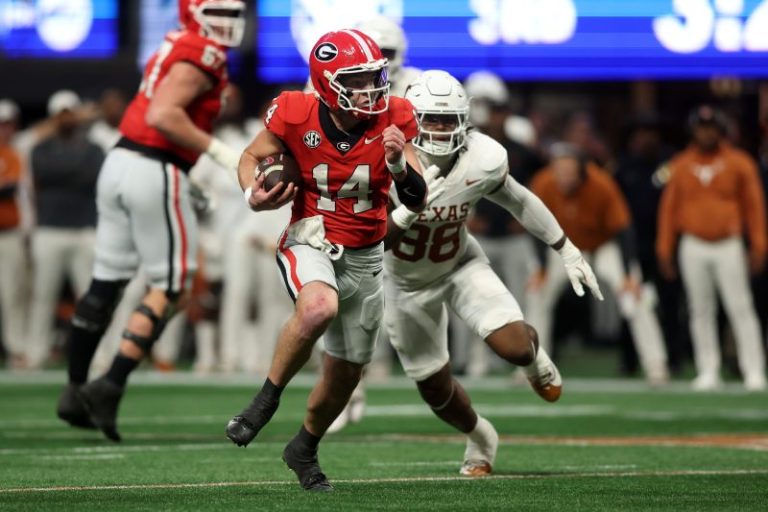
Georgia and Texas Tech among other schools, have said they plan to allocate large percentages of the money they pay to athletes to football players and men’s basketball players. Because this money will be coming from the schools, rather than third parties, this seems all but certain at some point to result in a Title IX lawsuit. As objectors have noted in their legal arguments, Title IX states, in part that no person ‘shall, on the basis of sex, be excluded from participation in, be denied the benefits of, or be subjected to discrimination under any education program or activity receiving Federal financial assistance.”

An array of objectors to the settlement, and their attorneys, vehemently raised Title IX issues about how the damages money is overwhelmingly set to go to football and men’s basketball players. Among their arguments was that such an arrangement would lead schools to have an extremely disproportionate payment structure going forward. The counter to this argument is that, in general, football and men’s basketball players have greater market value than women’s athletes, and that head coaches in football and men’s basketball, generally, are paid much more than coaches of women’s teams.

The counter to this counter, as one set of objectors argued, is that by historically ‘failing to invest in women’s sports, the NCAA depressed the value of women’s NILs relative to their male counterparts. The parties know this.’

While overruling Title IX-related objections to the settlement, Wilken wrote: ‘To the extent that schools violate Title IX when providing benefits and compensation to student-athletes … (athletes) will have the right to file lawsuits arising out of those violations.’

The Biden Administration in January issued guidance saying NIL payments from schools were subject to Title IX scrutiny. The Trump Administration has rescinded that guidance.

What new procedures for college sports are being implemented?

While NCAA governance groups have set up changes to the association’s rules to accommodate the settlement, the NCAA’s central-office investigative and enforcement staffs are not going to be involved in the day-to-day oversight and operation of rules and procedures created by the settlement.

That work is being left to the power conferences and the new College Sports Commission, which will handle:

Rules-making.

Managing the NIL Go system, an electronic system that athletes will be required to use to report the details of their NIL deals with entities other than their schools.

Figuring out how to determine the legitimacy of those deals, and how to deal with appeals by athletes, who — under the settlement — can seek arbitration if they want to challenge a determination that a deal is not legitimate relative to having a “valid business purpose” and being within “a reasonable range of compensation.”

Forming a new regulatory and enforcement entity that will be led newly named chief executive officer Bryan Seeley. According to the announcement of his hiring on June 6, Seeley ‘will build out the organization’s investigative and enforcement teams and oversee all of its ongoing operations and stakeholder relationships. … Seeley and his team will also be responsible for enforcement of the new rules around revenue sharing, student-athlete third-party name image and likeness (NIL) deals, and roster limits. The Commission will investigate potential rules violations, make factual determinations, issue penalties where appropriate, and participate in the neutral arbitration process set forth in the settlement as necessary.’ 

Attendant to all of this will be training school administrators in all of the new procedures and systems. In addition, Seeley faces the more intangible task of attempting to create buy-in and a culture of compliance among schools, administrators and coaches who are always looking for an edge on their competitors, and, in recent years, have become increasingly hostile toward investigations and enforcement from the NCAA, at least.

While there will be a cap on schools’ total pay to athletes, the athletes’ ability to have deals with other entities still leaves plenty of room for inequities, perceived or otherwise.   

What will school NIL deals with athletes look like?

They will be anything except “employment” agreements. (The issue of athletes as school employees remains pending before a federal district court in Pennsylvania, where the NCAA and schools are arguing for dismissal, and for consideration from Congress, where Sen. Ted Cruz, R-Texas, continues to pursue a comprehensive college-sports bill.)

In general, they will grant the schools wide-ranging use of athletes’ NIL and place some significant limitations on the athletes. This is based on a court filing by an entity that was seeking to submit a friend-of-the-court (or, a amicus) brief — a commentary on the case by an interested third party.

The filing, in late March, came from lawyers for Athletes.org, Inc., an organization that described itself in the filing as an entity that “exists to educate, organize and represent college athletes as their chosen players association to ensure that their interests are protected as college athletics continues to evolve.”

Supporting exhibits that included documents described as templates of NIL agreements written by the Big Ten and Southeastern conferences and from the universities of Arizona, Kansas and Minnesota.

In response to an open-records request from USA TODAY Sports after the filing, Minnesota provided the current version of its template “Memorandum of Understanding.” Among its provisions, in an “Annex” to the MOU, it says the athlete “grants the Institution the right to use and sublicense Athlete’s NIL to promote the Institution, the Conference, and/or the NCAA and/or such entities’ respective third party partners, sponsors, affiliates and sublicensees in any way …’’

In a provision that has taken on greater significance in the wake of Nico Iamaleava’s transfer from Tennessee to UCLA, the document attributed to Arizona includes as “optional” language the terms for a buyout that could be required of an athlete — or their subsequent school, on their behalf — if they transfers during the term of the agreement. Arizona did not respond to an inquiry in late March about this document.

How are schools paying for these deals?

All kinds of strategies are being pursued. Tennessee said it will be charging its football-ticket customers a “talent fee.” Virginia Tech is set to raise its student athletic fee for the 2025-26 school year by nearly $300. (It also hosted a concert in May by Metallica, whose song, “Enter Sandman,” long has been the Hokies’ pre-football-game entry soundtrack).

Minnesota is seeking a potential naming rights deal for its venerable basketball arena, currently known as Williams Arena. Virginia and other schools are re-visiting donation levels that will be required for season-ticket purchasing rights. Oklahoma’s athletics department has said it is laying off 5% of its full-time employees. Florida athletics director Scott Stricklin recently told longtime journalist Pat Dooley’s ‘Another Dooley Noted Podcast’ that he asked all Gators coaches to cut their budgets by 5%.

Meanwhile, schools from power conferences also will be counting on conference revenue shares increasing even as the conferences and the NCAA pay the settlement damages over time and the SEC also repays the $350 million it borrowed and distributed to members in 2021 to help them through the COVID-19 pandemic.

What about college athletes who opt out of settlement?

There are several hundred athletes who have opted out of the settlement and some, at present, are pursuing separate damages claims, though not all under the same lawsuit.

This may not turn out to be a class action, but there are some recognizable names making cases that they individually are owed money. Among them:

Men’s basketball players: Kris Jenkins, Frank Mason III, Franz Wagner, Moritz Wagner, Hunter Dickinson, Duncan Robinson, Jamal Shead, Jaime Jaquez.

Football players: Jake Browning, Cam Rising, Alex Hornibrook, Dax Milne, Drew Lock, Bryce Love, Cade McNamara, Donovan Peoples-Jones, Jake Fromm, Nakobe Dean, Will Levis, Trace McSorley.

Women’s basketball players: Kathleen Doyle, Kathryn Westbeld, Sophie Cunningham.

Baseball players: Griffin Conine, Jordan Beck, Matt McLain, Shea Langeliers.

This post appeared first on USA TODAY

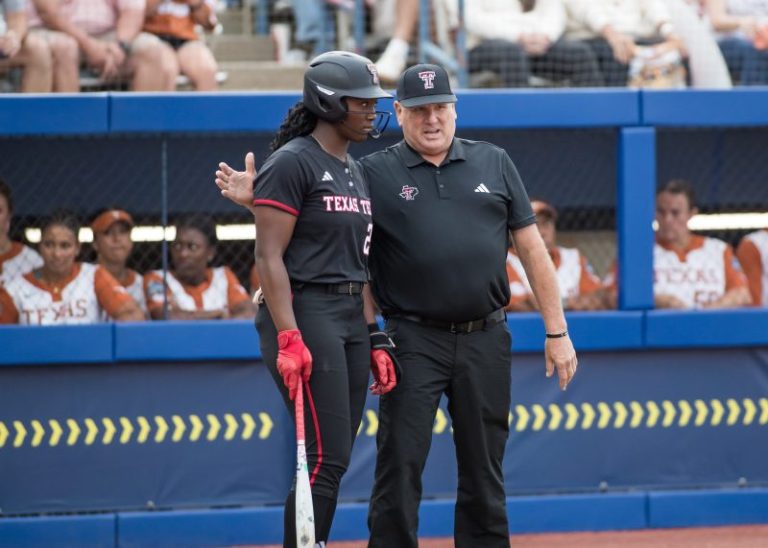
Shortly after his Texas Tech softball team lost to Texas 10-4 in game three of the championship series of the 2025 Women’s College World Series, Gerry Glasco was asked about a familiar subject.

Throughout the Red Raiders’ run in the NCAA tournament and WCWS, there was a significant amount of attention paid to NiJaree Canady, the Stanford transfer whose pitching excellence helped Texas Tech improve from an eighth-place finish in the Big 12 in 2024 to the precipice of a national title the following year.

Most any conversation around Canady inevitably turned to her name, image and likeness deal with the school’s collective, which reportedly paid her more than $1 million.

When Canady and her NIL payments were mentioned in a question during Glasco’s post-game news conference, the first-year Texas Tech coach pushed back.

“Why is it different for a female athlete to be paid a million dollars than a male football player getting three million or four million for a male basketball player?” Glasco asked rhetorically. “I think that’s an interesting question because the value of NiJa Canady to our program is, I think, unbelievable. I’m not an expert. Somebody could really do an in-depth study. But I have no doubt it would exceed a million dollars of value. I think it was of great value for our school.”

Canady sent shockwaves through the sport after the 2024 season, when the reigning national player of the year left Stanford and got a seven-figure deal from the Red Raiders, who had never even made the super regional round of the NCAA tournament and were coming off a season in which they went 8-16 in Big 12 play.

Along with Glasco and a handful of players he brought with him from Louisiana, Canady immediately improved the program’s fortunes, leading it to Big 12 regular-season and tournament titles, a school-record 54 wins and its first-ever WCWS appearance. This season, Canady went 34-7 with a 1.11 ERA and was one of three finalists for USA Softball player of the year honors. She was also one of the Red Raiders’ best power hitters, with a team-high 11 home runs. Until she was pulled early in Friday’s loss, she had thrown every pitch for Texas Tech since the beginning of the super regional round, a run of seven consecutive games.

While her NIL deal was the largest ever for a college softball player, Glasco said he believed the rate at which it was brought up during broadcasts of Texas Tech games was “almost insulting” to Canady. Canady’s NIL arrangement with the school was cited constantly by television crews throughout the WCWS.

It highlights what Glasco believes is a double standard between how highly-paid female college athletes are treated versus their male counterparts.

“I think it’s interesting, you watch Ohio State in the men’s football game, national championship game, you don’t hear any announcers talking about NIL,” he said. “They just don’t talk about it. And yet, you know Ohio State had one of the highest two or three NIL payrolls last year in college football. I wonder why we talk about it for a female athlete.”

Glasco added that the exposure she brought to a previously overlooked program was invaluable. When Canady transferred to the Red Raiders, he was told there were 700,000 stories that mentioned Canady, Texas Tech and Stanford. He estimated that after Friday, the team had played 10 or 11 games on national television.

Though Canady struggled in her final game of an otherwise stellar season, giving up five earned runs in one inning while pitching her third game in as many days, she has one more season of eligibility remaining and is well-positioned to keep the Red Raiders in national title contention. In the hours before the first pitch of the final WCWS game, ESPN reported that Canady had signed another seven-figure deal to stay at Texas Tech.

If her coach has his way, it might not be the same kind of talking point next season that it was throughout this one.

“Personally, I’m thrilled for NiJa,” Glasco said. “I found it almost insulting to her at times when I listened to broadcasts, how much they talked about it because, like I said, I don’t hear it when we watch a men’s basketball game or a men’s football game. And to me that’s not right. That shouldn’t be that way.”

This post appeared first on USA TODAY
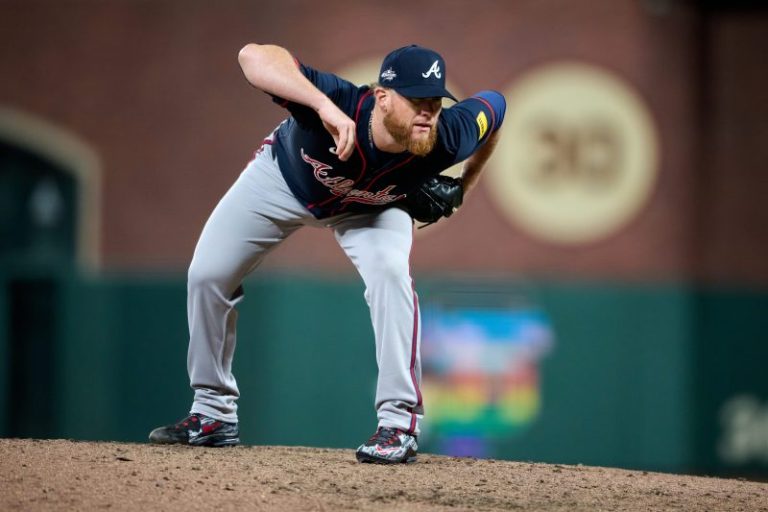
The Atlanta Braves designated nine-time All-Star reliever Craig Kimbrel for assignment on Saturday.

Kimbrel, 37, made his season debut Friday night and allowed one hit in a scoreless seventh inning in Atlanta’s 5-4, 10-inning loss at San Francisco. The right-hander had one walk and one strikeout and threw 14 pitches.

Kimbrel, who began his career in Atlanta in 2010, was called up from Triple-A Gwinnett prior to Friday’s game against the Giants. He signed a minor league deal with the Braves in March.

Kimbrel led the National League in saves in four straight seasons with the Braves from 2011-14.

He ranks fifth all-time with 440 saves and has a 2.59 ERA in 838 career games (no starts) over 16 seasons with eight teams.

Atlanta recalled left-hander Austin Cox, 28, from Triple-A Gwinnett in a corresponding transaction. He last pitched in the majors with the Kansas City Royals in 2023.

This post appeared first on USA TODAY
Spencer Carbery of the Washington Capitals was named the winner of the 2024-25 Jack Adams Award on Saturday.

The honor is presented to the NHL coach who is judged to have made the biggest contribution to a team’s success.

While attending what he thought was a season-ending interview, the 43-year-old Carbery was presented with the award by his wife, Casey, and their children, Hudson and Vivian.

‘Wow, I had no idea,’ a clearly stunned and choked-up Carbery said.

If that weren’t emotional enough for Carbery, extended family members from throughout the U.S. and Canada also were there to share in the moment.

Carbery led the Capitals to a 51-22-9 (111 points) record this season as the team finished first in the Eastern Conference in his second season as Washington’s coach.

He got strong seasons out of a host of new players who were acquired in the offseason and improved on the team’s offensive and defensive numbers. He kept the team winning while eventual all-time leading goal Alex Ovechkin missed 16 games with a broken leg.

Carbery becomes the fourth coach in franchise history to win the award, joining Bryan Murray (1983-84), Bruce Boudreau (2007-08) and Barry Trotz (2015-16).

He is also the first person recognized as coach of the year in the ECHL, American Hockey League and NHL.

The members of the NHL Broadcasters’ Association select the Jack Adams winner.

Carbery received 81 first-place votes on the 103 ballots cast and finished with 464 points. Scott Arniel of the Winnipeg Jets had 249 points, followed by Martin St. Louis of the Montreal Canadiens with 66.

The Capitals lost in the second round of the Stanley Cup playoffs, defeated by the Carolina Hurricanes in five games.

Other NHL awards winners

Mark Messier Leadership Award: Alex Ovechkin, Washington Capitals

This post appeared first on USA TODAY
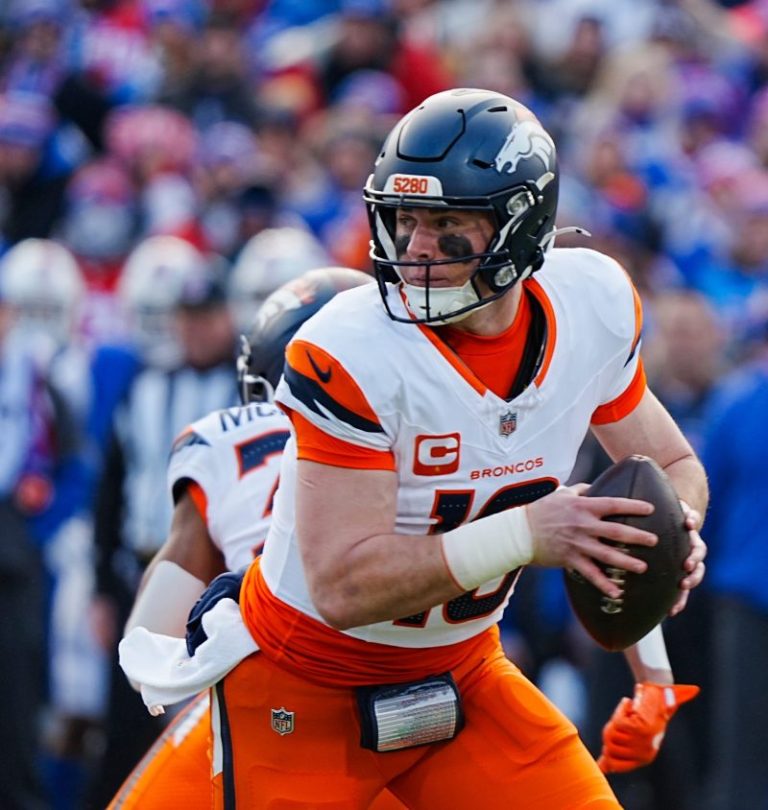
It was about quarterback Bo Nix. It went like this. They knew that Nix was a good athlete. They saw it when Nix was at Oregon. But they didn’t realize how explosive he was until Nix started actually practicing and playing in the NFL.

‘One thing about the QB that came even as a little surprise for us,’ Payton told USA TODAY Sports, ‘was seeing some of these off-schedule throws from him, and it kind of stunned us at how good he was at that. It’s because he’s so fast. I don’t think people get how athletic and how fast he is.’

Off-schedule or off-platform throws are when the quarterback makes a pass while not in a balanced or standard throwing position. Kansas City’s Patrick Mahomes excels at these. Nix is getting really good at them. In fact, he’s getting good at it all. He’s a big reason why the Broncos’ Super Bowl window is officially open now. You read that correctly.

Payton is asked for a bottom-line evaluation of Nix. ‘I’m seeing a player who I think will continue to make big strides,’ said Payton.

Nix last season was off to a good start. He set Broncos rookie records for passing touchdowns (29), completions (376) and passing yards (3,775). He was also the first rookie quarterback in league history to record multiple games with at least 300 passing yards, four passing scores and a passer rating of at least 140.

What Payton has found in Nix is most likely another quarterback star. Payton has had this before. (More on that in a moment.) This season we could see this duo become the most dangerous coach-quarterback combo in football. It’s also why that Super Bowl window is opening now.

Notice, I didn’t say the best coach-quarterback combo (though that could happen as well). I said the most dangerous.

If anyone can unseat the current best combo right now in Andy Reid and Mahomes, with three straight Super Bowl appearances, it would be this one. Yes, the combo of Nick Sirianni and Jalen Hurts just beat Kansas City in the Super Bowl, but Reid-Mahomes is still the gold standard.

Payton and Nix, however, just entered the chat. The Broncos were a stunning 10-7 last year in part because Nix shocked everyone. But there’s a reason he did. This is what Payton does. Give him a good quarterback, he makes him really good. Give him a great quarterback, he helps make him a certain Hall of Famer. See: Brees, Drew.

Brees finished his career as the NFL’s all-time leader in passing yards and completions when he retired in 2021. Tom Brady would later pass him. (Brady would later pass errybody.) Brees made 13 Pro Bowls and won a Super Bowl, where he was also named Super Bowl MVP.

Brees once remembered how this historic pairing began.

‘It goes back to when he first sat me down before I ever signed with the Saints, and he started drawing up plays on the board that was a combination of his West Coast offensive background and philosophy, and the things that I did well with the San Diego Chargers,’ Brees said. ‘I remember looking at him saying, ‘Oh, you guys run these concepts as well?’ And he said, ‘No, but I know that you ran these and you ran them very well, and we’re going to build this offense around you and your strengths.’

‘Right away, I realized that that was such a unique approach and maybe so much different than what I expected, especially from a first-time head coach, coming into a really tough situation with high expectations.’

That is classic Payton.

I’ll always believe that Payton is the best play caller in the history of the sport. One of the best play designers. One of the best at getting his players to understand his concepts, and adapting his concepts to the player. I know this because I’ve seen it up and close and personal. Watched him do it. Brees will skip into the Hall of Fame and some day Payton will follow him.

Now, I’m seeing the same thing in Denver. It goes beyond the obvious that Nix and Brees are similar specimens. It’s Payton again morphing the offense around what Nix does best. Payton is also criminally underrated in building a good culture. He’s creating Saints West. Not the Saints you see now. Or the almost comically bad Saints teams from the 1970s. It’s the one that was once solid and even feared.

Payton is helping his own cause by putting pieces all around Nix. The Broncos had a successful offseason signing key free agents in safety Talanoa Hufanga, linebacker Dre Greenlaw, and tight end Evan Engram. The latter will be that ‘joker’ weapon for the Broncos who maneuvers around the formation creating mismatches.

“That is a cool thing to just embrace,” Engram said. “Sean talks about it a lot. It was a big part of the pitch coming here. … I definitely see that it is something that has to be earned with the way I work and the way that I learn the offense to gain the trust of Sean, Bo, and the rest of the coaches and players. I think we have a bunch of ‘Jokers’ on this team, honestly, that can have a great role on this offense. It is definitely something that I like to embrace, but it is also something that I am going to earn, too.”

And there’s a piece of data you should know. The Broncos had 134 games missed due to injuries in 2022. That number fell to 35 in 2023 and 33 last season. It shows Payton is figuring out more than just the QB situation.

So, this is just your warning. Will the Broncos win the Super Bowl this year? Maybe not. Or, heck, maybe so.

What’s certain is the Super Bowl window for this team is officially open. Thanks primarily to Payton and Nix.

This post appeared first on USA TODAY