Archive

2025

Browsing

Boxing superstar Canelo Alvarez will return to the ring in September to face undefeated Terence Crawford in a bout streamed live on Netflix.

The battle for the unified Super Middleweight title will take place September 13 in Las Vegas, according to a news release from the Saudi Boxing Federation, which is promoting the match in partnership with UFC chairman Dana White.

“I’m super happy to be making history again and this time on a Riyadh Season Card that will be broadcast on Netflix,’ Alvarez said in the release. ‘On September 13, I’m ready to show once again that I am the best pound-for-pound fighter in the world.”

Alvarez will take a 62-2-2 record into the fight. Crawford is 41-0 with 31 knockouts. 

The bout comes roughly 10 months after Netflix rode a wave of massive public interest in its production of Jake Paul’s unanimous decision over Mike Tyson last November, which tallied upwards of 65 million streams.

However, Netflix’s first foray into live boxing also suffered from a rash of technical glitches that drew widespread frustration and criticism from viewers.

The streaming giant also pulled in another 65 million combined viewers on its two NFL broadcasts on Christmas Day 2024. But perhaps more significantly, the glitches that plagued the Paul-Tyson bout were largely corrected.

Netflix’s says its live coverage of Alvarez vs. Crawford will be available to its more than 300 million worldwide subscribers at no extra cost.

This post appeared first on USA TODAY

If College Football Playoff indeed expands to 16 teams, it will become a more attainable destination for three-loss teams from coast to coast.
Bigger playoff could help teams ranging from Alabama and Michigan to Northwestern and Kentucky.
In multiple seasons, the SEC would have qualified seven teams for a 16-team playoff.

When Oregon State went 9-3 during the 2022 regular season – its best season in 16 years – the Beavers earned a trip to the Las Vegas Bowl. If a 16-team College Football Playoff had been in place that season, the Beavers would have qualified.

Conference commissioners are debating the playoff’s future format for 2026 and beyond, and momentum swells behind growing the playoff from 12 to 16 teams.

If the playoff indeed expands by four teams, it will become a more attainable destination for three-loss teams from coast to coast.

No two-loss team ever qualified for the playoff until the playoff grew from four to 12 teams. No three-loss team has ever qualified, but my analysis of the 11-year playoff era shows that at least two three-loss teams would have made the playoff each year if a 5+11 playoff format had been in place during those seasons.

That 5+11 model is the favored format by the Big 12 and ACC, and it’s gaining support within the SEC, too. In that model, the top five conference champions would gain automatic bids, and the remaining 11 spots would be filled via at-large selection.

The Big Ten favors a different 16-team model in which most qualifiers would gain entry via an auto-bid process. For the purposes of my analysis, I used the 5+11 framework.

The analysis became tricky, because so many teams changed conferences in the past 11 years. I counted teams in the conferences that they’ll call home in 2026. So, a bid for Texas counted toward the SEC, a bid for Oregon counted for the Big Ten, and so on. In some years when Texas or Oklahoma, now in the SEC, won the Big 12, I awarded an automatic bid to the Big 12’s runner-up. Other years, I assigned the Big 12’s auto bid to Central Florida or Cincinnati – those schools are now in the Big 12 – when those schools were highly ranked and won conference championships. Assigning the Group of Six’s automatic qualifier became a chore in certain years, too, because of conference realignment.

You could conduct this analysis in slightly different ways, but it wouldn’t change the upshot that a 16-team playoff would have been a boon for three-loss teams these past 11 years.

FALL FROM GRACE: SEC explanations shows its no longer top playoff dog

NO CUPCAKES: If SEC wants playoff respect, it needs tougher games

Last season, a trio of three-loss SEC teams – Alabama, Mississippi and South Carolina – would have qualified.

The SEC and Big Ten would have benefited most from the four extra at-large spots, as compared to a 12-team playoff, but teams from the Big 12, ACC, the reconstructed Pac-12 and Notre Dame also would have grabbed last-four-in spots in some years.

In 2014, a whopping seven teams with three losses scattered across each of the Power Four conferences would have qualified for a 16-team playoff using the 5+11 format.

Oh, and how about this: The playoff would have featured its first four-loss teams. Auburn (2016), Stanford (2017) and Texas (2018) were four-loss teams ranked high enough to crack a 16-team playoff.

In other words, once the playoff hits 16 teams, it’s no longer a destination reserved for the elite.

Kentucky, Northwestern could have made 16-team playoff

Based off past results during the playoff era, the four extra at-large bids would have helped teams ranging from Northwestern, Kentucky, UCLA, Washington State and Georgia Tech to blue bloods like Alabama and Michigan.

“Sixteen teams, you’d get more people excited about it, more people in play,” said Mississippi coach Lane Kiffin, a proponent of a 16-team playoff.

Beyond the 16 teams that qualify would be many more remaining in playoff contention into November.

The 12-team playoff ‘created a lot of interest,’ Big 12 commissioner Brett Yormark said during a call with reporters. ‘Going to 16 teams, I think, there’s more of that.”

The four-team playoff became an exclusive party reserved for top-perch programs like Alabama, Ohio State, Oklahoma and Clemson.

A 16-team playoff would broaden avenues of access to the middle class and even traditionally lower-tier teams within power conferences that could align the stars and crack the bracket with a 9-3 record.

Blue-blooded Alabama twice would have been among the last-four-in in a 5+11 playoff format. That’s also true of fellow blue bloods like Michigan and Notre Dame. Also, though, Northwestern twice would have qualified in the last-four-in.

Three times in the past 11 years, Ole Miss would have been in the last-four-in of a 5+11 playoff, ranking the Rebels as the biggest beneficiary of the playoff expanding by four teams.

Is it any wonder Kiffin wants 16 teams?

Expanded College Football Playoff would help blue bloods, too

Here are some other findings from my analysis applying the 5+11 format to the past 11 seasons:

∎ Alabama and Ohio State never would have missed the playoff. Georgia would have qualified in nine of 11 seasons, and Clemson would have qualified eight times.

∎ Notre Dame is among the programs that would have qualified seven times.

∎ The Big Ten would have led with 53 bids, followed by the SEC’s 51, meaning each conference would have averaged more than four bids per year. The Big 12 and ACC would have averaged more than two bids per year.

∎ Fourteen of the SEC’s 16 programs would have qualified at least once, with Arkansas and Vanderbilt as the only exceptions.

∎ Twelve of the Big Ten’s 18 programs would have qualified at least once. The non-qualifiers would have been Illinois, Maryland, Minnesota, Nebraska, Purdue and Rutgers.

∎ The Big Ten would have peaked at six bids but never qualified fewer than four teams.

∎ The SEC’s bid total would have bottomed out at three bids but peaked with seven bids in 2018 and again in 2023.

∎ Thirty-one programs would have qualified as a last-four-in team at least once throughout the 11 years.

No wonder the 16-team playoff concept gains steam. The four extra spots would help a wide range of programs gain playoff access.

College football accelerates away from an era that demanded an undefeated or one-loss record to make an elitist playoff, and toward a terrain in which 9-3 equals a playoff berth instead of a mid-tier bowl bid.

Blake Toppmeyer is the USA TODAY Network’s national college football columnist. Email him at BToppmeyer@gannett.com and follow him on X @btoppmeyer.

This post appeared first on USA TODAY

One thing is certain as the College World Series advances to Omaha, Nebraska: There will be a new national champion in 2025.

Defending winner Tennessee was ejected in super regional play by Arkansas, which swept the Volunteers in their best-of-three series. The Razorbacks join LSU to make the SEC the only league with multiple schools in the eight-team field.

Instead, the World Series features an eclectic makeup of national programs representing six conferences along with one independent, Oregon State. There’s even a Cinderella story in Murray State, which beat Duke 5-4 in Monday’s elimination game to continues its magical run through the tournament.

For a few teams, this year’s College World Series marks a long-awaited return to Omaha. That includes the Beavers, who hadn’t reached this point since 2018, and UCLA, which hadn’t advanced to the final eight since winning the 2013 national championship.

With no obvious favorite heading into the weekend – on paper, the Razorbacks and LSU are probably the teams to beat – this looks to be a wide-open CWS that could end with any one of the teams celebrating on Charles Schwab Field.

The double-elimination World Series format will conclude with the top two teams playing a best-of-three championship series. The initial matchups will be Arizona against Coastal Carolina, Louisville against Oregon State, UCLA against Murray State and Arkansas against LSU.

Before moving on to Omaha, let’s look back at the biggest winners and losers from the super regionals:

Winners

Murray State

The Racers will make the program’s College World Series debut after winning two in a row against the Blue Devils, rolling to a 19-9 win on Sunday and then winning 5-4 in Monday’s decider. The loss continues Duke’s World Series drought, which dates to 1961. Murray State simply wasn’t expected to get here: Underdogs in the Oxford regional against Mississippi, the Racers beat the Rebels 12-11 to reach the program’s first super regional and then rallied out of another hole to become just the fourth regional No. 4 seed to reach Omaha.

Coastal Carolina

The Chanticleers will make the second World Series appearance in program history after sweeping Auburn out of the tournament, winning 7-6 in the first game and 4-1 in the second. In the opener, Coastal coughed up a 6-1 lead but went back ahead in the top of the 10th inning on a solo homer from junior catcher Caden Bodine, one of the top backstops in the country. Tied 1-1 in the seventh inning in the second matchup, the Chanticleers got an RBI single from Walker Mitchell to take the lead and then scored another pair on a fielding error and a bases-loaded hit-by-pitch. Keep an eye on these guys: CCU has now won 23 games in a row. The last time Coastal was here it won the whole thing in 2016.

Arizona

Reaching this point is a surprisingly rare achievement for one of the nation’s more notable programs. Beating North Carolina in Chapel Hill sends Arizona to the College World Series for the 19th time but the programs hasn’t won a title since 2012. And this year’s team was not expected to advance this far after scuffling through the end of the regular season, dropping five of six in May against some middling competition, including two of three in a series against Utah, the last-place team in the Big 12. But Arizona is now 8-1 in postseason play after capturing the Big 12 tournament, sweeping through the regional hosted by Oregon and taking two of three against the Tar Heels.

Variety

There are some heavyweights in the field: LSU won the seventh championship in program history in 2023; Oregon State has won three, most recently in 2018; Coastal won in 2016; UCLA won in 2013; and Arizona has won four times. Arkansas is still seeking its elusive first title after reaching the finals twice, in 1979 and 2018. But none of the teams in Omaha made the World Series last year, bringing a fresh new feel to college baseball’s biggest stage.

Losers

The ACC

Let’s start with the good news: Louisville outlasted Miami in three games to make the sixth cws in program history. But the ACC had another two teams join Duke in losing in super regional play. North Carolina walloped Arizona 18-2 in the opener of this past weekend’s set in Chapel Hill but then dropped back-to-back games for the first time since March. Florida State also pushed Oregon State to the distance but dropped the opener 5-4 in extra innings and then fell behind 13-3 in the deciding matchup before fighting back to lose 14-10.

North Carolina

The second loss to the Wildcats was absolutely brutal. UNC led 3-1 heading into the eighth inning thanks to a three-run homer from senior Jackson Van De Brake only to give the game away with a pair of errors on the infield. The first, on a grounder booted by Van De Brake, cost the Tar Heels a possible double play. UNC then swapped out starter Ryan Lynch for freshman Walker McDuffie only to commit a throwing error on Arizona’s bunt attempt to move runners over, allowing a run to score. Another pitching change to Aidan Haugh, working on back-to-back days for the first time this year, resulted in a two-run single that gave Arizona the lead and eventually the College World Series berth.

The biggest stories, every morning. Stay up-to-date on all the key sports developments by subscribing to USA TODAY Sports’ newsletter.

This post appeared first on USA TODAY

LOS ANGELES — Free-agent pass rusher Za’Darius Smith is aware of where he wants to continue his playing career.

His heart is still in Motown.

“We both know where I want to be,” Smith told USA TODAY Sports at the 2025 BET Awards. “Hopefully I can get back to Detroit because the coaching staff and everybody in the front office are great. When I’m there I feel like a leader and like I can influence the young guys and do great things. Hopefully I can get back to where I want to be in Detroit.”

Smith played for the Baltimore Ravens, Green Bay Packers, Minnesota Vikings, Cleveland Browns and Detroit Lions during his NFL career. The Lions acquired Smith from the Browns last season ahead of the trade deadline. Detroit got Smith at a time in which the club desperately needed pass rush help following Aidan Hutchinson’s season-ending leg injury.

The veteran produced 12 tackles, four sacks and 40 pressures in eight games with the Lions all without Hutchinson. Hutchinson, Smith and defensive tackle Alim McNeill were the Lions highest-graded pass rushers last year, per Pro Football Focus.

Hutchinson’s since been cleared to return to football activities this offseason, and Smith believes the two can form a stout edge tandem.  

“I’m still a veteran. He’s still a young guy. I can help him with a lot of things. He’s already great but as a player there are some tools that I know that I can help him with,” Smith said. “And there are some things as a young guy that he can help me with.”

Smith is one of USA TODAY Sports’ top remaining free agents. He’s compiled 333 tackles, 69 sacks and 173 QB hits in 140 career regular-season games. The 32-year-old showed this past season that he still has plenty left to give to a team. At this stage of Smith’s career, though, the three-time Pro Bowler wants to compete for a championship – and he’s holding out hope that he’ll chase a ring in Detroit.

“I’m going into Year 11. As a veteran (a championship) is the only thing that I’m missing,” Smith said. “I did the sacks, All-Pro, Pro Bowl, so it’s really just me getting a ring now and winning a championship.”

Follow USA TODAY Sports’ Tyler Dragon on X @TheTylerDragon.

This post appeared first on USA TODAY

President Donald Trump told Fox News that Iran has become ‘much more aggressive’ in nuclear talks. 

‘Iran is acting much differently in negotiations than it did just days ago,’ Trump told Fox News’ Bret Baier. ‘Much more aggressive. It’s surprising to me. It’s disappointing, but we are set to meet again tomorrow – we’ll see.’

Senior administration officials also told Fox News that Iran appears to be dragging negotiations on without concrete progress while pushing forward with its nuclear efforts.

Meanwhile, outgoing Commander of U.S. Central Command (CENTCOM), General Michael E. Kurilla, told the House Armed Services Committee earlier this year that he had prepared ‘several plans and options’ for Trump and Defense Secretary Pete Hegseth ‘in the event there is no agreement with Iran.’

This is a developing story. Check back for updates. 

This post appeared first on FOX NEWS

The U.S. State Department and Secretary Marco Rubio punched back at claims that contracts providing Ready-to-Use Therapeutic Foods (RUTFs) have been halted and affirmed the agency will continue its commitment to ‘delivering critical humanitarian aid.’

‘As USAID transitions under the State Department, our commitment to delivering critical humanitarian aid remains steadfast and aligned with America’s foreign policy priorities,’ a senior State Department official told Fox News Digital in an exclusive statement. 

‘We are proud to continue working with our local partners to deliver life-saving ready-to-use therapeutic food. Most recently, an additional $50 million in RUTFs was approved. This is enough to nourish over one million of the world’s most vulnerable children.’

RUFTs’ contracts and operations were previously overseen by the United States Agency for International Development (USAID). However, oversight now lies with the State Department after USAID merged into the agency in February, largely influenced by then-Department of Government Efficiency (DOGE) head Elon Musk. 

RUTFs are pre-packaged, nutrient-rich, ready-to-eat meals that help prevent malnutrition, mainly in children. Some countries even refer to RUTFs as a form of medicine. 

The State Department’s comments come after Secretary Rubio faced questions from lawmakers on Capitol Hill in a May hearing, when Democratic Rep. Gabe Amo of Rhode Island confronted Rubio in a heated exchange, saying the agency was intentionally ‘freezing’ RUTF aid to countries in need. 

‘You need to figure out why they’re not moving, because it isn’t an impediment for us,’ Rubio fired back. 

Amo responded, ‘No, you need to figure [that] out, sir,’ and said that the secretary ‘refused to make’ a commitment to ensuring effective RUTF distribution. 

‘We’re going to continue to do food aid,’ Rubio answered. ‘We’re going to do more food aid than any other country on the planet, times 10.’

A source at the State Department revealed to Fox News Digital that key partnerships with non-profit RUTF producers, MANA and Edesia, have been active since March 2. Additionally, 1.4 million boxes of RUTFs were approved on May 26.

Fox also obtained an internal document and action memorandum for Jeremy Lewin, a former DOGE employee now overseeing the transition of merging USAID with the State Department, from USAID’s Dianna Darney de Salcedo. The document called for urgent approval to move food commodities and RUFTs that were stored in warehouses to be shipped for use. 

The sensitive but unclassified document also revealed a request to approve a new Title II award, valued at $35 million, which sources say was several times less than initially estimated, to cover the costs of warehouses, shipping overseas, transporting inland, programming and distribution.  

Fox News Digital spoke to MANA CEO Mark Moore, who outlined a detailed timeline of RUTF federal contract negotiations and the challenges the non-profit faced as USAID merged into the State Department at the beginning of 2025.

At one point, before the State Department and the Trump administration proposed contracts in May, Moore told Fox News, ‘We’re all looking at June and July running out of these old contracts and saying we’re just going to have to close the doors.’ He noted that ‘if this new order didn’t come out, we’d really be screwed going into the summer.’

‘It is trending the right way, and we’re thrilled,’ Moore added. 

Fox News Digital reached out to Rep. Gabe Amo and Edesia but did not receive a response. 

Preston Mizell is a writer with Fox News Digital covering breaking news. Story tips can be sent to Preston.Mizell@fox.com and on X @MizellPreston

This post appeared first on FOX NEWS

LONDON — Wherever Nvidia CEO Jensen Huang goes, excitement follows — this time, all the way to London Tech Week.

The Nvidia boss — whom Wedbush analyst Daniel Ives dubs the “godfather of AI” — is more like a rockstar these days, given his wide-spanning effect on the AI industry.

“The amount of infrastructure required for AI wouldn’t be possible without that man,” one attendee at London Tech Week said.

“He’s like Iron Man,” the attendee added, referencing the popular Marvel superhero who is a tech billionaire inventor under the name of Tony Stark.

The lines to get into the Olympia auditorium were already building around 40 minutes before Jensen was set to take the stage alongside U.K. Prime Minister Keir Starmer. Not everyone managed to get in — but there were helpfully screens around the venue where people could catch a glimpse of Huang’s talk.

The Nvidia CEO gave his continued bullish assessment of artificial intelligence, calling it an “incredible technology” and saying it should be seen as infrastructure, just like electricity.

There weren’t any multi-billion-dollar investments touted at London Tech Week. But the biggest win for Starmer and the U.K. by far was Huang’s lavish praise for the country.

Wearing his trademark leather jacket, Huang called the U.K. the “envy of the world” that is in the midst of a “Goldilocks circumstance,” boasting a vibrant venture capital ecosystem, as well as budding AI entrepreneurs from leading firms including Google DeepMind, Synthesia, Wayve and ElevenLabs.

Speaking alongside Huang, Starmer spoke in an animated manner as he touted Nvidia’s investments in the U.K. Earlier in the day, the U.S. chipmaker announced a new “U.K. sovereign AI industry forum,” as well as commitments from cloud vendors Nscale and Nebius to deploy new facilities containing thousands of its Blackwell GPU chips.

Starmer spoke at length about AI’s promise and the ways in which it could ease the burdens faced by the U.K.’s public sector institutions, from hospitals to schools.

Huang added that the U.K. is “such a great place to invest,” noting that Nvidia plans to partner with the country to upskill tech workers and build out domestic AI infrastructure.

“Infrastructure enables more research — more research, more breakthroughs, more companies,” the Nvidia chief said. “That flywheel will start taking off. It’s already quite large, but we’re just going to get that flywheel going.”

Starmer thanked Huang for his point, commenting that “the confidence it gives when you explain it that way is huge.”

“From our point of view, we’re really pleased to be seen that way,” the U.K. leader said.

The pair shook hands at the end.

Altogether, there was a lot of energy in the room. Huang said he was “excited” for London Tech Week, and he was met with a round of applause from the audience.

Huang has become the CEO everyone wants to be seen with. Nvidia has positioned itself as central to the AI revolution, which many commentators say is in the early innings.

Nvidia wants that revolution to be built on its chips. And for countries like the U.K., these moments provide a chance for the country to tout its investment potential and for its leader to publicly share a stage with the man seen as powering the AI push.

London was Huang’s first stop in a broader European tour.

The Nvidia boss will travel to Paris later this week, where the chipmaker will host its GTC conference. Politicians including President Emmanuel Macron, who has driven France’s ambition to become a European AI hub, will also likely want some face time with Huang.

This post appeared first on NBC NEWS

According to a press release, the $50 million gift that will launch the Lurie Autism Institute (LAI) is ‘the largest single donation to U.S. academic medical centers focused on autism research across the lifespan.’

The Children’s Hospital of Philadelphia (CHOP), perhaps obviously, focuses its efforts in autism research with children, while Penn largely works with the adult community.

One of LAI’s main goals is to combine the work of CHOP and Penn and aid researchers in painting a broader picture of autism’s effects over a lifetime. As LAI Interim Director Dr. Dan Rader put it, the work they do will help researchers ‘better understand the condition, the heterogeneity, and how we can actually ultimately use the research to make a difference in their lives.’

In addition, the new institute and its funding will aim to incentivize other doctors and researchers — those not currently working on autism-related work — to join in supporting the work of CHOP and Penn Medicine. To that end, LAI will launch a certificate program from PhD trainees and postdocs called the ‘Next-Generation Program in Autism Bioscience,’ the press release said.

What are the goals for the Lurie Autism Institute?

‘This is a time when we’ve seen so many advances in neuroscience, genetics, imaging, molecular pathways, processes and artificial intelligence,’ Lurie told USA TODAY in an exclusive interview. ‘It’s opening up an entirely new world of possibilities for autism research.’

Both Rader and Lurie emphasized that a big part of LAI’s work will be determining how translational therapeutics might be effective in treating individuals on the spectrum, in part with the aid of the latest in artificial intelligence.

In other words, LAI’s efforts will consist of collecting data from existing and ongoing research and then, using new technology and AI, figuring out how that data can be translated into a form of treatment. That treatment, according to Lurie, could consist of repurposing certain drugs or gene editing.

‘The complex part of autism is there’s no single gene, there’s no single reason,’ Lurie said. ‘So it’s very research-based in order to get to the therapeutics.’

As LAI focuses largely on research, the clinical efforts at CHOP and Penn will continue and ‘likely expand’ in the wake of LAI’s launch, Rader said. Then, as those two organizations diagnose and work with more individuals on the spectrum, they could ‘recruit’ those individuals as ‘partners in the research to better understand this complex condition.’

In addition, Lurie said one of the main visions he has for LAI is to become a ‘catalyst’ for more worldwide funding and research to tackle the complexities of understanding autism.

As part of those efforts, the institute will host an annual international symposium and award a prize for autism research, according to the press release.

Lurie family has long history of autism research philanthropy

Lurie and his family are not newcomers to advocating for autism research and awareness.

“My brother is autistic. So for my family and me, we’ve been supporting the autism community for … decades,’ Lurie said. ‘That’s really where it all originated from.

‘My mother has really led the way over all these decades as the primary investor in autism research, and the rest of the family has followed suit. What I’ve done is just re-emphasize that over the decades, over the years.’

Lurie’s mother, Nancy Lurie Marks, founded the Nancy Lurie Marks Family Foundation (NLMFF) in 1977 to aid individuals with autism. In 2009, the NLMFF established the Lurie Center for Autism at Massachusetts General Hospital.

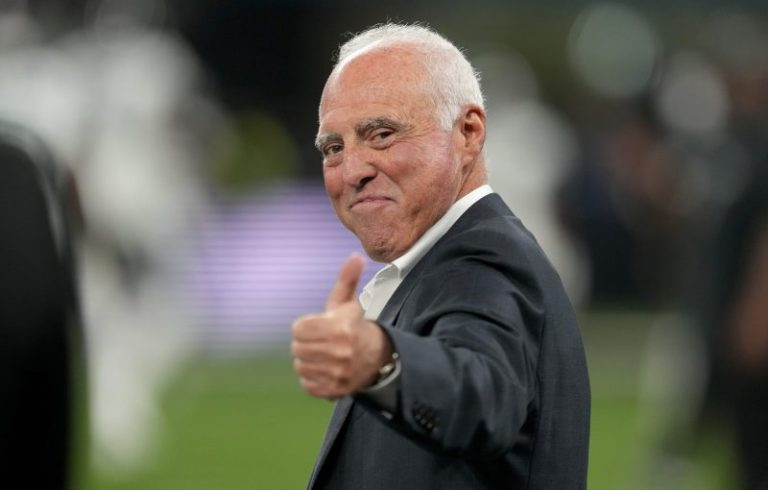
In 2018, Jeffrey Lurie started the Eagles Autism Foundation. And in 2019, the Eagles, the NFL team Lurie has owned since 1994, opened the NFL’s first in-stadium sensory room, ‘a dedicated space designed by medical professionals for those who may need a quieter and more secure environment,’ according to the team’s official website.

‘And wherever we go, whether it’s Brazil or the Super Bowl, we bring it along with us,’ Lurie said. ‘And (sensory-inclusive efforts have) become adopted by so many sports teams. It’s gratifying.’

Indeed, many sports teams across various leagues — MLB, MLS, the NBA and the NHL — have adopted similar sensory rooms and other tools. The Buffalo Bills, for example, offer sensory inclusion kits that include things like noise-canceling headphones and fidget toys to help make their games and events more inclusive to their neurodiverse fans.

Said Lurie: ‘I’ve always grown up in an atmosphere of acceptance and inclusivity, so when we have done things with the Eagles like we do with different organizations … we want to try to create inclusive atmospheres for autistic people no matter if they’re young or old.’

Increased efforts in autism research now ‘more important than ever’

The topic of autism research on a national level has gained steam in recent months. That has been inspired in part by U.S. health secretary Robert F. Kennedy Jr. — who in the past has promoted scientifically discredited theories that autism is linked to childhood vaccines — declaring in April that the U.S. will find the cause of autism by September.

As part of those efforts, Kennedy announced ‘a massive testing and research effort’ that will ‘involve hundreds of scientists from around the world.’

An HHS official told USA TODAY in late April that the National Institutes of Health (NIH) is using $50 million to invest in autism research. Other efforts headed by NIH — namely launching a real-world data platform using public data from federal agencies and data collected from private sector sources like smart watches and fitness trackers — and lack of clarity surrounding those efforts have resulted in heightened privacy concerns.

‘The use of registries and registry data in general can be a valuable tool in helping to understand the causes of diseases and disorders, but in this case, the lack of clarity around how data will be collected, shared, maintained and tested for accuracy raises red flags,’ a statement from the Autism Science Foundation read.

Despite the relevant timing, the launch of the LAI is not an event that is happening in response to Kennedy and the HHS’s recent initiative, Lurie clarified.

‘This notion of merging CHOP and Penn — I’ve been looking for where to do this for about three years,’ he said.

‘It just came to be probably about two years ago, and we’ve been talking ever since of how to make this great. So, no, it had nothing to do with anything else but trying to impact the lives of those with autism with all these new technologies and discoveries as best as possible.’

That doesn’t take away from the significance of the timing, says Rader.

‘There’s a lot of confusion right now about what are the causes of autism, what should we be doing about it, how might we better prevent it,’ he said. ‘It’s more important than ever to bring this information together in a synthetic way that allows us to really better understand this complex condition.

‘So, I think, yes, the rationale for this got even greater over the last few months.’

Kinsey Crowley contributed to this report.

This post appeared first on USA TODAY

Both Republicans and Democrats have used analysis from the nonpartisan Congressional Budget Office as a political cudgel when it suits them, but with unfavorable reviews of President Donald Trump’s ‘one big, beautiful bill’ coming out, some in the GOP are questioning the relevancy of the agency.

The CBO’s latest analysis of the gargantuan tax cut and spending package found that the House Republican-authored super bill would add $2.4 trillion to the national deficit over the next decade and boot millions off of health insurance.

Senate Republicans will now get their chance to tweak and change the legislation, and have vowed to do so, despite warnings from Trump to reshape the bill as little as possible.

Congressional Republicans have largely scoffed at the agency’s findings, arguing that the CBO doesn’t include expected economic growth or other factors into its scoring of the bill.

‘I don’t care what the CBO says,’ Sen. Jim Banks, R-Ind., told Fox News Digital. ‘They’re irrelevant to me. They were biased before. They’ve been biased in other things, but all the numbers speak for themselves.’

The agency’s latest score found that the House’s reconciliation offering would cut $1.2 trillion over a decade, add $2.4 trillion to the deficit and decrease revenues by $3.6 trillion. It also found that if the GOP’s proposals to slash Medicaid stay as is, nearly 11 million people would be booted from their health care.

That number cranks up to about 16 million Americans removed from the benefit rolls when factoring in Affordable Care Act provisions that are set to expire. 

However, the White House declared the CBO scores inaccurate, and argued that the package achieved, through a combination of spending cuts, reversing regulations ushered in by the Biden administration and tariffs – which are not part of the bill – roughly $6.6 trillion in savings over the next decade.  

Many raised issues with the agency’s accuracy, arguing that they got the score wrong for Trump’s 2017 tax package.

‘I mean, I heard the numbers are always wrong,’ said Rep. Troy Nehls, R-Texas. ‘What’s the purpose?’

Rep. Pat Fallon, R-Texas, agreed, and contended that it was ‘time to discuss the CBO being more damn accurate.’ 

Still, some Republicans believe the CBO serves a purpose.

Sen. Lisa Murkowski, R-Alaska, said she didn’t believe the agency should be done away with, adding ‘we need to have a source for scores.’

‘We kind of go back and forth in terms of condemning CBO because we hate their score, or praising CBO because we like the outcome,’ she said. ‘And I think that’s what we’re seeing a lot of right now, is looking at that CBO score and saying, ‘That’s not real.’’

Other lawmakers questioned what the alternative would be. Sen. Roger Marshall, R-Kan., told Fox News Digital, ‘We need something,’ but acknowledged that he felt the agency was biased, and that both parties used scores ‘to our manipulation.’

Sen. Ron Johnson, R-Wis., believes that the agency’s score was wildly incorrect. Still, he is one of the main antagonists of the current bill because it does not go far enough to achieve deep spending cuts.

The lawmaker told Fox News Digital that he believed the 50-year-old agency would soon be a relic of the past.

‘I think just AI is gonna replace them,’ he said. ‘I’m using AI all the time to do the sensitivity analysis. I don’t need CBO to do these sensitivity analyses anymore, I can do it myself.’ 

This post appeared first on FOX NEWS

Swedish climate activist Greta Thunberg was deported from Israel after the country’s naval forces detained her Gaza-bound flotilla, the Israeli Ministry of Foreign Affairs said.

The ministry said Tuesday that Thunberg was on a flight headed back to Sweden via France. 

‘Greta Thunberg just departed Israel on a flight to Sweden (via France),’ the Israeli Ministry of Foreign Affairs posted on X.

Thunberg and three other activists were transported to Ben Gurion Airport to be deported, while eight others — including a member of the European Parliament — refused to sign deportation paperwork, according to the Times of Israel.

The 22-year-old climate activist reportedly told her attorneys that she could do ‘more good outside of Israel’ and that refusing to leave would ‘harm’ her cause, the Times of Israel reported, citing Adalah, an Israeli organization.

Thunberg famously avoids air travel as part of her climate activism, making this flight out of Israel an anomaly for her.

The Israeli navy intercepted the flotilla, named the Madleen, early on Monday. Thunberg posted a video amid the chaos saying that she had been ‘kidnapped’ by Israel, a comment which drew heavy scrutiny, as some pointed out the plight of the hostages who have been held in Gaza since Oct. 7, 2023.

When asked about Thunberg’s claim that she had been ‘kidnapped,’ President Donald Trump said, ‘I think Israel has enough problems without kidnapping Greta Thunberg.’ The president called the climate activist a ‘strange person’ and told reporters that she needed ‘anger management’ courses.

Thunberg was one of 12 people aboard the flotilla, which Israel dubbed the ‘selfie yacht,’ claiming that the entire thing was a publicity stunt. The Madleen was carrying aid for the people of Gaza, though Israel said that the ship contained less than a single truckload. 

‘The tiny amount of aid that wasn’t consumed by the ‘celebrities’ will be transferred to Gaza through real humanitarian channels,’ the Israeli Ministry of Foreign Affairs wrote on X after the Madleen was intercepted. ‘There are ways to deliver aid to the Gaza Strip — they do not involve provocations and selfies.’

Israel said on Monday that more than 1,200 aid trucks had entered Gaza over the past two weeks, and the Gaza Humanitarian Foundation, a controversial Israeli and U.S.-backed organization, had delivered almost 11 million meals to the civilians in Gaza.

This post appeared first on FOX NEWS