Archive

2025

Browsing

MIAMI — FIFA president Gianni Infantino tried to promote next year’s World Cup in a way Americans not familiar with soccer will understand. 

‘From a global audience’s perspective, it’s the equivalent of 104 Super Bowls,” Infantino said in a video Wednesday, which marked one year until the biggest event in sports begins in the United States, Canada and Mexico.

Infantino’s claim is a boisterous one but could come to fruition since the 2026 World Cup will be the biggest edition yet.

A total of 48 teams will play 104 matches across three countries during the tournament. The last seven World Cups featured just 32 national teams, while the last World Cup had 64 total matches. 

The 1994 World Cup hosted in the United States featured just 24 teams, with Brazil beating Italy in the final at the Rose Bowl Stadium in Los Angeles. That World Cup helped put soccer on the map in the United States, and the 2026 event is poised to take the ever-growing U.S. fandom for the sport to another level.

World Cup 2026 begins at Estadio Azteca in Mexico City on June 11, 2026, and will end with the final at MetLife Stadium in East Rutherford, New Jersey on July 19, 2026. 

American cities hosting World Cup games include Atlanta, Dallas, Houston, Kansas City, Miami, Philadelphia, Seattle and near the Boston, Los Angeles and San Francisco areas. World Cup games will also be played in Guadalajara and Monterrey in Mexico, and Toronto and Vancouver in Canada.

The U.S., Canada and Mexico are in the tournament field as hosts, while 10 others have already qualified. 

Argentina, the defending champion who beat France to win the 2022 Qatar World Cup, has already qualified. However, star Lionel Messi — who turns 38 on June 24 and would turn 39 during the World Cup next year — has yet to declare he will play again in 2026. 

Brazil, Ecuador, Australia, Iran, Japan, New Zealand and South Korea have also already qualified. Jordan and Uzbekistan will make their first World Cup appearances in 2026.

While the hype has already begun for the World Cup, FIFA will host the Club World Cup this summer in the United States featuring 32 of the best clubs in the world. 

Messi and Inter Miami play in the Club World Cup opener on Saturday against Egyptian club Al Ahly at Hard Rock Stadium in Miami. The Club World Cup final will also be at MetLife Stadium on July 13. 

Real Madrid, Paris Saint-Germain, Inter Milan, Chelsea, Manchester City, Bayern Munich, Borussia Dortmund and MLS clubs Los Angeles FC and the Seattle Sounders are among the participants. Games will also be played in Atlanta, Charlotte, Cincinnati, Los Angeles, Orlando, Nashville, Philadelphia, Seattle and Washington D.C. 

Cities hosting matches for both tournaments will get a bit of a trial run this summer during the Club World Cup. However, FIFA has experienced slow ticket sales for the new event.

“For fans in the United States and around the world, the Club World Cup will be a once-in-a-lifetime opportunity to see some of the world’s greatest clubs and players, the legends we know and some we don’t yet know, but will never forget,” Infantino said in a video message during the Olé Soccer Summit event Tuesday in Coral Gables. “It is also, of course, a magnificent opportunity to grow soccer in North America, especially when combined with the 2026 FIFA World Cup, which will be the largest and most inclusive in history, with 48 teams in 16 cities across three countries. It will be like having 104 Super Bowls in just over a month.

“There is still something missing for soccer — or perhaps I should say football — to achieve the popularity it enjoys in the rest of the world. These next two summers could be just what is needed to make soccer the number one sport in the United States and Canada.”

This post appeared first on USA TODAY

Sen. Lindsey Graham is pushing forward to fund President Donald Trump’s border security agenda despite objections from a key Senate Republican who wants to cut the spending in half.

The South Carolina Republican, who chairs the Senate Budget Committee, unveiled the Senate’s plan to fund the president’s border security desires, with billions of dollars slated to go toward building a wall at the Southern border, beefing up Immigration and Customs Enforcement’s (ICE) detention capacity and hiring more Border Patrol Agents, among others.

But Graham’s decision to plow ahead with the Senate Homeland Security & Governmental Affairs Committee’s $128.4 billion bill, which funds the lion’s share of the administration’s border security request, comes after the committee’s chair, Sen. Rand Paul, R-Ky., proposed to cut half the funding baked into the House GOP’s bill.

Paul’s concerns mobilized White House Deputy Chief of Staff for Policy Stephen Miller to hold a closed-door meeting with Senate Republicans on Thursday to justify the price tag.

‘As Budget Chairman, I will do my best to ensure that the President’s border security plan is fully funded because I believe it has been fully justified,’ Graham said in a statement to Fox News Digital. ‘I respectfully disagree with Chairman Paul’s proposal to cut the Trump plan by more than 50 percent.’

‘The President promised to secure our border,’ he continued. ‘His plan fulfills that promise. The Senate must do our part.’

The Homeland Security Committee accounts for the bulk of the White House’s $150 billion request, but not all. The remaining money is expected to come from the Senate Judiciary and Commerce committees.  

Graham’s bill, which closely mirrors the House GOP’s version, includes $46.5 billion in funding to build the border wall and additional infrastructure, $4.1 billion to hire more border patrol agents, $2 billion for retention and signing bonuses for the new agents, $5 billion to improve border patrol facilities and $855 million to repair the Border Patrol’s vehicle fleet.

The measure also includes $45 billion to beef up ICE’s detention capacity, $6 billion to improve border surveillance, $6 billion to the Department of Homeland Security to ‘ensure adequate funding for border security across the board’ and $10 billion in grant funding to reimburse states for border security efforts during the Biden years.

Paul, who did not attend Miller’s meeting with Senate Republicans, said the White House ‘threw a number at the wall to see what would stick’ and that certain line items, like the tens of billions for border wall construction, could be drastically reduced to roughly $6.5 billion when breaking down the cost of construction per mile.

He presented his number to the Senate GOP on Wednesday and noted that there were ‘half a dozen senators’ who agreed with him.

When asked why Graham and the leadership opted to skip over him as chair of the committee to release the text of the bill, he said ‘because they disagree with me.’

‘I think Sen. Graham’s job, as he sees it, is to do what the president tells him to do, and my job is to do what I think is fiscally most responsible,’ he said. ‘And so we just have different agendas.’

Senate Republicans are in the midst of producing their version of the House GOP’s ‘big, beautiful bill.’ They’re using the budget reconciliation process to pass a sweeping bill advancing Trump’s agenda on taxes, immigration, energy, defense and the national debt. They are also working to use it to bring down the national debt – nearing $37 trillion – with the aim of cutting $1.5 trillion in federal spending.

But whatever comes from the Senate has to pass muster with the House before making its way to Trump’s desk.

And Miller’s meeting with the Senate GOP was meant to shore up support behind the funding detailed in the House’s bill and answer lingering concerns from fiscal hawks who are trying to find ways to further cut spending in the reconciliation process.

Sen. Markwayne Mullin, R-Okla., lauded Miller after the meeting but noted that there were some lawmakers who ‘were upset, and some that just didn’t want to hear.’

‘I mean, Rand Paul’s solution is to cut everything in half and call it good,’ he said. ‘That’s not real budgeting.’

Sen. Ron Johnson, R-Wis., said there was ‘a little frustration’ from some lawmakers who wanted to see a spreadsheet of the funding. He dismissed the notion that the meeting became tense and said ‘there’s no way to precisely calculate what the administration is going to need’ to clean up the ‘enormous mess’ left by the Biden administration.

‘If anything, we maybe ought to need more. It’s such a big problem,’ Johnson said. ‘I don’t think we’re going to move the number up, but we’re not going to shortchange it.’

‘This is a mess we have to clean up,’ he said. ‘It’s going to cost a lot of money, and we want to make sure this administration has the money to clean up.’

This post appeared first on FOX NEWS

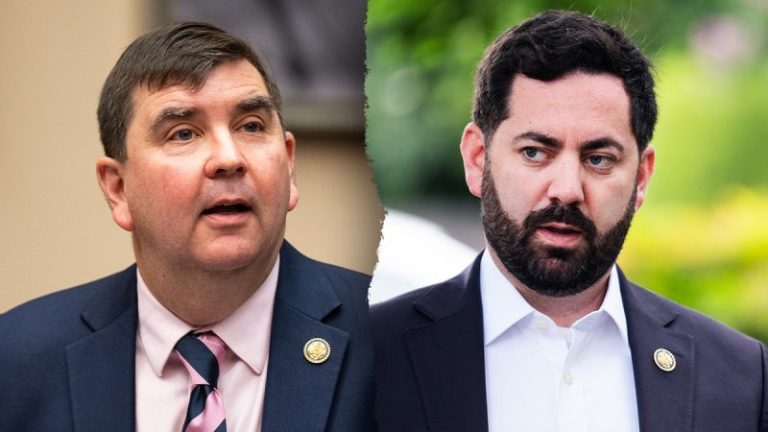
Rep. Mike Lawler, R-N.Y., tore into a fellow Empire State lawmaker Thursday after the latter accosted Lawler on the House floor.

Chaos briefly broke out in the House of Representatives during the chamber’s final vote series of the week, when Rep. John Mannion, D-N.Y., began shouting at Lawler that he was on the wrong side of the floor.

Democrats and Republicans traditionally sit on opposite sides of the chamber, but it’s not unusual for lawmakers of either party to enter through any door and cross to their side.

Mannion was then heard shouting at Lawler, ‘Get over there and tell them the country is falling apart.’

‘F—ing get over there and get some f—ing balls,’ Mannion could be heard shouting. ‘You know who I am. I’m a New Yorker, just like you.’

Lawler responded to Mannion on X, writing, ‘John Mannion was entirely unhinged and unprofessional. That was a shameful display that exposed his complete lack of temperament.’

‘No wonder numerous staffers have previously alleged a toxic work environment. He should go seek help for anger management — and f— off.’

Unverified accusations arose during Mannion’s campaign that he had created a toxic work environment for staffers in the New York State Senate, which the New York Democrat dismissed at the time as a ‘false political attack.’

Fox News Digital reached out to Mannion’s office for comment but did not immediately hear back.

The New York Democrat was heard shouting at reporters ahead of the confrontation, ‘We need you. We need you to hold them accountable. Media, it’s your country too.’

‘Don’t cover the distractions. Cover the actions that lead us towards authoritarianism, please,’ Mannion yelled, according to Politico.

Mannion is a first-term Democrat who unseated former Rep. Brandon Williams, R-N.Y., whose district boundaries were changed last year to include more blue-leaning areas.

Lawler’s office referred Fox News Digital to his statement on X when reached for comment.

The dust-up was brief but is a sign of the sky-high tensions in the current political climate.

Democrats were already furious over the forced ejection of Sen. Alex Padilla, D-Calif., from a media event being held by Homeland Security Secretary Kristi Noem Thursday.

This post appeared first on FOX NEWS

INDIANAPOLIS – T.J. McConnell could walk through any city in America – except Indianapolis – and no one save the most diehard NBA fan would recognize him as a professional basketball player in the best league in the world.

Make no mistake, McConnell is a paid professional.

McConnell, the Indiana Pacers’ 6-foot-1 reserve guard, did what no player in NBA Finals history has done since steals and blocks became an official stat in 1973-74: he is the first reserve to have at least 10 points, five steals and five assists in a Finals game.

Indiana’s bench stole Game 3, helping the Pacers to a 116-107 victory against the Oklahoma City Thunder on Wednesday, June 11, pushing the Pacers to a 2-1 series lead.

A 10-year veteran, McConnell was a major part of a massive Pacers’ bench effort that reshaped the tone of the series, scoring 10 points, delivering five assists and collecting five steals.

Indiana’s bench outscored the Thunder’s 49-18, and had more rebounds (13-1), assists (7-6), blocks (3-0) and steals (7-3).

“Those guys were tremendous,” Pacers coach Rick Carlisle said. “T.J. just brought a will, competitive will to the game. Mathurin jumped in there and immediately was aggressive and got the ball in the basket.

“This is the kind of team that we are. We need everybody to be ready. It’s not always going to be exactly the same guys that are stepping up with scoring and stuff like that. But this is how we got to do it, and we got to do it as a team.”

Much discussion has been given to Oklahoma City’s depth and for good reason. But the Pacers have depth, too, going 10 deep with nine guys playing at least 15 minutes in Game 3.

McConnell’s first steal came on an OKC in-bounds pass after a Pascal Siakam layup.

Here was McConnell’s sequence in a six-second span: assist, steal, offensive rebound, assist.

Three of his steals came on Thunder in-bounds passes, including a steal and layup that tied the score at 95-95 with 8:35 remaining.

“In a series like this what’s so important is the margins. You have to win in the margins,” Pacers star Tyrese Haliburton said. “It’s not necessarily who can make the most shots or anything. It’s taking care of the ball, rebounding, little things like that. He does a great job of giving us energy plays consistently and getting downhill and operating. Nobody operates on the baseline like that guy. He does a great job of consistently getting there and making hustle play after hustle play.”

Mathurin, 22, was injured last year during Indiana’s run to the Eastern Conference finals, but Carlisle said, “He was with the team. He just wasn’t playing. He took a lot of notes, a lot of mental notes, and he may have written some things down. He’s putting (in) a lot of work to be ready for these moments, and tonight he was an absolute major factor.”

His scoring is down in the playoffs compared to the regular season, but he has scored at least 20 points in four games. His first-half offensive production was necessary and his points in the second half either extended Indiana’s lead or cut into a deficit at a critical time. They were important buckets.

Mathurin is the youngest player to score 25 or more points off the bench in a Finals game since starters and bench players were first tracked in 1970-71.

“He’s had games like this in previous series. He seems to have a game like this in every series. He’s a talented player,” Thunder coach Mark Daigneault said. “He was really aggressive tonight. He did a great job. … Their bench really came in the game and was excellent.”

The Pacers had their best start-to-finish game of the series. Haliburton had 22 points, 11 assists, nine rebounds and two steals, producing his game against the Thunder. Indiana needed that from him.

But the Pacers don’t win Game 3 without their bench play. And they will need that again at some point if they want to win two more games and earn the franchise’s first NBA championship since they left the ABA in 1976.

This post appeared first on USA TODAY

MIAMI – One unique way the FIFA Club World Cup will appeal to fans this summer is the introduction of the referee camera, which will provide viewers with point-of-view action they’ve never seen before watching soccer games.

FIFA referees will wear tiny cameras on the sides of their heads, connected to a microphone and transmitter that will send the video to DAZN – the company broadcasting all 63 Club World Cup matches for free on its app and website.

The video will also be shown inside six NFL stadiums during Club World Cup games so fans can experience the referee’s decision-making process and enhance transparency during on-field reviews.

Sports fans are typically accustomed to seeing cameras zoom in on referees making announcements during NFL and NBA games, while MLB fans have recently experienced the home-plate umpire’s point of view from cameras on their facemask.

If it goes well, maybe referee cameras could infiltrate the viewing experience in other sports.

“The main purpose is to offer the TV viewers a new experience,’ FIFA Referees Committee chairman Pierluigi Collina told USA TODAY Sports this week during a Club World Cup referee training session in Miami.

Referees will place customized molded earpieces into their right ears, then watch a screen as they adjust and tighten their cameras to the ideal angle for capturing the action.

Two wires – one for the camera and the other for a microphone – will be clipped on the back collar either on the referee’s uniform or an undershirt. And the transmitter, called a ballpack, will be placed in their shorts’ pocket.

FIFA tested several cameras, including some at chest level, but felt the side of the ear resulted in the best perspective. It offers a direct line of sight of the referees, especially when they turn their heads – something that wouldn’t be offered if they wore a body camera on their chest.

“We were thinking about what’s the best way to attach the camera,” said German referee Nicolas Winter, whose idea has come to life for the Club World Cup and could be employed by FIFA for other matches in the future. “For us, it was important to have the original point of view of the referee because when you have a body cam and move your head to the right or left, you never really have the original point of view.”

Added FIFA Director of Innovation Johannes Holzmuller: ‘If we replicate the referee view, it should really be 100% what the referee is looking at.”

FIFA announced its referee cameras late last week, sharing a video of Pachuca’s Oussama Idrissi dribbling around several defenders to score a goal in their win against Botafogo in a FIFA Intercontinental Cup match last December.

The referee’s camera captured the player receiving a pass from his teammate in the penalty area, the player’s creative playmaking before firing the shot, the roar of the crowd and defenders helplessly looking up at the referee after the score.

“The view from the referee’s camera was amazing,” Collina said. “It’s interesting.”

Holzmuller says the video transmitted will be in 1080i quality, sent over a private 5G network so DAZN and the stadiums can use the video.

Referees have worn the devices during their training sessions to get used to their ear molds, which aim to make the wearing experience more comfortable for them.

The referees will also have assistance putting on their camera devices before matches to ensure they are recording as soon as matches begin.

“From there, it goes live on air,” Holzmuller said.

FIFA will use the findings from the Club World Cup to create guidelines and explore the use of them in future matches. It’s possible it could be a mainstay for soccer broadcasts – including next year’s FIFA World Cup.

Along with improving the fan experience, the referee cameras could also help them improve their craft.

“I was sitting at home on my couch seven years ago, thinking about how to improve refereeing,” Winter said.

“We have 30+ camera angles in a top match, but we can never see our own perspective after a match again. It’s really helpful for us to analyze matches – like our positioning, for example. But I think it’s good to give the audience and spectators a more transparent view, so they can understand what it means to be a referee.

“Of course, we are all human. We all make mistakes. But I think it’s always good to show everyone the way decision making works.”

This post appeared first on USA TODAY

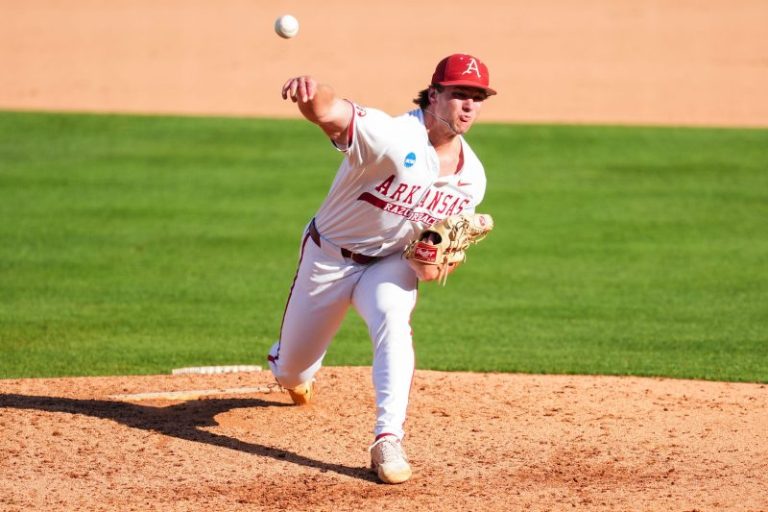
The group of teams set to descend on Omaha, Nebraska, for the premier event in college baseball is an intriguing mix of longtime powers and recent upstarts. Perhaps the most curious fact is this – none of the eight participants in this year’s College World Series made it there last year.

That is not to say there is no tradition of winning among the participants. Five of the eight programs have earned titles within the last 13 years. The list of past champions, however, does not include the team that should probably be considered the favorite to claim the crown this season.

Here’s how we’d rank the Omaha eight, bearing in mind as always that at this juncture any of them could win the whole thing.

No. 1 Arkansas

Will this 12th trip to the CWS finally be the year that the first championship will be coming home to Fayetteville with the Razorbacks? Arkansas look to be the most complete team of the group, with the right mix of fire power at the plate and pitching depth to succeed on the big stage. They’ve dominated in the postseason, winning all five games with a combined margin of 41-13.

No. 2 Coastal Carolina

Built around superb pitching and timely run support, the Chanticleers are anything but underdogs in this field despite playing outside the Power Four conferences. The program hasn’t been back to Omaha since its groundbreaking run to the title in 2016, but this year’s version is more than capable of capturing that magic once again. Coastal enters this round on a 23-game winning streak and proved its mettle in sweeping Auburn on the road last weekend.

DIVERSE FIELD: College World Series highlights what college sports is about

No. 3 LSU

Historically the most accomplished squad here, the Tigers have the bats to add an eight trophy to their collection in Baton Rouge. They also boast two excellent starters – Kade Anderson and Anthony Eyanson – and reliever Zac Cowan. Being in the same half of the bracket as Arkansas is the biggest obstacle, but it also creates a first game should be appointment viewing Saturday night.

No. 4 UCLA

It’s been a while for the Bruins, who haven’t been back to Omaha since claiming the program’s first baseball title in 2013. The pitching staff – in particular starter Michael Barnett – has answered the bell thus far in the postseason, which should continue to serve the team well at Charles Schwab Field where runs can be hard to come by.

No. 5 Oregon State

The Beavers represent the Pac-12’s old guard as well as the league’s future. In the here and now though, the decision to make a go of it as an independent in 2025 has worked out well. They were forced to travel for the majority of games and that experience helped shape them for difficult challenges when facing elimination in both the regionals and super regionals. Oregon State might not have the number of proven bullpen arms as others in this field, but it has power throughout the lineup, led by 2B Aiva Arquette, and are never out of a game.

No. 6 Louisville

The super regionals were not nearly as good for the ACC as the earlier rounds, as the Cardinals are the only squad among the league’s five entries to survive the second weekend. But now that they’ve reached the CWS for the sixth time in program history and first since 2019, they might have what it takes to claim their initial title. The outfield duo of Lucas Moore and Zion Rose leads the offense. Louisville’s pitching has been outstanding in the postseason and could propel a run to the championship series.

No. 7 Arizona

Credit the Wildcats for getting off the deck after being bludgeoned for 18 runs in their series opener at North Carolina. They then rallied late in the next two games to knock off the No. 1 team in the coaches poll. Arizona is a program full of championship pedigree. This is its 18th trip to Omaha. The Wildcats play sound defense in the field and are capable of putting up a high run total themselves, but they must avoid more meltdowns from the mound like that opener against the Tar Heels last week.

No. 8 Murray State

The Racers, just the fourth No. 4 regional seed to make it all the way to Omaha, are sure to be fan favorites. The thing they do best is hit. They rank 11th in score and have generated 70 runs in seven tournament games. But the fact that they’re made it this far indicates they can get key outs when needed as well. Going through the loser’s bracket may be difficult but anything is possible if Murray State can win early and save arms.

This post appeared first on USA TODAY

The White House is in ongoing discussions with Capitol Hill to amend a proposed sanctions bill targeting Russia, Fox News Digital has learned, and prefers that route over sanctions led by the executive branch. 

Sens. Lindsey Graham, R-S.C., and Richard Blumenthal, D-Conn., introduced the legislation months ago and garnered 82 co-sponsors, but the Senate has delayed a vote to give President Donald Trump room to pursue a diplomatic settlement between Russia and Ukraine.

Now, with Trump increasingly skeptical of Vladimir Putin’s intentions to end the war, the bill could soon come to the floor. According to three sources familiar with the matter, talks between lawmakers and the White House are active, though no firm timeline has been set.

‘The House has appetite to move it, too,’ said one congressional source. 

Companion legislation has 70 House co-sponsors.

State Department policy planner Michael Anton has privately indicated to allies that the White House isn’t interested in imposing unilateral sanctions, but also won’t stand in the way of the Graham–Blumenthal legislation.

Behind the scenes, the White House is pushing for revisions that would grant the president greater discretion in enforcement. Specifically, officials are seeking to replace any ‘shall’ with ‘may’ in the bill’s text — a subtle but significant shift that would weaken mandatory enforcement.

‘The White House, no matter who is there, always wants the bill watered down — it’s normal,’ the source said. ‘Whenever any committee, congressman or senator wants to do a sanctions bill, career officials always email back and say, ‘Change the ‘shall’ to ‘may.’’

The legislation would impose sweeping economic penalties, including 500% tariffs on any country that does business with Moscow, and sanctions on key Russian officials and entities.

Graham has acknowledged that revisions are likely, including potential carve-outs from the tariff provision for nations providing aid to Ukraine. The exception would offer relief to European allies that are still dependent on Russian energy.

‘Why don’t we carve out for countries who are helping Ukraine?’ Graham said in an interview with Semafor earlier in June. ‘If you’re providing military economic assistance to Ukraine, you get a carve-out. So China, if you don’t want to get sanctioned, help Ukraine.’

Trump, speaking candidly on a podcast published Wednesday, questioned whether Putin has any interest in ending the conflict.

‘I’m starting to think maybe he doesn’t,’ Trump said when asked whether the Russian president minds losing thousands of soldiers in Ukraine each week.

On Capitol Hill, Trump’s top military advisors were pressed Wednesday on whether they believe Putin intends to halt his offensive.

‘I don’t believe he is,’ said Gen. Dan Caine, chairman of the Joint Chiefs of Staff.

‘Remains to be seen,’ added Defense Secretary Pete Hegseth.

The European Union unveiled a fresh sanctions package, that still needs to be voted on, which would ban transactions with the Nord Stream energy pipelines. 

Since Russia’s 2022 invasion of Ukraine, the U.S. has imposed sweeping sanctions: cutting Russian banks off from the U.S. financial system, freezing over $300 billion in Kremlin assets, banning key technology exports, and blocking imports of Russian fuel.

This post appeared first on FOX NEWS

The House of Representatives passed President Donald Trump’s $9.4 billion plan to claw back federal funds for foreign aid, PBS and NPR.

The 214 to 212 vote was mostly along party lines, with no Democrats voting for the bill. Four Republicans voted against the measure, however – Reps. Brian Fitzpatrick, R-Pa., Mike Turner, R-Ohio, Mark Amodei, R-Nev., and Nicole Malliotakis, R-N.Y.

A dramatic scene played out on the House floor on Thursday afternoon as the bill appeared poised to fail, with six Republican lawmakers having voted ‘no.’

Fox News Digital observed Speaker Mike Johnson, R-La., and Majority Whip Tom Emmer, R-Minn., huddled with several moderate Republicans who either voted ‘no’ or had not yet voted.

In the end, two of those holdouts – Reps. Nick LaLota, R-N.Y., and Don Bacon, R-Neb. – elected to support the bill, enabling it to pass on a narrow margin.

Trump allies largely viewed the package as a test run to see whether congressional Republicans could stomach cuts that were widely seen across the GOP as low-hanging fruit.

Spending cuts in the legislation include a $8.3 billion rollback of funding to the U.S. Agency for International Development (USAID), and just over $1 billion in cuts to the Corporation for Public Broadcasting, which funnels federal dollars to NPR and PBS.

Republican leaders argued the majority of the USAID dollars getting cut were going toward ‘woke’ programs like $1 million for voter ID in Haiti and $3 million for Iraqi Sesame Street.

On NPR and PBS, conservatives have long accused the two networks of taking federal money while growing increasingly liberal in their bias, rather than focusing on impartiality.

But some moderate Republicans had concerns about the legislation’s effect on critical disease prevention research in Africa.

Others argue that entirely slashing federal funding to public broadcasting would disproportionately hurt small local news outlets that rely on it most, and which are situated in areas that otherwise would be an information desert without those resources.

The legislation ultimately passed, however, and will now be sent to the Senate for consideration.

The $9.4 billion proposal is called a rescissions package, a mechanism for the White House to block congressionally approved funding it disagrees with.

Once transmitted to Capitol Hill, lawmakers have 45 days to approve the rescissions proposal, otherwise it is considered rejected. 

Such measures only need a simple majority in the House and Senate to pass. But that’s no easy feat with Republicans’ thin majorities in both chambers.

If passed, Republican leaders hope the bill will be the first of several rescissions packages codifying spending cuts identified by Elon Musk’s Department of Government Efficiency (DOGE).

This post appeared first on FOX NEWS

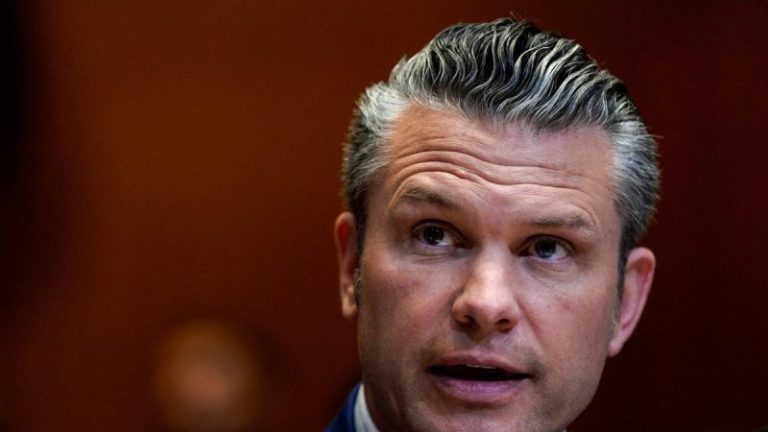
Rep. Seth Moulton, D-Mass., confronted Defense Secretary Pete Hegseth Thursday in a tense exchange over whether Hegseth improperly shared classified details about U.S. airstrikes against Houthi rebels.

In what was the sharpest line of questioning during a week of congressional hearings, Moulton pressed Hegseth to take ‘accountability’ if it’s confirmed he disclosed sensitive operational timing on an unclassified chat app.

‘When you texted the launch time for F-18s going into combat over enemy territory, facing anti-aircraft missiles, on an unclassified Signal chat – did that launch time come from Central Command? Yes or no?’ demanded Moulton, a Marine Corps veteran. 

Hegseth declined to give a direct answer, stating that any communication from the secretary of defense is inherently classified.

‘As you know, having served yourself, any way that the secretary of defense communicates or provides information in and of itself is classified and not to be discussed,’ Hegseth responded.

Moulton pressed again for specifics: ‘So what was the classification marking of the launch time when it was sent to you? Because DoD regulations require classified information to be labeled. Was it secret or top secret?’

Hegseth sidestepped, emphasizing the mission’s outcome. 

‘What’s not classified is that it was an incredibly successful mission against the Houthis,’ he said. 

‘OK, so it was classified,’ Moulton replied. ‘Are you trying to say that the information was unclassified?’ 

‘I’m not trying to say anything,’ Hegseth said.

Moulton then accused the secretary of receiving marked classified information from Central Command and allegedly sharing it outside secure channels.

He also noted the Pentagon inspector general is expected to release a report ‘in a few days’ on the matter. ‘If the DoD inspector general finds what is pretty obvious… that the information was, in fact, classified, do you plan to take any accountability for that?’ Moulton asked.

Hegseth pushed back, stating, ‘There were no names, targets, locations, units, routes, sources, methods – no classified information.’

When pressed again on whether he would accept accountability if the report finds a breach, Hegseth added: ‘Of course. I serve at the pleasure of the president, like everybody else.’

Moulton shifted gears to question the cost of the U.S. campaign against the Houthis, citing reports suggesting the operation topped $1 billion. ‘How many U.S.-flagged commercial ships have transited the Red Sea since your so-called successful operation?’ he asked. ‘The answer is zero.’

The Pentagon IG probe, launched in April, will examine whether Hegseth improperly discussed operational plans for a U.S. offensive against the Houthis in Yemen and will also review ‘compliance with classification and records retention requirements,’ according to a memo from Inspector General Steven Stebbins.

Hegseth’s Signal messages to the president’s principal advisers, leaked when former national security advisor Mike Waltz inadvertently added the Atlantic magazine’s Jeffrey Goldberg to the chat, revealed F-18, Navy fighter aircraft, MQ-9s, drones and Tomahawks cruise missiles would be used in the strike on the Houthis.

‘1215et: F-18s LAUNCH (1st strike package),’ Hegseth said in one message notifying the chat of high-level administration officials that the attack was about to kick off.

‘1345: ‘Trigger Based’ F-18 1st Strike Window Starts (Target Terrorist is @ his Known Location so SHOULD BE ON TIME – also, Strike Drones Launch (MQ-9s)’ he added, according to the report. 

‘1410: More F-18s LAUNCH (2nd strike package)’

‘1415: Strike Drones on Target (THIS IS WHEN THE FIRST BOMBS WILL DEFINITELY DROP, pending earlier ‘Trigger Based’ targets)’

‘1536 F-18 2nd Strike Starts – also, first sea-based Tomahawks launched.’

‘MORE TO FOLLOW (per timeline)’

‘We are currently clean on OPSEC’ – that is, operational security.

Trump administration officials have long insisted that nothing classified was shared over the chat. 

This post appeared first on FOX NEWS

President Donald Trump on Thursday wouldn’t say an attack by Israel on Iran was imminent, but warned it ‘could happen’ as the U.S. continues to pressure Tehran on a nuclear deal, but simultaneously prepares evacuations from the Middle East. 

‘I don’t want to say imminent, but it looks like it’s something that could very well happen,’ Trump said. ‘Look, it’s very simple, not complicated. Iran can not have a nuclear weapon. 

‘Other than that, I want them to be successful,’ he continued. ‘We’ll help them be successful, will trade with them. We’ll do whatever is necessary.’

Trump said ultimatelyhe’d ‘love to avoid the conflict,’ but said that Iran is going to have to negotiate a ‘little bit tougher.’

‘Meaning they’re going to have to give us some things that they’re not willing to give us right now,’ he said in apparent reference to Iran’s so far refusal to give up nuclear enrichment capabilities. 

The president said the U.S. and Iran are ‘fairly close to a pretty good agreement’ but then added, ‘It’s got to be better than pretty good though.’

Trump on Wednesday told reporters that the U.S. has advised some evacuation efforts in the Middle East as the security situation with Tehran could become ‘dangerous’ amid uncertain nuclear negotiations. 

‘They are being moved out because it could be a dangerous place,’ Trump said.  ‘We’ve given notice to move out, and we’ll see what happens.’

The president’s comments came after the U.S. embassy in Iraq ordered a partial evacuation of non-emergency government personnel and military dependents have been authorized to leave locations around the Middle East.

Reports originally claimed similar orders had been issued in Bahrain and Kuwait, though no notices have been posted to the U.S. embassy in Kuwait, and the embassy in Bahrain said that reports that it ‘has changed its posture in any way are false’ and staffing operations remain ‘unchanged and activities continue as normal.’

Embassies near Iran have been ordered to hold emergency action committees and report back to DC on their risk-mitigation plans.

No U.S. troops have been pulled from the Middle East at this time. 

The State Department did not immediately respond to Fox News Digital’s questions on why Iraq was deemed particularly dangerous when similar notices have not been issued in other nations surrounding Iran. 

Bahrain holds the highest number of military families according to reports, and though no embassy or military changes have been made, Trump on Thursday said, ‘We have a lot of American people in this area. And I said, we got to tell them to get out because something could happen soon, and I don’t want to be the one that didn’t give any warning and missiles are flying into their buildings.

‘It’s possible. So I had to do it,’ he added. 

When asked this week how the U.S. can calm the escalating security situation in the region, Trump did not provide a direct answer, but said, ‘They can’t have a nuclear weapon. Very simply, they can’t have a nuclear weapon. We’re not going to allow that.’

The status of negotiation progress remains unclear as Special Envoy Steve Witkoff prepares to head to Oman on Sunday for the sixth round of direct and indirect nuclear negotiations with Iran, Omani Foreign Minister Badr al-Busaidi confirmed on Thursday. 

The negotiations have become increasingly strained in recent weeks and appear to have reached an impasse over the levels of enriched uranium.

The U.S. has repeatedly said Iran must not be allowed to have any enrichment programs, including for civil energy use – of which Iran contributes less than 1% of its overall energy needs to nuclear energy.

Iran has thus far flatly refused to abandon all nuclear enrichment, and it remains unclear what it would be required to do with the stockpiles of near-weapons-grade enriched uranium that it currently possesses – which it drastically increased over a three-month period earlier this year.

The IAEA began sounding the alarm last month that Iran had increased its stockpiles by nearly 35% between February and May, when the nuclear watchdog said its stores had jumped from roughly 605.8 pounds worth of uranium enriched to 60% to 900.8 pounds by mid-May.

The Institute for Science and International Security assessed earlier this week that Iran could further the enrichment process to create at least one nuclear warhead’s worth of weapons-grade uranium in as little as two to three days at its Fordow Fuel Enrichment Plant (FFEP).

Nine nuclear weapons could be made within three weeks, and in coordination with Natanz Fuel Enrichment Plant (FEP), Iran could turn around 22 nuclear warheads within a five-month period, the Institute for Science and International Security claimed.

The IAEA’s 35-nation Board of Governors on Thursday declared Iran is in breach of its non-proliferation obligations for the first time in nearly 20 years.

The board may next take the breach to the UN Security Council, which could then be prompted to enforce severe snapback sanctions on Tehran, which Western security experts have long been urging the UNSC to pursue.

Only three nations on the board objected to the breach declaration, including Russia, China and Burkina Faso, despite years of mounting evidence of man-made highly enriched uranium, and Tehran’s refusal to grant the IAEA full access to all its nuclear facilities, which is a violation of the Joint Comprehensive Plan of Action (JCPAO). 

Tehran is still bound to the international deal, though the agreement drastically unraveled after the U.S. withdrew from the agreement in 2018 under the first Trump administration after it claimed Iran was already in breach of the terms. 

Defense Secretary Pete Hegseth, who returned to the Hill today to testify in front of the House Armed Services Committee, told Senators on Wednesday that ‘There are plenty of indications that [Iran has] been moving their way towards something that would look a lot like a nuclear weapon.’

The secretary’s comments contradict assertions made by the Director of National Intelligence, who said in March that Iran is not building a nuclear weapon.

This post appeared first on FOX NEWS