Archive

2025

Browsing

New York Mets ace Kodai Senga suffered a hamstring strain covering first base in a win over the Washington Nationals on Thursday and will be placed on the injured list, manager Carlos Mendoza said after the game.

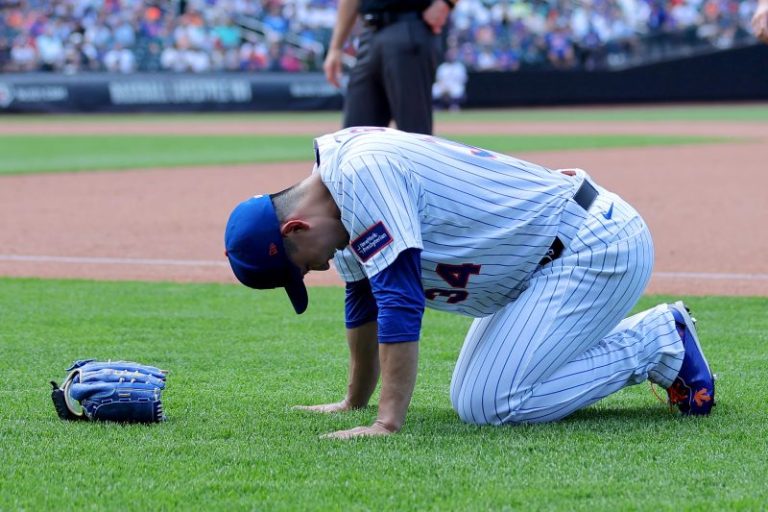
Senga came down awkwardly on first base after jumping to catch a toss from Pete Alonso in the sixth inning on a ground ball hit by C.J. Abrams. He recorded the out, but crumpled to the ground and clutched his right leg. After a brief conversation with staff, Senga was removed from the game and walked off under his own power.

Senga will undergo further testing on Friday, June 13 to determine the severity of the hamstring issue.

Mendoza told reporters that after leaving the game, Senga had asked his interpreter to let Alonso know he had felt something in his hamstring a step before jumping to receive the throw – and that it wasn’t the first baseman’s high throw that caused the injury.

The injury could a big blow for the Mets, who have MLB’s best record. Senga, whose 1.47 ERA is the best in baseball, was cruising along in a scoreless outing until the injury forced him out, but picked up the win to improve to 7-3 in 13 starts this season.

The unfortunate scene was reminiscent of Senga’s only regular-season start from 2024, during which he which he suffered a calf injury that kept him out of action until the postseason. Prior to that outing, Senga had missed the first half of his second MLB season with arm problems.

While the Mets will be without Senga, offseason signings Sean Manaea ($75 million) and Frankie Montas ($34 million) are rehabbing from injuries and are expected to make their 2025 debuts in the coming weeks.

The USA TODAY app gets you to the heart of the news — fastDownload for award-winning coverage, crosswords, audio storytelling, the eNewspaper and more.

This post appeared first on USA TODAY

INDIANAPOLIS – The New York Knicks have botched their search for a new head coach.

At this rate, they’re going to ask the 29 other teams for permission to interview their coach and get denied permission 29 times.

The Dallas Mavericks denied the Knicks permission to interview Jason Kidd. The Minnesota Timberwolves did the same with Chris Finch. The Houston Rockets did the same with Ime Udoka. The Chicago Bulls did the same with Billy Donovan and the Atlanta Hawks did the same with Quin Snyder, according to multiple reports.

So what was their plan? Just hope that a team with a good coach was going to let a good coach go to the Knicks in exchange for a couple of second-round draft picks.

When you fire a coach – a coach who just took your team to its first Eastern Conference finals appearance in 25 seasons and had established a winning identity and helped changed the perception of the franchise – you better have a list of coaches ready and available for interviews and the job.

And since the Knicks do not appear to have that part of their house in order, it leads one to believe the front office had not planned on firing Thibodeau, which leads one to believe that Knicks owner James Dolan’s fingerprints are Thibodeau’s firing and the ensuing chaos.

“The Knicks have to be the damn stupidest people in the world,” TNT’s Charles Barkley said before Game 3 of the NBA Finals on Wednesday.

Yahoo Sports’ Vincent Goodwill reported that “Dolan and team president Leon Rose held exit meetings with key Knicks players and the complaints were clear. Dolan, whom sources said was never a huge Thibodeau fan through the years, asked the questions in the meeting while Rose took a secondary role.”

Somebody (or multiple somebodies) convinced Dolan that firing a successful coach with three years and $30 million was necessary.

Was Thibodeau the perfect coach? Of course not. All coaches have flaws. He could’ve tried to develop more of a bench and give starters fewer minutes, but he also had considerable success. The Knicks hadn’t had back-to-back 50-win seasons since the mid-1990s until they won 50 games in 2023-24 and 51 games in 2024-25.

The Knicks look like the bumbling franchise they were before bringing in Rose and Thibodeau. And all the good work that has been done to make the Knicks a competent franchise is at risk of being undone.

How do the Knicks salvage this? Great question. Former Memphis Grizzlies coach Taylor Jenkins and longtime NBA coach Mike Brown are available and names to watch. Jenkins has the right mix of challenging players while not embarrassing them, and Brown has experience with stars and big markets. Johnnie Bryant, a former New York Knicks assistant who spent last season as the associate head coach for the Cleveland Cavaliers, is another name to watch.

The Knicks will try to frame this as doing their due diligence and that they are in no rush to make a hire. That’s hard to believe when they are knocking on the door of several big-name coaches who already have jobs with other teams.

This post appeared first on USA TODAY

One of the top free agent linebackers on the market officially has a new home for 2025.

Germaine Pratt signed a one-year deal worth up to $4.78 million with the Las Vegas Raiders on June 12. The six-year pro had spent his entire career with the Cincinnati Bengals and started every game over the last two seasons.

The Bengals released Pratt on June 9 after he requested a trade earlier in the offseason. Pratt reportedly was close with former Bengals defensive coordinator Lou Anarumo, who was fired after the 2024 season.

Cincinnati drafted Pratt in the third round, No. 72 overall, in the 2019 NFL draft. He started nine games as a rookie before taking on a bigger role in 2020 and started every game he played in since 2021.

Pratt posted a career- and team-high 143 tackles in 2024, including five tackles for loss. He tied a career-high with two interceptions in addition to six passes defensed and two forced fumbles.

In coverage, Pratt allowed a 69% completion percentage when targeted, per Sports Information Solutions (SIS) data. Despite his gaudy tackling numbers, Pratt posted a career-high 39 broken or missed tackles in 2024, according to SIS data.

Raiders LB depth chart

Pratt is the latest free agent linebacker Las Vegas has signed this offseason. It’s now a crowded room with his addition as minicamp rolls on.

Here’s how things look after his signing:

Germaine Pratt
Elandon Roberts
Devin White
Tommy Eichenberg
Jaylon Smith
Amari Gainer
Jailin Walker
Cody Lindenberg
Michael Barrett
Matt Jones

Pratt and Roberts are currently projected to start with White and Eichenberg backing them up.

This post appeared first on USA TODAY

Perhaps it was the extra baggage No. 1 overall picks carry, a weight Spencer Torkelson admits delayed his eventual rise to feared slugger. Or the isolation one can feel as a flailing superstar with a $140 million contract on a struggling team, like Javy Baez endured for most of three seasons.

Not even the greatest Tiger of all, peerless left-hander Tarik Skubal, is immune, undergoing Tommy John surgery at his no-name college, climbing to the big leagues only to suffer a flexor tendon injury that wiped out nearly a full season of his prime.

Yet look at them now.

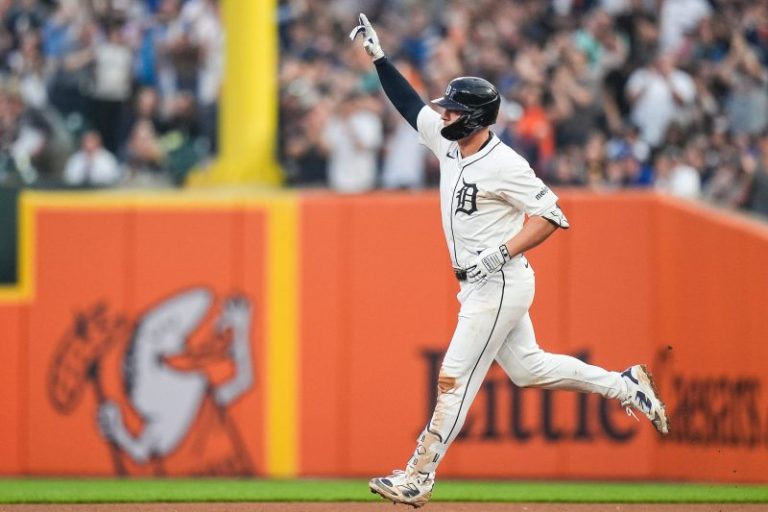
The Tigers are 44-25, a start so dominant that the last Detroit club to break so strongly reached the 2006 World Series. They are a curious mix of largely twentysomething talent, versatile and fungible youngsters and the occasional veteran like World Series champion Báez – all willing to play anywhere or bat in whatever position, so long as everything they have is for the team.

“All things that it takes to have a lot of sustained success is definitely shining,” Torkelson, their first baseman possibly headed to his first All-Star Game, tells USA TODAY Sports, “and having guys that have been at the bottom, been at the top, like Javy, it’s such a cool perspective.

“That’s baseball. That’s sports. It’s not going to be amazing every single day, every single year. You’re going to battle through it.

“For me, that’s what’s so rewarding about it. You’ve seen the worst and when you do have success, it makes it that much sweeter.”

The franchise itself can relate. A 114-loss 2019 was the nadir during seven consecutive losing seasons, a stretch of futility that netted it the top overall pick in two drafts. It wasn’t until this spring that those two No. 1 overall picks, Torkelson and right-hander Casey Mize, found concurrent success.

“This is definitely a game of failure,” says Riley Greene, the Tigers’ All-Star outfielder. “They worked on the things they needed to work on and they’re crushing now. Some people don’t get it right away and others do; but that’s the ups and downs of baseball.

“They had stuff to work on, and they took it and ran with it. And now look at ‘em.”

‘I wanted to make everyone happy’

For Torkelson, the unkindest cut of all came when he least expected it. After spending all of 2023 in Detroit, the Tigers shipped him to Class AAA Toledo on June 3, 2024. He was toting a .201/.266/.330 slash line, with just four homers and 56 strikeouts in 230 plate appearances.

It would have been humbling for any player who fancied himself a big league regular. But carrying that first overall pick designation – a tag no one ever forgets – only added to the weight.

So Torkelson, still just 25 even as he’s five years removed from the Tigers taking him No. 1 out of Arizona State, learned to leave all that behind.

“A lot of it was eliminating expectations. As a people pleaser, I wanted to make everyone happy,” says Torkelson. “As a No. 1 pick, you want to live up to what everyone’s writing about you rather than take a step back and be like, ‘Wait, what got me selected No. 1?’ My God-given ability and work ethic got me selected. So why not trust that – which is a lot easier said than done.

“Really going back to the basics and doing it not for anyone else but my own pleasure.”

The mindset paid off. Torkelson earned an August recall to Detroit and produced a .781 OPS over the final two months, compared to .597 before his demotion. He’s continued the trend this season, his 16 home runs tops among AL first basemen.

He also leads the majors with 10 two-strike home runs, possibly a testament to his adjusted mindset.

“Baseball or golf, it’s like, staying out of your own way is probably the biggest key to success for guys,” says Torkelson. “The goal is to stay as present as possible. As a baseball player, your mind is always looking forward. You get a hit, now you’re 3 for 4. You get another home run, now you’ve got 17. Your mind is always trying to look into the future, which it is supposed to do.

“But that’s not how you maintain in a sport. It’s taking a step back and seeing how you attack this pitch. Sometimes you catch yourself and you get yourself back to present.”

Says manager A.J. Hinch: “The way he bounces back from tough at-bats – he’s pretty resilient.”

A star embraces versatility

Torkelson’s recall, combined with a trade-deadline makeover and Hinch unleashing the Tigers’ “pitching chaos” plan awakened a franchise. The Tigers finished 33-16, snagged a wild-card spot and upset the Houston Astros in the wild-card round before losing a wild five-game AL Division Series to Cleveland.

 And Báez wasn’t around for almost all of it.

He and the Tigers decided he’d undergo season-ending hip surgery after an August series at Wrigley Field, site of Báez’s greatest triumphs as a member of the 2016 World Series champion Chicago Cubs.

With the Tigers, he’d been more a liability, producing a .221 OBP and 71 adjusted OPS in his first three seasons. Repairing his hip might have been the unkindest cut at the time, but now he and the Tigers are reaping the rewards.

Báez returned healthy and with a new identity – the do-anything super utilityman. Báez hadn’t played center field since winter ball in 2015 until Hinch tossed him out there as a late-game defensive replacement.

He ended up playing 23 consecutive games in center, robbing home runs, chasing balls into the gap and, in that span, slugging six home runs with an .898 OPS. With center fielder Parker Meadows’ return, Báez is more often back at his natural shortstop.

Either way, he has been remarkably valuable, producing four outs above average and 1.3 WAR, putting him on pace for his finest season as a Tiger.

“A guy like Javy, who’s been the center part of a lot of teams he’s been on, can just be one of the guys,” Hinch says of Báez, who made two All-Star teams and won a Gold Glove and Silver Slugger as a Cub. “He doesn’t have to carry us; we have a true team and a lot of guys who can do it. But when he adds something to the mix, we usually win.

“He’s a big part of what we’re doing and I think he’s one of the best, versatile players in the league.”

Báez’s production fused with the young core was the outcome he envisioned when he signed with the Tigers, the last major transaction of former GM Al Avila’s tenure.

“Everything is getting better as a team, as an organization. The only difference for me is being healthy,” says Báez, whose deal runs through 2027. “I’m playing better for myself and playing better for the team.

“That was one of the reasons I came here: I saw the other prospects coming here and would make a good team in the future. The future is now – we’re doing it right now.”

Báez might have been envisioned as a franchise hub, but he’s probably serving as a better avatar for the young players in his current role – versatile, willing to trot out to any position, starter or reserve, always ready.

“He’s unbelievable. He’s one of the best athletes, baseball players, that I’ve got to see live,” says Torkelson. “You stick him in center field, he’d probably win a Gold Glove out there. He’s such a great athlete and special to see every day.

“He’s willing to do whatever. And he’s so comfortable in whatever situation he’s in – he’s never sped up. He’s always cool, calm and collected, something we aspire to do every game.”

‘A complete team’

As the season unfolds, the Tigers will have to accept their new lot in life – that of division favorites. They hold a seven-game lead in the AL Central, and with the rampant inconsistency in the AL West, would be a fair bet to earn a first-round bye should they hold onto the division.

Promising right-hander Jackson Jobe has been lost to Tommy John surgery, a big blow for his development, yet one the Tigers can weather given their depth with Skubal, Jack Flaherty and Mize out front of the rotation. Mize, the No. 1 overall pick in 2018, already weathered that storm undergoing Tommy John and also back surgery, a double whammy that wiped out his 2023 season.

“We have Tarik leading us at the top. He’s the best pitcher in the league,” says Mize, who has a 2.95 ERA in 11 starts. “And we have some depth we really like and bullpen guys we really like.

“A complete team.”

One that’s on the verge of what could be an unforgettable summer, the promise of greatness tempered by the humility that helped them reach this threshold.

“What got us to this point is taking it day by day, being there for each other and enjoying the ride,” says Torkelson.

“It’s not going to be perfect. But it’s going to be a lot of fun.”

This post appeared first on USA TODAY

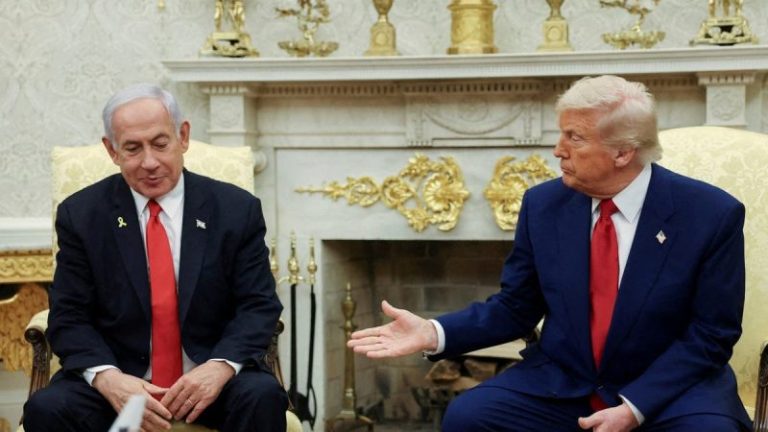
Israeli Defense Forces launched a sweeping strike on Iran following months of attempted, and seemingly failed, nuclear negotiations between the Trump administration and Tehran.

Fox News’ Trey Yingst reported that Israel carried out strikes in Iran, adding that explosions were heard in the capital of Tehran.

A state of emergency has been declared across Israel as the country braces for an Iranian response.

The strikes came after Israel first threatened to go after Iran’s nuclear facilities in early November following a series of back-and-forth missile attacks between April and October last year.

Direct engagement between Israel and Iran began after Tehran in April 2024 levied its first ever direct strikes against Israeli territory. Israel responded less than a week later and destroyed part of Iran’s S-300 long-range air defense system.

On Oct. 1, Iran levied a ballistic missile strike on Israel, to which Jerusalem responded with a series of hits on Oct. 26 that targeted military facilities and missile storage locations.

Israeli Prime Minister Benjamin Netanyahu later confirmed that Israel’s October strike partially degraded part of Iran’s nuclear program, and international concerns remained heightened that the security threat could escalate in the region. 

Some hoped that President Donald Trump’s administration would be able to make headway in nuclear negotiations where the Biden administration, and others in the international community could not. 

Negotiations between Washington and Tehran, mediated by Oman, resumed in Muscat on April 12 and Trump repeatedly called on Netanyahu not to hit Tehran and to let negotiations proceed. 

Following the first round of talks, Middle East Special Envoy Steve Witkoff told Fox News that the U.S. was looking to limit Iran’s uranium enrichment to 3.67%, a level generally used for civil nuclear energy needs. 

Under the Joint Comprehensive Plan of Action (JCPOA), which Trump pulled out of in 2018, Iran committed to maintaining no more than this level of enrichment until 2031 – though it has been found to have repeatedly violated this agreement. 

But the next day, on April 15, Witkoff backtracked his comments and said in a statement that ‘Iran must stop and eliminate its nuclear enrichment and weaponization program.’

Four days later the U.S. entered its second round of nuclear talks in Rome on April 19, before a third round was held in Muscat on April 26. Both sides expressed optimism following the talks.

Details of the negotiations were not released, but reports suggested the discussions largely focused on limiting Iran’s nuclear program in exchange for sanction relief.

Talks appeared to take a turn after the U.S. hit Iran with another round of sanctions in late April, which resulted in the postponement of the previously scheduled May 3 talks.

The fourth round of talks began to show signs of strain when Iran described the negotiations as ‘difficult but useful,’ and Iran’s Foreign Minister Abbas Araghchi made clear that Washington’s zero enrichment demand was a ‘non-negotiable.’

Oman’s Foreign Minister Badr al-Busaidi reported that ‘some but not conclusive progress’ was made following the fifth round of talks held in Rome on May 23. 

By early June, Trump and Iranian leader Ayatollah Ali Khamanei had repeatedly made clear they both would refuse to bend when it comes to the issue of enrichment, but a sixth round of talks was still set for June 15 in Oman.

It is unclear if those talks will continue following the Israeli strike.

This post appeared first on FOX NEWS

Elmo has a friend, indeed.

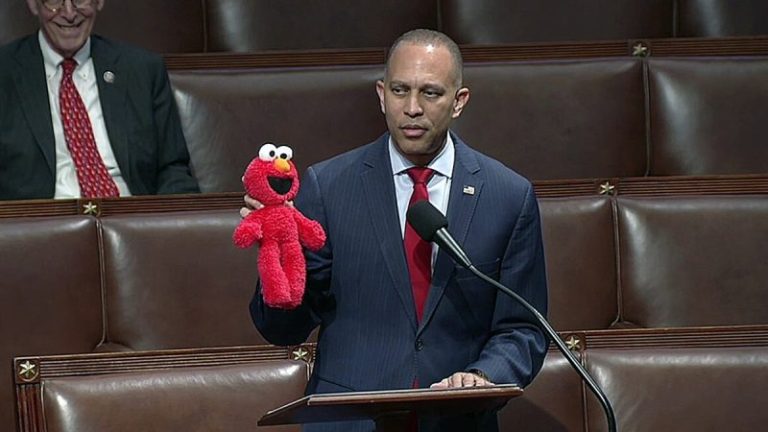
Minority Leader Hakeem Jeffries,D-N.Y., brought along a stuffed friend to help make a point on the House floor Thursday.

Jeffries held up a stuffed Elmo doll while accusing Republicans of targeting beloved children’s shows like ‘Sesame Street’ in their push to slash federal spending.

‘Today, we are on the floor of the House of Representatives debating legislation that targets Elmo. And Big Bird. And Daniel Tiger and ‘Sesame Street,” Jeffries said, waving the puppet as he railed against the GOP-led rescissions package.

The moment, widely circulated online, came during debate over the Republican-backed Proposed Rescissions of Budgetary Resources from President Trump, which would eliminate over $9 billion in unspent or low-priority federal funds.

Among the targeted programs: $3 million in taxpayer support for an international version of Sesame Street in Iraq.

Democrats objected to what they characterized as cultural and humanitarian vandalism disguised as fiscal responsibility. Rep. Sydney Kamlager-Dove, D-Calif., delivered one of the sharpest lines of the day: ‘While you all have killed off Elmo, I urge my colleagues to vote no on this trash and I yield back,’ Garcia said.

Republicans dismissed the theatrics and defended the package as a commonsense rollback of bloated, ideological spending. The bill also includes broader cuts to the Corporation for Public Broadcasting, which supports PBS and NPR, long-time targets of fiscal conservatives who argue the taxpayer shouldn’t subsidize public media.

Rep. Lisa McClain, R-Mich., rebutted, ‘I never realized Elmo was more important to my colleagues on the other side of the aisle than the American people.’

House Majority Leader Steve Scalise, R-La., pushed back forcefully: ‘The Minority Leader held up a Sesame Street character here on the floor as if Sesame Street’s somehow going to go away,’ Scalise said. 

‘I was watching a commercial on TV yesterday where the Cookie Monster was actually doing an advertisement for Netflix because a private company is paying money to run Sesame Street. It’s not going away. It’s doing just fine. Very lucrative.’

Scalise argued the bill doesn’t threaten Sesame Street’s survival, only its taxpayer subsidy, and called out what he described as ‘far-left, radical views’ being promoted through outlets like NPR and PBS.

‘There is still going to be a plethora of options for the American people,’ he said. ‘But if they are paying their hard-earned dollars to get content, why should your tax dollars go to only one thing that the other side wants to promote?’

He concluded bluntly: ‘They can still watch Sesame Street in Iraq. But let the Iraqi people pay for it — not the taxpayers of the United States of America’s children.’

Even more eyebrow‑raising was the inclusion of taxpayer‑funded global health spending for procedures like circumcisions.

Among the line items flagged by GOP lawmakers: $3 million to subsidize circumcisions, vasectomies and condoms in Zambia, alongside similar grants for transgender surgeries in Nepal. Republicans contended that pulling back these types of low-impact or ideological slush funds was a logical first step toward returning more than $9 billion to the U.S. Treasury.

The bill passed the House Appropriations Committee earlier this week and Senate Democrats have signaled strong opposition.

The bill passed the House in a 214–212 vote. Four Republicans, Reps. Mark Amodei, R-Nev.; Mike Turner, R-Ohio; Brian Fitzpatrick, R-Pa.; and Nicole Malliotakis, R-N.Y., broke ranks to vote against the bill. All Democrats voted no.

This post appeared first on FOX NEWS

The Indiana Pacers are two wins away from their first-ever NBA title.

Behind a second quarter spark and a barrage from its bench, Indiana controlled the Oklahoma City Thunder on June 11 in the pivotal Game 3 of the NBA Finals, 116-107.

Backup Pacers shooting guard Bennedict Mathurin led all players with 27 points, while Tyrese Haliburton added 22 and Pascal Siakam chipped in 21.

And for the Pacers, this was massive; when NBA Finals have been tied at 1-1, the winner of Game 3 has gone on to win the title 80.5% of the time.

The Pacers are now 5-0 this postseason when coming off a loss. They still have not trailed in any of the four series they have played these playoffs.

Here are the winners and losers from the crucial Game 3 of the 2025 NBA Finals between the Pacers and Thunder:

WINNERS

Bennedict Mathurin, T.J. McConnell and the Pacers bench

The Pacers’ bench, overall, was outstanding, yes. They outscored Oklahoma City’s reserves by a margin of 49-18. But two players, above all, lifted Indiana and were key in a second quarter run that changed the course of the game.

Bennedict Mathurin led all players with 27 points on an absurd 9-of-12 shooting night — outscoring the entire Thunder bench — in 22:24. T.J. McConnell scored 10 timely points, but his five steals, three of them off inbounds passes, and five assists invigorated Indiana.

Simply put, the Pacers’ bench won them this game.

“Those guys were tremendous,” Pacers coach Rick Carlisle said after the game. “T.J. just brought a competitive will to the game. Mathurin jumped in there and was immediately aggressive and got the ball in the basket. This is the kind of team we are: we need everybody to be ready. …

“This is how we’ve got to do it, we’ve got to do it as a team.”

For at least one night, the Indiana defense was better

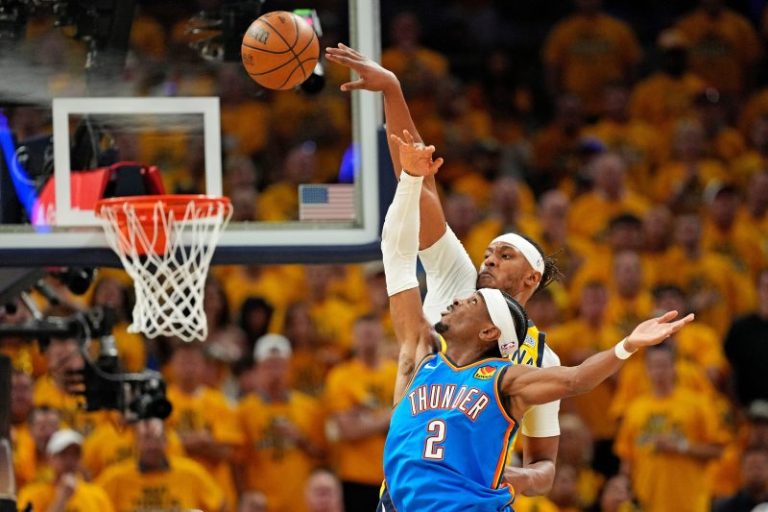
It looked, at least for one game, that it was the Pacers who were the No. 1 defense in the NBA. Indiana put forth a monstrous team effort, particularly on NBA Most Valuable Player Shai Gilgeous-Alexander, sending multiple players at him, swarming and swatting at the ball when he had it in vulnerable spots.

After Game 2, Pacers coach Rick Carlisle said of Gilgeous-Alexander that “you can mark down 34 points before (the Thunder) even get on the plane.” Perhaps it was a subtle way of sending a message to his players, but Indiana held SGA to 10 points fewer than that, on 9-of-20 shooting.

The Pacers rotated players on Gilgeous-Alexander and put full-court pressure on him basically the entire game, and the spike in energy appeared to tire Gilgeous-Alexander, especially late. He had just three attempts in the fourth quarter and did not register an assist

“Their overall tone was better than ours for the majority of the game,” Thunder coach Mark Daigneault said after the game.

Tyrese Haliburton finds his shot — early

In Games 1 and 2, Pacers star Tyrese Haliburton had combined for just nine first half points. On Wednesday night, Haliburton had scored 12 on 5-of-8 shooting, adding seven assists, before intermission.

It set the tone. When Haliburton — who finished with 22 points, 11 assists and nine rebounds — is aggressive and gets his shot, the Pacers tend to win. This season, they are 20-1 when he scores at least 20 points and dishes out at least 10 assists.

LOSERS

Thunder offense sputters without massive SGA game

Oklahoma City has actually had nice spurts of offense this series from role players. Luguentz Dort has shot 10-of-17 (66.7%) from 3. Aaron Wiggins popped off for 18 points in Game 2. Alex Caruso poured in 20 in Game 2.

But this felt like a game that, for the Thunder to have a chance to win, Gilgeous-Alexander was going to have to go off and score 35 or more. Oklahoma City shot just 35.3% from the field in the fourth quarter. With players pressing some, the Thunder also committed five turnovers in the period.

Thunder ball protection

The steals off the inbounds were indicative of a larger issue for Oklahoma City: the turnovers were debilitating.

“They sucked,” Jalen Williams said. “Just bad, unforced turnovers.”

Indiana had lost the turnover battles in Games 1 and 2 by 19 combined. But Wednesday night, the Thunder were more careless with the ball, committing 19 turnovers — compared to Indiana’s 14. Not surprisingly, the Pacers won the battle in points off turnovers, 21-14.

The decision to start Cason Wallace over Isaiah Hartenstein

The Thunder — the team with the best record (68-14) in the NBA — had rolled through the NBA playoffs, going 12-4 before the start of the Finals.

Center Isaiah Hartenstein had started each of those games, but Thunder coach Mark Daigneault opted to start Cason Wallace in all three games against the Pacers. It now seems like an overcorrection and perhaps even something of a panic move.

Though it was just by two points, the Pacers outscored the Thunder in the paint for the first time this series, 50-48. Oklahoma City had carried a plus-20 advantage prior to Wednesday night. Keeping Indiana out of the paint and forcing them to settle for jump shots will be key for the Thunder in Game 4. Hartenstein, who played just 22 minutes and was not a factor, makes that prospect much easier.

The biggest stories, every morning. Stay up-to-date on all the key sports developments with USA TODAY’s sports newsletter. Your inbox will approve.

This post appeared first on USA TODAY
BEREA, OH — Story time in the Cleveland Browns quarterback meeting room can take a while sometimes. Or, as veteran signal-caller Joe Flacco relayed at minicamp Wednesday, it could last the entire meeting. 

Take a recent 9 a.m. gaggle, with a team lift scheduled 20 minutes later. Somebody brought up taking vacations and whether it was possible not to enjoy going on them. 

‘That turned into five stories, and next thing you know you know, it’s 9:17, you’re like, ‘All right, guys, see you later,’’ said Flacco, entering his 18th NFL season. “So, yeah, that can happen. But throughout the course of my career, that happens on Fridays in the season. You’re prepared, you’re ready, you’ve kind of covered everything, and sometimes you tell stories for 15 minutes. That’s what being a teammate and getting to know these guys is all about.”

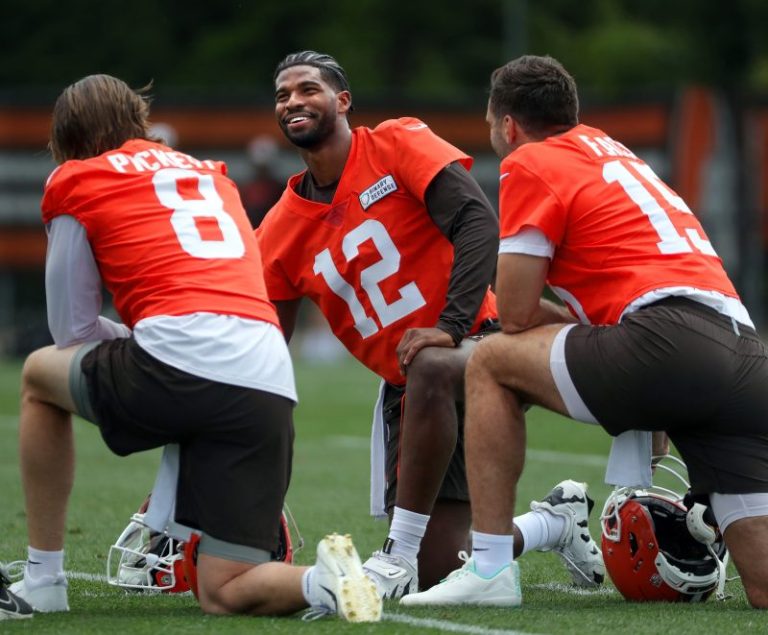
The Browns’ quarterback room – led by Flacco and filled with young journeyman Kenny Pickett and rookies Dillon Gabriel and Shedeur Sanders – is crowded. It deals with heightened outside attention in the aftermath of drafting Sanders following his dramatic fall in the 2025 NFL draft. But the main priority of the group, which also includes the injured Deshaun Watson and head coach Kevin Stefanski in addition to quarterbacks coach Bill Musgrave and offensive coordinator Tommy Rees, is to turn a high-profile quarterback competition into a way to build team chemistry and win football games.  

“The discussion that occurs in the quarterback room is outstanding,” Stefanski said. “It’s fun. It’s high-level discussion. It’s new for the two young guys…I think it’s an impressive thing for those young guys to absorb.”

Having the chance to throw a play up from the respective careers of Flacco or Pickett is often a good way to start a discussion about football. For the other topics, oftentimes Sanders will offer something up and Flacco will run with it. Sanders is also prone to give Flacco a verbal jab about their age gap (Sanders is 23, while Flacco is 40). 

“It’s real fun having those guys in the room,” Sanders said. “Quarterbacks, we think in similar ways, but not everybody always talks about it.” 

During practice, Sanders said, Flacco has helped instruct him on the quickest way to progress through route reads. And Sanders wants the feedback. Throughout the first two days of minicamp, the two have conversed plenty on the field, with Flacco often gesturing with his hands – and maybe even flashing a smile barely visible through his facemask. 

“He’s a pro. I’d be dumb not to get insight from somebody who’s had success over all the years he has,” Sanders said. 

On Wednesday, Gabriel took first-team reps in the red zone. The lefty pumped three hard throws over the middle for completions later in practice during move-the-ball drills. 

Gabriel referred to the quarterbacks on the roster as diverse “in experience.” 

“I think what we’ve done really well as a room is just the inability to dwell on the past,” the former Central Florida, Oklahoma and Oregon quarterback said.  

He added: “I think there’s a lot of juice in the squeeze. But you’ve got to ask the right questions.”

Most of the technique questions, according to Flacco and Pickett, have revolved around the under-center snaps required in Stefanski’s offense to set up the play-action pass and run concepts. 

“Hopefully I can give them some insight,” said Pickett, who won Super Bowl 59 earlier this year with the Philadelphia Eagles as Jalen Hurts’ backup after an unsuccessful stint starting for the Pittsburgh Steelers. 

Maximizing time on the practice field – more reps lead to more confidence, Pickett said – is paramount and Cleveland has often split the team into two so a pair of quarterbacks can rotate in and out. It also means that a player may have the chance to run a certain play once the entire camp.

Flacco appears to be the presumed starter but didn’t take many snaps during minicamp by design. Pickett primarily worked with the starters, although the coaching staff gave Gabriel a shot with them, while Sanders has yet to face the first-team defense. 

“I think everyone in this game sees themselves as starters and that belief of self is why a lot of guys are in the NFL,” Gabriel said. “So you just continue to improve, continue to challenge yourself.” 

Teams can dress three quarterbacks on the game-day roster, but carrying four on the roster is rare. The odds of all four quarterbacks staying in Cleveland through the season are slim. 

“Let’s not look too much into who’s out there when we’re in the installation phase, we’re in the teaching phase,” Stefanski said.

Flacco said he trusts Stefanski’s plan and that’s all he can do. 

“Listen, I’d love to go out there and take 120 reps a day and get in a groove,” he said. 

As a rookie in 2008, Flacco joined the Baltimore Ravens with Kyle Boller and Troy Smith on the roster as the two veterans slated to battle for the starting job. But after camp and before the season, they signed veteran backup Todd Bouman, who was 36 at the time.

“His family was back in Minnesota, and he’d take me out to dinner and go out for a drink here and there, and just an unbelievable person,” Flacco said. “I appreciated it in the moment, but looking back also, it was something that kind of calmed me down because you had a good relationship with somebody in the room you could feel comfortable around and you felt was genuinely rooting for you.” 

Having that type of chemistry depends on the personalities in the room, Stefanski said. He remembers being the Vikings’ assistant quarterbacks coach during the season with Brett Favre, Sage Rosenfels, Joe Webb and Tarvaris Jackson. 

“I’ve been very fortunate to be in some great rooms with professionals,” Stefanski said. “Guys who try to work hard at their craft but also have some fun while we’re in there.” 

For the 2025 Browns, Stefanski is hoping that formula works once again and produces a clear-cut starter that can take Cleveland back to the postseason – or even be the franchise quarterback of the future.

All the NFL news on and off the field. Sign up for USA TODAY’s 4th and Monday newsletter.

This post appeared first on USA TODAY
With one month until Major League Baseball’s draft, all but a handful of the hundreds of draft-eligible players have concluded their amateur seasons.

Yet the 2025 College World Series will provide a final showcase for a fortunate few – including a group that will hear their names called very early on draft night. Others may have to wait a day, although the high-profile platform the CWS affords can likely only help their stock, even as most of the data is already in hand.

With bracket play commencing in Omaha, USA TODAY Sports examines eight draft-eligible players among college baseball’s final octet: 

Aiva Arquette, SS, Oregon State

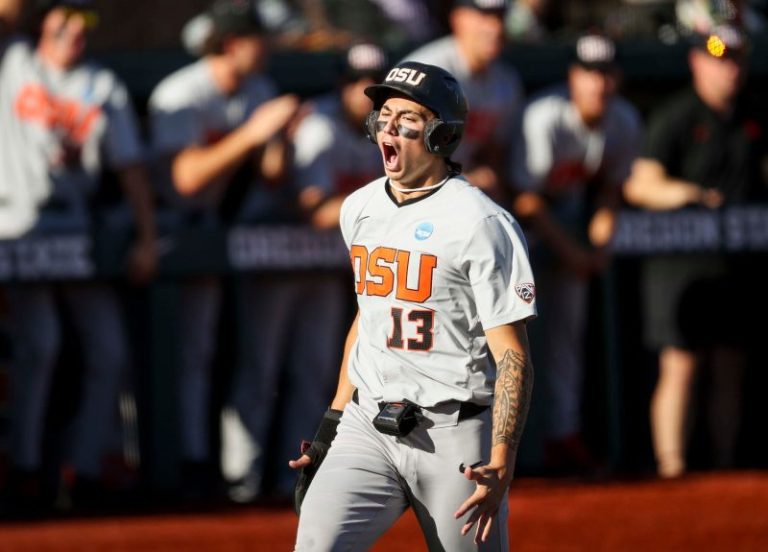
It could be a long stay in Omaha for the Beavers, but a very short draft night for their 6-5, 220-pound anchor. Arquette has, according to some draft projections, joined the pool of players under consideration for the No. 1 overall pick by the Washington Nationals and shouldn’t fall beyond the top three. His farewell to Corvallis was outstanding: Arquette had 14 hits in 36 at-bats (.389) during regional and super regional play as the Beavers survived winner-take-all tilts in both rounds. Arquette plays as large as his measurements suggest, which theoretically might pose a problem as a future shortstop, but he has very smooth actions around the bag and a deluxe offensive package (.354, 18 homers, 1.124 OPS, 112 mph maximum exit velocity).

Wehiwa Aloy, SS, Arkansas

Not sure if two Hawaiian-born shortstops have ever squared off in the CWS, but that would occur if the Beavers and Razorbacks advance to the championship series. And while Aloy won’t likely elbow his way into the draft’s top 10, he hardly takes a backseat to Arquette. The SEC player of the year, Aloy is a specimen himself, at 6-foot-2, 200 pounds, and cranked 20 home runs for the Razorbacks. A Golden Spikes Finalist, Aloy has elite arm strength and committed just five errors in more than 200 chances this season, and played his way into at least the teens of the first round.

Kade Anderson, LHP, LSU

The Razorbacks and Tigers are the lone SEC survivors in this diverse pool, and they’ll meet in Saturday’s opener – with a decent chance at a repeat engagement. Catch Anderson while you can: He’ll likely fall somewhere between No. 1 and No. 5 on draft night. In his first season as a starter, Anderson is second in the nation with 163 strikeouts in 103 innings, with a powerful repertoire that belies his 6-2 frame.

Zach Root, LHP, Arkansas

Root might have been leaped by rotation mate Gage Wood on the draft board, but his import to the Razorbacks can’t be undersold. He pitched seven innings of one-hit ball eliminate Tennessee in the super regional and, in 13 postseason innings, given up just four hits and one run. Root, a transfer from East Carolina, seems burlier than his 6-2, 210-pound frame would indicate, but pumps his fastball up to 97 mph and features a fastball-changeup-curveball mix that seems pro-ready. Likely on the outskirts of the first round at the moment, and could benefit from a high-profile Omaha showcase.

Mason White, SS, Arizona

A third-generation Wildcat, White offers one of the most compelling narratives in this CWS, as his two-run single atoned for an earlier error and lifted Arizona past North Carolina in the decisive super regional game at Chapel Hill. White, at 5-11 and 180 pounds, is the glue for the Wildcats and is aiming to play his way into a first-day draft selection. He went a long way toward that this season, equaling his 19 home runs as a sophomore while cutting his strikeout rate from 30.5% to 21.2%.

Jacob Morrison, RHP, Coastal Carolina

While the Chanticleers’ lone first-round hope is contact-crazy catcher Caden Bodine, Morrison is crucial to their survival in Omaha. He’s already slain one big-conference giant, tossing six innings of six-hit, one-run ball at Auburn to eliminate the Tigers. Now, he’ll be tough to miss: At 6-8, Morrison is a towering presence on the mound, using that extension to cultivate weak contact and finish sixth in the nation with a 2.15 ERA. Like White, Morrison will be on the fringes of the first-day selection pool, but could be a nice mid-round find for a pitching-hungry team.

Daniel Dickinson, 2B, LSU

While Anderson figures to be their lone first-round pick, the Tigers will be littered all over the first few rounds. Dickinson’s one who will be fun to watch in Omaha. In his lone season in Baton Rouge, the Utah Valley transfer posted a .312/.463/.534 line, stole nine bases and hit 12 home runs. A late bloomer, the 6-foot Dickinson bats third and is a contact machine, drawing 39 walks to just 36 strikeouts over 286 plate appearances. Multiple projections peg him in the second to third round.

Payton Brennan, UCLA

We’d be remiss to ignore the Bruins, who have quietly dominated their Westwood regionals yet feature few draft-eligible stars. No, the Bruins are a year ahead of schedule, with shortstop Roch Cholowsky a likely top 10 pick in 2026 and a bevy of power arms right behind him. So let’s toss some roses to Brennan, a third-year sophomore who’s produced 12 hits in 24 at-bats this postseason and slashing .304/.384/.500, with 11 steals this season.

The USA TODAY app gets you to the heart of the news — fastDownload for award-winning coverage, crosswords, audio storytelling, the eNewspaper and more.

This post appeared first on USA TODAY
Ladies and gentlemen, Shemar Stewart has left the building.

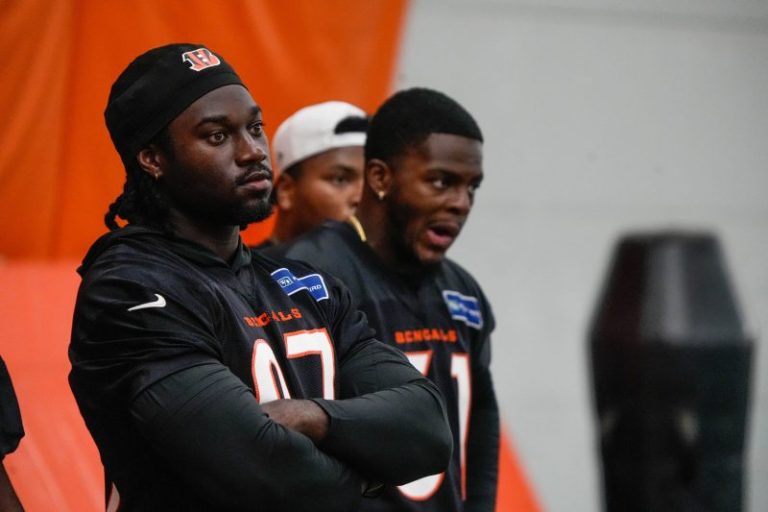
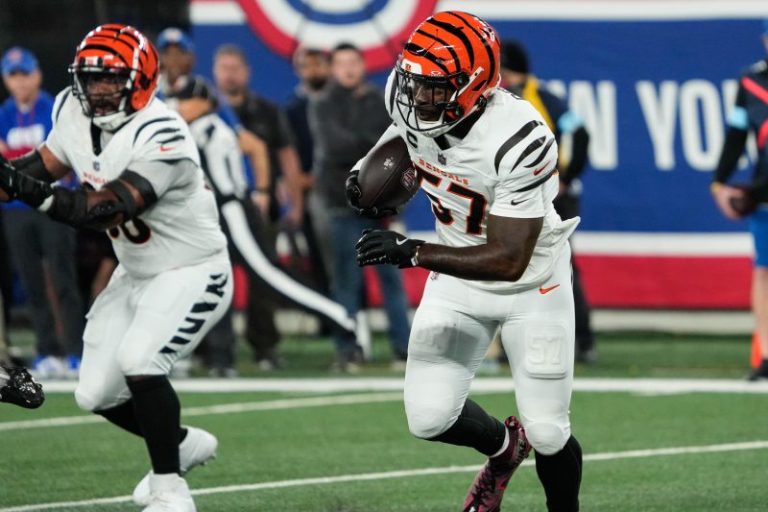
The Cincinnati Bengals’ first-round pick left mandatory minicamp Thursday as his contract dispute with the Bengals continues, according to ESPN’s Adam Schefter.

According to Kelsey Conway of the Cincinnati Enquirer, part of the USA TODAY Network, the Bengals are attempting to change the language in new rookie contracts to ‘allow the team to void future guarantees.’ Conway reported that Stewart’s camp is asking for his contract language to look the same as it did for defensive end Myles Murphy and right tackle Amarius Mims, the team’s previous two first-round picks.

It has been a month and a half since Cincinnati drafted Stewart, an edge rusher out of Texas A&M, with the 17th overall pick. Stewart has yet to participate in any practices – through rookie minicamp, OTAs and now mandatory minicamp – as the two sides have stalled in contract negotiations. Despite not practicing, the former Aggie had been in attendance at the team’s offseason training programs prior to Thursday’s departure from minicamp.

ESPN’s Jordan Reid pointed out in a social media post that Stewart has the option of re-entering the 2026 NFL Draft. But to do so, the 21-year-old edge rusher would have to sit out for one year, potentially losing the money he’s set to earn as a first-round pick and missing out on a year of development.

Bengals head coach Zac Taylor called Stewart’s holdout situation a learning experience for him and some of the other players in a media availability session after Thursday’s practice.

‘There’s a first for everything,’ Taylor said. ‘Every year, you kinda learn something new in this position, and this is just one of those things that the players have managed really well. We keep the team moving, and when he jumps on the field, that’ll be great for our team.’

While Stewart continues to wait to take his first on-field reps with the rest of the team, Taylor has continued to try to put a positive spin on things. Among them, the fact that Stewart has been present in off-field meetings and activities means he is still getting important lessons for his development.

‘I think for all the rookies, you’d like them to be out on the field,’ Taylor said, ‘but certainly, there’s things that happen over the course of an NFL career, and this is one of them right now.

‘He’s been in the meetings, he’s been positive in that way. He’s been learning. He’s a good learner. We look forward to getting him back on the field quickly.’

Stewart is not the only disgruntled edge rusher holding out from Bengals offseason workouts.

Hendrickson is set to become a free agent after the 2025 season. NFL Network’s Tom Pelissero and Ian Rapoport reported Tuesday that he and the Bengals have made ‘no progress’ on a multiyear contract, and the defensive end has not reported for any of minicamp.

This post appeared first on USA TODAY