Archive

2025

Browsing

A recent pause in the U.S. sending Patriot missiles and ammunition to Ukraine is part of a wider, global review of military aid driven in part by the Pentagon’s China-leery policy chief, Elbridge Colby.

‘A capability review is being conducted to ensure U.S. military aid aligns with our defense priorities,’ Pentagon spokesperson Sean Parnell told reporters this week. 

That review is part of a plan championed by Colby to conserve U.S. resources that may be needed for war in the Indo-Pacific. 

Upon first news of the pause, Pentagon officials said it was due to concerns about the U.S.’ stockpile of munitions, which came after the U.S. and Iran traded strikes on each other in the Middle East. 

However, Parnell wrote on X that it was ‘flat out wrong’ to suggest Colby caught other administration officials off-guard with the aid pause. Colby ‘routinely provides policy recommendations to the Secretary of Defense and the President,’ but they have the ultimate say, he said.

A White House official confirmed to Fox News Digital they were ‘aware of the pause ahead of time.’

‘The President and top officials expect the DOD to regularly review aid allocations to ensure they are in line with the America First agenda,’ the official said. 

Colby has long advocated for limiting resources in Europe and the Middle East in case they’re needed in a war over Taiwan. 

‘What I have been trying to shoot a signal flare over is that it is vital for us to focus and enable our own forces for an effective and reasonable defense of Taiwan and for the Taiwanese, as well as the Japanese, to do more,’ Colby said during his confirmation hearing. 

‘A Europe first policy is not what America needs in this exceptionally dangerous time. We need to focus on China and Asia – clearly,’ he wrote on X. last year. 

The weapons put on pause, including missile interceptors and 155 mm ammunition shells, were already on their way to Ukraine, U.S. officials told Fox News.

Since Russia’s 2022 invasion, the U.S. has provided Ukraine with nearly $66 billion in security assistance, the Pentagon noted.

‘Part of our job is to give the president a framework that he can use to evaluate how many munitions we have and where we’re sending them,’ Parnell added. ‘We can’t give weapons to everybody all around the world.’

Still, critics like former GOP Rep. Adam Kinzinger claimed Colby had ‘blood on his hands’ over the halt. 

Rep. Brian Fitzpatrick, R-Pa., requested an ’emergency briefing’ from the White House and the Defense Department to ‘review our nation’s weapons and munitions stockpiles, and ensure the United States remains fully committed to providing Ukraine with the resources it urgently needs.’

Dan Caldwell, a former Pentagon official who worked with Colby on policy, defended his past colleague on X. ‘The incentives at DoD favor maintaining the status quo: Keep troops in Syria, keep sending weapons to Ukraine that we need for our defense, etc. That is why when patriots like @ElbridgeColby put the interests of their own country and own troops first, they are viciously smeared.’

Six months into President Donald Trump’s second term, U.S. military prowess has largely focused back on the Middle East: an offensive campaign against the Houthis in Yemen, hitting Iran’s nuclear sites and boosting defenses in the region.

Air Force Gen. Daniel Caine, chairman of the Joint Chiefs of Staff, said defending the Al-Udeid base from an Iranian counterattack was the largest Patriot missile salvo in history. 

Fox News’ Jen Griffin contributed to this report. 

This post appeared first on FOX NEWS

As lawmakers march toward a vote on President Donald Trump’s ‘big, beautiful bill,’ House Republicans aren’t too worried about primary threats from tech billionaire Elon Musk.

Musk, who once served as the head of Trump’s Department of Government Efficiency (DOGE), has been highly critical of the president’s legislative agenda. He had remained quiet about the bill until earlier this week when Senate Republicans were making strides to pass it.

‘We don’t take threats lightly up here,’ Rep. Buddy Carter, R-Ga., told Fox News Digital. ‘And, you know, Elon, we appreciate all the work he did with DOGE — and he did some fine work, some great work — but at the same time, this is something we’ve got to do.’

Musk again returned to bemoan Republicans for supporting the legislative behemoth for its staggering $3.3 trillion price tag and the impact it would have on the nation’s already massive, $37 trillion debt. He went so far as to threaten to back primary challengers against any Republican that voted for the bill. 

It wouldn’t be the first time that Musk has been involved — he dumped millions into Trump’s campaign last year.

Now, House Republicans are gearing up to vote after hours of delays, negotiations and a near record-breaking amount of open floor time in the lower chamber. Additionally, many don’t care about Musk’s threats.

Rep. Tim Walberg, R-Mi., told Fox News Digital that he was focused on doing the best ‘we could do, which is, frankly, better than what Elon Musk did.’

‘I don’t worry about Elon Musk,’ he said. ‘I do know that DOGE found some good things that we needed to remedy in this government. But the $2 trillion that Elon said he was going to find, he didn’t.’

Musk took particular issue with the Senate’s changes to the bill, too, and slammed it for adding trillions to the deficit.

Rep. Brad Knott, R-N.C., noted that the bill cuts north of $1.5 trillion in an effort to help offset the cost of extending or making permanent Trump’s 2017 Tax Cuts and Jobs Act.

‘I appreciate Mr. Musk’s motivation,’ he told Fox News Digital. ‘I appreciate his focus on debt reduction, and I hope he’ll take a step back and realize that we’re still all on the same team here.’

While the Senate’s changes, particularly to Medicaid and a reduction in the rollback of green energy subsidies from former President Joe Biden’s Inflation Reduction Act, among other cost-driving issues, gave fiscal hawks in the House heartburn, House Republican leadership is confident that the bill will pass.

This post appeared first on FOX NEWS

Constellation Brands on Tuesday reported quarterly earnings and revenue that missed analysts’ estimates as beer demand slid and tariffs on aluminum weighed on its profitability.

Still, the brewer reiterated its forecast for fiscal 2026, showing confidence that it can hit its financial targets despite the weaker-than-expected quarterly performance and higher duties.

Shares of the company fell less than 1% in extended trading on Tuesday evening but rose 3% during morning trading on Wednesday after the company’s conference call.

The stock has shed more than 20% of its value this year, fueled by concerns about how the higher duties imposed by President Donald Trump would affect demand for its beer.

Here’s what the company reported compared with what Wall Street was expecting, based on a survey of analysts by LSEG:

The report, which covers the three months ended May 31, includes the start of Trump’s tariffs on canned beer imports in early April. He also hiked trade duties on aluminum to 25% in mid-March and to 50% in early June.

Both imported beer and aluminum are crucial to Constellation’s beer business, which accounts for roughly 80% of the company’s overall revenue. Constellation’s beer portfolio only includes Mexican imports, like Corona, Pacifico and Modelo Especial, which overtook Bud Light as the top-selling beer brand in the U.S. two years ago.

Constellation reported fiscal first-quarter net income of $516.1 million, or $2.90 per share, down from $877 million, or $4.78 per share, a year earlier. Constellation’s operating margin fell 150 basis points, or 1.5%, in the quarter, in part driven by higher aluminum costs.

Excluding items, the brewer earned $3.22 per share.

Net sales dropped 5.8% to $2.52 billion, fueled by weaker demand for its beer and the company’s divestiture of Svedka vodka.

Constellation is still facing softer consumer demand, CEO Bill Newlands said in a statement. He attributed the weaker sales to “non-structural socioeconomic factors.” Constellation’s beer business saw shipment volumes fall 3.3%, caused by weaker consumer demand.

Last quarter, Newlands said Hispanic consumers were buying less of the company’s beer because of fears over Trump’s immigration policy. Roughly half of Constellation’s beer sales come from Hispanic consumers, according to the company.

But on Wednesday, Newlands demurred when asked about Hispanic consumer sentiment, saying that all shoppers are concerned about higher prices.

“When you see a fair amount of change, both Hispanic and non-Hispanic consumers are concerned about inflation and about cost structure,” Newlands said.

He added that consumers aren’t going out to eat as much and hosting fewer social occasions, which means they are drinking less beer. Still, he maintained that consumer interest in drinking beer hasn’t waned; while shoppers’ overall spending on beer has fallen, their relative spend on beer compared with their total grocery bill has held steady.

For fiscal 2026, Constellation continues to expect comparable earnings per share of $12.60 to $12.90. The company is projecting that organic net sales will range from declining 2% to rising 1%.

This post appeared first on NBC NEWS

The Indiana Fever, the newly minted 2025 Commissioner’s Cup Champions, return home to Gainbridge Fieldhouse in Indianapolis on Thursday, July 3 to face off against the Las Vegas Aces without Caitlin Clark.

Clark will sit out her fourth consecutivegame Thursday due to a left groin injury, which also kept her out of the Fever’s 74-59 win over the Minnesota Lynx in the 2025 Commissioner’s Cup final on July 1. She’s set to miss her ninth game of the season after a quad injury sidelined her five games last month. The Fever have gone 4-4 without Clark in the lineup, but eagerly await her return to the court.

‘(I’m) doing everything I can to put myself in a position to play the next game every single time,’ Clark said on June 29. ‘That’s always my goal to be available for the next game. Doing everything I can with the medical staff to be able to get my body right and be able to do that.’

Despite being listed as ‘day-to-day,’ Clark was ruled out of Thursday’s matchup one day before the game. Fever head coach Stephanie White said July 2 that the team was taking a cautious approach with Clark and putting ‘her long-term health and wellness at the forefront.’

‘I think it’s five games before All-Star break,’ White continued, ‘so let’s just ease her mind even though she’s antsy, and let’s do this the right way and make sure we’re ready to go and 100% when she comes back.’

Here’s everything you need to know about the 2024 WNBA Rookie of the Year’s playing status:

2025 WNBA COMMISSIONER’S CUP: Highlights, recap as Fever beat Lynx

Is Caitlin Clark playing vs. Las Vegas Aces?

No. Clark was ruled out for Thursday’s matchup against the Aces, the second meeting between the two teams this season. The Fever lost the first matchup 89-81 in Las Vegas on June 22. Clark had 19 points, 10 assists and three rebounds in the loss.

The game is scheduled for 7 p.m. ET on Thursday, July 3. It can be streamed on Prime Video.

Caitlin Clark injury update: What happened?

Head coach Stephanie White said she first learned of Clark’s groin injury on June 25 following the Fever’s 94-86 win over the Seattle Storm on June 24, where Clark finished with six points (3-of-13 FG, 0-of-6), nine assists, three steals and two rebounds in 31 minutes of play.

Clark previously suffered a quad injury during the Fever’s 90-88 loss to the New York Liberty on May 24. Clark returned to the Fever’s lineup on June 14 in the Fever’s 102-88 win over the Liberty after missing five games, which officially ended her longest stretch of missed due to injury in her collegiate or WNBA career. She dropped 32 points, nine assists and eight rebounds in her first game back.

‘No one said this season was going to be perfect for us. There’s going to be ups and downs,’ Clark said on June 29. ‘From injuries or coaches not being here for a couple of games. Everybody has been through a little bit of adversity here. So I think just giving our group credit for being able to stick together and know that whatever we have in our locker room is really all we need to go out there and win. I’m just proud of our group.’

Caitlin Clark stats

Clark ranks second in the WNBA in assists per game to start the 2025 season. Here’s a look at the 2024 Rookie of the Year’s full stats (per game):

Games played: 9
Minutes: 33.3
Points: 18.2
Rebounds: 5.0
Assists: 8.9
Steals: 1.6
Blocks: 0.7
Turnovers: 5
FG%: 39.0
3P%: 29.5

The USA TODAY app gets you to the heart of the news — fast. Download for award-winning coverage, crosswords, audio storytelling, the eNewspaper and more.

This post appeared first on USA TODAY

LOS ANGELES – Agonizing.

Excruciating.

Tortuous.

At times it was that tough watching Los Angeles Dodgers starter Clayton Kershaw on the mound before the magical moment

Kershaw became the 20th pitcher to strike out 3,000 batters and he did it against the lowly Chicago White Sox – the hard way.

Entering the game needing only three strikeouts to reach the milestone, Kershaw labored through six innings. Until on his 100th pitch, he recorded strikeout No. 3,000.

Kershaw, 37, left with the Dodgers trailing the Chicago White Sox 4-2 – and the home crowd roaring after his achievement. He was on the hook for the loss until the Dodgers rallied with three runs in the bottom of the ninth, earning a 5-4 win with Freddie Freeman’s walk-off single.

‘Honestly didn’t pitch that great tonight,” Kershaw said after the game. ‘Slider was so bad. But this was such a special night all the way around. It really was. Couldn’t have asked for anything more really. It just was so fun to get to be out there.”

Kershaw is not flawless, given his share of postseason struggles. But Dodgers manager Dave Roberts was spot on before the game when he called Kershaw “a unicorn.’

The Dodgers clubhouse also happens to be occupied by baseball’s ultimate unicorn – Shohei Ohtani. He’s the ultimate two-way superstar, recently throwing a 102 mph fastball and at 30 already having won three MVP awards.

But Kershaw has done something Ohtani can’t match. 

In fact, there’s a chance no player ever will.

It starts with loyalty.

Tommy Lasorda, the late Dodgers manager insisted he bled Dodger Blue. There’s no need to check Kershaw’s veins. Clearly, he’s a blueblood.

He has spent his entire 18-year career with the Dodgers, and joining the exclusive club of pitchers with 3,000 strikeouts further underscored how rare that is.

Of the 20 pitchers in the 3,000 club, only Walter Johnson and Bob Gibson got there while playing exclusively with one club – Johnson with the Washington Senators and Gibson with the St. Louis Cardinals.

‘I don’t know if I put a ton of stock in being with one team early on,” said Kershaw, who was selected by the Dodgers in the first round of the 2006 MLB Draft. ‘Just kind of something that happened and over time. I think as you get older and you appreciate one organization a little bit more.

‘And the Dodgers are stuck with me, too. It hasn’t been all roses, I know that. So there’s just a lot of mutual respect, I think. And I’m super grateful now looking back to get to say that I spent my whole career here. … I have a lot more appreciation for it now.”

Kershaw’s on-field contributions to the Dodgers put him in rare company. Ten All-Star appearances. Three Cy Young awards. Two World Series rings.

Entering Wednesday, he had a 216-94 career record and a ERA of 2.51.

Roberts said Kershaw also has an impact on the younger pitchers on the Dodgers’ staff.

“A lot guys grab him, get his ear,’ Roberts said. “But for the most part, I think that’s just kind of how he goes about it. He’s always talking the game. He’s watching the game. More importantly, he’s very consistent.

“Even yesterday I was watching in the pen, he was doing his dry work (practicing skills without using a ball) and this is something he’s done for 18 years the day before a start.’’

Roberts said Kershaw had the 3,000-strikeout milestone in mind when he decided to return to the Dodgers in 2025. But before the season started, Kershaw underwent surgery to repair a torn meniscus in his left knee and a ruptured plantar plate in his left big toe.

Recovering, Kershaw did not make his first start until May 17. He entered the historic game 4-0 with a 3.03 ERA and with 29 strikeouts in 38 ⅔ innings pitched this season.

It’s more than many people expected from a veteran who’s grown more brittle, and, Roberts said, “A reminder for me for anyone to never bet against that guy.’

The USA TODAY app gets you to the heart of the news — fastDownload for award-winning coverage, crosswords, audio storytelling, the eNewspaper and more.

This post appeared first on USA TODAY

The ‘bunker busting’ bombs dropped on Iranian nuclear sites last month by U.S. forces have degraded Tehran’s atomic program by up to two years, the Pentagon confirmed Wednesday.

‘We have degraded their program by one to two years, at least intel assessments inside the Department [of Defense] assess that,’ Defense Department spokesman Sean Parnell told reporters. 

‘We believe that Iran’s nuclear capability has been severely degraded, perhaps even their ambition to build a bomb,’ he added, though security experts have told Fox News Digital that Tehran is unlikely to be deterred in its ambition to build a nuclear weapon.

The announcement reflects a far more positive assessment regarding the success of the June 22 strikes that targeted the Fordo, Isfahan and Natanz nuclear sites than previous estimates regarding the extent to which Tehran’s atomic capabilities had been degraded. 

Rafael Grossi, head of the U.N.’s International Atomic Energy Agency (IAEA), over the weekend warned that Iran may be able to resume enriching uranium within a matter of months. 

The comments also coincided with reports that Iran may have been able to move some of its stockpiles of near-weapons-grade enriched uranium, or possibly centrifuges, after satellite images showed more than a dozen cargo trucks were spotted at the Fordow nuclear site prior to the U.S. strikes. 

The U.S. has fervently denied that any intelligence suggests Iran was successful in moving its nuclear capabilities off site. Secretary of Defense Pete Hegseth became angry when asked about the possibility by reporters.

Fox News Digital has confirmed that Israel is continuing to monitor the security situation. 

Iranian Foreign Minister Abbas Aragchi this week acknowledged that there was severe damage to the Fordow facility, though he also insisted that ‘the technology and knowhow is still there.’

‘No one exactly knows what has transpired in Fordow. That being said, what we know so far is that the facilities have been seriously and heavily damaged,’ Aragchi said during a CBS interview this week.

Though according to Parnell on Wednesday, ‘All of the intelligence that we’ve seen (has) led us to believe that Iran’s – those facilities especially, have been completely obliterated.’

This post appeared first on FOX NEWS

At this point, most Americans are aware that their personal information is often up for sale. But few would have expected their domestic flight records to be part of the trade. 

You might think that when you book a flight, the data stays between you, the airline and perhaps your travel agency, but a new report suggests otherwise. Internal documents reveal that major U.S. airlines have been funneling detailed passenger data to a little-known broker, which then sells that information directly to the Department of Homeland Security. 

Get my best tech tips, urgent security alerts and exclusive deals delivered straight to your inbox. Plus, you’ll get instant access to my Ultimate Scam Survival Guide — free when you join my CYBERGUY.COM/NEWSLETTER

Which airlines shared data and how the travel intelligence program works

At the center of the controversy is the Airlines Reporting Corporation (ARC), a company jointly owned by several of the largest U.S. airlines, including Delta, American Airlines and United. ARC’s core business includes managing ticket settlements between airlines and travel agencies. However, under a lesser-known initiative called the Travel Intelligence Program (TIP), ARC collects and monetizes vast amounts of data from domestic flight bookings. This includes names, complete itineraries and payment details.

Internal government records and procurement documents reveal that Customs and Border Protection (CBP), part of the Department of Homeland Security, has purchased access to ARC’s TIP data to track individuals of interest across the U.S. While CBP maintains that this data supports criminal and administrative investigations, critics argue that the arrangement raises major privacy concerns. 

The data is shared without travelers’ knowledge or consent, and ARC reportedly requested that the agency keep its identity confidential unless legally required to disclose it.

The documents confirm that CBP’s initial contract with ARC began in June 2024. It has already been extended and may continue through 2029. Although the initial amounts seem modest, around $11,000 with a recent $6,800 update, the implications are far-reaching.

What DHS is collecting from your flight bookings and why it’s concerning

ARC’s Travel Intelligence Program goes far beyond basic passenger manifests. It includes over a billion records spanning both past and future travel, updated daily. The system can be queried by name, credit card or even travel agency. Importantly, it does not include data from tickets purchased directly through airline websites, focusing instead on bookings made via travel agencies, such as Expedia.

The DHS has justified its use of TIP data in a public Privacy Impact Assessment, noting the program helps in active investigations. CBP echoed this, stating that data is only used when a case is already open. Still, this sets a dangerous precedent. It normalizes mass surveillance through third-party data purchases, undermining safeguards designed to limit unnecessary intrusion.

This isn’t an isolated incident. Last month, Immigration and Customs Enforcement also acknowledged purchasing ARC data. Other federal agencies listed in procurement records include the Secret Service, SEC, DEA, TSA and even the Air Force.

6 ways you can protect your privacy from data brokers

If you want to take back control of your personal information, here are six smart steps you can take right now to reduce your exposure to data brokers.

Whenever you can, avoid using third-party travel sites like Expedia, Orbitz or travel agencies. These platforms are the main sources of the data collected by the Airlines Reporting Corporation (ARC) through its Travel Intelligence Program. When you book directly on an airline’s official website or mobile app, your data is far less likely to be shared with ARC or sold to government agencies. While it might be tempting to look for deals on aggregator sites, once you find a fare you like, try to book it directly through the airline.

The ARC system allows queries by credit card number, which means your travel activity can be tracked even if your name is not directly searched. To protect yourself, consider using a virtual credit card or a disposable card number for flight bookings. These are often available through banking apps or fintech services like Revolut, Privacy.com or certain American Express accounts. Virtual cards are tied to your main account but generate a temporary number that can only be used once or at a specific merchant. This makes it much harder for brokers to link future bookings to you.

Be cautious about the personal information you enter during the booking process. Unless it is legally required, avoid adding unnecessary details like your frequent flyer number, passport data for domestic flights or secondary phone numbers. You can also create a separate email address specifically for travel bookings to reduce the risk of cross-linking data with your other online accounts. When it comes to loyalty programs, consider opting out or using a separate identity if you are concerned about data being shared across companies.

The most effective way to take control of your data and avoid data brokers from selling it is to opt for data removal services. While no service promises to remove all your data from the internet, having a removal service is great if you want to constantly monitor and automate the process of removing your information from hundreds of sites continuously over a longer period of time. Check out my top picks for data removal services and get a free scan to find out if your personal information is already out on the web by visiting Cyberguy.com/Delete

Prevent tracking at the source by using privacy-first tools. Switch to browsers like Brave, Firefox or DuckDuckGo, which block ads and data collectors by default. Set up a separate, secure alias email address for booking travel using services. This limits how easily brokers can link your travel data to your online identity. See my review of the best secure and private email services by visitingCyberguy.com/Mail

If your travel or payment data is ever leaked or abused, freezing your credit can help prevent identity theft. Identity theft companies can assist you in freezing your bank and credit card accounts to prevent further unauthorized use by criminals. They can also monitor personal information like your Social Security number, phone number and email address and alert you if it is being sold on the dark web or being used to open an account. 

One of the best parts of my No. 1 pick is that is it has identity theft insurance of  and a white glove fraud resolution team where a . See my tips and best picks on how to protect yourself from identity theft by visiting Cyberguy.com/IdentityTheft 

Kurt’s key takeaway

The ARC incident is yet another example of federal agencies bypassing traditional legal channels by buying sensitive data from private firms. Travelers are not just passengers, they are data points in a growing ecosystem where information is currency. The fact that this trade happened without informed consent and behind legal smokescreens should worry anyone who values privacy.

Would you change how you book flights if it meant protecting your personal data? Let us know by writing to us at Cyberguy.com/Contact

Get my best tech tips, urgent security alerts and exclusive deals delivered straight to your inbox. Plus, you’ll get instant access to my Ultimate Scam Survival Guide — free when you join my CYBERGUY.COM/NEWSLETTER

Copyright 2025 CyberGuy.com.  All rights reserved.  

This post appeared first on FOX NEWS

President Donald Trump’s administration released its annual report revealing the salaries for every staffer inside the White House on Thursday.

The report shows employees’ earnings in a range of $59,070 at the lowest to $225,700 at the highest, though a few aren’t accepting salaries at all.

The top-paid staffer at the White House is Jacalynne Klopp, a senior advisor and the sole staffer earning $225,700. Behind her is Edgar Mkrtchian, an associate counsel, making $203,645.

Behind them comes a group of 33 staffers making $195,200, which includes many well-known names. White House press secretary Karoline Leavitt takes in this level of salary, as does border czar Tom Homan, chief of staff Susan Wiles, trade advisor Peter Navarro, communications director Steven Cheung and police chief of staff and homeland security advisor Stephen Miller.

The White House did not immediately respond to a request for comment from Fox News Digital.

According to the report, there are 108 employees who make between $59,000 and $80,000, while Trump’s speechwriters earn between $92,500 and $121,500.

Eight employees do not receive salaries at all, though some of those are due to overlapping roles in other sections of government.

Secretary of State Marco Rubio is chief among these, not receiving any compensation for his White House role as national security advisor. Special envoy Steve Witkoff also receives compensation from the State Department rather than the White House.

Trump’s own compensation is not listed in the report, but the pay scheme for the president is laid out in federal law. As president, Trump earns a base salary of $400,000, as well as a $50,000 expense allowance, $100,000 for travel and $19,000 for entertainment.

Trump donated his salary to government agencies during his first term in office and said he will do the same during his second term.

The White House did not immediately respond when asked about Trump’s compensation.

This post appeared first on FOX NEWS

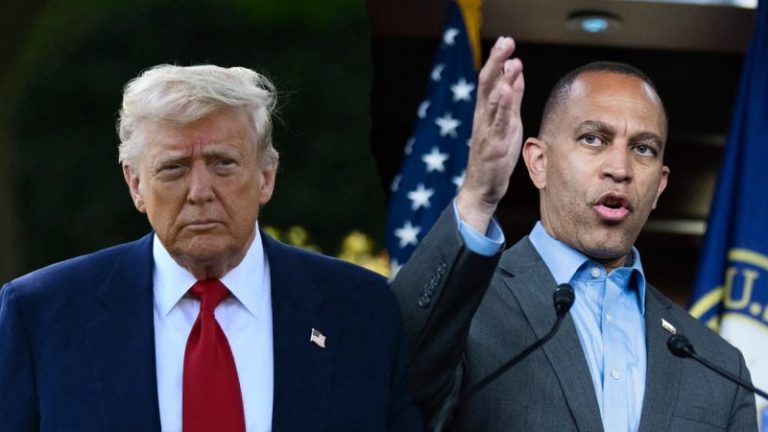
The House of Representatives’ progress on President Donald Trump’s ‘big, beautiful bill’ has temporarily come to a screeching halt thanks to the chamber’s top Democrat.

House Minority Leader Hakeem Jeffries, D-N.Y., began speaking in the chamber minutes before 5 a.m. and appears to be poised for hours more.

One GOP lawmaker told Fox News Digital that Jeffries was seen arriving with multiple binders, one of which he read from for roughly three hours. If the rest of the binders also hold portions of his speech, the New York Democrat could keep the House floor paused into the afternoon.

He’s able to command the House floor via a ‘magic minute,’ a privilege for party leaders in the chamber that allows them to speak for however long they want.

It comes after the House of Representatives voted to advance Trump’s $3.3 trillion ‘big, beautiful bill’ to its final phase in Congress, overcoming fears of a potential Republican mutiny.

It’s a significant victory for House Speaker Mike Johnson, R-La., though the fight is not over yet.

Lawmakers voted to proceed with debate on the mammoth-sized Trump agenda bill in the early hours of Thursday – a mechanism known as a ‘rule vote’ – teeing up a final House-wide vote sometime later Thursday morning.

The House adopted the rules for debate on the measure in a dramatic 219 to 213 vote – with all but moderate Rep. Brian Fitzpatrick, R-Pa., voting to proceed.

Next comes a vote on the actual measure, likely sometime on Thursday.

But the timing is largely contingent on when Jeffries finishes speaking. 

‘I feel the obligation, Mr. Speaker, to stand on this House floor and take my sweet time,’ he said at one point.

The first part of Jeffries’ speech saw him read from a binder that he said contained accounts of people who could lose their Medicaid coverage under the GOP bill, taken from residents of states with Republican lawmakers.

‘This Congress is on the verge of ripping food out of the mouths of children, veterans and seniors as a result of this one big ugly bill in order to reward billionaires with massive tax breaks and exploding the debt in the process,’ he said at one point.

Jeffries called it ‘one big, ugly bill’ that ‘our Republican colleagues are trying to jam down the throats of the American people will undermine their quality of life.’

The budget reconciliation process, which Republicans are using to pass the bill, is a mechanism that allows the party in power to completely sideline the minority in most cases. 

That means Jeffries nor his caucus have no real power to stop the bill from moving forward, making delay tactics their only tangible form of opposition right now.

The vote had been stalled for hours, since Wednesday afternoon, with five House Republicans poised to kill the measure before lawmakers could weigh the bill itself.

Several members of the conservative House Freedom Caucus and their allies, meanwhile, appeared ready to skip the vote altogether in protest of GOP leaders’ compromise bill.

But both Johnson and Trump spent hours negotiating with holdouts, apparently to some success.

But the process could still take hours. Democrats could still call up various procedural votes to delay the final measure, as they did when the legislation passed the House by just one vote for the first time in late May.

Plus, the bill itself could still face opposition from both moderates and conservative Republicans.

Conservative lawmakers were threatening to derail the rule vote as recently as Wednesday over changes the Senate made to the legislation, which fiscal hawks argued would add billions of dollars to the federal deficit.

But those concerns appear to have been outweighed by pressure from House GOP leaders and the president himself – who urged House Republicans to coalesce around the bill.

The Senate passed its version of the bill late on Tuesday morning, making modifications to the House’s provisions on Medicaid cost-sharing with states, some tax measures, and raising the debt ceiling.

Moderates are wary of Senate measures that would shift more Medicaid costs to states that expanded their programs under Obamacare, while conservatives have said those cuts are not enough to offset the additional spending in other parts of the bill.

Two members of the conservative House Freedom Caucus who also sit on the House Rules Committee, Reps. Ralph Norman, R-S.C., and Chip Roy, R-Texas, voted against the measure during the Rules Committee’s 12-hour hearing to consider the bill.

Johnson himself publicly urged the Senate to change as little as possible in the run-up to the vote. But the upper chamber’s bill ultimately passed by a similarly narrow margin as the House – with Vice President JD Vance casting the tie-breaking vote.

‘I’m not happy with what the Senate did to our product,’ Johnson told reporters late on Tuesday afternoon. ‘We understand this is a process that goes back and forth, and we’ll be working to get all of our members to yes.’

But Trump took to Truth Social after the Senate passed the bill to urge House Republicans to do the same.

‘It is no longer a ‘House Bill’ or a ‘Senate Bill’. It is everyone’s Bill. There is so much to be proud of, and EVERYONE got a major Policy WIN — But, the Biggest Winner of them all will be the American People, who will have Permanently Lower Taxes, Higher Wages and Take Home Pay, Secure Borders, and a Stronger and More Powerful Military,’ the president posted.

‘We can have all of this right now, but only if the House GOP UNITES, ignores its occasional ‘GRANDSTANDERS (You know who you are!), and does the right thing, which is sending this Bill to my desk. We are on schedule — Let’s keep it going, and be done before you and your family go on a July 4thvacation. The American People need and deserve it. They sent us here to, GET IT DONE.’

Both the House and Senate have been dealing with razor-thin GOP majorities of just three votes each.

The bill would permanently extend the income tax brackets lowered by Trump’s 2017 Tax Cuts and Jobs Act (TCJA), while temporarily adding new tax deductions to eliminate duties on tipped and overtime wages up to certain caps.

It also includes a new tax deduction for people aged 65 and over.

The legislation also rolls back green energy tax credits implemented under former President Joe Biden’s Inflation Reduction Act, which Trump and his allies have attacked as ‘the Green New Scam.’

The bill would also surge money toward the national defense, and to Immigrations and Customs Enforcement (ICE) in the name of Trump’s crackdown on illegal immigrants in the U.S.

The bill would also raise the debt limit by $5 trillion in order to avoid a potentially economically devastating credit default sometime this summer, if the U.S. runs out of cash to pay its obligations.

New and expanded work requirements would be implemented for Medicaid and federal food assistance, respectively.

Democrats have blasted the bill as a tax giveaway to the wealthy while cutting federal benefits for working-class Americans.

But Republicans have said their tax provisions are targeted toward the working and middle classes – citing measures eliminating taxes on tipped and overtime wages – while arguing they were reforming federal welfare programs to work better for those who truly need them.

Progressive Rep. Maxwell Frost, D-Fla., told reporters it was Democrats’ intent to delay proceedings on Wednesday for as long as possible.

‘This last go around, we were able to delay the bill upwards of 30 hours. And so we’re going to do the same thing, do everything we can from a procedural point of view to delay this,’ Frost said.

Meanwhile, there were earlier concerns about if weather delays in Washington could delay lawmakers from getting to Capitol Hill in time for the planned vote.

‘We’re monitoring the weather closely,’ Johnson told reporters. ‘There’s a lot of delays right now.’

Fox News’ Dan Scully contributed to this report.

This post appeared first on FOX NEWS

The United States Men’s National Team is advancing to the 2025 Concacaf Gold Cup final after defeating Guatemala 2-1 on Wednesday, July 2. 

American star Diego Luna got the USMNT on the board early by scoring two goals in the fourth and 15th minute of the semifinal match, which was enough to seal the win. Luna was named the Man of the Match for his efforts.

“I think it’s just finding the rhythm and being able to get the freedom from the coaching staff and from the team,’ Luna said after the match. ‘I know that they are going to have my back and trust of the defensive responsibilities lets me do what I do on the ball.’

Guatemala made it close in the end. Olger Escobar cut Guatemala’s deficit in half with a goal in the 80th minute, and José Morales nearly scored the equalizer in stoppage time, but American goalie Matt Freese blocked the shot to hold the Guatemalans off and secure the win.   

With the victory, the USMNT will face Mexico in the final. Mexico defeated Honduras 1-0 in the other semifinal.

Gold Cup semifinal highlights: USMNT 2, Guatemala 1

Olger Escobar scores: USMNT 2, Guatemala 1

Guatemala’s Olger Escobar has cut the U.S. men’s lead in half with a goal. Escobar scored in the 80th minute on an assist by Arquímides Ordóñez to get Guatemala on the board. It marked Escobar’s second goal of the tournament.

Yellow cards are flying

Here’s all the yellow cards assessed so far. It’s worth noting that a second yellow card would lead to a suspension in Sunday’s Gold Cup final:

USA’s Matt Freese | 77′
USA’s Diego Luna | 51′
Guatemala’s Stheven Robles | 49′
USA’s Chris Richards | 45’+1′

First half ends: USMNT 2, Guatemala 0

The USMNT has a two point advantage heading into halftime. USA’s Chris Richards heads into the locker room with a yellow card after picking it up in the first minute of stoppage.

Diego Luna scores again: USMNT 2, Guatemala 0

Diego Luna strikes again. Malik Tillman found a wide-open Luna up the middle. Luna then juked a defender and scored the ball with a clean strike in the fifteenth minute to put the USMNT up 2-0 over Guatemala. Luna pointed to his last name on the back of his jersey in celebration of his second goal of the night.

Diego Luna scores goal: USMNT 1, Guatemala 0

The U.S. men’s national team is off to a great start in the Gold cup semifinals. Diego Luna got the Americans on the board first after finding the back of the net in the fourth minute, marking his second goal in as many games.

How to watch USMNT Gold Cup semifinals

The 2025 Concacaf Gold Cup semifinals will feature two matches on Wednesday: the United States will face Guatemala at 7 p.m. ET on FS1, followed by Mexico battling Honduras at 10 p.m. ET on FS1.

How to watch USMNT vs. Guatemala

The United States will face Guatemala in the 2025 Concacaf Gold Cup semifinals on Wednesday, July 2at 7 p.m. ET.

Date: Wednesday, July 2
Time: 7 p.m. ET
TV: FS1, Univision
Stream: Fox Sports, Fubo, Sling TV
Location: Energizer Park, St. Louis, Missouri

Watch Gold Cup action with Fubo

USMNT lineup for Gold Cup semifinal

This post appeared first on USA TODAY