Archive

2025

Browsing

On Saturday, college football’s most prestigious individual honor will be handed out, with the Heisman Trophy being awarded to the young man deemed to be the most outstanding player in the sport.

While the winner won’t be announced until Dec. 13, the four players vying for the famed, 45-pound bronze trophy have been revealed.

Indiana quarterback Fernando Mendoza, Vanderbilt quarterback Diego Pavia, Ohio State quarterback Julian Sayin and Notre Dame running back Jeremiyah Love are the finalists for the 2025 Heisman Trophy, with ESPN announcing the group on Monday, Dec. 8.

Mendoza and Pavia are in line to make history for their respective programs, as neither Indiana nor Vanderbilt has ever produced a Heisman winner.

Twelve of the past 15 Heisman recipients have been quarterbacks, though only three of the past five. Last season, Colorado wide receiver/cornerback Travis Hunter took home the award.

Unlike Hunter, whose Buffaloes team went 9-3 in the 2024 regular season, each of the Heisman finalists played on teams that won at least 10 games, including Mendoza and Sayin, whose squads earned first-round byes in the 12-team College Football Playoff.

Love had some history on his side, though. Since 1955, a running back or halfback has won the Heisman in every year that ends in a five, a trend that most recently saw Alabama running back and future NFL All-Pro Derrick Henry hoist the trophy.

In what has become an increasingly transient sport over the past several years, threeof the Heisman finalists are transfers. Mendoza is in his first season at Indiana after transferring from Cal, Pavia is in his second season at Vanderbilt after coming in from New Mexico State and Sayin was an early enrollee at Alabama who spent about a month with the Crimson Tide before transferring to Ohio State shortly after legendary coach Nick Saban’s retirement in Jan. 2024.

Who are the finalists for the Heisman Trophy?

Here’s a look at the four finalists for the 2025 Heisman Trophy:

QB Fernando Mendoza, Indiana
QB Diego Pavia, Vanderbilt
QB Julian Sayin, Ohio State
RB Jeremiyah Love, Notre Dame

Heisman Trophy ceremony date

The 2025 Heisman Trophy will be awarded during a ceremony on Saturday, Dec. 13 at 7 p.m. ET from Jazz at Lincoln Center’s Appel Room in New York City.

The ceremony will air on ABC.

Fernando Mendoza stats

In his first season with the Hoosiers, Mendoza has completed 71.5% of his passes for 2,980 yards, 33 touchdowns and six interceptions. He has also rushed for 240 yards and six touchdowns. He led Indiana to a program-record 13 wins, the Hoosiers’ first Big Ten championship game victory and the program’s first undefeated regular season since 1945.

Mendoza had only thrown for a combined 30 touchdowns in his first two seasons of college football, both of which came at Cal.

Mendoza’s 33 touchdown passes are the most among FBS players. He’s tied for second nationally, along with Pavia, in yards per attempt (9.4) and is sixth in completion percentage.

Diego Pavia stats

Pavia improved upon what was already a stellar debut season for Vanderbilt, completing 71.2% of his passes for 3,192 yards, 27 touchdowns and eight interceptions. He added 826 rushing yards and nine touchdowns.

He’s second among all FBS players in total yards per game, with 334.8, ranking him behind only South Florida quarterback Byrum Brown.

With Pavia at quarterback, the Commodores have gone 17-9 the past two seasons, including a 10-2 mark this season that set a program record for wins. Vanderbilt went just 12-45 in the four seasons before Pavia transferred there.

Julian Sayin stats

In his first season as a starter, Sayin has completed 78.4% of his passes for 3,323 yards, 31 touchdowns and six interceptions.

He’s tied for second among all FBS quarterbacks in touchdown passes, behind only Mendoza, and his completion percentage is currently an FBS single-season record.

Jeremiyah Love stats

The lone non-quarterback of the group, Love has rushed for 1,372 yards and 18 touchdowns this season while averaging 6.9 yards per carry. Love had been a receiving threat out of the backfield, too, with 27 catches for 280 yards and three touchdowns.

Love is third among all FBS players in rushing touchdowns and fourth in rushing yards.

This post appeared first on USA TODAY
The UFC event at the White House on June 14 will feature eight or nine championship fights, President Donald Trump told reporters at the Kennedy Center Honors on Dec. 8.

“The biggest fights they’ve ever had,’’ Trump said. “Every one’s a championship fight. And every one’s a legendary type of fight.’’

Trump also said UFC CEO Dana White is holding back fights “right now’’ to save them for the White House. The UFC event will be held there to celebrate America’s 250th anniversary.

An arena being built in front of the White House for the UFC event will have 5,000 to 6,000 seats, according to Trump, who said there will be 100,000 people in the back, where they’re putting up eight or 10 “very big screens.’’

“That’s going to be an exciting night,’’ Trump added. “So many people are asking for tickets.’’

Conor McGregor, the former UFC champion who hasn’t fought since 2021, has lobbied for a spot on the White House card. So has Jon Jones, arguably the greatest fighter in UFC history.

This post appeared first on USA TODAY
Republican Rep. Marjorie Taylor Greene of Georgia announced Tuesday that she intends to vote against the proposed fiscal year 2026 National Defense Authorization Act, saying the legislation spends too much taxpayer money on foreign priorities. 

Greene said in a post on X that the NDAA is ‘filled with American’s hard earned tax dollars used to fund foreign aid and foreign country’s wars.’

Greene pointed to the rising national debt, which, according to fiscaldata.treasury.gov, is more than $38.39 trillion.

‘These American People are $38 Trillion in debt, suffering from an affordability crisis, on the verge of a healthcare crisis, and credit card debt is at an all time high. Funding foreign aid and foreign wars is America Last and is beyond excuse anymore. I would love to fund our military but refuse to support foreign aid and foreign militaries and foreign wars. I am here and will be voting NO,’ Greene declared in her post.

But House Speaker Mike Johnson has praised the proposed NDAA.

‘This year’s National Defense Authorization Act helps advance President Trump and Republicans’ Peace Through Strength Agenda by codifying 15 of President Trump’s executive orders, ending woke ideology at the Pentagon, securing the border, revitalizing the defense industrial base, and restoring the warrior ethos,’ Johnson said in part of a lengthy statement.

Greene plans to leave office early next month, in the middle of her two-year term.

This post appeared first on FOX NEWS

Senate Republicans appear to be closing in on a plan to counter Senate Democrats’ proposal to extend expiring Obamacare subsidies as a vote on credits at the end of the week draws closer.

Senate Health, Education, Labor and Pensions chair Bill Cassidy, R-La., and Senate Finance Committee Chair Mike Crapo, R-Idaho, unveiled their proposal to tackle the Obamacare issue that would abandon the subsidies for Healthcare Savings Accounts (HSAs).

The lawmakers have been leading Senate Republicans’ planning for a counter-proposal to Senate Minority Leader Chuck Schumer, D-N.Y., and Senate Democrats’ legislation, which would extend the Biden-era subsidies for three years.

Cassidy and Crapo pitched the legislation as ‘an alternative to Democrats’ temporary COVID bonuses, which send billions of tax dollars to giant insurance companies without lowering insurance premiums.’

The long-awaited proposal would funnel the subsidy money directly to HSAs rather than to insurance companies, an idea that has the backing of President Donald Trump and is largely popular among Senate Republicans.

‘Instead of 100% of this money going to insurance companies, let’s give it to patients. By giving them an account that they control, we give them the power,’ Cassidy said in a statement. ‘We make health care affordable again.’

Crapo contended that the legislation would build off of Trump’s marquee legislative package, the ‘big beautiful bill,’ from earlier this year and would ‘help Americans manage the rising cost of health care without driving costs even higher.’

‘Giving billions of taxpayer dollars to insurers is not working to reduce health insurance premiums for patients,’ he said in a statement.

Whether the bill gets a vote in the upper chamber this week remains in the air, given the growing number of Obamacare subsidy plans floated by Senate Republicans. But Senate Majority Leader John Thune, R-S.D., signaled that he thought their plan could work.

‘It represents an approach that actually does something on affordability and lowers costs,’ Thune said.

‘But there are other ideas out there, as you know, but I think if there is going to be some meeting of minds on this, it is going to require that Democrats sort of come off a position they know is an untenable one, and sit down in a serious way,’ he continued.

Cassidy and Crapo’s plan would seed HSAs with $1,000 for people ages 18 to 49 and $1,500 for those 50 to 65 for people earning up to 700% of the poverty level. In order to get the pre-funded HSA, people would have to buy a bronze or catastrophic plan on an Obamacare exchange.

The legislation also ticks off several demands from Senate Republicans in their back and forth with Senate Democrats over the subsidies that are unlikely to gain any favor from Schumer and his caucus.

Shortly after the legislation was unveiled, Schumer charged in a post on X that ‘Republicans are nowhere on healthcare, and the clock is ticking.’

Included in Cassidy and Crapo’s bill are provisions reducing federal Medicaid funding to states that cover undocumented immigrants, Requirements that states verify citizenship or eligible immigration status before someone can get Medicaid, a ban on federal Medicaid funding for gender transition services and nixing those services from ‘essential health benefits’ for ACA exchange plans, and inclusion Hyde Amendment provisions to prevent taxpayer dollars from funding abortions through the new HSAs.

Senate Republicans are expected to discuss the several options on the table, including newly-released plans from Sens. Susan Collins, R-Maine, and Bernie Moreno, R-Ohio, and Sen. Roger Marshall, R-Kan., respectively, during their closed-door conference meeting Tuesday afternoon.

When asked if there could be a compromise solution found among the proposals, Cassidy said, ‘That’s going to be the will of the conference, if you will.’

This post appeared first on FOX NEWS

‘The U.S. struggle with China is the single greatest competition the United States has ever faced,’ defense analyst Seth Jones writes in his new book The American Edge.

And in an interview with Fox News Digital, Jones warned that if war broke out over Taiwan, the United States could burn through key long-range missiles ‘after roughly a week or so of conflict’ — a shortfall he says exposes how far behind the U.S. industrial base remains as Beijing moves onto what he calls a wartime footing.

Jones is a former Pentagon official and president of the Defense and Security Department at the Center for Strategic and International Studies (CSIS). He argues the United States isn’t dealing with a superpower like the Soviet Union, whose system was brittle and economically isolated. China’s economy, he noted, is roughly the size of the U.S. and deeply tied into global production. That economic weight is fueling a military buildup across every major domain, from fifth- and sixth-generation aircraft to an enormous shipbuilding sector he describes as ‘upwards of 230 times the size of the United States.’ The effect, he said, is unmistakable. ‘The gap is shrinking.’

In ‘The American Edge,’ Jones lays out how great powers historically win long wars through production, not just innovation — and that’s where he believes the U.S. has the most to worry about. China’s missile forces now field a wide range of weapons designed to hold U.S. ships and aircraft at risk far from Taiwan. That makes stockpiles and throughput central to any American strategy in the Indo-Pacific.

‘When you look at the numbers right now of those long-range munitions, we still right now would run out after roughly a week or so of conflict over Taiwan,’ he said. ‘That’s just not enough to sustain a protracted war.’

Jones stressed that China’s strengths often overshadow a major vulnerability: its limited ability to hunt submarines. He said Beijing ‘still can’t see that well undersea,’ a gap the U.S. could exploit in any fight over Taiwan. If China tried to ferry troops across the Strait or impose a blockade, American attack submarines — along with a larger fleet of unmanned underwater vehicles — would pose a serious threat. He called the undersea environment one of the few places where the U.S. retains a decisive advantage, and one where production should accelerate quickly.

China has other problems as well. Jones pointed to corruption inside the PLA, inefficiency across its state-owned defense firms, ongoing struggles with joint operations and command-and-control and the fact the Chinese military hasn’t fought a war since the late 1970s. Its ability to project power beyond the first island chain also remains limited. But none of those challenges, he said, change the broader trajectory: China is building weapons in mass and at high speed — and the U.S. is still trying to catch up.

That theme sits at the center of his book. Jones describes a U.S. defense industrial base constrained by long acquisition timelines, aging shipyards, complicated contracting rules and production lines that aren’t built for a modern great-power conflict. In his view, the United States must rediscover the industrial urgency that once allowed it to surge output in wartime.

That responsibility is now falling to the Trump administration, which has pushed the Pentagon and the services to move faster on drones, munitions and new maritime capabilities. Over the past year, the Army, Air Force and Navy have launched new rapid-acquisition offices and programs aimed at fielding systems more quickly and helping smaller companies survive the long, expensive path to production. Senior defense officials have started using the phrase ‘wartime footing’ to describe the moment — language Jones said is overdue.

‘That is exactly the right wording,’ he said. ‘The Chinese and the Russian industrial bases right now … are both on a wartime footing.’

He said identifying a set of priority munitions for multiyear procurement is a meaningful step, and early moves to streamline contracting are encouraging. But he cautioned that the scale of the problem is much larger than the reforms announced so far. ‘The Pentagon writ large is a massive bureaucracy,’ he said. ‘It’s going to take a lot to break that bureaucracy. There’s been some progress, but it’s trench warfare right now.’

Jones said parts of the new National Defense Authorization Act move the needle in the right direction — especially support for expanding shipbuilding and efforts to strengthen the defense workforce. He also pointed to growing interest in leveraging allied shipyards in Japan and South Korea to relieve America’s overburdened maritime industry. But he argued that Washington is still not investing at a level that matches the threat.

‘As a percentage of gross domestic product, [defense spending] is about three percent,’ he said. ‘It’s lower than at any time during the Cold War. I think we need to start getting closer to those numbers and increase the amount of that budget that goes into procurement and acquisition.’

Artificial intelligence is another area Jones believes will reshape the battlefield faster than Washington anticipates. He noted that missile and drone threats now move at a volume and speed no human operator can manually track. ‘You can’t do things like air defense now without an increasing role of artificial intelligence,’ he said. The same applies to intelligence and surveillance, where AI-driven systems are already sorting vast amounts of satellite and sensor data.

But Jones said the United States will fall behind unless the Pentagon brings commercial AI leaders — companies like Nvidia and Google — more directly into national security programs. He argued that the United States needs the opposite of the consolidation that collapsed the defense industry in the 1990s. ‘We’ve got to get to a first breakfast,’ he said, meaning more tech firms competing in the defense space, not fewer.

Despite his warnings, Jones said the United States still has time to rebuild its industrial advantage. But it must act quickly. The Trump administration is talking about a wartime footing. China, he warned, is already living it.

This post appeared first on FOX NEWS

George Washington Plunkitt was born into poverty in 1842 but rose through the ranks of the Democratic Party machine of New York, the famed ‘Tammany Hall,’ to become a state representative and a state senator. He also became quite wealthy along the way.

Plunkitt always defended his machine and its methods — and the money they made him. Plunkitt would gladly defend the practices of Tammany, rebutting charges of corruption with the standard reply that ‘nobody thinks of drawin’ the distinction between honest graft and dishonest graft. There’s all the difference in the world between the two.’

Plunkitt’s brazenness lives on in the modern-day machines of the left, found in the deep-blue jurisdictions of the country. With the focus on the bilking of Minnesota taxpayers by the Somali community of the Twin Cities (many citizens, many not), voters across the country are still in shock as the story has unfolded since 2022. The lights shone on the Gopher State should get much brighter now, and after that, I have a follow-up that will make the swamp of the Twin Cities seem like a puddle.

The Minnesota story has been hiding in plain sight, with superb reporters from one of the original blogs of more than 20 years ago, Powerline, poring over the scandal for years.

Powerline’s founders John Hinderaker and Scott Johnson, and more recently their colleague Bill Glahn, have continued to dig and report, dig and report, dig and report on the ‘Somali connection.’

In recent weeks, the story caught fire with the help of reporting by Ryan Thorpe and Christopher Rufo of the Manhattan Institute’s City Journal and by Fox News. That ‘Minnesota is drowning in fraud,’ as Thorpe and Rufo put it, has now become a national story. Pray that it is the first of many.

‘There’s an honest graft, and I’m an example of how it works,’ Boss Plunkitt would say. ‘I might sum up the whole thing by sayin’: I seen my opportunities and I took ‘em.’

Turns out the defendants, the indicted and the convicted in the Gopher State saw their opportunities as well, and they put Tammany to shame when it came to scale and speed.

The conmen of Minnesota bilked the state out of vast piles of cash through a variety of plays, the most infamous of which is, for the moment, ‘Feeding Our Future.’ It took truly extraordinary efforts by Minnesota Gov. Tim Walz and the state’s attorney general, Keith Ellison, to turn their eyes the other way to allow that scam and soon others to flourish. The possessed girl in ‘The Exorcist’ had nothing on Walz and Ellison when it came to turning their heads.

We have former Attorney General Eric Holder and former White House Counsel Dana Remus to thank for elevating the massive fraud ring run primarily out of the Somali American and Somali community in the Twin Cities to the nation’s attention.

Why? Because that pair made Walz much more than an obscure governor of a deep-blue state. That duo was primarily responsible for ‘vetting’ the 2024 Democratic nominee for vice president as one of Democratic presidential candidate Kamala Harris’ potential running mates. The dynamic duo of Holder and Remus either wholly missed the massive cons run on Walz’s watch or judged them not significant enough to derail his candidacy.

During ‘Brat Summer,’ the legacy media abandoned its past practices and joined in the effort to push the worst pair of candidates to the finish since Alf Landon and Frank Knox got blown out by FDR in the 1936 referendum on Roosevelt’s New Deal.

Holder blessed Walz, and Holder’s fans in the Manhattan–Beltway corridor followed suit. Media elites blessed Holder’s judgment in turn.

Big mistake.

Now Walz is part of the national Democratic Party’s brand and refuses to go away, choosing to concentrate his efforts on running for a third term as governor next year — and apparently hoping he might be the party’s standard-bearer in 2028. Instead, ‘Feeding Our Future’ broke out of the Minnesota news ghetto and onto the national stage.

‘Run Tim Run’ should be the GOP’s chant, alongside ‘Run Gavin Run,’ because just like Walz, California Gov. Gavin Newsom has some industrial-level explaining to do.

No, I’m not referring to the California governor’s French Laundry debacle. And no, not the devastating fires that tore through L.A. in January. Not even his indicted former chief of staff. No, the exact parallel to Walz’s woe is the Newsom administration’s handling of COVID-era relief for the unemployed — a statewide con run by political cons.

The Pandemic Unemployment Assistance program (PUA), like the Lost Wages Assistance plan, was devised and funded by Congress to keep alive Americans left unemployed or with their businesses shuttered by COVID lockdowns. Like standard unemployment programs, these COVID-era programs were primarily run through state unemployment insurance offices and other state agencies.

The COVID lockdowns were unprecedented, and the public health ‘authorities’ responsible for advising and administering them should never be taken seriously again.

Many of those bureaucrats, drunk on new authority, stepped forward when elected officials sought guidance on what to do about the mysterious and deadly disease imported from China. (Their dismissal of the lab-leak theory speaks to their actual, as opposed to presumed, expertise.)

When lockdowns became the solution du jour, Congress rightly understood that they were shutting down the livelihoods of tens of millions of Americans and flooded the country with life-saving money — three times.

It was not just the Minnesota Somali community that had ‘seen their opportunities and took ‘em.’ So, too, did the cons of California: the real, honest-to-goodness cons of the California penal system — inmates for whom available time to scheme and scam is abundant.

Ask your favorite AI engine, ‘How much fraud was perpetrated against the California Employment Development Department during COVID?’ The answers will vary, but the floor on the cost of the fraud is $20 billion. The ceiling is more than $30 billion.

The Golden State’s EDD is ‘run’ by a director, and Gov. Newsom, who took office in 2018, has appointed two: Rita Saenz and Nancy Farias. COVID arrived on Newsom’s watch, and he and his appointees should own the fraud that followed. They make the Walz–Ellison team look like pikers when it comes to ignoring fraud.

In his first term, President Trump stood up Operation Warp Speed, and Congress rightly decided to (1) spend federal dollars to lessen the lockdown pain and (2) leave the payment of most public benefits to state agencies, while COVID business loans were handled by private-sector banks as the Federal Reserve and Treasury Department innovated in a variety of ways to prevent an economic crash.

The years following the mishap at the Wuhan lab demonstrated the vast incompetence of the American administrative state but also the necessity of a federal government to pick up the tab when ‘scientists’ lose their collective minds and, for example, counsel the closure of schools.

The official timeline has COVID appearing in Wuhan in December 2019 and reaching U.S. shores a month later. We may never know when the first cases were diagnosed by the Chinese Communist Party, and we are not in a position to investigate the horrific fraud and consequent disaster for which General Secretary Xi Jinping is responsible.

But President Trump could order a six-month deep dive into the financial fraud that followed in the U.S., not just in Minnesota and California — though those are the ‘patient zeroes’ for never allowing a crisis to pass without enriching the state’s worst actors.

Could President Trump stand up a time-limited panel to investigate fraud perpetrated on state agencies during COVID? Yes. Might that panel torch a few GOP reputations along the way? Inevitably.

But the interest in the Minnesota Somali shakedown should be a demand signal for accountability across the country.

President Trump often acts in the mold of Teddy Roosevelt, who, like 45–47, was never afraid of a headline — provided he provoked it.

Now is the time for the president to ask a handful of the smartest, most respected people in the country to sort through the wreckage of the COVID era’s many state governments’ responsibilities and ‘initiatives’ and report in rapid fashion — and in clear English — the scale of fraud perpetrated upon state agencies.

Make your search-and-publicize team smart and fast. Putting Johnson and Hinderaker as co-chairs of a strike team devoted to compiling the facts as we know them today would ensure accuracy and fine writing.

And give them a deadline: Aug. 31, 2026. Voters deserve to know how their state governments worked during COVID — or didn’t — before they vote again.

This post appeared first on FOX NEWS

The Cleveland Browns are no longer determining their quarterback outlook on a week-by-week basis.

‘He has constantly and consistently gotten better in each one of these games and how he’s approached this game,’ Stefanski said of Sanders. ‘He’s been working very hard. So I feel good about where his development is heading. He knows there are always plays where he can be better and those type of things. But he’s very intentional about getting better each and every game he’s out there.’

The decision comes one day after Sanders threw for 364 yards and totaled four touchdowns in a 31-29 loss to the Tennessee Titans. In the fifth-round pick’s third start, he became the only rookie quarterback other than Joe Burrow to record at least 350 passing yards, three touchdown passes and a rushing score in a game in the Super Bowl era.

His third-quarter interception that led to the Titans’ go-ahead score loomed large in the contest, which ended on a sour note for Cleveland when a botched two-point conversion attempt – which Sanders was not on the field for – ended the team’s comeback bid.

‘He fought throughout the game, which we knew he would,’ Stefanski said on Sunday of Sanders’ performance. ‘Obviously with any young player, there’s going to be ups and downs, and I though there were some really, really, really good moments. He’ll keep learning from some of the plays he wants back, but (there were) some really good moments.’

Stefanski had previously not committed to starting Sanders for the remainder of the regular season. The Browns first turned to the quarterback when fellow rookie Dillon Gabriel landed in the concussion protocol after exiting a Week 11 loss to the Baltimore Ravens.

Stefanski at first said that Gabriel would reclaim his starting role once healthy but reversed course after the Browns won in Sanders’ first start against the Las Vegas Raiders.

This post appeared first on USA TODAY

ORLANDO, Fla. – It was a side of Jeff Kent that no one had really seen Monday afternoon, struggling to speak, breaking down several times, and overcome with emotion at his Hall of Fame press conference.

He broke down at the mention of the San Francisco Giants’ greats inducted into the Hall of Fame before him. He choked up knowing this was the final step of his baseball career. He was emotional talking about former San Francisco Giants general manager Brian Sabean taking the gamble and trading Matt Williams for him, and how former Giants manager Dusty Baker helped make him a Hall of Fame player.

Yet, the most poignant moment was when he was asked about his son, Kaeden, a minor leaguer in the New York Yankees organization, with his voice cracking several times while trying to speak.

“He always thought he could be better than me,’’ Kent said, “because he’d always say, “Dad, you’re not in the Hall of Fame.’ So, after I got the call, I hugged him and said, ‘Good luck.’’’

Kent’s press conference was attended by virtually the entire Giants’ front office, which will include three more Giants’ Hall of Famers in two years. Catcher Buster Posey, president of baseball operations, is a virtual lock to be a first-ballot Hall of Famer along with former Giants managers Bruce Bochy and Dusty Baker.

Jeff Kent, an old school player heads to the Hall of Fame

Kent’s impact of his six years in the Giants organization will reverberate forever, not simply because he hit more homers and drove in more runs than any second baseman in the modern era, but also for the way he played the game of baseball.

“I texted him this morning,’’ Posey told USA TODAY Sports, “and told him, ‘You were one of my favorite guys to watch when I was growing up.’ And then to see how emotional it was, how much this meant to him, was really special. I think that’s the coolest part about our game is the impact we can have as players on fans and their families. So then when you get to honor somebody like this, and see just how important the game was to him for so long, it’s pretty fun to see.’’

Bochy, who won three World Series championships with Posey as his catcher, never managed Kent in San Francisco, but grew to admire him from across the field for simply the way he played the game.

“He was old school, real old school,’’ Bochy said. “You didn’t see any fraternization with other players. He just played the game hard. And he played the game right.

“What we saw today, with all of those emotions coming out, you never saw that on the field. All you saw was his fierce competitiveness. He always played the game hard. He looked for any way to beat you.’’

Hall of Fame shortstop Alan Trammell, who was on the contemporary era committee that voted Kent into the Hall of Fame, says Kent reminded him of former teammate Kirk Gibson. He could be surly. He could be crude. You may hate him as an opponent, but you loved him as a teammate.

And no matter how you felt about him, you respected him.

“I remember just watching him run on the field before games,’’ Trammell said. “Guys would run across the infield, and meet and talk to other players. Not Kent. He would always go further down away from everyone. You know why? He didn’t want to fraternize. He was like Gibson or Jack Morris. You don’t mess with those guys before games.

“I don’t know what it really means, but it’s just a different breed, and that was Jeff Kent. He was a hell of a player who deserved this. He just exemplified how you play the game.’’

Said Kent: “It was a cliché, but I didn’t want people to get in my house. I didn’t want people to get in my brain because I wanted to focus on the game. I think a lot of times throughout my career people thought I took the game too serious at times. I didn’t have too much fun on the field. …

“But I played the game with passion. I played with integrity. I loved every minute that I played the game.’’

Kent still regrets never having won a World Series championship, saying the ultimate joy would have been simply to sit on the floor in a dirty uniform, soaked with champagne, and experiencing the feeling of being on the greatest team of the year.

“That has to be the ultimate fun,’’ Kent said. “I never got to experience that, and I miss that. But along the way, did I have fun? Yeah, but I still feel a little incomplete.

“But today, there’s no more. That’s it.’’

Follow Nightengale on X: @Bnightengale

This post appeared first on USA TODAY
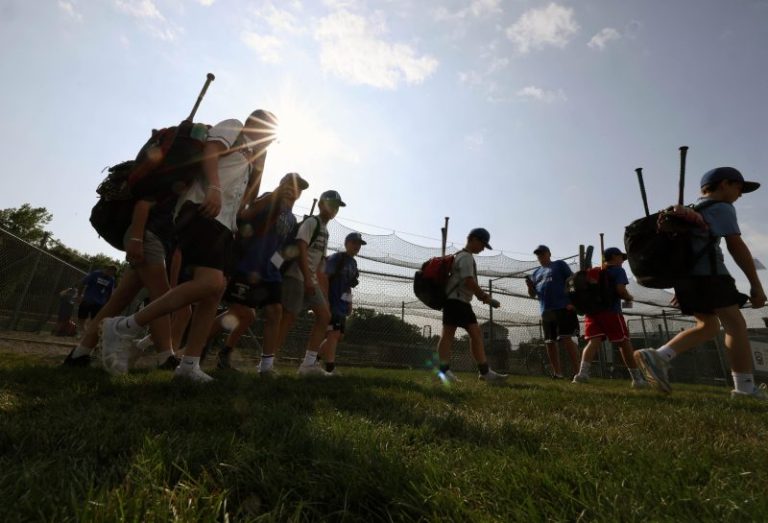
The Florida State women’s college soccer team is the national champion once again.

No. 3 Florida State defeated No. 1 overall seed Stanford 1-0 in the Women’s College Cup on Monday at CPKC Stadium in Kansas City, Missouri. It is the Seminoles’ third national title in five years and fifth overall.

‘I’m honestly just so grateful. My team worked so hard and I’m so glad we got the outcome (we wanted), because we really went through it this game,’ Florida State sophomore Wrianna Hudson, who socred the game-winner in the 87th minute, said.

Florida State weathered an offensive attack from Stanford, who entered Monday’s championship with a nation-best 96 goals, 25 more goals than the next closest team. But the Cardinal were shut out when it mattered most. Stanford had 18 shots and nine shots on goal, but Florida State freshman goalkeeper Kate Ockene recorded a career-high nine saves for the clean sheet.

Florida State head coach Brian Pensky called Ockene ‘the MVP of this match. She kept us in the game. That’s what great goalkeepers have to do.’

USA TODAY Sports provided live updates of the Women’s College Cup final between Florida State and Stanford. Catch up below:

Women’s College Cup final live score

The section will be updated throughout the game.

Women’s College Cup final live updates

87′ – FSU 1, Stanford 0

Florida State is on the board. Wrianna Hudson, Florida State’s leading scorer this season, put the Seminoles in the lead with less than four minutes remaining in the championship match. The goal came off a corner kick.

85′ – FSU 0, Stanford 0

Florida State’s Jordynn Dudley was issued a yellow card for charging the ref after a non-call.

70′ – FSU 0, Stanford 0

Stanford’s Jasmine Aikey drew a foul from Florida State’s Janet Okeke and earned a free kick in the 70th minute. Aikey has a direct goal off a free kick in each of the last two matches, including the game-winning goal against Duke in the semifinal. Aikey unleashed another direct shot at the goal on the free kick, but it was saved by the Seminoles’ Kate Ockene. It marked Ockene’s eighth save of the match.

63′ – FSU 0, Stanford 0

After not recording any shots on goal in the first half, Florida State opened the second half more aggressive and registered back-to-back shots on goal in the 63rd and 65th minute. Stanford goalkeeper Caroline Birkel saved both shots from Kameron Simmonds and Jordynn Dudley, respectively.

Halftime – FSU 0, Stanford 0

The teams are scoreless heading into halftime. Stanford is outshooting Florida State 11-4, with six shots on the goal, but Florida State goalkeeper Kate Ockene’s six saves have kept Florida State in the game. Ockene’s six saves through the first half are a season-high for the freshman keeper.

Stanford head coach Paul Ratcliffe called for his team to have ‘more composure on the ball.’

34′ – FSU 0, Stanford 0

Stanford’s Sophie Murdock was assessed a yellow card on a hard foul on Florida State’s Jordynn Dudley. Florida State wasn’t able to capitalize on the free kick.

15′ – FSU 0, Stanford 0

Taylor Suarez got a good look at the goal, but her shot sailed high over the crossbar.

9′ – FSU 0, Stanford 0

Florida State goalkeeper Kate Ockene has been busy. Stanford came out the gate hot against Florida State, recording five shots and four shots on goal in the first nine minutes of the College Cup championship match. The best attempt came from a header from Eleanor Klinger at the 8-minute mark, but Ockene made one of four saves to keep Stanford off the board. The Cardinal are used to scoring early. Stanford has scored in the first 15 minutes in 17 of 24 games this season, including every game of the 2025 NCAA Tournament.

Florida State has one shot against Stanford.

Florida State women’s soccer starting lineup

Stanford women’s soccer starting lineup

Stanford invites Taylor Swift to Women’s College Cup

Musician Taylor Swift is familiar with Kansas City. She’s been a staple at Arrowhead Stadium over the years to cheer on her fiancé, Kansas City Chiefs tight end Travis Kelce. The Cardinal extended an invite for Swift to come out and watch the Women’s College Cup championship match at CPKC Stadium in Kansas City on Monday. Will Swift make an appearance?

What time does Women’s College Cup final start?

Date: Monday, Dec. 8
Time: 7 p.m. ET ∣ 6 p.m. CT
Where: CPKC Stadium (Kansas City, Missouri)

Florida and Stanford will kick off at 7 p.m. ET on Monday, Dec. 8 from CPKC Stadium in Kansas City, Missouri in the Women’s College Cup final.

What TV channel is Women’s College Cup final on today?

TV channel: ESPNU
Livestream: Fubo (free trial)

The Women’s College Cup final between Florida State and Stanford will be broadcast on ESPNU. Streaming options for the game include Fubo, which carries ESPNU and offers a free trial to new subscribers.

Women’s College Cup final predictions

Craig Meyer, USA TODAY Sports: Florida State 2, Stanford 1

The Seminoles lost the previous matchup between the teams this season, but largely controlled the game, nearly doubling the Cardinal in shots (16 to nine). This time around, they’ll get a more favorable result for their third title in the past five years.

The USA TODAY app gets you to the heart of the news — fastDownload for award-winning coverage, crosswords, audio storytelling, the eNewspaper and more.

This post appeared first on USA TODAY

The NFL is flexing its first prime-time game of the 2025 season.

The league announced Monday that it is rescheduling the originally slotted ‘Sunday Night Football’ game for Week 16, the Cincinnati Bengals’ visit to the Miami Dolphins on Dec. 21, into that day’s 1 p.m. ET window, where it will be televised by CBS.

Moving into the league’s marquee weekly window on NBC will be the New England Patriots and Baltimore Ravens, their game at M&T Bank Stadium sure to have much broader playoff implications. The Bengals and Dolphins are still mathematically alive, though barely so with matching 6-7 records.

The Patriots currently lead the AFC East with an 11-2 record and are virtually tied atop the conference with the Denver Broncos, though the AFC West leaders currently hold the tiebreaker. Though 6-7, the Ravens are one game back of the Pittsburgh Steelers for the AFC North lead.

The only games the NFL had shifted so far this season were within the Sunday afternoon window.

This post appeared first on USA TODAY