Archive

2025

Browsing

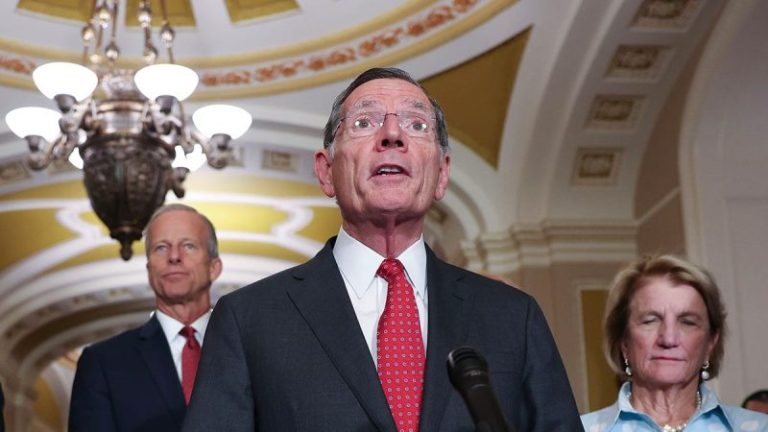
Senate Majority Whip John Barrasso is ready to go nuclear on Senate Democrats and their blockade of President Donald Trump’s nominees.

Before leaving Washington, D.C., for their respective home states, Senate Republicans were on the verge of a deal with their colleagues across the aisle to hammer out a deal to ram through dozens of Trump’s picks for non-controversial positions.

But those talks fell apart when Trump nuked any further negotiations over funding demands from Senate Minority Leader Chuck Schumer, D-N.Y. Currently, there are 145 pending nominations on the Senate’s executive calendar, with that number expected to balloon when the upper chamber reopens for business.

Lawmakers are set to return on Tuesday, and Barrasso, R-Wyo., wants to immediately tackle the nomination quandary. He’s engaged in a public pressure campaign, writing an op-ed for the Wall Street Journal directly calling out Schumer.

Meanwhile, he’s facilitated talks among Senate Republicans on the best path forward, and told Fox News Digital in an interview that, at this point, he’s willing to do anything necessary to see the president’s picks confirmed.

‘We need to either get a lot of cooperation from the Democrats, or we’re going to have to roll over them with changes of the rules that we’re going to be able to do in a unilateral way, as well as President Trump making recess appointments,’ he said.

Senate Democrats, under Schumer’s direction, are unlikely to play ball, however.

Schumer, in response to Barrasso’s public jab against him and Senate Democrats, contended in a statement that ‘historically bad nominees deserve a historic level of scrutiny by Senate Democrats.’

‘Anybody nominated by President Trump is, in Schumer’s words, ‘historically bad.’ Why? Because they were nominated by President Trump,’ Barrasso shot back. ‘That is his sole criteria for which these people are being gone after and filibustered, each and every one of them, even those that are coming out of committee, many, many of whom are with bipartisan support.’

Unilaterally changing the rules, or the nuclear option, would allow Republicans to make tweaks to the confirmation process without help from Democrats, but it could also kneecap further negotiations on key items that would require their support to advance beyond the Senate filibuster.

Barrasso was not worried about taking that route, however, and noted that the nominees that he and other Republicans were specifically considering would be ‘sub-Cabinet level positions’ and ambassadors.

Up for discussion are changes to the debate time, what kind of nominee could qualify for a speedier process and whether to give the president runway to make recess appointments, which would require the Senate to go into recess and allow Trump to make appointments on a temporary basis.

‘When you take a look at this right now, it takes a 30-minute roll-call vote to get on cloture, and then two hours of debate time, and then another 30-minute roll-call vote,’ Barrasso said. ‘Well, that’s three hours, and it’s time when you can’t do legislation, you can’t do any of the other things.’

But there is a menu of key items that Congress will have to deal with when they return, particularly the deadline to fund the government by Sept. 30.

Barrasso acknowledged that reality, and noted that it was because of the hefty schedule that he wanted a rules change to be put front and center.

‘There’s not going to be any time to — or there’s going to be limited time, I should say, to actually get people through the nominations process, which is just going to drag on further, and you’ll have more people having hearings and coming out of committees,’ he said.  

‘This backlog is going to worsen this traffic jam at the Schumer toll booth. So, we are going to do something, because this cannot stand.’
This post appeared first on FOX NEWS

A new push by states to tax the real estate of the wealthy has sparked a backlash among brokers and potential buyers, who say the taxes punish the most important local spenders.

From tax hikes on pricey second homes in Rhode Island and Montana to Cape Cod’s proposed transfer tax on homes over $2 million and the L.A. mansion tax, state and local governments see a revenue gold mine in the pricey properties of the wealthy.

“It’s a smack in the face to people who just spend money here,” said Donna Krueger-Simmons, sales agent with Mott & Chace Sotheby’s International in Watch Hill, Rhode Island.

The tax hikes are being driven by tighter state budgets and populist anger over housing costs. States are looking to offset budget cuts expected from the new tax and spending bill in Washington. At the same time, the housing market has become a tale of two buyers, with the middle class and younger families struggling to afford homes while the luxury housing market thrives from wealthy all-cash buyers.

The solution for many states: tax the homes of the rich.

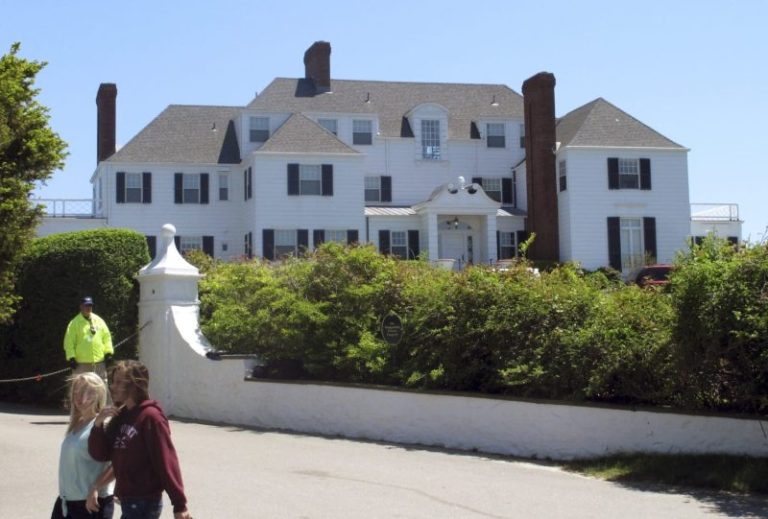
Rhode Island’s new levy, nicknamed “The Taylor Swift Tax,” is among the most extreme. The popstar bought a beach house in the state’s elite Watch Hill community in 2013.

The measure imposes a new surcharge on second homes valued at more than $1 million. For non-primary residences, or those not occupied for more than 182 days a year, the state will charge $2.50 for every $500 in assessed value above the first $1 million. That charge is on top of existing property taxes and will add up to big increases for luxury homes in Newport, Watch Hill and other well-heeled, summer communities in the state.

A version of this article appeared in CNBC’s Inside Wealth newsletter with Robert Frank, a weekly guide to the high-net-worth investor and consumer. Sign up to receive future editions, straight to your inbox.

Swift’s house, for instance, is assessed at around $28 million, according to local real estate records. Her current property taxes are estimated at around $201,000 a year. The new charges will add another $136,442 to her annual taxes, bringing her yearly total to $337,442 — even though locals say she rarely visits.

Real estate brokers say the increase targets the very taxpayers who already contribute the most. Wealthy second-homeowners pay hefty property taxes but don’t use many local services, since their primary residences are in New York; Boston; Palm Beach, Florida; or other locales. Their kids typically don’t attend the local schools, and they’re infrequent users of the police, fire, water and other municipal services since most stay for only 10 to 12 weeks out of the year.

“These are people who just come here for the summer, spend their money and pay their fair share of taxes,” said Krueger-Simmons. “They’re getting penalized just because they also live somewhere else.”

Brokers and longtime residents say the summer residents of Newport, Watch Hill and other seasonal beach towns are the economic engines for local businesses, restaurants and hotels.

“You’re just hurting the people who support small business,” said Lori Joyal, of the Lila Delman Compass office in Watch Hill. “You’re chasing away the people who spend most of the money in these towns.”

Rhode Island is also hiking its conveyance tax on luxury real estate starting in October. The tax on real estate sales will be an additional $3.75 for each $500 paid above $800,000 for a real estate purchase. At the same time, the state’s steep estate tax deters many of the ultra-wealthy from living there full-time.

Brokers say some second-home owners are considering selling and many would-be buyers are pausing their purchases. While the tax hike alone isn’t expected to lead to any significant wealth flight, Joyal said potential buyers in Rhode Island are already looking at coastal towns in Connecticut as alternatives.

“It’s always about choices,” she said. “At the end of the day it’s about how they can choose to spend their discretionary dollars. Connecticut has some beautiful coastal towns without some of these other high taxes.”

Montana has passed a similar tax. The influx of Californians and other affluent newcomers who poured into the state during Covid has led to soaring home prices and growing resentment over gentrification. Meanwhile, the state’s low income tax rate and lack of a sales tax has left it little room for revenue increases to handle the necessary increase in services.

In May, the state passed a two-tier property tax plan, lowering rates for full-time residents and raising taxes on second homes and short-term rentals. For primary residences and long-term rentals valued at or below the state’s median home price, the tax rate will be 0.76%. Homes worth more than that will face a tiered-rate system of up to 1.9% on any value over four times the median price.

The Montana Department of Revenue expects the changes, which will start next year, will hike second-home taxes by an average of 68%. Brokers say some buyers are waiting to see the tax bills next year before making any decisions about whether to buy or sell.

“I’ve heard about some buyers who have put on the brakes to wait for the dust to settle and see what happens,” said Valerie Johnson, with PureWest Christie’s International Real Estate in Bozeman, Montana.

Johnson said that while the tax was touted by legislators as hitting wealthy second-home owners, it will also hit longtime locals who own investment homes and rent them out for income.

“These are small businesses for many people,” she said.

Manish Bhatt, a senior policy analyst at the Tax Foundation, said tax hikes aimed at wealthy second-home owners may be popular politically, but they rarely make for successful or efficient tax policy. Real property tax reform should be broad based, rather than focused on taxpayers who are singled out just because they don’t live in a community full-time, he said.

“There is a grab to find revenue right now,” he said. “But taxing second-home owners could have the opposite impact — dissuading people from owning a second home or continue to own in those communities.”

While the new taxes alone might not drive out the wealthy, “we do know that taxes are important to businesses and individuals and could cause people to make a decision to buy in another nearby state,” Bhatt said.

The projected revenue from the new taxes may also disappoint. When Los Angeles passed its so-called “mansion tax” in 2022, proponents touted revenue projections of between $600 million to $1.1 billion a year. The tax, imposed on real estate sales over $5 million, has only raised $785 million after more than two years, according to the Los Angeles Housing Department.

Higher interest rates that hurt the housing market have played a role, experts say. Yet Michael Manville, professor of urban planning at the UCLA Luskin School of Public Affairs, said wealthy buyers and sellers also reduced transactions in response to the tax.

“The lower revenue is a reason to be concerned because it suggests that the tax might actually be reducing transactions, which in turn can reduce housing production and property tax revenue,” he said.

This post appeared first on NBC NEWS

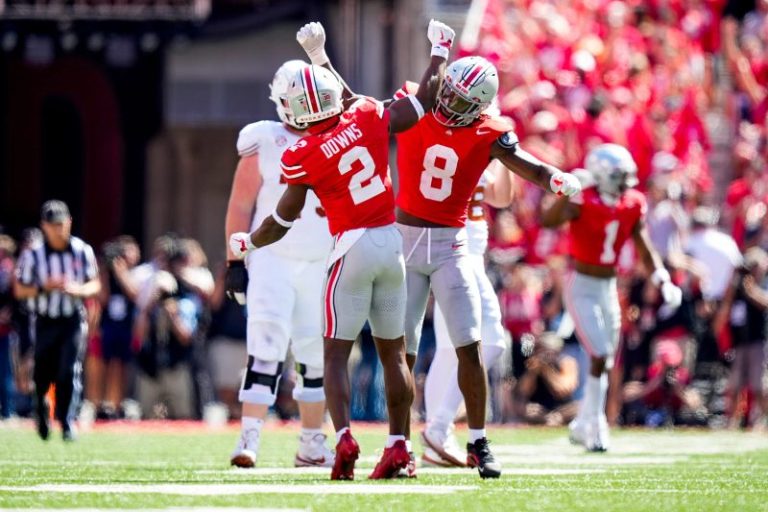
Ohio State’s 14-7 win against Texas triggered one of the cardinal rules of the US LBM Coaches Poll: When No. 2 beats No. 1, No. 2 becomes No. 1.

What happens after No. 1 is very much up in the air after the first full weekend of the 2025 season, but the Buckeyes likely will assume the top spot after taking the season opener. Look for Big Ten rival Penn State to climb one spot to No. 2 after the Nittany Lions cruised through the opener against Nevada.

Georgia could also take a one-rung move to No. 3, though there will be competition for the third spot from LSU and Miami. The Tigers scored a huge win against Clemson and Miami nailed a late field goal to knock off Notre Dame.

The debate comes after No. 5, centering on where to place Oregon and one-loss teams in the Longhorns and Fighting Irish. Texas could easily slot in at No. 6 and probably no lower than No. 7.

After an eventful weekend, here’s how the top of this week’s Coaches Poll should look:

1. Ohio State (1-0)

The offense will need time to run into form with a new quarterback and coordinator but the defense looks ready to carry the load. The Buckeyes held Arch Manning to 5.7 yards per attempt while the Longhorns converted just 6 of 20 attempts on third and fourth down.

2. Penn State (1-0)

Things will stay easy for Penn State after the 46-11 rout of the Wolf Pack. Next up are Florida International and Villanova before a huge matchup at home against Oregon to end September.

3. LSU (1-0)

Finally taking a season opener under Brian Kelly will give LSU a major shot in the arm heading into this weekend’s tune-up game against Louisiana Tech. Then comes Florida, in the first of four SEC games against teams ranked in the preseason Coaches Poll.

4. Georgia (1-0)

The 45-7 win against Marshall featured a broad overview of how the offense will look with Gunner Stockton at the controls. The Bulldogs’ new starter threw for 190 yards on 7.9 yards per attempt while running the ball 10 times for a team-high 73 yards and a pair of scores. In comparison, Carson Beck run for 187 yards across his two years as the starter.

5. Miami (1-0)

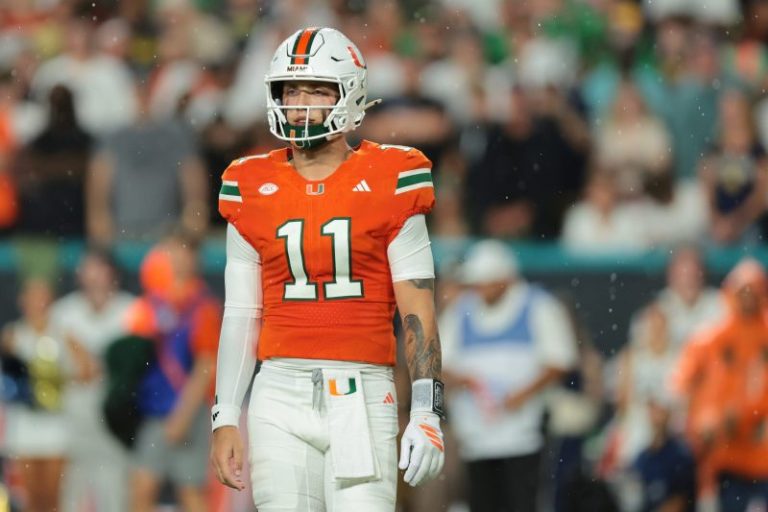
After he injured his arm in last year’s SEC championship game and transferred to Miami in the offseason, Beck’s performance in a 27-24 win against Notre Dame served as a quick reminder of why he’s one of the top quarterbacks in the Bowl Subdivision. He completed 20 of 31 passes for 205 yards and two touchdowns as the Hurricanes replaced Clemson as the team to beat in the ACC.

6. Oregon (1-0)

Look for the Ducks to remain under the radar until meeting Penn State. Not that the rest of the month will be a total breeze: Oregon will take on Oklahoma State, Northwestern and Oregon State before that faceoff with the Nittany Lions.

7. Texas (0-1)

A major thud in Columbus has opened the door to criticism of Manning, his surrounding personnel, the general state of the offense and the Longhorns’ overall ability to weather an SEC slate that includes Florida, Oklahoma, Georgia and Texas A&M.

8. Notre Dame (0-1)

The loss to Miami isn’t too painful in the big picture given how Notre Dame will be a prime at-large candidate even with two regular-season defeats. And the Irish have to like what they saw from young quarterback CJ Carr, who had 237 yards of total offense and two fourth-quarter touchdowns to nearly pull out the win.

9. Arizona State (1-0)

An easy win against Northern Arizona leads into Saturday’s matchup with Mississippi State. While the Bulldogs are the worst team in the SEC, the cross-conference game gives ASU a nice shot at making a national statement.

10. Clemson (0-1)

This fall might end at No. 9. For voters, the disappointing loss to LSU could feed into the perception of Clemson as a program still struggling to put things together despite last year’s late charge to the ACC crown. If coaches are really cynical about the Tigers’ state of affairs, South Carolina is a contender for this spot after beating Virginia Tech.

This post appeared first on USA TODAY

Florida State quarterback Thomas Castellanos backed up his preseason trash talk, leading the Seminoles to an upset victory over Alabama.
Lee Corso correctly predicted the outcomes of three marquee games in his final appearance on ‘College GameDay.’
Preseason hype proved to be misleading, as highly touted teams like Alabama and Texas struggled in Week 1.

Everyone knows talking trash can get you in some hot water. Not only does it cause a stir, but failing to back it up could lead to plenty of criticism.

But turning that trash talk from a prediction to a spoiler? That’s some legendary stuff.

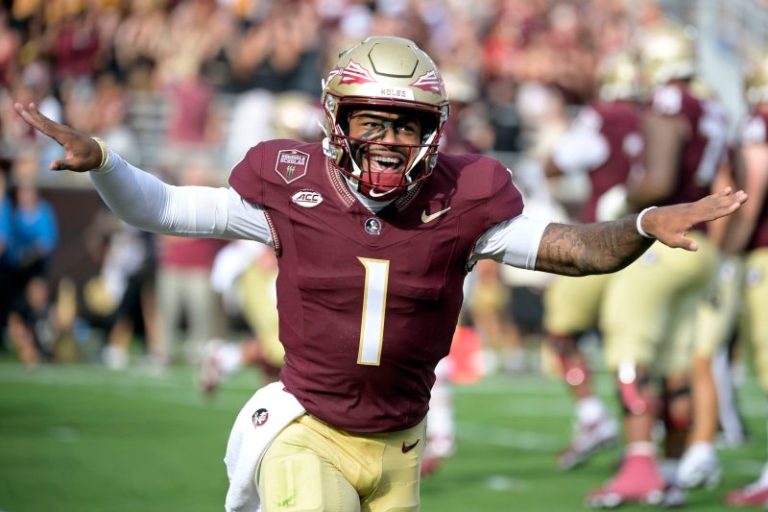
It only took one game for Thomas Castellanos to cement himself in Florida State lore. He couldn’t be stopped by Alabama in the 31-17 upset the Seminoles quarterback said would happen two months ago.

There was a collective groan when Castellanos declared Alabama didn’t ‘have Nick Saban to save them’ and ‘I just don’t see them stopping me.” It was bulletin board material for the Crimson Tide. Even more, Castellanos doubled-down on his words. You wouldn’t blame anyone for expecting a blowout Alabama win and Castellanos to become the meme of the season.

Instead, Castellanos proved Alabama needed Saban to stop him from running for a game-high 78 yards and a touchdown along with 152 yards in the air on just 14 attempts, leading a physical domination over a supposed College Football Playoff contender.

It took guts for Castellanos to back up his trash talk, and he leads the best and worst things we saw in Week 1 of the 2025 season.

Best: Lee Corso goes out with a bang

College football fans rejoiced their beloved game was back, but they also poured love to the retirement of Lee Corso after 38 memorable years on ‘College GameDay.’ There’s no debating his contributions to the sport, and while he has given us several iconic moments, it was clear Corso was reaching the end of his remarkable career.

But he left proving he still got it.

It’s not often greats end their careers with such a high note, but in his final act, Corso reminded everyone he knows ball.

Worst: Preseason hype

It’s practically a guarantee a team with preseason hype will get smacked by reality in Week 1. It’s just a matter of who.

In 2025, that belongs to Arch Manning and Alabama. The Heisman Trophy favorite, Manning struggled against Ohio State with just 38 passing yards through three quarters. He finished with 170 yards in the air but it wasn’t a performance that looked like the next great college quarterback.

Meanwhile, Alabama was believed to be ready to return to the title picture after an up-and-down first year with Kalen DeBoer. Instead, the Crimson Tide didn’t look anything close to a contender, beaten by Florida State team coming off a two-win season. Now, people in Tuscaloosa are already wondering if Saban’s successor was a mistake.

Reality hits you fast.

Best: Tulane makes New Orleans proud

Tulane wanted to recognize the 20th anniversary of Hurricane Katrina by wearing blank green helmets and white jerseys in its home opener, what the team wore in its first game after the devastating hurricane. However, they weren’t able to because Northwestern declined the decision as the road team.

What was supposed to be a nice tribute to their city was denied. The Green Wave responded by dismantling the Wildcats, 23-3, and coach Jon Sumrall made sure everyone knew it fueled the dominant win.

‘When you disrespect the city of New Orleans, that’s what’s going to happen to you. You’re going to run into a team like this that had a chip on their shoulder,’ he said. ‘We might’ve used that for a little motivation to represent the city.’

‘Don’t disrespect the City of New Orleans, ever.’

Worst: Poorly planned ‘neutral’ games

Neutral site games to start the season are pretty good ideas. They provide excitement for teams and fans to travel to fun cities and stadiums while increasing national exposure.

Unless it’s pretty much a road game.

Cincinnati and Syracuse signed themselves up for complete hostility; the Bearcats had to deal with Nebraska fans taking over Arrowhead Stadium − even though it was a ‘home’ game − and the Orange were taken over by Tennessee orange in Atlanta.

Essentially playing true road games, Cincinnati and Syracuse came up short and will probably rethink their future non-conference scheduling strategy.

Worst: The Oregon Duck loses his head

Even the greats have to shake off the offseason rust.

The Oregon Duck is one of the best mascots in sports, but his 2025 debut was rocky. Its head fell off as it made its way onto the field, resulting in a full sprint back to the locker room to protect the identity. A really tough moment from the person in the costume.

It could’ve been a bad omen, but luckily, the football team wasn’t affected with a 59-13 win over Montana State.

Best: Kent State snaps losing streak

The nation’s longest losing streak is no more as Kent State snapped its run of 21 consecutive defeats with a win against Merrimack.

It’s easy to forget how miserable the Golden Flashes have been. The last time they won a game was Sept. 16, 2023. That’s 714 days of waiting. Since Kent State’s last victory, Oregon has won a nation-high 23 games.

The cobwebs of the victory bell finally got to be shaken off. Enjoy it Kent State.

Sure it was a win over an Championship Subdivision team, but not every FBS team can say they won their game against one.

Worst: Losing to FCS teams

Case in point.

Army and Middle Tennessee State, congratulations on paying for a loss. The Black Knights were the first FBS team in 2025 to lose to an FCS team in Tarleton State. A missed field goal stopped them from winning in regulation, and another failed kick doomed them in overtime for a 30-27 loss. Army paid the Texans $250,000 for the game, and it doesn’t look like a great use of government funds.

Middle Tennessee suffered a worse fate. Austin Peay jumped out to a 21-0 lead over the Blue Raiders and won 34-14 for its first win over an FBS team since 1987. It hasn’t been revealed how much Middle Tennessee paid, but getting completing outplayed already cost too much.

At least Kansas State avoided being on this list, barely getting past North Dakota in a game it paid $475,000 for.

This post appeared first on USA TODAY

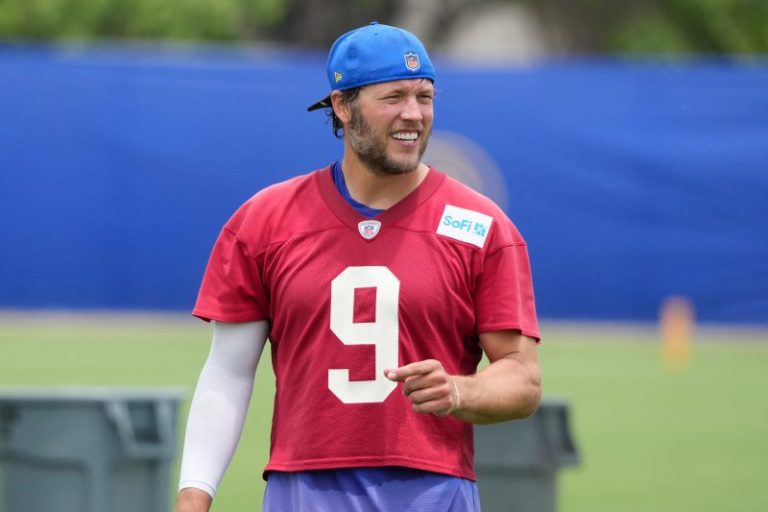
The Los Angeles Rams expect Matthew Stafford to start at quarterback in Week 1 against the Houston Texans, coach Sean McVay told reporters Monday.

‘He’ll be good,’ McVay said when asked about Stafford’s status for the week ahead.

McVay also said he expects Stafford to participate in the full week of practice leading up to Sunday’s game.

The 39-year-old coach did not say whether he anticipated Stafford would be a limited or full participant in the practice sessions.

Stafford, 37, missed the first few weeks of Rams training camp while dealing with an aggravated disc in his back. He was initially expected to return to practice on Monday, Aug. 11, but he didn’t feel good enough to throw. That fueled speculation he could end up sidelined early in the 2025 NFL season.

Stafford eventually returned to practice a week later on Aug. 18, quelling concerns about his Week 1 status.

McVay’s announcement positions Stafford to make his 17th consecutive Week 1 start across 12 years with the Detroit Lions and five with the Rams.

This post appeared first on USA TODAY

Carson Beck won’t regret transferring from Georgia to Miami. That doesn’t mean Gunner Stockton won’t answer Georgia’s problems.
Kalen DeBoer faces trouble at Alabama, but not the hot seat. Not yet, at least
For Notre Dame, it all comes down to Texas A&M.

It’s gotten so bad in Alabama in Kalen DeBoer’s quest to replace Nick Saban, fans are musing about the availability of Georgia Tech’s coach, and talk-show host Paul Finebaum is tweeting his show’s phone number, lest dejected fans require an on-air therapy session.

Is Georgia Tech’s coach also available to call plays for Notre Dame? The Irish are reeling after their play-callers were out to lunch in the season opener, while Carson Beck dined on leprechaun.

Clemson fought for the driver’s seat on the struggle bus, but the Tigers failed that task, too. Alabama already called dibs. At Texas, they’re left rationalizing that it’s only Week 1.

Here are four lingering questions after college football’s first full weekend:

Will Georgia regret losing Carson Beck?

Beck won’t regret transferring from Georgia to Miami. He wisely left Kirby Smart behind in favor of Miami’s superior wide receivers. Dependable big fellas and reliable pass catchers are a quarterback’s best friends.

For Beck, it became notable that Miami receivers didn’t drop a pass, and CJ Daniels turned a would-be interception into a touchdown with the greatest grab you’ll see all season. Notre Dame sacked Beck just once. Allow Beck comfort in the pocket, and he’ll use his big-league arm to dissect a defense.

Beck’s performance in a 27-24 takedown of the Irish became proof positive of the power in a change of scenery – and the value in wide receivers. Georgia led all Power Four teams in dropped passes last season.

Beck missed his Brock Bowers security blanket in 2024, but, more than that, he missed having a target whom he could throw to without worrying the ball would bounce off their hands. Beck compounded the problem by forcing passes that resulted in interceptions. It’s revisionist history to act like Beck wasn’t part of Georgia’s underachievement last year. His slump played a part, but he was far from the only (or biggest) flaw.

Smart, realizing he had a problem, upgraded Georgia’s wide receivers in the offseason, but the collection in Athens still isn’t as good as what Beck will have at Miami.

So, Beck will enjoy his new digs, but will Georgia regret losing Beck? That’s tougher to answer.

Gunner Stockton, Beck’s successor, lacks Beck’s howitzer, but he’s no noodle-armed quarterback. He’s a veteran blue-chipper. Stockton fared well in Georgia’s smashing of Marshall, but there’s little to glean from playing what Smart aptly described as an “overmatched” opponent.

Still, I couldn’t help but notice Stockton score on a pair of read-option runs.

Georgia’s offense never looked better than it did while possessing dual-threat veteran Stetson Bennett IV in its 2022 national championship season. Bennett could improvise and extend plays with his legs. He became the epitome of a gamer. Georgia rallied around him.

Stockton seems popular inside Georgia’s locker room, and teams that lack receivers like Miami’s Daniels and Malachi Toney benefit from mobile quarterbacks. Stockton’s running abilities give Georgia a callback to Bennett.

Is Kalen DeBoer on the hot seat?

No. Not yet, anyway. He’s on an uncomfortable seat. Rightfully so. Alabama’s defense lacked none of its vintage ferocity in a season-opening loss to Florida State. You could’ve made a similar assessment after last year’s losses to Vanderbilt, Tennessee and Oklahoma.

The drop-off of Alabama’s defense didn’t begin under DeBoer. That started at the end of the Nick Saban era, but the problem’s worsened.

DeBoer is protected by a whopper buyout, and the fact that athletic departments now need money to pay athletes. He’s also got five-star freshman quarterback Keelon Russell waiting in reserve. He might want to consider tapping that reserve sooner than later.

For now, DeBoer’s facing heat, but not the firing squad. Ask me again if Alabama loses to Louisiana-Monroe.

Should Texas or Clemson be more concerned?

Texas. Why? Because Clemson’s game against LSU equated to a free swing.

Georgia smashed Clemson last season, and the Tigers still made the College Football Playoff. Clemson’s neatest path to the playoff remains winning the ACC, though Florida State, Miami, Louisville and SMU will make that an obstructed path.

Clemson’s vaunted defensive line will shine within the ACC.

For Texas, the Horseshoe won’t be the only difficult environment it faces. Two of its toughest remaining games, against Georgia and Florida, will be on the road, in addition to a neutral-site game against Oklahoma and home game against Texas A&M. Arch Manning has yet to prove he can diffuse landmines such as those.

It’s not time to panic about Manning or this Texas offense, but it’s also not irrational to be concerned after a clunker in Columbus.

Does Notre Dame’s season hinge on Week 2?

Consider the Irish’s next game – they’ll host Texas A&M – a matchup with win-or-bust consequences.

Notre Dame scheduled its toughest games in the season’s first two weeks, and it’s reasonable to think the Irish need to go 1-1 in those games to build a playoff résumé.

Pinning at-large playoff credentials to opponents like Purdue, Stanford and Syracuse is a bootless errand. The Irish need to beat the Aggies to avoid falling from the playoff picture by Week 3.

The good news for Notre Dame? CJ Carr showed promise against Miami in his first career start. The game plan became a problem. That can be addressed. Start by remembering the existence of Jeremiyah Love.

Texas A&M’s run defense showed vulnerability in a Week 1 triumph against Texas-San Antonio.

Beating Texas A&M buoyed Notre Dame a year ago, even after the Irish lost to Northern Illinois. A year later, the Aggies could sink Notre Dame.

Blake Toppmeyer is the USA TODAY Network’s senior national college football columnist. Email him at BToppmeyer@gannett.com and follow him on X @btoppmeyer.

This post appeared first on USA TODAY

NEW YORK — The last time Coco Gauff and Naomi Osaka met at the US Open six years ago, the emotions for a then-15-year-old Gauff were overwhelming, with her bursting into tears at the end of the 6-3, 6-0 third-round defeat.

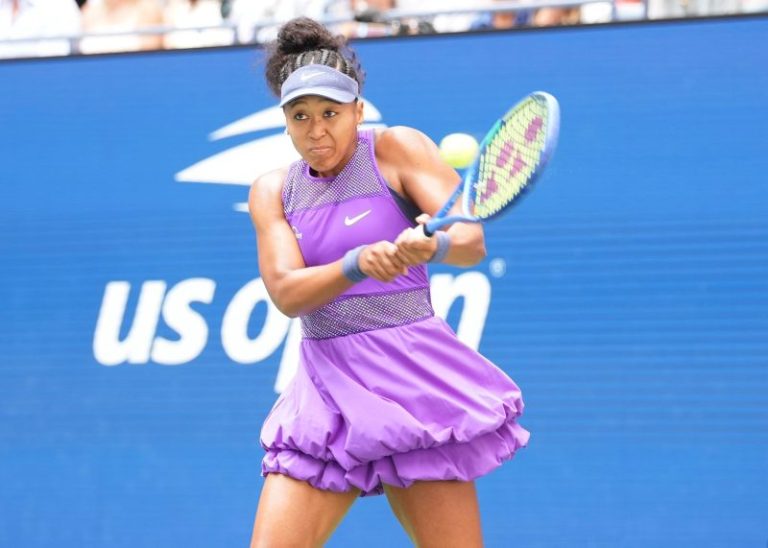
It was Gauff’s first appearance on the big stage of Arthur Ashe Stadium, but on Monday, a resurgent Osaka was the one fighting back tears. The No. 23 seed again got the best of her fellow former US Open champion and someone she affectionately calls her ‘little sister,’ advancing to the quarterfinals with a rather efficient 6-3, 6-2 victory in front of a packed Arthur Ashe Stadium on Sept. 1, 2025.

Gauff’s issues from earlier matches in the tournament reared their ugly head again, with a flurry of unforced errors and double faults, putting her down early as Osaka, a two-time winner at Flushing Meadows, sat back, waited patiently to capitalize on every mistake, and worked her forehand to win points along the baseline.

The problems started early, as Gauff, the No. 3 seed, was broken on her initial serve. Then, serving to stay in the first set, she started off with an ace but faltered, double-faulting twice, the last one giving Osaka the set.

Gauff was serving to stay in the match, and held a 40-15 lead, only to suffer another meltdown, and Osaka celebrated her victory when Gauff’s return of her effective forehand return hit the net.

It is the fifth time Osaka has reached a Grand Slam quarterfinal, and she has gone on to win that title each time. She also advanced to the quarterfinals for the first time since the 2021 Australian Open, the last of her four Grand Slam titles.

“I’m a little sensitive and I don’t want to cry, but I had so much fun out here,’ Osaka said in a post-match interview. ‘I was in the stands two months after I gave birth to my daughter, watching Coco. I really wanted an opportunity to come out here and play. This is my favorite court in the world. It means so much to me to be back here. ‘

“I look up to her. The way she conducts herself is really special. To be such an amazing role model at such a young age, it’s a gift. I have all the respect in the world for her.’

Osaka’s quarterfinal opponent will be No. 11 seed Karolína Muchová, a 6-3, 6-7 (0-7), 6-3 winner over No. 27 seed Marta Kostyuk.

USA TODAY had full coverage of the match between Naomi Osaka and Coco Gauff. Scroll below for a recap and highlights:

Osaka seems primed for victory

Two games away from victory, Osaka has played a steady match so far, limiting her mistakes and capitalizing on opportunities when Gauff’s game has gone astray. In the sixth game, Gauff again couldn’t get together and was broken, giving Osaka a 4-2 advantage.

Osaka takes the first set

Naomi Osaka is halfway home, a set away from the quarterfinals, winning the first set 6-3, as Gauff double-faulted and is broken on her service game to stay in the set. Gauff had 14 unforced errors in the set.

Gauff having issues with errors

Naomi Osaka is continuing to put the pressure on Gauff, and continues to be up a break at 4-2; Gauff, at times, is having trouble returning Osaka’s serve, and several rallies have ended up in the net for unforced errors

Osaka takes two-game lead over Gauff

Osaka is in control in the early part of the match, as Gauff was broken on her serve and Osaka powered through with a clean sweep of games, thanks to several enforced errors by the 2023 U.S. Open champion.

Packed house for Gauff vs. Osaka

It is more than 20,000 strong at Arthur Ashe Stadium for the sixth meeting between Coco Gauff and Naomi Osaka. Gauff leads the head-to-head matchup 3-2, including victories in the last two meetings (2022 San Jose and 2024 Beijing).

Osaka’s first win over Gauff came at the 2019 US Open in the third round, with Gauff winning the next time they met at a Grand Slam, a third-round victory at the 2020 Australian Open.

What time is Gauff vs Osaka from the US Open?

The Round of 16 match between No. 3 seed Coco Gauff and No. 23 seed Naomi Osaka is the second match in Arthur Ashe Stadium on Monday, Sept. 1. It will take place immediately following the match between No. 25 seed Felix Auger-Aliassime and No. 15 seed Andrey Rublev, which is scheduled to begin at 11:30 a.m. ET.

Gauff and Osaka are likely to begin play in the early afternoon on Monday.

How to watch Osaka vs. Gauff

No. 23 seed Naomi Osaka will face No. 3 seed Coco Gauff in a U.S. Open women’s singles fourth-round matchup on Monday, Sept. 1, on ESPN.

Date: Monday, Sept. 1
Time: TBD, early afternoon ET
TV channel: ESPN
Streaming: ESPN+ and Fubo (free trial)

Watch the US Open with Fubo

How to watch all the 2025 US Open action: Dates, TV, streaming

Dates: Sunday, Aug. 24-Sunday, Sept. 7
Location: USTA Billie Jean King National Tennis Center (New York)
TV channels: ABC, ESPN, ESPN2, ESPN Deportes (Spanish language)
Streaming: ESPN+ and Fubo (free trial)

This post appeared first on USA TODAY

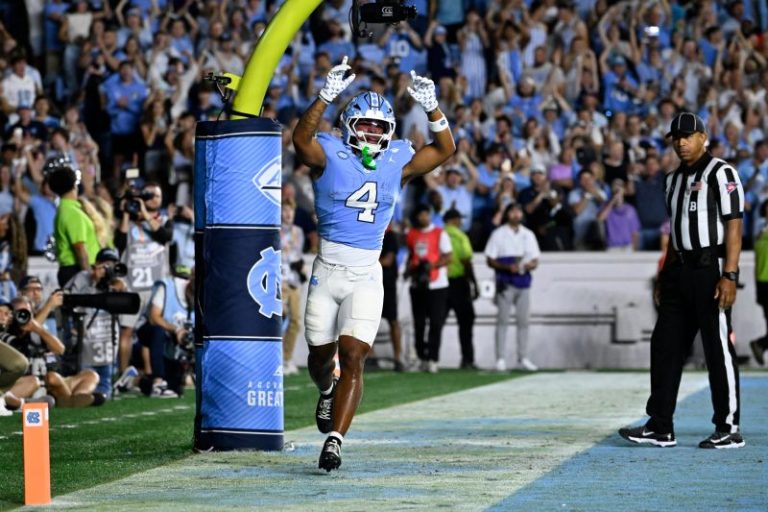
The first possession of the Bill Belichick era with North Carolina football ended with a touchdown.

It was downhill from there for the Tar Heels, as the TCU at one point scored 41 unanswered points and put a spoiler on Belichick’s collegiate coaching debut on Monday, Sept. 1, at Kenan Stadium in Chapel Hill, North Carolina.

UNC led 7-0 following a Caleb Hood rushing touchdown with 10:55 left in the first quarter. The Horned Frogs tied the game at 7-7 on a touchdown pass from Josh Hoover to Jordan Dwyer just over six game clock minutes later. It was all TCU from there.

Here’s a look at some reactions on social media from fans on Belichick’s dud debut at the collegiate level:

Social media reactions to TCU blowing out UNC

This post appeared first on USA TODAY

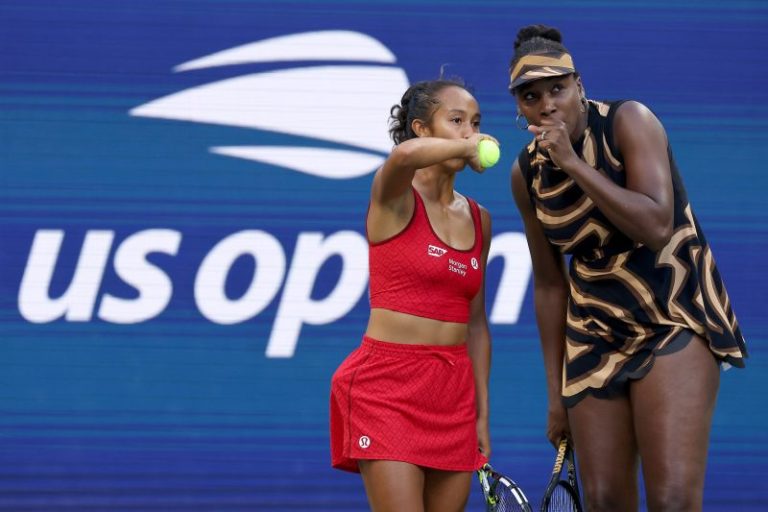
NEW YORK — Venus Williams isn’t letting her age or anything else, for that matter, get in her way of trying to take home a 15th Grand Slam doubles title, and with three more victories, she will head back to the podium.

Williams and her partner Leylah Fernandez are on to the quarterfinals after needing only an hour and 15 minutes to beat the No. 12 seeds Ekaterina Alexandrova and Shuai Zhang 6-3, 6-4 in front of a frenzied Louis Armstrong Stadium.

The road gets tougher, though, as the duo takes on No. 1 seed Taylor Townsend and Katerina Siniakova, who won Wimbledon in 2024 and this year’s Australian Open, in the quarterfinals.

Each of Williams’ 14 Grand Slam doubles titles has been with her sister Serena, with whom she also won three Olympic gold medals.

For the 45-year-old Williams, it is her first doubles quarterfinal appearance at a Grand Slam since 2016, when she and Serena won their sixth Wimbledon championship.

Teaming with the 22-year-old Fernandez from Canada, who was a 2021 US Open finalist, has Williams back in the spotlight after she took a 16-month hiatus before returning to the sport this summer. The duo has yet to lose a set in the tournament.

“I have full confidence in Venus, and I hope she has full confidence in me during our match,” Fernandez said. “We’re just going out there, playing our game: Be offensive, aggressive and ready for the ball.”

The praise didn’t stop there when Williams called Fernandez ‘the best doubles partner’ she has had outside of her sister Serena.

But Venus also had a message for her younger sister before her quarterfinal match.

“She’s so happy for Leylah and I. She’s given us advice, and we just need her in the box. So, my message is, Serena, you need to show up,’ Williams said while laughing.

This post appeared first on USA TODAY

Several NFL teams could get off to slow starts in 2025 thanks to tough schedules and pervasive problems.
The Bengals have been one of the league’s worst early-season underperformers in recent years, and Cincinnati is under pressure to turn things around.
The Chiefs have been strong in September throughout Andy Reid’s run, but Kansas City faces a daunting slate to open the 2025 campaign.

NFL teams are judged on the entirety of their body of work – once they reach the season’s finish line. Until then, new verdicts are rendered constantly in a week-to-week league.

While every team has its slate wiped clean in the standings to start the fresh campaign, there’s hardly even footing in Week 1. Schedule imbalances, for one, confer advantages and disadvantages from the get-go. The latter can prove particularly troublesome to some franchises, which can be tripped up by various vulnerabilities that weren’t fully sorted out in the preseason. And while some teams end up shaking off the initial narratives that surround them and their slow starts, others end up engulfed by them.

With the new season kicking off Thursday, here are five NFL teams that could stumble out of the gates this season:

Cincinnati Bengals

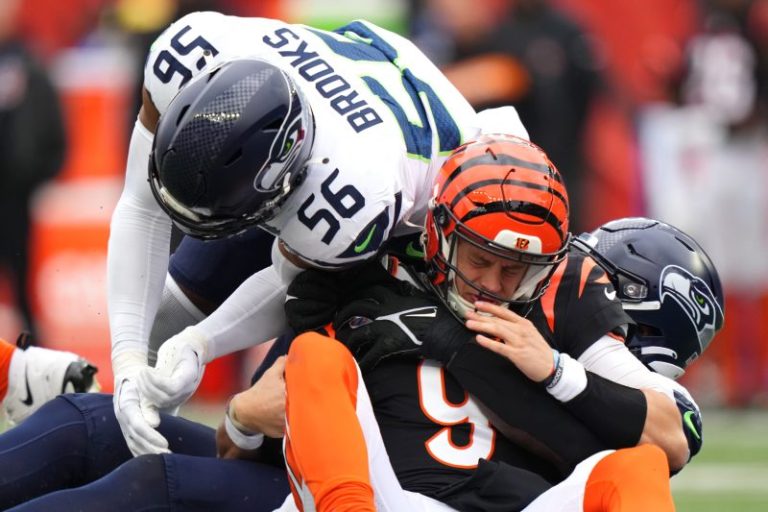
No contender in recent history has embodied September struggles quite like Zac Taylor’s crew, which is just 7-14-1 in the month since the coach took the reins in 2019. Only once in that span – during the team’s 2021 Super Bowl run – has the franchise avoided an 0-2 start.

But Cincinnati has at least some reason to believe it can break out of the pattern that has dogged it for the better part of a decade. For once, Joe Burrow was granted a sense of normalcy not afforded to him in previous training camps, during which he was either battling an ailment or on the comeback trail. Last summer might have been relatively smooth for the quarterback if not for All-Pro receiver Ja’Marr Chase missing all of camp and preseason amid a contract standoff. An 0-3 start ensued, and the hole proved to be too deep for the team to climb out of, with the Bengals missing the postseason for the second consecutive season despite winning their final five contests.

With Burrow healthy and Chase signed to a massive extension, Cincinnati surely hopes its all-important passing attack skews closer to the form in which it finished last season rather than the manner in which it opened 2024, when it faceplanted in a stunning home loss to the New England Patriots. But the effort to give starters more preseason run yielded mixed results, with Burrow and Taylor calling out the sloppiness that spoiled the opener. Cohesion could prove problematic along the offensive line, where two new guards join a starting lineup that’s seldom granted Burrow any semblance of comfort, and throughout the defense, which is counting on new coordinator Al Golden to develop a host of underperforming young players.

The schedule should provide a bit of relief – at least initially. With the opener at home against the Cleveland Browns followed by a tilt with the Jacksonville Jaguars, the Bengals have a solid shot at their first 2-0 start since Andy Dalton’s penultimate season with the organization. But an intensely difficult five-game stretch afterward – at the Minnesota Vikings, at the Denver Broncos, vs. the Detroit Lions, at the Green Bay Packers and vs. the Pittsburgh Steelers – threatens to put the team at another serious deficit in the standings approaching midseason.

Chicago Bears

In building a reputation as one of the NFL’s offensive masterminds, Ben Johnson has repeatedly hammered the importance of precision. So far, it’s clear the new head coach in Chicago isn’t seeing much of that.

After a preseason finale in which his starters gained just 22 yards on their two first-quarter drives and the offense committed several miscues thereafter, Johnson made clear the showing left him with a bad feeling.

NFL’s airtime domination: How NFL TV schedule gets bigger and bigger

‘This is our first time on the road, and we were going to find out what kind of road team we were going to be,’ Johnson said. ‘If the first quarter was any indication, it was not good enough. We have to get better in a hurry.’

Johnson represents a sea change for the Bears, as a long listless franchise finally appears to be energized. But growing pains are inevitable given the immense scope of the shift. Johnson acknowledged that even exponential growth for Caleb Williams likely entails an initial lag, and operating within structure and better sensing danger might not come easily to the 2024 No. 1 pick after he took a league-high 68 sacks last season. And while the overhauled interior offensive line looks much improved, there’s no guarantee the front will coalesce early, especially with the question at left tackle remaining open. With a slate that opens against the Vikings and Lions and includes October trips to face the Washington Commanders and Baltimore Ravens, Chicago might require a bit of a recalibration on the feel-good vibes.

Houston Texans

Equipping C.J. Stroud with more responsibility seems bound to produce better results than the ones Houston saw in 2024, when the signal-caller ranked second in both quarterback hits (109) and sacks taken (52). But how much can first-year coordinator Nick Caley’s new scheme do to cover for a front that still looks to be on shaky ground? Meanwhile, the receiving corps lacks a reliable running mate for Nico Collins, and Joe Mixon’s uncertain injury outlook leaves an already suspect ground game in a dangerous spot.

There’s plenty for a first-time play-caller to compensate for, leaving lots of reasons to believe that this unit might not find its footing until much later into the fall or winter. The schedule also does little to assuage any acclimation concerns. Houston opens up on the road against the Los Angeles Rams, a team that has famously tripped itself up at the start of each of the last two seasons but now has enviable continuity. Two other matchups against 2024 division winners – vs. the Tampa Bay Buccaneers and at the Baltimore Ravens – loom before the Week 6 bye.

Kansas City Chiefs

Maybe it’s foolhardy to doubt the NFL’s model of consistent excellence, with Kansas City having won at least four of its first five games in each of the last three seasons. But despite all the advantages readily accessible to any team with Patrick Mahomes at the helm, the Chiefs are facing a slate that easily could ignite a Super Bowl hangover discourse. Six teams that won at least 11 games last season await in the first nine games, though only the opener against the Los Angeles Chargers in Brazil and the pre-bye tilt with the Buffalo Bills will be played away from Arrowhead Stadium.

With Rashee Rice’s suspension in place for the first six weeks, the renewed commitment to reviving the downfield passing game might be forced to go on hold for a bit. And if the reshuffled left side of the offensive line doesn’t provide Mahomes with sufficient protection, Kansas City might fully revert to scraping by with its aerial attack in the short term. Don’t expect a full-blown crisis, but a mere regression to the mean in one-score games for a historic outlier could produce an uncharacteristic run of early setbacks.

Detroit Lions

If Dan Campbell’s crew really does feel the effects of substantial attrition, it should be apparent in short order. While new coordinators John Morton and Kelvin Sheppard can stand firm on the foundation put in place by their predecessors, replacing eight assistant coaches in total is bound to yield some instability. An offensive line that ranked as one of the league’s elite once looked perfectly capable of ironing out imperfections elsewhere, but the loss of Kevin Zeitler and Frank Ragnow, the latter serving as the mainstay in the middle, leaves a lot for rookie Tate Ratledge and second-year blocker Christian Mahogany to take on in starting roles.

The biggest issue for Detroit, however, is its unrelenting schedule. Road matchups against the Packers, Bengals, Ravens and Chiefs will keep the Lions on their toes in the first six weeks, and a brutal four-game stretch that features the Buccaneers, Vikings, Commanders and Eagles follows.

After a historic 15-win campaign in 2024, success can and should be measured differently for Detroit moving forward. That’s good for all involved, because matching the regular-season output amid so much change will be a nearly impossible task for a still-formidable group.

This post appeared first on USA TODAY