Archive

2025

Browsing

South Carolina’s LaNorris Sellers and LSU’s Garrett Nussmeier are ranked as the top two prospects after Week 1.
Texas quarterback Arch Manning had a disappointing start to his season in a loss to Ohio State.
The weekly rankings consider raw statistics, advanced metrics, and game film to evaluate the passers.

College football is in full swing as the calendar turns to September. Fans got a treat to start the season with three games between top-10 ranked teams in Week 1: Texas-Ohio State, LSU-Clemson and Notre Dame-Miami.

Two of those three matchups included quarterbacks that NFL fans will want to know about come draft season. Unlike the 2025 NFL Draft class, there are a handful of draft-eligible quarterbacks who have a good chance at making it in the first round.

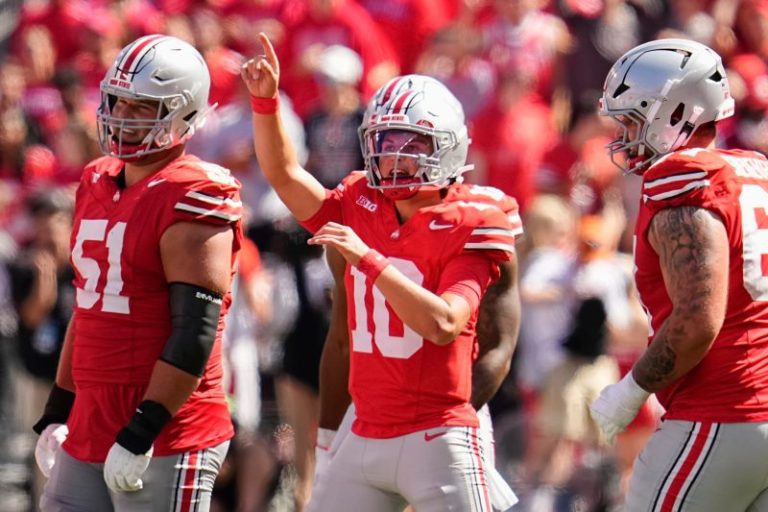
The biggest name of all is Arch Manning, the nephew of Pro Football Hall of Fame quarterback Peyton Manning and Super Bowl champion Eli Manning. His Texas Longhorns fell on the road to the Ohio State Buckeyes in Week 1 in the opening game of his first season as a starter.

Behind him are names to know in the context of both the College Football Playoff (CFP) and the NFL Draft. LSU, Clemson, Penn State and Texas are all likely to be in contention for CFP berths behind quarterbacks with first-round talent.

We’ll be taking stock of these passers weekly throughout the college football season and ranking the top eight after the latest week with two more designated as the next up. We’ll be using raw statistics, advanced metrics from Pro Football Focus (PFF) and game film to generate these rankings.

Here’s how things shape up after Week 1:

2026 NFL Draft QB prospect rankings

1. LaNorris Sellers, South Carolina

Week 1 vs. Virginia Tech: 12-19 (63.2%) passing, 209 yards, one touchdown; 12 carries, 55 yards, one touchdown

Sellers moves into the top spot after a solid season opener against one of the toughest defenses in the ACC. Virginia Tech gave No. 1 overall pick Cam Ward some trouble last season and was the only defense to force him to throw multiple interceptions all season.

Sellers didn’t put on a show but made a few plays that will have NFL scouts excited about him in the top 10 of next year’s draft. He shrugged off multiple tacklers and tight-roped his way down the sideline for a key fourth-quarter third-down conversion.

Sellers’ athleticism is no surprise at this point of his career. That’s been one of his calling cards as a 6-foot-3, 240-pound former soccer player. But he made a few throws to show he’s not a purely running quarterback at this stage of his development.

Sellers’ physical tools will make him a first-round pick barring serious injury. How high he goes will come down to how he performs as a passer in the next few months.

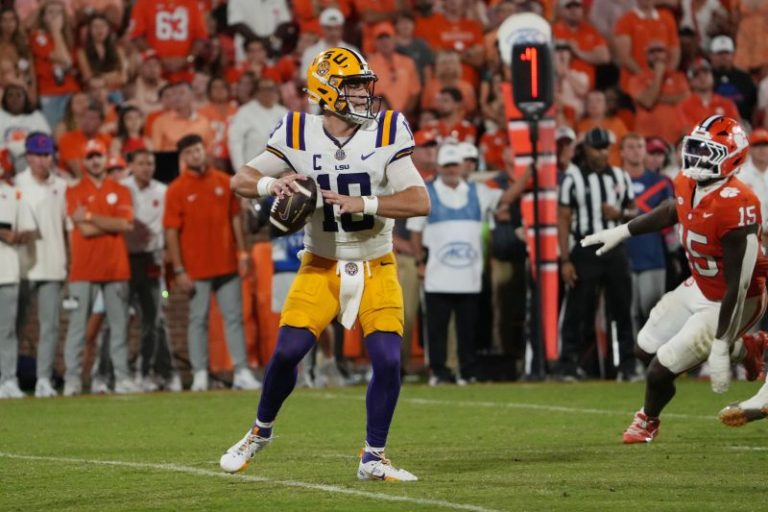
2. Garrett Nussmeier, LSU

Week 1 at Clemson: 28-38 (73.6%) passing, 232 yards, one touchdown; five carries, 12 yards

LSU is 1-0 to start a season for the first time since 2019, thanks in no small part to Nussmeier. He entered the season as a likely first-round pick because of his arm talent, anticipation and pocket presence. A matchup on the road against No. 4 Clemson was a tough early-season test for the son of New Orleans Saints offensive coordinator Doug Nussmeier.

Clemson boasts NFL talent on the defensive line (Peter Woods, T.J. Parker) and the secondary (Avieon Terrell). Nussmeier played up to the competition and got the ball out quickly against Clemson’s rushers with an average time to throw of 2.09 seconds, per PFF.

Yes, LSU’s staff schemed up a quick passing game with an average depth of target of 4.4 yards (for comparison Sellers’ was 7.9) but he still showed the type of command and pre-snap acumen NFL teams are looking for.

His touchdown pass to Trey’Dez Green to put LSU up for good was one of his best throws all game.

3. Arch Manning, Texas

Week 1 at Ohio State: 17-30 (56.7%), 170 yards, one touchdown, one interception; nine carries, 39 yards

You’ve likely heard all about Manning’s struggles in Week 1 against defending champion Ohio State. His first attempt of the day was disappointing: a play-action rollout to his right in a zone-beating route concept. His pass fell far short of an open DeAndre Moore Jr. for what would’ve been an easy first down.

There’d be more of that throughout the game with multiple throws that fell short of the target or sailed over a receiver.

The Buckeyes brought a solid plan on defense to the season opener and have one of the top prospects in the entire 2026 class in safety Caleb Downs. But Manning made mistakes in some key moments, like this interception in the third quarter:

The sky certainly is not falling. Manning will be a top pick in the 2026 NFL Draft if he declares and has plenty of time to grow as one of the most-hyped starters in recent college football history. His talent is undeniable, even in a disappointing loss like this on the road.

4. Drew Allar, Penn State

Week 1 vs. Nevada: 22-26 (84.6%) passing, 217 yards, one touchdown; five carries, 31 yards

Allar and the Nittany Lions built a 27-3 lead by halftime and cruised to a 46-11 win at home against Nevada. He didn’t have nearly the test of the top three passers on this ranking. That’ll come later in the season.

Still, Allar made some highlight throws you’d like to see against a lesser opponent at home. His touchdown strike to Kyron Hudson late in the first half looks very similar to the kinds of throws he’ll be expected to make in the NFL.

Allar’s physical tools are outstanding and he’s shown steady growth as a passer since Penn State made a change at offensive coordinator. He likely would’ve been a first-round pick in the 2025 NFL Draft and he’ll reinforce that status as the season goes on. Penn State looks to be in contention in the playoffs, so the stage is set for Allar to thrive.

5. Fernando Mendoza, Indiana

Week 1 vs. Old Dominion: 18-31 (54.5%) passing, 193 yards; five carries, 39 yards, one touchdown

Mendoza transferred from Cal to Indiana this season on the heels of the Hoosiers’ first CFP appearance. He was the lone passer not to throw a touchdown of the top five in these rankings but that isn’t entirely his fault.

Arguably his best throw of the game against Old Dominion fell incomplete on what would’ve certainly been a touchdown late in the second quarter.

He played with solid timing but lacked the types of plays we’d hoped to see against a team that’s not on par with the Big Ten’s best. Mendoza acknowledged that he didn’t play well in the opener and has a chance to right that in Week 2 at home against Kennesaw State.

With his size (6-foot-5, 225 pounds), arm talent and mobility, there are tools and lots of good tape to make him a worthy first-rounder. He just needs to show up bigger in these moments.

6. Cade Klubnik, Clemson

Week 1 vs. LSU: 19-38 (50%) passing, 231 yards, one interception; seven rushes, 22 yards

Like Manning, Klubnik’s first throw of Week 1 didn’t set the tone well for the rest of the day. A quick drop from shotgun on an in-breaking route from the slot wobbled well out of reach of both wide receiver Antonio Williams and his nearest defender.

It took until Klubnik’s fifth dropback for him to complete his first pass. The LSU defense got after him in a big way – his 18 pressures were more than any of the passers in the top five of these rankings. His interception came on an unblocked pressure on his right in what appeared to be a miscommunication by the offensive line.

On the plus side, Klubnik’s dual-threat ability was on display throughout the game. He didn’t hesitate to use his legs to gain extra yards if pressure got to him and that resulted in some key first downs. There are positives to Klubnik’s game but this was a shaky start to the season.

7. Sam Leavitt, Arizona State

Week 1 vs. Northern Arizona: 24-38 (63.2%) passing, 257 yards, two touchdowns, one interception; five carries, 94 yards, two touchdowns

Arizona State made a run to the CFP in 2024 with an offense focused on running back Cam Skattebo. With Skattebo on to the NFL, Leavitt’s expected to take on a bigger role this season – his second as a starter – and he delivered in the opening game.

His arm talent is undeniable and he has a solid frame at 6-foot-2 and 210 pounds. His scrambling ability can make a difference and he made plays with his feet against Northern Arizona, including an impressive 52-yard touchdown run in the third quarter.

Leavitt should have a good connection with Jordyn Tyson, one of the best draft-eligible wide receivers in the country. That’ll give him a foundation to showcase his talent every week.

8. John Mateer, Oklahoma

Week 1 vs. Illinois State: 30-37 (81.1%) passing, 392 yards, three touchdowns, one interception; six carries, 28 yards, one touchdown

If you’re looking for the ideal start to the season, Mateer’s got you covered. The transfer from Washington State set a school record for most yards in an Oklahoma debut and set a career-high for passing yards as well.

A significant caveat, similar to Allar’s evaluation, is that this occurred against non-conference competition in Illinois State. Some of the throws he made in small windows against zone coverage may not be there later in the season.

Still, he made plays on seam routes and showcased his arm talent with multiple deep shots. It took until the final minute of the first quarter for Mateer to find the end zone on a touchdown run but he made plays throughout the day.

This week’s game against Michigan will be very telling, as it represents a level of competition that should test the transfer quarterback.

Next two up: Miller Moss, Louisville; Taylen Green, Arkansas

This post appeared first on USA TODAY

One of the world’s largest piracy networks, which offered live streams to sports fans looking to evade streaming subscriptions, has been shut down, according to a coalition of media companies.

The Alliance for Creativity and Entertainment (ACE), a coalition of more than 50 global entertainment companies and film studies, announced on Sept. 3 that in collaboration with Egyptian authorities it had shut down Streameast. Through over 80 domains, the illegal sports streaming platform logged more than 1.6 billion visits in the past year, ACE stated in a news release.

ACE worked with Egyptian authorities from July 2024 through June 2025 to investigate and ultimately arrest two operators based in Sheikh Zayed City, Egypt, on Aug. 24, according to an ACE statement shared with USA TODAY. Among the confiscated items were three laptops and four smartphones used to operate the websites, in addition to 10 Visa cards containing about 6 million Egyptian pounds, which is around $123,613.

Streameast was popular with viewers in the United States, Canada, United Kingdom, Philippines and Germany, ACE states. Viewers could stream American sports like the NFL, NBA, NHL and MLB. Other popular sporting events streamed through the network included England’s Premier League, Spain’s La Liga, Italy’s Serie A and Germany’s Bundesliga.

Sports fans react to Streameast shutdown

Despite the illegalities of Streameast, many sports fan are upset about its takedown, especially as the NFL season starts on Sept. 4.

‘Losing Streameast before the start of the NFL season feels like your best friend just told you they’re moving across the country right before a school year starts,’ TikTok user Goose Talks Sports said in a video on Sept. 3.

‘For those who don’t know, I don’t think y’all understand the magnitude … of how many times Streameast came in the clutch,’ TikTok user Lontizzle Yaps said in a video on Sept. 3.

Sports fans pointed to the price of sports streaming services as a reason why Streameast was so popular. For context, an ESPN Unlimited subscription, which includes streaming for programming like the NFL, NBA and WNBA, NHL, U.S. Open and Sports Center is $30 per month. A YouTube TV Sports Programming subscription, which also includes non-sports networks, is $83 per month.

The move will also impact NFL viewers this coming season, with popular streaming options like NFL Sunday Ticket and RedZone collectively costing fans hundreds of dollars.

Greta Cross is a national trending reporter at USA TODAY. Story idea? Email her at gcross@usatoday.com.

This post appeared first on USA TODAY

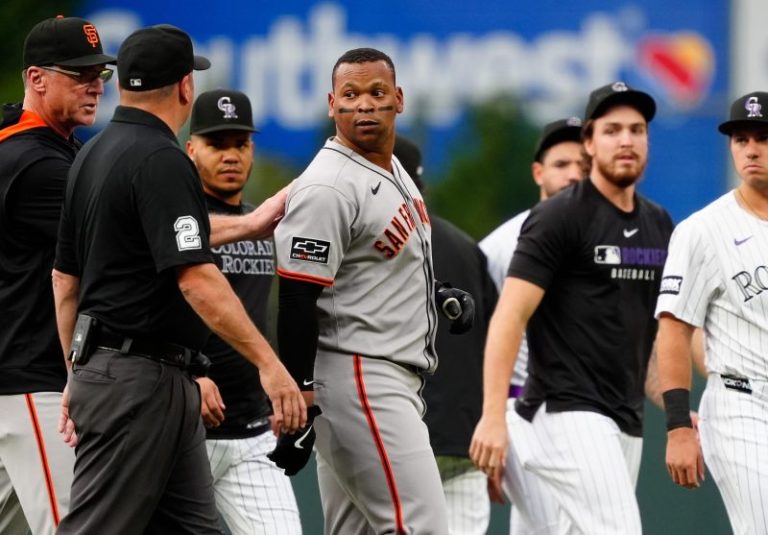
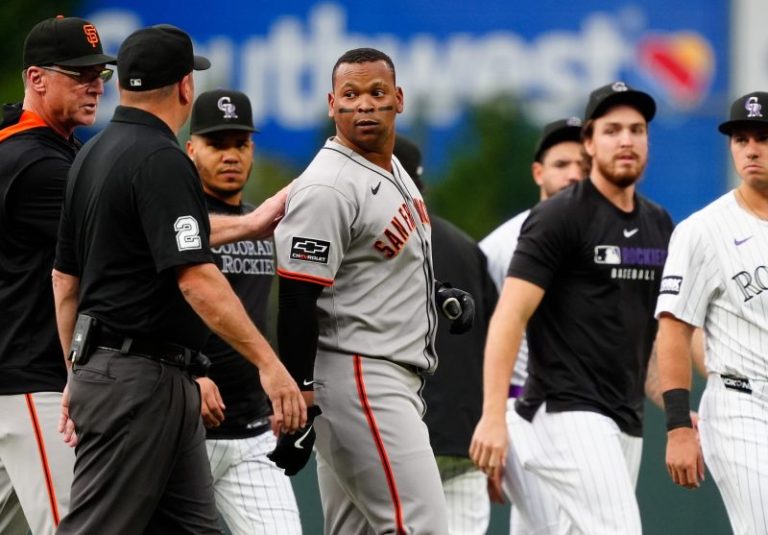
A red-hot slugger admiring a home run and a frustrated left-hander toiling for one of the worst teams in major league history intersected at Coors Field, resulting in a benches-clearing fracas.

And the craziest season in Rafael Devers’ decorated career took yet another turn Tuesday, Sept. 2 when the San Francisco Giants faced the Colorado Rockies.

Devers hit his 30th home run of 2025 off Rockies lefty Kyle Freeland, the fourth 30-homer season of his career, but like everything else in Devers’ world this year, it did not go to form.

Freeland, who lugged a 5.28 ERA into his start against San Francisco, took offense to Devers’ time getting to first base and stepped toward him on the base paths screaming in protest.

That prompted the Giants’ bench to stream out to defend Devers, with third baseman Matt Chapman giving Freeland a shove back toward the mound, earning an ejection.

And it resulted in one of the longest trips around the bases in major league history, Devers completing the circuit only after order was restored and Freeland, Chapman and San Francisco’s Willy Adames were ejected – nearly 10 minutes after he deposited the baseball in the right field seats.

The long ball continued a recent heater for Devers, who has hit seven homers in his past 15 games and posted a 1.175 OPS in that span. Freeland, meanwhile, has given up 21 home runs for the 39-100 Rockies, who lost the game 7-4 and are on pace for 116 losses.

If nothing else, the incident showed that the Giants certainly have Devers’ back. He got off to a slow start after a stunning trade from the Boston Red Sox on June 15, but is back to his typically robust level of production: an .879 OPS, including a .383 on-base percentage, and 96 RBIs.

‘I think that’s what a team does,’ Devers told reporters via a translator. ‘We’re a very united team, and I think in situations like that, that’s what we should do: stick up for each other.”

Said Freeland: “I just found it extremely disrespectful to show me up like that in the first inning after hitting the home run, standing there watching it, taking your sweet time, getting (to) first base. Been in this league for quite some time. I know he has as well. I just find that extremely disrespectful and felt that I needed to let him know about that.”

Major League Baseball announced Sept. 3 that Chapman, the Giants’ 32-year-old team leader, was suspended for one game for his actions during the melee. Chapman elected to appeal the suspension and was in the lineup for that night’s game. Devers, Freeland and Adames were fined ‘as a result of their inappropriate actions leading up to and during the incident,’ the league said.

The trade from Boston was the endgame of a tumultuous sequence that began when the Red Sox signed Alex Bregman, who offered to play second base and keep Devers at third. Instead, a messy stare-down between Devers and the club ultimately resulted in Devers moving to designated hitter.

When first baseman Triston Casas went down with a season-ending injury, the Red Sox again asked Devers to move there. But Devers balked, having settled in at DH, and rather than keeping a Silver Slugger bat in the lineup, Boston traded him to San Francisco, where he was given the runway to adapt to first base comfortably.

It all came full circle, in a sense, at Coors Field: After the ejections of Chapman and Adames, the shorthanded Giants shuffled their lineup around and … Devers ended up at third base.

Right where he was when this crazy season started.

The USA TODAY app gets you to the heart of the news fast. Download for award-winning coverage, crosswords, audio storytelling, the eNewspaper and more.

This post appeared first on USA TODAY

Leading members of President Donald Trump’s political team met Wednesday behind closed doors with House Republicans to offer what’s being described as a ‘clear and simple’ message to sell the GOP’s sweeping domestic policy package to Americans.

The sales pitch, from top Trump pollster Tony Fabrizio, senior Trump political aide James Blair, and White House press secretary Karoline Leavitt, is part of an ongoing effort by the president and his team to rebrand the massive tax cuts and spending measure, which polls indicate isn’t popular with Americans.

‘The best marketer out there is our president,’ National Republican Congressional Committee (NRCC) chair Rep. Richard Hudson of North Carolina told Fox News’ Aishah Hasnie following the meeting.

Hudson noted that Trump ‘used the name One Big Beautiful Bill to help get it passed. And now, to try and explain to the American people, he’s suggesting we call it the Working Families Tax Cut, which is exactly what it is. It’s a big component of it.’

But the Democratic Congressional Campaign Committee (DCCC) argued that ‘the so-called rebrand of the Big, Ugly Law is an admission that the GOP’s signature legislative ‘achievement’ is a toxic failure.’

‘Only Republicans seem surprised that ripping away health care and gutting rural hospitals just to hand billionaires a massive tax break is completely out of step with what the American people want,’ DCCC spokesperson Justin Chermol claimed in a statement to Fox News Digital.

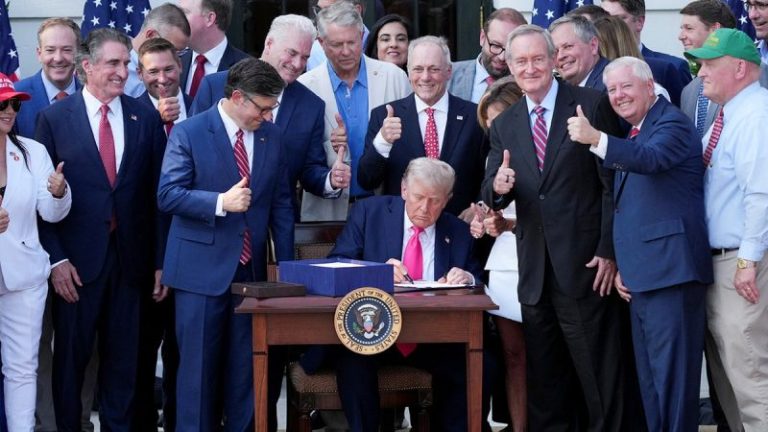
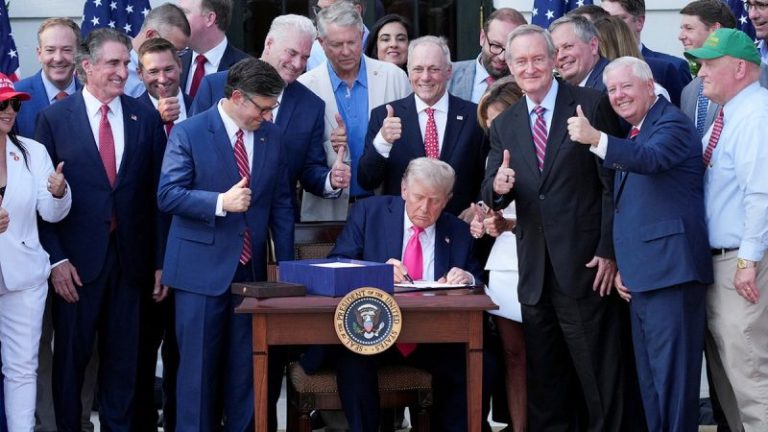
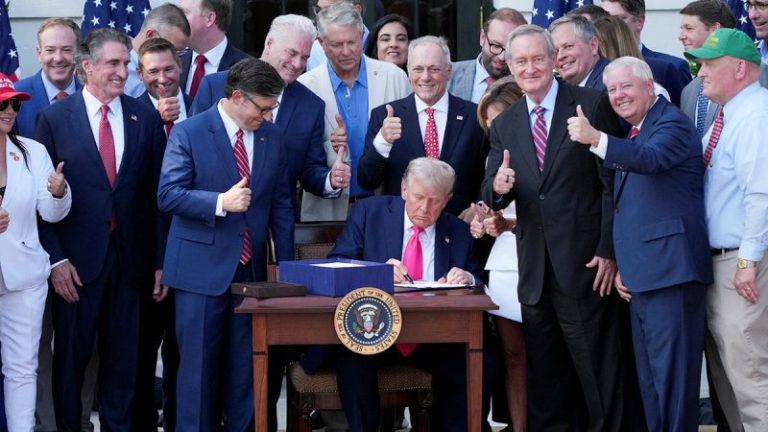
The package narrowly passed through the Republican-controlled Congress earlier this summer, nearly entirely along party lines, and Trump signed it into law during a July 4 ceremony at the White House.

For months, Trump touted his Big Beautiful Bill, but at a Cabinet meeting last week he seemed to acknowledge the difficult sales job he and his party face.

‘I’m not going to use the term great, big, beautiful – that was good for getting it approved, but it’s not good for explaining to people what it’s really about,’ Trump said.

And he described the package as a ‘major tax cut for workers.’

The measure is stuffed full of Trump’s 2024 campaign trail promises and second-term priorities on tax cuts, immigration, defense, energy and the debt limit. 

It includes extending the president’s signature 2017 tax cuts, which were set to expire later this year, and eliminating taxes on tips and overtime pay. 

The shift in branding that Trump noted last week has already been reflected by Vice President JD Vance, who has been stopping in key 2026 midterm states to sell the measure.

At his earlier stops on his tour, Vance called the package the ‘One Big Beautiful Bill.’ But the vice president now refers to the measure repeatedly as the ‘Working Families Tax Cut.’

The package also provides billions for border security and codifies the president’s sweeping and controversial immigration crackdown.

And the new law also restructures Medicaid — the almost 60-year-old federal program that provides health coverage to roughly 71 million low-income Americans. 

The changes to Medicaid, as well as cuts to food stamps, another one of the nation’s major safety net programs, were drafted in part as an offset to pay for extending Trump’s tax cuts. The measure includes a slew of new rules and regulations, including work requirements for many of those seeking Medicaid coverage.

The nonpartisan Congressional Budget Office estimates the new law could result in roughly 10 million people losing health coverage, and $3.4 trillion added to the nation’s already massive federal deficit. Republicans dispute those projections.

Regardless, some Republican House members who’ve held town halls this summer have faced vocal constituents angry over the social safety net cuts in the GOP’s measure.

And Democrats for months have repeatedly blasted Republicans over those social safety net changes. They charge it will gut Medicaid, forcing rural hospitals and nursing homes to close their doors. 

‘Rural hospitals were already on the brink of collapse thanks to Donald Trump, but now he has put the last nail in the coffin for rural hospitals with his billionaire budget bill,’ Democratic National Committee (DNC) chair Ken Martin claimed.

Republicans have pushed back on the Democrats’ criticism.

‘Overall, most people’s awareness comes from the lies they’ve heard from Democrats and our mainstream media. But when they hear the details of what’s in the actual bill, it’s very, very popular,’ Hudson told Fox News.

According to sources in the room, the president’s political advisors urged House Republicans to court low-propensity Trump voters who supported the president in 2024 but traditionally don’t turn out for midterm elections. 

The GOP is aiming to defend its fragile House majority in next year’s midterms, when the party in power normally faces political headwinds and ends up losing congressional seats. 

‘We got a lot of good information about where voters are on the working families tax cuts,’ Hudson said.

And the NRCC chair highlighted, ‘There’s a segment of our voting population that only vote in presidential elections. There’s also a very specific group that show up for President Trump.’

‘I don’t need all of them to show up, but I need some of them to show up. And the good news is, we know who they are. We know what they care about. And the message today was, communicate with them and let them know what we’re doing,’ Hudson said.

This post appeared first on FOX NEWS

The transformation from of predictions for the college football regular season before and after Week 1 is like the adjustment from staring at an impressionist painting up close and far feet away. The view changes with a better perspective. We’ve seen every team take the field. What you might have thought for the last seven months gets thrown out the window very quickly.

Which brings us to what happened last week. Texas was the nation’s No. 1 team in the opinion of many experts, but didn’t look the part against Ohio State. While last week’s edition of our bowl projections didn’t have Texas in the top four, there’s greater concern about its future prospects. On the opposite side, the Buckeyes have moved into a favorites role after showcasing an outstanding defense and with expected growth of quarterback Julian Sayin.

Texas and Ohio State weren’t the only adjustments this week. Optimism around Alabama tumbled and so did the Crimson Tide from the forecasted College Football Playoff field. Moving to the field were Miami – off it’s impressive outing against Notre Dame – and Tulane, who now looks to be the clear favorit in the Group of Five.

PATH TO PLAYOFF: Sign up for our college football newsletter

For those that might be feeling consternation or be overly optimistic at this stage, there’s still 14 weeks left to go. That view we are seeing now is sure to change with even more perspective.

Note: Legacy Pac-12 schools in other conferences will fulfill existing Pac-12 bowl agreements through the 2025 season.

This post appeared first on USA TODAY

A red-hot slugger admiring a home run and a frustrated left-hander toiling for one of the worst teams in major league history intersected at Coors Field, resulting in a benches-clearing fracas.

And the craziest season in Rafael Devers’ decorated career took yet another turn Tuesday, Sept. 2 when the San Francisco Giants faced the Colorado Rockies.

Devers hit his 30th home run of 2025 off Rockies lefty Kyle Freeland, the fourth 30-homer season of his career, but like everything else in Devers’ world this year, it did not go to form.

Freeland, who lugged a 5.28 ERA into his start against San Francisco, took offense to Devers’ time getting to first base and stepped toward him on the base paths screaming in protest.

That prompted the Giants’ bench to stream out to defend Devers, with third baseman Matt Chapman giving Freeland a shove back toward the mound, earning an ejection.

And it resulted in one of the longest trips around the bases in major league history, Devers completing the circuit only after order was restored and Freeland, Chapman and San Francisco’s Willy Adames were ejected – nearly 10 minutes after he deposited the baseball in the right field seats.

The long ball continued a recent heater for Devers, who has hit seven homers in his past 15 games and posted a 1.175 OPS in that span. Freeland, meanwhile, has given up 21 home runs for the 39-100 Rockies, who are on pace for 116 losses.

If nothing else, the incident showed that the Giants certainly have Devers’ back. He got off to a slow start after a stunning trade from the Boston Red Sox on June 15, but is back to his typically robust level of production: an .879 OPS, including a .383 on-base percentage, and 96 RBIs.

‘I think that’s what a team does,’ Devers told reporters via a translator. ‘We’re a very united team, and I think in situations like that, that’s what we should do: stick up for each other.”

Said Freeland: “I just found it extremely disrespectful to show me up like that in the first inning after hitting the home run, standing there watching it, taking your sweet time, getting (to) first base. Been in this league for quite some time. I know he has as well. I just find that extremely disrespectful and felt that I needed to let him know about that.”

The trade from Boston was the endgame of a tumultuous sequence that began when the Red Sox signed Alex Bregman, who offered to play second base and keep Devers at third. Instead, a messy stare-down between Devers and the club ultimately resulted in Devers moving to designated hitter.

When first baseman Triston Casas went down with a season-ending injury, the Red Sox again asked Devers to move there. But Devers balked, having settled in at DH, and rather than keeping a Silver Slugger bat in the lineup, Boston traded him to San Francisco, where he was given the runway to adapt to first base comfortably.

It all came full circle, in a sense, at Coors Field: After the ejections of Chapman and Adames, the shorthanded Giants shuffled their lineup around and … Devers ended up at third base.

Right where he was when this crazy season started.

The USA TODAY app gets you to the heart of the news fast. Download for award-winning coverage, crosswords, audio storytelling, the eNewspaper and more.

This post appeared first on USA TODAY

Leading members of President Donald Trump’s political team met Wednesday behind closed doors with House Republicans to offer what’s being described as a ‘clear and simple’ message to sell the GOP’s sweeping domestic policy package to Americans.

The sales pitch, from top Trump pollster Tony Fabrizio, senior Trump political aide James Blair, and White House press secretary Karoline Leavitt, is part of an ongoing effort by the president and his team to rebrand the massive tax cuts and spending measure, which polls indicate isn’t popular with Americans.

‘The best marketer out there is our president,’ National Republican Congressional Committee (NRCC) chair Rep. Richard Hudson of North Carolina told Fox News’ Aishah Hasnie following the meeting.

Hudson noted that Trump ‘used the name One Big Beautiful Bill to help get it passed. And now, to try and explain to the American people, he’s suggesting we call it the Working Families Tax Cut, which is exactly what it is. It’s a big component of it.’

But the Democratic Congressional Campaign Committee (DCCC) argued that ‘the so-called rebrand of the Big, Ugly Law is an admission that the GOP’s signature legislative ‘achievement’ is a toxic failure.’

‘Only Republicans seem surprised that ripping away health care and gutting rural hospitals just to hand billionaires a massive tax break is completely out of step with what the American people want,’ DCCC spokesperson Justin Chermol claimed in a statement to Fox News Digital.

The package narrowly passed through the Republican-controlled Congress earlier this summer, nearly entirely along party lines, and Trump signed it into law during a July 4 ceremony at the White House.

For months, Trump touted his Big Beautiful Bill, but at a Cabinet meeting last week he seemed to acknowledge the difficult sales job he and his party face.

‘I’m not going to use the term great, big, beautiful – that was good for getting it approved, but it’s not good for explaining to people what it’s really about,’ Trump said.

And he described the package as a ‘major tax cut for workers.’

The measure is stuffed full of Trump’s 2024 campaign trail promises and second-term priorities on tax cuts, immigration, defense, energy and the debt limit. 

It includes extending the president’s signature 2017 tax cuts, which were set to expire later this year, and eliminating taxes on tips and overtime pay. 

The shift in branding that Trump noted last week has already been reflected by Vice President JD Vance, who has been stopping in key 2026 midterm states to sell the measure.

At his earlier stops on his tour, Vance called the package the ‘One Big Beautiful Bill.’ But the vice president now refers to the measure repeatedly as the ‘Working Families Tax Cut.’

The package also provides billions for border security and codifies the president’s sweeping and controversial immigration crackdown.

And the new law also restructures Medicaid — the almost 60-year-old federal program that provides health coverage to roughly 71 million low-income Americans. 

The changes to Medicaid, as well as cuts to food stamps, another one of the nation’s major safety net programs, were drafted in part as an offset to pay for extending Trump’s tax cuts. The measure includes a slew of new rules and regulations, including work requirements for many of those seeking Medicaid coverage.

The nonpartisan Congressional Budget Office estimates the new law could result in roughly 10 million people losing health coverage, and $3.4 trillion added to the nation’s already massive federal deficit. Republicans dispute those projections.

Regardless, some Republican House members who’ve held town halls this summer have faced vocal constituents angry over the social safety net cuts in the GOP’s measure.

And Democrats for months have repeatedly blasted Republicans over those social safety net changes. They charge it will gut Medicaid, forcing rural hospitals and nursing homes to close their doors. 

‘Rural hospitals were already on the brink of collapse thanks to Donald Trump, but now he has put the last nail in the coffin for rural hospitals with his billionaire budget bill,’ Democratic National Committee (DNC) chair Ken Martin claimed.

Republicans have pushed back on the Democrats’ criticism.

‘Overall, most people’s awareness comes from the lies they’ve heard from Democrats and our mainstream media. But when they hear the details of what’s in the actual bill, it’s very, very popular,’ Hudson told Fox News.

According to sources in the room, the president’s political advisers urged House Republicans to court low-propensity Trump voters who supported the president in 2024 but traditionally don’t turn out for midterm elections. 

The GOP is aiming to defend its fragile House majority in next year’s midterms, when the party in power normally faces political headwinds and ends up losing congressional seats. 

‘We got a lot of good information about where voters are on the working families tax cuts,’ Hudson said.

And the NRCC chair highlighted, ‘There’s a segment of our voting population that only vote in presidential elections. There’s also a very specific group that show up for President Trump.’

‘I don’t need all of them to show up, but I need some of them to show up. And the good news is, we know who they are. We know what they care about. And the message today was, communicate with them and let them know what we’re doing,’ Hudson said.

This post appeared first on FOX NEWS

The House Budget Committee has begun having early discussions on a second Republican megabill, eyeing more potential reforms to Medicaid, sources told Fox News Digital.

Republicans on the panel are expected to hold closed-door talks in the coming days, as lawmakers return from the August recess, three people familiar with the matter said. 

Two sources familiar with discussions said the committee has begun early talk on mapping out further reforms to Medicaid, including revisiting and modifying measures that did not make the Senate’s final version of the bill. 

‘I think you can kind of put this puzzle together, but I think we were talking about things that last time didn’t go through,’ one person said.

Rep. Ralph Norman, R-S.C., said committee Republicans would meet this week to discuss ‘Medicaid reform.’

‘Same thing we debated before, same thing that we were fighting for,’ Norman told Fox News Digital. ‘I don’t know that the appetite is there right now, but we’ll see.’

Rep. Jodey Arrington, R-Texas, chair of the House Budget Committee, confirmed to Fox News Digital that his panel had begun laying the groundwork for a second reconciliation package.

‘Reversing the curse is a continuous effort when you’re $36-plus trillion in the hole,’ Arrington said, referencing the national debt. ‘It’s going to take more than one reconciliation bill to get out of it. So that process is underway.’

He added that details remain fluid, with ongoing talks between his committee and leaders of other House panels on what should be included.

When asked about Medicaid specifically, Arrington said he supported proposals potentially blocking federal dollars from covering transgender medical procedures and from going to illegal immigrants.

‘I’d be shocked if those don’t go back in, in some form,’ he said. ‘They also happen to be 80-20 issues, like 80% of the American people would expect that that already happens and are shocked that it’s not happening.’

Arrington suggested that more contentious ideas, such as altering the federal-state cost sharing ratio for Medicaid — known as FMAP — would likely not be central to the new bill. Conservative Republicans had pushed for changes to FMAP during the first reconciliation effort, but the proposal divided the party.

‘I guess the two big ones would be the transgender procedures and then prohibiting states from using federal funding, which is fungible, to support their extending Medicaid services to illegals. Those are absolutely two that should be included,’ Arrington said. 

‘The FMAP is, it’s unfortunately an unfair situation set up by Democrats through the Obamacare expansion, and I think a lot of members feel like it should be addressed. But again, it was debated, and it wasn’t included in the first one, so I don’t know how much time we’ll be spending on it.’

Republicans have long argued that Medicaid is plagued by waste, fraud, and abuse, framing reforms as necessary to protect benefits for the most vulnerable.

Any final decisions on policy related to Medicaid would have to go through the House Energy & Commerce Committee, which has jurisdiction over federal healthcare programs. 

A spokesperson for that committee told Fox News Digital, ‘Energy and Commerce Republicans have not proposed policies to be considered for a potential second reconciliation effort.’

The first reconciliation bill — signed into law on July 4 — advanced several of President Donald Trump’s campaign priorities, including tax cuts on tipped and overtime wages, increased immigration enforcement, and rollbacks of green energy initiatives.

Trump branded the package his ‘one big, beautiful bill,’ though he later sought to shift that to reflect its middle- and working-class tax relief. The legislation also imposed 20-hour-per-week requirements for some able-bodied adults on Medicaid and strengthened work requirements for federal food benefits.

The White House has not been making a public push for a second bill, however.

Democrats have seized on the GOP’s Medicaid proposals as a political weapon, accusing Republicans of pushing millions off the program to fund tax breaks for the wealthy. GOP lawmakers have pushed back on that charge and even accused Democrats of lying about the bill.

The path forward remains uncertain, however, with skepticism about whether both chambers have the appetite for another reconciliation bill. 

The first package, though a major GOP victory, took months of negotiation and internal wrangling.

House Minority Leader Hakeem Jeffries, D-N.Y., declined to directly assess the odds of a second reconciliation bill when asked Tuesday.

‘If we’re going to go down the road of a second reconciliation bill, we suggest cancel the healthcare cuts and save our hospitals,’ Jeffries said. ‘That should be the focus of a second reconciliation bill. It’s something that Democrats will broadly support.’

Budget reconciliation allows the party in power to pass vast pieces of policy legislation while sidelining opposition, in this case Democrats, by lowering the Senate’s passage threshold from 60 votes to 51. It can only be used three times in a single congressional term.

This post appeared first on FOX NEWS

Amazon is eliminating a program that allows members of its Prime subscription program to share free shipping benefits with people outside their household.

The company began notifying users in recent days that it plans to end the Prime Invitee Program on Oct. 1, according to a notice viewed by CNBC.

“We are writing to inform you that the Prime Invitee Program, which allowed sharing Prime’s fast, free delivery with others, will end on October 1, 2025,” the notice states. “Your invited guests will be notified directly about this change by September 5, 2025.”

Amazon previously let Prime members share free, two-day shipping with one other adult in their household, even if they used a different address.

Starting next month, the company will require invitees who don’t live with the account holder to sign up for their own Prime membership.

It’s phasing out the program in favor of Amazon Family, which lets Prime members share free shipping and other benefits with one other adult, four children and up to four teens added before April 7, 2025.

All users must share the same primary residential address, or the “address you consider to be your home and where you spend the majority of your time,” Amazon said.

The change comes as Reuters reported Monday that Amazon’s Prime signups in the U.S. fell short of last year’s total and its own targets, citing internal company documents. Amazon told the outlet that Prime membership continues to grow in the U.S. and internationally.

This post appeared first on NBC NEWS

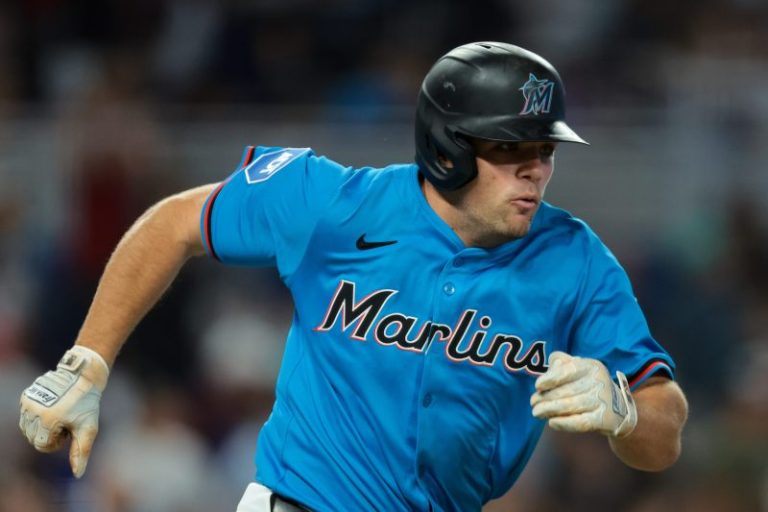
Jakob Marsee has 25 RBIs and nine steals in 32 games to begin his MLB career for Miami.
The 24-year-old outfielder had an amazing August, but may be too late to win NL rookie honors.
‘There’s a lot more to come,’ says Miami’s manager.

WASHINGTON – Any true measurement of just how real this Jakob Marsee thing is will have to wait.

Perhaps you’ve never heard of the young man, and that’s understandable: Marsee made his major league debut barely a month ago, toils in front of Miami Marlins home crowds often numbering in the four figures and has done his finest work when the news cycle tilts away from second division baseball games toward other pursuits.

Yet from the numbers he’s posted, to the offensive profile he’s created and the WAR he’s already banked in this short time in the majors, Marsee, a 24-year-old center fielder, is constructing a case worth examining as this season lurches toward a conclusion.

And there’s a chance that the National League’s greatest rookie won’t be its Rookie of the Year.

See, Marsee has just 129 plate appearances and with 23 games remaining would end up with roughly 221 by season’s end. That’s just two more than Willie McCovey’s total in 1959, when he won NL Rookie of the Year with the fewest plate appearances in the rookie award’s history.

Two months do not a season make. But oh, what a start to a career.

Marsee debuted Aug. 1 and in 30 games last month, banged out 18 extra-base hits, stole nine bases in 11 attempts and posted a .352/.430/.629 line. His 25 RBIs were the most by an NL rookie in any month, and across the majors trailed only the 27 by Nick Kurtz in July.

Marsee has accrued 2.0 fWAR since Aug. 1, behind only Milwaukee’s Brice Turang (2.2) in that span. And it’s kind of what the Marlins expected out of him – though perhaps not to this degree.

“What Jakob’s shown here is he runs real high-quality at-bats, he’s shown ability to impact the ball with some doubles and some slug, so that’s very encouraging,” says Marlins manager Clayton McCullough. “The things he was bringing to the table upon arrival he’s continued to display.

“And he really had a great month.”

Perhaps the start of something bigger.

Another Padres package

Ever wonder what happens to all those prospects the San Diego Padres trade?

Sometimes they can galvanize an organization, like when the generational Juan Soto was dealt west and the Washington Nationals received a bounty in return. Many others you never hear from again.

And then there’s players like Marsee, part of a four-player package received when Miami stunningly traded batting champion Luis Arráez on May 4, 2024, just weeks into a season the club was coming off a playoff berth.

The move inspired a small protest from fans tiring of the Marlins’ perpetual sell-off, and Arráez went on to help San Diego to the NL Division Series.

Marsee, drafted by San Diego out of Central Michigan in the sixth round in 2022, quickly played his way into prospect status with an excellent 2023 in the Padres’ system. Which meant he wasn’t going to be a Padre much longer.

“It’s not necessarily a bad thing,” says Marsee. “A lot of the culture is just about winning and our group we had coming up in the minor leagues, all we wanted to do was win and have fun and it was a lot about getting better each day and trying to win games.

“Everyone’s goal is just to make it up to the big league team they’re with at the time.”

It’s easy to see why the Marlins zeroed in on Marsee.

At 6-1 and 180 pounds, Marsee was a running back, receiver and safety at his suburban Detroit high school, and the manner in which he applies that athleticism to the diamond is apparent. Marsee’s sprint speed of 27.9 feet per second doesn’t put him among the top MLB speedsters – he’s step for step with veterans Mike Trout and George Springer – but he is elite on the basepaths, with 159 thefts in 189 attempts in his minor league career.

Three months after Marsee was shipped to Miami, right-hander Adam Mazur – a second-round pick in that 2022 draft – was included in a deal sending reliever Tanner Scott to the Padres. He’s seen Marsee every step of the way in their pro careers.

Just because the stadiums are far bigger than when they were knocking around the Padres’ minor league system doesn’t mean Mazur expected less from Marsee.

“Fort Wayne, San Antonio, I’ve been with him quite some time and it’s not surprising at all,” says Mazur. “He’s one of the best center fielders I’ve seen out there and he’s got a good bat.

“Personally, I love Marsee. He’s the man. I want to see him do as well as he can.’

And while the Marlins tracked his elite strike zone control well before they dealt for him, it has not abated facing the greatest pitchers in the world – Marsee’s 14.2% rate of swinging at pitches outside the strike zone is the lowest among hitters with at least 120 plate appearances. (For reference, the great Soto is second, at 15%).

“The ingredients Jakob has,” says McCullough, “what he’s shown and what piqued the interest of the organization to acquire him are the things we’ve seen: He has a chance to play above-average defense at a premium position. He’s going to bring value on the basepaths.

“He’s historically been very good at controlling the strike zone. And then it was going to be a big determination of, what does he do when he gets pitches in the zone and how does he impact them?”

Pretty well: Marsee’s 91.2 mph average exit velocity equals Freddie Freeman and is just behind Bryce Harper. His 50% hard-hit ball rate would place him among the top 35 hitters in the majors if he had sufficient plate appearances to qualify.

A sustainable resource

It’s been said that April and September are baseball’s most deceiving months, with the meat of the season its true test. McCullough was musing about recent callup Victor Mesa, and what a strong September may or may not mean for the young outfielder.

“The danger can be if a guy just has a great month offensively – it’s a lot of hits, a high batting average – but there’s no walks attached, what makes you think that’s going to continue on?” he asked. “You can’t take away performance – getting a hit up here is hard – but what makes you have more confidence this kind of performance is sustainable.”

Using that criteria, there’s plenty for the Marlins to hang their hat on with Marsee, thanks to his elite OBP. It’d just be hard to justify the youngster getting the top NL rookie honor this year.

On one hand, the field is somewhat wide open. Atlanta Braves catcher Drake Baldwin has had a fine season – 15 homers and an .818 OPS – but is not entirely a full-time player. Marlins teammate Agustin Ramirez leads NL rookies with 19 homers yet has a .288 OBP.

Chicago Cubs right-hander Cade Horton has nine wins and a 2.92 ERA in nearly 100 innings for a division-winning team.

On the other, 55 games played likely won’t be enough of a sample to convince voters, perhaps rightfully so.

But 2026 will offer a greater look at Marsee’s capabilities, even if there’s no Sophomore Of the Year award to lock down. Marsee still wears No. 87 on his back, more befitting a kid on the back fields of Jupiter trying to win a job in the spring rather than a regular.

He’s not sure if he’ll change it someday. Others are more confident his breakout is real, and simply a prelude.

“This is just a nice little show-out for him,” says Mazur, “but there’s a lot more to come.”

This post appeared first on USA TODAY