Archive

2025

Browsing

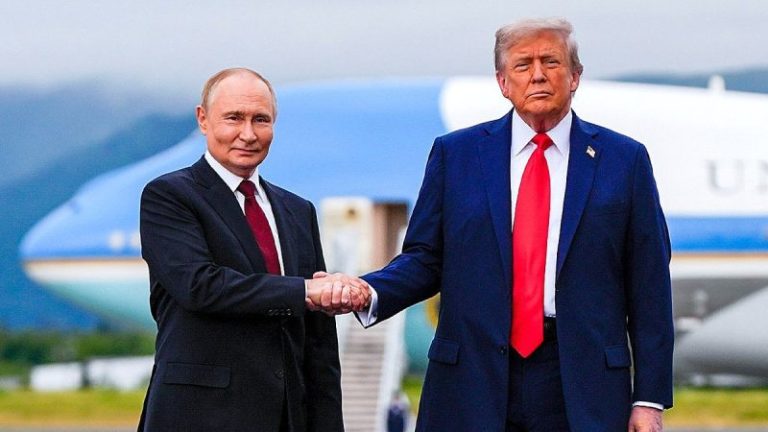
Kennedy Center President and Ambassador Richard Grenell slammed former President Joe Biden for avoiding Russian President Vladimir Putin as war raged between Russia and Ukraine, while praising President Donald Trump’s ‘common sense’ foreign policies.

‘You have a president who is really watching the situation, unlike the last president, Joe Biden, who literally didn’t talk to Vladimir Putin for three and a half years,’ he said. ‘President Trump doesn’t believe in that strategy. He wants to confront the issues. He wants to figure out ways to fix them.’

Trump plans to speak with Russian President Vladimir Putin Thursday — just hours after Russian missiles and drones attacked Ukrainian cities. Ukrainian President Volodymyr Zelenskyy already had been scheduled to head to Washington to meet with Trump Friday, to discuss the war and strengthening his country’s defenses. 

Trump vowed from the campaign trail that he would facilitate negotiations for a peace deal to end the war between Russia and Ukraine, which has raged since 2022, but ongoing talks have yet to yield an agreement. 

In addition to Russia and Ukraine, Trump also has been active in efforts to bring peace to the Middle East. Trump secured a historic peace declaration as of Monday, when he traveled to Israel and Egypt to meet with foreign leaders stretching from the Middle East to Europe.

Grenell discussed Trump’s strategy for international conflicts during his second term in office while attending ‘The Sound of Music’ at the Kennedy Center in Washington, D.C.

‘Well, first of all, I’ve worked with President Trump for a long time, and the one thing about President Trump is that he’s filled with common sense, and he evaluates his decisions constantly,’ Grenell told Fox News Digital.

Grenell said Trump can make America stronger on the world stage with his ability and willingness to adapt to different international conflicts.

‘You see him adjust the policy,’ he said. ‘Something isn’t working, he’s not afraid to replace somebody or change the policy.’

Grenell described Trump as an ‘active president’ who is ready to make moves and advance U.S. interests.

‘I think that what we’re seeing on the global stage is someone who is an activist president, watching the situation, adjusting the policy so that it’s making America stronger, more prosperous, and solving problems around the world,’ Grenell said.

This post appeared first on FOX NEWS

FIFA has backed away from a potential conflict with President Donald Trump over his assertion that he could move some of next summer’s World Cup matches out of U.S. cities he deemed unsafe.

In suggesting earlier this week that parts of Boston had been ‘taken over’ by recent unrest, Trump said FIFA president Gianni Infantino would ‘very easily’ move 2026 World Cup matches away from designated host cities if he asked him to.

In response, FIFA conceded that host countries are ultimately responsible for making sure their World Cup venues are safe.

‘Safety and security are the top priorities at all FIFA events worldwide. Safety and security are obviously the governments’ responsibility, and they decide what is in the best interest for public safety,’ a FIFA spokesperson said in a statement.

Earlier in the day, Boston mayor Michelle Wu implied the city was ready for a faceoff with Trump if he tried to move the matches scheduled for Gillette Stadium in nearby Foxborough.

‘Much of it is locked down by contract so that no single person, even if they live in the White House currently, can undo it,’ Wu said on the ‘Java with Jimmy’ show. ‘We are going to continue to be who we are and that means, unfortunately, we are going to continue to be in a conversation in a way that is targeting Boston’s values.’

The United States is scheduled to host 78 of 104 matches in the 2026 World Cup, expanded to 48 teams for the first time. FIFA had no comment on any of the cities or stadiums mentioned by Trump.

Trump also suggested that he would consider moving the 2028 Summer Olympics out of Los Angeles for similar reasons.

‘If I thought L.A. was not going to be prepared properly, I would move it to another location if I had to.’

This post appeared first on USA TODAY

Several preseason college football favorites, including Clemson, Florida State, and Penn State, have underperformed in the first half of the season.
Texas quarterback Arch Manning has faced scrutiny for the Longhorns’ slow start and inconsistent play.
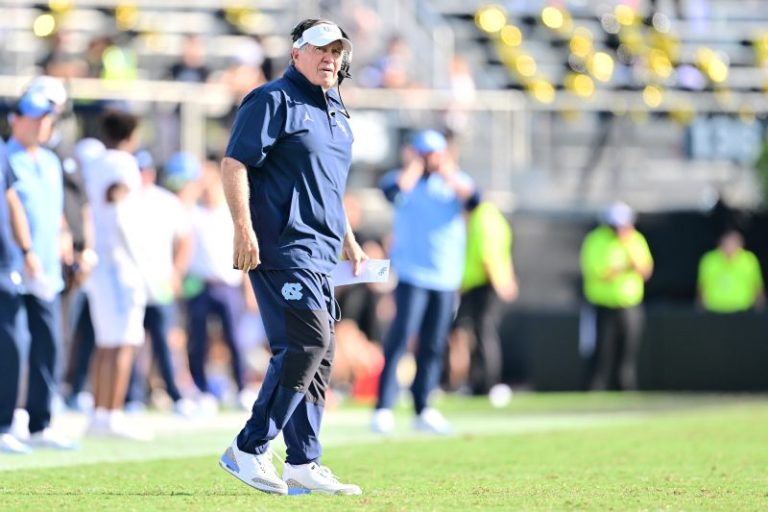
Coach Bill Belichick’s move to North Carolina has been labeled a historic bust, with the team struggling significantly against Power Four opponents.

No. 12 Georgia Tech and No. 19 Virginia have climbed to the top of the ACC at the expense of Clemson, Florida State and North Carolina, which head into the heart of the regular season a combined 2-6 in conference play.

The ACC doesn’t have a monopoly on disappointment. Flops, failures and fiascoes dot every Bowl Subdivision conference at the year’s midway point, redrawing a College Football Playoff race that no longer includes preseason favorites such as Penn State, Kansas State and Florida.

No player has come under more scrutiny than No. 17 Texas quarterback Arch Manning, who has shouldered the blame for the Longhorns’ slow start.

No coach has been a bigger bust than 73-year-old Bill Belichick. North Carolina hasn’t even come close in three games against Power Four teams and could be headed for a historically unsuccessful finish.

These teams, players and coaches lead the biggest disappointments from the first half of the regular season:

Clemson leads most disappointing teams

Clemson dropped three of four to open the year but has rebounded with a pair of ACC blowouts against North Carolina and Boston College. Now up to 2-2 in league play, the Tigers could make a run to the ACC championship game.

Those two wins could signal an in-season turnaround similar to the one that landed the Tigers in last year’s playoff. Then again, the Tar Heels and Eagles are terrible. Based on the first half, Clemson is the biggest disappointment in the FBS.

The notable flops from other FBS conferences include:

American: Army lost to Tarleton State and was blown out by East Carolina in one of the program’s worst starts under longtime coach Jeff Monken.

Big 12: Kansas State’s four losses have come by a combined 11 points thanks to careless play in the second half.

Big Ten: While not the only contender for the distinction, Wisconsin gets the nod for the pure level of incompetence in three league games.

Conference USA: After going 10-3 last season, Sam Houston State are one of three winless teams in the FBS under new coach Phil Longo.

Mid-American: Toledo is 1-2 in the MAC after a loss to rival Bowling Green and has dropped all three road games.

Mountain West: Air Force has given up 8.1 yards per play and nearly 500 yards per game in a 1-5 start.

SEC: Florida was No. 17 in the US LBM Coaches Poll heading into the season but has gone 1-4 against FBS teams.

Sun Belt: Texas State started fast, putting coach G.J. Kinne on the map for openings such as Oklahoma State, but have since dropped a pair of Sun Belt games and are sitting near the bottom of the West division.

Bill Belichick hits rock bottom at North Carolina

The six-time Super Bowl champion has been a historic bust.

Belichick’s résumé is one reason why his foray into college football has outsiders rubbernecking the scene in Chapel Hill. Another is a landscape that allows for new coaches to overhaul their rosters in a single offseason instead of the more laborious, multiple-year rebuilding projects of the recent past.

Given the chance to build a competitive roster — after all, he said UNC would be the NFL’s “33rd team” — the group Belichick constructed has weaknesses nearly across the board. Despite his reputation, he hired an unimpressive staff that seems to have no answers for the Tar Heels’ issues.

UNC has won twice, against Charlotte and Richmond, and been outscored by 87 points in losses to Clemson, Central Florida and TCU.

Arch Manning fails to match unrealistic hype

Manning has not completed every pass he’s thrown as the Longhorns’ starter. In fact, he even completed less than half of his attempts in last month’s win against Texas-El Paso.

He hasn’t won every game he’s played. Texas has lost twice, actually, and have dangerously little room for error in the second half.

Manning is in part a victim of oversized expectations. It’s also true that he’s missed the mark more often than not, putting up duds against No. 1 Ohio State and Florida but rallying for his best start to date in last Saturday’s win against No. 13 Oklahoma.

The redshirt sophomore has thrown for 1,317 yards and run for 194 yards with 17 total touchdowns. He’ll need to step up his game in the second half to get the Longhorns back into the playoff mix.

Penn State’s historic disappearing act

In the span of just over two weeks, Penn State went from No. 2 in the US LBM Coaches Poll to unranked and in the market for a new head coach.

Few promising seasons and even fewer established coaching tenures have unraveled with such speed. But the cracks were showing during non-conference play, when the offense really struggled, and then were fully revealed in Big Ten play.

The search for Franklin’s replacement is now the dominant storyline of Penn State’s season, replacing the quest for the program’s first national championship since 1986.

The schedule does play out nicely for interim coach Terry Smith, though, and the Nittany Lions could still win seven or eight games in the regular season even after losing quarterback Drew Allar to injury.

Another lost season for Florida State

Florida State seemed revived during a win against No. 6 Alabama to open the year. What’s followed has been more the same, unfortunately, and the lack of progress could result in massive offseason changes.

The Seminoles are winless in the ACC and have virtually no shot at playing for the conference championship, which would be the only way they’d make the playoff.

To have another season run off the tracks by the midway point should make coach Mike Norvell very antsy about his job security nearly two years after he was at or near the top of the list for Alabama opening.

Worse yet, the Seminoles are sliding while rival Miami has climbed to No. 2 in the US LBM Coaches Poll and is looking more and more like one of the teams to beat for the national championship.

Time runs out on the Luke Fickell era

The next Big Ten program to make a coaching change will be Wisconsin, which hit a new low with last weekend’s 37-0 loss to Iowa at Camp Randall Stadium. Amid injuries and general inexperience, the Badgers have dropped four in a row, three in the Big Ten, and are almost definitely not going to make the postseason.

The next two games are against No. 1 Ohio State and No. 9 Oregon. After hosting Washington, the Badgers go to No. 3 Indiana and then end the year against Minnesota and Illinois. Winning two of this group is unlikely; winning three seems impossible; winning the four needed to reach bowl eligibility is just unimaginable.

Falling short of six wins should spell the end of the line for Luke Fickell, who in the span of three seasons has gone from one of the most foolproof hires the Group of Five has recently produced to a cautionary tale about finding the right Power Four fit.

Nothing is working for Hugh Freeze

One of four teams still winless in SEC play, Auburn will need to hold serve against Arkansas, Kentucky and Mercer simply to reach bowl eligibility in Freeze’s third season.

Picked as a dark-horse contender in the preseason, the Tigers have been ruined by an abysmal offense that ranks second from the bottom in the SEC in yards per game and yards per play. The Tigers have managed just four touchdowns in three conference games.

If not to Fickell’s level, the odds of Freeze’s tenure continuing past this season are dropping by the week. Beyond a nonsensical offense, supposedly his area of expertise, Freeze has completely failed in building a roster through normal recruiting and the transfer portal.

This post appeared first on USA TODAY

The SEC hosts three games between ranked opponents, including No. 5 Mississippi at No. 7 Georgia.
Other significant ranked matchups include No. 22 Utah at No. 14 Brigham Young and No. 15 Notre Dame versus No. 21 Southern California.
In the ACC, No. 2 Miami (Fla.) plays on Friday, while No. 12 Georgia Tech faces Duke.

Our panel of pigskin prognosticators returns to weigh in on the college football contests involving the Top 25 in the US LBM Coaches Poll. The Week 8 slate skews heavily toward SEC country, but opinions might differ on several other games as well.

There are three ranked-on-ranked pairings in the SEC alone, headlined by the top-10 clash matching No. 5 Mississippi and No. 7 Georgia between the hedges. Elsewhere in ‘just means more land,’ No. 6 Alabama hosts No. 11 Tennessee in their traditional third Saturday in October encounter, and No. 10 LSU heads to No. 18 Vanderbilt.

OF course, there are other locales where the games this weekend also mean a lot. It’s Holy War week in the Beehive State as No. 22 Utah visits No. 14 Brigham Young. There is also the annual showdown between No. 15 Notre Dame and No. 21 Southern California, with this year’s version likely to serve as a playoff eliminator.

In the ACC, No. 2 Miami (Fla.) gets a jump start on the weekend hosting a Friday night tilt against Louisville, and No. 12 Georgia Tech puts its perfect record on the line at Duke, which is also off to a 3-0 start in conference play. Here’s how our staffers think all the action will unfold.

This post appeared first on USA TODAY
With the season more than a third of the way through, there are only two ways to improve your rosters — waiver wire and trades.

Evaluating a fantasy trade can be a daunting task. Most managers value their players more than they’re actually worth. That’s where the Week 7 fantasy football trade value charts come in.

The charts can be used as your very own fantasy football trade analyzer in standard, half-PPR (point per reception) and full PPR leagues. Someone sends you an offer? Simply pull out a calculator (on your phone, you don’t need an actual calculator) and plug in the values for each player. Don’t worry, six-points-per-passing-touchdown and superflex leagues are covered as well.

Important note: If you’re offered an uneven trade (i.e., a 2-for-1 or 3-for-1), include the values for the players you’d be moving to the bench or dropping within your calculation. Example: If someone in your league offers you Alvin Kamara, Tee Higgins and Cooper Kupp (combined value of 88) for Bijan Robinson (73), it might look like you’re getting the better end of it. However, if you’re bumping down, say, Tyjae Spears and Kendrick Bourne (combined value of 42) in the process, it’s a net negative deal for you.

The rankings are based on how players should be valued in 12-team leagues. Players are sorted in order of their half-PPR values.

Quarterback trade value chart

(Note: ‘6/TD’ is for leagues that award six points for passing touchdowns and ‘SFLEX’ stands for superflex.)

Running back trade value chart

Wide receiver trade value chart

Tight end trade value chart

Overall Week 7 fantasy football rest-of-season rankings

Note: These values are for 12-team, one-QB leagues with half-PPR scoring.

This post appeared first on USA TODAY

Just how much impact can one 6-foot, 245-pound slugger have on a playoff series?

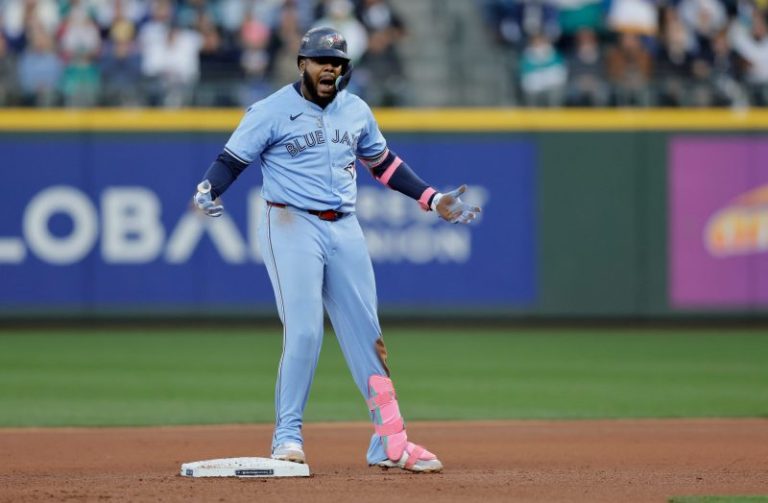
We’re about to find out now that Vladimir Guerrero Jr. has checked into the American League Championship Series.

Vladdy was an equal-opportunity destroyer in Game 3: Nearly drilling a hole through the left field fence with a key double, eluding the leaping grasp of center fielder Julio Rodriguez with a tack-on home run, and splitting the gap in right center field for what could’ve been a triple and a playoff cycle.

Vladdy was a soothsayer, pulling aside No. 9 hitter Andrés Giménez before the game and telling the light-hitting shortstop, “You’re going to go yard today.”

“I told him, try to pull the ball,” Guerrero said in a Fox Sports postgame interview of the conversation with Giménez that preceded his game-tying, two-run homer. “He listened to me, and thank God he goes yard today.”

 And Vladdy, perhaps most important, verified his status as a postseason monster.

He entered the game 0-for-7 in this ALCS and the Blue Jays 0-for-2, facing a must-win against Mariners right-hander George Kirby.

Four Guerrero hits – just a triple shy of the cycle – and a 13-4 throttling of Seattle later, they exit in far better shape.

Guerrero is now 13-for-28 (.464) with four home runs, 10 RBIs and just one strikeout in this postseason. And the Blue Jays are now trailing just 2-1 in this ALCS, thanks to one swing and one superstar.

“Yeah, man,” Blue Jays manager John Schneider said of Giménez’s two-run, game-tying blast in the third inning, “that was a big swing from Andrés.”

Oh, it reversed so much:

The score, as the Mariners once again jumped the Blue Jays on a Julio Rodriguez two-run homer for a 2-0 lead and a 3-0 ALCS lead in sight.

The Blue Jays’ offensive doldrums, as they came in with no extra-base hits and just eight hits in 61 at-bats in Games 1 and 2.

The vibes, to say the least.

Suddenly, Toronto could not be contained, as Giménez’s blast started a five-run eruption, the rally re-started when Guerrero seared a 105-mph liner into the left field wall, a wild pitch and a Daulton Varsho two-run double eventually providing a 5-2 lead.

Amazingly, it all started with Giménez simply wanting to move Ernie Clement to third base with a grounder to the right side. He got a little more of Kirby’s fastball than that.

“You know,” Giménez told reporters in Seattle, with a laugh, “I’m okay with what happened.”

We won’t know for another one, two, four games if that swing flipped this ALCS. But in the Toronto dugout, it certainly did.

“You got to trust everyone in that lineup and when you tie the game like that, I mean, everything changed in that dugout,” Guerrero told a postgame news conference.

The flogging was on. Guerrero, George Springer, Alejandro Kirk and Addison Barger joined Giménez in donning the deep blue La Gente del Barrio sports coat to celebrate their home runs.

Shane Bieber locked in, inspired by the fact his “pick me up” plea after giving up Rodriguez’s home run was heeded, five-fold. And now the curiosity of Max Scherzer, 41-year-old, pitching to square the series is upon us.

Who knows what the old boy will have, but Schneider will sleep much better tonight knowing that there was an awakening at T-Mobile Park.

For a team, and its catalyst.

The USA TODAY app gets you to the heart of the news — fastDownload for award-winning coverage, crosswords, audio storytelling, the eNewspaper and more.

This post appeared first on USA TODAY
When U.S. forces launched strikes against Iranian military targets in June, critics warned it could ignite a regional inferno — even the start of World War III. Four months later, the Middle East is quieter than at any point in years. Iranian proxies have scaled back attacks, Gulf tensions have cooled, and Washington has shifted attention toward the Western Hemisphere.

The unexpected calm is raising a new question: Did decisive U.S. action restore deterrence — or has Washington simply been lucky?

Those who favor a more forceful U.S. foreign policy counted Iran’s lack of a response as a win for their frame of mind — and a loss for restrainers. They now credit the strikes with bringing about a period of relative peace that culminated in a fragile ceasefire between Israel and Hamas this week.

Rep. Marjorie Taylor Greene, R-Ga., publicly broke from her longtime support of President Donald Trump after the strikes.

‘Six months in and here we are turning back on the campaign promises, and we bombed Iran on behalf of Israel,’ she said on Newsmax at the time.

‘We’re entering a nuclear war, World War Three, because the entire world is going to erupt. And you know what, the people that are cheering it on right now, their tune is going to drastically change the minute we start seeing flag-draped coffins on the nightly news.’

On Monday, she praised Trump for brokering the peace deal between Israel and Hamas. ‘Blessed are the peacemakers! May healing begin for all.’ 

‘You’ve put every U.S. troop and embassy in the region at risk and squandered America’s diplomatic leverage — though you’ll likely think you’ve strengthened it,’ said Adam Weinstein, deputy director of the Middle East Program at the Quincy Institute, at the time.

Sen. Chris Murphy, D-Conn., claimed the strike ‘put the United States on a path to a war in the Middle East that the country does not want, the law does not allow, and our security does not demand.’

Rep. Thomas Massie, R-Ky., was even more blunt. ‘It was a good week for the neocons in the military-industrial complex who want war all the time,’ he said on CBS’ Face the Nation.

Four months later, those who once warned of a spiral toward World War III are facing an uncomfortable reality: the region is largely quiet.

‘Those who warned of World War III before the U.S. and Israeli strikes on Iran fundamentally misunderstood both the nature of deterrence and the regime in Tehran,’ said Mark Dubowitz, CEO of the Foundation for Defense of Democracies.

‘Strength and resolve don’t invite escalation — they prevent it. What we’ve seen in recent months is a return to deterrence through escalation dominance: Iran, Hezbollah, Hamas, and other American enemies are recalibrating precisely because the United States finally imposed real costs on the Islamic Republic.’

Dubowitz said years of Western restraint emboldened Iran. ‘For years, Western policymakers indulged in a fantasy that restraint would produce stability,’ he said. ‘It did the opposite. Tehran read our de-escalation as weakness and kept pushing.’

‘Everybody who said that a strike on Iran would be a disaster was wrong,’ said Matthew Kroenig, vice president of the Atlantic Council’s Scowcroft Center and a former Pentagon strategist. ‘These fears about Iranian retaliation and region-wide war were exaggerated. Iran doesn’t want a major war with the United States, the greatest superpower on earth that could end its regime. Instead, Iran engaged in some kind of token retaliation, and the whole thing died down.’

Trump’s authorization of the strikes was not a departure from his ‘America First’ principles, as Greene suggested, but a continuation of them.

‘When it comes to hitting an adversary hard, Trump has always been open to that kind of short, sharp, decisive use of force to achieve a clear objective,’ Kroenig said.

Those in the restraint camp say they don’t count Trump’s decision as a total loss for their viewpoint. They argue that predictions of a wider war were based on a different scenario — one that Trump ultimately avoided.

‘The prediction that this could lead to a wider war was for the scenario in which the U.S. would join Israel in a larger military campaign against Iran with the intent of regime change,’ said Trita Parsi, co-founder of the Quincy Institute. ‘This is not what Trump opted for. He clearly signaled to Tehran before the strikes where he would strike to ensure that the locations would be vacated and that there would be no casualties. He also signaled his intent to only strike these sites and be done with it. This significantly reduced the risk of a larger escalation.’

Rosemary Kelanic of Defense Priorities acknowledged that the strikes were ‘not a win for restraint’ in principle, and though the U.S. felt few repercussions, it was still a gamble.

‘I think it’s really easy to learn the wrong lesson from this, which is, all we have to do is go in and bomb for 45 minutes and then everyone will back down,’ she said. ‘Most of the time, U.S. military force doesn’t actually produce the outcomes that we want.’

Adam Weinstein said the operation came at the cost of diplomacy, noting that the strikes took place in the midst of ongoing negotiations with Tehran over its nuclear program.

‘The strikes were a setback on diplomacy with Iran,’ he said. ‘They negatively affected the world’s ability to ensure that Iran doesn’t develop a nuclear capability. It essentially destroyed trust between Iran and the international community.’

This post appeared first on FOX NEWS

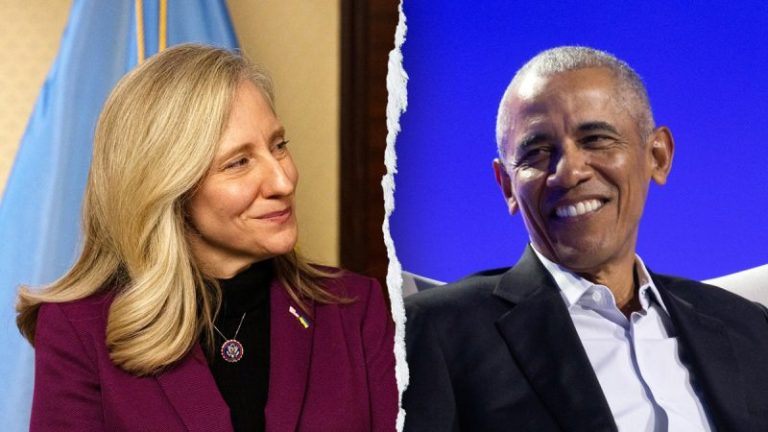
Former President Barack Obama endorsed former Democratic Rep. Abigail Spanberger in Virginia’s governor race, releasing a pair of ads attacking Republicans. 

The contest between Spanberger, a former CIA officer, and Virginia Lt. Gov. Winsome Earle-Sears is one of only two governor races in the U.S. this November. The contests are viewed as political bellwethers ahead of the 2026 midterm elections. 

‘Virginia’s elections are some of the most important in the country this year. We know Republicans will keep attacking abortion rights and the rights of women. That’s why having the right governor matters, and I’m proud to endorse Abigail Spanberger,’ Obama said in one of the ads, titled ‘Protect Our Rights.’ 

‘In Congress, Abigail held Republicans accountable and fought to protect voting rights and abortion rights,’ Obama said. ‘But it won’t happen without you. Every vote counts, so turn out. Virginia, Abigail Spanberger is the best choice for governor.’

Earle-Sears’ press secretary Peyton Vogel told Fox News Digital in reaction to the ads that, ‘Abigail Spanberger is scared, and it shows.’

‘After losing support across Virginia, she’s leaning on liberal elites to try and save her collapsing campaign. This is a desperate play from a candidate who’s run out of support, out of ideas, and out of time. Voters see through it, and that’s why Winsome Earle-Sears is surging,’ Vogel added.

In the other ad, Obama said, ‘Republican policies are raising costs on working families so [that] billionaires can get massive tax cuts.’

‘As governor, Abigail will stand up for Virginia families,’ Obama said. ‘She’ll work to build an economy that works for everyone, not just big corporations and the wealthy.’ 

Earle-Sears most recently criticized Spanberger on her X account Wednesday night for her reaction to the texting scandal surrounding Democratic Virginia attorney general candidate Jay Jones. 

The scandal involving Jones came to light earlier this month when the National Review published text message exchanges between Jones and his former state legislative colleague, Republican House Delegate Carrie Coyner. In the exchanges, Jones appears to call for violence against then-Virginia House of Delegates Speaker Todd Gilbert, his wife, Jennifer, and their children. 

‘Jay Jones expressed his desire to murder a dad and his two young boys — and to see police officers get shot,’ Earle-Sears said. ‘Abigail Spanberger still supports him.’ 

Fox News Digital reported this week that Spanberger’s campaign store continues to sell merchandise co-branded with the rest of the statewide Democratic ticket — which includes Jones. 

Fox News’ Paul Steinhauser, Rachel Wolf and Charles Creitz contributed to this report. 

This post appeared first on FOX NEWS

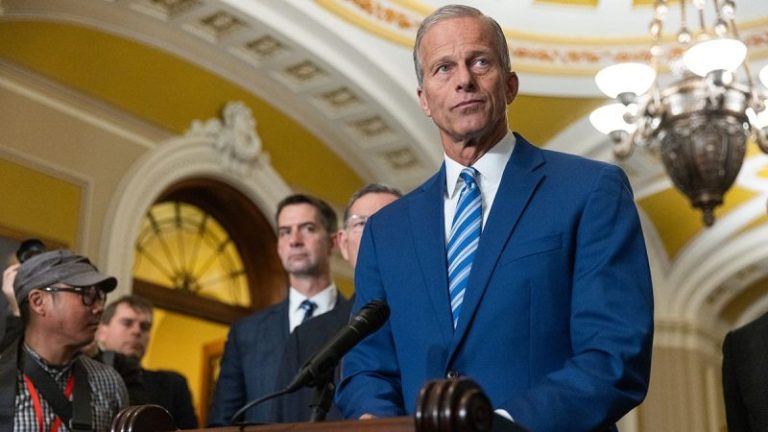
Senate Democrats wanted an equal say in crafting spending bills before the shutdown and are about to get a chance to do so, but they’re unlikely to support Republicans’ latest effort to jump-start the government funding process.

The Senate on Thursday is set to move through a procedural hurdle on the annual defense spending bill, which, among other things, would ensure that military service members would get their paychecks.

Senate Majority Leader John Thune, R-S.D., teed up the bill earlier this week as the shutdown raged on to pressure Senate Democrats to make good on their desire to fund the government in a bipartisan manner, and in the hopes of getting the appropriations process moving again. 

‘We can actually get the appropriations process going forward,’ Thune said. ‘So that’s in the works.’

And in the Senate, given the 60-vote filibuster threshold, spending bills are prime examples of the many pieces of legislation that have to be bipartisan to pass. But Senate Democrats seemed unwilling to go all in on supporting the defense bill, and like the Republicans’ plan to reopen the government, appear ready to block Thune’s effort.

They want to know exactly what Republicans plan to put on the floor later on, despite the vote on Thursday afternoon being designed to give lawmakers the chance to move forward with at least one of several spending bills that must be passed to fund the government.

‘We have to see what they’re going to put on the floor,’ Senate Minority Leader Chuck Schumer, D-N.Y., said. ‘They haven’t told us yet.’

Republicans are also eyeing at least three other spending bills to attach to the defense appropriations bill, including legislation that would fund the departments of Labor, Commerce, Transportation, Health and Human Services, and Housing and Urban Development.

Sen. Mike Rounds, R-S.D., is a member of the Senate Appropriations Committee and appears ready for the reality that Democrats would block the defense bill and broader spending package.

‘You have to start with the defense, and then you can add the other ones to it, but once again, it takes agreement by our Dem colleagues that want to move that forward,’ he said. ‘I’m not sure that we’ve got the votes to do that yet.’

There is a trust deficit between Senate Democrats and Republicans from earlier this year when the GOP passed President Donald Trump’s request to claw back billions in funding for foreign aid and NPR and PBS, in addition to continued actions by Office of Management and Budget Director Russ Vought to withhold or cancel funding for Democratic priorities.

Sen. Sheldon Whitehouse, D-R.I., told Fox News Digital after Senate Democrats met behind closed doors on Wednesday that there had been no indication from Republicans there would be ‘bipartisan cooperation or any willingness to put any guardrails around what they plan to do.’

‘I think the stage we’re at is that we’ve been shown nothing,’ he said. ‘So there’s no reason to vote for it yet.’

‘I think what was needed is a larger agreement about how the appropriations process is moving forward, so it’s clear that our priorities are respected,’ he continued.

However, pairing the defense bill could grease the wheels for some in the Democratic caucus.

‘No, not unless it’s paired with [the Labor and HHS bill],’ Sen. Angus King, I-Maine, said.

Thune’s move to reignite the appropriations process, an exercise that played out in the Senate in early August when lawmakers advanced a trio of funding bills ahead of the shutdown deadline, is part of Republicans’ broader desire to fund the government the old-fashioned way, rather than through a colossal omnibus spending package.

It’s an exercise, however, that hasn’t been fully completed since the 1990s.

Sen. Eric Schmitt, R-Mo., noted to Fox News Digital that a major part of selecting a new leader for the Senate GOP was returning to what’s known as regular order, or passing spending to fund the government.

He argued that when Schumer ran the Senate as majority leader, the upper chamber was often resigned to passing ‘these omnibus bills that were developed in the, you know, middle of the night with four people.’

‘We’re not interested in that. So we want to get bills on the floor, and they’ve got to move in a bipartisan way, right? So I think this is something that I would hope Democrats would support, too,’ he said. ‘But if their mentality is at this point, you know, just oppose everything Republicans want to do, it’s pathological, and I don’t have any advice for them except seek help.’

Republicans are still trying to reopen the government and plan to put the House-passed continuing resolution (CR) on the floor again Thursday for a 10th time. And just like many times before, it is expected to fail.

When asked if he believed that the shutdown could transform into lawmakers passing spending bills one-by-one to reopen the government, Thune said, ‘I certainly hope not.’ 

This post appeared first on FOX NEWS

Ohio State, Indiana, and Oregon are currently positioned as strong playoff contenders from the conference.
Key upcoming games include USC at Notre Dame, Nebraska at Penn State, and Ohio State at Michigan.
At least three Big Ten teams are expected to make the 12-team College Football Playoff field.

Things are about to get very serious in the Big Ten.

The first half of the college football is in the books. Penn State is out of the mix. Wisconsin is terrible. No. 1 Ohio State is intimidating. No. 3 Indiana looks unbeatable.

The second half of the regular season will decide which teams meet to decide the conference championship and which Big Ten teams make the College Football Playoff.

For now, the Buckeyes, Hoosiers and No. 9 Oregon look like playoff locks. The second tier of contenders include No. 21 Southern California, Michigan, Nebraska and Illinois.

The expectation is that at least three and as many as four Big Ten teams make the 12-team field. Four made last year’s bracket in the Buckeyes, Hoosiers, Ducks and Nittany Lions.

These games will shape the Big Ten race in the second half and help clean up an unsettled playoff race:

Southern California at No. 15 Notre Dame, Oct. 18

After beating Michigan to break into the US LBM Coaches Poll, the Trojans take on another big test against the red-hot Fighting Irish. USC could lose this game and still make the playoff as an at-large team, or even rally in Big Ten play to reach the conference championship game. What happens in South Bend will show whether the Trojans have what it takes.

UCLA at Indiana, Oct. 25

This is looking like Indiana’s biggest test the rest of the way, underscoring how the Hoosiers might have the best playoff odds of any team in the Power Four. UCLA has turned a corner since firing Deshaun Foster and clearly found an offensive identity. Will that be enough to score a mammoth upset?

Southern California at Nebraska, Nov. 1

One-loss Nebraska is hanging around the playoff race in Matt Rhule’s third season. A close win against Maryland shows how thin the margin of error is for a team that has improved dramatically under Rhule but isn’t quite a finished product. Beating USC would provide some national respect and set up the possibility of a 10-win regular season.

Nebraska at Penn State, Nov. 22

This might be awkward. A former Penn State linebacker, Rhule was immediately floated as James Franklin’s successor due to his ties to the program and deep connection with Nittany Lions athletics director Pat Kraft. It’s possible that Rhule will have made a public commitment to Nebraska before this road trip. If not, though, and if the Cornhuskers are surging in the Top 25, this matchup will be one of the most storyline-heavy of the second half.

Oregon at Washington, Nov. 29

The Ducks should be in firm position for an at-large playoff bid and even the Big Ten title game before the trip to Seattle. If not, though — let’s say they slip and fall at Iowa or the week prior against USC — this could be a winner-take-all matchup that determines much more than just bragging rights.

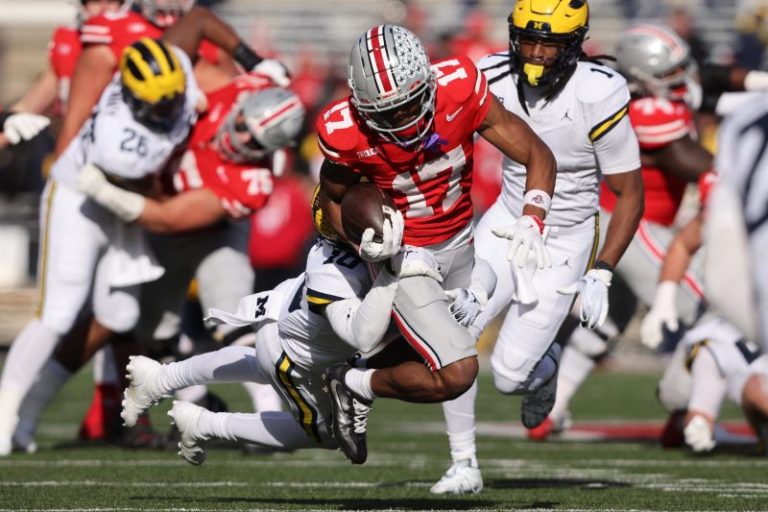
Ohio State at Michigan, Nov. 29

Can the Buckeyes finally crack Michigan’s code? The Buckeyes seem better equipped to handle the Wolverines thanks to an elite defense that ranks near the top of the country in every major category. And by this point in the year, the Julian Sayin-led offense could be the best in the conference.

This post appeared first on USA TODAY