Archive

2025

Browsing

Taiwan’s Ministry of National Defense said China has been conducting training missions in the western Pacific aimed at limiting U.S. and allied military access. The exercises reflect Beijing’s effort to expand its anti-access/area-denial, or A2/AD, capabilities – a strategy meant to keep opposing forces from entering or operating freely in nearby regions.

The military spokesman for Taiwan – officially known as the Republic of China (ROC) – Lt. Gen. Sun Li-fang, told Fox News Digital in exclusive comments that the armed forces of the independently governed island fully understand the threats posed by China’s expanding military might. 

Sun said Taiwan has prepared a series of responses if the People’s Liberation Army’s (PLA) provocations escalate into acts of war and has detailed plans to counter and survive a potential Chinese naval blockade.

Taiwan’s military is on alert for the possibility that Communist China could turn ‘training’ or an exercise into an actual war. Some analysts warn that a Chinese blockade would be difficult to break, but Sun said Taiwan has ‘holistic plans to breach [any] blockade.’ He added that Taipei would ‘urge its allies and like-minded partners to treat any blockade as an act of war that should trigger a coordinated international response,’ noting that shipping disruptions in the seas near Taiwan would have serious effects on the global economy.

Sun said Taiwan expects the PLA to continue its campaign of ‘hybrid warfare’ or ‘gray-zone operations,’ a mix of nonmilitary and paramilitary actions designed to pressure and harass Taiwan without formally declaring war. He warned that the PLA seeks to ‘exhaust [Taiwan’s] defense capability and blur the battlespace.’

An example of this can be seen in the near-daily incursions by Chinese warplanes into Taiwan’s air defense identification zone, resulting in Taiwanese air force jets scrambling to intercept them. The tactic, analysts say, is deliberate – part of a broader effort to wear down Taiwan’s air force, degrade equipment and exhaust Taiwan’s personnel.

Beijing has never ruled Taiwan for even a single day, and Taiwan’s military insists it will not allow China to dictate the rules of any future conflict. Instead, the island democracy is prioritizing the development of asymmetric warfare, a strategy in which, as Sun put it, ‘the weaker party strikes at the weak point of the stronger party with appropriate tactics and weapons in order to gain advantages on the battlefield and change the outcome of the war.’

The general said Taiwan’s top priorities are to build asymmetric capabilities, strengthen operational resilience, expand reserve force capacity and improve defenses against gray-zone harassment. To achieve these goals, he said, Taiwan is expanding production and deployment of unmanned and AI-driven systems while dispersing command-and-control networks to make a knockout punch much more difficult. He also noted that Taiwan’s surveillance and reconnaissance units are ‘vigilant’ and that they ‘exchange intelligence and perspectives on PLA activities with our allies and partners.’

Sun also rejected the idea that Taiwan lacks the will to defend itself and believes people here would strongly resist any attempt by the PRC to take Taiwan by force. Taiwan’s military wants the world to know it is committed to its own defense, Sun said, pointing to the proposed 2026 defense budget, which will exceed 3% of GDP. Furthermore, he said, the government is actively pursuing reforms to make training ‘as realistic as possible,’ is expanding reserve forces, and has already extended mandatory military service to one year.

Taiwan’s government is stressing that an attack or blockade by Beijing would not just be a local confrontation but a global crisis. Government and military leaders of democratic Taiwan hope their statements and actions will convince China – and the world – that Taiwan will fight back with everything it’s got.

This post appeared first on FOX NEWS

Former President Joe Biden suggested that the U.S. is currently facing ‘dark days.’

During a ceremony where he was honored with a lifetime achievement award for inspired leadership from the Edward M. Kennedy Institute, Biden described the current state of affairs as the ‘worst’ he has seen in his many decades of ‘elected public life,’ opining that ‘our very democracy is at stake in my view.’

‘Friends, I can’t sugarcoat any of this. These are dark days,’ Biden asserted.

But the Democrat said the U.S. is one of the only nations that comes out of each crisis it faces ‘stronger’ than before.

Biden said he believes the U.S. will ’emerge… stronger, wiser, more resilient, more just, so long as we keep the faith,’ urging people to ‘fight like hell.’

The lifetime achievement award recognizes Biden for serving 36 years as a senator, eight years as vice president alongside President Barack Obama, and four years as president. Before his time in federal posts, he served on the New Castle County Council in Delaware.

Biden, who left office earlier this year at the age of 82, was the oldest person ever to serve as president in American history.

This post appeared first on FOX NEWS

The U.S. Navy’s Tomahawk cruise missile would put Moscow well within target range if President Donald Trump were to fulfill Ukrainian President Volodymyr Zelenskyy’s request.

The Tomahawk has long been one of the most recognizable weapons in America’s arsenal. At $2 million per missile and $6 million per launcher, it can strike up to 1,500 miles into enemy territory.

If the United States were to authorize Ukraine to use it, it would mark a dramatic escalation in both capability and psychology. For the first time, Russian forces and strategic sites far beyond the front lines — including inside Russian territory — would fall within reach of a Western-supplied, precision long-range weapon that Moscow has no reliable defense against.

Unlike the shorter-range Storm Shadow or ATACMS systems already used by Kyiv, the Tomahawk would give Ukraine the ability to strike targets hundreds of miles inside Russia — air bases, ammunition depots, logistics hubs and naval assets supporting the war in Ukraine. That reach would instantly change the strategic balance.

Critically, it would give Ukraine the ability to hit at Russia’s energy industry, which, through exports to nations like China, Iran and India, funds the war effort.

Ukraine has used ATACMS systems to strike behind enemy lines in Russian-occupied Ukraine and near Russia’s borders — helicopter shelters, ammunition depots and runways. But even as missiles regularly rain down on Kyiv, its defense forces have not been able to respond in kind to Moscow, leaving the Kremlin hub unscathed and largely secure after three and a half years of war.

Recently, Ukraine used U.K.-made Storm Shadow missiles to strike a gun depot in Russia. The U.S. supplies targeting data for the Storm Shadow, and The Wall Street Journal reported that the Trump administration had lifted a ban on using the missiles to strike inside Russia.

‘Transferring Tomahawks to Ukraine would mark a major inflection point for Western support of Ukraine,’ Hudson Institute defense analyst Can Kasapoglu wrote in a recent essay. ‘The Tomahawk is one of the most effective missiles in the arsenals of North Atlantic Treaty Organization (NATO) nations.’

Kasapoglu noted that the Tomahawk’s strategic appeal ‘lies less in its raw explosive yield and more in its precision.’

For Moscow, the implications would be profound. Russia’s military doctrine has long depended on the assumption that its homeland infrastructure — especially command and logistics networks — would remain beyond direct threat from Western-supplied weapons. The introduction of Tomahawks into Ukrainian hands would destroy that assumption overnight.

The missile’s ability to fly low and evade radar would make it extremely difficult for Russian defenses to stop. Even advanced systems like the S-400 or S-500, already stretched across multiple fronts, could not guarantee interception. Each missile launched would carry not only destructive power but psychological weight — forcing Russia to divert resources away from its offensive operations in Ukraine to protect bases hundreds of miles away.

‘Such a move would inevitably free up airspace for the Ukrainian Air Force’s growing fleet of F-16 aircraft and Western-supplied ground-attack smart munitions,’ Kasapoglu wrote.

It would also inject uncertainty into Russian planning. Commanders would have to assume that every major staging area — from Belgorod to the Black Sea Fleet in Sevastopol — could be targeted. That uncertainty erodes confidence, slows operations, and imposes constant strain on air defense assets.

Trump explained on Wednesday why he did not provide Tomahawks to Ukraine despite speculation that he would do so.

‘There is a tremendous learning curve with the Tomahawk. It’s a very powerful weapon, very accurate weapon,’ Trump said Wednesday. ‘And maybe that’s what makes it so complex. But it will take a year. It takes a year of intense training to learn how to use it, and we know how to use it. And we’re not going to be teaching other people. It will be just too far out into the future.’

Trump also made clear he believes the U.S. has few to spare.

‘We need Tomahawks for the United States of America too. We have a lot of them, but we need them.’

The U.S. supply of Tomahawks is classified. But analysts say providing Ukraine with the missiles would weaken preparations for conflict in the Indo-Pacific. 

‘Tomahawk is one of the few munitions (Patriot is another) that would be useful both in Ukraine and the Western Pacific,’ an analysis by the Center for Strategic and International Studies (CSIS) said. 

The Department of War has already established a review process to ensure that weapons offered to Ukraine do not weaken what it regards as higher priority needs. 

‘This review process will almost certainly raise objections to this transfer, and presidential intervention may be required,’ the analysis found. 

Over the weekend, Zelenskyy told Axios Ukraine would welcome other long-range missiles as well. 

‘We speak not only about Tomahawks. The U.S. has a lot of similar things that doesn’t require much time for training. I think the way to work with Putin is only through pressure,’ Zelensky said.

Earlier in the week, he expressed skepticism that Ukraine could win the war.

‘They could still win it. I don’t think they will, but they could still win it,’ Trump told reporters Monday.

Putin’s calculus depends heavily on escalation control — the belief that NATO will stop short of providing weapons capable of directly threatening Russian territory. Tomahawks would shatter that red line. For the Kremlin, it would signal that Washington is prepared to move from containment to punishment — just after Trump triggered sanctions on Russia’s lucrative energy exports.

Putin told journalists this week that if Russia were attacked with Western long-range missiles, the response would be ‘very serious, if not overwhelming. Let them think about it.’

This post appeared first on FOX NEWS

In the view of Avik Roy — one of the first and most vocal critics of the Affordable Care Act (ACA), also known as Obamacare — Republicans and Democrats alike have missed the mark in the healthcare debate that has dragged the government into a 24-day shutdown.

‘Both sides are wrong,’ Avik said. ‘I’m sympathetic to the Republican view, but it’s a strategic mistake.’

The way Roy sees things, Republican wariness over renewing expanded government subsidies should be directed at the bigger problem behind them.

‘The subsidies aren’t inherently the problem,’ Roy said. ‘If you want low-income people who are near the poverty line to have insurance, you’re going to have to subsidize. Subsidies have been a part of Republican [healthcare] plans and Democratic plans. I would argue that the approach to subsidies that Obamacare used was actually pretty reasonable.’ 

That doesn’t mean he believes the government’s current healthcare trajectory is sustainable, either.

The federal government entered a 24-day shutdown at the beginning of October when lawmakers failed to come to an agreement over spending legislation to begin the new fiscal year. Republicans advanced a short-term spending bill that would have bought more time for lawmakers to finalize funding for 2026. But Democrats, led by Senate Minority Leader Chuck Schumer, D-N.Y., and House Minority Leader Hakeem Jeffries, D-N.Y., have shot down that measure repeatedly, demanding that Congress first address expiring COVID-era insurance subsidies. 

As a part of its American Rescue Plan, the Biden administration greatly widened the pool of eligible applicants who could receive a federal subsidy to help pay for their Obamacare health insurance.

In its original form, Obamacare capped subsidies for anyone making over 400% of the federal poverty level. But that changed in 2021 when, as an emergency response to COVID-19, Congress temporarily removed that cap.

The cap will go back into effect at the end of 2025.

Findings by KFF, a healthcare policy think tank, indicate that over 90% of the 24 million Obamacare enrollees make use of the expanded credits. Letting them expire could leave those Obamacare enrollees suddenly footing a substantially heftier bill. But, according to the Committee of a Responsible Federal Budget, a nonpartisan fiscal policy think tank, continuing the policy would also come with a steep price tag; upwards of $30 billion annually.

Republicans — especially the Hill’s most fiscally conservative lawmakers — have called for the subsidies to expire to help reel the country’s spending back under control.

Despite agreeing with Republicans that Obamacare did little to make health insurance more affordable, Roy believes Republican insistence on letting them expire won’t solve Obamacare’s underlying problems that are driving prices higher: regulations. 

Roy believes Republicans should use the moment to negotiate, extending the subsidies for maybe one to two years for existing enrollees in exchange for a permanent fix of the costliest Obamacare regulations driving costs upward. 

‘In Switzerland [health insurance] costs $200 a month or $300 a month. The same plan in America costs $1,000 a month or $15,000 a month. Subsidizing it also costs a lot. But having a scale where the subsidy fades out gradually as you go up the income scale — that part is fine.’

Roy praised efforts from the Trump administration to bring the underlying costs of healthcare down, most recently through the most favored nation strategy. Under that plan, the Trump administration had leveraged the price other countries pay for pharmaceuticals to bring U.S. prices down.

In theory, the most favored nation plan would set American prices at the lowest rates other countries pay.

‘They’re not actually deals that truly establish most favored nation status because it’s company by company, and they are on particular drugs. But the general idea — if you want to participate in the U.S. market you’ve got to give us the lowest price you give any other advanced economy — I think that’s eminently reasonable,’ Roy said of the administration’s negotiations. 

In response to Democratic demands, Republicans in Congress maintain that the enhanced premium tax credits are completely unrelated to the government’s funding and rejected those demands out of hand.

The Senate has voted on a short-term funding bill 12 times since the beginning of the shutdown and appeared no closer to finding a resolution when the lawmakers left town on Thursday.

The Senate will return to Washington, D.C., at the beginning of next week. 

This post appeared first on FOX NEWS

Standout performances from players like Breece Hall and James Cook were among Sunday’s major fantasy football takeaways.
Several key players, including Saquon Barkley and Quinshon Judkins, suffered injuries, impacting fantasy football lineups.

Week 8 hadn’t even started, and it was already a wild one.

First came bye-mageddon, as the NFL once again put six teams on bye for seemingly no reason.

Then, as Sunday approached, injuries kept popping up out of nowhere, making it even harder to fill fantasy lineups.

Once the games began, there were blowouts, shocking upsets, and more tough injuries. And with the Jets finally getting their first win, there are no longer any winless teams in the NFL.

Many fantasy football managers will be glad to see Week 8 go, but before it does, here’s a recap of every game with the key fantasy takeaways you need.

Week 8 fantasy football game recaps

Dolphins 34, Falcons 10

The Dolphins were able to take advantage of the Falcons, who did not have Michael Penix Jr. and Drake London.

Miami Dolphins

QB Tua Tagovailoa had his best game of the season. He completed 20-of-26 for 205 yards and four touchdowns. Still not someone to trust week-to-week.
Without TE Darren Waller, WR Malik Washington stepped up as the second receiver with five targets. Could be a deeper league bench option, but that is about it.
RB De’Von Achane led the backfield in touches, but it’s notable that Ollie Gordon received 10 carries. Most likely due to mop-up duties, but something to keep an eye on if it continues next week.

Atlanta Falcons

With no Drake London, Darnell Mooney was supposed to be the primary receiver. He did tie David Sills V in receiver snaps, but was second in targets, catching only one for 11 yards.
First in targets was WR KhaDarel Hodge, with a whopping eight. The offensive struggles meant he caught only three, but if London is going to miss time, Hodge is at least somebody to keep in mind for deeper leagues.
Bijan Robinson played a season low in snaps, but the Falcons barely played him in the fourth quarter when they were down multiple scores. No need to panic.
The Kirk Cousins tryout did not go well. Safe to leave him on waivers even if Penix is out again.

Jets 39, Bengals 38

It looked like there was no chance the Jets were going to win this game heading into the fourth quarter down 31-16, but they had other things in mind.

New York Jets

QB Justin Fields was not spectacular, but did enough to win. His ceiling in fantasy is great thanks to his rushing ability, but he is a landmine. Start at your own risk.
Breece Hall was story of the day. He rushed for 133 yards, two touchdowns and threw for one as well. He should be good in games in which the Jets are competitive.
TE Mason Taylor was good again, yet he continues to be under-rostered. Outside of a bad game in London, where he caught just one pass on two targets, he has had 38 targets in the other five games starting Week 3. That is elite usage for a tight end; go get him if he is out there.

Cincinnati Bengals

The snap count for RBs Chase Brown and Samaje Perine is getting closer each week. This week: 32-25. Brown is still getting the majority of the early-down work, but Perine is getting more as of late, and this week it led to 94 yards and a touchdown on nine carries. Perine is worth a flyer on teams as a bye-week flex option and a premium handcuff.
Joe Flacco is starting to look like a possible top-12 QB the rest of the way. Eight touchdowns in his first three games with the Bengals. Those relying on QBs like Caleb Williams and Jordan Love might want to take a look.

Patriots 32, Browns 13

Not even the Browns’ stout defense could hold down Drake Maye and the Patriots.

New England Patriots

RB TreVeyon Henderson ran the ball significantly better than Rhamondre Stevenson by quite a bit. One huge blemish is a fumble.
Fumbles have not stopped Stevenson from losing the starting role and better production has yet to give Henderson the role. It is great to see the game from Henderson, but we need to see the role change to trust him.
Mack Hollins led this receiving room this week in targets, receptions and yards. Don’t get too excited. This is still a spread-the-ball-around offense, led by Stefon Diggs and Kayshon Boutte — the secondary receiver who’s a big play threat.

Cleveland Browns

Bad news: RB Quinshon Judkins left in the third quarter with a shoulder injury. The extent of the injury is unknown. It is possible he did not return due to the Browns being down so much. At the very least, they have a bye in Week 9 for him to recover.
Dylan Sampson would be the primary running back if Judkins misses time. Worth a stash pick up just in case, especially for Judkins managers.
TE David Njoku returned from injury, and both he and Harold Fannin Jr. played well, being the two best pass-catchers for the Browns. That should be the norm the rest of the season while Dillon Gabriel is the starting quarterback.

Eagles 38, Giants 20

Philadelphia Eagles

Saquon Barkley looked like the Saquon from 2024: 14 carries for 150 yards and a touchdown. Also added four receptions for 24 yards and a score.
Bad news for Barkley is he suffered a groin injury at the end of the third quarter. Hopefully, he did not return due to the Eagles being up multiple scores. Also noteworthy, they have a bye this week.
If he is out, Tank Bigsby is the running back to roster as he saw 13 of 16 fourth-quarter snaps.
WR A.J. Brown was out, so it was DeVonta Smith and not a lot else. There didn’t need to be with how well the Eagles ran the ball. This led to Jalen Hurts only passing the ball 20 times.

New York Giants

Cam Skattebo looks to have suffered a season-ending ankle injury. This is going to open the door for Tyrone Tracy to take over the leading role.
Tracy is a clear top waiver option in all leagues where he’s available.
WR Darius Slayton returned from his hamstring injury and went right back to his role. He led the team in targets, although it didn’t amount to much. Not a must-roster, but could be sneaky in PPR some weeks.

Bills 40, Panthers 9

The Panthers offense was lifeless today without Bryce Young.

Buffalo Bills

James Cook “cooked” with 19 carries, 216 yards and two touchdowns. It had been a rough two-week stretch for him compared to his first five weeks, so this was great to see.
The only receiver to do much of anything, Khalil Shakir caught six for 88 yards and a touchdown. There are likely to be many more games like this when the Bills blow out their opponent and only need to pass the ball 21 times (19 from Josh Allen).

Carolina Panthers

WR Tetairoa McMillan had one of his more productive games of the season. Managers have to hope he can build off this and be more consistent. It’ll be hard with how much the Panthers want to run
Speaking of the run, the 50/50 rotation continues between Rico Dowdle and Chuba Hubbard. Dowdle has outperformed Hubbard since the latter returned from his injury, so maybe they start leaning more on Dowdle.
In his second week back, WR Jalen Coker took on a much larger role, which significantly affected Xavier Legette. Coker is an intriguing speculative add, while Legette is droppable.

Ravens 30, Bears 16

In a must-win game, Tyler Huntley leads the Ravens to victory. Bears’ holes on offense are exposed, mostly at quarterback.

Baltimore Ravens

Derrick Henry’s buy-low window has officially closed. He now has 193 yards and two touchdowns in his last two games. It should only get better when Lamar Jackson returns, likely this week.
WR Zay Flowers still produced with Tyler Huntley at quarterback. He more than doubled the next receiver with nine targets. Zay has boom-bust games with Lamar for sure, but he is a must-start when Jackson is back.
TEs Mark Andrews and Isaiah Likely will both be very hard to trust moving forward with how they are splitting snaps.

Chicago Bears

This was supposed to be a premium matchup for Caleb Williams. Instead, he turned in his second game in a row with zero touchdowns. The Williams from early in the season seems long gone and is best left on your bench if you want to roster him at all moving forward.
TE Colston Loveland did see an increase in snaps and routes run with Cole Kmet sidelined, but it only amounted to five targets and three receptions. Still a bit away from being trusted in fantasy.
The snaps are just about 50/50 now for RBs D’Andre Swift and Kyle Monangai. Swift is getting more usage when in the game though. This still limits Swift’s ceiling quite a bit.

Texans 26, 49ers 15

Looks like the Mac Jones magic has worn off for the 49ers.

Houston Texans

Without WR Nico Collins (concussion), C.J. Stroud spread the ball around to Xavier Hutchinson, Jayden Higgins and Jaylin Noel the most.
None of these receivers will reproduce this when Nico returns, but out of the three, Hutchinson and Noel are the most trustworthy while Christian Kirk is still out.
The Texans RB usage flip-flop continues. Woody Marks saw his snap count fall to 40%. He was behind Nick Chubb in carries 17 to 11, but doubled his workload in the passing game.
Marks has the higher ceiling due to being the more explosive back, but as long as Chubb is involved this much he will be hard to trust.

San Francisco 49ers

The Texans defense has shut down most quarterbacks and offenses this year; Mac Jones and the 49ers were no different.
For some good news. TE George Kittle (four receptions, 43 yards, TD) looked a little more like himself after being shut out last week.
WR Jauan Jennings looked healthier, leading the team in targets. Could be a good buy-low with Brock Purdy expected to return soon.

Buccaneers 23, Saints 3

This was a poor offensive game by both teams, yet there are way more question marks from the Saints. Bucs win this game thanks to a defense that scored more points than it allowed.

Tampa Bay Buccaneers

RB Sean Tucker saw a much larger workload with Rachaad White struggling. Both had double-digit carries.
The Bucs have a bye in Week 10, so maybe Bucky Irving can return after that. If not, still expect White to get first crack at it.
With Mike Evans and Chris Godwin out, WR Emeka Egbuka has dominated targets with 21 over the last two weeks. It has only led to seven receptions and 93 yards. Better days are ahead, but you wonder how healthy he is too.
Tez Johnson has taken advantage of Godwin’ being out’s absence. Despite a lackluster day, he has been the primary Z receiver.
Godwin could return after the bye. Don’t forget about Jalen McMillan as well.

New Orleans Saints

QB Spencer Rattler was benched after struggling early. Rookie Tyler Shough did not have any better luck.
The hope was that RB Alvin Kamara would get a massive bump in usage now that Kendre Miller is out. It is hard to read a lot into this one, but at least early in the game it appeared Kamara was the early-down back and Devin Neal was the third-down back. Kamara did not see much work in the run or pass game though adding to the frustration of managers
Neal is a stash only in deep leagues. He did not record a single rush, but did catch three passes.

Broncos 44, Cowboys 24

The Broncos defense was able to shut down the Cowboys offense, one that is still averaging the NFL’s second-most points per game.

Denver Broncos

Don’t get fooled by RB R.J. Harvey’s three-touchdown game. His role stayed mostly the same.
Troy Franklin stepped up and was the leading receiver. He has had games like this, only to disappoint thanks to a frustrating receiver rotation in Denver. But this feels different. Franklin’s snap percentage has been rising slightly all season.
TE Evan Engram might have a door open for more playing time with Nate Adkins suffering a knee injury.

Dallas Cowboys

WRs George Pickens and CeeDee Lamb both had solid PPR days, despite not being able to find the end zone. Expect even better days against weaker defenses.
This was likely due to the blowout, but RB Jaydon Blue saw a season-high eight carries. Something to keep an eye on, but not picking him up quite yet.

Colts 38, Titans 14

The Colts have surprisingly established themselves as one of the best teams in the NFL. This game did nothing to counter that opinion.

Indianapolis Colts

There really is not much to analyze about the Colts. They took care of business against one of the league’s worst teams as they should have.
Jonathan Taylor: 12 carries, 153 yards and two touchdowns. Oh, and two receptions for 21 yards and a touchdown. That is all. Moving on.

Tennessee Titans

WR Chimere Dike saw a significant usage increase with Tyler Lockett released and Calvin Ridley out again. He turned it into a team-leading seven receptions and 93 yards.
Will be interesting to see if Dike keeps the second wideout role over Elic Ayomanor when Ridley returns. That potential role change makes him a waiver add.
Tyjae Spears played more snaps than Tony Pollard; not a surprise given the game script. He feels like the running back to roster over Pollard since they should be behind in more games than not.

Packers 35, Steelers 25

The Packers ruined Aaron Rodgers’ revenge-game narrative with Jordan Love completing 20 consecutive passes at one point.

Green Bay Packers

RB Josh Jacobs played a vast majority of the snaps early, but struggled despite scoring. A lead, those struggles and a lingering calf injury caused the Packers to turn to Emmanuel Wilson in the fourth quarter. Don’t read more into the usage than that.
Romeo Doubs and Matthew Golden led the receivers in snaps as expected. The latter did not produce much at all, but keep in mind he was dealing with a hip injury.
WR Christian Watson had a big debut, playing the third-most snaps and catching four for 85. You could add him off waivers, but know the Packers’ depth at WR will cause him, like others, to be inconsistent. Even without that, Watson has been wildly inconsistent in his career.
The best of the best on National Tight Ends Day: Tucker Kraft. He should be safely locked into your starting TE slot the rest of the season.

Pittsburgh Steelers

WR DK Metcalf once again struggled to rack up yardage, but was saved in fantasy by a touchdown.
RB Jaylen Warren more than doubled Kenneth Gainwell’s touches. Gainwell is a solid handcuff, but will be hard to start, even in a flex spot.
Rookie RB Kaleb Johnson did not see a snap for the second week in a row.

This post appeared first on USA TODAY

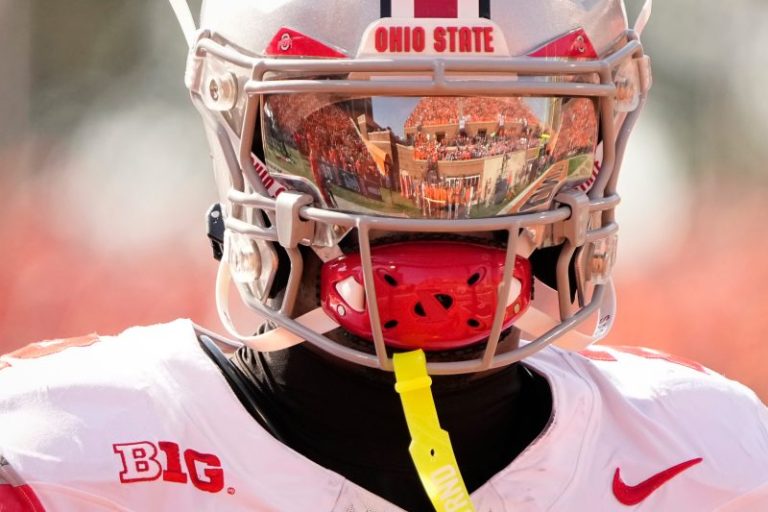
The Big Ten champion, either Ohio State or Indiana, has a strong chance to finish the regular season undefeated.
Texas A&M’s path to an undefeated season will likely require a victory in the SEC title game.
Georgia Tech, BYU, and Navy face more difficult schedules in their quests for a perfect season.

A college football weekend relatively free of upsets yielded little in the way of material ripe for overreaction. So rather than look at individual moments or outcomes, we’ll take a look at the sport’s most exclusive club.

As fate and mathematics would have it, on the eve of the season’s final month there could conceivably be five teams left with unblemished slates when College Football Playoff time arrives, one from each of the top five conferences. Obviously, the postseason will start reducing that list even further, so we’ll limit our exercise to which members of the unbeaten club have the best chance to reach the playoff still unscathed.

Ohio State/Indiana

Obviously the Buckeyes and Hoosiers can’t both be unbeaten after the Big Ten title game since under this scenario they’ll have played each other in Indianapolis. That said, both of them have a good chance of getting there with 12-0 marks, but for one small matter.

We’ll start with the Hoosiers, who only have one more home game in November, a probable romp over offense-challenged Wisconsin. None of Indiana’s three remaining road dates, however, loom as being particularly daunting. Maryland has improved but can’t seem to close in the fourth quarter, Penn State will have an interim coach and a backup quarterback and Purdue is just trying to make it to basketball season.

Ohio State also faces Penn State and Purdue, and the Buckeyes’ other remaining dates are at home against UCLA – which just received a reality check from Indiana – and Rutgers, which had a similarly humbling result against Oregon.

Then there’s the Thanksgiving week finale. We don’t even have to say it, do we, Ohio State fans? In truth, if the Buckeyes can shed their own collective mental baggage they’ll beat a largely one-dimensional Michigan team with little fanfare, and in the process check that last box on Ryan Day’s coaching resume. But a rivalry can be a strange beast. So with all that stated up front, we’d say the Big Ten champ has the best chance to reach Selection Sunday unscathed.

Texas A&M

The Aggies have a road date at Missouri and a season finale at renewed rival Texas (see above on rivalry games), but for the most part they’ve done the heavy lifting already with the first two months of the season successfully negotiated. A&M’s biggest remaining obstacle then will likely come in the SEC title game. It could be another recent upstart like Ole Miss or Vanderbilt awaiting the Aggies in Atlanta. But it’s more likely to be Alabama or Georgia, programs accustomed to the bright lights and the big stage.

Even with a loss there, the Aggies would still have plenty on their resume to warrant playoff inclusion, and perhaps still a bye to the quarterfinals. But an SEC title with a 13-0 ledger would present a compelling argument for the top overall seed – unless the Big Ten champ is also perfect. But that’s an overreaction debate for another day.

Georgia Tech

Having already survived a couple of games decided on the final play, the Yellow Jackets can’t exactly guarantee victory just by stepping on to the field. We’ll allow that their remaining ACC contests are winnable, however, though their final league test against Pittsburgh in a few weeks is looking trickier.

After that, of course, is the annual showdown with Georgia. The Bulldogs have gotten the better of it for a number of years, but Tech has closed the gap of late and by rights probably should have won last year’s meeting. Up next then would be the conference final against – Miami? Virginia? Louisville? Someone else? Suffice it to say that is very much up in the air at this point.

Could the Jackets make the playoff without winning the ACC? It’s unlikely without a win against Georgia to bolster their at-large case. But again, that’s a hypothetical argument that will be taken up on another day, possibly by the committee members themselves.

Brigham Young

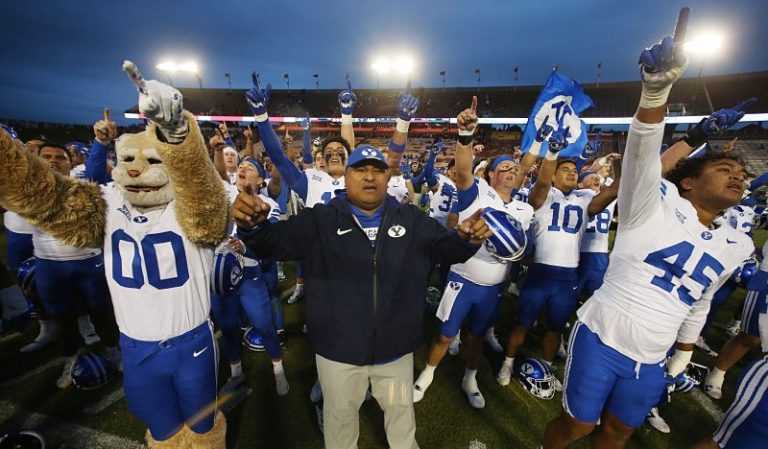
We’d say that of the Power Four conference leaders, BYU’s path to perfection is the most treacherous. Then again, the Cougars passed one of their remaining road tests this weekend at Iowa State, overcoming an early two-score deficit in the process.

But two Big 12 road trips remain against ranked opponents. The next one in two weeks might be the toughest at Texas Tech, then a couple weeks after that is an even longer flight to Cincinnati. The good news is the Cougars have the coming week off to prepare for the difficult stretch drive. They might not have to win all their November games to play for the conference title, but they’ll probably need to at least split those two road dates.

Navy

Let’s state this up front. What the Midshipmen have accomplished thus far to get to 7-0 is tremendous, and quarterback Blake Horvath absolutely belongs in the Heisman discussion. But with that said, Navy is the longest of long shots on this list to run the table, simply by virtue of having the toughest November schedule.

Navy’s finishing stretch in the American is tough enough, starting with next week’s trip to 7-1 North Texas. A home date with 6-2 South Florida and a season-ending visit to 7-1 Memphis are also on the docket. And oh yeah, there’s also the trip to Notre Dame in two weeks. But though perfection is a tall order, Navy could win the league, and yes, even make the playoff. This whole exercise is about daring to dream, right?

This post appeared first on USA TODAY
Albernaz, 42, previously served as the associate manager for the Cleveland Guardians.
He will be tasked with improving the team after a disappointing 2025 season led to the firing of Brandon Hyde.
Albernaz has been a popular candidate for managerial openings, previously interviewing with multiple teams.

The Baltimore Orioles appear to have found their new manager.

Multiple media reports say the team is finalizing a contract with Cleveland Guardians associate manager Craig Albernaz to guide the Orioles after a disappointing 2025 campaign that led to the midseason firing of Brandon Hyde.

The selection was first reported by ESPN.

Albernaz, 42, was a finalist for the Guardians managerial job two years ago, eventually joining the team as bench coach after Stephen Vogt was hired. Albernaz got his start in the Tampa Bay Rays organization, first as a player for eight years and then as a coach, starting in 2015.

He served as a manager for two years in the low minors, followed by a stint with the San Francisco Giants as a bullpen and catching coach.

Albernaz has been a popular candidate for managerial openings in the recent past. In addition to interviewing for the Cleveland job in 2023, he was a finalist last season for vacancies with the White Sox and Marlins.

He has the task of reversing the Orioles’ slide this past season after earning consecutive playoff berths under Hyde in 2023 and 2024. This year’s team started poorly, leading to Hyde’s firing in mid-May with a record of 15-28.

Third base coach Tony Mansolino took over on an interim basis as the Orioles finished 75-87. He was considered for the job after the team was one game over .500 during his tenure, but the front office opted for Albernaz instead.

This post appeared first on USA TODAY
The Los Angeles Lakers needed someone to supply the offense against the Sacramento Kings on Sunday night and Austin Reaves was willing to take on the challenge.

He set a new career-high of 51 points, surpassing his previous mark of 45, in the Lakers’ 127-120 victory over the rival Kings. He became the 12th player in Lakers history to record 50-plus points in a single game.

Reaves had the opportunity to lead the offense following the absence of Luka Doncic, who was ruled out in the hours leading up to the game due to a finger sprain and a lower left leg contusion and will miss at least a week.

‘He was fantastic and did a little bit of everything tonight,’ Lakers coach JJ Redick told reporters after the game. ‘He was all over the place and scored the basketball at an incredible level. … He lives in the moment and is ready for every moment that comes.’

Reaves filled in the void left behind and nearly produced a triple-double performance and finishing with 11 rebounds and nine assists for the Lakers.

The fifth-year player also had a career-high night from the free-throw line, shooting 21-of-22. He also became the eighth player in franchise history to make 20-plus free throws in a game.

The Lakers players celebrated with Reaves in the moments after the game and in the locker room to acknowledge his big night.

‘It means a lot,’ Reaves said. ‘We play basketball for those moments, and for them to treat me like that is special.’

Lakers vs. Kings highlights

The USA TODAY app gets you to the heart of the news fast. Download for award-winning coverage, crosswords, audio storytelling, the eNewspaper and more.

This post appeared first on USA TODAY

In late September 2017, Palestinian American activist Linda Sarsour, once the darling of the Women’s March and the self-declared face of the ‘resistance’ against Donald Trump, was facing mounting criticism for antisemitic remarks and her embrace of extremist views. 

But, beaming in a photograph taken on a city sidewalk, Sarsour appeared unfazed, her iconic fist pumped in the air as she knelt shoulder-to-shoulder with campaign volunteers for City Council candidate Khader El-Yateem. The photo was posted by El-Yateem on the Facebook page he used to promote his campaign, which he lost, but among the smiling faces was a young organizer named Zohran Mamdani.

That photo would mark the start of a carefully constructed political project that, in less than a decade, would propel a now-34-year-old socialist newcomer to the precipice of running America’s largest city – even while campaigning with radical imams, some of whom have supported terrorists and terrorist financiers.

A Fox Digital investigation reveals that Mamdani’s rise was no accident. It was engineered.

A database of 110 groups backing Mamdani exposes a tight inner circle of organizations that identify as Muslim or socialist, working hand-in-glove with 76 Democratic Party affiliates, allied groups and unions. Particularly important in this political machine are two networks – Sarsour’s MPower organizations and another constellation of groups called Emgage, with which she works closely.

The organizations have been generously funded. In total, billionaire George Soros’ Open Society philanthropies have given MPower and Emgage nearly $2.5 million in recent years, according to tax filings. 

‘We fund a range of civil society organizations that work to deepen civic engagement through peaceful democratic participation, counter discrimination including against Muslim Americans and advance human rights,’ a spokesperson for Open Society Foundations told Fox News Digital. ‘The grants that you cite all occurred years before the mayoral race, and we are a nonpartisan organization that does not fund political candidates and their campaigns.’

Mamdani, Sarsour and the groups supporting Mamdani’s campaign didn’t return requests for comment.

MPower and Emgage have been part of a tight inner circle of 30 ethnic and religious groups, that also includes CAIR Action, the 501(c)(4) political wing of the 501(c)(3) Council on American-Islamic Relations nonprofit, the Islamic Circle of North America,’ ‘Muslim Action Coalition,’ Yemeni American Merchants Associations Inc., the ‘Bangladeshi American Advocacy Group’ and ‘Desis Rising Up and Moving.’ They have pumped up Mamdani’s campaign with social media campaigns, canvassing, voters and buzz.

Altogether, they have annual revenues of about $24 million, and they have worked to promote Mamdani’s campaign with endorsements, fund-raising, social media campaigns and canvassing.

The result: a carefully constructed political career that mainstreams the socialist goals long embraced by Sarsour and fellow members of the Democratic Socialists of America.

It’s a machine that is expressing itself in races from New York to Virginia, Minnesota, Texas and California with MPower and Emgage aligning with the Democratic Socialists of America and the Democratic Party to propel candidates who may share their views. In a campaign called ‘Defend and Advance,’ Emgage SuperPac is pushing Mamdani and Democratic Virginia Lt. Governor candidate Ghazala Hashmi as its ‘star candidates.’

Emgage’s ‘Defend and Advance’ roster of supported candidates and office holders includes Dearborn, Mich., Mayor Abdullah Hammoud.

‘I want you to know as mayor, you are not welcome here,’ Hammoud recently told a Christian pastor who objected to a proposal to name a street in honor of a local man who had allegedly praised terrorist groups Hamas and Hezbollah. ‘And the day you move out of the city will be the day that I launch a parade celebrating the fact that you moved out of the city because you are not somebody who believes in coexistence.’

Emgage’s donations include $175,000 from a group little-noticed by political observers but important in Islamist circles: Sterling Charitable Gift Fund, based in Herndon, Va. It is part of a network of groups that FBI agents raided in 2002 as part of wider investigations into the funding of Palestinian terrorist groups, including Hamas. Federal prosecutors ultimately didn’t file criminal charges against any officials at Sterling Charitable Gift Fund.

Over almost a decade, Sarsour and her allies have orchestrated a network of well-financed and tightly connected socialist activists, radical imams, political organizers and nonprofit organizations funded with millions of dollars by major philanthropies, including Foundation to Promote Open Society, the Ford Foundation, Macarthur Foundation and the Tides Foundation.

The confluence of big philanthropy, partisan operatives and clerical authority has helped drive Mamdani’s ascent. Its architecture combines nonprofit activism with faith-based politics and the precision of a professional campaign operation. 

‘To the casual observer, Zohran Mamdani’s rise might appear meteoric – a story of grassroots energy and demographic change in America’s largest city,’ said Dalia Al-Aqidi, an Iraqi American Muslim who is running against Democratic Rep. Ilhan Omar in Minnesota, with Omar supported by the same kind of political machine being unleashed to propel Mamdani to office.

‘The data, the money trail and the affiliations, from the Democratic Socialists of America to the Islamists, tells a different story.’

‘Mamdani’s ascent is the product of deliberate design: a sophisticated collaboration between socialist activism and Islamist organizing, lubricated by millions in foundation grants and political donations and normalized through a revolving door of political operatives and nonprofits who embrace Islamists, the destruction of the state of Israel and hostilities to the police, the U.S. and the West,’ Al-Aqidi said.

The timeline of Mamdani’s rise tracks precisely with the growth of this network. In 2012, as a student at Bowdoin College, in Maine, he cofounded a chapter of Students for Justice in Palestine, the campus organization known for its rabid anti-Israel activism. By 2017, he was canvassing for El-Yateem’s campaign with Sarsour’s mentorship.

In 2018, Mamdani formally entered Sarsour’s orbit through the Muslim Democratic Club of New York, an organization she co-founded in 2013 to mobilize Muslim voters and elect progressive Democrats to local office. The Muslim Democratic Club of New York served as both incubator and amplifier for Sarsour’s political brand, one that fused progressive politics with an explicitly Islamist social identity. By December 2018, Mamdani joined the board, in an announcement in which the group said, ‘Help build Muslim power across the city with us!’

With his new role, Mamdani gained access to an emerging infrastructure of influence: voter lists, donor networks and organizing muscle that would later power his campaign to a seat on the New York General Assembly. The Muslim Democratic Club endorsed Mamdani.

Around that time, Sarsour was building her own empire, founding MPower Change as a 501(c)(3) nonprofit housed at Neo Philanthropy Inc. Public filings show MPower Change took in at least $2.4 million between 2017 and 2024, the latest year available, with Soros’s Foundation to Promote Open Society giving her organization $1.125 million and the Macarthur Foundation funneling her $450,000. It would become a flagship digital organizing hub for not just Sarsour but Mamdani. 

Meanwhile, Emgage Action was expanding its footprint nationally. Also backed by the Open Society network, Emgage Action received a share of $42.5 million that Soros’ foundations pledged to Muslim, Arab and South Asian civic groups beginning in 2021. It has received $1.8 million from the Open Society Policy Center and another $1.35 million from the Foundation to Promote Open Society.

Together, MPower Change and Emgage created an unprecedented financial and political ecosystem, leveraging big philanthropy’s dollars and digital strategy to elevate candidates like Mamdani under the banner of Muslim empowerment.

In 2020, Mamdani won his first election to the New York State Assembly, with Sarsour’s explicit endorsement and fundraising help.

By 2020, Mamdani was being featured in Sarsour’s #MyMuslimVote summit, promoted by MPower Change as the face of a new generation of unapologetic Muslim progressives. By this year, his campaign for mayor became the culmination of that project — backed by PAC money, boosted by clerical endorsements and legitimized by an activist ecosystem that had spent a decade grooming him for this very moment.

To push Mamdani toward the helm of the nation’s biggest city, the network extended far beyond activist circles. Central to Mamdani’s political ascent was a series of carefully cultivated relationships with clerics with some troubling views.

In January, Mamdani courted Imam Muhammad Al-Barr of the Islamic Society of Bay Ridge, visiting his mosque just months after Al-Barr had publicly prayed to ‘annihilate’ Israel.

In May, Imam Siraj Wahhaj, the longtime imam of Brooklyn’s Masjid At-Taqwa, personally donated $1,000 to the Unity and Justice Fund. More recently, Mamdani met with Wahhaj and called him ‘one of the nation’s foremost Muslim leaders and a pillar of the Bed-Stuy community.’

Wahhaj, who served as a character witness in the trial of Omar Abdel-Rahman, the ‘Blind Sheikh’ later convicted of masterminding the 1993 World Trade Center bombing, has a long history of calling for the exploitation of America’s democracy to further a conquest for Islam.

‘You don’t get in politics because it’s the American thing to do,’ he said in a videotaped 1991 sermon. ‘You get involved in politics because politics can be a weapon to use in the cause of Islam.’ 

Wahhaj has also denounced the U.S. government as ‘controlled by Shaitan,’ the Arabic word for the devil, urged Muslims not to befriend ‘non-believers,’ condemned homosexuality as ‘a disease of this society,’ and supported Islamic laws that punish sex outside of marriage with 100 lashes and stoning. In 2011, Wahhaj urged Muslims to donate to the legal defense of the since-convicted Aafia Siddiqui, a Pakistani neuroscientist dubbed ‘Lady Al Qaeda’ for attempting to kill U.S. troops in Afghanistan.

Over the years, Wahhaj’s sermons have praised ‘jihad’ without ‘a gun,’ called for an Islamic America governed by sharia law and urged the creation of an ‘army of 10,000 men in New York City.’

Other imams now backing Mamdani’s mayoral run have also been controversial. Imam Talib Abdur-Rashid, a cleric leading the Mosque of Islamic Brotherhood in Harlem, co-founded the Muslim Alliance in North America, alongside Wahhaj. In 2005, Abdur-Rashid publicly defended Rafiq Sabir, an American doctor who joined al Qaeda and was subsequently sentenced to 25 years in prison.

In 2008, Abdur-Rashid defended Sami Al-Arian, a Palestinian American professor whom the U.S. later deported to Turkey for ‘conspiring to provide services’ to Palestinian Islamic Jihad. Still in the U.S., Al-Arian’s wife joined the anti-Israel encampments at Columbia University.

In September, Mamdani appeared as the special guest speaker at Abdur-Rashid’s annual gala. A month earlier, Muslim Association of North America’s social media featured Abdur-Rashid visiting Wahhaj’s mosque, underscoring the continued collaboration between the two imams.

In Manhattan, Imam Khalid Latif, the executive director of the Islamic Center at New York University, has been another prominent Mamdani backer. Latif publicly endorsed Mamdani on Facebook in June, calling him ‘a bearer of compassion in a time where it is far too rare.’

In 2012, Latif led a pilgrimage to Saudi Arabia that included Omar Mateen, who would later murder 49 people at the Pulse nightclub in Orlando, the deadliest anti-LGBTQ attack in U.S. history. He has denied radicalizing Mateen and he hasn’t faced the same type of allegations that surround the other imams.

For many Muslim political organizations backing Mamdani, these clerics are not liabilities but assets, serving as trusted gatekeepers to the city’s growing community of Muslim voters.

After Mamdani visited Wahhaj’s mosque earlier this month, he tweeted out a photo of the two with the caption: ‘Pleasure to meet Imam Siraj Wahhaj, one of the nation’s foremost Muslim leaders.’ When a firestorm ensued, several allies rose to his defense: Sarsour, the Council on American-Islamic Relations and the leaders at Emgage Action.

Sarsour shared a selfie with Mamdani, beaming, like they did back in 2017, and wrote, ‘May Allah continue to bless and protect you.’

A defiant Wa’el Alzayat, the executive director of Emgage Action, sent out a dispatch to followers on Tuesday, amid criticism for their political work, promising, ‘We are in this for the long haul.’

Back in Minnesota, Al-Aqidi closely watched the defense of Mamdani.

‘For over a decade, Linda Sarsour and her network of allies have built the Mamdani machine piece by piece: the institutions, the donors, the narratives and now, the candidate. There was no way they were going to throw him under the bus for one photo with one imam whom they happen to love,’ said Al-Aqidi. ‘Mamdani is the fresh face of a radical coalition, and I hope New Yorkers will reject him. Win or lose, one fact remains undeniable. His rise was not spontaneous. It was engineered and the machinery behind it is only getting stronger.’

Al-Aqidi said; ‘I hope New Yorkers will shut the Mamdani machine down.’

This post appeared first on FOX NEWS

President Donald Trump is shifting his attention to key allies Japan and South Korea as his Asia tour enters its next phase, with trade, regional security and military cooperation expected to top his agenda this week.

Trump’s five-day Asia tour will include talks with Japan’s newly elected Prime Minister Sanae Takaichi in Tokyo and a planned meeting with Chinese President Xi Jinping during the final stop in South Korea.

The trip comes at a time of renewed uncertainty in the region, with North Korea ramping up missile tests and China asserting greater control in the South China Sea.

Economic ties are expected to play a central role in Trump’s meetings, with trade imbalances, technology cooperation and energy security topping the agenda. The administration has signaled an interest in expanding semiconductor and critical minerals partnerships with Japan and South Korea to counter China’s dominance in global supply chains.

The Trump administration said Sunday that the world’s two largest economies are close to reaching an agreement to avert a new 100% U.S. tariff on Chinese goods, with both sides expected to meet in person soon.

‘President Trump gave me a great deal of negotiating leverage with the threat of the 100% tariffs, and I believe we’ve reached a very substantial framework that will avoid that and allow us to discuss many other things with the Chinese,’ Treasury Secretary Scott Bessent said on NBC’s ‘Meet the Press.’

Before heading north, Trump began his trip in Malaysia, where he was greeted with traditional music and dancing, even joining performers in celebration. 

He also oversaw the signing of a peace agreement between Cambodia and Thailand on Sunday, a development viewed as a key step in reducing regional tensions and bolstering U.S. diplomatic influence in Southeast Asia.

As part of the agreement, Thailand agreed to release 18 Cambodian soldiers held captive and for both countries to begin removing heavy artillery from their shared border. The Thai prime minister called the signing of a ceasefire deal ‘the building blocks for a lasting peace,’ and Cambodia’s prime minister described the events as a ‘historic day.’

‘We did something that a lot of people said couldn’t be done,’ Trump said. 

The White House has framed the trip as a showcase of Trump’s foreign policy approach: ending conflicts, striking deals and reasserting U.S. leadership abroad.

This post appeared first on FOX NEWS