Archive

2025

Browsing

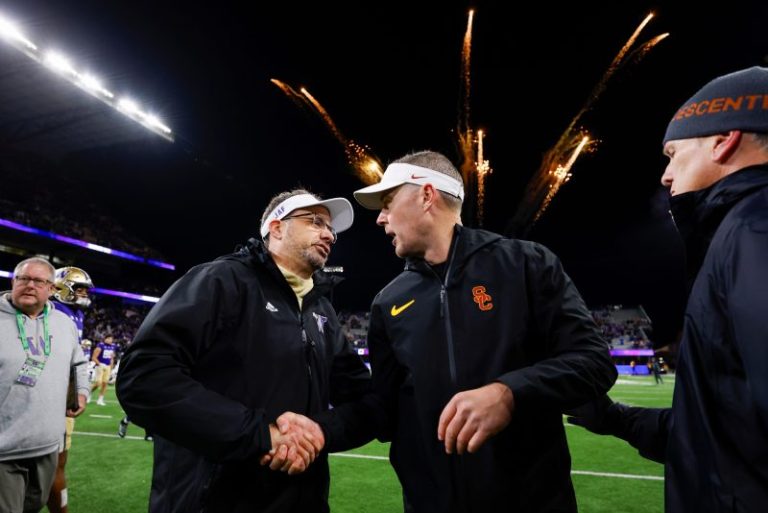
Southern California football caught Northwestern off guard early in the second quarter of the teams’ Week 11 game on Friday, Nov. 7, when third-string quarterback Sam Huard successfully attempted a disguised fake punt.

That sneaky special teams play from the No. 21-ranked Trojans (No. 19 in CFP) was a missed penalty by the officials on the field.

In a Sunday, Nov. 9 news release, the Big Ten Conference said Lincoln Riley’s Trojans should have incurred a ‘team unsportsmanlike conduct penalty,’ as Huard wore the same jersey number as USC’s normal punter, Sam Johnson.

‘During Friday’s Northwestern at Southern California football game, with 13:58 remaining in the second quarter (fourth-and-6), USC No. 80 (Huard) lined up 13 yards in the backfield within a punt formation and completed a 10-yard pass. A second USC No. 80 (Johnson) is listed on the Trojans roster and punted twice in the contest,’ the release read.

The issue of the matter was that Huard, who is listed as No. 7 on USC’s online roster, was listed on the game day roster as No. 80, the same number as Johnson. The Big Ten cited Rule 9, Section 2, Article 2, Paragraph D — ‘Unfair Tactics — of the NCAA football rulebook as the rule that the Trojans violated:

‘Two players playing the same position may not wear the same number during the game,’ the rulebook states.

Here’s a clip from the Fox broadcast where there was initial confusion from broadcasters Jason Benetti and Robert Griffin III on the situation:

‘It was just a well thought out thing by several of our staff members,’ Riley said following USC’s win on Friday, Nov. 7. ‘It got added at the right time and we had confidence in it. Sam stepped in there, made a good throw, had a guy kind of in his face, was a good throw, made a nice play, and it was a key point of the game.’

The Big Ten added that its review of the fake punt will continue with both USC and Northwestern.

The USA TODAY app gets you to the heart of the news — fastDownload for award-winning coverage, crosswords, audio storytelling, the eNewspaper and more.

This post appeared first on USA TODAY

Marshawn Kneeland’s death by suicide has reverberated far beyond his Dallas Cowboys teammates.
For the Cowboys, experts say, the remainder of the season won’t be business as usual as players and staff move forward.

This article discusses suicide and suicidal ideation. If you or someone you know is struggling or in crisis, help is available. Call or text 988 or chat at 988lifeline.org.

Marshawn Kneeland replied to a text message with praying hands.

That image is firmly planted in the mind of Greg Ellis as he tries to process the tragedy, Kneeland’s death by suicide, that has rocked the Dallas Cowboys and NFL universe.

It was their last exchange, roughly two months ago. Ellis, the former NFL defensive end who coached Kneeland last year but is no longer on the Cowboys coaching staff, reached out on Sept. 3, a day before Dallas opened the season at Philadelphia, with a message of encouragement about Kneeland’s development as a football player.

Kneeland responded, “Yes, sir,” Ellis remembers, and added the emoji.

Now, Ellis is second-guessing himself for not trying to do more – and wondering whether he missed clues that signaled distress. After all, Ellis is a mental health advocate who created and wrote the script for an independent film, “My Dear,” about such issues. And he suspected the young defensive end, who lost his mother weeks before he was drafted in the second round by the Cowboys in 2024, could have used support that involved more than honing football skills.

“My heart goes out to his family. Then I instantly go into what-could-I-have-done mode,” Ellis told USA TODAY Sports. “In hindsight, obviously, I wish I would have followed my instinct and sent more text messages, to let him know that I am here. And that, even though I’m not coaching him anymore, I’m still here for anything he would need to talk about.

“So, you just look back and you think he was a bright, smiley guy, but he was also a guy that had a deep sadness look about him through a lot of things. I felt that in him, I saw that in him, and I just wasn’t around him enough to help him deal with that.”

It is unknown whether Kneeland, who was 24, sought or received treatment provided by the Cowboys, or the NFL and the NFL players union for mental health concerns. His body was discovered early Thursday morning in Frisco, Texas, during a search that included the use of a drone after Kneeland fled on foot following his vehicle’s crash on Dallas North Tollway. Police and Texas state troopers had pursued Kneeland for an apparent traffic violation.

According to emergency dispatch audio from the Frisco Police Department posted by The Dallas Morning News, Kneeland sent a goodbye text to family and friends. It was also relayed on the dispatch that his girlfriend, Catalina, told authorities that Kneeland had mental health issues, was armed and would “end it all.”

‘I should have known better’

Such details add to the anguish that Ellis, and undoubtedly those in Kneeland’s inner circle, are experiencing. Ellis, who played 11 of his 12 NFL seasons with the Cowboys, spent one season as an assistant defensive line coach with the team but wasn’t retained after Brian Schottenheimer replaced Mike McCarthy as head coach earlier this year. Ellis said he didn’t try to engage more with Kneeland this year because he didn’t want to undercut the existing coaching staff. He now wonders if he should have tried another approach.

“I’m not an expert or anything like that,” Ellis said. “But I am a committed activist for mental wellness. That’s why, for me, it’s ‘I should have known better.’ I should have followed my instinct to reach out a whole lot more than I did, but I was trying to respect the boundaries as I’m not coaching over there anymore.”

This is what happens for family, loved ones and others connected to the victim in the wake of suicide. They reflect, rehash and examine from so many angles, seeking answers that may never be concretely revealed. Often, if not always, the first question is why? It typically coincides, experts contend, with reflections about signs that might have been missed in leading up to the tragedy. On top of that, there is angst considering whether they could have made a difference that prevented the outcome.

Added Ellis, “I hate that he had to suffer.”

Suddenly, a Cowboys squad (3-5-1) bogged down by a bad defense and the prospects of another season of failing to live up to massive hype, has a crisis that has nothing to do with football. When the team reassembles for practice on Monday after a bye this weekend, the healing process – not just for the players and coaches, but also for others in the organization – will weigh heavily in the equation with the normal matters of their operation.

Cowboys quarterback Dak Prescott revealed that the team held a Zoom call on Thursday, which illustrates the urgency of the team’s response. Cornerback Josh Butler shed light on the team’s emotions on Friday as he posted a photo on Instagram showing several bouquets of flowers left at Kneeland’s locker. He added the inscription, “Love you dawg.”  

It can’t be business as usual.

“Well, yes and no,” Yolanda Brooks, a clinical psychologist who previously worked for the Cowboys, told USA TODAY Sports. “The season is not going to stop because of this. You still have things to do. For some, getting back to work is a good distraction. It gives you something else to focus on, because the situation is going to keep ruminating in your mind. When you look at something, you’re going to be reminded of it. You have to push through and work through that.

“That’s hard, because you don’t know what a trigger is going to be. Some people, who were closer (to Kneeland) than others, might have struggles sleeping, or not have an appetite, or are just highly distracted. Restless. Being able to talk about it, engaging with others, is important. Even if you’re not talking about it specifically.”

Ask 4 Help

Prescott, the Cowboys’ classy quarterback and undisputed team leader, said Thursday that it was difficult to balance his emotions regarding Kneeland’s death. Prescott, who wears the hand-written message, “Ask 4 Help” on his wrist tape during games, lost his older brother, Jace, to suicide in 2020. He called it “a triggering day” as he spoke to reporters following a ceremony at his old high school in Haughton, Louisiana.

Like Prescott, Cowboys defensive tackle Solomon Thomas also lost a sibling to suicide. Thomas’ sister Ella passed in 2018. Both Thomas and Prescott have established foundations committed to suicide prevention and will be leaned on as locker room leaders while the Cowboys grapple with their loss.

In a heartfelt post on X, Thomas wrote: “Brother Marshawn, I love you. I wish you knew it was going to be okay. I wish you knew the pain wouldn’t last and how loved you are. I wish you knew how bad we wanted you to stay. My heart breaks for you and your loved ones. We will lift your spirit up every day.”

As you might expect, Kneeland’s death – days after he scored his first NFL touchdown by recovering a blocked punt in the end zone on Monday night – resonated in every locker room in the NFL. On top of an outpouring of emotional reaction from several coaches and players, including former teammates Micah Parsons, Rico Dowdle and DeMarcus Lawrence, Ravens coach John Harbaugh described a flow that could help detect hidden signs of distress.

“In the world, there are just a lot of challenges people face,” Harbaugh said during his Thursday press conference. “We encouraged our guys just to keep an eye on one another. Look out for one another. Ask questions. See how people are doing. Take care of yourself. Try to be connected.”

‘This doesn’t go away quickly’

Today, the Cowboys have to navigate an unexpected ordeal that will rely heavily on first-year coach Brian Schottenheimer’s leadership. Next time, another team likely will be forced to address a real-life situation that puts football in a different context.

Ask the Buffalo Bills. In early 2023, safety Damar Hamlin’s heart stopped beating on the football field as he made a seemingly routine tackle during a primetime game at Cincinnati. Hamlin was resuscitated by first responders during a tense, emotional delay that included players from both teams kneeling in prayer and several openly weeping. The game was called off and ultimately canceled, but for months, Hamlin’s career was in doubt.

The possibility that a player could die on a football field forced the Bills to engage in crisis management for a type of emergency never experienced.

“All these situations … there’s no exact playbook,” Bills general manager Brandon Beane told USA TODAY Sports. “You try to plan for everything, and I’m sure the Cowboys have a plan for how to handle it, but it’s just devastating.”

Hamlin recovered and has resumed his career. Yet Beane’s perspective about Buffalo’s situation is valuable in understanding the challenge for the Cowboys.

“Each situation has its own caveat to it,” Beane said. “There’s no wrong response for anyone in your organization. You just try and have counselors and people available through the healing process.

“This doesn’t go away quickly,” he added. “In our situation, fortunately Damar made it out of that thing, but it rattled our organization past that season. Hearts go out to everyone. I know they’ll work through it.”

Erase the stigma

Brooks, who teaches and operates a private practice in Dallas, recognizes the widespread attention the tragedy has generated because Kneeland was a member of the NFL’s most visible franchise – and one that has faced myriad crises involving off-the-field situations for players over many years.

She is adamant, however, about the need to view this tragedy through a much broader lens, considering rising suicide rates and societal pressures.

“This is not a Cowboys issue,” Brooks said. “This affects mostly everybody. Especially now. Why? Look at our society. Look at the world. And I’m not talking about the politics. I’m talking about the loneliness, the isolation, and how technology has detached people, so that you have to text somebody just to get a feeling or a connection, because there’s nobody physically around you.”

Whether isolation was a factor in Kneeland’s decision is unclear, and Brooks was careful not to infer that.

Kneeland, who hailed from Grand Rapids, Michigan, and starred at Western Michigan, unexpectedly lost his mother, Wendy, in February 2024. He wore a necklace that contained her ashes.

Yet it would be grossly unfair to draw any conclusions, particularly without intimate knowledge of Kneeland’s circumstances and state of mind.

“Who knows what goes through the minds of people?” Brooks said. “Sometimes, it’s impulsive. They see it as a quick way out, and they don’t see any other way.”

Said Ellis: “We just have to continue to learn about mental disorders, mental health and what mental wellness looks like. Let’s continue to erase the stigma, so people can feel better about reaching out for help and receiving help, and we can feel better about extending that hand of help.”

 Especially if we were better equipped to recognize the signs.

This post appeared first on USA TODAY

This was the moment for No. 6 Oregon.

Down 16-15 to No. 20 Iowa with 1:51 remaining, the Ducks drove 54 yards in 10 plays and made a 39-yard field goal with three seconds left to notch a must-have win against a ranked opponent.

This is the result the College Football Playoff selection committee was waiting for.

In explaining why the committee had the Ducks No. 9 in last week’s debut rankings, chair Mack Rhoades expressed reservations about their résumé, which before Saturday featured just one victory against an opponent with a winning record.

While there’s still more work to be done – and opportunities to further impress the committee against Minnesota, No. 21 Southern California and Washington – the win in Iowa City helps bring the Ducks’ résumé more in line with their reputation as one of the best teams in the Power Four.

Looking ahead to Tuesday night’s rankings, Oregon is assured of climbing at least one spot and inching closer to an at-large berth.

The Ducks, Texas A&M and Brigham Young lead Saturday’s biggest winners and losers:

Winners

Texas A&M

No. 3 Texas A&M turned a fumble recovery into a touchdown late in the first half and pulled away coming out of the break for a 38-17 win at No. 22 Missouri, the team’s third road win this season against an opponent that was in the Top 25. After some diminishing returns in a shootout win against Arkansas and over the first two quarters against LSU, the A&M defense carried over the ferocious close in Baton Rouge to hold Missouri to just 284 yards and harassed freshman quarterback Matt Zollers into just passing 77 yards on 3.5 yards per attempt. The only unbeaten team in the SEC, the Aggies’ convincing win might trigger a debate over which team lands at No. 2 in this week’s US LBM Coaches Poll and Tuesday’s playoff rankings.

Vanderbilt

The No. 16 Commodores’ playoff hopes are still alive after they pulled out a 45-38 overtime win against suddenly frisky Auburn, which clearly experienced some sort of addition by subtraction with the firing of Hugh Freeze. Beating the Tigers meant weathering 442 yards of offense and four scores by quarterback Ashton Daniels, overcoming a 17-3 deficit in the first half and bouncing back from the heartbreak of a failed fourth-down attempt late in regulation when Vanderbilt could’ve tried a 42-yard field goal. This isn’t the first time we’ve written this sentence this season: Diego Pavia was the hero, delivering 377 passing yards on 11.2 yards per attempt, running for a team-high 112 yards and accounting for four touchdowns, including the game winner in overtime.

Texas Tech

No. 8 Texas Tech’s 29-7 win against No. 7 Brigham Young confirms the Red Raiders’ place as the unquestioned team to beat in the Big 12. With games against Central Florida and West Virginia to end November and head-to-head tiebreakers against the BYU and Houston in hand, Tech steps into the driver’s seat for the conference championship game looking to make some history – the program hasn’t won an outright league crown since taking the defunct Border Conference in 1955. The Red Raiders were plus-three in turnover margin, dominated the line of scrimmage and held BYU to only 3.9 yards per play, highlighting the program’s immense edge in talent compared to the rest of the conference.

Indiana

Fernando Mendoza tossed a touchdown pass with 36 seconds left and No. 2 Indiana escaped Penn State with a 27-24 win, essentially locking down an appearance in the Big Ten championship game. This is just the Hoosiers’ second single-digit win of the year, joining the earlier win against the Ducks, and comes on the heels of wins against Maryland and UCLA by a combined 95 points. Don’t read too much into the late comeback and narrower-than-expected win: Indiana might be a powerhouse – that’s simply inarguable at this point – but even powerhouse teams need to get lucky once or twice to post an unbeaten regular season in the current landscape of college football.

Wisconsin

Wisconsin scored a touchdown in a home game for the first time since Sept. 20 and won a Big Ten game for the first time in over a year in beating Washington 13-10. That’s just the start: Sean West was the Badgers’ leading passer, and Sean West had 24 yards, and Sean West is also the punter. Starting quarterback Danny O’Neil left the game due to injury in the first quarter and was replaced by freshman Carter Smith, who had 3 completions in 12 attempts for 8 yards with 47 rushing yards in his debut. But the defense turned in a vintage performance by holding the Huskies to 251 yards with two takeaways. The win comes after athletics director Chris McIntosh announced that coach Luke Fickell would be returning for the 2026 season.

North Carolina

North Carolina held on for dear life and beat Stanford 20-15 for a second win in a row, something Bill Belichick hadn’t done since the 2022 Patriots took three in a row against Jets, Colts and Jets again. (This still counts even if two wins came against the Jets.) The Tar Heels have started to climb closer to bowl eligibility with three rivalry games to close the regular season: Wake Forest, Duke and North Carolina State.

Losers

Brigham Young

It was a bad but not fatal loss, docking BYU a chunk of national credibility but still leaving the Cougars in range of a rematch with wins against TCU, Cincinnati and UCF. The nature of the loss raises eyebrows, though, while also raising concerns about the Cougars’ quarterback play and run defense. Bear Bachmeier averaged a season-low 4.9 yards per pass and tossed his fourth interception of the season while running for just 12 yards, his fewest in a conference game. BYU allowed 149 yards on the ground and is giving up 175.2 yards per game in league play. TCU will force the Cougars’ passing game to keep pace while the Bearcats are averaging a tick under 200 rushing yards per game; both games will stress and strain BYU.

The ACC

No. 11 Virginia lost 16-9 to Wake Forest and No. 15 Louisville fell 29-26 in overtime to California, leaving the ACC with just one single one-loss team in No. 14 Georgia Tech and potentially without a team in the top 15 of this week’s playoff rankings. The Cavaliers had been walking a tightrope all season, narrowly getting past Florida State, Louisville, Washington State and North Carolina, and couldn’t overcome three turnovers and losing quarterback Chandler Morris in the second quarter. After rising in the rankings on the back of wins against James Madison, Pittsburgh and Miami, Louisville falls behind five teams with just one league loss. This whole thing is messy, but can be basically boiled down to this: Like the Big 12 last year, it’s more likely than ever the ACC is a one-bid playoff league.

Iowa

The Hawkeyes might not be the most accomplished three-loss team in the country – those six wins are really nothing to write home about – but the three defeats show how close this team is to perfection. Iowa’s losses to Iowa State, Indiana and the Ducks have come by a combined 10 points. The Cyclones drilled a 54-yard field goal with under two minutes left to win 16-13 and the Hoosiers trailed 13-10 in the fourth quarter before pulling out a 20-15 win in the final two minutes..

Colorado

The bottom has dropped out in Deion Sanders’ third season, with Colorado falling toward the bottom of the Big 12 ladder and ceding much of the goodwill that came from last year’s breakthrough. (To little surprise, the Buffaloes have struggled to replace the most prolific passer and the best pound-for-pound player in program history.) But this is a brand-new low: Colorado was plus-two in takeaways and drew a nice game from freshman quarterback Julian Lewis but fell behind early and lost 29-22 to West Virginia, which has taken two in a row under new coach Rich Rodriguez. While more competitive than blowouts against Utah and Arizona, the loss eliminates the Buffaloes from bowl contention.

This post appeared first on USA TODAY

DENVER – Nearly 100 nights a year, thousands of dollars in cash poured into a room the size of a broom closet in downtown Denver’s Ball Arena.  

Each night, Randy Kanai collected the cash and stashed it in a safe.   

The money came from the charity 50/50 raffle held for a decade at Colorado Avalanche, Denver Nuggets, Colorado Mammoth and Colorado Rapids home games. As the state-certified raffle manager, it was Kanai’s job to ensure the money reached its intended recipients.  

Half the jackpot went to the winner. The other half was supposed to go to charity – primarily the Colorado Amateur Hockey Association, the nonprofit USA Hockey governing body that regulates the sport in the state. Kanai was its president.   

The money could have been used to offset the costs of a notoriously expensive youth sport, in which ice rental, equipment and travel costs routinely exceed $10,000 a year for a single child. But instead of going to the hockey nonprofit and its member teams and leagues, a USA TODAY investigation found that 1 in 3 dollars the raffle raised from late 2016 through 2022 was misspent or remains missing.  

More than $300,000 was never deposited into the raffle bank account. Another $275,000 was paid to outside groups with little or no connection to hockey. And $25,000 more was spent on travel and entertainment, including $2,000 plane tickets and season tickets to Nuggets games.  

At the same time money was going missing, Kanai made a string of large cash deposits into his private bank account, court records show. Asked to explain them during an April 2025 civil trial – in which he was found liable for stealing money from the hockey association unrelated to the raffle – Kanai said the cash came from bags he found lying around his parents’ house.  

“I see exactly why it looks suspicious,” Kanai, who denies all wrongdoing, told USA TODAY. “But I’m telling you, I operated that raffle the best that I could. I did the best job that I could with the resources that I had.”  

Kroenke Sports & Entertainment, which owns the National Hockey League, National Basketball Association, National Lacrosse League and Major League Soccer franchises that hosted the raffle at their games from 2013 to 2022, declined to answer specific questions about the raffle from USA TODAY. Its nonprofit arm, Kroenke Sports Charities, received a portion of the proceeds. 

‘We have been disappointed and saddened to learn what CAHA and its members have had to endure through this process,” Kroenke Sports & Entertainment communications director Jim Mulvihill said in an emailed statement. 

“The raffles in question were overseen by the former CAHA president who was the subject of the underlying litigation. All raffle proceeds received by Kroenke Sports Charities were fully distributed to our nonprofit charitable partners.’ 

To track the raffle money, USA TODAY obtained and analyzed more than 3,000 pages of the Colorado Amateur Hockey Association’s bank statements, check images, tax returns, emails, court filings and quarterly reports to the Colorado Secretary of State detailing its raffle activity. The news organization spoke to dozens of hockey parents, raffle volunteers, state officials, attorneys and two accountants who signed off on the methodology.  

The investigation reveals how Kanai skirted the state’s charitable gaming laws for years while shortchanging the hockey families whose interests he was supposed to serve. It also raises the question of why the entities that oversee the nonprofit’s finances – the Colorado Secretary of State and USA Hockey – both failed to notice.  

State launches investigation 

The Colorado Amateur Hockey Association ran the raffle from 2013 to 2022 under a license from the Colorado Secretary of State, which regulates charitable gaming. 

A week after receiving detailed questions from USA TODAY about Kanai’s management of the raffle, the Secretary of State’s office on Oct. 23, 2025, launched an investigation into the Colorado Amateur Hockey Association’s “past operating practices.”  

“It is illegal to submit false information regarding charitable gaming activities to this office,” deputy communications director Kailee Stiles said in an emailed statement to USA TODAY.  

“The Department takes its enforcement role seriously, reviews submitted information to ensure compliance with Colorado law, and investigates failure to comply with the law whenever it has the basis and evidence to do so.”  

The Colorado Amateur Hockey Association will fully cooperate with the state’s investigation, Tom McGann, the nonprofit’s current president, told USA TODAY.  

“Mr. Kanai has a demonstrated lack of transparency with both USA Hockey and former CAHA Boards of Directors,” McGann said. “Similarly, his information sharing on the 50/50 Raffle which he operated was less than transparent.”  

Bill Brierly, the association’s executive vice president, encouraged county and state prosecutors to investigate its former president’s handling of the raffle, too.  

“If what you’ve found is true, then this is money that was diverted from CAHA that should have been used to make hockey more affordable and provide other opportunities for youth and amateur hockey players in Colorado,” Brierly said.   

“It’s just not a proper way to be running a nonprofit.”  

Stacks of raffle cash  

When the 50/50 raffle started in 2013, it was clear where the money was flowing.  

But within four years, money started to disappear.  

The idea for the raffle originated with Kanai.  

A hockey parent whose kids played in Colorado’s youth leagues, Kanai in 2009 co-founded a Tier I hockey club – the top level of youth competition. Three years later, he was elected Colorado Amateur Hockey Association president.  

Kanai approached Kroenke Sports & Entertainment with the idea soon after he took office, he later testified in court. Under their partnership, the hockey nonprofit would run the raffle and share the proceeds with Kroenke Sports Charities, the company’s nonprofit arm.   

The two organizations worked closely with the Secretary of State’s office to make sure they complied with state laws, according to a July 2013 report on the agency’s website. The office touted the partnership as a resounding success.   

Kroenke Sports Charities’ portion of the money would fund sports programs for underserved children, the report said. The hockey association’s share would go to local hockey teams and leagues and help improve its SafeSport program for protecting young athletes from abuse.  

With more than 100 home games a year among the four pro teams, the raffle quickly grew into one of the state’s biggest charitable gaming operations. Fans bought hundreds of thousands of dollars’ worth of raffle tickets each year. Some swiped credit cards. Many paid cash.  

Roughly once every two weeks during the pro teams’ 2016-17 seasons, Kanai took stacks of raffle cash out of the safe in the arena and brought them to one of two KeyBank branches within five miles of his house in Wheat Ridge, Colorado, bank records show.   

There, he deposited the cash into the hockey nonprofit’s segregated raffle bank account, where state law required it to store all raffle revenue. It was from that account that the nonprofit paid the winners, charities and other raffle expenses.  

Practically every penny was accounted for in bank statements that year. But the next year, a gap started to appear between the amount the raffle recorded making and the amount Kanai deposited.  

The gap grew for five years – and never closed.  

The raffle sold at least $1.8 million in tickets from October 2016 through the last one in June 2022, according to quarterly reports Kanai submitted to the state and jackpot results on the official raffle website.   

But less than $1.5 million was deposited into the raffle bank account during that time, bank statements show – a $300,000 shortfall.    

Kanai told USA TODAY he was unaware of the gap. Almost every game, $100 or $200 would go missing, he said, but he never calculated the total amount lost over the 351 raffles in question. He suggested that the volunteer ticket sellers could have pocketed cash, that it could have fallen out of their aprons, or that they did not turn in raffle tickets printed in error that should have been voided.   

Kanai said he did not always count the money after each game. Sometimes, he let it sit in the arena safe for weeks before reconciling the receipts against sales.   

“Since I’m there every single night, I didn’t want to hang out there longer than I needed to, so I’d just gather up all the cash and credit card receipts and throw it in a safe and walk out the door without counting it,” he said. “I didn’t reconcile every night. I didn’t have the staff to reconcile.” 

Kanai later added that he sometimes posted inflated jackpot amounts on the scoreboard at games to boost ticket sales, which he said could cause the online jackpot results to be inaccurate. Still, it does not explain the $300,000 gap between the deposits and revenue figures he reported to the state, which he affirmed under penalty of perjury were true and correct.  

Nonprofit officers have a fiduciary duty to be good stewards of their organizations’ resources, said Laurie Styron, the executive director of CharityWatch, a nonprofit that rates and investigates other nonprofits. If Kanai didn’t have the resources to manage the raffle properly, he shouldn’t have run it.  

“This is just another example of someone running a nonprofit as if it’s their personal proprietorship,” Styron said. “If you want to risk your own money, that’s your own business.  

“But this is not his personal money. This is the charity’s money.”  

Hockey orgs received a fraction of the money 

In the raffle’s first few months, the Colorado Amateur Hockey Association gave its entire share of the proceeds to its member teams and leagues.  

But by 2017, it stopped giving to its members almost entirely.  

Kroenke Sports Charities continued to get its share. But Kanai gave most of the hockey association’s cut to a handful of youth baseball, softball and collegiate club sports teams.   

For years, Kanai enlisted those outside groups to sell raffle tickets at games in exchange for a roughly 15% cut of the jackpot. As a result, $277,000 intended for hockey families was instead paid to non-member organizations with little or no connection to the association’s mission of regulating and growing the sport.   

Paying groups to staff raffles is illegal under Colorado laws and the state constitution, said Stiles, the Secretary of State spokesperson. Only “bona fide members” of a licensed nonprofit can volunteer to work games. No person or organization can receive compensation for working. The entire net proceeds must be “exclusively devoted” to the nonprofit’s lawful charitable purpose.   

Twice in the last five years, Colorado voters rejected ballot measures that would have amended the constitution to let nonprofits pay raffle workers. Opponents argued that the measures would have diverted money away from nonprofits’ core missions and made charitable gaming more like “for-profit gambling.”   

By signing each of the Colorado Amateur Hockey Association’s annual raffle license renewal applications, Kanai repeatedly affirmed under penalty of perjury that he read, understood and was responsible for following Colorado’s raffle laws. Yet over and over, he continued paying organizations to sell tickets.  

The University of Denver and University of Northern Colorado club sports departments each got $47,000 in raffle funds for working games from October 2016 through 2022, quarterly reports, bank statements and check images show. Another $57,000 went to three youth travel softball teams. No one organization received more – $55,000 – than Centennial Panthers Elite Youth Baseball, a nonprofit with no website and one officer, according to its tax filings: a treasurer.   

Most of the Panthers’ entire budget in 2016 came from the 50/50 raffle, its tax filing that year shows. It spent most of it on a weeklong, summer baseball camp and tournament at Cooperstown Dreams Park, in the same upstate New York town as the National Baseball Hall of Fame.  

Kanai does not deny paying outside groups to staff the raffle. He told USA TODAY he did so to keep the raffle alive because hockey teams refused to volunteer. The Secretary of State’s office, he said, knew and approved of his practice of giving these groups “donations” in exchange for selling tickets.  

“I don’t ever recall sitting down and actually reading all the state raffle laws,” Kanai said. “I was operating under the belief that the state knew what I was doing, and if I was outside of the raffle law, they would let me know. And that never happened.”  

Stiles declined to answer specific questions about the Colorado Amateur Hockey Association, including whether the Secretary of State’s office knew of the arrangement. But the investigation notice the office sent the nonprofit on Oct. 23, 2025, ordered it to preserve all records on, among other things, “remuneration.”   

“Colorado law and the state constitution prohibit direct remuneration to individuals or groups for volunteering to run charitable games,” Stiles said. “Department staff regularly communicate with operators of charitable games to ensure that the legal and constitutional requirements are abundantly clear.”  

Kanai insisted that he kept the raffle going for the Colorado hockey community’s benefit. Based on its contract with Kroenke Sports & Entertainment, roughly a third of the net proceeds should have gone to the hockey nonprofit and its members.   

In fact, those hockey organizations got just 7% – $124,000.  

“That’s $124,000 that they would not have had otherwise,” Kanai told USA TODAY. “Had there been no raffle, there would have been nothing.”  

Raffle irregularities go undetected 

The 50/50 raffle came to a near total halt in March 2020, when the COVID-19 pandemic shut down in-person events across the country.   

The Colorado Amateur Hockey Association held a few online-only raffles through June 2022, when they ended. By then, the people charged with overseeing its finances had ample reason to question Kanai’s practices.  

In 2018 and 2019, Kanai made a series of unusual purchases from the raffle bank account that don’t appear to fall within the narrow list of expenses permitted under the state’s raffle laws, such as advertising, equipment and accounting fees.  

He spent $9,000 on airfare, hotels and ground transportation for three separate business trips in 10 months, which he logged in quarterly reports as “vendor meetings.” On one trip, he bought two plane tickets for $2,130 each.  

Kanai also made $16,000 worth of purchases at an online ticket seller for Avalanche and Nuggets games and other events. He listed them in quarterly reports as donations, describing one $5,460 transaction as “Nuggets season tickets for donations to charitable causes,” without specifying what.   

The trips were for training hosted by the association’s raffle software vendor, Kanai told USA TODAY. Some of the ticket purchases were for game tickets given out as jackpot prizes, he said, while others were for golf tournaments and galas hosted by Kroenke Sports Charities.   

He said he did not recall what charitable causes the Nuggets tickets benefited or why the plane tickets were so expensive. He later said Nuggets tickets were given to volunteer ticket sellers as incentives for working games.  

The Colorado Secretary of State’s six-person bingo-raffle team is responsible for reviewing 500-plus nonprofits’ charitable gaming reports each quarter for inconsistencies, discrepancies and missing information, Stiles said.  

The team, however, did not flag the Colorado Amateur Hockey Association’s high-dollar travel and entertainment expenses, hundreds of “donations” to outside groups that helped sell tickets, or the missing $300,000. Nor did it notice that the nonprofit’s reported revenue and expenses and its raffle bank account statements, which were attached to each report, almost never matched.  

Stiles declined to say whether the bingo-raffle team’s review processes should have flagged the issues. The team did not receive any complaints about the hockey nonprofit or have any independent reason to audit or investigate its legal compliance, she said, until USA TODAY raised the issues in October.  

The only enforcement action the state agency took against the nonprofit, she said, was issuing a Class 3 violation in 2014 for failing to keep copies of raffle tickets. The Colorado Amateur Hockey Association paid a $50 fine.  

No one on the hockey nonprofit’s board seemed to notice the issues, either. That includes its longtime treasurer and secretary, Shawn Tanaka, who filed its tax returns each year, had access to the raffle bank account and received $20,000 annually from the association’s main operating budget for “professional services.”  

Tanaka, who no longer serves on the board, did not respond to phone, text and email messages from USA TODAY seeking comment.  

USA Hockey – recognized by federal law as the sport’s national governing body – is supposed to conduct site reviews of each of its 34 affiliates’ finances every three years. Despite reviewing tax filings as part of the reviews, USA Hockey does not appear to have noticed that the Colorado Amateur Hockey Association’s tax filings, bank statements and quarterly reports all showed widely different charitable gaming revenue figures. 

USA Hockey spokesperson Dave Fischer did not respond to multiple requests for comment for this story. 

It wasn’t a regulator who finally noticed the discrepancies. It was a local hockey mom.  

Concerned about conflicts of interests involving Kanai and other board members, Brooke Wilfley, who runs a hockey academy in Denver, personally hired an accounting firm in late 2022 to examine the association’s finances. The firm’s January 2023 report found six-figure differences between its bank statements and internal books, “questionable raffle activity,” and financial records it called “illogical.”   

Only after receiving that report – and a whistleblower retaliation complaint from Wilfley – did USA Hockey hire an accounting firm of its own to forensically audit the association’s finances.   

USA Hockey’s accounting firm ordered Kanai to turn over numerous documents about both his private business and the raffle.  

Kanai refused to provide them. 

Wilfley said she is grateful to USA Hockey for intervening and supporting her. But she said there needs to be a better system for rooting out bad actors in a youth sport where, across the country, businesses and individuals are exploiting families for profit.  

“Families give up everything for their kids to play, and these programs take advantage of them,” she said. “Thousands of kids in our state are being impacted by the decisions that these people are making. And nobody’s doing anything.”  

‘Cash in bags, just sitting around the house’ 

Randy Kanai took the witness stand in Courtroom 550 of Jefferson County District Court, swearing to tell the whole truth and nothing but it.  

It was April 1, 2025 – his day in court to defend himself against allegations that he had stolen at least $180,000 from the hockey nonprofit he ran for over a decade.   

The Colorado Amateur Hockey Association filed a lawsuit against Kanai in October 2023, five months after the board voted him out of office. The lawsuit accused him of funneling the association’s money through his private business. Although it wasn’t one of the main charges, it also accused him of failing to keep adequate records on the raffle.   

At the civil trial, Thomas Krysa, an attorney representing the association, questioned Kanai about a string of large cash deposits into his personal bank account in 2020 and 2021 – specifically, whether the cash came from the 50/50 raffle.  

Kanai said it did not. The money, he testified under oath, came from bags of cash he found lying around his parents’ house after they died in 1997.  

“That was all cash that I was pulling from stuff that they had laying around,” Kanai said.  

“I’m confused,” Krysa said. “So your parents had a lot of cash in bags just sitting around the house?”  

“Yeah.”  

Reading from Kanai’s bank statements, Krysa rattled off 10 of the cash deposits:  

$4,000 on July 20, 2020.  
$4,000 on August 25, 2020.  
$3,960 on September 24, 2020.  
$4,000 on October 22, 2020.  
$4,000 on November 18, 2020.  
$4,000 on December 18, 2020.  
$4,000 on January 20, 2021.   
$4,000 on February 24, 2021.  
$2,000 on March 17, 2021.   
$4,300 on May 11, 2021.   

“It’s not cash from the 50/50 raffle, right?”   

“No.”  

“Why were you depositing $4,000 at a time?”  

“It was just an easy way, the way my parents had the cash bundled.”  

Krysa asked if Kanai knew that banks must file currency transaction reports to the U.S. Department of the Treasury’s Financial Crimes Enforcement Network when they process cash transactions exceeding $10,000.  

Kanai said he was aware.  

“Were you trying to avoid that?”  

“No,” Kanai said. “If I would’ve been trying to avoid that, I would’ve put in $9,900.”  

Why wait 23 years to deposit the money?   

Kanai said he and his siblings put all the money into a safe in one of their houses, “forgot about it, and just left it there.”  

“You forgot?”   

“Oh, we knew it was there, but there was no urgency to do anything with it.”  

“You didn’t want to earn interest on it?”   

“We were earning interest in other places, and nobody wanted to sit there and take the time to deposit that.’ 

“How much cash did you have in that safe at one time?” 

“I don’t know,” Kanai said. “Two, $300,000.”    

Six months after the trial, Judge Chantel Contiguglia issued her written verdict. It found Kanai liable for civil theft, unjust enrichment, conversion of funds and breach of fiduciary duty.   

Contiguglia ordered Kanai to pay the nonprofit $579,000 – three times the amount he stole, with interest – plus attorney fees, and turn over all his documents related to the nonprofit and its finances. The 47-page judgment, which centered on Kanai’s private business, did not mention the raffle.   

Kanai told USA TODAY he planned to appeal. He was disappointed with the ruling, he said, but will “sleep good every night knowing the truth.”   

That the cash he found in his parents’ house is about the same amount missing from the raffle fund, he said, is a “total coincidence.”  

“I’ll swear on a stack of bibles,” he said. “That’s not raffle cash.”  

Some of the money, he said, still sits in his personal safe. 

Kenny Jacoby is an investigative reporter for USA TODAY who covers college and youth sports. Email him at kjacoby@usatoday.com.

This post appeared first on USA TODAY

As Major League Baseball’s hot stove gets fired up for the winter of 2025-26, rumors are swirling about where the game’s best free agents will be signing in the months to come

Outfielder Kyle Tucker, who spent 2025 with the Cubs, is widely considered the best player on the free agent market and could fetch a deal in excess of $400 million. There’s plenty of other All-Stars available including Bo Bichette, Alex Bregman, Pete Alonso and Framber Valdez.

Where will the best available players land? USA TODAY Sports’ MLB writers and editors give their predictions for the top free agents in this winter’s class:

Kyle Tucker, OF, Cubs

Bob Nightengale: Blue Jays
Gabe Lacques: Yankees
Jesse Yomtov: Dodgers

Bo Bichette, SS, Blue Jays

Nightengale: Atlanta
Lacques: Blue Jays
Yomtov: Blue Jays

Alex Bregman, 3B, Red Sox

Nightengale: Red Sox
Lacques: Cubs
Yomtov: Red Sox

Framber Valdez, LHP, Astros

Nightengale: Blue Jays
Lacques: Giants
Yomtov: Orioles

Pete Alonso, 1B, Mets

Nightengale: Red Sox
Lacques: Mets
Yomtov: Mets

Cody Bellinger, OF/1B, Yankees

Nightengale: Yankees
Lacques: Diamondbacks
Yomtov: Giants

Kyle Schwarber, DH, Phillies

Nightengale: Phillies
Lacques: Phillies
Yomtov: Phillies

Dylan Cease, RHP, Padres

Nightengale: Atlanta
Lacques: Orioles
Yomtov: Giants

Zac Gallen, RHP, Diamondbacks

Nightengale: Mets
Lacques: Phillies
Yomtov: Mets

Edwin Diaz, RHP, Mets

Nightengale: Mets
Lacques: Dodgers
Yomtov: Blue Jays

Ranger Suarez, LHP, Phillies

Nightengale: Cubs
Lacques: Tigers
Yomtov: Cubs

This post appeared first on USA TODAY

Luka Dončić and the Los Angeles Lakers have produced a 7-3 record to start the season through the first 10 games.

The Lakers will be tested this week, starting with the second game of a five-game road trip, as they will be in Charlotte, North Carolina, to take on the Hornets.

Los Angeles managed a 4-0 start on the road this season before dropping a road game to the shorthanded Atlanta Hawks on Saturday, Nov. 8.

The loss to the Hawks snapped the Lakers’ five-game win streak, while proving that Los Angeles won’t be able to stay hot forever with the ongoing state of the roster.

The Lakers have benefited from high-scoring performances from Dončić and Austin Reaves, but haven’t had the two on the court together since Nov. 2.

When Dončić and Reaves are on the court together, the Lakers are 3-1, with the only loss coming in the season-opener against the Golden State Warriors 119-109.

In each of the first two games of the season, Dončić scored at least 43 points with Reaves in the lineup. The Slovenian star benefits from Reaves being alongside him in the lineup. Without Reaves, Dončić has not scored more than 35.

Dončić has averaged nearly a triple-double this season with 37 points, 10 rebounds and 9.5 assists in six games played.

For the first two games without Dončić in the lineup, Reaves produced 51 and 41 points. The fifth-year guard has averaged 24.5 in games he’s shared the court with Dončić.

Reaves has averaged 31.1 points, 9.3 assists and 5.1 rebounds. His points and assists totals have him ranked fourth in the league in both categories. He’s missed the last three games due to a groin injury.

The Lakers had just one game so far this season without Dončić or Reaves in the lineup, managing to pull off a win against the Portland Trailblazers 123-115 on Nov. 3.

Deandre Ayton put together a double-double performance with 29 points and 10 rebounds in the win. Rui Hachimura added 28 points and Nick Smith Jr. came off the bench to add 25 points and six assists.

Without two of their better players in the lineup, the victory provided some hope that the Lakers still have enough talent to overcome a .556 team like Portland.

That same support did not shine through with Dončić back in the lineup against the Hawks, with Ayton going 5-for-5 from the field for 11 points and Hachimura being limited to eight points after shooting 3-for-9 from the field. Smith was limited to just three points in 23 minutes of play.

‘I feel like we were just behind the ball a little bit and they killed us in transition and they played amazing defense,’ Ayton told reporters after the loss in Atlanta. ‘We weren’t ready for it and JJ (Redick) got on us about it.’

The Lakers’ coach was not pleased with the team’s performance and held his shortest postgame press conference of the season.

‘I realized that in the first two minutes of the game,’ Redick told reporters when he was asked if there was something in the third quarter that he could point to regarding the lack of production from his first unit.

The Lakers are still waiting for LeBron James to rejoin the team and make his season debut.

When will LeBron James return?

James has not officially started his 23rd season in the NBA and remains unavailable for the Lakers due to a right sciatica injury.

The veteran was expected to be reevaluated three or four weeks from the initial Oct. 9 date when the injury was announced. Four weeks passed on Thursday, Nov. 6, and he did not join the Lakers to start their current road trip.

James is coming off a 2024-25 season in which he was named second-team All-NBA and finished sixth in the MVP voting. The four-time NBA champion averaged 24.4 points, 8.2 assists and 7.8 rebounds per game in 70 games played last season.

When do the Lakers play next?

The Lakers will play the second game of a five-game road trip against the Charlotte Hornets on Monday, Nov. 10, at 7 p.m. ET (4 p.m. PT)

This post appeared first on USA TODAY

With Week 10 here, we have reached the halfway point of the 2025 NFL regular season.
Who will win Super Bowl 60? Our experts make their picks.
The three-time defending AFC champion Kansas City Chiefs are the favored team among our group.

The NFL playoff bracket is still nine weeks away from being solidified. That will set the stage for Super Bowl 60 in Santa Clara, California.

But it’s never too early to think about the Big Game.

With Week 10 here, we have reached the halfway point of the 2025 NFL regular season. There are nine weeks left for the league’s playoff picture to round into shape, but the USA TODAY Sports staff sits at the table and provides predictions and picks for which team will win the Super Bowl this season.

Will the Kansas City Chiefs meet the Philadelphia Eagles in the Super Bowl for the third time in four years? Will the Buffalo Bills or Detroit Lions finally break through? Or maybe there’s a sleeper team our experts believe will hoist the Lombardi Trophy in February?

As the world begins gearing up for the second half of the regular season, our staff provides predictions and picks for which team will win and cement its legacy in NFL lore.

Super Bowl predictions

Buffalo Bills 27, Los Angeles Rams 24

Jacob Camenker, NFL writer: Perhaps I’m riding a bit too high off the Bills’ most recent regular-season win over the Chiefs, but Buffalo’s balanced offense and top-six pressure defense make it a threat to knock off anyone in the AFC. Even if the Bills can’t chase down the Patriots atop the AFC East, Buffalo has the playoff experience needed to win on the road and navigate its way through a wide-open AFC.

Meanwhile, the Rams have gotten an MVP-type performance from Matthew Stafford in 2025 and, like the Bills, have generated the pressure needed to rattle opposing quarterbacks in the playoffs. Add in a top-tier receiver duo in Puka Nacua and Davante Adams, and Los Angeles could end up being the NFC’s most explosive offense come January.

A Bills vs. Rams Super Bowl would be a fun matchup between similarly-built teams, but Josh Allen’s dual-threat ability would likely be the difference maker between the two squads.

Kansas City Chiefs 21, Seattle Seahawks 16

Ayrton Ostly, NFL writer: Yes, I know that the Chiefs just lost to the Bills in Week 9. Yes, I know they got shellacked in their last trip to the Super Bowl. No, I don’t care.

This Chiefs team is much, much better than the squad that won the AFC title last season. The offense is more dynamic now that Rashee Rice is back in the lineup. The defense is playing well enough, especially against the pass, to provide the advantage the offense needs to win games.

Now, to the surprising side of my prediction. The Seattle Seahawks’ defense is terrifying because they have so many answers for anything you throw at them. They’re also remarkably good on the road under second-year coach Mike Macdonald at 11-1 through Week 9. Going on the road to face the likes of Detroit, Philadelphia or Green Bay likely wouldn’t faze them. On offense, Jaxon Smith-Njigba is a superstar, and coordinator Klint Kubiak has built one of the best offenses in the league around him.

Ultimately, the Seahawks fall short as quarterback Sam Darnold makes a couple of costly errors and Patrick Mahomes earns Super Bowl ring No. 4.

Kansas City Chiefs 24, Philadelphia Eagles 17

Jack McKessy, NFL writer: Chiefs vs. Eagles III ends with a return to form for the reigning AFC champs. It’s easy to bet against the Chiefs making it back to the Big Game at this point in the season. They just lost to the Bills! They’re 5-4! They’re not even in a playoff spot if the season ended today!

Yeah, but at the end of the day, Patrick Mahomes is Patrick Mahomes. The Chiefs are the Chiefs. Kansas City’s defense has allowed the fourth-fewest points of any team – and the fewest of any that has played nine games. The Chiefs’ +76 points differential is fourth-best in the league and second-best in the AFC. Their offense is so one-dimensional that Mahomes was leading Kansas City in rushing yards through the first four weeks of the season, but the Chiefs still rank fourth in EPA/play and success rate through nine weeks.

Meanwhile, the Eagles are a juggernaut that’s only getting better. Philadelphia’s offense struggled through the first six weeks of the season, unable to find a way to get the ball into the hands of all its supremely-talented playmakers. The Eagles ranked 21st in the league in EPA/play (0.015) and success rate (44%) in that span.

In the last three weeks, they’ve won both of their games (they had a Week 9 bye). In Week 7, quarterback Jalen Hurts had a perfect passer rating with over 300 yards and three touchdown passes. In Week 8, running back Saquon Barkley had his first game with over 100 rushing yards (he had 150). Philadelphia ranks first in the league in EPA/play (0.370) and sixth in success rate (49.5%) in the last three weeks.

When the two teams meet again on the NFL’s biggest stage, the difference is the Chiefs’ outstanding defense. And with wide receiver Rashee Rice healthy for this matchup, Kansas City takes full advantage of the Eagles’ Achilles’ heel: their defensive secondary.

Tampa Bay Buccaneers 31, Baltimore Ravens 27

Nick Brinkerhoff, NFL writer: While my colleagues take turns alternating between the Chiefs and Bills, it’s up to me to go off the board. Crazy? Perhaps. Genius? Time will tell. The Buccaneers and Ravens are two undervalued squads as we enter the second half of the season and it’s time we start acting like it.

We all know what the Ravens have been through this season, but it’s not about the past. Lamar Jackson is back, Baltimore plays in a wide-open AFC, and there is an AFC North title there for the taking. From 1-5 to the 415, Baltimore has as good a chance as any team to make the trek to San Francisco in February. The defense has picked it up, some trade deadline reinforcements are on the way and Jackson is healthy – which is the most important thing.

With plenty of winnable games down the stretch, the Ravens are poised to enter the postseason firing on all cylinders with their two-time MVP quarterback – what’s not to like about that?

The storybook ending would be for the Ravens to defy the odds and capture the Lombardi, but that’s not how things work. Another undervalued team is being slept on in the far better NFC. Does anyone know that the Bucs are 6-2? Anyone? Baker Mayfield is firmly in the MVP discussion and is doing this without Mike Evans, Chris Godwin and Bucky Irving. There is no real threat in the NFC South, meaning Tampa can waltz to another division crown.

Evans could return for the playoffs, Godwin could return in December and Irving’s return should be coming sooner than later. They have been one of the league’s best teams without those stars, all while Emeka Egbuka emerges as a star of his own. Mayfield finally has his championship moment as the gritty underdog is no more. Better start fitting Captain Fear for his crown now.

Kansas City Chiefs 27, Detroit Lions 25

Tom Viera, NFL writer/editor: The “Super Bowl runner-up” theory is important to point out. In Super Bowl history, 51 of the 58 losers (87.9%) failed to return the following season, and just one of the most recent 30 runner-ups returned to the Big Game. In other words, history suggests the AFC will have a new team representing it this season.

However, the Patrick Mahomes-led Chiefs are built to defy the odds, and quietly, their defense has allowed the fourth-fewest points per game. Kansas City will continue its historic run and win a 10th consecutive AFC West crown. The Chargers’ offensive line is decimated, and Bo Nix has been inconsistent. Kansas City has to get ahead of both, but will face Denver twice and L.A. at home. Arguably, the Chiefs’ toughest matchup in the second half comes in Week 11 after their bye against the Broncos. Andy Reid is 22-4 all-time off a bye.

Teams want to be playing their best football in December/January and the Chiefs have a great schedule down the stretch.

Fans hoping for fresh blood deep in the playoffs may have to wait at least one more season because Mahomes isn’t ready to relinquish the crown. The Chiefs reach the Super Bowl for the sixth time in seven seasons.

The Lions have the best roster top to bottom. Some forget Detroit clinched its first NFC North title since 1993 and hosted its first playoff game at Ford Field just two years ago. That quest was cut short in the NFC Championship after fumbling away a 17-point halftime lead against the 49ers. Battered by injuries in 2024, the Lions are out for redemption in 2025, and Dan Campbell guides Detroit to its first Super Bowl appearance.

Detroit’s explosive, balanced offense is averaging 28.8 points per game (third-most in the league). The defense features impact players. The departures of defensive coordinator Aaron Glenn and offensive coordinator Ben Johnson are challenging, but it has galvanized the franchise. Detroit’s window remains wide open.

Mahomes put the Chiefs on his back to start the season with Rashee Rice suspended for the first six weeks and Xavier Worthy knocked out with an injury for three. He’ll do the same in the playoffs, leading another Super Bowl comeback to earn his fourth Super Bowl MVP, and the GOAT conversation dominates Summer 2026.

When is Super Bowl 60?

Date: Sunday, Feb. 8, 2026
Time: 6:30 p.m. ET

The Super Bowl will be held on the second Sunday in February, as it has been since the league shifted to a 17-game schedule for the 2021 NFL season.

This post appeared first on USA TODAY

After Texas A&M routs Missouri, Aggies have stadium to themselves.
Texas A&M underachieved for years. Mike Elko redirected the course.
Aggies aren’t unblemished. Elko calls run defense ‘awful.’

COLUMBIA, Mo. – Rueben Owens II scored his second touchdown late in the fourth quarter, and he looked into the stands expecting to see fans. He saw rows of empty seats.

“I was like, ‘Dang, there ain’t nobody here,” Owens, the Texas A&M running back, said.

That’s the sign of a rout in motion.

Then Owens shifted his gaze toward the southeast corner of Missouri’s Memorial Stadium. He saw packed stands in that nook. That’s where Aggies fans congregated and celebrated as No. 3 Texas A&M pulled away in a 38-17 romp over No. 17 Missouri.

“That just shows a lot of love from the 12th Man,” Owens said.

The wind whipped, and the temperature plummeted after the sun set. That tends to happen on fall nights in the Midwest. Combine the elements with the increasingly lopsided score, and most Missouri fans headed for warmth or to pursue something more pleasurable to the eye.

Those wearing maroon and white in the southeast corner still wouldn’t leave, even after the clock showed 0:00. They cheered and they chanted, and wide receiver KC Concepcion decided he’d join the party. He ascended the steps from the field and gave the fans what they wanted: another reason to chant and cheer.

“KC! KC! KC!” they chanted.

Aggies fans waited too long for a season like this.

It’s not finished yet, but pinch yourself, because it’s the second weekend of November, and Texas A&M hasn’t folded. To the contrary, these Aggies grow stronger. They’re undefeated. They’re on a march toward Atlanta.

Mike Elko reminded of why he took Texas A&M job

This is what’s long been expected of a program steeped in financial resources, blessed with gleaming facilities, backed by loyal fans and rooted in fertile recruiting terrain.

And it became a rite of summer we’d vault the Aggies into some lofty position in preseason polls. And it became a rite of November we’d say another Texas A&M team showed itself to be overhyped.

As one coach after another failed, we kept considering this a top-shelf job. Because, never mind the history, why shouldn’t this program succeed?

That’s what Mike Elko thought when he succeeded Jimbo Fisher.

“From a CEO perspective, obviously I believe this is what this program is capable of,” Elko said. “That’s why we’re here. We’re here because we believe in the ceiling of this program.”

“This is kind of what everyone had been talking about with this program for a long time,” Elko added. “For nine games we’ve lived up to it. Now, we’ve got to go finish.”

Mike Elko is done talking about the past

They’re already finishing better than how they did last season, when a three-loss November spoiled an otherwise solid debut to Elko’s tenure.

Throughout the offseason and into the preseason, one word became a mantra around the program.

Finish.

By now, Elko’s tired of hearing about last season’s collapse. When a reporter referenced the events of last November, Elko waved it aside.

“Is this our weekly last year question?” he said, a tad miffed at the query.

He’s also a tad miffed at his run defense. Missouri’s 207 rushing yards stood out as a blemish on this result. Asked how the Aggies handled the running back tandem of Ahmad Hardy and Jamal Roberts, Elko offered a succinct assessment.

“Awful,” he said.

An unfinished product, these Aggies, but an undefeated one.

‘The culture of this group is really strong,’ Elko said. ‘The work that they put into this thing is really strong. They believe in each other, and they believe in what we’re doing.”

Texas A&M’s vulnerabilities on defense help explain why the College Football Playoff committee ranked it behind Ohio State and Indiana, even though the Aggies own better strength of schedule and strength of record metrics.

That feedback from the committee “motivated us a lot,” linebacker Daymion Sanford said. The Aggies allowed fewer points against Missouri than they did in their past two wins, but an asterisk accompanies that achievement. Missouri started its third-string quarterback, Matt Zollers, and its pass game became a pileup of incompletions.

Why let asterisks and caveats interfere with a celebration in the stands, though? Just as Texas A&M did at LSU, the Aggies kept scoring until the stands cleared, ‘til all who remained supported the road team.

“I love to see that,” Sanford said. “With our fans, it almost feels like it’s a home game for us, every time we clear out the fans.”

That leaves one road game on Texas A&M’s schedule. It will play at rival Texas on Black Friday.

That leaves one to wonder, when Owens looks into the stands in Austin late in the fourth quarter, what will he see?

Blake Toppmeyer is the USA TODAY Network’s senior national college football columnist. Email him at BToppmeyer@gannett.com and follow him on X @btoppmeyer.

This post appeared first on USA TODAY

Love is in the air in Oxford, Mississippi and Lane Kiffin wanted to be a part of it.

During a third-quarter timeout of No. 7 Ole Miss football’s 49-0 win over The Citadel on Saturday, Nov. 8, a field goal kicking challenge turned into two Ole Miss fans getting engaged on the field, creating an everlasting moment in their lives and Rebels fandom.

As the moment was wrapping up, Kiffin walked over to the happy couple to extend his congratulations and take a photo with them.

As is the case with most proposals, the moment started with some disguise. Instead of kicking the field goal attempt, the Ole Miss fan dropped down to one knee on the field to propose to his now fiancée, who was the place holder for the kick.

‘I didn’t know I’d be part of that,’ Kiffin said in his postgame news conference when asked about the proposal. ‘Things happen in the ‘Sip, you know? That was cool. I didn’t know what was going on at all. Someone on the headset said it. That was really cool and how the crowd cheered for them.’

Here’s a field-level view of the proposal, in which you can see the young man:

Trinidad Chambliss led the Rebels to their ninth win of the season with a big day in the air, as he completed 29 of 33 passes for 333 yards and three touchdowns. Rebels running back Kewan Lacy also finished with three touchdowns on the day, his second game of at least three rushing touchdowns in a game this season.

Next up for Ole Miss will be a Week 12 home game against Florida on Saturday, Nov. 15 at 7 p.m. ET at Vaught-Hemingway Stadium.

The USA TODAY app gets you to the heart of the news — fastDownload for award-winning coverage, crosswords, audio storytelling, the eNewspaper and more.

This post appeared first on USA TODAY
The Iranian regime has managed to smuggle at least $1 billion to its terrorist proxy Hezbollah in Lebanon despite heavy sanctions this year, top officials at the U.S. Treasury Department say.

John Hurley, the undersecretary for terrorism and financial intelligence, says Iran remains committed to its proxy groups throughout the Middle East. Nevertheless, he says there is any opportunity to cut off the funding streams while Iran is in its current weakened state.

‘There’s a moment in Lebanon now. If we could get Hezbollah to disarm, the Lebanese people could get their country back,’ Hurley said.

‘Even with everything Iran has been through, even with the economy not in great shape, they’re still pumping a lot of money to their terrorist proxies,’ he continued.

‘The key to that is to drive out the Iranian influence and control that starts with all the money that they are pumping into Hezbollah,’ he argued.

Hurley pushed for the increased pressure campaign during a tour of Turkey, Lebanon, the United Arab Emirates and Israel this weekend.

Western nations have already laid down heavy sanctions on Tehran over its unwillingness to negotiate a nuclear deal. The regime insists its nuclear development program exists solely for civilian purposes.

President Donald Trump ordered bombings on Iran’s key nuclear cites earlier this year in Operation Midnight Hammer, which U.S. officials say succeeded in crippling Tehran’s progress toward a bomb.

Iran has nevertheless continued its efforts to spread chaos across the globe. U.S. officials say they, along with Israel and Mexico, thwarted an Iran-backed attempt to assassinate Israel’s ambassador to Mexico earlier this year.

‘We thank the security and law enforcement services in Mexico for thwarting a terrorist network directed by Iran that sought to attack Israel’s ambassador in Mexico,’ Israel’s foreign ministry told Fox News on Friday.

‘The Israeli security and intelligence community will continue to work tirelessly, in full cooperation with security and intelligence agencies around the world, to thwart terrorist threats from Iran and its proxies against Israeli and Jewish targets worldwide.’

A U.S. official told Reuters the plot targeting ambassador Einat Kranz Neiger ‘was contained and does not pose a current threat.’

Fox News’ Greg Norman and Reuters contributed to this report.

This post appeared first on FOX NEWS