Archive

2025

Browsing

The Supreme Court revealed on Monday it will consider a lawsuit, originally brought by the Republican National Committee, over whether counting ballots that arrive after Election Day is lawful.

The case will examine a state law in solid red Mississippi that allows ballots postmarked by Election Day to be counted if they are received up to five days after the election. 

The RNC, which has fought to stop late-arriving ballots over allegations that they undermine trust in the vote counting process, argues the state law conflicts with federal law and is hoping the Supreme Court will ban them nationwide.

David Becker, executive director of the Center for Election Innovation & Research, emphasized that the court would not be weighing in on the legality of mail-in ballots, which are accepted in some form in every state, or whether ballots could be cast after Election Day.

‘What this case is about is whether a ballot that was cast on or before Election Day, sealed in an envelope, placed in the U.S. Mail and received by a state some days later can be counted if a state law says that that’s okay,’ Becker told Fox News Digital.

Mississippi’s rule went into effect in 2020, when many states implemented new emergency election policies over COVID-19. Well over a dozen, both red and blue, accept late mail-in ballots if they are postmarked by Election Day. 

The RNC sued over the law and secured a win at the conservative U.S. Court of Appeals for the 5th Circuit, leading Mississippi to bring the matter to the Supreme Court. The state argues ‘election’ means voters’ final choice, which occurs when ballots are cast by Election Day. Receipt of ballots that are marked and submitted effectuates the voters’ choice but are ‘not part of the election itself,’ Mississippi told the Supreme Court in a filing. As such, the state argues, federal law does not prohibit short, post-Election Day windows to receive ballots cast on time. 

Becker warned of repercussions that could come of the Supreme Court upholding the 5th Circuit’s ruling, saying it could invite a host of new litigation because close races could come down to ballots cast by Election Day that arrive a day or two after the election because of U.S. Postal Service delays.

‘We as a society do not want a bunch of ballots coming in the day or two after, delivered late, not because of the voter but because of the Postal Service, and having those ballots being the margin of victory in a close race,’ Becker said.

In a statement, RNC chairman Joe Gruters echoed broader sentiments of election security hawks who have taken issue with late-arriving ballots.

‘Allowing states to count large numbers of mail-in ballots that are received after Election Day undermines trust and confidence in our elections,’ Gruters said.

‘Elections must end on Election Day, which is why the RNC led the way in challenging this harmful state law. The RNC has been hard at work litigating this case for nearly two years, and we hope the Supreme Court will affirm the Fifth Circuit’s landmark decision that mail-in ballots received after Election Day cannot be counted.’

This post appeared first on FOX NEWS

A case could be made for Texas A&M to leapfrog Indiana at No. 2.
Texas Tech deservingly gets a bump for beating Brigham Young, but the Cougars get punished too harshly.
Some teams outside the top 12 are still in the hunt to make the field by the end of the season.

With some notable results in the past week, how did the College Football Playoff selection committee do in its second batch of rankings?

There was plenty to be happy or confused about in the first reveal of rankings that will determine who makes the 12-team playoff. But we must remember they aren’t definitive, and they are bound to be shaken up as high stakes, late season matchups happen. From Texas Tech’s major win over Brigham Young, Indiana’s scare at Penn State and more ACC contenders losing in Week 11, there are some changes that make sense, while others are still questionable.

Here are the grades for every single team in the Nov. 11 edition of the College Football Playoff rankings.

1. Ohio State: A+

The defending champions keep rolling, and it would take a loss for the Buckeyes to get taken down from the top spot given the committee’s praise for their play on both sides of the ball.

2. Indiana: A-

It took a spectacular catch for Indiana to avoid a damaging loss to Penn State. Even though the Hoosiers have mostly been dominant, a case was made to knock them down a spot given the depressed state of the Nittany Lions.

3. Texas A&M: B+

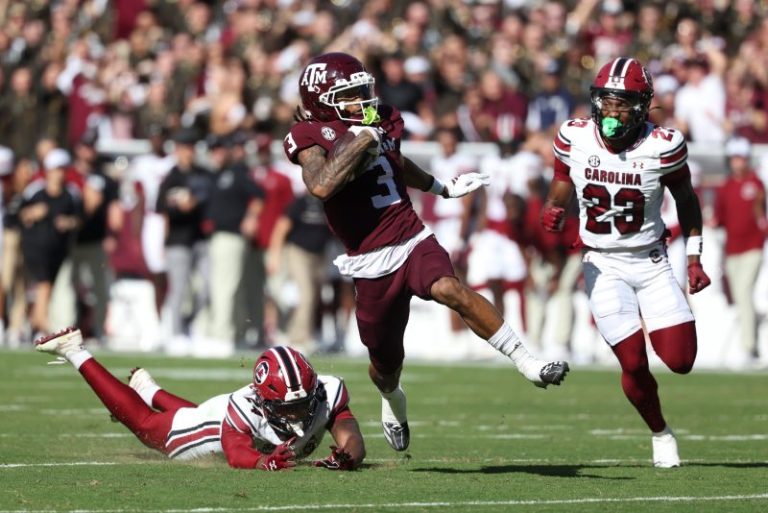
An argument could be made for Texas A&M to jump to No. 2 after a quality road win at Missouri and Indiana’s scare. Still, there’s nothing wrong with the Aggies staying put with their biggest games to come.

4. Alabama: A+

It wasn’t a pretty win against LSU, but the Crimson Tide didn’t deserve to move up or down. They’re on track for the SEC title game with a win against Oklahoma.

5. Georgia: A+

No upset scare from Mississippi State lets the Bulldogs stay put, hoping Alabama or Texas A&M will lose so it can jump up in the top four.

6. Texas Tech: A+

It was going to be interesting to see how much the Red Raiders would be rewarded for beating Brigham Young. Texas Tech jumping past Mississippi is a smart move considering how it has manhandled the Big 12 with Behren Morton in the lineup, but staying behind the SEC stalwarts.

7. Mississippi: A-

There shouldn’t be any brownie points for beating a Championship Subdivision team. The Rebels could have dropped a spot after their defeat of The Citadel, but nothing wrong with them staying at No. 7.

8. Oregon: A

It’s not easy going into Kinnick Stadium and leaving with any type of win. The short-handed Ducks get rewarded for the Iowa victory and more opportunities await with Southern California and Washington ahead.

9. Notre Dame: A

Don’t get it wrong, Navy is a good team. Notre Dame is just way better with the Midshipmen not having quarterback Blake Horvath, and if it can beat Pittsburgh, there’s a case for the Fighting Irish to jump up.

10. Texas: B+

The Red River was quiet with bye weeks, and Texas gets to move up as a result of Brigham Young losing in emphatic fashion.

11. Oklahoma: D+

Another team that gets to move up a spot while it didn’t play, but Oklahoma didn’t deserve that improvement.

12. Brigham Young: F

The Cougars finally fell, but they drop completely out of the projected field. It wasn’t close against Texas Tech, but the drop is way too much for losing to a top six team on the road. BYU has a better resume than Oklahoma.

13. Utah: C+

The Utes should stay behind a team it lost to, but this ranking still seems too high. It’s clear Cincinnati joining the rankings helped add weight to their win last month.

14. Vanderbilt: D+

Even though Vanderbilt looks good, it doesn’t own any wins over teams currently ranked. The Commodores need at least an impressive win to justify this.

15. Miami: B-

Great job by the Hurricanes to reaffirm dominance by beating down Syracuse. Miami still has the Notre Dame win still in its pocket, and the losses aren’t as awful as they appeared to be.

16. Georgia Tech: B-

No movement for the idle Yellow Jackets but they won’t stay put if they finish the season strong. They head back on the road to Boston College after their loss to North Carolina State two weeks ago.

17. Southern California: B+

The Trojans probably think they’re good enough to be in the top 16, but they get plenty of chances to move up with Iowa and Oregon next on the schedule.

18. Michigan: A-

19. Virginia: A

One could argue the loss of Chandler Morris greatly affected Virginia’s defeat to Wake Forest, but it still isn’t pretty losing to another unranked team.

20. Louisville: B+

After a confounding home loss to California, it appears the only way for Louisville to get in the playoff is by winning the ACC, which will require a lot of help.

21. Iowa: C+

Yes, Iowa nearly beat Oregon. But its still the third loss of the season, and the Hawkeyes should have fallen more than just one spot.

22. Pittsburgh: B+

23. Tennessee: C-

Moving up as a product of other teams losing, but Tennessee remaining in rankings − especially above deserving teams − is still confusing.

24. South Florida: B-

The Bulls are grateful Tulane knocked off Memphis last week, but is South Florida the best Group of Five team?

25. Cincinnati: A

The Bearcats should’ve been in the initial rankings to begin with. The committee finally fixed the problem.

This post appeared first on USA TODAY

Toronto Maple Leafs captain and U.S. Olympian Auston Matthews left Tuesday’s game and didn’t return after a series of hits involving him and Boston Bruins defenseman Nikita Zadorov.

Matthews, who was one of the first six players named to the U.S. Olympic men’s hockey team, went hard into the boards after he was checked from behind by Zadorov during the second period of the Nov. 11 game. The center got up, skated down the ice, checked the defenseman and lost his balance. Matthews also was hit by a cleared puck right before he checked Zadorov.

The Maple Leafs later announced that Matthews would not return to the game because of a lower body injury.

Auston Matthews injury update

Maple Leafs coach Craig Berube had no updates on Matthews after the game.

He said he couldn’t provide a timeline or say how serious the injury was.

‘We’ll see (tomorrow),’ he told reporters on Tuesday. ‘Right now, it’s lower body. We’ll see (tomorrow) how he is.’

On the original Zadorov hit, Berube said, ‘I think it’s a penalty, personally, but I’m not the referee. I don’t like it. I don’t like the hit. It’s a vulnerable position.’

Zadorov, known for his physical play, told reporters about his perspective on the hit.

‘It was just a normal play,’ he said. ‘I didn’t really hit him. I hit my right shoulder, 99% of my hits in the NHL are with my right shoulder.

‘I’m not sure what hit he got hurt (on). Is it like when he went after me again and I counter-hit him? Or maybe when I cleared the puck, I hit him with the puck. … There was really no intention to hurt him. I play hard against top players on the other team, that’s my job.’

U.S. Olympic team injuries

Four of the original six players named to the U.S. Olympic team have been injured since the announcement.

Florida Panthers forward Matthew Tkachuk had offseason hernia surgery. Ottawa Senators forward Brady Tkachuk had thumb surgery in October. Both remain out but are expected back before the Olympics in February.

Vancouver Canucks defenseman Quinn Hughes missed four games with a lower body injury but returned in early November. He left Tuesday’s game after an injury scare but returned.

Vegas Golden Knights forward Jack Eichel and Bruins defenseman Charlie McAvoy also were named to the U.S. team.

Final rosters are due on Dec. 31.

This post appeared first on USA TODAY

STORRS, Conn. — If you can’t beat ’em, join ’em.

That may not be exactly how sophomore Kayleigh Heckel ended up playing for No. 1-ranked UConn, but it is true that she finished her freshman season at USC with a loss to the team she ended up joining after entering the transfer portal.

‘My last game at USC was against UConn,’ Heckel said in a video posted by UConn prior to the season. ‘The stakes were high, was the Elite Eight game, so excited to to be on this side now.’

Heckel is fitting right in with the Huskies, averaging 13 points, 2.5 assists and 3.5 steals. She brings energy off the bench to a backcourt led by Azzi Fudd and KK Arnold. Heckel had six steals as UConn ran its press and overwhelmed Florida State, 99-67, on Sunday. The Huskies scored 42 points off 23 turnovers.

‘A lot of people on our team are very aggressive defensively,’ said Heckel, whose Huskies host Loyola on Wednesday (truTV, 7:30 p.m. ET). ‘(Running the press) helps us a lot. The six steals, that comes from my teammates helping me and getting a position where I can get a steal. We all work together defensively.’

Coach Geno Auriemma said Heckel is familiar with UConn’s style of defense.

‘Her whole high school career, the team that she played on, they were a pressure defense’ Auriemma said ‘It kind of fits in with what she likes, that’s her skills. That’s your skill set. So it sound like we’re introducing anything new here, but she’s going to get better at it.’

A 5-foot-9 native of Port Chester, New York, Heckel was the No. 13-ranked recruit in her class. Auriemma said that although he wasn’t sure about the fit out of high school, he was impressed with her play last season. The Huskies lost to USC in December last season before getting their revenge in the Elite Eight.

‘Watching her play, playing against her, I just thought that things that she’s really good at can help us, the other stuff, I think we can work with,’ Auriemma said. ‘I don’t think she’s changed (her game) that much (last season), but the changes she has made have made her for the better.

‘She’s a way better offensive player than I thought she was. You know, She loves that pull up. She knows that.’

Heckel has already doubled her 6.1 point scoring average with USC. She said Auriemma challenged her to work on being aggressive.

‘Coach told me that I have to have a very consistent midrange shot, so I’ve been working on it a lot, and I just try to get to my spots,’ Heckel said. ‘If it’s open, I’m gonna take it. If not, I can always pass to an open teammate.’

Heckel watched UConn raise its championship banner on Sunday. The Huskies have won 12 national titles, the last against South Carolina in April. She said playing for UConn comes with pressure, but she’s here for it.

‘I would say the biggest adjustment is like, the expectations,’ Heckel said. ‘I think that they’re super high and I really like that because I have a lot of goals for myself and for the team this year, so I’m super excited to just be held to the expectations and those standards.

‘I really want to get better, and I think that that can really be something that I can do here.’

This post appeared first on USA TODAY

The ACC could see a seven-team tie, potentially requiring advanced analytics to decide the matchup.
In the Big Ten, the race could come down to the rivalry game between Ohio State and Michigan.
The SEC has several one-loss teams, creating multiple pathways to the championship game behind likely participant Alabama.

Dozens of scenarios are still in play as the Power Four inches toward conference championship games, beginning with the possibility of an absurdly convoluted quagmire in the ACC.

The league is likely to travel far down the list of tiebreaker scenarios to decide which teams meet in Charlotte, North Carolina, for the league’s one assured College Football Playoff bid.

While other Power Four conferences could have two, three or even four teams with identical records, the ACC faces the possibility of a seven-team stalemate that would require an NSA-level cryptologist to decipher.

Things are simpler in the SEC, relatively speaking. While Indiana is on the verge of locking down a championship game appearance, the other half of the Big Ten race could come down to the final day of the regular season and the rivalry between No. 1 Ohio State and No. 17 Michigan.

With three weeks remaining until conference championship games, here’s where each race stands in the Power Four and the American, which has the inside track for the Group of Five’s playoff berth:

(League records in parentheses)

SEC conference tiebreakers

Contenders: No. 3 Texas A&M (6-0), No. 4 Alabama (6-0), No. 5 Georgia (6-1), No. 7 Mississippi (5-1), No. 10 Texas (4-1).

Let’s start by agreeing on this: Alabama is going to make the championship game.

The Crimson Tide can lose to Oklahoma or Auburn and still make it to Atlanta because of its head-to-head tiebreaker over Georgia and an advantage over Mississippi in conference opponent winning percentage. That Alabama is unlikely to lose both games could block Georgia from reaching Atlanta for the fifth year in a row, while the Rebels are also held at arm’s length by a loss to the Bulldogs.

The Tide would face Texas A&M if the Aggies beat South Carolina and Texas to end the regular season. But just one loss would throw the SEC into chaos.

Begin with the assumption that Alabama goes unbeaten in conference play. That would leave the possibility of three other one-loss teams in the Aggies, Rebels and either the Bulldogs or Longhorns, who meet this weekend. Here’s how that would unfold:

If Texas A&M, Georgia and Mississippi are in a three-way tie for second place, Georgia would likely advance based on conference opponent winning percentage.
If the Texas A&M, Mississippi and Texas are in a three-way tie, Texas would be eliminated by a loss to Florida, one of three common opponents along with Mississippi State and Arkansas. The tiebreaker would then be conference opponent winning percentage. If that fails to break the stalemate, the SEC would turn to “capped relative scoring margin,” a formula created by the firm SportSource Analytics.
The Rebels’ path to Atlanta requires wins against Florida and Mississippi State, a Texas win against Georgia, an A&M loss to South Carolina and then an A&M win against the Longhorns.
Lastly, Texas returns to the championship game by beating Georgia and beating A&M while the Rebels drop one of two.

Hey, no one said this was going to be easy.

Big Ten conference tiebreakers

Contenders: No. 2 Indiana (7-0), No. 1 Ohio State (6-0), No. 18 Southern California (5-1), No. 6 Oregon (5-1), No. 17 Michigan (5-1).

The Big Ten is easier to decipher, at least. For the two favorites, Indiana ends the year against Wisconsin and Purdue while Ohio State closes with UCLA, Rutgers and Michigan. Let’s work off two assumptions: one, the Hoosiers take care of the Badgers and Boilermakers, and two, Oregon beats Southern California and eliminates the Trojans.

If Ohio State loses again to Michigan, the Ducks are in position to earn a rematch against Indiana over the Wolverines because of an expected higher common opponent winning percentage. That same edge would send the Ducks to Indianapolis should the Buckeyes lose to UCLA. Should Ohio State lose to Rutgers, the Ducks would finish ahead of Ohio State thanks to a better record among five common Big Ten opponents.

There is a way for Michigan to face the Hoosiers. First, Oregon or USC would have to lose this weekend to Minnesota or Iowa, respectively, and then the loser would have to win next Saturday’s matchup at the Coliseum, leaving both teams with two conference losses. The Wolverines would then have to beat the Buckeyes for the fifth time in a row.

USC makes the championship game by running the table combined with a Michigan win against Ohio State.

Big 12 conference tiebreakers

Contenders: No. 8 Texas Tech (6-1), No. 12 Brigham Young (5-1), No. 22 Cincinnati (5-1), Houston (5-2), No. 15 Utah (4-2).

Texas Tech finishes with Central Florida and West Virginia, so let’s start with the expectation the Red Raiders end November with one league loss and lock up one spot.

It’s win-and-in time for BYU, which has been miserable in November games since joining the Big 12. The Cougars close with TCU, Cincinnati and Central Florida. The Bearcats are in by beating the Cougars, Arizona and TCU.

There’s a fairly high likelihood of having multiple teams with two conference losses, however.

In the case where BYU, Cincinnati, Houston and Utah finish are tied at 7-2 in conference play, the Utes would be expected to have a rematch with the Red Raiders by having the best common opponent winning percentage.

ACC conference tiebreakers

Contenders: No. 12 Georgia Tech (5-1), No. 19 Virginia (5-1), No. 23 Pittsburgh (5-1), SMU (5-1), Duke (4-1), No. 21 Louisville (4-2).

Georgia Tech ends with Boston College and Pittsburgh. Two wins in guarantee the Yellow Jackets head to the ACC championship game for the first time since 2014.

Even if Tech takes care of business, there’s the high probability of multiple teams tied with two conference losses, which would trigger the use of the SportSource Analytics formula to decide who faces the Jackets.

Saturday’s matchup between Duke and Virginia could be a tipping point. Should Duke win and Louisville beat SMU next weekend, the Blue Devils could finish second even with a loss to North Carolina or Wake Forest because of a higher common opponent winning percentage than Louisville, Virginia, Miami and SMU.

The Cardinals would finish second with a win against SMU combined with a Virginia win against Duke and a Virginia loss to Virginia Tech. Should Virginia beat Duke and SMU beat Louisville, the Cavaliers would finish ahead of the Mustangs based on common opponent winning percentage.

And yes, there is a chance of a seven-win tie for first. That’s how Miami — somehow, someway — makes the championship game. In the case where Georgia Tech loses once, Virginia beats Duke but loses to the Virginia, Louisville beats SMU and Miami wins out, the Hurricanes would draw a rematch with the Cardinals.

Got all that?

American conference tiebreakers

Contenders: Navy (5-1), South Florida (4-1), Tulane (4-1), North Texas (4-1), East Carolina (4-1).

Memphis is no longer a serious contender after losing to Tulane. North Texas is the most likely to finish with one loss given games against Alabama-Birmingham, Rice and Temple to end the month. One of Navy and South Florida will be sent to the back of the line after the two meet on Saturday in Annapolis.

Should Navy beat South Florida but then lose to Memphis, the most likely matchup in the championship game is North Texas against Tulane, which seems set to finish with one loss based on upcoming games against Florida Atlantic, Temple and Charlotte. The Green Wave also own the tiebreaker over East Carolina.

The likeliest scenario has a three-way tie between the Bulls, Mean Green and Green Wave. In this case, the playoff rankings or computer metrics would be used to break the deadlock.

Should two teams be ranked in the penultimate playoff rankings and then win their season finales, that pair would meet in the conference championship. This is the dream scenario for the American and the playoff.

That’s because of the growing possibility the league has to use computer metrics — our old, much-maligned friend from the Bowl Championship Series days — to determine the two teams left standing.

In the case where playoff rankings won’t settle the story, the American will split hairs between three or more teams by using the compositive average of four metrics: ESPN reporter Bill Connolly’s SP+, SportSource Analytics’ TR116 SOR, ESPN’s SOR and the KPI, a measurement tool created by Michigan State associate athletics director Kevin Pagua.

So, boiled down: One spot in the 12-team playoff could be decided by computers. The more things change, the more they stay the same.

This post appeared first on USA TODAY

No one is talking about them. Just an overlooked name on a lost line among College Football Playoff Top 25 poll. 

But No. 14 Vanderbilt is in prime position to win out and find a way to the CFP.

At this point, it’s a numbers game. A strange and surreal numbers game we’ve never seen in the history of the CFP. 

Texas, Oklahoma and Vanderbilt will be vying for what could be two playoff spots. Texas has the most difficult road, but the story is Oklahoma and Vanderbilt. 

They have seven common SEC opponents, a rarity in any season, in any conference. 

Texas has the head-to-head win over Vanderbilt, and the Commodores likely need the Longhorns to lose two games. But the resume comparison with Oklahoma is where it gets interesting. 

Both lost to Texas, and both beat South Carolina on the road and Auburn at home.
Oklahoma beat Tennessee on the road, Vandy plays at Tennessee on the final week of the regular season. 
Vanderbilt lost at Alabama, Oklahoma plays at Alabama this weekend. 
Vanderbilt beat Missouri at home, Oklahoma plays host Missouri Nov. 22. 
Vanderbilt beat LSU at home, Oklahoma plays host to LSU on the final week of the regular season. 

Never have two teams fighting for one spot been so easy to compare via common opponents. 

The question: How many more losses can Texas and Oklahoma sustain before Vanderbilt passes them? This three-team comparison is the only way Vanderbilt reaches the playoff. 

While No. 10 Texas plays at No. 5 Georgia and plays host to Arkansas and No. 3 Texas A&M over the final three weeks of the season, Vanderbilt plays Kentucky and at No. 23 Tennessee.

Do three-loss Oklahoma and Texas remain ahead of Vanderbilt? Can the Commodores use a big win at Tennessee to strengthen its resume enough that one loss by Oklahoma will be enough for the Commodores to jump them?

This, as much as anything, will show the committee’s ability to look past name and television property value, and reward resume.

The Fortunate

No. 15 Miami

The classic makeup call. Canes were ranked No. 18 in the first poll of the season, out of reach from No. 9 Notre Dame — which it beat in the season opener and has an identical record and a comparable schedule.

Apparently, Miami’s 38-10 win over Syracuse — which has lost six straight by an average of 22.5 points — was a game-changer in the committee’s eyes.

“We had some teams lose,” CFP chairman Mack Rhoades said on the ESPN selection show — and then mumbled some word salad about consistency, playing great defense, the offense needs to play better … and then I lost interest. 

Because here’s the reality: Even with Miami’s win over the Irish, this choice could come down to how each plays at Pitt. A common opponent, and prisoner of the moment game. 

No. 2 Indiana

Penn State is bad. One of the worst teams in the Big Ten bad. And but for some late game heroics from Hoosiers QB Fernando Mendoza, Penn State would’ve given Indiana its first loss of the season. 

The committee could’ve easily moved Texas A&M — which continues to roll through its SEC schedule — to the No. 2 spot, but stuck with the Hoosiers. With games against Wisconsin and Purdue, Indiana may not have enough to hold off the Aggies who still play SEC games against South Carolina and No. 10 Texas.

No. 13 Utah  

What exactly have the Utes done to be ranked in the top 13? Utah beat No. 25 Cincinnati two weeks ago, and that’s about it. 

The problem: Who has Cincinnati beaten?

Utah was blown out at home by Texas Tech, and lost by three at BYU. Other than that. A whole lot of nothing. A win over Arizona State without its starting quarterback is Utah’s next best win.

The Frantic

No. 10 Texas

Longhorns likely need two wins over the final three weeks of the season to reach the CFP. That means beating one of two top 5 teams (Georgia or Texas A&M).

A 9-3 record isn’t a lock, but there would have to be some wild upsets over the final three weeks of the season for three-loss Texas to not reach the CFP. A win over either Georgia or Texas A&M would be too difficult to ignore.

The ACC

There are five teams with one conference loss, and only two control their destiny (Georgia Tech, Duke). The best team could be SMU, which struggled early this season and lost to rivals Baylor and TCU. 

Then there’s No. 22 Pitt, which finishes the season playing host to No. 9 Notre Dame, at No. 16 Georgia Tech and playing host to No. 15 Miami. Win those three and the Panthers will move into the top 10.

No. 12 BYU

The remaining games: TCU, at No. 25 Cincinnati, UCF. BYU will be favored in all three games, and control their destiny in the race for the Big 12 championship game. 

Cincinnati, too, controls its destiny — and is unbeaten at home this season.

Matt Hayes is the senior national college football writer for USA TODAY Sports Network. Follow him on X at @MattHayesCFB.

This post appeared first on USA TODAY

The second round of College Football Playoff rankings reaffirmed the possibility that the SEC sends not one, two, three or even four teams into the tournament but possibly five — or even six, if things get really crazy.

No. 1 Ohio State and No. 2 Indiana continue to lead the rankings out of the Big Ten. But then comes a parade of contenders from the SEC, starting with No. 3 Texas A&M, No. 4 Alabama, No. 5 Georgia and No. 7 Mississippi.

All four teams are potentially one more conference win away from locking down at-large playoff berths, though the Rebels might face elimination with a loss to Florida or Mississippi State.

This group is followed by three more prime contenders in No. 10 Texas, No. 11 Oklahoma and No. 14 Vanderbilt. The Longhorns can play their way in by splitting games against Georgia and Aggies. Oklahoma has a huge game at Alabama followed by home contests with Missouri and LSU. Vanderbilt’s chances will come down to the season finale against Tennessee.

At this point, having four SEC teams in the bracket seems guaranteed. At the same time, the ACC and Big 12 might end up as one-bid leagues. Even if those two leagues share three bids, there’s an opportunity for the SEC to make up half of the 12-team field.

That puts the conference front and center among the biggest winners and losers of Tuesday night’s rankings, joining South Florida and the ACC:

Winners

Indiana

The Hoosiers were able to stay ahead of Texas A&M despite of — or because of, from one perspective — last weekend’s 27-24 escape at Penn State. While the Aggies had no issues taking care of Missouri, the Hoosiers were able to pull down the first win at Beaver Stadium in program history, something the committee clearly recognized as meaningful despite the narrow victory. Remaining in the No. 2 spot solidifies Indiana’s near-lock status with games against Wisconsin and Purdue to end the month.

South Florida

South Florida squeezed into the rankings at No. 24 as the only Group of Five representative, giving the Bulls a clear edge for an automatic playoff bid should they take care of business and win the American. Given games against Navy and the second-best team in the American for the conference championship, USF is essentially a lock for the No. 12 seed in the bracket with a clean finish. Looking ahead, placing in the rankings is a huge deal given that in the case of a multiple-team tie atop the standings, the championship game pairings could end up being decided by which team or teams were in the penultimate rankings and where.

Texas Tech

Saturday’s 29-7 win against No. 12 Brigham Young moved Texas Tech up two spots to No. 6, leapfrogging ahead of Mississippi. While the clearest path to the playoff remains via the Big 12 championship, the Red Raiders have built up enough wiggle room and goodwill with the committee to potentially survive a loss to BYU in a Big 12 title game rematch and earn an at-large bid, though that might come down to whether or not the Big Ten has a fourth team in the conversation.

Notre Dame

No. 9 Notre Dame must win out, starting on Saturday at No. 22 Pittsburgh, but are now firmly in at-large position after climbing one spot from last week’s rankings. With both the ACC champion and Group of Five representatives potentially finishing outside the top 12 in the final rankings, climbing inside the top nine at this point guarantees the Fighting Irish will make the playoff for the second year in a row with a perfect close to the regular season.

Losers

The ACC

For the second week in a row, there’s no bigger loser in the playoff rankings than the ACC. After a horrific weekend that included losses by No. 19 Virginia, No. 20 Louisville and Duke, the league’s highest-ranked teams are No. 15 Miami and No. 16 Georgia Tech. The Cavaliers and Cardinals both dropped five spots from last week. While No. 15 Miami and Pittsburgh give the ACC five teams in Top 25, these rankings strongly suggest only the conference champion will make the bracket unless the Yellow Jackets win the conference, the Hurricanes run the table and there is chaos ahead. That USF made the rankings helped the Hurricanes climb three spots and definitely breathes some life into their chances.

BYU

The five-spot drop from last week leaves BYU only one clear path to the playoff: via the Big 12 championship. There’s a chance for an at-large bid, though that demands not just a perfect finish to November, complete with a win against No. 25 Cincinnati, but also help from bottom-feeders in the SEC and Big Ten to clear an avenue for a second team from the Big 12. In addition to that assistance, the Cougars would need to put together a much stronger and competitive performance in the rematch with Texas Tech.

This post appeared first on USA TODAY

Former first lady Michelle Obama revealed on a recent episode of her podcast that she was left infuriated by a moment on Air Force One in 2009 when she debated whether to wear Bermuda shorts while on vacation — which ultimately led to controversy. 

‘The fact that we had to spend time thinking about that kind of stuff in ways that my husband didn’t — it was really infuriating,’ Obama said during an episode on her podcast, ‘IMO With Michelle Obama and Craig Robinson,’ which she co-hosts with her brother. ‘Then an article, a negative article, still happened.’ 

The former first lady explained that in August 2009 she and the former president were set to depart Air Force One for a hike in the Grand Canyon while on their first vacation since the inauguration earlier that year. While she fretted over what attire would be appropriate for a first lady and not draw public criticism, Barack Obama did not need to put effort into thinking about his outfit, she recounted. 

‘It was 100 degrees,’ Michelle Obama remembered of the conversation. ‘Barack — I was like, ‘Well, what are you wearing?’ He was like, ‘Well, I’m gonna throw on some sneakers, I’m gonna take my jacket off and roll my sleeves up’ because that’s what men can do. White shirt, no collar, no tie. That was how he changed.’

Michelle Obama said she debated whether to wear hiking shorts or a dress before landing on wearing Bermuda shorts. 

‘I can’t wear hiking shorts there, and I can’t wear a dress to hike,’ she said. ‘That would be crazy. People would call me ‘disconnected’ and ‘un-American.’ I’m at the Grand Canyon in a tea-length dress with flats? I was like, ‘That’s not how people go to the Grand Canyon.”

‘I eventually opted for the thing that felt mostly me,’ Michelle Obama continued. ‘And it was the Bermuda shorts. Because if we’re going on a hike, this is how a normal person would go on a hike.’

The former first lady did face backlash for the attire, as pundits at the time criticized that a first lady wearing shorts while departing Air Force One was too casual, with outlets running headlines such as, ‘Who Wears Short Shorts? Michelle Obama,’ ‘First lady’s shorts draw some long, hard looks,’ and ‘Michelle Obama: The Shorts Heard Round the World.’

Michelle Obama said in 2013 that she would not wear shorts again on Air Force One after the 2009 outfit caused ‘a huge stink.’ She explained at the time that she made the more relaxed choice because ‘we’re on vacation.’

First lady Melania Trump also has faced backlash over her wardrobe attire, including in 2017 when she wore a baseball cap and jeans to visit Texas after Hurricane Harvey that was viewed by some critics as too casual, and again in 2018 when she wore a green jacket while on a trip to visit the border that read, ‘I really don’t care. Do u?’ 

Melania Trump later told the media she wore the jacket as a message to the liberal media and other critics: ‘I want to show them that I don’t care,’ she told ABC News in 2018. 

Fox News Digital reached out to Michelle Obama’s office Tuesday for additional comment on the matter but did not immediately receive a reply. 

This post appeared first on FOX NEWS

In 2015, when Donald Trump was running for the Republican nomination for president, a refrain that was often heard from his supporters and mocked by his detractors was, ‘He fights.’

It seemed empty and vacuous, but in fact, it represented a few core issues that GOP voters felt their party was ignoring, or at least not prioritizing. Today, it is the Democratic base that is demanding its party ‘fight.’ But fight for what?

Trump’s core issues, and those of what would become known as MAGA, were a bit obscure at first, but eventually became very clear: Secure the border, abandon globalism and bad trade deals, and fight the culture war.

What are the issues or policies that are animating today’s fighting spirit in the Democratic Party? There are three that are dominant.

The first issue can roughly be called redistribution of wealth. We should avoid using the term socialism here, because it is vague and toxic, and what Democrats are really talking about is the very purpose of the social safety net, from welfare to food stamps.

At least nominally, the position of the Democratic Party for half a century has been that welfare programs are a hand up, not a hand out. As John F. Kenndy put it, they are the rising tide that lifts all ships.

In practice, this has led to a permanent underclass that is funded by high-earning taxpayers, but Democrats have long refused to admit it. Democrat socialists have ripped off the Band-Aid. Soaking the rich to pay for the basic needs of the poor and working man is their proud new mantra.

It turns out, the likes of New York City Mayor-elect Zohran Mamdani have Democratic voters with them on this about-face. In a recent Gallup poll, 66% of Democrats had a positive view of socialism, with only 42% saying the same about capitalism.

Former President Joe Biden used to whisper that billionaires should ‘pay their fair share.’ Today, Sen. Bernie Sanders, I-Vt., and Rep. Alexandria Ocasio-Cortez, D-N.Y., shout from the rooftops that the rich should pay way more than their ‘fair share,’ and basically subsidize everyone else.

The second major issue that the democrat socialists have locked onto is Israel, and America’s relationship with and military funding of the Jewish state, something that even a decade ago the party supported as bedrock policy.

According to a Pew survey, since 2022, the percentage of Democrats with a negative view of Israel has gone from 53% to a staggering 69%, and the lean and hungry New Democrats know it.

Rep. Ro Khana, D-Calif., who has been quietly crafting a new vision for his party, recently posted a list of issues at the core of his mission. They included ‘Medicare-for-all,’ child care for $10 a day, housing, and then, right there at the bottom, ‘No bombs to Israel.’

Meanwhile, pro-Israel Sen. John Fetterman, D-Pa., has all but admitted there is ‘no room’ in the party for those on his side of the issue. That’s not good news for the political future of moderates like Pennsylvania Gov. Josh Shapiro.

The third issue that is clearly firing up the Democratic base is immigration, and when I say they are fired up, I mean seemingly normal people leaping in front of the cars of federal authorities to keep them from deporting illegal alien criminals.

Take Mamdani’s acceptance speech in Brooklyn last week: ‘Thank you to those so often forgotten by the politics of our city, who made this movement their own. I speak of Yemeni bodega owners and Mexican abuelas,’ he said. ‘Senegalese taxi drivers and Uzbek nurses. Trinidadian line cooks and Ethiopian aunties. Yes, aunties.’

The key words here are ‘who made this movement.’

Make no mistake, this new iteration of the Democratic Party will not only seek to give amnesty to every person illegally in the United States, they will open the border again, and their voters will cheer on the invasion.

It wasn’t just establishment Republicans who underestimated Trump’s appeal in 2015, it was the whole country. What we didn’t see then was that on his big three issues, the border, globalism and the culture war, he was tapping into a real popular zeitgeist.

Today, we are at a similar point, on redistribution of wealth, Israel and immigration, the democrat socialists have found popular policies among their base, and all the Chuck Schumers in the world can’t talk them out of it.

Just as Trump took over the GOP before anyone quite knew it, the democrat socialists have found the same fighting path to dominance among Democrats, and for the few moderates left, it already looks far too late to stop it.

This post appeared first on FOX NEWS

The end of the longest government shutdown in U.S. history is finally in sight, with the House of Representatives set to vote on a federal funding bill later Wednesday evening.

House lawmakers are set to take a procedural vote in the 5 p.m. hour on whether to allow debate on the measure. If the legislation survives, a final vote is expected in the 7 p.m. hour.

The government has been shut down for 43 days as Democrats and Republicans hotly debated the merits of the GOP’s initial federal funding bill, a short-term extension of fiscal year (FY) 2025 spending levels through Nov. 21.

The vast majority of Democrats are still against the legislation, including House Democratic leadership, but GOP lawmakers across several ideologically diverse factions have signaled confidence in a nearly unified Republican vote.

House Freedom Caucus Policy Chairman Chip Roy, R-Texas, said he heard no dissent on the bill from his band of fiscal hawks.

‘I’m not going to speak for everybody, but I think there’s general support. So you know, I’m unaware of any opposition of significance,’ he told reporters Tuesday night.

House Appropriations Committee Chairman Tom Cole, R-Okla., said, ‘Nothing’s ever easy around here. But, look, I didn’t notice any dissent … I think the votes will be there on our side.’

But with a razor-thin majority, House GOP leaders can only afford to lose two Republican votes at most to pass the bill without relying on any Democrats.

‘I’m very hopeful,’ House Majority Leader Steve Scalise, R-La., told Fox News Digital when asked if Republicans had the votes to pass the bill. ‘I think you’re seeing just a few Democrats come to their senses. It should be a lot more.’

Meanwhile, the shutdown’s effects on the country have grown more severe by the day.

Many of the thousands of air traffic controllers and Transportation Security Administration (TSA) agents who had to work without pay were forced to take second jobs, causing nationwide flight delays and cancellations amid staffing shortages at the country’s busiest airports. Millions of Americans who rely on federal benefits were also left in limbo as funding for critical government programs ran close to drying out.

At the heart of the issue was Democratic leaders’ refusal to back any funding bill that did not also extend COVID-19 pandemic-era enhanced Obamacare subsidies that are set to expire at the end of this year. Democrats argued it was their best hope of preventing healthcare price hikes for Americans across the U.S.

Republicans agreed to hold conversations on reforming what they saw as a broken healthcare system, but they refused to pair any partisan priority with federal funding.

The initial bill passed the House on Sept. 19 but stalled in the Senate for weeks, when Democrats sank the bill more than a dozen times.

However, after weeks of stalemate and the clock running down on their Nov. 21 bill, a new compromise emerged that got support from eight Senate Democrats to carry it across the finish line.

The new legislation would extend FY 2025 federal funding levels through Jan. 30, to give negotiators more time to strike a longer-term deal for FY 2026.

It would also give lawmakers some headway with that mission, advancing legislation to fund the Department of Agriculture and the Food and Drug Administration; the Department of Veterans Affairs and military construction; and the legislative branch.

In a victory for Democrats, the deal would also reverse federal layoffs conducted by the Trump administration in October, with those workers getting paid for the time they were off.

A side deal struck in the Senate also guaranteed Senate Democrats a vote on legislation extending the enhanced Obamacare subsidies. Speaker Mike Johnson, R-La., however, has made no such promise in the House.

If passed on Wednesday night, the legislation heads to President Donald Trump’s desk for a signature.

When asked about the bill on Tuesday, a White House official told Fox News Digital, ‘President Trump has wanted the government reopened since the first day Democrats shut it down. The action in the Senate is a positive development, and we look forward to seeing it progress.’

This post appeared first on FOX NEWS