Archive

2025

Browsing

South Carolina did the unthinkable… then had the unthinkable done to it, the Texas hype train finally ran out of track and never let fireworks go to waste.

Here’s the worst from Week 12 of the college football season with our Flop 10:

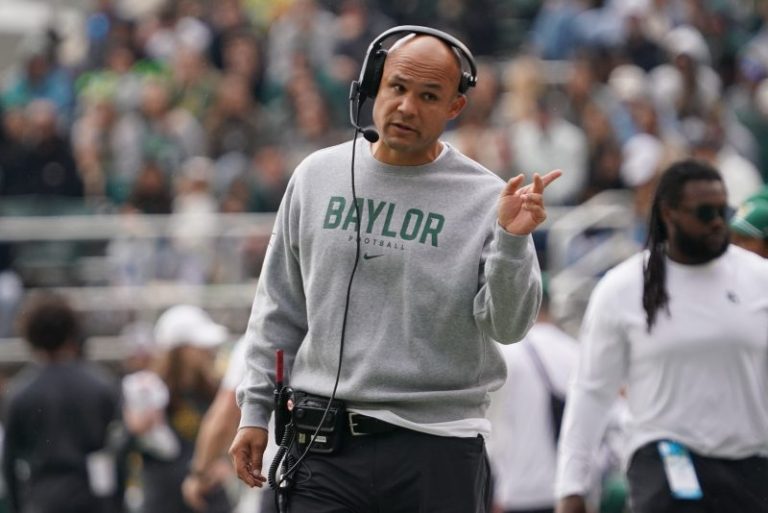
Shane Beamer

Does Shane Beamer get any credit for having South Carolina up 30-3 at halftime vs. No. 3 Texas A&M, or does he get the blame for a colossal Gamecocks choke job?

‘This was the third SEC game — Alabama, Missouri and A&M — that we led going into the fourth quarter,’ Beamer said afterward. ‘It makes me want to puke.’

Puke, choke, whatever. It was an epic collapse, which allowed Texas A&M to stay unbeaten after pulling off its largest comeback in program history. Beamer’s seat has been warming with a 3-7 record (1-7 in SEC). That’s a far cry from a preseason ranking and darkhorse CFP vibes.

Texas

Steve Sarkisian called it ‘a disaster.’ Texas defensive lineman Colin Simmons used the same word. A preseason lock for the CFP will now be on the outside looking in after the Longhorns’ 35-10 loss at No. 5 Georgia on Saturday night.

Two Texas teams will likely be in the CFP. But they’re in College Station and Lubbock. Not Austin.

Does anyone want to win the AAC?

A week after Memphis saw its name in the CFP bracket projection and promptly lost its next game, guess what happened to South Florida after the Bulls landed inside the CFP’s Top 25 this week… Yup, they lost. It seems no one in the American wants to take the bull by the horns, per se. It’s long been assumed the winner of the AAC would be the CFP’s Group of Five entrant. But Navy’s win over USF on Saturday opens the door for James Madison of the Sun Belt to perhaps be the highest-ranked G5 champion.

Michigan State

Earlier this week, the Spartans were forced to vacate 14 wins from 2022-24 and were placed on probation for NCAA violations under Mel Tucker’s reign. Saturday didn’t offer much solace. Here’s Graham Couch of the Lansing State Journal summing it up:

‘When college football goes bad, it looks like it does right now at Michigan State. Losing week after week, NCAA investigations, changes in leadership, disengaged donors, disenchanted fans, players living in a state of flux.

‘This sucks for everybody involved, even those who deserve a slice of the blame. You could feel that more than ever after MSU’s 28-10 home loss to Penn State on Saturday.

‘There have been some heavy Jonathan Smith press conferences this season. But when you add the conversation about NCAA penalties to an afternoon that saw the Spartans suffer their seventh straight defeat, on a senior day didn’t feel anything like a celebration, with Smith for the first time indirectly addressing the elephant in the room that is his job status, all the while athletic director J Batt watched from the back of the room …

‘Good luck finding anyone around MSU’s program who’s having fun right now.’

Pat Narduzzi vs. Notre Dame

This was Pitt’s big moment. ESPN ‘College GameDay’ in town for the first time in 20 years, and the Panthers were the ACC’s hottest team. Were being the operative word. Notre Dame hammered Pitt, 37-15, as Jeremiyah Love was spinning and sprinting past Panthers defenders like he was playing Madden. Pat Narduzzi has done good work at Pitt, headed for an eighth bowl in 11 seasons, but he’s got an Irish curse. According to John Brice of the Football Scoop, Narduzzi is 0-5 in his career against the Fighting Irish, by a combined 201-69 margin.

UMass football

The Minutemen surrendered 40+ points for the sixth time this season in a 45-3 home loss to Northern Illinois on Wednesday. UMass (0-10) has lost 21 straight games to FBS schools. Heck, it even lost to FCS Bryant this season. Just how bad has it been? Down 45-0, UMass hit a field goal to avoid the shutout, and the stadium fireworks folks let it rip.

Oregon State

Last week was probably rock bottom, losing at home to previously winless Sam Houston. But a 31-14 loss to Tulsa (who was 2-7) isn’t much better. The Golden Hurricane entered the game on a five-game losing streak and led this one 31-0. The dam broke long ago for the Beavers (2-9) this season.

Mike Locksley

Maryland’s skid hit six games in a row after a 24-6 road loss to Illinois. Locksley is 36-42 in his seventh season as full-time Terps coach — including a woeful 2-14 in the Big Ten in his past two seasons.

Maryland athletic director Jim Smith was non-committal earlier this week when asked whether Locksley will be back in 2026.

“He’s gonna coach against Illinois, then he’s gonna coach against Michigan, and then he’s gonna coach against Michigan State,” Smith told The Baltimore Sun. “We got a chance to win three games and go to a bowl game. We can’t make a decision right now. That’d be silly.”

Smith, in his first year as Maryland AD, backtracked on his comments on Sunday, Nov. 16, telling ESPN Locksley will return to Maryland in 2026.

Let Missouri State go to a bowl

Missouri State won its seventh game of the season with a 38-24 win over UTEP. Yet the Bears may be sitting at home come bowl season.

The school appealed to the NCAA to let it be bowl eligible despite being in its second year of a transition from the FCS to the FBS.

‘I think all policies and structure of anything in regards to college football should be around the student athlete,’ Bears coach Ryan Beard told the Springfield News-Leader. ‘In the modern day of college football, I don’t know if it makes sense to build a transition period. There are no rules that give us a competitive advantage. If you want to see a competitive disadvantage, come see some of the things we have going on here at Missouri State.’

As recently as 2023, three programs transitioning to the FBS had their postseason waivers denied by the NCAA, including James Madison, which started the year 10-0. The Dukes and Jacksonville State ultimately were allowed to play in bowl games due to the lack of bowl-eligible teams. The same can happen for Missouri State if fewer than 82 teams are eligible come the end of the regular season.

UNC football good vibes

With two wins in a row vibes were on the up in Chapel Hill. Bill Belichick was shutting down NFL rumors and committing his future to UNC and playing nice with the media, giving 20-minute news conferences. But a 28-12 loss at Wake Forest on Saturday dealt a major blow to the Tar Heels’ fleeting bowl hopes and those longer, more cuddly pressers.

“Disappointing game. Just not good enough in any area,” Belichick said at the start of a news conference that lasted 5 ½-minutes. 

On to Duke.

This post appeared first on USA TODAY

Steve Sarkisian: ‘The fourth quarter was, for lack of better terms, a disaster.’ Pretty much.
Texas not officially eliminated from College Football Playoff hunt, but bid absurbed a gut punch from Georgia.
Texas A&M has resolve. Texas has three losses.

ATHENS, GA – And so it’s come to this for Texas, that senior leader Michael Taaffe is complimenting rival Texas A&M’s resolve after the Aggies’ comeback victory against South Carolina and declaring his own team must look in the mirror and take stock of itself after another humbling loss, this one to Georgia.

“Clearly, A&M showed what type of team they were,” Taaffe said, unprompted, of an Aggies team that rallied to overcome a 27-point halftime deficit against South Carolina.

Hours later against Georgia, the Longhorns reminded us who they are, too. They’re a group that doesn’t play well on the road, a team that hasn’t played up to its payroll or the hype.

And so it’s come to this, that even if Texas beats Arkansas and the Aggies these next two weeks, it still wouldn’t be guaranteed a playoff bid.

Texas went into the fourth quarter against No. 5 Georgia trailing by one score. By the end of the quarter, the final score of 35-10 looked like a rout.

“The fourth quarter was, for lack of better terms, a disaster,” Texas coach Steve Sarkisian said. “We got beat 21-0 in the fourth quarter.”

You can say that again.

“It was a disaster,” Texas defensive lineman Colin Simmons said. “We didn’t finish.”

Georgia converted two fourth downs en route to a touchdown early in the fourth quarter. Then, it recovered an onside kick and scored again. Now down by three scores, Texas went three-and-out. Georgia scored again.

By the end of Georgia’s three-score flurry, the Bulldogs had snapped 16 fourth-quarter plays for 123 yards. Texas had the ball at that point in the quarter for three plays that produced negative-4 yards.

That’s how a close game spirals into a blowout.

When the fourth quarter mercifully ended, Georgia fans danced in the stands as their band played peppy victory tunes. The Longhorns sang “The Eyes of Texas,” and it sounded like such a sad ballad.

The eyes of the nation were upon Texas this season. The Longhorns could not get away from the hype or expectations, and by Sunday morn’ after Texas’ 10th game, the Longhorns had three losses.

And so it’s come to this.

“They kicked our butts in all three phases,” Taaffe said. “We messed up a lot of stuff.”

Georgia coach Kirby Smart compared his team’s offense to “a big anaconda” that just keeps squeezing until eventually the prey succumbs.

Gunner Stockton is the head of the snake. The Georgia quarterback completed 24-of-29 passes with four touchdown tosses. He’s not the first quarterback to pick apart this Texas defense.

“I give credit to him, for sure, but we made it pretty easy (on him),” Taaffe said.

And so it’s come to this, that by mid-November, a team billed as a national championship frontrunner in August has been eliminated from the SEC Championship hunt, and now Sarkisian’s lauding Georgia as still “the standard of college football,’ and the undefeated team in Texas is located in College Station, and there’s another team in Lubbock that probably would squeeze the breath out of the Longhorns.

“I’m frustrated and disappointed we didn’t play better,” Texas quarterback Arch Manning said. “We just didn’t play well.”

And it’s come to this that Manning could have used the same words to describe Texas’ losses to Ohio State and Florida or even its road wins against Kentucky and Mississippi State.

Fortunately for Texas, its last two games will be at home, and a Black Friday takedown of the No. 3 Aggies would make a good last impression entering Selection Sunday.

And yet even then the Longhorns would be at the committee’s mercy and left rooting for upsets elsewhere, because in a crowded playoff race, 9-3 might well not cut it.

Two teams in Texas sit in great shape for playoff qualification. The Longhorns aren’t one of them. It’s come to this.

“Disappointing,” Sarkisian said.

That says it all.

Blake Toppmeyer is the USA TODAY Network’s senior national college football columnist. Email him at BToppmeyer@gannett.com and follow him on X @btoppmeyer.

This post appeared first on USA TODAY

Dana White did not cast blame when asked about a massive brawl that broke out during UFC 322 Saturday night, Nov. 15 at Madison Square Garden in New York.

“I blame myself for that actually,’’ White, UFC’s CEO, told reporters during a post-event news conference.

Before he walked out for the main card, White said, he was told MMA fighter Dillon Danis was in the arena, sitting in fighter seats and not sitting in his own seat. In 2018, Danis was involved in a brawl at UFC 229 after Khabib Nurmagomedov beat Conor McGregor by submission.

Then McGregor’s teammate, Danis was suspended for seven months and fined $7,500 for his role in the incident. He denied allegations that he directed a Muslim slur at Nurmagomedov.

In 2023, Danis boxed Logan Paul and was disqualified in the sixth round when he attempted a takedown and an illegal choke.

But back to Saturday night at Madison Square Garden.

Of Danis, White said: “He had a ticket and they said, ‘Do you want us to throw him out of here?’ ‘

White indicated there was another potential problem: a retired UFC fighter profanely informed people he was going to hurt Danis “on site.’’ Told the fighter was sitting six or seven rows away from Danis, White said he responded, “Well, if the guy has a ticket, let him sit in his seat and let him do what he’s doing and keep an eye on him.

“It never even crossed my mind, as stupid as this could be, that the entire Muslim brotherhood was here tonight in the first five rows for Islam.’’

That is, Islam Makhachev, who was fighting in the main event and works with Nurmagomedov, a prime combatant with Danis during the brawl at UFC 229.

Sure enough, a brawl broke out at Madison Square Garden – with Danis serving as instigator.

Said White, “And as soon as it broke out I was over on the other side and I go, ‘(Expletive), I know exactly what that is. I knew it. And yeah, you’ll never see Dillon Danis at a UFC fight ever again.’’

This post appeared first on USA TODAY

Texas A&M overcame a 27-point deficit to defeat South Carolina 31-30, marking the largest comeback in school history.
Quarterback Marcel Reed’s strong second-half performance may have positioned him as a front-runner for the Heisman Trophy.
In other key games, Oklahoma upset Alabama, and Notre Dame defeated Pittsburgh, impacting the national playoff picture.

Down 30-3 at halftime to South Carolina, No. 3 Texas A&M remained unbeaten, made school and SEC history, stayed on track for the conference championship game and might’ve moved quarterback Marcel Reed to the front of the Heisman Trophy race in storming back for the 31-30 win.

Steadily chipping away at the Gamecocks’ lead, the Aggies went ahead for good on a 4-yard touchdown run by EJ Smith four minutes in the fourth quarter. By that point, the comeback was a foregone conclusion: South Carolina was melting down amid the now-typical A&M second-half barrage.

The 27-point comeback is the largest in school history. Since 2004, SEC teams were 0-286 when trailing by 27 or more points.

Beating the Gamecocks doesn’t change the math in terms of an SEC championship. That path still leads through the Black Friday rivalry against No. 10 Texas and will be impacted by other conference results that determine how many teams end November with one league loss.

But avoiding this pothole maintains the Aggies’ dual avenues to the 12-team tournament. By remaining one of three Bowl Subdivision teams still unbeaten, A&M retains the wiggle room to potentially lose to the Longhorns and again in the SEC championship and still earn an at-large berth with room to spare.

On an individual level, Reed’s second half could move him ahead of No. 2 Indiana quarterback Fernando Mendoza and into the driver’s seat for the Heisman Trophy, finally bringing some clarity for one of the most unsettled races in recent history.

After throwing two interceptions and coughing up a fumble the Gamecocks returned for a score in the first half, Reed rebounded to complete 16 of 20 throws for 298 yards and three scores in the final two quarters.

After a dominant six-quarter run that started in the second half against LSU and continued through last week’s win against Missouri, the sluggish start against USC should be a wakeup call leading into the games that will decide where the Aggies land in the final playoff rankings.

But A&M joins No. 10 Oklahoma as one of the clear winners from Saturday’s action, along with losers such as No. 4 Alabama and South Florida:

Winners

Oklahoma

The Sooners converted 3 of 13 third-down attempts, averaged 2.6 yards per carry, compiled 212 yards of offense and still beat Alabama 23-21, securing the biggest win of the Brent Venables era and likely rocketing into prime at-large position. Being plus-three in turnover margin made the difference. With the offense stuck in neutral and unable to move bodies at the line of scrimmage, the Sooners’ defense came up big time and again, from a pick-six in the first quarter through a fumble recovery that set up the go-ahead field goal in the fourth quarter through a game-clinching fourth-down stop near midfield with under a minute to play. In the big picture, this upset is great news for the SEC, which could send at least five teams to the tournament.

Georgia

With Alabama losing and A&M sneaking past the Gamecocks, No. 5 Georgia should be seen as the SEC favorite after hammering No. 10 Texas 35-10. The Bulldogs took control with a pair of Gunner Stockton touchdowns in the first half, were temporarily wobbled when Texas turned a Stockton interception into a touchdown to make it 14-10 but clobbered the Longhorns with a 21-point fourth quarter. The Texas offense disappeared, mounting just 271 yards on 4.6 yards per play, and Stockton wildly outplayed Arch Manning, who needed 43 attempts to throw for 251 yards, a touchdown and a pick. This was a complete performance that should open some eyes about Georgia’s chances at the national title.

Notre Dame

The No. 9 Fighting Irish aced their final real test left in the regular season by blitzing No. 23 Pittsburgh 37-15 behind 147 rushing yards and a score from Jeremiyah Love, who has essentially locked down All-America honors with two games remaining in November. This one was over early: Notre Dame led 21-3 at halftime and pushed that lead to 28-3 on the first drive of the third quarter. Now 8-2 with Syracuse and Stanford ahead, only an unexpected flop against an overmatched opponent will keep the Irish out of the playoff.

Southern California

Down 21-7 in the first half and struggling to get moving against Iowa’s physical defense, No. 18 USC scored 19 unanswered points and beat the Hawkeyes 26-21 to remain in the Big Ten and playoff conversation. By holding serve at home, the Trojans will face No. 6 Oregon next weekend still very much alive in the Big Ten race; a clean finish and another Michigan win against Ohio State would give them the tiebreakers to earn a spot opposite Indiana at Lucas Oil Stadium. The ability to handle the Hawkeyes highlights the growth USC has undergone since a very disappointing Big Ten debut last season.

Michigan

Dominic Zvada made a 31-yard field goal as time expired and the No. 17 Wolverines beat Northwestern 24-22 to just barely hang on to any shot at the Big Ten crown and a playoff berth. Ahead 21-9 early in the fourth quarter, Michigan turned the ball on three successive possessions, including a pair of interceptions from Bryce Underwood, before mounting a 50-yard drive in the final two minutes to escape with a road win. While a team that needs every second to beat the Wildcats might not have a shot at beating Ohio State and then Indiana to earn an automatic bid, the Wolverines are at least still in the conversation for the tournament and could end up as the third of fourth Big Ten team in the field with an upset of the Buckeyes.

Virginia

Over in the ACC, No. 19 Virginia rallied from last week’s rough loss to Wake Forest to beat Duke 34-17 and move one step closer to the conference championship game. One big reason for rebound: After missing the game against the Demon Deacons due to injury, Chandler Morris was back under center for the Cavaliers and delivered 316 yards and two touchdowns. After notching a rare blowout win in a year defined by close calls, Virginia takes next weekend off before facing rival Virginia Tech.

Losers

Texas

There was an idea heading into Saturday night that Texas could be the first three-loss team to make the playoff, thanks to a nice list of wins, a really tough schedule and the chance to beat one of Georgia and A&M down the stretch. The Longhorns could still beat the Aggies — and might still be favored at home, even. But to lose by 25 points at Georgia might make that result moot by shutting down one major factor in the Longhorns’ corner: credibility. While Texas will still have an argument for an at-large bid at 9-3, it’ll be much weaker for having this blot on its résumé should five other SEC teams ahead of it hold serve.

Alabama

Down the line, the big fallout from the loss to OU will be seen in where Alabama falls in the playoff rankings, and whether the Crimson Tide end up earning a bye or even hosting in the opening round. An eight-game winning streak in the wake of a loss to Florida State in the opener still as Alabama in very good position to land in the tournament, potentially even as the top seed in the SEC. But after giving the game away with careless turnovers, the Tide will have to dodge disaster in the Iron Bowl against Auburn to avoid potentially missing the league championship game.

South Florida

Losing 41-38 to Navy drops South Florida into sixth place in the American and ends any realistic chance of squeezing into the playoff while reopening a path for the Midshipmen and East Carolina. This is hugely disappointing: USF scored a key win against Florida in September and was in position to reach the American championship game behind one of the top offenses in the FBS. The blame falls on a defense that has cratered in recent weeks and gave up 338 rushing yards to Navy. Two big winners in the wake of this loss are Tulane, which now has a clear path to the championship game, and Sun Belt-leading No. 25 James Madison, which benefits from any disarray in the American.

Bobby Petrino

Petrino has zero chance of securing the full-time job as Sam Pittman’s replacement after dropping to 0-5 in the interim role with a 23-22 loss to LSU. This is great news for the Razorbacks – there are handfuls of strong candidates on the market even if Rhett Lashlee seems poised to stay at SMU – but bad news for anyone hoping for a reprise of Petrino’s previous run in Fayetteville, which was gloriously dysfunctional long before his memorable motorcycle ride.

This post appeared first on USA TODAY

Love it or hate it, the Philadelphia Eagles’ ‘tush push’ has become one of the most recognizable plays in modern NFL history. Since quarterback Jalen Hurts became the Eagles’ starter, Philadelphia’s deployed the play in short yardage situations to convert first downs or touchdowns.

There was a conversation about potentially banning the play ahead of the 2025 season. That ban did not pass and the play remained legal for the year.

Teams have struggled to stop the tush push once again this year. Minnesota Vikings defensive coordinator Brian Flores came up with a new idea of how to defend it by having edge rusher Tyler Batty line up perpendicular to the Eagles’ offensive line as the ‘low man’ to make things theoretically harder on Philadelphia.

The Eagles still converted, though, proving defenses must be even more creative to stop it.

Through Week 10, the Eagles have deployed the tush push with Hurts 18 times in short-yardage situations (1-2 yards to go) according NFL Next Gen Stats.

The most recent use of the tush push came with plenty of scrutiny in the Eagles’ ‘Monday Night Football’ win over the Green Bay Packers. Multiple Eagles offensive linemen appeared to jump early on the third-and-1 play from the Eagles’ own 18-yard line midway through the first quarter.

Have there been multiple missed false start calls on tush push plays? We reviewed the tape from the Eagles’ first nine games to find out:

Every Eagles tush push in 2025

Here’s a look at every tush push play with Hurts as the ball-carrier and the Eagles facing a short-yardage situation (1-2 yards for a first down or touchdown), the down, distance and whether it was converted or not:

Week 1 vs. Dallas:

13:24 in the fourth quarter, 3rd and 1 from the Eagles’ 22-yard line: Converted
11:05 in the fourth quarter, 3rd and 1 from the Eagles’ 32-yard line: Converted

Week 2 at Kansas City:

3:44 in the first quarter, 3rd and 1 from the Chiefs’ 43-yard line: Converted
8:30 left in the fourth quarter, 3rd and goal from the Chiefs’ 1-yard line: Not converted
7:53 left in the fourth quarter, 4th and goal from the Chiefs’ 1-yard line: Converted
5:29 left in the fourth quarter, 3rd and 1 from the Eagles’ 25-yard line: Converted
2:13 left in the fourth quarter, 2nd and 1 from the Chiefs’ 32-yard line: Not converted
2:00 left in the fourth quarter, 3rd and 1 from the Chiefs’ 32-yard line: Converted

Week 3 vs Los Angeles Rams:

9:08 in the first quarter, 4th and 1 from the Rams’ 3-yard line: Converted
8:12 left in the first quarter, 1st and goal from the Rams’ 1-yard line: Converted
3:47 left in the third quarter, 4th and 1 from the Rams’ 11-yard line: Converted

Week 6 at New York Giants:

9:02 in the second quarter, 3rd and 1 from the Giants’ 3-yard line: No gain
8:31 left in the second quarter, 4th and 1 from the Giants’ 3-yard line: Converted
7:42 left in the second quarter, 1st and goal from the Giants’ 1-yard line: Not converted
7:02 left in the second quarter, 2nd and goal from the Giants’ 1-yard line: Converted

Week 7 at Minnesota:

11:30 in the first quarter, 4th and 1 from the Eagles’ 45-yard line: Converted

Week 8 vs. New York Giants:

12:57 in the second quarter, 4th and 1 from the Giants’ 11-yard line: Converted

Week 10 at Green Bay:

8:18 in the first quarter, 3rd and 1 from the Eagles’ 18-yard line: Converted

Philadelphia converted the tush push 14 times on 18 attempts and that makes it one of the most effective plays in the NFL.

Potential missed false starts on the tush push in 2025

Multiple offensive linemen jumped early for the Eagles on their tush push against the Packers to the point that analyst Troy Aikman said he saw it happen in real time. Both guards Tyler Steen and Landon Dickerson committed false starts but were not flagged for it.

This is relatively unusual, though. Of the 18 tush push plays we examined, this is by far the most egregious false start committed by the offensive line. Even by slowing down the film to 0.25 speed, there were only two other times you could make a reasonable argument that an Eagles lineman jumped early.

Both came against the Chiefs and included Steen moving his arm up early before center Cam Jurgens snapped the ball. The first potential false start came at the 8:30 mark of the fourth quarter that the Eagles did not convert. The second came at the 5:29 mark of the same quarter that Hurts did convert for a first down.

Football fans were right to be upset by the Eagles not getting flagged for what happened in Week 10 but don’t take that to be the example of every tush push. That’s occurred once every six attempts as best we can tell through nine games.

All the NFL news on and off the field. Sign up for USA TODAY’s 4th and Monday newsletter.

This post appeared first on USA TODAY

Former NFL player Kyle Turley has long advocated for the medicinal and health benefits of marijuana – even opening his own cannabis dispensary in California five years ago. But he says the impending legislation to reopen the U.S. government contains an easily overlooked provision that could ultimately cost lives.

The bill includes strict new rules for hemp products that critics say threaten to outlaw mainstream drinks, creams, gummies, oils and vapes. Hemp is a plant related to marijuana that produces the active ingredient (tetrahydrocannabinol, often abbreviated as THC) at a much lower level.

‘This bill here is going to completely devastate the hemp industry,’ Turley said in a recent interview with CNN. ‘Unfortunately there’s a lot of things in there that’s going to take a lot of people out of work. And more importantly, it’s going to criminalize American citizens for things that they are participating in (for) medicinal use.’

The new law lowers the amount of THC allowed in hemp products. Even products not marketed for their THC content may face legal limbo.

Turley, 50, credits marijuana’s medicinal benefits for saving his life after developing what he called a ’20-year addition to pharmaceuticals’ he took to alleviate the pain accumulated over his career playing football – which included nine seasons as an offensive lineman for the New Orleans Saints, St. Louis Rams and Kansas City Chiefs.

He told USA TODAY Sports in a 2020 interview shortly after opening his own dispensary that marijuana has cured him of vertigo, seizures, light sensitivity, pain and numbness in the feet and uncontrollable rage. 

“Because I chose cannabis as an alternative and to understand it the way I have, it saved my life,’’ he said. “It kept my family together.’

The new legislation – and its impact on the sale of hemp products – brought Turley to Washington to lobby against the provision, which Sen. Mitch McConnell (R-KY) says will protect children from intoxicating products.

Turley disagrees: ‘This is not killing kids. This is saving kids. I’ve seen this save the lives of young children, from seizures to cancer.’

This post appeared first on USA TODAY

A quarter of the 2026 World Cup’s can be secured over the next three days.

In Europe, nine of UEFA’s 16 total World Cup spots can be secured during games played Nov. 16-18. In Concacaf, the three host nations — Canada, Mexico and the United States — are automatic qualifiers, but three others spots are up for grabs with seven squads still in contention.

So far, 30 nations have punched tickets to next summer’s 48-team tournament.

Here’s what to know about where qualifying stands for the 2026 World Cup, including which nations could secure berths next:

Who has qualified for World Cup 2026?

The 2026 World Cup will include 48 teams, a huge jump up from the 32 that participated in Qatar 2022. As November’s qualifiers play out, 30 nations have qualified.

Here is a complete list of every country to qualify for the 2026 World Cup:

Host nations: Canada, Mexico, United States
Asia: Australia, Iran, Japan, Jordan, Qatar, Saudi Arabia, South Korea, Uzbekistan
Africa: Algeria, Cape Verde, Egypt, Ghana, Ivory Coast, Morocco, Senegal, South Africa, Tunisia
Concacaf: None yet
Europe: England, France, Croatia
Oceania: New Zealand
South America: Argentina, Brazil, Colombia, Ecuador, Paraguay, Uruguay

World Cup qualifying: Who could clinch a 2026 spot next?

Qualification is nearing its conclusion (the World Cup draw is Dec. 5, after all). Each confederation’s schedule and process mean each continent wraps up at different points – for example, spots in Africa, Asia and South America already have been claimed.

Austria: Austria — which hasn’t qualified for a World Cup since 1998 — can qualify if it avoids defeat against Bosnia and Herzegovina on Nov. 18.
Belgium: The Red Devils can qualify for their fourth consecutive World Cup with a win over Liechtenstein on Nov. 18. Belgium also can qualify with a draw or loss to Liechtenstein, and if Wales draws with North Macedonia. If Belgium draws with Liechtenstein and Wales or North Macedonia also win, Belgium’s goal differential works in its favor (plus-6 over North Macedonia; plus-11 over Wales).
Bosnia and Herzegovina: Bosnia and Herzegovina — which last qualified for the World Cup in 2014 — needs to defeat Austria on Nov. 18.
Costa Rica: Costa Rica — which has qualified for five of the last six World Cups — needs to defeat Honduras and hope Haiti does not win against Nicaragua.
Curaçao: Curaçao needs to get a result on the road against Jamaica on Nov. 18 to qualify for its first World Cup.
Denmark: Denmark can qualify for its third consecutive World Cup by getting a result against Scotland on Nov. 18.
Germany: The four-time World Cup winners can qualify by avoiding defeat against Slovakia in Leipzig, Germany, on Nov. 17. Die Mannschaft are level on points with Slovakia heading into the group finale, but own the goal differential tiebreaker. Slovakia did defeat Germany, 2-0, when the two squads met in for a World Cup qualifier in September.
Haiti: Haiti — which hasn’t qualified for a World Cup since 1974 — can do so with a win over Nicaragua and if Honduras does not get a win over Costa Rica. Haiti can also qualify if they defeat Nicaragua by a margin that moves the Haitians ahead of Honduras on goal differential.
Honduras: Honduras needs a result against Costa Rica, and for Haiti to not get a win over Nicaragua. If Honduras defeats Costa Rica and Haiti wins against Nicaragua, then Haiti needs to overcome Honduras’ plus-two goal differential. Honduras has qualified for three World Cups in its history (1982, 2010 and 2014).
Hungary: Hungary — which hasn’t qualified for a World Cup since 1986 — can qualify with a win on Nov. 16 over the Republic of Ireland coupled with Portugal losing to Armenia. If Portugal draws with Armenia, Hungary can qualify by defeating Ireland by four or more goals.
Italy: The Azzurri — four-time World Cup winners — trail group leaders Norway by three points and by a hefty 17-goal difference. The Italians need to defeat Norway by nine or more goals at Stadio Giuseppe Meazza in Milano, Italy, on Nov. 16. It appears the UEFA playoff might be Italy’s best shot at avoiding missing a third consecutive World Cup.
Jamaica: The Reggae Boyz haven’t qualified for a World Cup since 1998, and have a Nov. 18 showdown with Curaçao for Concacaf Group B bragging rights. Jamaica needs to win that game to qualify.
Kosovo: Kosovo needs to defeat Switzerland on Nov. 18, and also overcome a goal differential of 11 in order to qualify for its first World Cup as an independent nation.
Netherlands: The Oranje — which knocked the USMNT out of the 2022 World Cup during the Round of 16 — need to not lose against Lithuania on Nov. 17. It also can qualify if Malta gets a result against Poland, or if Poland defeats Malta but the Netherlands can retain its goal differential over Poland (plus-13 entering Nov. 17 games). The Netherlands failed to qualify for the 2002 and 2018 tournaments. In between, however, they were runners-up in 2010 and the third-place finisher in 2014.
North Macedonia: North Macedonia – which has never qualified for the World Cup as an independent nation – needs to defeat Wales and hope Liechtenstein wins against Belgium on Nov. 18 (it should be noted that Liechtenstein has seven losses in seven World Cup qualifiers so far). If Belgium draws with Liechtenstein, there is a scenario in which North Macedonia qualifies if it can overcome Belgium’s plus-6 goal differential.
Norway: It appears one of the game’s biggest stars — Erling Haaland — finally will play in his first World Cup. Norway is on the verge of its first World Cup berth since 1998 after beating Estonia a 4-1 in Oslo on Nov. 13. Norway sits atop UEFA Group I, three points ahead of Italy in second place and 17 goals better off of its Nov. 16 opponent.
Panama: Panama can qualify for just its second-ever World Cup (it qualified in 2018) with a win over El Salvador and if Guatemala gets a result against Suriname. If Panama draws with El Salvador, then it needs Suriname to lose to Guatemala. There’s a scenario in which Panama can qualify even if Suriname win, so long as Panama overcomes Suriname’s plus-three goal differential.
Poland: Poland needs to defeat Malta on Nov. 17 and hope Lithuania defeats the Netherlands, while also overturning the Netherlands’ huge goal difference advantage (plus-13). Poland has qualified for the previous two World Cups, and four of the last six tournaments.
Portugal: Portugal remains on the precipice of getting Cristiano Ronaldo to a record sixth World Cup, though it faltered in its first opportunity to clinch, losing to Ireland 2-0 on Nov. 13. Portugal still sits atop UEFA Group F and next faces Armenia on Nov. 16. A win gets Portugal in. Without a win, things get complicated for Portugal. Portugal can qualify if Hungary-Republic of Ireland ends in a draw. If Portugal draws against Armenia, it then needs Hungary to not defeat Ireland by four or more goal (or by a margin of three goals while outscoring Portugal on the final matchday by three or more goals). Another scenario has Portugal qualifying even with a loss to Armenia, but only if Ireland defeats Hungary by a margin that does not better Portugal’s goal difference or match Portugal’s combined goal difference and number of goals scored.
Republic of Ireland: The Republic of Ireland faces a slim shot at World Cup qualification. It needs to defeat Hungary on Nov. 16 by four or more goals and hope Armenia can defeat Portugal. If Ireland defeats Hungary, it also needs to better Portugal’s overall goal difference, or match Portugal’s combined goal difference and number of goals scored.
Slovakia: Slovakia hasn’t qualified for a World Cup since 2010, and needs a win over Germany to secure a spot in next summer’s tournament. The loser of the Germany-Slovakia game will need to qualify via UEFA’s playoff in March 2026. The runners-up from each of UEFA’s 12 groups qualify for the playoff, as well as the four best Nations League group winners that have not already qualified for the World Cup. Albania and Czechia already have qualified for that playoff tournament, which will determine UEFA’s final four World Cup bids.
Scotland: Scotland can qualify for its first World Cup since 1998 with a win over Denmark at Hampden Park in Glasgow, Scotland, on Nov. 18.
Spain: Spain are vying to qualify for its 13th consecutive World Cup. Spain prevailed 4-0 against Georgia on Nov. 15, and can secure a spot in next summer’s tournament with a result over Türkiye on Nov. 18. The reigning European champions haven’t gotten past the Round of 16 in the previous two World Cups.
Suriname: Suriname — which has never qualified for a World Cup — can do so by getting a result against Guatemala and if El Salvador gets a result against Panama. If Suriname defeats Guatemala and Panama defeats El Salavdor, then goal difference must remain in Suriname’s favor. If Suriname and Panama both lose, then goal differential also must remain in Suriname’s favor.
Switzerland: In order to reach their sixth consecutive World Cup, Switzerland needs a result against Kosovo on Nov. 18, or not lose its plus-11 goal differential edge over Kosovo.
Türkiye: Türkiye can qualify for the World Cup with a win over Spain on Nov. 18 by more than 14 goals. Türkiye hasn’t qualified for the World Cup since its third-place finish in the 2002 World Cup.
Wales: Wales — which made its first World Cup appearance in 64 years at the 2022 tournament in Qatar — needs to defeat North Macedonia and hope Liechtenstein defeats Belgium. If Belgium draws with Liechtenstein, there is a scenario in which Wales qualifies if it can overcome Belgium’s plus-11 goal differential.

World Cup qualifiers: How many spots for each region?

Here is a complete breakdown of how FIFA divided all 48 berths at the 2026 World Cup:

Host nations (3): Canada, Mexico and the United States all qualified as soon as they were picked to host the tournament.
Asia (8): Eight Asian countries have qualified. The Asian Football Confederation will place one team in the intercontinental playoff, with Iraq and the United Arab Emirates facing off for that last-chance ticket in a two-legged tie on Nov. 13 and Nov. 18.
Africa (9): African qualifying sorted 54 countries into nine groups of six (though Eritrea withdrew from Group E before play began). The nine group winners have qualified, while the four best runners-up — Cameroon, DR Congo, Gabon and Nigeria — convene for a dramatic playoff in Morocco in November. Gabon faces Nigeria and Cameroon plays DR Congo on Nov. 13. The winners of those games play on Nov. 16 for a spot in the intercontinental playoff.
Concacaf (3): The region’s third round — featuring three groups of four — began play on Thursday, Sept. 4. Group winners qualify directly, while the two best runners-up will enter the intercontinental playoff.
Europe (16): UEFA qualifying features 54 teams broken up into 12 groups. Group winners qualify for the World Cup, while the second-place finishers (along with the top four teams from the UEFA Nations League who didn’t win their qualifying groups) will enter a playoff for Europe’s final four berths that is set for March 2026.
Oceania (1): New Zealand has already claimed Oceania’s only guaranteed berth at the 2026 World Cup, while New Caledonia is headed to the intercontinental playoff.
South America (6): CONMEBOL’s marathon qualifying tournament has concluded, with six teams getting places at the World Cup. A seventh (Bolivia) claimed the region’s spot in the intercontinental playoff.
Intercontinental playoff (2): New Caledonia and Bolivia have locked in spots in what will be a six-team tournament scheduled for March 2026. The tournament will be held in Mexico.

This post appeared first on USA TODAY

Shane Beamer felt confident during his in-game interview about South Carolina football’s performance against Texas A&M on Saturday, Nov. 15.

Following a defensive scoop-and-score that put South Carolina up 17-3 in the first quarter, Beamer — in an in-game interview with ESPN’s Taylor McGregor — offered a surprisingly candid response for a college football coach:

‘Just guys making plays,” Beamer said. “We’re not surprised. We beat this team by 24 points last year. Our guys didn’t come in here just to compete.”

However, it was the No. 3-ranked Aggies (No. 3 in College Football rankings) who got the last laugh over Beamer and the Gamecocks after the Aggies made an improbable 27-point comeback to defeat the Gamecocks 31-30 at Kyle Field in College Station.

Following the game, the Texas A&M football took a clip from the interview and quote-retweeted the video to the final score of the game on X (formerly Twitter).

‘We’re not surprised,’ Beamer says in the one-second clip.

Texas A&M trailed South Carolina 30-3 at halftime. Going into the game, SEC teams were 0-286 when trailing by 27 points or more since 2004. The Aggies scored 28 unanswered points, making it the program’s largest comeback ever.

This post appeared first on USA TODAY

From new stealth bombers to AI-enabled drones, the U.S. and China are reshaping airpower for a Pacific showdown – each betting its technology can keep the other out of the skies.

The U.S. is charging ahead with its next-generation F-47 fighter, while China scrambles to catch up with jets designed to match the F-35 and F-22.

After a brief program pause in 2024, the Air Force awarded Boeing the contract in March for the F-47, a manned sixth-generation fighter meant to anchor America’s next air superiority fleet. The first flight is expected in 2028.

At the same time, the B-21 Raider, the stealth successor to the B-2, is deep into testing at Edwards Air Force Base. The Air Force plans to buy at least 100 Raiders – each built to survive inside heavily defended Chinese airspace.

The Pentagon is also betting on Collaborative Combat Aircraft, or CCAs – drones designed to fly alongside fighters as ‘loyal wingmen.’ Prototypes from Anduril and General Atomics are already in the air. Officials say CCAs will let one pilot control several drones at once.

China outpaces the rest of the world in the commercial drone market, but that doesn’t necessarily give it the advantage from a military perspective. 

‘I’m not sure that’s really true. In terms of high-end military drones that are really important to this fight, the U.S. still has a pretty significant edge.’ said Eric Heginbotham, a research scientist at MIT’s Center for International Studies. 

He pointed to the Air Force’s stealth reconnaissance platforms – the RQ-170 and RQ-180 – and upcoming ‘loyal wingman’ drones designed to fly with fighters as proof that the U.S. still leads in advanced integration and stealth technology.

China’s leap forward

China’s airpower modernization has accelerated as the U.S. reshapes its force. Beijing has zeroed in on three priorities – stealth, engines and carriers – the areas that long held its military back.

The Chengdu J-20, China’s flagship stealth fighter, is being fitted with the new WS-15 engine, a home-built powerplant meant to rival U.S. engines.

‘It took them a while to get out of the blocks on fifth generation, especially to get performance anywhere near where U.S. fifth gen was,’ Heginbotham said. ‘The J-20 really does not have a lot of the performance features that even the F-22 does, and we’ve had the F-22 for a long time.’

Meanwhile, China’s third aircraft carrier, the Fujian, was commissioned this fall – the first with electromagnetic catapults similar to U.S. Ford-class carriers. The move signals Beijing’s ambition to launch stealth jets from sea and project power well beyond its coast.

Together, the J-20, the carrier-based J-35, and the Fujian give China a layered airpower network – stealth jets on land and at sea backed by growing missile coverage.

Chinese military writings identify airfields as critical vulnerabilities. PLA campaign manuals call for striking runways early in a conflict to paralyze enemy air operations before they can begin. Analysts believe a few days of concentrated missile fire could cripple U.S. bases across Japan, Okinawa and Guam.

‘The U.S. bases that are forward deployed – particularly on Okinawa, but also on the Japanese mainland and on Guam – are exposed to Chinese missile attack,’ said Mark Cancian, a retired Marine colonel and senior advisor at the Center for Strategic and International Studies. ‘In our war games, the Chinese would periodically sweep these air bases with missiles and destroy dozens, in some cases even hundreds, of U.S. aircraft.’

Heginbotham said that missile-heavy strategy grew directly out of China’s early airpower weakness.

‘They didn’t think that they could gain air superiority in a straight-up air-to-air fight,’ he said. ‘So you need another way to get missiles out – and that another way is by building a lot of ground launchers.’

Different strategies, same goal

The two militaries are taking different paths to the same target: air dominance over the Pacific.

The U.S. approach relies on smaller numbers of highly advanced aircraft linked by sensors and artificial intelligence. The goal: strike first, from long range, and survive in contested skies.

China’s model depends on volume – mass-producing fighters, missiles, and carrier sorties to overwhelm U.S. defenses and logistics.

‘U.S. fighter aircraft – F-35s, F-15s, F-22s – are relatively short-legged, so they have to get close to Taiwan if they’re going to be part of the fight,’ Cancian said. ‘They can’t fight from Guam, and they certainly can’t fight from further away. So if they’re going to fight, they have to be inside that Chinese defensive bubble.’

Both sides face the same challenge: surviving inside that bubble. China’s expanding missile range is pushing U.S. aircraft farther from the fight, while American bombers and drones are designed to break back in.

The fight to survive

Heginbotham said survivability – not dogfighting – will define the next decade of air competition.

‘We keep talking about aircraft as if it’s going to be like World War II – they go up, they fight each other. That’s not really our problem,’ he said. ‘Our problem is the air bases themselves and the fact that aircraft can be destroyed on the air base.’

China, he warned, is preparing for that reality while the U.S. is not.

‘They practice runway strikes in exercises, they’re modeling this stuff constantly,’ Heginbotham said. ‘Unlike the United States, China is hardening its air bases. The U.S. is criminally negligent in its refusal to harden its air bases.’

Cancian’s war-game findings echo that vulnerability. He said U.S. surface ships and aircraft would likely have to fall back under missile fire in the opening days of a conflict.

‘At the initial stages of a conflict, China would have a distinct advantage,’ Cancian said. ‘Now, over time, the U.S. would be able to reinforce its forces, and that would change.’

Looking ahead

The Pentagon’s fiscal 2026–27 budget will determine how fast the U.S. can build out its F-47s, B-21s and CCAs – systems that will shape American airpower through the 2030s.

China’s rapid modernization is closing what was once a wide gap, but the U.S. still holds advantages in stealth integration, combat experience and autonomous systems.

‘The ability to protect our aircraft, whatever form those aircraft take, on the ground is going to be central to our ability to fight in the Asia theater,’ Heginbotham said.

‘Survivability is going to be key… The ability to protect and disperse your firepower is going to be central to whether we can really stay in this game.’

For decades, U.S. air dominance was taken for granted. In the Pacific, that advantage is no longer guaranteed. 

This post appeared first on FOX NEWS

The St. Louis Cardinals could trade multiple All-Stars in the their first offseason under new president Chaim Bloom and are likely to sell low on third baseman Nolan Arenado after actively trying to trade the eight-time All-Star for the past 12 months.

Starting pitcher Sonny Gray and utilityman Brendan Donovan are also expected to draw interest, and Bloom openly discussed the possibility of trading Gray, who is due $35 million in 2026.

“He signed here for a reason, and I think he’s been happy,’ Bloom said of Gray at MLB’s general manager meetings. ‘He’s also in a situation where he’s more open than he would have been in the past to thinking about different possibilities with where he’s at in his career and understanding our focus is more long term.”

Donovan was an All-Star last season and finished the year with a .287 average and 42 extra-base hits. Outfielder Lars Nootbaar, who made $2.95 million in 2025 is another player the Cardinals could trade for prospects.

Here’s what else Bloom said at the GM meetings:

Nolan Arenado trade finally coming?

The Cardinals have been trying to trade Arenado for a year now, with the 10-time Gold Glove winner using his no-trade clause to nix a deal with the Houston Astros last winter.

And finding a trade partner this offseason won’t be easy with Arenado coming worst year of his career, batting .237 with a .666 OPS with 12 home runs in 401 at-bats. He’s earning $42 million over the next two seasons – with $5 million being paid by the Colorado Rockies – and St. Louis will have to eat a significant portion of Arenado’s salary in any trade.

‘We are on the same page with Nolan,” Bloom said. “I believe he’s going to the Hall of Fame. One of the better players in the history of the game. We all feel like it’s best to find a different fit. So, obviously, we’ll work on that with him. If and when that will happen, I don’t know. But it’s something that he’s been a total pro about.”

Sonny Gray contract limiting trade partners?

Bloom said the Cardinals have ‘definitely been listening’ on Gray, a three-time All-Star at age 36. The right-hander had a 4.28 ERA in 32 starts last season, his second year with St. Louis.

“It’s not a surprise. I mean, he’s still one of the better pitchers in the league. We value him very highly,’ Bloom said. ‘Just with where we are and thinking long term, we’ve talked to him, and I think we all feel like there might be something that makes sense, but we’ll continue to explore that.”

Gray’s $35 million salary for 2026 – plus a $5 million buyout on his $30 million 2027 option – is steep for potential suitors.

This post appeared first on USA TODAY