Archive

2025

Browsing

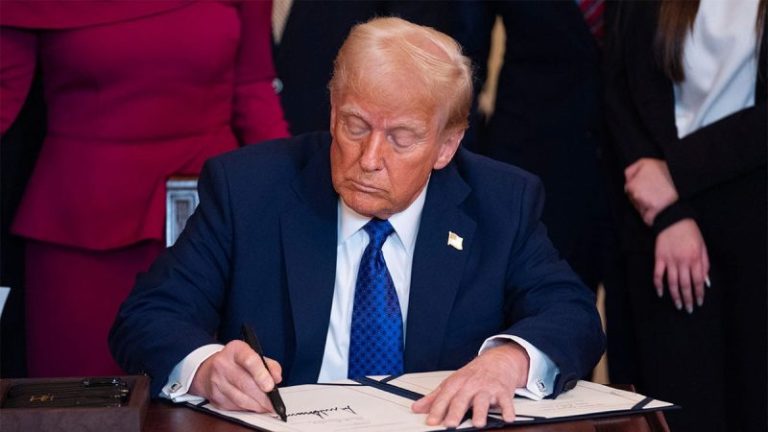
President Donald Trump unveiled an executive order reinstating a ‘maximum pressure’ campaign against Iran on Tuesday, coinciding with a visit from Israeli Prime Minister Benjamin Netanyahu to the White House. 

Trump voiced that he was ‘torn’ on signing the order and admitted he was ‘unhappy to do it,’ noting that that the executive order was very tough on Iran. 

‘Hopefully, we’re not going to have to use it very much,’ Trump told reporters Tuesday. 

The order instructs the Treasury Department to execute ‘maximum economic pressure’ upon Iran through a series of sanctions aimed at sinking Iran’s oil exports. 

His first administration also adopted a ‘maximum pressure’ initiative against Tehran, issuing greater sanctions and harsher enforcement for violations. 

Lawmakers are also interested in exerting more pressure on Iran. For example, Sens. Lindsey Graham, R-S.C., and John Fetterman, D-Penn., along with lawmakers in the House, introduced a resolution on Thursday that affirms that all options should remain on the table in dealing with Iran’s nuclear threat. 

Graham said in a statement Thursday that should Iran obtain a nuclear weapon it would prove ‘one of the most destabilizing and dangerous events in world history.’ 

Additionally, Graham said ahead of Netanyahu’s visit that the moment is right to eliminate Iran’s nuclear threat now, and that the U.S. should back Israel if it chooses to ‘decimate’ Iran’s nuclear program.

‘Israel is strong. Iran is weak. Hezbollah, Hamas have been decimated,’ Graham said in an interview with Fox News Sunday. ‘They’re not finished off, but they’ve been weakened. And there’s an opportunity to hit the Iran nuclear program in a fashion I haven’t seen in decades. And I think it would be in the world’s interest for us to decimate the Iranian nuclear threat while we can. If we don’t, we will regret it later.’

Strict sanctions were reimposed upon Iran after Trump withdrew from the Iran deal, known as the Joint Comprehensive Plan of Action, in May 2018. The 2015 agreement brokered under the Obama administration had lifted sanctions on Iran in exchange for limits on Iran’s nuclear program. 

Meanwhile, Trump signaled in January some optimism about securing a nuclear deal with Iran when asked if he backed Israel striking Iran’s nuclear facilities. 

‘We’ll have to see. I’m going to be meeting with various people over the next couple of days,’ Trump told reporters Jan. 24. ‘We’ll see, but hopefully that could be worked out without having to worry about it.’

‘Iran hopefully will make a deal. I mean, they don’t make a deal, I guess that’s OK, too,’ Trump said. 

Other executive orders that Trump signed on Tuesday include pulling the U.S. out of the United Nations Human Rights Council and cutting funding for the United Nations Relief and Works Agency for Palestine Refugees (UNRWA). 

Fox News’ Morgan Phillips contributed to this report. 

This post appeared first on FOX NEWS

Monday’s market opening was a doozy, with all three indices down nearly 2% in overnight trading. This was in response to President Trump’s 25% tariffs on Mexico and Canada and a 10% tariff on China. Eventually, the indices were able to stem their losses as Trump paused the tariffs on Canadian and Mexican imports for a month, a strategic move aimed at pressuring trade negotiations.

Before the markets stabilized, however, I ran a few scans to identify stocks bucking the trend, looking for resilience amid fears of escalating trade tensions. Using StockCharts’ MarketCarpets, I quickly zoomed in on the Consumer Staples sector—one of the most tariff-sensitive areas likely to impact consumers.

FIGURE 1. MARKETCARPETS 1-DAY VIEW OF CONSUMER STAPLES.  Walmart and Costco were among the top-gaining stocks in the sector. While both are exposed to tariff pressures, their positioning and scale allow them to mitigate the impact differently.Image source: StockCharts.com. For educational purposes.

Following this, I chose to run a scan for Outperforming SPY: 52-Week Relative Highs to identify top-gaining stocks in the Consumer Staples sector.

FIGURE 2. SCAN RESULTS FOR OUTPERFORMING SPY: 52-WEEK RELATIVE HIGHS.  Three big grocery stocks came up—COST, WMT, and SFM.Image source: StockCharts.com. For educational purposes.

Here’s where it gets interesting:

Costco (COST) benefits from a loyal membership base, bulk discounts, and strong private label offerings, helping it absorb tariff-related costs. Its diversified supply chain and purchasing power further mitigate exposure.

Walmart (WMT) enjoys similar economies of scale and private label advantages, but if consumers trade down or cut discretionary spending, margin pressures could weigh on revenues.

Sprouts Farmers Market (SFM) sources some products locally but relies heavily on Mexican imports. If rising prices make customers more price-sensitive, they may shift to larger chains like Walmart or Costco. Among the three, SFM is most at risk in the event of a prolonged trade war with our local neighbors.

Let’s take a one-year look back using the StockCharts PerfCharts and see how these stocks performed relative to the Consumer Staples Select Sector SPDR Fund (XLP), a sector proxy, and the S&P 500 ($SPX).

FIGURE 3. PERFCHARTS ONE-YEAR VIEW OF XLP, COST, WMT, SFM, AND $SPX. Note how far SFM outperformed them all.Chart source: StockCharts.com. For educational purposes.

I’ve written about SFM before, but I wasn’t expecting the stock to have outperformed its peers in the way that it has over the last year. All three stocks outperformed the S&P 500, while XLP underperformed the broader market.

Now it’s time to zoom in, starting with a daily chart of COST.

FIGURE 4. DAILY CHART OF COST. Relative to the Consumer Staples Bullish Percent Index ($BPSTAP), Costco is remarkably bucking the trend.Chart source: StockCharts.com. For educational purposes.

Costco is poised to break above resistance at $1,008, a move that would push the stock to an all-time high. But does it have the momentum to sustain the rally? While breadth in the sector looks weak, with just 29% of stocks flashing Point & Figure buy signals according to the Consumer Staples sector’s Bullish Percent Index (BPI), COST stands out as an exception alongside two other names. The Relative Strength Index (RSI) suggests the stock is entering overbought territory but still has room to run, while the StockCharts Technical Rank (SCTR) has just cleared the bullish 70 threshold, although it has struggled to hold above the ultra-bullish 90 level.

If the breakout fails, key support levels are $908 and $870. Momentum and volume are critical indicators of any potential bounce.

Shifting to a daily chart of WMT, the stock has maintained a steady uptrend with minimal volatility, aside from a summer dip, a sharp November rally, and a December pullback. The stock recently cleared resistance at $96, propelling it toward an all-time high.

FIGURE 5. DAILY CHART OF WMT. The stock price is at all-time highs. Volume and momentum are giving slightly, which may signal a pullback. Watch the Keltner Channel bands that are overlaid on the price chart.Chart source: StockCharts.com. For educational purposes.

The SCTR score remains around 90, signaling strong technical momentum across multiple timeframes. Keep an eye on price as the RSI is signaling potential overbought territory.

In terms of volume, the Chaikin Money Flow (CMF) indicates a surge in buying pressure, reinforcing bullish sentiment. If WMT pulls back, keep an eye on the Keltner Channel bands, which act as both a trend indicator and dynamic support/resistance levels. Additionally, the most recent swing low of around $90 could serve as a key support zone.

Now, the strongest performing stock of the bunch: Sprouts. Below is a daily chart of SFM.

FIGURE 6. DAILY CHART OF SFM. This stock is the outperformer of the bunch. Watch key support levels (blue dashed horizontal lines) should it pull back.Chart source: StockCharts.com. For educational purposes.

Sprouts Farmers Market has exhibited strong technical momentum throughout 2024, mirroring WMT’s bullish trajectory. With the stock breaking above $155 to reach an all-time high, the Money Flow Index (MFI) signals overbought conditions, hinting at a potential pullback. If selling pressure emerges, key support levels to watch include prior resistance at $155, a congestion zone between $138 and $143, and the major swing low around $125. While MFI confirms strong volume and momentum, it also suggests that the rally may be a bit stretched in the short term.

At the Close

Costco, Walmart, and Sprouts Farmers Market have outperformed their sector peers, defying broader weakness in the group. While strong sector performance usually provides a tailwind for individual stocks, the opposite scenario raises concerns that sector-wide pressure could eventually drag these leaders lower. Monitor their key levels closely, especially during pullbacks, to determine whether they present a buying opportunity or a signal to stay on the sidelines.

If some stocks, like COST, are too pricey to buy several positions outright, check out StockCharts’ OptionsPlay Strategy Center to discover alternative strategies that align with your directional bias and risk tolerances, allowing you to capitalize on market opportunities more efficiently.

Disclaimer: This blog is for educational purposes only and should not be construed as financial advice. The ideas and strategies should never be used without first assessing your own personal and financial situation, or without consulting a financial professional.

President Donald Trump said Monday he would create a sovereign wealth fund, a pool of assets like those that exist in other countries that can help pay out regular funds to ordinary citizens.

However, full details on how the fund would work were not immediately available. Trump made the announcement in an Oval Office ceremony. He had floated the idea of creating such a fund during his 2024 presidential campaign.

Treasury Secretary Scott Bessent offered brief remarks at the event outlining the fund.

‘It will be a combination of liquid assets, assets that we have in this country as we work … to bring them out for the American people,’ he said.

Trump said Commerce Secretary Howard Lutnick would also be involved in standing up the fund, which could take as long as a year to establish. Lutnick said Monday that the fund could possibly be used to help take over TikTok, though he did not offer details about how such an endeavor would work.

“The extraordinary size and scale of the U.S. government and the business it does with companies … should create value for American citizens,” Lutnick said. “If we are going to buy 2 billion Covid vaccines, maybe we should have some warrants and some equity in these companies and have that grow for the help of the American people.”

Norway has the largest sovereign wealth fund in the world. It takes oil revenues and reinvests them in assets like stocks. Its current net worth is equivalent to approximately $325,000 per Norwegian citizen.

Other countries with large sovereign wealth funds include China, Saudi Arabia, Australia, Iran and Russia.

Alaska and Texas also have state-run funds.

A 2024 study from the Carnegie Endowment for International Peace found that without proper safeguards, such as governance and regulatory structures, sovereign wealth funds can turn into ‘conduits of corruption, money laundering, and other illicit activities.’

CORRECTION (Feb. 3, 2025, 8:39 p.m. ET): A previous version of this article misattributed a quotation. Howard Lutnick said the U.S. government’s transactions with companies “should create value for American citizens,” not Scott Bessent.

This post appeared first on NBC NEWS

The White House on Monday released a list of projects overseen by the top U.S. aid agency it identified as ‘waste and abuse’ as Elon Musk’s cost cutters seek to dismantle the decades-old provider of foreign aid. 

Musk, a ‘special government employee,’ according to White House press secretary Karoline Leavitt, oversees the newly created Department of Government Efficiency (DOGE). Despite its title, DOGE is not a government agency but has been tasked by the White House’s executive office with dismantling top spending initiatives, and the billionaire’s most recent target is the U.S. Agency for International Development (USAID).

‘For decades, the United States Agency for International Development (USAID) has been unaccountable to taxpayers as it funnels massive sums of money to the ridiculous — and, in many cases, malicious — pet projects of entrenched bureaucrats, with next-to-no oversight,’ the White House said Monday. 

According to a list released by the White House, USAID allocated millions of dollars for programs the Trump administration considers controversial and that frequently involved diversity, equity and inclusion (DEI) initiatives launched during the Biden administration.

At the top of the list was a $1.5 million program slated to ‘advance diversity, equity and inclusion in Serbia’s workplaces and business communities’ and a $70,000 program for a ‘DEI musical’ in Ireland.

Initiatives that supported LGBTQI programs were also flagged as an inappropriate use of taxpayer funds, including $47,000 for a ‘transgender opera’ in Colombia, $32,000 for a ‘transgender comic book’ in Peru and $2 million for sex changes and ‘LGBT activism’ in Guatemala.

Fox News Digital could not independently verify the initiatives detailed by the White House in Colombia or Guatemala. The White House referenced reports about these programs by the Daily Mail, the Daily Caller News Foundation and other outlets. 

The White House also detailed spending initiatives that launched during Trump’s previous administration, including a 2017-2019, $6 million agreement that it said was intended to ‘fund tourism’ in Egypt. 

However, the link referencing the Egyptian program detailed how it was intended to build on previous investments in North Sinai that provided potable water and wastewater services to hundreds of thousands of people and would provide further ‘access to transportation for rural communities and economic livelihood programming for families.’

The White House also outlined USAID’s funding for coronavirus research, including millions of taxpayer dollars supplied to EcoHealth Alliance for coronavirus research, support for contraceptive initiatives and programs that it said benefited terrorists in several countries. 

The future of USAID remains unclear, though the doors to its headquarters were closed Monday, and thousands of employees across the globe sat waiting to hear whether they still had jobs after the apparent Musk takeover.

Secretary of State Marco Rubio has been named the acting director, and he agreed Monday with the White House that the agency needed an overhaul.

‘The president made me the acting administrator,’ he told Fox News. ‘I’ve delegated that power to someone who is there full-time, and we’re going to go through the same process at USAID as we’re going through now at the State Department.’

Questions remain over whether the White House has the legal authority to dismantle an independent agency, and Democratic lawmakers on Monday joined agency employees who stood outside the headquarters protesting the shutdown despite having been told to remain at home. 

Rubio took issue with the protests and referred to them as ‘rank insubordination.’

‘The goal was to reform it, but now we have rank insubordination,’ he said. ‘Now we have basically an active effort — their basic attitude is, ‘We don’t work for anyone. We work for ourselves. No agency of government can tell us what to do.’’

This post appeared first on FOX NEWS
NEWYou can now listen to Fox News articles!

The first two weeks of President Donald Trump’s return tour of the White House have been a whirling dervish of executive orders, governmental reform and thermonuclear transparency, leaving his biggest fans in unmitigated ecstasy. But is he risking going too far, too fast? 

On February 3, three issues dominated the news, all of which pitted the MAGA base’s impulse to burn it all down against the more independent Trump voters who want change, but in less radical doses. 

The fight over the United States Agency for International Development (USAID) was a perfect example of the fundamental tensions Trump is dealing with, and his approach to easing them. 

At around midnight on February 2, Elon Musk, head of the still somewhat murky Department of Government Efficiency (DOGE), announced during a conversation on his social media platform X that Trump had agreed that USAID must be ended. 

Musk asserted that the agency wasn’t an apple with a worm in it, but just a ball of worms that could not be salvaged. 

By morning, MAGA world was on fire, boasting about the latest alphabet agency scalp that DOGE had secured, but this was also likely around the time Secretary of State Marco Rubio was waking up, as the very real and senate confirmed Secretary of State, and realizing this whole situation is actually his problem. 

Rubio spent much of the day giving interviews in which he said he had personally taken over administering USAID, that it would be folded into the State Department, and all programs reviewed, but stopped short of saying the agency would cease to exist, or that its core function, foreign aid, would be abandoned.  

These are not mixed messages; they are different messages for different parts of the Trump coalition. It is a kind of good cop/bad cop routine in which Musk threatens to fire the entire federal government and Rubio says something like, ‘Wouldn’t you rather deal with me? I’m nice.’ 

This arrangement neatly allows Trump to stay, more or less, above the fray, and to judge public reaction to his proposed policies before settling on them. 

We saw something similar on display the following day, with the tariff brinkmanship against Mexico and Canada. After months of promising harsh 25% tariffs on our closest neighbors, Trump pirouetted and jetéd back to a one-month reprieve having gained a few minor concessions. 

Just as with USAID, Trump was making it clear that his finger is on the tariff trigger and that he is willing to pull it, even if he doesn’t want to. 

Finally, that same day, we saw Trump float a proposal to continue aid to Ukraine in its war against Russia as long as Ukraine promises the United States access to the rare earth minerals deep in its soil. 

Republican voters are split about 50/50 on money for Ukraine, and for those who back the blue and yellow news of continued aid was welcome. 

But let’s be clear, much of the MAGA base at this point is opposed to sending Ukraine and its president Volodymyr Zelensky so much as a used toaster oven, and yet the president refused to throw the embattled nation, and the western order, under the bus. 

So much for Trump being Russian President Vladimir Putin’s puppet. And what’s more, the stability Trump is maintaining puts a lot of nervous Americans at greater ease. 

In all three major stories February 3, Trump used chaos to his advantage. To his most die-hard supporters he affirmed his willingness to take a hammer to the deep state, and to those less ardent in their affection, he showed patience and a willingness to compromise. 

Just as with USAID, Trump was making it clear that his finger is on the tariff trigger and that he is willing to pull it, even if he doesn’t want to. 

Trump was carried to a shock popular vote victory on the back of a new coalition of Republican and Independent voters. It is a diverse and growing gaggle that could open the door to generational political power, provided everyone feels they belong and are heard. 

The author Henry Miller said that, ‘chaos is the score upon which reality is written,’ Trump seems to understand this in his bones, even his wavy blond locks express a controlled chaos. 

And isn’t this ultimately what Americans voted for? Radical change under a steady hand, whether one’s emphasis is on the former or the latter? 

So far, Donald Trump is giving the American people both, with breakneck speed, reforming government, while keeping the gears in motion. In other words, he is listening to the people who elected him and giving them what they asked for. 

This post appeared first on FOX NEWS

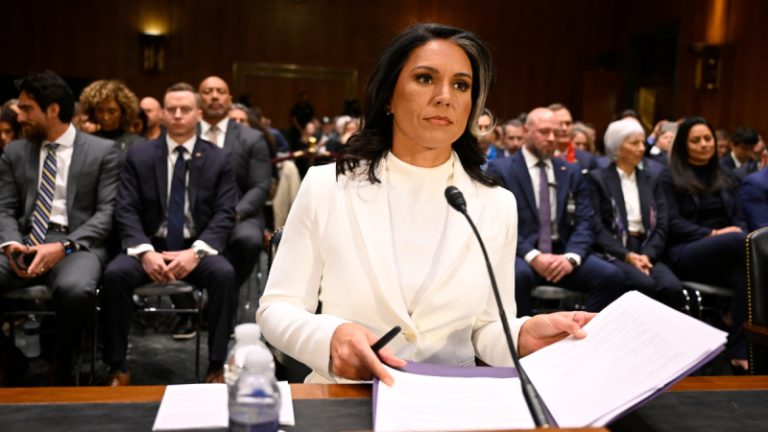
Tulsi Gabbard passed a key committee hurdle on Tuesday, and her nomination will now head to the Senate floor where she’ll get a final confirmation vote. 

President Donald Trump tapped Gabbard, a former Democratic congresswoman, to be Director of National Intelligence (DNI) in his second term. 

‘I’m pleased that the Senate Intelligence Committee voted to advance the nomination of Tulsi Gabbard to be the Director of National Intelligence. Once confirmed, I look forward to working with Ms. Gabbard to keep America safe and to bring badly needed reforms to the Office of the Director of National Intelligence,’ Senate Select Committee on Intelligence Chairman Tom Cotton, R-Ark., said in a statement. 

Gabbard was advanced out of the committee along party lines, 9-8.

She received a last-minute endorsement from Sen. Mike Rounds, R-S.D., a member of the committee, minutes after the vote was scheduled to get underway.

‘I will be voting today for [Gabbard] to serve as President Trump’s Director of National Intelligence. I’ve had the opportunity to work with Tulsi throughout the confirmation process, and I’m confident she will bring a fresh perspective to President Trump’s national security team and the intelligence community. Tulsi and President Trump have my support,’ he wrote on X. 

Some issues the nominee has been pressed on during her confirmation process are her past meeting with former Syrian President Bashar al-Assad, her previous FISA Section 702 stance and her past support for NSA whistleblower Edward Snowden. 

She faced questions about each in her hearing last week. 

Gabbard managed to impress some Republicans on the Intel committee with her answers, as both Sens. John Cornyn, R-Texas, and Susan Collins, R-Maine, revealed afterward that they would vote to advance her. 

Sen. James Lankford, R-Okla., endorsed Trump’s DNI nominee last month after she announced her changed beliefs about section 702, a critical and controversial intelligence gathering tool. 

He reiterated this support after her hearing. 

However, there were remaining questions about certain senators up until the committee’s closed-door vote on Tuesday. Sen. Todd Young, R-Ind., is one of the lawmakers that did not disclose how he would vote until hours before. 

In a statement to Fox News Digital on Tuesday, the senator said, ‘American intelligence officers around the globe deserve our respect and support. I appreciate Tulsi Gabbard’s engagement with me on a variety of issues to ensure that our intelligence professionals will be supported and policymakers will receive unbiased information under her leadership.’

‘I have done what the Framers envisioned for senators to do: use the consultative process to seek firm commitments, in this case commitments that will advance our national security, which is my top priority as a former Marine Corps intelligence officer. Having now secured these commitments, I will support Tulsi’s nomination and look forward to working with her to protect our national security,’ he added. 

In a since-deleted post on X the weekend prior, Trump-aligned billionaire Elon Musk slammed Young as a ‘deep state puppet’ in regard to his uncertainty about Gabbard. 

But the two seemed to patch things up on a phone call soon after.

A spokesperson for Young told Fox News Digital in a statement, ‘Senator Young and Mr. Musk had a great conversation on a number of subjects and policy areas where they have a shared interest, like DOGE.’

Musk also shared on X over the weekend, ‘Just had an excellent conversation with [Young]. I stand corrected. Senator Young will be a great ally in restoring power to the people from the vast, unelected bureaucracy.’ 

This post appeared first on FOX NEWS

The top super PAC supporting House Democrats has created a $50 million fund aimed at finding ways to win back working-class voters thanks to some of the richest Democrats in the country. 

‘We’re laying a marker down now,’ Mike Smith, president of the House Majority PAC, told the New York Times about his group’s ‘Win Them Back Fund,’ which was created to appeal to working-class voters that shifted away from the party in the November election. 

‘This is a priority.’

The list of donors to the House Majority PAC over the last few years includes several Democratic billionaires such as businessman Michael Bloomberg, Illinois Gov. J.B. Pritzker, hedge fund manager Tom Steyer, and Linked In co-founder Reid Hoffman.

FEC records show that Bloomberg gave $13 million to the PAC between 2023 and 2024 to go along with $3 million from Pritzker and $2 million from Steyer.

Hoffman gave over $1.5 million to the PAC, according to FEC records. 

Other high-profile donations to the House Majority PAC include $10 million from philanthropist Fred Eychaner, $3.5 million from investor Stephen Mandel Jr., and $2 million from software developer Chris Wanstrath.

The PAC announced it will target roughly a dozen specific races, including GOP Reps. Nick Begich in Alaska; Eli Crane, in Arizona’s 2nd District; David Valadao, California’s 22nd District; Ken Calvert, California’s 41st District; Gabe Evans, Colorado’s 8th District; Mariannette Miller-Meeks, Iowa’s 1st District; John James, Michigan’s 10th District.

‘One of the major roadblocks we have faced as a party has been declining support among a multi-racial group of working class voters,’ HMP said in a press release this week. ‘That’s why HMP is today launching a 2026 Win Them Back Fund focused on ensuring that we win back working class voters across the congressional battlefield. ‘

‘While Democrats at the Presidential level have consistently lost ground with working class voters for over the last decade, House Democrats like Reps. Adam Gray, Marie Gluesenkamp Perez, Don Davis, and Gabe Vasquez continue to overperform with this crucial bloc of voters. Their victories demonstrate that House Democrats can win back this coalition of voters with the support of strategic investments in recruitment, research, and programming.’

In a statement to Fox News Digital regarding the billionaires’ support, House Majority PAC communications director CJ Warnke said, ‘The Trump administration is currently being run by Ghislaine Maxwell’s BFF Elon Musk and the richest, most elite, and out-of-touch men on the planet.’

‘Their plan is to steal benefits from hardworking Americans and enrich themselves even further, and House Democrats will put an end to their scams and schemes,’ he continued.

A long list of polls, pundits and politicians have publicly concluded since the November election that the Democratic Party shifted away from working-class voters during the presidential campaign, causing Republican victories in key House and Senate races along with President Donald Trump’s return to the White House.

‘It should come as no great surprise that a Democratic Party which has abandoned working class people would find that the working class has abandoned them,’ Sen. Bernie Sanders, I-Vt., posted on X after the election. ‘While the Democratic leadership defends the status quo, the American people are angry and want change. And they’re right.’

This post appeared first on FOX NEWS

The Trump administration is eyeing an expansion of the Abraham Accords, hoping to bring new countries into the agreement, and the rebuilding of Gaza, senior administration officials said before the commander in chief’s meeting with Israeli Prime Minister Benjamin Netanyahu. 

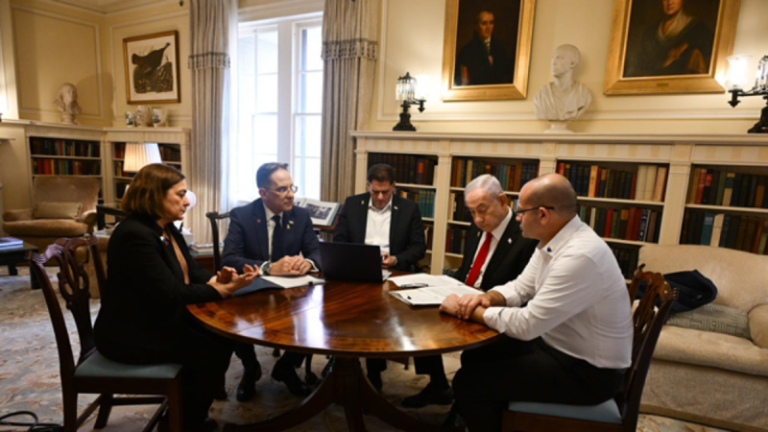
The meeting is set to take place at the White House on Tuesday afternoon, followed by a joint press conference with President Donald Trump and Netanyahu. The meeting and the joint press conference will be the first Trump has held with a world leader since taking office again in January. 

The two leaders are expected to discuss maintaining ceasefire deals and a joint commitment to freeing hostages taken by Hamas on Oct. 7, 2023, senior administration officials said. 

Officials said Trump is focused on getting all hostages out and ensuring Hamas cannot continue to govern. 

Trump and Netanyahu are also expected to discuss the second phase of talks on the Gaza ceasefire and hostage release deal. 

‘There will be unity in how they intend to pursue that,’ one official said. 

Beyond the ceasefire agreement, the president is expected to raise the issue of rebuilding Gaza. 

A senior administration official said Trump sees Gaza as a ‘demolition site,’ and thinks it is ‘inhumane to force people to live’ there in its current state. 

Officials said Trump expects it to take between 10 years and 15 years to rebuild Gaza, but said the rebuild is not something the U.S. is going to solve unilaterally. 

Meanwhile, senior administration officials said the president hopes for an expansion of the Abraham Accords, which was brokered during the first Trump administration. 

The Abraham Accords was a historic peace agreement between Israel and the United Arab Emirates that normalized relations and created bilateral agreements regarding ‘investment, tourism, direct flights, security, telecommunications, technology, energy, health care, culture, the environment, the establishment of reciprocal embassies, and other areas of mutual benefit.’ 

‘We obviously hope that the expansion of the Abraham Accords will continue and flourish, in this administration,’ a senior administration official said, adding that the president sees ‘an opportunity throughout the region and throughout the world, to, to bring more countries into Abraham Accords.’ 

‘It’s going to take time. It’s not going to happen overnight. But that’s certainly on the top of the agenda,’ the official said.  

In 2018, the Trump administration moved the U.S. Embassy from Tel Aviv to Jerusalem – a relocation long debated in Washington – and one that showed the U.S. officially recognizing Jerusalem as the capital of Israel.  

Also during the first Trump administration, the president recognized Israeli sovereignty of the Golan Heights and withdrew the U.S. from the U.N. Human Rights Council. 

The meeting between Trump and Netanyahu is the first since July, when Netanyahu visited Trump’s Mar-a-Lago in Palm Beach, Florida.

That meeting came during the Israeli prime minister’s visit to the U.S. During that visit, Netanyahu addressed Congress and met with former President Joe Biden to meet with families of American hostages held hostage by Hamas.

There are currently 79 hostages held by Hamas in Gaza, including six dual U.S.-Israeli citizens. 

Netanyahu, upon traveling to the U.S., said of Trump: ‘The fact that this will be his first meeting with a leader of a foreign country since his inauguration holds great significance for the State of Israel.’ 

‘First of all, it indicates the strength of the alliance between Israel and the United States. Secondly, it also reflects the strength of our connection; a connection that has already yielded great things for the State of Israel and the region, and has also brought about the historic peace agreements between Israel and four Arab countries – the ‘Abraham Accords’ that President Trump led,’ the prime minister said. 

This comes nearly 16 months after the war in Gaza began, prompted by Hamas’ Oct. 7, 2023, attack against Israel, leading to military retaliation from Israeli forces.

‘The decisions we made during the war, combined with the bravery of our IDF soldiers, have already changed the face of the Middle East,’ Netanyahu said. 

‘They have changed it beyond recognition. I believe that with hard work alongside President Trump, we can change it even more for the better,’ he said. 

Fox News’ Landon Mion, Yael Rotem-Kuriel and The Associated Press contributed to this report. 

This post appeared first on FOX NEWS

If you thought this would be it for Travis Kelce, think again.

Retirement rumors have swirled around the tight end for years now, especially as the Kansas City Chiefs continue their run of success. It would be a bit surprising for Kelce to hang up his cleats in the midst of a dynasty, but the 35-year-old has already positioned himself for life after the NFL.

Between those countless ventures and his ongoing relationship with Taylor Swift, no one would blame the star from walking away.

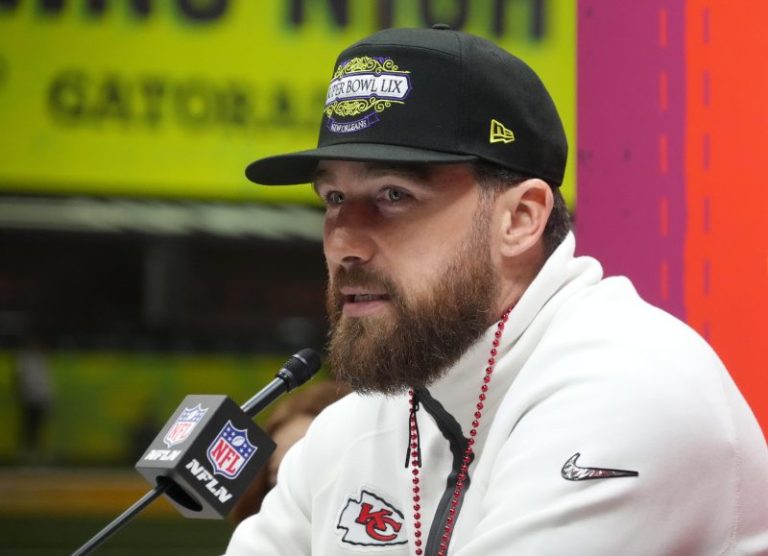
Regardless, his focus now, and into the future, is still on football. During Super Bowl opening night, Kelce was asked about where he sees himself in three years.

NFL STATS CENTRAL: The latest NFL scores, schedules, odds, stats and more.

‘Hopefully still playing football,’ Kelce said. ‘I love doing this, I love coming into work every day. I feel like I still have a lot of good football left in me. We’ll see what happens. I know I’ve been setting myself up for other opportunities in my life. That’s always been the goal knowing football only lasts for so long. You have to find a way to get into another career and another profession. I’ve been doing that in my offseason. But for the most part, I plan on being a Kansas City Chief and playing football.’

A third-round pick in the 2013 NFL draft, Kelce was an imperfect prospect coming out of college. Andy Reid, former Philadelphia Eagles and current Chiefs head coach, made the decision to draft the younger Kelce after his brother, Jason, vouched for him.

In the now-famous draft story, Kelce and Reid, who drafted both brothers, have spoken about how the relationship came to exist.

‘I guess he told my brother ‘Make sure this kid doesn’t screw this up for me,” Kelce told Fox Sports’ ‘The Herd’ in 2017 about his draft call with Reid. ‘I get back on. ‘Alright, we’re gonna take you. This minute you start to go astray I’m going to kick your (expletive).’”

Kelce delivered and has also been remarkably durable over the years as missing games is a rare occurrence. Since appearing in just one game during his rookie year, the tight end has been a regular in Chiefs’ games ever since.

Father Time comes for all, however. After posting seven straight seasons with at least 1,000 yards, Kelce has dropped below that mark in each of the last two, posting a career-low in 2024 with just 823. He also scored just three touchdowns during the regular season, also a career-worst.

As the Chiefs get set to play for a record third-straight Super Bowl win and their second in three years against the Eagles, there is a notable absence on the other sideline. Kelce’s older brother, Jason – who announced his retirement after last season – will just be a fan this time around.

‘Of course I wish Jason was out there,’ Travis Kelce said. Being at the mountaintop with your brother is something special that I’ll never forget.’

Retirement has treated Jason nicely. In addition to co-hosting the ‘New Heights’ podcast, he’s been part of ESPN’s ‘Monday Night Football’ broadcasts all season, and also secured a late-night show on the network for the NFL playoffs. He’s been seemingly everywhere since stepping away from the game in March 2024, but Travis still wishes his brother didn’t call it quits.

‘I wish he would have played another year, but he’s very content where he is in life right now and I’m happy as hell for him,’ Kelce said. ‘He gets to be around his family and his baby girls a little bit more. I’ll go out there and try to represent the family as best I can.’

While it doesn’t appear he’ll walk away from football after Super Bowl 59, Kelce is entering the final year of his contract with the Chiefs.

He’ll be 36 when that time comes and retirement questions will only get louder as time goes on.

Then again, Kelce has always thrived in the chaos.

This post appeared first on USA TODAY

Cooper Kupp apparently showed the Los Angeles Rams’ hand on Monday when the former Super Bowl MVP said the team hoped to trade him this offseason.

Orchestrating a deal for the 31-year-old, however, might not come easily.

After winning the NFL’s receiving triple crown in a campaign in which he was named the league’s Offensive Player of the Year, Kupp has missed 18 regular-season games in the last three seasons due to injury. Compounding the complications are the financial factors, as Kupp is due a $7.5 million roster bonus and $12.5 million in salary in 2025. That payout might prove untenable for teams poking around on a player who has not reached 850 receiving yards in a season since 2021, meaning the Rams might need to either be willing to foot the bill for a portion of what Kupp is due or outright release him.

Regardless, the receiver’s market should materialize in the coming weeks.

Here are six teams that could be fits for Kupp, either in a potential trade or as a free-agent landing spot if he’s released.

All things Rams: Latest Los Angeles Rams news, schedule, roster, stats, injury updates and more.

Houston Texans

It’s easy to draw the connection here after Nick Caley, who last year served as the Rams’ passing game coordinator, was hired to be Houston’s offensive coordinator. Caley was only with Los Angeles for the last two years, so he hasn’t worked with Kupp at his peak. But there’s little question that Houston should be evaluating options for a trusted target given Tank Dell’s uncertain timeline for a return from his gruesome knee injury suffered in December and Stefon Diggs’ free-agent status. Kupp could take over Diggs’ work as a short-to-intermediate target while allowing Nico Collins to remain the focal point of the offense, and his addition could help C.J. Stroud better navigate the protection problems that plagued the attack in 2024. The financials, however, could be tricky, as Houston currently has just $101,000 in cap space, according to Over The Cap.

New England Patriots

With a league-high $120 million in cap space at their disposal, the Patriots should be plenty active this offseason in reshaping their offense around Drake Maye. But might New England have their sights set on other pass catchers? Tee Higgins looks to be the most transformational figure available for the aerial attack, and New England is well positioned to win any bidding war it chooses to enter for the pending free agent. Still, Kupp could be one part of an overhaul of the receiving corps, and he could help New England claw closer to Robert Kraft’s stated desire of getting back to the playoffs.

Washington Commanders

Another team flush with cap space, the Commanders have more than $78 million available for 2025. That doesn’t mean that Dan Quinn and Adam Peters will rush out to burn the flexibility afforded to them by Jayden Daniels’ rookie deal, but Washington might be more equipped than many other teams to tolerate some risk here. A solid No. 2 receiver could elevate the attack given that no wideout came within half of Terry McLaurin’s 1,096 receiving yards on the season. Kupp would serve as a fine complement to McLaurin, who is arguably the league’s best in contested catch scenarios and thrives as a downfield option. But the two-time Pro Bowler is also due a hefty extension, and Washington might not want to reconfigure its receiver room around another high-cost option.

Chicago Bears

They’re not exactly a move away from contending for the NFC North crown, so maybe this move would be a tough sell for general manager Ryan Poles. But Chicago does have nearly $63 million in cap space available, ranking sixth among all teams. And after the Keenan Allen acquisition backfired, the Bears could stand to add a safety valve for Caleb Williams as the quarterback tries to master new coach Ben Johnson’s offense by learning to play more on schedule.

Denver Broncos

This doesn’t seem like a pure Sean Payton move, as the coach might be more inclined to fill a void for the Joker role of a running back or tight end who can create mismatches in the passing game with their versatility. But finding a veteran playmaker in free agency could prove difficult, and Denver has to consider all of its options for better supporting Bo Nix in Year 2 of the quarterback’s tenure. Establishing more consistency might begin with finding any pass catchers who can regularly create separation in the intermediate area, and Kupp can step in to solve that issue.

Pittsburgh Steelers

Mike Tomlin’s team doesn’t have clarity at quarterback yet after the coach said the team needed to weigh all of its options with Russell Wilson and Justin Fields both currently ticketed for free agency. No matter what the plan of attack behind center, however, a receiving corps that too often depended on volatile wideout George Pickens is due for a recalibration. Kupp could represent one of Pittsburgh’s better shots at implementing a more sustainable offense in 2025, and his blocking should make him a fast favorite of both Tomlin and offensive coordinator Arthur Smith.

The USA TODAY app gets you to the heart of the news — fast.Download for award-winning coverage, crosswords, audio storytelling, the eNewspaper and more.

This post appeared first on USA TODAY