Archive

2025

Browsing

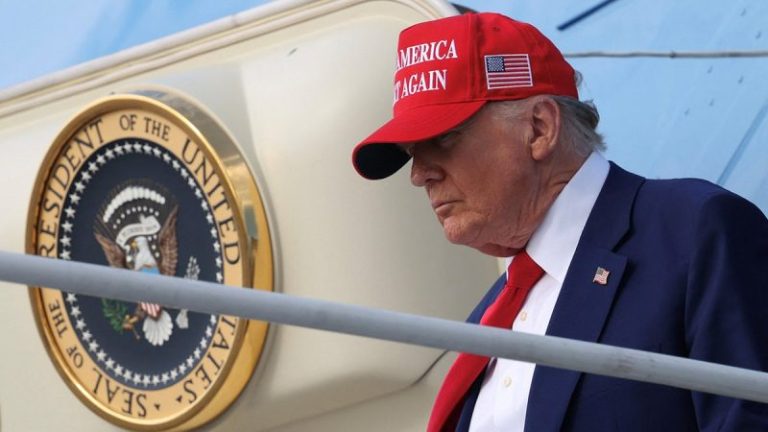
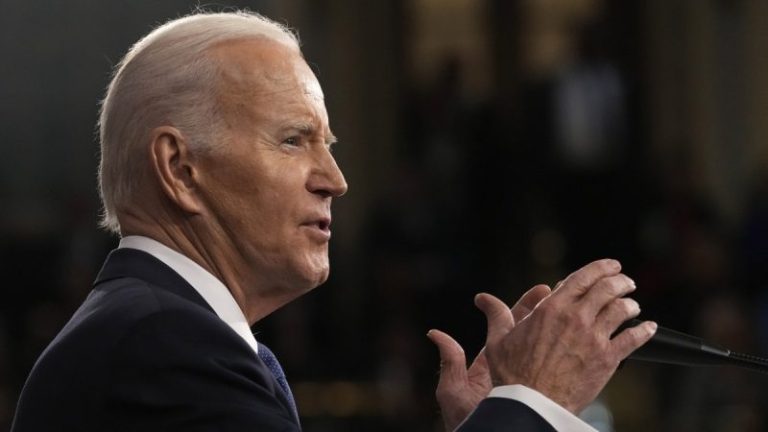
The U.S. 8th Circuit Court of Appeals put a final end to former President Joe Biden’s student loan forgiveness plan on Tuesday.

Missouri Attorney General Andrew Bailey originally sued the Biden administration over its nearly $500 billion effort to wipe away student loans, known as the SAVE plan. The court’s Tuesday ruling found that Biden’s secretary of education had ‘gone well beyond this authority by designing a plan where loans are largely forgiven rather than repaid.’

Bailey noted in a statement that the ruling has no active impact beyond blocking future presidents from attempting Biden’s maneuver.

‘Though Joe Biden is out of office, this precedent is imperative to ensuring a President cannot force working Americans to foot the bill for someone else’s Ivy League debt,’ Bailey said in a statement.

The Supreme Court of the United States denied the Biden administration’s request to lift a block on the SAVE plan last year. A federal appeals court in Missouri had earlier blocked the entire SAVE program from being enforced while litigation over the merits continues in the lower courts. The Department of Justice, which is part of the Biden administration, most recently asked the high court for emergency relief.

The Biden administration argued the court went too far when it issued a nationwide injunction, which effectively put a temporary freeze on the SAVE plan.

‘Our Administration will continue to aggressively defend the SAVE Plan – which has helped over 8 million borrowers access lower monthly payments, including 4.5 million borrowers who have had a zero dollar payment each month,’ a White House spokesperson told Fox News Digital at the time. ‘And, we won’t stop fighting against Republican elected officials’ efforts to raise costs on millions of their own constituents’ student loan payments.’

Biden introduced SAVE after the Supreme Court struck down his initial student loan forgiveness plan. The White House said that the SAVE plan could lower borrowers’ monthly payments to zero dollars, reduce monthly costs in half and save those who make payments at least $1,000 yearly. Additionally, borrowers with an original balance of $12,000 or less will receive forgiveness of any remaining balance after making 10 years of payments.

Fox News’ Greg Wehner contributed to this report.

Read the full 8th Circuit ruling here:

This post appeared first on FOX NEWS

The Senate confirmed Howard Lutnick on Tuesday to serve as President Donald Trump’s secretary of commerce. 

The Republican-controlled Senate voted to confirm Lutnick on Tuesday, less than a week after senators voted to invoke cloture on his nomination. He needed a simple majority for a full Senate confirmation, getting confirmed on a 51- 45 tally on Tuesday.

Lutnick passed his procedural vote last week after the Senate Commerce, Science, and Transportation Committee voted 16-12 to motion for cloture on Feb. 5. 

Lutnick said he aligns with Trump’s ‘trade and tariff agenda,’ which seeks to remedy trade imbalances by imposing reciprocal tariffs. His confirmation indicates a milestone for Trump’s America First policy agenda. 

Lutnick, chair and CEO of investment firm Cantor Fitzgerald, is one of the wealthiest people to serve in a presidential administration. Lutnick vowed to divest his financial interests upon confirmation to remain impartial. 

‘My plan is to only serve the American people. So I will divest, meaning I will sell all of my interests, all of my business interests, all of my assets, everything,’ Lutnick said. ‘I’ve worked together with the Office of Government Ethics, and we’ve reached agreement on how to do that, and I will be divesting within 90 days upon my confirmation.’

During his confirmation hearing on Jan. 29, Lutnick said he would sell his businesses and elect someone else to lead them once confirmed. Lutnick aligned closely with Trump’s trade and tariff policies during the hearing. He said it’s ‘nonsense’ that tariffs create inflation and advocated for reciprocity. 

‘We are treated horribly by the global trading environment. They all have higher tariffs, non-tariff trade barriers and subsidies. They treat us poorly. We need to be treated better. We can use tariffs to create reciprocity,’ Lutnick said.

Trump last week directed federal agencies to explore the implementation of reciprocal tariffs to remedy tariff imbalances imposed by countries that sell American products. The presidential memorandum directed Lutnick to study reciprocal trade relations within 180 days. Lutnick said Thursday he will have the report ready by April 1. 

Trump also announced last week a 25% tariff on all steel and aluminum imports from all countries, adding up to a 35% tariff for Chinese steel and aluminum imports. The tariffs are set to begin March 12. 

Trump nominated Lutnick to serve as commerce secretary two weeks after he was elected. Lutnick was a co-chair of Trump’s 2024 presidential transition team. 

‘I am thrilled to announce that Howard Lutnick, Chairman & CEO of Cantor Fitzgerald, will join my Administration as the United States Secretary of Commerce. He will lead our Tariff and Trade agenda, with additional direct responsibility for the Office of the United States Trade Representative,’ Trump said in the announcement.

Trump praised Lutnick’s leadership during the presidential transition and said he ‘created the most sophisticated process and system to assist us in creating the greatest Administration America has ever seen.’

This post appeared first on FOX NEWS

DOGE chief Elon Musk revealed details about his thought process on endorsing President Trump during a sit-down interview with Trump and Fox News anchor Sean Hannity on Tuesday night that the president said he had not heard before.

‘I was going to do it anyway,’ Musk said during the interview that aired Tuesday night when Hannity mentioned that his endorsement of Trump came after an attempt on his life in Butler, Pennsylvania on the campaign trail.

‘That was it?’ Hannity said.

‘That was a precipitating event,’ Musk said. 

‘That sped it up a little bit?’ Trump then said to Musk. ‘I didn’t know that.’

Musk responded, ‘It sped it up, but I was going to do it anyway.’

Musk announced that he ‘fully supports’ former President Trump after gunshots rang out at his Pennsylvania rally in July in a move that many, including some Democrats, believe played a significant role in Trump’s campaign.

‘Not even just that he has endorsed [Trump], but the fact that now he’s becoming an active participant and showing up and doing rallies and things like that,’ Dem. Sen. John Fetterman told the New York Times in October, explaining that the enormously successful Tesla and SpaceX CEO is an attractive figure for the kinds of voters Harris needs to win.

‘I mean, [Musk] is incredibly successful, and, you know, I think some people would see him as, like, a Tony Stark,’ said Fetterman, referencing the popular Marvel Comics character. ‘Democrats, you know, kind of make light of it, or they make fun of him jumping up and down and things like that. And I would just say that they are doing that at our peril.’

In an interview with CNN, Fetterman added, ‘Endorsements, they’re really not meaningful often, but this one is, I think. That has me concerned.’

Fox News Digital’s Chris Pandolfo contributed to this report

This post appeared first on FOX NEWS

SCOTTSDALE, Ariz. — Spring training has just begun, with opening day still a month away, but players and executives echo the phrase no one in the industry wants to hear:

Work stoppage.

The Collective Bargaining Agreement doesn’t expire until Dec. 1, 2026, with two full seasons still to be played, but you can’t stroll into a spring training camp without hearing about it.

Many team owners already are campaigning for a salary cap, blaming the Los Angeles Dodgers and New York Mets with payrolls exceeding $300 million, convincing their fans they can’t compete with the huge payroll disparity.

Players are blaming the owners, saying that everyone should act like the Dodgers and Mets and do everything they possibly can to win a World Series championship.

Follow every MLB game: Latest MLB scores, stats, schedules and standings.

Tony Clark, executive director of the Major League Baseball Players Association, hears it too, as he begins talking to all 30 teams beginning Tuesday with the Arizona Diamondbacks and Cleveland Guardians.

“When the commissioner suggests openly that the expectation is a work stoppage and that a lockout is the new norm or should be considered as much,’ Clark told USA TODAY Sports, “that’s going to lend itself to some conversation even though we’re a year and a half, two years away from the expiration of the agreement.

“We’ll continue to talk about it openly too. It’ll be in an environment where the game seems to be moving forward positively, while the other side keeps interjecting negativity into the conversation. But we’ll navigate it accordingly.’

It’s perfectly clear that no matter how much rhetoric there is about a salary cap over the years, the union has never altered its stance.

“I’ll say this, the league has been interested in a salary cap for decades,’ Clark said at the union’s office before the Players Trust Playmakers Classic event Tuesday.

“And our position has been the same for decades.’

Instead of moaning and groaning about the Dodgers’ $390 million payroll, or Mets owner Steve Cohen signing Juan Soto for a record $765 million, perhaps, Clark suggests, it’s time to emulate them.

“I have a dream,’ Clark said, “that starting the year all 30 teams would be committed to be the last team standing.’

Yet, the reality is that 22 of the 30 teams have lowered payroll this season, with only five free agents receiving contracts of at least five years. While there has been nearly $3.2 billion spent in free agency, pleasing the union, eight teams have accounted for about 75% of the spending. There are 14 teams that have spent less than $45 million in an industry that generated a record $12.1 billion last year.

“It’s interesting that more questions aren’t being asked of those teams,’ Clark said of the teams that lowered their payroll. “We’re in a climate where there have been releases highlighting how well the industry is doing, and that the revenue in the industry is growing at all-time highs, and yet we’ve got two-thirds of the league that seems to be sitting on its hands.’

Clark also points out that owners claiming poverty seem to have money for other investments.

“Hypothetically speaking, it’s an interesting dynamic when a club says it doesn’t have any money,’ Clark said, “but it’s otherwise investing hundreds of millions in properties around the ballpark. And then leveraging the value it creates for the club to take more money to do more more with that property, all while running a professional ballclub. …

“I always find it fascinating when clubs talk about their finances and do so against the backdrop of an industry that’s growing as quickly as this one. That’s an interesting dynamic.’

There’s something amiss when 19 teams have spent less than the Athletics, who broke club-records in the free-agent market only because they were forced to raise their payroll as a revenue-sharing recipient. The union can file a grievance if revenue-sharing recipients don’t have a payroll of at least 150% of what they receive in assistance to improve their performance.

“It was good to see a team involved in improving itself and accessing the free agent market to do so,’ Clark said. “It will be exciting when all 30 teams are looking to be the last team standing.’

Clark is not suggesting that all teams have to spend money like the Dodgers or the Mets, but believes there’s no reason why all 30 teams can’t have the same desire to win. Money doesn’t guarantee a championship, with only four of the highest-spending teams winning the World Series in the past 25 years, but it can certainly provide hope.

“It’s amazing, when you talk to a player, he’s going to challenge whoever is assumed to be at the mountaintop,’ Clark said. “Fans are too, except they want to see their teams put themselves in the best position to challenge, and that’s simply not happening.

“It’s a concern, it has been a concern in the past, and it’s a concern now.’

Instead of calling the Dodgers the new “Evil Empire,’ perhaps they should be the model franchise for all to emulate.

Instead of complaining about the Dodgers and their $1 billion in deferred contracts, there’s no reason why other teams can’t follow suit. You don’t have to be a big-market team to defer contracts. Everyone has the right.

“We want to make sure that the clubs and the players have as much flexibility to sign they deals they want to sign,’ Clark said, “and the [clubs] to get the players that they want to sign.

“That flexibility has been there for a long time. Some clubs have been taking advantage of it. Some have not. The Dodgers have started taking advantage of it more. But there’s no reason other clubs can’t do it too.

“There’s flexibility there. It’s there for a reason despite the fact that the league has been interesting in trying to remove it.’

It’s too early for dialogue between MLB and the union for the next CBA. The two sides aren’t expected to even begin talking about minor issues until January 2026. But that day is approaching, and already it has become a burning topic.

“I try to be a glass half-full guy,’ Clark said.

Follow Nightengale on X: @Bnightengale

The USA TODAY app gets you to the heart of the news — fastDownload for award-winning coverage, crosswords, audio storytelling, the eNewspaper and more.

This post appeared first on USA TODAY

The silence from the Baltimore Ravens and the NFL on Justin Tucker is, sadly, not at all surprising.

It’s now 16 female massage therapists who’ve said the star kicker was sexually inappropriate with them during massages, and the details reported by The Baltimore Banner are disturbingly similar. Tucker intentionally exposed himself during massages booked outside the team, the women said. In some cases, therapists said he brushed his erect penis against them. At least four therapists told the Banner they found what appeared to be ejaculate on the sheet after Tucker left.

Several of the women provided corroboration of their experiences, and two spas told the Banner they had banned Tucker because of his inappropriate behavior.

Yet all the Ravens will say is that they’re “aware” of the allegations against Tucker, long one of their most high-profile players, as well as his denial of them. The NFL says it is reviewing the matter under its personal conduct policy, with no timeline for a decision.

“We take any allegations of this nature seriously and will continue to monitor the situation,” the Ravens said.

NFL STATS CENTRAL: The latest NFL scores, schedules, odds, stats and more.

How many more women need to come forward before the Ravens or the NFL take action? 15? 30? 100? What happened to that “zero tolerance” policy coach John Harbaugh so proudly noted when he was asked about the last NFL player to sexually abuse massage therapists?

“I respect what (owner) Steve Bisciotti has created here … really almost 10 years ago. We’re kind of zero tolerance,” Harbaugh said in August 2022 in response to Deshaun Watson’s suspension.

“You’ve got to know the truth, you’ve got to try to understand the circumstances,” Harbaugh added. “But we’ve stayed away from that particular situation. When we draft players, when we sign them as free agents. We just haven’t dealt with it. That’s Steve’s decision, and I’m glad we have that policy.”

Baltimore has that policy because of the abysmal way it handled Ray Rice punching his then-fiancee, Janay, in a casino elevator, knocking her unconscious, an incident that laid bare the disdain the NFL has for women.

Don’t let the league’s cheerleading for girls playing flag football or its Super Bowl ads starring self-confident, empowered young women fool you. Don’t be duped by the pink backpacks and Raven-themed thongs and bralettes Baltimore is pushing at its team store.

More than 10 years after Ray Rice, any ‘changes’ the NFL has implemented is lip service at best. The NFL still sees women solely as commodities, their only worth as consumers and to pump up its participation numbers. The Ravens still don’t see abuse of women as a disqualifier.

If a player, especially one as popular as Tucker, harms women, oh well.

Tucker insists he “did not act inappropriately,” and characterized the Banner’s reporting as “desperate, tabloid fodder.” But just as in Watson’s case, it is the sheer volume of women that is so damning. This is not one or two women complaining (though even that would be too many). It is 16, most of whom did not know each other or work together.

Also, just as in Watson’s case, it has to be asked why a professional athlete, whose body is his livelihood, would go to so many different massage therapists without knowing if they’re good or bad, competent or inept. Especially when every NFL team employs or contracts their own.  

It does not matter that these incidents allegedly occurred years ago, between Tucker’s rookie season in 2012 and 2016, or that Tucker has built a seemingly pristine reputation in his 13 years in Baltimore. Degrading a woman is wrong no matter when it happens or who’s doing it, and the lack of urgency from the Ravens and the NFL is telling.

The NFL has proven it can move quickly when it feels a player has tarnished its precious shield. The league is also notorious for its lack of loyalty when players get old and less productive. Yet almost three weeks after the Banner published its first story, the Ravens are still holding on to a 35-year-old kicker who just had the worst season of his career.

Tucker might be a future Hall of Fame kicker. He might also be a sexual predator. That the NFL and the Ravens can’t recognize which of those matters more is not a surprise. They’ve never cared about women and they never will.

Follow USA TODAY Sports columnist Nancy Armour on social media @nrarmour.

This post appeared first on USA TODAY
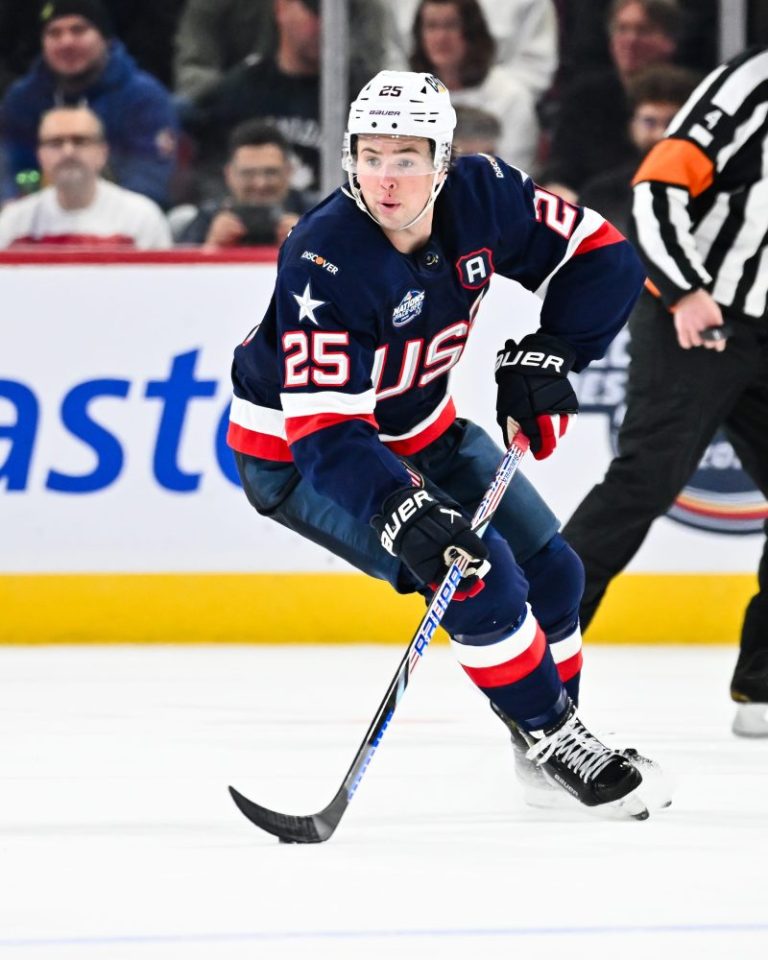
Team USA is dealing with a slew of injuries before playing Canada in the 4 Nations Face-Off final on Thursday at TD Garden in Boston.

The Americans lost to Sweden 2-1 on Monday and played with a depleted lineup as forwards Matthew Tkachuk and Auston Matthews sat out and forward Brady Tkachuk was injured in the first period, returned from the dressing room for one shift and didn’t return for the second period.

Team USA coach Mike Sullivan told reporters Tuesday he expects those three to be available for Thursday’s game.

Defenseman Charlie McAvoy is also on the shelf. The Boston Bruins on Tuesday announced that McAvoy was admitted to Massachusetts General Hospital to undergo testing related to an ‘upper-body injury’ and will not play in the championship game on Thursday.

Charlie McAvoy injury

McAvoy, a 27-year-old defenseman, was admitted to Massachusetts General Hospital on Monday night to undergo testing related to an upper-body injury sustained during the 4 Nations Face-Off and was being evaluated on Tuesday, the Bruins announced.

The team, which also announced that McAvoy will not play in Thursday’s championship game, said it will provide further updates on McAvoy’s condition and status as they become available.

Sullivan said Vancouver Canucks defenseman Quinn Hughes is coming to Boston ahead of the final.

NHL deputy commissioner Bill Daly told USA TODAY by email that ​Hughes can play ‘only in the event Team USA has an injury emergency prior to (the) game on Thursday that leaves them at below six healthy defensemen.’

Hughes, last year’s Norris Trophy winner, was named to the original team but was ruled out because of a pretournament injury. He has 59 points, matching the total of the USA’s top-scoring defenseman, Zach Werenski.

In 2022, McAvoy underwent a left shoulder arthroscopic stabilization procedure, which put him out for six months. He has also had numerous upper body injuries during his eight-year NHL career.

McAvoy is married to Sullivan’s daughter, Kiley, and the two welcomed a son last month. Sullivan is the Penguins head coach.

“We’re hopeful we’re going to get some of these guys back. I would anticipate we would. We’ll have to wait and see how things play out here over the next day or so,’ Sullivan said Monday night. ‘Obviously, there will be contingency planning in the event that we need people.’

McAvoy has seven goals and 16 assists this season for Boston.

All the players and the plays: Sign up for USA TODAY’s Sports newsletter.

This post appeared first on USA TODAY
Harlow, 30, and her NBA star beau Kyle Kuzma, 29, revealed in an exclusive interview with Vogue, published Tuesday, that they got engaged during a romantic trip to Turks and Caicos. Disguised as a getaway for the long weekend, Kuzma chartered a private plane filled with roses, balloons, Champagne and chocolate to jet them off to the Caribbean islands.

‘We’re over the moon,’ Harlow told Vogue.

There, the 6-foot-9 Milwaukee Bucks newcomer ‘threw me off the scent’ by choosing Feb. 13 for his proposal. Harlow gushed to Vogue. ‘I was just like, ‘This is so cute for Valentine’s Day, oh my gosh!”

The Cay Skin founder started to have her suspicions when Kuzma started reading her a poem he’d written but tried to not have any expectations. That is, until he read his final line: ‘Will you be my wife?’

Need a break? Play the USA TODAY Daily Crossword Puzzle.

Vogue noted Harlow gave an immediate yes before her newly minted fiance could propose with the 8.5-carat oval-cut engagement ring he’d spent three months custom designing.

Of the design, which features two baguette stones on the side, Kuzma said: ‘I never really asked her what type of ring she liked or anything. I just wanted to draw a picture of what I felt resembled her — something that was elegant, but very timeless and simplistic at the same time.’

To top it all off, both their families were there to celebrate the couple’s milestone.

A DJ played Jagged Edge’s ‘Let’s Get Married’ as the happy couple arrived at their villa, and everyone enjoyed a surf and turf dinner on the beach. A fireworks show was the cherry on top for Kuzma and Harlow’s engagement story.

Just a week earlier, Harlow had a prime role in opening Christian Siriano’s fall/winter 2025 runway show at New York Fashion Week. She took the lead as the first model to kick off the show, donning a black minidress with red draping in the skirt and off the shoulder, USA TODAY’s Anika Reed reported from the star-studded event. The star-studded front row featured the likes of Katie Holmes, Whoopi Goldberg, Laverne Cox, Danielle Brooks and Julianne Hough.

She also closed out the show with Siriano muse Coco Rocha, with the two holding hands for the grand finale.

Kyle Kuzma ‘slid in the DMs’ twice to get Winnie Harlow’s attention

Kuzma and Harlow first connected ‘at the top of quarantine’ in 2020, when the NBA forward messaged Harlow on Instagram. It was actually his second time reaching out to the model, because Harlow never saw his first message from a year prior.

‘He shot his shot, you know? He slid in the DMs,’ Harlow explained on The Ellen DeGeneres Show in 2021. ‘That was cute. I was like, ‘Oh hey, how has quarantine been? We kind of just started talking from there.’

‘After a month of being on FaceTime for 24 hours every single day for a month, he was like, ‘You’ve got to come to LA.’ And I’ve been in LA every since,’ she added.

This post appeared first on USA TODAY
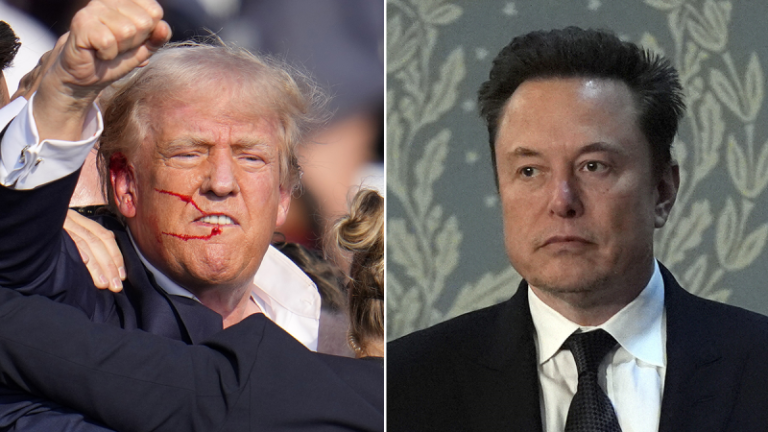
President Donald Trump issued an unsmiling warning to bureaucrats on Tuesday, ordering that leaders of government agencies begin to be ‘radically transparent’ about spending.

The White House published a memo entitled ‘Radical Transparency About Wasteful Spending’ on Tuesday afternoon, directed at the heads of executive departments and agencies.

The memo begins by arguing that the American government ‘spends too much money on programs, contracts, and grants that do not promote the interests of the American people.’

‘For too long, taxpayers have subsidized ideological projects overseas and domestic organizations engaged in actions that undermine the national interest,’ the note continues. ‘The American people have seen their tax dollars used to fund the passion projects of unelected bureaucrats rather than to advance the national interest.’

‘The American people have a right to see how the Federal Government has wasted their hard-earned wages.’

Trump continued the memo by ordering that all heads of executive departments and agencies must ‘take all appropriate actions to make public, to the maximum extent permitted by law…the complete details of every terminated program, cancelled contract, terminated grant, or any other discontinued obligation of Federal funds.’

‘Agencies shall ensure that such publication occurs in accordance with all applicable laws, regulations, and the terms and conditions of the underlying contract, grant, or other award,’ Trump continued.

The memo came as Trump’s Department of Government Efficiency (DOGE) commission continues to audit government agencies with a mission to reduce waste. On Monday night, White House press secretary Karoline Leavitt appeared on ‘Hannity’ to express support for DOGE’s audits.

‘[L]isten to the words from those Democrat politicians, you would think you are listening to President Trump, Elon Musk and our entire administration, who are saying the exact same things that Democrat politicians promised the American people they would do for decades,’ Leavitt said. ‘President Trump is just the first president in our lifetimes to actually do it.’

‘And now you see the Democrat Party and the mainstream media spiraling out of control about a very simple promise: rooting out waste, fraud and abuse from our federal bureaucracy,’ she continued. ‘This is a promise President Trump campaigned on. He is now delivering on it.’

This post appeared first on FOX NEWS

President Donald Trump signed an executive order on Tuesday to expand access to in vitro fertilization (IVF) and other fertility treatments through the reduction of out-of-pocket costs.

IVF has become unaffordable for many Americans, and Trump’s executive order directs the Domestic Policy Council to find ways to make IVF and other fertility treatments more affordable.

White House press secretary Karoline Leavitt posted about the order shortly after it was signed.

‘PROMISES MADE. PROMISES KEPT: President Trump just signed an Executive Order to Expand Access to IVF!’ she wrote on X. ‘The Order directs policy recommendations to protect IVF access and aggressively reduce out-of-pocket and health plan costs for such treatments.’

Sen. Katie Britt, R-Ala., expressed gratitude on X after learning the president had expanded access to IVF.

‘Thank you, @POTUS! Yet another promise kept,’ Britt wrote. ‘IVF is profoundly pro-family, and I’m proud to work with President Trump on ensuring more loving parents can start and grow their families.’

Trump pledged on the campaign trail that if he won a second term, he would mandate free in vitro fertilization treatment for women.

‘I’m announcing today in a major statement that under the Trump administration, your government will pay for — or your insurance company will be mandated to pay for — all costs associated with IVF treatment,’ Trump told the crowd at Alro Steel in Potterville, Michigan,  back in August. ‘Because we want more babies, to put it nicely.’

IVF treatments are notoriously expensive and can cost tens of thousands of dollars for a single round. Many women require multiple rounds, and there is no guarantee of success.

Trump’s announcement, which was short on details, came after he faced intense scrutiny from Democrats for his role in appointing Supreme Court justices who overturned Roe v. Wade, sending the issue of abortion back to the states. 

Trump has tried to present himself as moderate on the issue, going as far as declaring himself ‘very strong on women’s reproductive rights.’

Fox News Digital’s Bradford Betz contributed to this report.

This post appeared first on FOX NEWS

The two-week window for NFL teams to apply the franchise tag to pending unrestricted free agents (UFAs) opened Tuesday.

Among stars with expiring contracts, the tag is often an unpopular mechanism as it hinders (or completely eliminates) the ability to negotiate with other clubs during free agency. And while the one-year tag pays well – generally speaking, its value is based on the average of the top five salaries at a player’s respective position – it doesn’t offer the security of a long-term contract and prevents players from approaching the top of their financial market … though for some, typically players not drafted in the first round, the tag is a welcome windfall after they’ve outperformed a rookie contract.

Yet tags can also be a precursor to a trade or simply a placeholder that allow a player and his camp more time to hammer out a long-term arrangement (see Lamar Jackson, circa 2023). However when those outcomes don’t materialize, they can lead to missed training camps, occasional early season absences or – like in the infamous case of former Steelers star Le’Veon Bell – skipping a whole campaign and an entirely altered career arc. Consequently, buyers tend to be leery – especially considering, as the Jackson case ostensibly proved, other teams are apparently completely unwilling to part with two first-round picks, the cost to lure away a franchised player.

As all 32 teams mull their tag options preceding the 4 p.m. ET deadline on March 4, here’s a bit of advice for each (notes: salary cap projections courtesy of Over The Cap; teams listed alphabetically):

Arizona Cardinals

Plenty of free agent money (nearly $70 million) in the bank for a team that seems very close to a postseason breakthrough … but no reason to use any in the tag space.

NFL STATS CENTRAL: The latest NFL scores, schedules, odds, stats and more.

Atlanta Falcons

Be nice to keep C Drew Dalman, 26, but he doesn’t warrant the offensive line tag – effectively a left tackle tag – especially for a team that has to do nearly $12 million worth of belt tightening.

Baltimore Ravens

The big question is what they’ll do with Pro Bowl LT Ronnie Stanley. He’s fantastic when on the field and a key component of what was the NFL’s top-ranked offense in 2024. But he’ll be 31 next month, just played a full season for the first time and could cost nearly $25 million if tagged – and Baltimore would have to clear cap space to franchise him. Seems like the best play is to let Stanley assess his market while leaving the door open for him to re-sign.

Buffalo Bills

Not only are the perennial AFC East champions nearly $17 million over the cap, none of their significant free agents – WR Amari Cooper, CB Rasul Douglas, S Damar Hamlin – are at an age or performance level worthy of a tag. This could be a second straight offseason where Buffalo struggles to make noticeable additions or retentions.

Carolina Panthers

It appears like they might be on the way up after bottoming out. But no need for GM Dan Morgan to get too far over his skis with a fairly tight cap (about $17 million to spend) and no marquee free agent on his roster, which wasn’t the case last year when OLB Brian Burns was tagged.

Chicago Bears

GM Ryan Poles can best use his $60+ million on outside UFAs – maybe the O-line specifically with two starting spots about to be vacated – rather than consider a tag for anyone positioned to depart.

Cincinnati Bengals

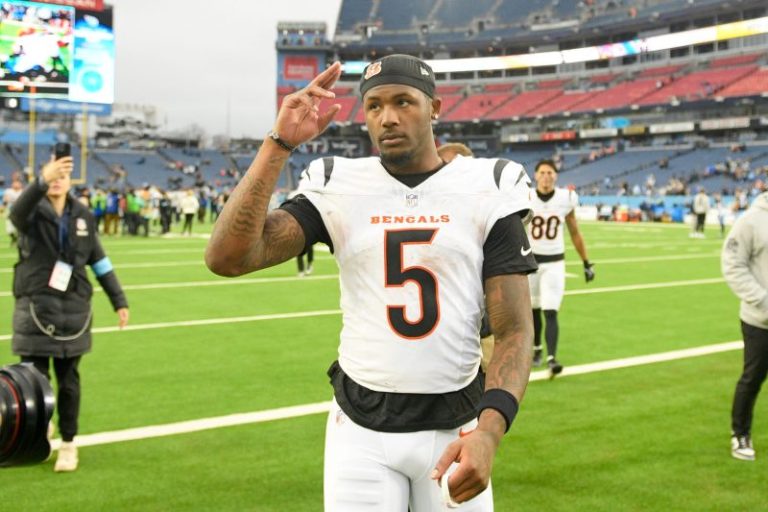
The fate of WR Tee Higgins, who was franchised last year, might be the most compelling question of any free agent – he’s ranked No. 1 by USA TODAY Sports – this offseason. A second tag would grant a 20% bump to nearly $26.2 million for Higgins, the only franchised player in 2024 who didn’t ultimately sign an extension. With more than $46 million in cap space, the Bengals can afford to do it. The question is whether they should given their significant defensive needs – and at a time when WR1 Ja’Marr Chase and DE Trey Hendrickson, among the top players at their respective positions league-wide, are both seeking top-of-market compensation. QB Joe Burrow hasn’t been shy about his desire to keep all of the above. However the roster might be best served with a tag-and-trade approach to Higgins, which would better enable Cincinnati to pay Chase and Hendrickson and perhaps pick up draft picks to flesh out the depth chart’s weak points.

Cleveland Browns

They’re overspent by more than $31 million, most in the NFL after New Orleans. Zero reason to make one of this organization’s many pressing challenges worse.

Dallas Cowboys

Kickers aside, no position can be tagged more cheaply than a running back. Therefore, case to be made here to franchise Rico Dowdle, who’s only 26, coming off a breakout season (1,328 yards from scrimmage) and relatively low professional usage prior to 2024. But considering Dallas has no wiggle room at present and will need to create some to extend LB Micah Parsons, that case for Dowdle falls apart pretty quickly.

Denver Broncos

After paying former QB Russell Wilson handsomely not to play for them in 2024, the Broncos are now out of cap purgatory with nearly $35 million available. But they have no reason to devote a sizable chunk of that to any of their UFAs.

Detroit Lions

They couldn’t convert the NFC’s No. 1 playoff seed into their first-ever Super Bowl berth, so they probably should spend a good portion of their $45 million free agency budget for depth – not a tag for CB Carlton Davis III or anyone else – after being ravaged by injuries late in the 2024 season.

Green Bay Packers

Similar situation to the NFC North rival Lions in that the Pack can be competitive in free agency – and have been much more so recently – but need not reserve any of their bankroll for a tag … especially given the opportunity to perhaps reel in a veteran wideout.

Houston Texans

Their only noteworthy free agent is WR Stefon Diggs … who is 31 and coming off reconstructive knee surgery. Moving on.

Indianapolis Colts

C Ryan Kelly has been a faithful, accomplished player here for nine seasons. He’ll also be 32 at the start of next season. Might make sense to retain Kelly but at a more prudent price point.

Jacksonville Jaguars

G Brandon Scherff, 33, has been a standout for most of his decade in the NFL. But, like the case with Kelly, tags are generally reserved for players with their best years ahead of them.

Kansas City Chiefs

They have several key players on expiring deals: LB Nick Bolton, G Trey Smith and S Justin Reid. What they don’t have is cap room … or, as their failed three-peat highlighted, a serviceable left tackle or sufficient pass rush depth.

Las Vegas Raiders

Their new regime has more than $92 million in available cap space … but no UFAs worthy of a tag. Hard to believe the Silver and Black won’t be more aggressive in pursuing a quarterback in the coming weeks, but stands to reason new coach Pete Carroll will otherwise be more focused on resetting the culture than trying to immediately spend this team out of its AFC West talent deficit.

Los Angeles Chargers

OLB Khalil Mack, who turns 34 on Saturday, remains a very effective player … if not one you tag to the tune of $25+ million. RB J.K. Dobbins just turned 26 and comes off his first NFL season with more than 1,000 yards from scrimmage … but his injury history makes him a dicey proposition – especially with his positional tag likely to jump past $13 million. The Bolts would be better served targeting players like Higgins and Smith while trying to re-up Mack at a more reasonable rate.

Los Angeles Rams

Could be some significant moving parts here, the futures of Super Bowl 56 heroes Matthew Stafford and Cooper Kupp currently in flux, Kupp revealing that the Rams are looking to deal him. Either way, with more than $37 million available, the Rams are in position to tag Alaric Jackson, a 26-year-old who’s held down the left tackle spot for the past two seasons. And if they stick with Stafford, paying the premium for Jackson makes further sense.

Miami Dolphins

They’ve already begun cutting costs, parting with players like CB Kendall Fuller and RB Raheem Mostert. That will need to continue for this bloated roster if the Fins  want to tag talented S Jevon Holland – though easy to argue they’re better off letting him go in order to focus on a pair of lines with significant issues.

Minnesota Vikings

With $55 million in the player acquisition coffers, they could tag QB Sam Darnold – even at roughly $40 million – and that might be the optimal strategy given this year’s light supply of quarterbacks, whether in free agency or the draft, even if it precedes a trade that brings back more draft capital to help 2024 first-round QB J.J. McCarthy. But there’s also a case to just keep Darnold to see if he can replicate or improve upon his Pro Bowl breakout. Barring that, franchising CB Bryon Murphy Jr., 27, at half the cost of Darnold, is equally sensible, especially as a bridge to a long-term deal.

New England Patriots

A ton of needs and ton of cap room here – nearly $120 million at present, most in the NFL – but no need to resource any of those funds on any players about to shake loose here.

New Orleans Saints

As is the case most years, no cap credit card is more maxed out – the Saints $54 million overbudget in 2025, highest in the league. Though the cap gymnastics here will begin soon enough, no reason to make them more difficult by adding a tag to the mix.

New York Giants

Lot of issues here but worrying about where to allot a tag isn’t one of them.

New York Jets

Among their slew of free agents, 28-year-old CB D.J. Reed is the most appealing. But for a team in the midst of its latest reboot and with limited cap space (shy of $17 million) – not to mention with stars like WR Garrett Wilson and CB Sauce Gardner newly eligible for extensions – a tag doesn’t make sense.

Philadelphia Eagles

The recently crowned champs will likely be raided in free agency with LB Zack Baun, G/T Mekhi Becton, OLB/DE Josh Sweat and DT Milton Williams poised to hit the market. With only $18 million in cap space, using the tag probably isn’t judicious – especially since Baun isn’t a pass rusher and Becton isn’t a regular tackle (here anyway). But with fellow LB Nakobe Dean rehabbing from a major knee injury suffered last month, EVP/GM Howie Roseman might want to figure out some way to re-sign Baun, a Defensive Player of the Year finalist, while relying on his depth and the draft to backfill the other spots.

Pittsburgh Steelers

They more than $53 million available for free agency. Doesn’t mean they should overspend on potential departures such as QBs Justin Fields and Russell Wilson or RB Najee Harris. Fields, who turns 26 next month, seems like the wisest investment among that trio. But even if the Steelers somehow wind up in a bidding war for him, it certainly wouldn’t justify such a prohibitively expensive tag.

San Francisco 49ers

Copious fluidity here, from the presumption that QB Brock Purdy will get his long-awaited extension while WR Deebo Samuel currently sits on the trade block. The Niners have nearly $44 million in cap room, and a good portion could go to Purdy. But they could quite feasibly pay their quarterback and also tag S Talanoa Hufanga, 26, who’s two years removed from an All-Pro season and one from a major knee injury. However his age and position should make him a preferable option to CB Charvarius Ward, who’s almost 30.

Seattle Seahawks

Even if they had cap room and a free agent worthy of a tag, they’re better off (belatedly) importing more players – on both sides of the ball – who better fit the way coach Mike Macdonald wants to operate.

Tampa Bay Buccaneers

Great as it would be to keep Chris Godwin in the building, you can’t risk paying an aging wideout coming off a dislocated ankle anything close to $25 million for one season of labor.

Tennessee Titans

They have more than $44 million at their disposal but need to spend more wisely than they did in 2024. That means no tag and a careful assessment of the quarterback market, which can provide the Titans an upgrade – whether via free agency or the draft.

Washington Commanders

As far as the culture and talent have come here in the last year, HC Dan Quinn and GM Adam Peters will doubtless try to maintain (and augment) it tag-free – and have more than $75 million to assist with that aim – despite how reliable soon-to-be 35-year-old LB Bobby Wagner remains.

What is the NFL franchise tag?

It’s a one-year tender that provides a player with a significant raise from his current team but impedes his ability to test the free agent market. A tag’s value is based on a player’s position. Per the NFL CBA:

“The Nonexclusive Franchise Tender shall be a one year NFL Player Contract for (A) the average of the five largest Prior Year Salaries for players at the position . . . at which the Franchise Player participated in the most plays during the prior League Year, which average shall be calculated by: (1) summing the amounts of the Franchise Tags for players at that position for the five preceding League Years; (2) dividing the resulting amount by the sum of the Salary Caps for the five preceding League Years . . . ; and (3) multiplying the resulting percentage by the Salary Cap for the upcoming League Year . . . (the ‘Cap Percentage Average’) . . . ; or (B) 120% of his Prior Year Salary, whichever is greater.”

Tag values rarely decrease year over year.

Franchised players have until July 15 to reach a long-term deal with their team. Otherwise, they must play the 2025 season on the tag.

Non-exclusive franchise tag: They allow players to negotiate with other clubs. If the player signs an offer sheet with a different team, his current one has the option of matching it or letting him go and receiving two first-round draft picks as compensation – a scenario that hasn’t occurred since 1998. However players can be franchised and traded for alternative compensation if an arrangement is reached.

Exclusive franchise tag: A player receiving this version of the tag cannot negotiate with another team.

Transition tag: Slightly less lucrative than a franchise tag, it returns no draft compensation to a player’s original team if it declines to match an offer sheet.

How much are franchise tags worth?

The value for each tag in 2025 has not yet been finalized. The following are the tag values, by position, in 2024:

Quarterback: $38.3 million

Running back: $11.95 million

Wide receiver: $21.82 million

Tight end: $12.69 million

Offensive lineman: $20.99 million

Defensive end: $21.32 million

Defensive tackle: $22.1 million

Linebacker: $24.01 million

Cornerback: $19.8 million

Safety: $17.12 million

Kicker/punter: $5.98 million

Which players received the franchise tag in 2024?

Giants OLB Brian Burns: Franchised by the Panthers, he was later traded to New York and signed a five-year, $141 million contract.

Bengals WR Tee Higgins: Played last season on the $21.82 tag for wideouts.

Jaguars OLB Josh Hines-Allen: Eventually signed five-year, $141.3 million contract.

Bears CB Jaylon Johnson: Eventually signed four-year, $76 million extension.

Ravens DT Justin Madubuike: Eventually signed four-year, $98 million extension.

Colts WR Michael Pittman Jr.: Eventually signed three-year, $70 million extension.

Titans CB L’Jarius Sneed: Franchised by the Chiefs, he was later traded to the Titans and signed a four-year, $76.4 million contract.

Buccaneers FS Antoine Winfield: Eventually signed four-year, $84.1 million extension.

Patriots S Kyle Dugger (transition tag): Eventually signed four-year, $58 million extension.

All NFL news on and off the field. Sign up for USA TODAY’s 4th and Monday newsletter.

This post appeared first on USA TODAY