Archive

2025

Browsing

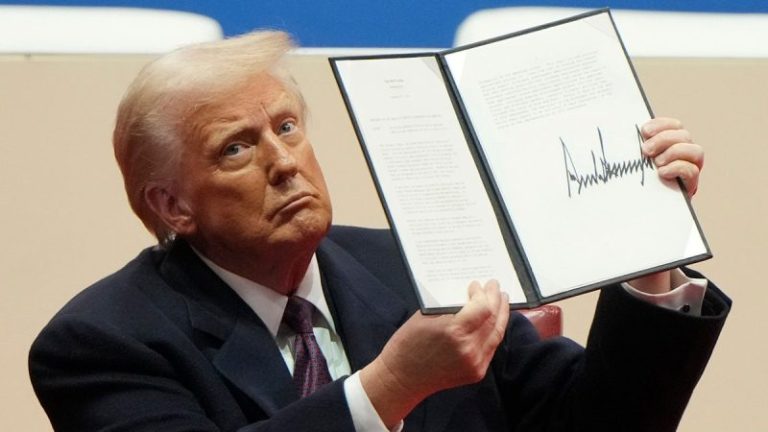
President Donald Trump trolled former President Joe Biden in a social media post on Sunday, highlighting the controversy surrounding his alleged ‘autopen signatures’ during his presidency.

On Truth Social, Trump posted three images side-by-side – his official portrait from his first term, a picture of Biden’s autopen and then finally his official portrait for his second term.

Trump then pinned the post. 

‘The person who was the real President during the Biden years was the person who controlled the Autopen!’ Trump wrote in another post on his account. 

Trump spoke about the autopen signature issue while speaking from the Oval Office on Friday about NATO spending.

‘The man was grossly incompetent. All you have to do is take a look, he signs by autopen. Who was signing all this stuff by autopen? Who would think to sign important documents by autopen?’ Trump asked reporters. 

‘These are major documents you’re signing, you’re proud to sign, yet you have your signature on something and in 300 years, they say ‘oh look.’ Can you imagine everything was signing by autopen? Almost everything. Nobody has ever heard of such a thing. It should have never happened,’ Trump continued. 

The post sparked a firestorm on social media with many backing Trump as Democrats have faced backlash over accusations that they dismissed Biden’s health concerns and engaged in a cover-up throughout the end of his term.

‘President Trump JUST POSTED the AUTOPEN that ran the White House from 2021-2025 next to his portraits,’ one X user commented.

‘Biden was an illegitimate president. Who controlled the auto pen?’ another X used commented.

Vice President JD Vance also shared the image on X without any comment.

‘Corrupt establishment was running the country from 2021-2025. Who controlled the auto pen for Biden?’ Missouri Lieutenant Governor David Wasinger commented, sharing Vance’s post. 

Elon Musk also chimed in on the photo, posting on X, with two emojis – a bullseye and laughing face. 

Fox News Digital reached out to Biden’s team about Trump’s post featuring the autopen image, but did not receive a response.

In a new report published by an arm of the Heritage Foundation, it was revealed that the majority of official documents signed by Biden allegedly used the same autopen signature, reinvigorating concerns over the former president’s mental acuity and if he ‘actually ordered the signature of relevant legal documents.’ 

‘WHOEVER CONTROLLED THE AUTOPEN CONTROLLED THE PRESIDENCY,’ the Oversight Project, which is an initiative within the conservative Heritage Foundation that investigates the government to bolster transparency, posted to X on Thursday. 

‘We gathered every document we could find with Biden’s signature over the course of his presidency. All used the same autopen signature except for the announcement that the former President was dropping out of the race last year. Here is the autopen signature,’ the group claimed on X, accompanied by photo examples. 

The Oversight Project posted three examples showing Biden’s signature, including two executive orders and the president’s announcement he was bowing out of the 2024 presidential race. The signature on the two executive orders, one of which was signed in 2022 and the other in 2024, showed the same signature that included what appeared to be a line, followed by ‘R. Biden Jr.’

Fox News Digital reached out to Biden’s office for comment on the Oversight Project’s findings on the autopen investigation, but did not immediately receive a reply.

Fox News Digital also examined the signatures on President Donald Trump’s executive orders, which are often signed in public or in front of the media, during his first administration and second administration and found the signatures were also the same. 

The Oversight Project continued in its findings that investigators should determine ‘who controlled the autopen’ during the Biden administration. 

Fox News Digital’s Emma Colton contributed to this report. 

Stepheny Price is a writer for Fox News Digital and Fox Business. She covers topics including missing persons, homicides, national crime cases, illegal immigration, and more. Story tips and ideas can be sent to stepheny.price@fox.com

This post appeared first on FOX NEWS

U.S. warships have shot down roughly a dozen Houthi drones since President Donald Trump launched airstrikes against the terrorist organization on Saturday, Fox News has learned.

A senior defense official told Fox News of the developments on Sunday. The drones were aimed at the U.S. Navy’s Truman Carrier Strike Group, and were shot down ‘well before’ they posed a serious threat, the official added.

The latest military action came after nearly a year and a half of attacks from Houthis, both on commercial merchant vessels and U.S. military ships. In a Truth Social post on Saturday, Trump wrote that he had ‘ordered the United States Military to launch decisive and powerful Military action against the Houthi terrorists in Yemen.’

‘It has been over a year since a U.S.-flagged commercial ship safely sailed through the Suez Canal, the Red Sea, or the Gulf of Aden,’ Trump continued. ‘The last American Warship to go through the Red Sea, four months ago, was attacked by the Houthis over a dozen times.’

Trump wrote that the ‘relentless assaults have cost the U.S. and World Economy many BILLIONS of Dollars while, at the same time, putting innocent lives at risk.’

‘To all Houthi terrorists, YOUR TIME IS UP, AND YOUR ATTACKS MUST STOP, STARTING TODAY. IF THEY DON’T, HELL WILL RAIN DOWN UPON YOU LIKE NOTHING YOU HAVE EVER SEEN BEFORE!’ his post concluded.

Trump re-designated the Houthis as a foreign terrorist organization (FTO) in January. His first administration had named the Houthis as an FTO, but the Biden administration later reversed the move.

On Sunday, the White House released photos of Trump, Secretary of State Marco Rubio and National Security Adviser Mike Waltz monitoring the strikes.

‘President Trump is taking action against the Houthis to defend US shipping assets and deter terrorist threats,’ the White House wrote on X. ‘For too long American economic & national threats have been under assault by the Houthis. Not under this presidency.’ 

Fox News Digital’s Danielle Wallace contributed to this report.

This post appeared first on FOX NEWS

The Orlando Magic defeated the Cleveland Cavaliers 108-103 on Sunday, ending the Cavaliers’ 16-game win streak.
Paolo Banchero led the Magic with 24 points, 11 rebounds and seven assists, recording his seventh double-double of the season.
The Cavaliers missed five 3-point attempts in the final 30 seconds of the game.

The Cleveland Cavaliers’ 16-game win streak is no more.

The Orlando Magic defeated the Cavs 108-103 on Sunday at Rocket Arena in Cleveland, handing the Cavaliers their first loss since Feb. 4.

Sunday’s game marked a rematch of the 2024 first-round playoff series between the two teams. The series went to seven games with the Cavs advancing, 4-3. The Magic lost each playoff game in Cleveland, but Sunday was a different story.

Paolo Banchero led the way for the Magic with a near triple-double, finishing with a game-high 24 points, 11 rebounds, seven assists, one steal and one block, marking his seventh double-double of the season. Banchero has a streak of his own going: He’s scored 20-plus points in 10 consecutive games, marking the longest streak of his career. 

How Magic beat Cavaliers

The Cavs had a 60-47 halftime lead, but the Magic went on a 16-6 run to take the lead 80-79 with 1:10 remaining in the third quarter, marking Orlando’s first lead since the opening minutes of the game.

Orlando’s Kentavious Caldwell-Pope tied the contest 100-100 with 1:41 remaining by knocking down a 3-pointer. The Magic closed the game on an 8-3 run to secure the win and snap the Cavs’ win streak.

The Cavaliers had opportunities down the stretch, but couldn’t knock down much-needed shots from beyond the arc. Cleveland missed five 3-point attempts in the final 30 seconds of the game and collectively went 10-of-40 from three, compared to 13-of-31 shooting from beyond the arc for the Magic. Cleveland had the advantage in the paint, outscoring the Magic 52-30, but Orlando had 16 fast-break points, compared to Cleveland’s four.

Orlando Magic stats

Four of the five starters for the Magic had 10 or more points in the win.

Banchero had 24 points, shooting 6-of-22 from the field and 3-of-8 from three. Franz Wagner had 22 points and eight rebounds. Wendell Carter Jr. recorded 16 points, 14 rebounds and one assist, while Caldwell-Pope had 15 points and three assists.

Cleveland Cavaliers stats

Four of the Cavaliers’ starters had 10 or more points in the loss.

Donovan Mitchell had a team-high 23 points (9-of-29 field, 3-of-14 three), six rebounds and five assists. Jarrett Allen had a double-double, with 20 points and 12 rebounds. Darius Garland added 19 points, six rebounds and four assists. Max Strus recorded 10 points and six rebounds.

Magic schedule

The Magic will host the Houston Rockets on Wednesday at 7 p.m. ET.

Cavaliers schedule

The Cavaliers hit the road to face the Los Angeles Clippers on Tuesday at 10:30 p.m. ET.

The USA TODAY app gets you to the heart of the news — fastDownload for award-winning coverage, crosswords, audio storytelling, the eNewspaper and more.

This post appeared first on USA TODAY

It’s time to start making a bracket — or at least thinking about one.

Who will cut down the nets at the Final Four? What lower-seed will become this year’s Cinderella team? What teams were under-seeded, or perhaps over-seeded, and have a favorable first-round matchup? Where will the upsets fall during the Road to San Antonio and the Alamodome?

Those questions and then some will be answered in just two hours when the official NCAA Tournament bracket is unveiled at 6 p.m. ET on CBS during the Selection Sunday bracket reveal show.

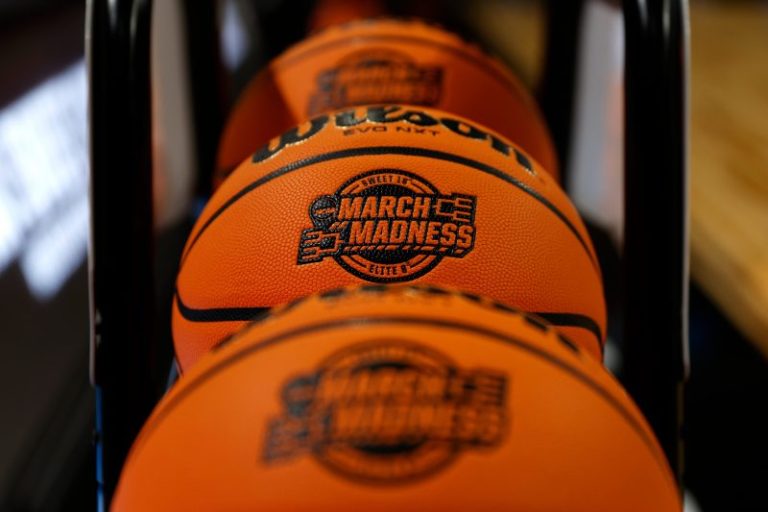
Making selections for the NCAA Tournament is one of several great traditions that make March Madness one of the greatest postseason tournaments there are in sports.

The reason? Well, there are several ways to approach making those picks — either randomly by choosing the better mascot in a matchup or overanalyzing bracketology metrics — that make it a fun event for all involved. Then there is the fun of hoping to have that perfect bracket — or what later becomes the best bracket — in a bracket group.

The First Four of the 2025 NCAA Tournament gets going on Tuesday, March 18 at UD Arena in Dayton, Ohio, while the first set of first-round games take place on Thursday, March 20 at different arenas across the country.

Here’s what you need to know on the odds of having a perfect March Madness bracket and more:

Has anyone ever had a perfect March Madness bracket?

Per the NCAA’s website, the longest a March Madness bracket has gone perfect — at least verifiable — has been 49 consecutive games, which took place during the 2019 NCAA Tournament.

There was one user on ESPN’s Bracket Challenge last year that correctly picked 31 games before their bracket was busted, per the NCAA. The game that killed the hopes of having a perfect bracket was No. 8 Utah State defeating No. 9 TCU.

Round busted in parentheses

1. 2019: 49 (Sweet 16)
2. 2017: 39 (Second Round)
3. 2014: 36 (Second Round)
4. 2015: 34 (Second Round)
5. 2024: 30 (First Round)

What are the odds for a perfect March Madness bracket?

The odds of having a perfect March Madness bracket are practically nil.

But to expound on this, the NCAA says the odds of predicting all 63 NCAA Tournament games correctly are approximately 1 in 9,223,372,036,854,775,808, or 1 in 9.2 quintillion.

However, if you are an avid men’s college basketball fan, the NCAA says the odds are slightly improved to 1 in 120.2 billion for a perfect bracket.

What is the March Madness bracket deadline?

March Madness bracket deadline: Thursday, March 20 at noon ET

Those who want to enter their name into the pool and hope to be the first to have a perfect March Madness bracket, you have to get that entry (or entries if you do multiple groups) in before the start of the first set of first first-round games on Thursday, March 20.

Click here to enter the USA TODAY Sports Men’s Bracket Challenge.

This post appeared first on USA TODAY

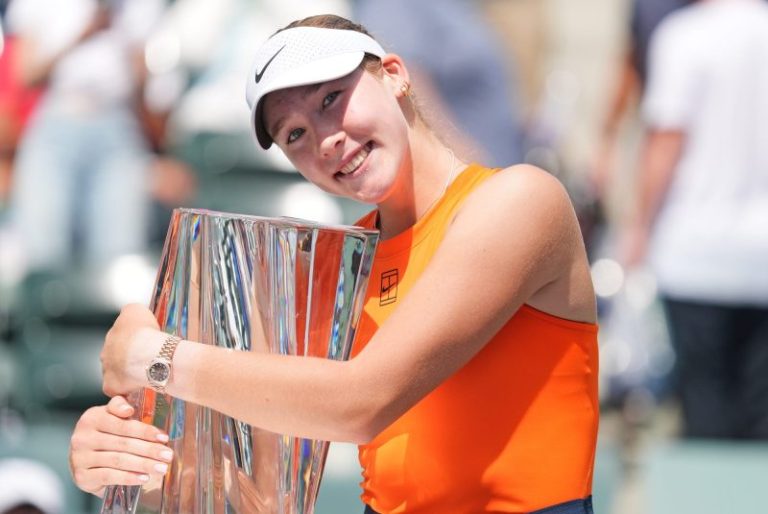
On this Sunday at the BNP Paribas Open, youth was served and volleyed and backhanded and every other tennis stroke you can think of as 17-year-old rising star Mirra Andreeva outplayed World No. 1 Aryna Sabalenka for a remarkable 2-6, 6-4, 6-3 victory.

In the process, the talented Russian teen with a complete game and unflappable nature became the third youngest player ever to win the women’s singles title at this event and the youngest in 26 years since Serena Williams in 1999.

She has now won 12 consecutive matches, having also won her previous tournament in Dubai. She is the youngest player to win 12 Masters 1000 matches in a row since the format’s inception in 2009.

Just as she did after her win in Dubai, she gave an endearing speech during the trophy ceremony where after thanking her team and the crowd and Sabalenka, she finished by saying: ‘Last but not least, I want to thank myself,’ to a roar of laughter from the crowd. ‘I thank myself for fighting until the end and always believing in myself and for never quitting.’

It is the continuation of a remarkable run for Andreeva who turns 18 in April and has already made it inside the top 10 of the world rankings.

Andreeva not only beat Sabalenka in the final, but World No. 2 Iga Swiatek in the semifinal. Sabalenka had been 4-1 in her career against Andreeva, including a quarterfinal win in Australia.

Sabalenka from Belarus is now 0-2 in finals at Indian Wells, having also lost to Elena Rybakina in the 2023 final. It was also the second heart-breaking loss in 2025 as she fell in the Australian Open final to Madison Keys. She was gunning for her eighth Masters 1000 title to go with three Grand Slam wins.

But as always, despite her disappointment, Sabalenka was gracious in defeat, joking that when she got home she would stack her two second-place trophies on top of each other to make one first-place trophy.

A full Stadium 1 on a perfect Southern California weather day was treated to a high-level match with tons of winners, creative play and passion from both women mixing extreme power with occasional deft touch.

A break at love in the fourth game of the first set was enough for Sabalenka to get control of the first set, and she finished it off with a second break of Andreeva to win 6-2 as Andreeva hit an uncharacteristic unforced error on the final point.

When the 17-year-old’s shot went into the net, she showed some frustration by launching the ball high into the sky and into the upper deck. But she proved to be unbothered by the setback.

Andreeva kept putting pressure on Sabalenka’s serve and finally broke through with a break in the third game of the second set. Both players held serve the rest of the way for a 6-4 Andreeva win, which she capped with two straight aces.

The third set started with a bang for Andreeva. After failing on 8 of 9 break points in the first two sets, she broke Sabalenka at love in the first game to start the final set on the right foot.

Sabalenka broke right back, but the rest of the set belonged to Andreeva. She broke Sabalenka twice more for the 6-3 win, touching off a celebration with a winner down the line.

She fell to her knees in disbelief. Sabalenka was disconsolate on the baseline.

And here is more from the ‘youngest-ever’ department for Andreeva.

She became the youngest player to beat the World No. 1 in a completed match since Tamira Paszek beat Ana Ivanovic in 2008. And the youngest to do it in a championship match since 2005 when Maria Sharapova beat Lindsay Davenport in Tokyo.
She is only the third player under 18 years old in the last 40 years to beat the No. 1 and No. 2-ranked player in the same tournament.
She is the youngest player to be in back-to-back to Masters 1000 finals, much less win them.

Youngest women to play in BNP Paribas Open final

1991: Monica Seles (17 years, 91 days) — Lost
1998: Martin Hingis (17 years, 166 days) — Won
1999: Serena Williams (17 years, 169 days ) — Won
2001: Kim Clijsters (17 years, 283 days) — Lost
2025: Mirra Andreeva (17 years, 301 days) — Won

This post appeared first on USA TODAY

South Carolina, UCLA, Texas, and USC are projected to be the top seeds in the 2025 NCAA Women’s Basketball Tournament.
Iowa State, Princeton, Harvard, and Washington are projected as the last four teams to reach Women’s March Madness.
Virginia Tech, Saint Joseph’s, Arizona, and Minnesota are the first four teams projected to be left out of the NCAA bracket.

Editor’s note: Follow Women’s March Madness bracket reveal live updates to see who makes the 2025 NCAA Tournament.

March Madness continues this evening with Selection Sunday, when the brackets for the women’s NCAA Tournament will be unveiled.

While the brackets will be set in stone, predictions and projections on who will help make up the field of 68 teams are already being decided. Several teams had already qualified for the tournament after earning an automatic bid after winning their conference tournament championship.

Here’s what experts are projecting for the 2025 bracket: 

Projected top seeds

USA Today staff (as of Saturday evening): South Carolina, UCLA, Texas, USC
ESPN’s Charlie Creme (as of Saturday evening): South Carolina, UCLA, USC, Texas
NCAA’s Autumn Johnson (as of Tuesday): UCLA, South Carolina, USC, Texas
CBS’ Connor Groel (as of Tuesday): UCLA, South Carolina, Texas, USC

Projected last teams in

USA Today staff (as of Saturday evening): Iowa State, Princeton, Columbia, Washington
ESPN’s Charlie Creme (as of Saturday evening): Iowa State, Washington, Columbia, Princeton
NCAA’s Autumn Johnson (as of Tuesday): Iowa State, Princeton, Harvard, Richmond
CBS’ Connor Groel (as of Tuesday): Iowa State, Harvard, Washington, Princeton

First four out

USA Today staff (as of Saturday evening): Virginia Tech, Saint Joseph’s, Arizona, Minnesota
ESPN’s Charlie Creme (as of Saturday evening): Virginia Tech, Saint Joseph’s, James Madison, UNLV
NCAA’s Autumn Johnson (as of Tuesday): Virginia Tech, Colorado, James Madison, Minnesota
CBS’ Connor Groel (as of Tuesday): Colorado, James Madison, Virginia Tech, Seton Hall

We occasionally recommend interesting products and services. If you make a purchase by clicking one of the links, we may earn an affiliate fee. USA TODAY Network newsrooms operate independently, and this doesn’t influence our coverage.

This post appeared first on USA TODAY

Each year as the NCAA Tournament looms, several topics of discussion repeat themselves as predictions are made for the field of 68.

Perhaps the most notable of these are the NET rankings and Quad 1 wins. As Selection Sunday for March Madness arrives approaches, this year is no exception. It may even be more prevalent than ever, considering the teams who find themselves on the bubble this year.

Look no further than North Carolina, which despite having a brand name, a 22-13 record and a No. 36 ranking in the NET finds itself squarely on the bubble with an abysmal 1-12 record in Quad 1 games. But what exactly are quadrant wins, and how do they impact the NET rankings?

Here’s what you need to know about the NCAA’s NET rankings and more ahead of Selection Sunday:

What is the NET? Explaining NCAA ranking system

The NET is a data-driven sorting system used by the NCAA Tournament selection committee when considering the field of 68. While it is not the only system the committee uses, it is perhaps its most important tool in helping the committee determine who makes the field, and where they’re seeded.

It was created ahead of the 2018-19 men’s basketball season by the NCAA, and replaced the Rating Percentage Index (RPI) system. The NET rankings, which are first released in December and updated throughout the year, reset each college basketball season, and do not keep old information or statistics.

Team Value Index: A results-based measure that rewards teams for beating quality opponents, with extra weight given to road and neutral-site wins.
Adjusted Net Efficiency: The difference between a team’s offensive efficiency (points per possession) and defensive efficiency (opponents’ points per possession), adjusted for opponent strength and game location.

Quad wins, explained

Wins and losses are divided into one of four categories by the NET, which are then used by the committee to help determine at-large bids and seed the entire field. Teams’ records are divided into Quads 1, 2, 3 and 4.

Perhaps the biggest sorting tool in the NET is a team’s record vs. Quad 1 opponents. The better a team’s record in Quad 1 games, the better chance a team has of making the 68-team field. Similarly, a team that has one or more losses in Quads 1, 2 or 3 would be assigned a ‘bad loss’ that is detrimental to their NCAA Tournament resume.

Where a win or loss falls in that spectrum depends on two factors:

The opponent’s ranking in the NET
Whether a team faced their opponent at home, on the road or at a neutral site

Quadrant 1: Home 1-30, Neutral 1-50, Away 1-75
Quadrant 2: Home 31-75, Neutral 51-100, Away 76-135
Quadrant 3: Home 76-160, Neutral 101-200, Away 135-240
Quadrant 4: Home 161-353, Neutral 201-353, Away 241-353

A team’s record against Quad 1 opponents — just like Quad 2, Quad 3 and Quad 4 opponents — can also change throughout the season. For example, if a team beats a Quad 2 team in January but that team becomes a Quad 1 team heading into the postseason, that becomes a Quad 1 win for that team. Similarly, if a Quad 1 team drops to a Quad 2 team or lower, that win would be removed from their Quad 1 record.

Best Quad 1 records on Selection Sunday

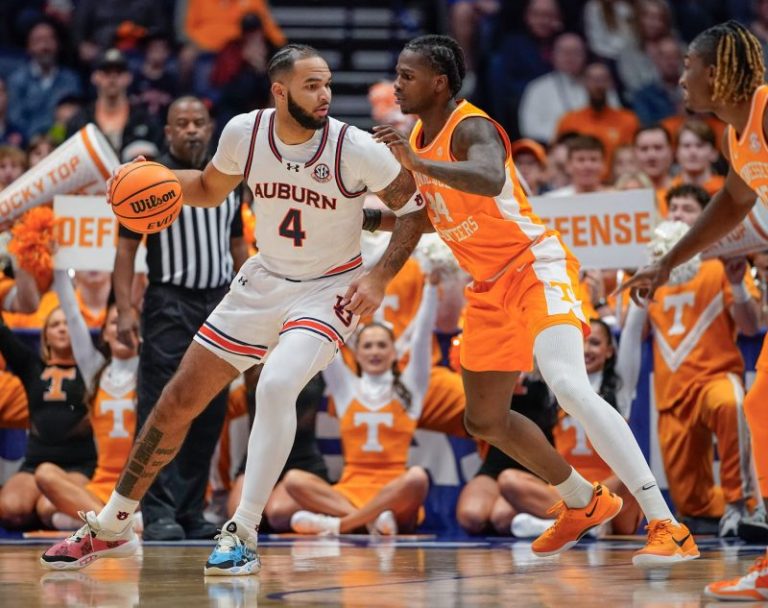
Auburn leads the country with 16 Quad 1 wins this season. Here’s a breakdown of which teams in the country have the best Quad 1 records entering Selection Sunday, per the NCAA:

Records reflective of games through Saturday, March 15

Auburn: 16-5
Houston: 14-3
Michigan State: 13-5
Kentucky: 11-10
Alabama: 11-8
Michigan: 11-7
Tennessee: 11-6
Arizona: 10-11
Iowa State: 10-7
Texas Tech: 10-5
Florida: 10-4

NET rankings on Selection Sunday

The NET rankings system also doesn’t factor in the date of the game and a team’s winning percentage, both raw winning percentage and adjusted winning percentage. Here’s a list of the top 16 teams in the country per the NCAA’s NET rankings, which theoretically would result in the teams seed 1-4 in their respective regions:

Ranking reflective of games through Saturday, March 15

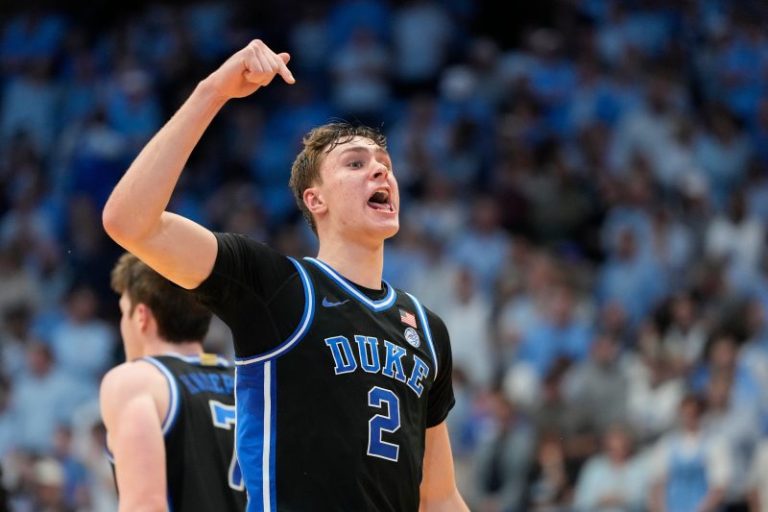
Duke
Auburn
Houston
Florida
Tennessee
Alabama
Texas Tech
Gonzaga
Iowa State
Maryland
Michigan State
Arizona
St. John’s
Wisconsin
Kentucky
Missouri

This post appeared first on USA TODAY

The moment we’ve been waiting for all college basketball season is finally here — March Madness.

Now that conference tournaments are wrapping up, college basketball fans around the country no longer have to speculate whether their team did enough to go dancing. Who’s in? Who’s out? We’ll know soon enough when the selection committee reveals the full, 68-team bracket for the men’s and women’s NCAA Tournament on Selection Sunday.

The tournament officially tips off on March 18 with the men’s First Four, followed by the women’s First Four on March 19. Until then, here’s everything you need to know about how to watch Selection Sunday, including the March Madness bracket reveal TV channel, live stream and more.

When is NCAA bracket revealed?

Men: 6 p.m. ET (approximately)
Women: 8 p.m. ET

The selection committee will unveil the men’s and women’s NCAA tournament bracket for the men and women on March 16, better known as Selection Sunday.

The men’s bracket will be revealed first at 6 p.m. ET, followed by the women’s bracket unveiling at 8 p.m. ET. However, the men’s bracket could be delayed till the conclusion of the final men’s conference final on Sunday.

March Madness bracket reveal TV channel

Men’s: CBS
Women’s: ESPN

The men’s and women’s selection shows will be broadcast nationally on CBS and ESPN, respectively. The men’s bracket reveal will be shown on CBS at 6 p.m. ET, while the women’s bracket unveiling will be broadcast on ESPN at 8 p.m. ET.

March Madness bracket reveal live stream

Streaming: ESPN app | Paramount+ | Fubo (free trial)

No TV, no problem. Selection Sunday can be live-streamed on Paramount+, Sling TV, DirecTV Stream, in addition to the ESPN app and Fubo, the latter of which carries both ESPN and CBS while offering a free trial to potential subscribers.

2025 men’s March Madness schedule:

Selection Sunday: Sunday, March 16 (6 p.m. ET)
First Four: March 18-19
First round: March 20-21
Second round: March 22-23
Sweet 16: March 27-28
Elite Eight: March 29-30
Final Four: April 5
NCAA championship game: April 7

2025 women’s March Madness schedule:

Selection Sunday: Sunday, March 16 (8 p.m. ET)
First Four: March 19-20
First round: March 21-22
Second round: March 23-24
Sweet 16: March 28-29
Elite Eight: March 30-31
Final Four: April 4
NCAA championship game: April 6

The USA TODAY app gets you to the heart of the news — fastDownload for award-winning coverage, crosswords, audio storytelling, the eNewspaper and more.

We occasionally recommend interesting products and services. If you make a purchase by clicking one of the links, we may earn an affiliate fee. USA TODAY Network newsrooms operate independently, and this doesn’t influence our coverage.

This post appeared first on USA TODAY

The acting administrator of DOGE detailed that Elon Musk is not an employee of the United States DOGE Service and does not report to the acting DOGE chief, a court filing shedding additional light on the internal workings of the office shows. 

‘Elon Musk does not work at USDS. I do not report to him, and he does not report to me. To my knowledge, he is a Senior Advisor to the White House,’ Amy Gleason, the acting administrator of DOGE, wrote in a declaration included in a court filing on Friday. 

Musk has been the public face of DOGE for months, as President Donald Trump celebrates the billions of dollars in savings his administration has secured through DOGE’s work to gut the federal government of overspending, mismanagement and fraud. Musk, however, ‘has no actual or formal authority to make government decisions himself’ and is working as a senior advisor to the president, a White House official said in a separate court filing in February.

The White House identified Gleason as the official acting chief of DOGE last month. Gleason, a little-known government employee who also worked in the first Trump administration, provided a declaration in a court filing involving a lawsuit against DOGE last week that further explains how the government office operates. 

‘In my role at USDS, I oversee all of USDS’s employees and detailees to USDS from other agencies,’ Gleason wrote in her declaration. ‘I report to the White House Chief of Staff, Susie Wiles.’

Gleason previously worked for the United States Digital Service, which was founded in 2014 by former President Barack Obama as a technology office within the Executive Office of the President. Trump signed an executive order in January that renamed the office to the United States DOGE Service, establishing DOGE. 

In addition to overseeing USDS, Gleason also oversees the U.S. DOGE Service Temporary Organization – an office established by Trump in January that sits under the USDS umbrella and will expire on July 4, 2026. 

Gleason explained in her declaration that under Trump’s executive order establishing DOGE, agency chiefs were charged with creating their own DOGE teams to find and eliminate overspending. Gleason said the respective agency DOGE teams are comprised of agency employees or detailees who do not report to her.  

‘Every member of an agency’s DOGE Team is an employee of the agency or a detailee to the agency. The DOGE Team members – whether employees of the agency or detailed to the agency – thus report to the agency heads or their designees, not to me or anyone else at USDS,’ she wrote. 

‘In some instances, members of agency DOGE Teams are detailees from USDS to the agency. Where USDS detailees are assigned to an agency DOGE Team and acting in their capacity as a detailee to the DOGE Team, they are supervised by personnel of the agency to which they are detailed,’ she added. 

Gleason has been described by former colleagues as ‘world-class talent’ who frequently works long hours and is apolitical. 

DOGE has saved an estimated $115 billion in government spending in the form of workforce reductions, contract cancellations, regulatory savings and other initiatives, according to its website. Trump has touted DOGE’s work repeatedly in public remarks, including rattling off a list of government grants that were axed since his inauguration during his first address to a joint session of Congress earlier this month. 

‘Forty-five million dollars for diversity, equity and inclusion scholarships in Burma,’ Trump said as he provided examples of federal waste on March 4 after thanking Musk and DOGE for its work. ‘Forty million to improve the social and economic inclusion of sedentary migrants. Nobody knows what that is. Eight million to promote LGBTQI+ in the African nation of Lesotho, which nobody has ever heard of. Sixty million dollars for indigenous peoples and Afro-Colombian empowerment in Central America. Sixty million. Eight million for making mice transgender.’

Democrats and federal employees have railed against DOGE since the investigations and mass terminations at various agencies got underway following Trump’s inauguration, including staging protests outside federal buildings in Washington, D.C., and specifically protesting Musk for his involvement with DOGE. 

This post appeared first on FOX NEWS

Selection Sunday is famously known for the unveiling of the brackets for both the men’s NCAA Tournament

But that isn’t the only postseason men’s college basketball tournament that reveals its field on Sunday. Shortly after the announcement of the 68-team field at 6 p.m. ET, the National Invitation Tournament (NIT), will begin unveiling its 32-team bracket.

The NIT is strictly an invitation style tournament, meaning Division I men’s basketball teams need to be extended an invite from the NIT selection committee to compete in it. It’s also one of several other postseason tournaments that take place alongside March Madness.

Unlike the NCAA Tournament, every game of the NIT is played on a college campus. Games begin on Tuesday, March 18 and run through Thursday, April 3 with the championship game at historic Hinkle Fieldhouse in Indianapolis. 

Here’s what you need to know: 

What channel is the NIT bracket revealed on? 

TV: N/A
Streaming: N/A

Unlike the NCAA Tournament bracket, the NIT bracket will not be released on TV or a streaming service platform. Instead, as noted by the NIT’s official X account (formerly Twitter), it will be announced on the tournament’s social media platforms. 

When is the NIT bracket released? 2025 NIT Selection Show start time

Date: Sunday, March 16

The bracket for the 2025 National Invitation Tournament (NIT) will be released on Sunday, March 16 following the conclusion of the NCAA Tournament bracket reveal show. 

Who makes the NIT? 

Thirty-two teams make the NIT bracket field. 

However, as noted by the NCAA, the 2025 National Invitation Tournament (NIT) has different eligibility qualifications than past years — most likely due to the arrival of The College Basketball Crown tournament.

There will be 16 “exempt” teams, with four spots taken up by the top two teams from the ACC and SEC that were not selected to the NCAA Tournament field. The remaining 12 “exempt” spots will go to the top team in the top 12 conferences based on the KenPom Rankings.

The remaining 16 spots in the 32-team field will go to automatic bids — conference regular-season champions that have a ‘KNIT’ score of 125 or better — and at-large teams of the best available teams that didn’t make March Madness.

When is the NIT? Full schedule for 2025 tournament 

NIT start date: Tuesday, March 18
NIT championship: Thursday, April 3

The 2025 National Invitation Tournament (NIT) will get started on Tuesday, March 18 with the first round of games — which also happens to be the first night of the First Four.

The semifinals and championship games of the NIT will take place on Tuesday, April 1 and Thursday, April 3, respectively, at Hinkle Fieldhouse in Indianapolis. It is the second straight season that both of the final rounds of the NIT are taking place at Hinkle Fieldhouse, the home of the Big East’s Butler Bulldogs. 

Here’s a breakdown of the NIT schedule: 

First round: Tuesday, March 18 and Wednesday, March 19
Second round: Saturday, March 22 and Sunday, March 23
Quarterfinals: Tuesday, March 25 and Wednesday, March 26
Semifinals: Tuesday, April 1
Championship: Thursday, April 3

NIT history, past champions

Here’s a look at past NIT champions dating back to 2000 per NCAA.com:

2000: Wake Forest
2001: Tulsa
2002: Memphis
2003: St. John’s
2004: Michigan
2005: South Carolina
2006: South Carolina
2007: West Virginia
2008: Ohio State
2009: Penn State
2010: Dayton
2011: Wichita State
2012: Stanford
2013: Baylor
2014: Minnesota
2015: Stanford
2016: George Washington
2017: TCU
2018: Penn State
2019: Texas
2020: Canceled due to COVID-19 Pandemic
2021: Memphis
2022: Xavier
2023: North Texas
2024: Seton Hall

Click here to look at all past NIT champions since 1938.

This post appeared first on USA TODAY