Archive

2025

Browsing

SUN VALLEY, Idaho — Mikaela Shiffrin is no longer the only U.S. woman making herself at home on the podium.

The U.S. women last week wrapped up their most successful season in more than a decade. Five different women made World Cup podiums, while four women got medals at the world championships.

“It’s a pretty special time to be part of the women’s U.S. ski team, tech or speed. We just continue to build off each other,” Paula Moltzan, who was the bronze medalist in two World Cup races and also finished third in the giant slalom at the world championships, said after wrapping up the World Cup finals.

“Hopefully we’re able to carry that momentum into the first couple races of the season and then yeah, carry it into the Olympics.”

For the last four decades, the Americans have always had a dominant female skier. Sometimes the dominant female skier. Tamara McKinney. Picabo Street. Lindsey Vonn. Shiffrin. But it was often a two-woman show at the end of Vonn’s career — the first iteration — and, during her five-year hiatus, up to Shiffrin to carry the load.

No more.

When Lauren Macuga won the super-G in St. Anton, Austria, it was the first time a U.S. woman not named Shiffrin or Vonn had been atop a World Cup podium since 2013, when Alice McKennis won the downhill, also in St. Anton. Breezy’s Johnson’s gold in the downhill at the world championships was the first win in an individual event at worlds by someone other than Shiffrin or Vonn since Hilary Lindh, also in the downhill, in 1997.

And Vonn’s silver medal in the super-G at the World Cup finals made her the fifth different U.S. woman to make a World Cup podium this season, the most since there were seven in 2012-13.

In addition to Moltzan and Vonn’s World Cup success, Shiffrin had four wins and a third-place finish in slalom, despite missing two months after a crash at Killington, Vermont, left her with a deep gash in her obliques. Macuga, who is 22, had a downhill silver in addition to her super-G win. Johnson won a bronze medal in the downhill.

“We always hope that we get these new generations coming in,” said Vonn, who came out of retirement in November after having a partial knee replacement. “And I think we’ve been waiting a little while for someone like Lauren Macuga to come along, and it’s great to see that because she’s so young. She’s going to keep going for a long time and we really need that.

“We’ve got to see that new group coming up and I think we have that. Especially on the technical side, we really have a strong group,” Vonn added. “It’s great to see because it’s the kind of thing that we need to keep stimulating ski racing in the U.S.”

While ski racing is expensive — athletes spend five months traversing Europe and North America in the World Cup season, and preseason training camps are often in the southern hemisphere — that alone doesn’t explain the depth challenge the Americans have had.

Training together as a team but then competing against one another in races is a challenge that doesn’t suit all athletes. But this group has found a way to make it work.

It doesn’t mean they care any less or are any less competitive. They’ve simply found a way to maximize the benefits of being part of a team, feeding off one another rather than feeding on one another.

“Finding the balance between being a supportive teammate and a fierce competitor is hard,” Shiffrin said. “I just feel like this group of women has been able to strike that balance in a really unique way that’s different from anything I’ve ever experienced or been able to witness. And that’s pretty cool going into next season.”

The atmosphere is also helping the women who didn’t make the podium. Nina O’Brien had her best season with four top-10 finishes — one more than in her previous seasons combined. Jacqueline Wiles had two top-10 finishes in the downhill. AJ Hurt was in the top 20 in both of her individual events at the world championships, giant slalom (13) and slalom (19).

“It’s been so much fun,” O’Brien said. “Our team has been pushing each other and it feels like every race, somebody is shining, which is really cool.”

The U.S. women, coming in hot to the Olympic year.

Follow USA TODAY Sports columnist Nancy Armour on social media @nrarmour.

This post appeared first on USA TODAY

They’re making this more difficult than it is, which falls in line of late with just about all things college football.

So while we soak in the majesty of the three-week event that is March Madness, it’s time to reassess the postseason football clunker rolled out last season by the smartest men and women in college sports. 

Something, everyone, must be done about the College Football Playoff.

It’s time to introduce the CFP for Dummies plan.

“We’re only one year into the new playoff format,” said Oklahoma athletic director Joe Castiglione. “I don’t know that you make drastic decisions based off one year.”

While I’m all about not being trapped as a prisoner of the moment, there’s something so reassuring about the simplicity of the NCAA basketball tournament that can’t be ignored.

Everyone has a chance to play in it, and the highest seeds get more favorable draws. That’s it, period.

Hence, the CFP for Dummies plan.

But as we move toward the new CFP contract in 2026, and a likely increase to at least 14 teams, they’re reinventing the wheel again. And by “they” I mean the Big Ten and SEC — the insatiable beasts running college sports.

They’ve got grievances, and they want to be heard.

They want more guaranteed admission to the CFP, and they’re not sure they like the idea of a selection committee — which doesn’t exactly use strength of schedule as the determining factor. 

They’re talking about turning Championship Week into play-in week, but each of the Power conferences have different ideas about how to pull it off.

They’re still not sure about campus games, or if more are needed. And the seeding thing is an absolute mess. 

This isn’t rocket science. Simple is better.

Follow the lead of the NCAA tournament, and begin the 2026 season with a clear and unmistakeable path to the national championship. Here’s how it happens: 

SPRING POWER RANKINGS: Big Ten | SEC | ACC | Big 12

LOOKING AHEAD: Our way-too-early college football Top 25 for 2025

Commit to the selection committee

This begins and ends with clear and unambiguous metrics from disinterested sources. Translation: computer nerds!

The NCAA tournament uses NET, KenPom, BPI, KPI and – tada! – strength of record (see: record in relation to schedule difficulty) to decide selections for the 68-team field. I refuse to believe the highly qualified mathematicians running these programs can’t easily translate their formulas to college football.

The human committee will still have the ultimate say, and there will undoubtedly be questionable decisions (hello, Indiana). But at least there’s transparency.

Commit to a 20-team field

How did we jump all the way to 20, you ask? It’s less postseason games, in totality, than what the power conferences are currently discussing.

The need for new revenue streams has led the power conferences to the idea of play-in games. More games for television means more money from the CFP contract. 

More money from the CFP contract means less of a financial hit when universities begin spending as much as $20 million-23 million annually on de facto pay for play, beginning July 1.

By moving to 20 teams, championship week doesn’t change, and conference championships aren’t minimized because the winner of the four power conference championships receives a spot in the playoff. 

The other 16 teams are at-large selections, much like the NCAA tournament. But here’s the catch: just because you’re a power conference champion doesn’t mean you avoid a play-in game.

Commit to a basketball bracket

After championship weekend, the selection committee releases its field of 20, and the bottom eight teams will compete in play-in games at campus sites. The winners then move to the round of 16, where the CFP is seeded just like the NCAA tournament: No. 1 vs. No. 16, No .2 vs. No. 15, and so on.

The round of 16 is played on campus, and the seven remaining games – quarterfinals, semifinals and championship game – will be neutral sites through the bowl system.

If this system were in place for the 2024 season, the SEC would’ve had seven of the 20 teams, and the Big Ten five. The Big 12 and ACC would’ve had three teams each, and the final two spots would’ve been committed to Boise State and Notre Dame.

The play-in games: Illinois (20) at Miami (13), Missouri (19) at Mississippi (14), Iowa State (18) at South Carolina (15), and Brigham Young (17) at Clemson (16). The four winners move to spots 13-16 in the playoff, based on their end of season CFP ranking. 

It is here where I need to stress that the Big Ten and SEC are pushing a 14- or 16-team format for 2026 that includes four automatic qualifications for their respective conferences, and two each for the Big 12 and ACC.

In the CFP for Dummies plan, everyone increases their access. And, more to the point, their ability to earn.

Don’t believe it? Check out this empirical evidence of teams per conference (with current conference alignment) beginning with the first CFP after the Covid season. 

2023: SEC (7), Big Ten (6), ACC (3), Big 12 (2).

2022: Big Ten (7), SEC (6), Big 12 (3), ACC (2).

2021: Big 12 (6), Big Ten (5), SEC (4), ACC (4).   

A simple plan for a simple process. 

Welcome, everyone, to The CFP for Dummies plan.

Matt Hayes is the senior national college football writer for USA TODAY Sports Network. Follow him on X at @MattHayesCFB.

This post appeared first on USA TODAY

There’s no shortage of star power in the NCAA men’s tournament Final Four. But who could be the unsung hero that steps up to help his team win a national championship?

With all four No. 1 seeds in San Antonio, Texas, it’s hard to ignore the big names that will be taking the court. Duke’s Cooper Flagg, Florida’s Walter Clayton or Auburn’s Johni Broome could very well lead their teams toward cutting down the nets at the Alamodome on Monday. But playing against the best of the best, they can’t do it all on their own. More than likely, a role player will emerge and provide the critical lift toward success on the sport’s biggest stage.

Here is one player on each Final Four team that could be the key person for each squad to advance to the national championship game and perhaps win it all.

Thomas Haugh, Florida

Walter Clayton Jr. provided the heroics in the comeback win over Texas Tech, but it wouldn’t have been possible without the contributions from Thomas Haugh. The sophomore tied career-highs with 20 points and 11 rebounds in the win over the Red Raiders.

Haugh has become one of the best players coming off the bench in the NCAA Tournament. He averaged 9.4 prior to the tournament started, but he’s been in double figures in three of the last four games. At 6-foot-9-inches, Haugh is also keep to why Florida is one of the best rebounding teams in the country. He’s gotten at least three offensive rebounds in every tournament game this season, allowing the Gators to capitalize on second-chance opportunities.

He showed off his 3-point shooting skills when he went 4-for-6 from deep against Texas Tech, and if he stays hot, Auburn will have its hands full trying to guard all of Florida’s shot makers. He put up 16 points and nine rebounds in the first meeting against the Tigers earlier this season, and he could have another productive night against the SEC foe.

Dylan Cardwell, Auburn

All eyes will be on whether Broome will be healthy enough for Auburn, but regardless of his status, there will be pressure on Cardwell to deliver for the Tigers.

Cardwell won’t wow anyone in points − averaging just 4.9 per game − but he is able to control the paint. He has contributed 27 rebounds in four tournament games, which is important with Florida one of the best rebounding teams in the country. The Gators are especially skilled on the offensive glass, so Cardwell will be critical to limiting second-chance points. He has excellent size and presence around the rim that could really stop the flow of opposing offenses by making sure other big men don’t get a rhythm. The fifth-year senior is a true leader on the court for the Tigers, and his toughness will set the tone for Auburn in the Final Four.

Auburn lost its lone meeting against Florida, but Cardwell was extremely productive in that game with a game-high 12 rebounds. If Cardwell can do that again, it sets up the offense for a potentially big night.

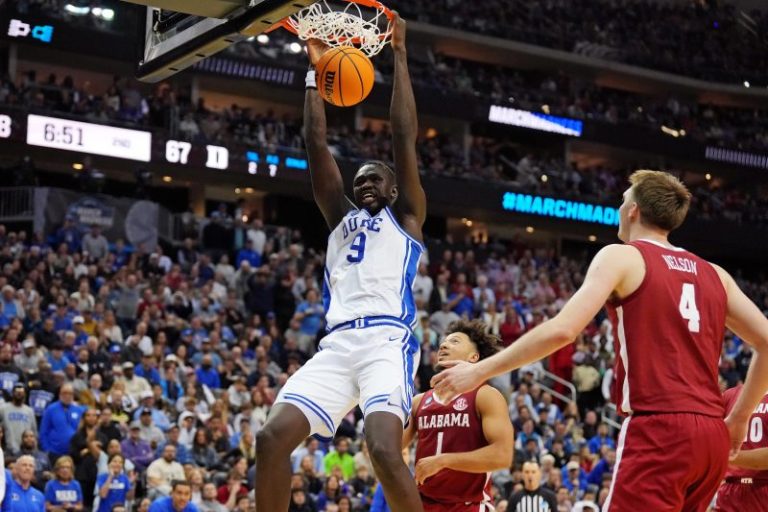
Khaman Maluach, Duke

Big-game experience is helpful, and Maluach played on the biggest stage at the 2024 Paris Olympics. The South Sudan native was a heralded international recruit and he’s lived up to the hype.

It took time for Malauach to get adjusted to the college game at the start of the season, but he’s blossomed into a solid post player, as if his 7-foot-2-inch frame wasn’t already helping him enough. In the tournament, Maluach has commanded the interior with 11.5 points and 6.3 rebounds per game. What’s even more impressive is his efficiency; he’s 20-for-23 (86.7%) from the field in the tournament with mostly dunks and other short-range baskets.

Duke is facing a top defense in Houston and will take any easy bucket it can get. Maluach can be the guy to throw down powerful slams for big momentum shifts, and he has an opportunity to own the boards against a team that doesn’t really have a premier rebounder. His effectiveness is tough to match, and the Cougars will have their hands dealing with his size and avoiding foul trouble.

Milos Uzan, Houston

Defense is what Houston is known for, but it’s somehow flown under the radar the Cougars are fifth in the country in 3-point shooting percentage. One of the biggest contributors to that is Uzan.

The junior guard is the best 3-point shooter for Houston at 44.5%, and it was on full display in the Sweet 16 matchup when he made a season-high six shots from behind the arc on nine attempts for a 22-point night. He didn’t make a 3-pointer in the Elite Eight against Tennessee in what was a quiet day for Uzan, but it wasn’t entirely needed given the Cougars dominated the Volunteers.

Houston will do its best to shut down Duke, but the Blue Devils are certainly going to find ways for the offense to score. That means the Cougars are going to need to find their own points, and they can do that with the three-ball from Uzan. If he’s able to replicate any of the big shots from the Purdue matchup, then Houston should like its chances of keeping up with the premier offense in the country.

This post appeared first on USA TODAY

Wednesday’s Washington Capitals-Carolina Hurricanes game is more than another chance for Alex Ovechkin to pull closer to Wayne Gretzky’s goal record.

It also is important to the NHL playoff standings.

The Hurricanes will clinch a playoff spot if they beat the visiting Capitals. Washington (105 points) can move 13 points ahead of Carolina (94) with a regulation victory and pull closer to a division title. The Capitals can also pass the idle Winnipeg Jets for best record in the league.

The Capitals will be playing their second road game in two nights after beating the Boston Bruins 4-3 Tuesday to end a three-game losing streak.

Ovechkin scored his 891st goal in that game and needs four more in the Capitals’ eight remaining games to break Gretzky’s record this season.

Here’s what to know about Wednesday’s game between the Capitals and Hurricanes:

When is Alex Ovechkin’s next game? Capitals vs. Hurricanes start time

The Capitals play the Hurricanes at 7 p.m. ET Wednesday at Lenovo Center in Raleigh, North Carolina.

Where to watch Capitals vs. Hurricanes game

The game is being aired by TNT and truTV. The truTV broadcast will feature an OviCast. An isolated camera will be on Ovechkin for the duration of the game. The alternate telecast will display Ovechkin’s live stats, his historical numbers and on-ice audio from the NHL on TNT broadcast.

How to stream Capitals vs. Hurricanes game

The game can be streamed on Max and Sling. Max will have the OviCast.

Capitals vs. Hurricanes date, start time, where to watch

Game Day: Wednesday, April 2, 2025
Game Time: 7 p.m. ET
Location: Lenovo Center (Raleigh, North Carolina)
TV Channel: TBS, truTV
Live Stream: Sling TV – Watch Now!

Alex Ovechkin goals vs. Hurricanes

Ovechkin has 51 goals in 91 career regular-season games against the Hurricanes, including one in an earlier meeting this season. He has scored 31 goals at Lenovo Center.

This post appeared first on USA TODAY

Vice President JD Vance condemned European countries last month for a lack of commitment to democracy as many of them lash out with lawfare attacks against populist leaders.

Vance’s critique applies to more than just Europe, however, as populist leaders across the globe are facing legal troubles from outright election bans to criminal convictions.

Here are the top populist leaders facing the most pressure.

1. Marine Le Pen, France

Right-wing French politician Marine Le Pen and several members of her ascendant National Rally party were convicted of embezzlement on Monday, and she herself has been banned from running in the 2027 presidential election.

Populist leaders from across Europe condemned the verdict, pointing to her significant lead in the polls.

‘Those who fear the judgment of voters often seek reassurance from the courts. In Paris, they have condemned Marine Le Pen and would like to remove her from political life,’ Italian Deputy Prime Minister Matteo Salvini said following Le Pen’s verdict.

‘We are not intimidated,’ he added. ‘Full speed ahead, my friend!’

2. Jair Bolsonaro, Brazil

Brazil’s Supreme Court accepted charges against former President Jair Bolsonaro last week over an alleged attempt to remain in office after his 2022 election defeat, ordering the former leader to stand trial.

All five justices ruled in favor of accepting the charges leveled by Prosecutor-General Paulo Gonet, who accused Bolsonaro and 33 others of attempting a coup that included a plan to poison his successor, current President Luiz Inácio Lula da Silva, and kill a Supreme Court judge.

The former president has repeatedly denied wrongdoing and says he’s being politically persecuted.

Under Brazilian law, a coup conviction carries a sentence of up to 12 years. When combined with the other charges, it could result in a sentence of decades behind bars.

3. Calin Georgescu, Romania

Calin Georgescu won the first round of Romania’s presidential elections earlier this year, only for the election to be canceled due to allegations of Russian collusion in Georgescu’s favor.

Georgescu was then taken into custody and has since been banned from running in the election, despite leading in polls.

4. Matteo Salvini, Italy

Italian Vice Premier Matteo Salvini faced years of legal trouble due to accusations that he had illegally detained roughly 100 migrants during his term as interior minister in 2019.

The 2019 incident saw migrants held offshore on a humanitarian rescue ship. Italian courts dropped the charges against Slavini in December.

‘Protecting our country’s borders from smugglers is not a crime,’ Salvini said shortly after the verdict. ‘This is a victory for the League and for Italy.’

5. Imran Khan, Pakistan

Pakistan’s former Prime Minister Imran Khan was jailed last month on corruption charges, though many of his supporters have compared his situation to that of President Donald Trump and the charges he has faced.

A Pakistani court sentenced Khan and his wife, Bushra Bibi, to 14 and seven years in jail after finding them guilty of corruption. They were convicted for allegedly accepting land as a bribe through the Al-Qadir Trust, which they had set up while Khan was in office. Khan, however, maintains his innocence, describing the events as a ‘witch hunt’ in exclusive comments to Fox News Digital. It is just one of the more than 100 cases he is facing.

Khan’s plight has also been highlighted by longtime Trump ally and adviser Richard Grenell, who took to social media late last year when he tweeted, ‘Free Imran Khan!’

6. Donald Trump, United States of America

President Donald Trump has faced waves of legal trouble from his political opponents stretching back nearly a decade to his first administration.

First he faced down the now-discredited Russia collusion claims before once again facing impeachment for negotiating aid for Ukraine. Once out of office, federal and state governments targeted his business dealings with investigations, eventually resulting in his conviction for falsifying business records, a verdict his allies say was bogus.

Trump has acknowledged that populist leaders like him are facing challenges across the globe. He remarked on Le Pen’s ‘very important’ situation in a statement Tuesday.

‘She was banned for five years and she was the leading candidate,’ Trump said. ‘That sounds like this country, that sounds very much like this country.’

Fox News’ Avi Kumar, Benjamin Weinthal and the Associated Press contributed to this report.

This post appeared first on FOX NEWS

The legal resistance to President Donald Trump’s second term is in full swing with more than 120 lawsuits filed since Jan. 20 by states, advocacy groups and individuals targeting his executive orders and policy agenda.

As the lawsuits move through the judiciary, understanding the structure of the federal court system can help clarify how these challenges are likely to unfold.

Article III of the U.S. Constitution establishes the Supreme Court along with ‘inferior Courts as the Congress may from time to time ordain and establish.’ The Constitution also states that judges shall hold their offices during a period of ‘good behavior.’

The federal judiciary has three main levels: district courts (trial courts), circuit courts (the first level of appeal) and the Supreme Court (the final appellate authority). There are 94 district courts, 13 circuit courts and one Supreme Court.

To hear a case, a court must have personal jurisdiction (authority over the parties involved), subject matter jurisdiction (authority to hear the type of legal issue at hand) and proper venue (the correct geographic location for the case to be tried).

Unlike state courts, which have broad authority, federal courts are courts of ‘limited jurisdiction,’ which means they can only hear cases authorized by the Constitution or federal law. Each lawsuit filed against the Trump administration raises a federal question, giving federal courts subject-matter jurisdiction.

Each district court has at least one United States district judge appointed by the president and confirmed by the Senate for a life term. Plaintiffs who lose at the district court level can appeal to a federal appellate court.

Appellate courts, also known as circuit courts, hear appeals from district courts within their geographic boundaries. Each circuit covers multiple states. For example, the Fifth Circuit includes Louisiana, Mississippi and Texas.

Each circuit also has multiple judges, ranging from six total judges to 29. Appeals to the circuit courts are first heard by a panel of three judges. Parties must file briefs to the court, arguing why the trial court’s decision should either be affirmed or reversed.

After briefs are filed, oral arguments are scheduled during which attorneys from both sides present their case and answer questions from a panel of judges. In some instances, the full court may hear a case in what’s called an en banc session. The Ninth Circuit, due to its size, follows a modified en banc process.

A circuit court’s decision is binding on all lower courts within that circuit. As such, those courts must follow that holding. Other circuits can look to that circuit’s holding as reference, but they are not bound by it.

A case can generally only be appealed once a final decision has been issued. However, some issues can be appealed before a final decision is made via what’s called an interlocutory appeal.

Parties can appeal a circuit court’s decision to the U.S. Supreme Court by filing a writ of certiorari, which is a request for the court to review the case. The Supreme Court isn’t required to take the case and denies most petitions, granting review in less than 1% of appeals. When cert is denied, the lower court’s ruling remains in place.

A circuit split is when circuits disagree on a particular legal matter. This will generally prompt the Supreme Court to grant cert in a case. If cert is granted, parties must file briefs and conduct oral arguments. 

Each circuit is assigned to a specific Supreme Court justice who handles certain appeals from that region, such as emergency applications and administrative requests. For example, Chief Justice Roberts oversees the D.C. Circuit, the 4th Circuit and the Federal Circuit. The assigned justice may act alone or refer the matter to the full court at their discretion.

The Trump administration has already appealed various decisions to the Supreme Court via emergency appeals. On March 28, the administration asked the court to review a temporary restraining order that blocked the administration’s use of an 18th-century wartime law to deport Venezuelan nationals, including alleged members of the gang Tren de Aragua, from the United States. 

The appeal came shortly after the U.S. Court of Appeals for the D.C. Circuit issued a 2-1 ruling to uphold the district court’s decision blocking the administration. 

Fox News Digital’s Breanne Deppisch contributed to this report. 

This post appeared first on FOX NEWS

The Senate Judiciary Committee is holding a hearing to examine the influx of nationwide orders against the Trump administration by federal district judges. 

Last week, Chairman Chuck Grassley, R-Iowa, revealed the details of the event, set one day after the House committee’s hearing on the same subject. 

‘Since the courts and the executive branch are on an unsustainable collision course, Congress must step in and provide clarity,’ he said in a statement last week. ‘Our hearings will explore legislative solutions to bring the balance of power back in check.’

The hearing, titled, ‘Rule by District Judges II: Exploring Legislative Solutions to the Bipartisan Problem of Universal Injunctions,’ will feature testimony from John N. Matthews Professor of Law at Notre Dame Samuel Bray, partner at Boies Schiller Flexner Jesse Panuccio, who was previously the acting associate attorney general at the Department of Justice (DOJ), and the chairman of the DOJ’s Regulatory Reform Task Force and vice chairman of the DOJ’s Task Force on Market Integrity and Consumer Fraud, as well as Agnes Williams Sesquicentennial Professor of Federal Courts at Georgetown University Law Center Stephen I. Vladeck.

After revealing details of the hearing, Grassley rolled out his own bill to tackle the issue. 

‘These nationwide injunctions have become a favorite tool for those seeking to obstruct Mr. Trump’s agenda,’ he wrote in an op-ed in the Wall Street Journal. ‘More than two-thirds of all universal injunctions issued over the past 25 years were levied against the first Trump administration. In the past two months alone, judges have issued at least 15 universal injunctions against the administration—surpassing the 14 President Biden faced throughout his four-year term.’

Grassley’s legislation would restrain the lower courts’ ability to issue nationwide orders, and they would no longer be able to stop ‘legitimate executive action’ by granting orders to entities or individuals who are not parties to the lawsuit. 

While similar bills have been introduced by Grassley’s GOP colleagues in both the Senate and House, it is unclear whether the issue will get floor votes, as it would need to amass more than 60 votes in the upper chamber to beat the filibuster. 

Senate Majority Leader John Thune, R-S.D., has not elaborated much on the issue and, when asked about it, he told reporters, ‘At the end of the day, there is a process, and there’s an appeals process. And, you know, I suspect that’s ultimately how it’s going to be ended.’

President Donald Trump has made his frustration with nationwide injunctions clear, urging action on them publicly. 

‘Unlawful Nationwide Injunctions by Radical Left Judges could very well lead to the destruction of our Country!’ the president said in a recent Truth Social post. ‘These people are Lunatics, who do not care, even a little bit, about the repercussions from their very dangerous and incorrect Decisions and Rulings.’

‘If Justice Roberts and the United States Supreme Court do not fix this toxic and unprecedented situation IMMEDIATELY, our Country is in very serious trouble!’ he continued. 

This post appeared first on FOX NEWS

Democrats have remained relatively quiet while President Donald Trump and Republicans hammer federal district judges for churning out nationwide orders halting his administration’s actions. 

But during President Joe Biden’s tenure, they decried similar wide-ranging injunctions and even sought to remedy the issue with legislation. 

In 2023, Sen. Mazie Hirono, D-Hawaii, debuted a measure to give the U.S. District Court for the District of Columbia sole jurisdiction over any cases with national implications. 

‘When parties are able to choose their judges, it creates the perception that they are able to predetermine their case’s outcome, compromising the integrity of our federal justice system,’ she said in a statement at the time. 

‘Activist plaintiffs should not be able to hand-pick individual judges to set nationwide policy, which is why it’s critical we address the issue of judge shopping in our federal courts. By routing cases with national implications through the D.C. District Court, which has expertise in cases challenging federal agency action, the Stop Judge Shopping Act will strengthen trust in our federal justice system and help ensure major cases are decided based on the law, not the ideological agenda of any one judge.’

The bill wouldn’t have ended nationwide injunctions as Republicans and Trump have sought, but it would give all jurisdiction on such decisions to one court, potentially reducing the probability of such orders being levied against Biden or other Democrat presidents. 

The D.C. court is made up of 11 district judges appointed by former Presidents Biden and Barack Obama, and four were appointed by Trump. The court’s chief judge is Obama-appointee James Boasberg, who is at the center of a key battle with the Trump administration over deportation flights using the Alien Enemies Act, a 1798 wartime immigration law. 

A similar measure was proposed by then-Majority Leader Chuck Schumer, D-N.Y., Sen. Sheldon Whitehouse, D-R.I., in addition to 37 other Democrats in 2024. The bill would have required cases involving broad injunctions to be randomly assigned in order to ‘promote uniformity and fairness.’

Hirono, Schumer and Whitehouse did not provide comment to Fox News Digital when asked if they still supported legislative action and if they backed any of the Republican bills. 

Multiple Republicans in Congress have rolled out legislation this Congress to explicitly prevent district-level courts from issuing such wide-ranging orders, including Senate Judiciary Committee Chair Chuck Grassley, R-Iowa. 

In an op-ed for the Wall Street Journal, he wrote, ‘The obvious solution is to limit district courts to resolving the cases only between the parties before them.’

‘Under my bill, lower courts could no longer block legitimate executive action by issuing orders to nonparties to the lawsuit. The bill would also make TROs against the government immediately appealable, to make sure that prudence wins out over rash decisions handed down in the heat of a political moment,’ he explained. 

The top judiciary Republican also pointed to past grievances Democrats have had with the practice of nationwide court orders. 

‘Two-hundred forty Democratic lawmakers, including Sens. Chuck Schumer and Dick Durbin, in 2023, submitted a friend-of-the-court brief warning of the ‘perilous consequences’ resulting from a district judge’s move to block the abortion pill mifepristone,’ he recalled. 

‘Justice Elena Kagan has similarly expressed dismay.’

The brief was filed to plead with the high court to overrule the nationwide injunction issued by U.S. District Judge Matthew Kacsmaryk, which suspended FDA approval of mifepristone. 

‘The consequences of the Fifth Circuit’s decision could extend far beyond mifepristone, for it undermines the science-based, expert-driven process that Congress designed for determining whether drugs are safe and effective,’ the lawmakers wrote at the time. ‘By permitting the district court to disrupt FDA’s current regulation of mifepristone, the Fifth Circuit has countenanced judicial interference that erroneously substitutes the district court’s judgment for FDA’s scientific determination.

Hirono, Schumer and Whitehouse have not been publicly critical of nationwide injunctions during the new Trump administration as district judges across the country manage to halt actions.

On Wednesday, the Senate Judiciary Committee will hold a hearing on the subject as Republicans push legislation to end the practice of issuing nationwide orders. 

This post appeared first on FOX NEWS

Former NFL kicker Jay Feely is ‘seriously considering’ running for a United States Congress seat, according to a report from The Arizona Republic, part of the USA TODAY Network.

Feely, who spent 14 seasons suiting up for NFL teams, would seek to be the representative for Arizona’s 5th Congressional District. The kicker played for the Atlanta Falcons, New York Giants, Miami Dolphins, New York Jets, Arizona Cardinals and Chicago Bears from 2001 to 2014.

The potential move into politics is made possible by the departure of Rep. Andy Biggs, R-Ariz., who has held the seat since 2017 but is running for Arizona governor in 2026. Republicans have held the seat since 2011.

The 48-year-old Feely figures to make a final decision within the next three months, GOP strategist Brian Seitchik told The Arizona Republic on Feely’s behalf.

Feely has grown close with President Donald Trump as well, previously joining the president for golf at his clubs in Mar-a-Lago and Bedminster, New Jersey, praising Trump’s ‘earnest desires for our great country.’

According to Seitchik, Feely was ‘enthusiastically introduced’ to conservative members of Congress, including House Freedom Caucus founding member Rep. Jim Jordan, R-Ohio, when he visited in March.

One of Feely’s old teams, the Jets, are owned by businessman and GOP donor Woody Johnson, who went on to be the United Kingdom ambassador during the first Trump administration – adding another connection to Feely’s potential political future.

He previously entertained a role in politics, criticizing then-President Barack Obama in a 2009 television news segment, before electing to focus on family. Now, 16 years later, he might be diving into the political realm to represent a district that Seitchik said Feely has lived in with his wife and kids for more than 10 years.

Feely does carry some national name recognition. The kicker has worked as a commentator for CBS Sports in his post-playing days.

During the regular season, Feely serves as a game analyst. He worked alongside Philadelphia Phillies play-by-play announcer Tom McCarthy and former NFL offensive lineman Ross Tucker last season.

In the postseason, Feely joined CBS’s top broadcast team with Jim Nantz, Tony Romo and Tracy Wolfson as a kicking analyst.

The district Feely is contemplating a run in covers most of Arizona’s East Valley, including parts of Gilbert, Chandler, Queen Creek and Apache Junction.

About 20% of active voters in the district are Democrats, 45% are Republicans and 35% are not affiliated with a political party, according to the Arizona Secretary of State’s Office.

This post appeared first on USA TODAY

Colorado football safety Shilo Sanders hasn’t kept up on his payments for his 2023 Mercedes-Benz, leading the car company’s financial services arm to seek relief from the court where Sanders filed for bankruptcy in 2023 with more than $11 million in debt, according to court records filed Tuesday by Mercedes-Benz Financial Services.

The company said Sanders, son of Colorado coach Deion Sanders, was past due for $6,877 on his monthly payments from December through February. It also noted Sanders has an outstanding balance of $97,239 while the trade-in value for the car is less than that at $97,000.

As a result, the company wants the court’s permission to take possession of the car and for Sanders to provide the location of it.

Why Mercedes is making this move now

Sanders, an NFL draft prospect, filed for bankruptcy in October 2023, hoping to discharge more than $11 million in debt – almost all of it owed to one man, John Darjean, a security guard from his former school in Texas.

The Chapter 7 bankruptcy filing triggered an automatic stay or hold on debt collection efforts against him. But Mercedes-Benz Financial Services now is arguing it should be entitled to relief from this stay under these circumstances.

“The motor vehicle is depreciating in value, the contract is in default and the movant (Mercedes Benz Financial Services) is being prevented by the automatic stay from exercising its remedies to repossess and liquidate its collateral, the motor vehicle,” said the filing from Mercedes Benz Financial Services and its creditor attorney Doug Koktavy.

Records show Shilo Sanders, 25, agreed to buy the $135,000 car with installment payments in May 2023, several months before he filed for bankruptcy. He continued to make payments after filing for bankruptcy but recently defaulted, according to the company.

“Debtor (Sanders) indicated an intent to retain the motor vehicle and reaffirm the obligation,” the company’s filing stated. “Debtor has not accomplished this intention.”

Shilo Sanders’ debt stems from an incident 10 years ago

Shilo Sanders’ bankruptcy case stems from an incident in 2015, when Darjean said Shilo caused him severe and permanent injuries as he tried to confiscate his phone at school. Shilo was only 15 years old at the time and said he acted in self-defense and that Darjean was the aggressor. But Darjean sued Shilo for damages. And when the case finally went to trial in Dallas in 2022, Shilo didn’t show up, leading to a default judgment against him of $11.89 million.

Shilo then filed for bankruptcy, hoping for a “fresh start” free of that debt. In response, Darjean is still fighting to get what he is owed from that judgment and has filed two complaints that seek to prevent the debt from being discharged.

The filing by Mercedes-Benz this week comes as Shilo Sanders is preparing for the NFL draft later this month. It’s not clear if he will be drafted, but even if he’s not, he is expected to get a shot with an NFL team as an undrafted free agent.

If the debt isn’t discharged by the court, Darjean still could pursue debt collection against Shilo Sanders in the future. If it is discharged by the court, Darjean likely only will collect a small fraction of the judgment he’s owed from Shilo Sanders.

Sanders’ attorney didn’t return a message seeking comment.

Follow reporter Brent Schrotenboer @Schrotenboer. Email: bschrotenb@usatoday.com

This post appeared first on USA TODAY