Archive

2025

Browsing

The parents of a Bucknell football player who died two days after collapsing during a team practice in 2024 filed a wrongful death lawsuit on Wednesday against the university in Lewisburg, Pennsylvania, according to a copy of the complaint.

The parents of Calvin “CJ” Dickey Jr., who was an 18-year-old freshman when he died July 12, allege the university failed to take action that could have prevented their son’s death, according to the complaint filed with the Court of Common Pleas of Philadelphia County.

Dickey’s death occurred two days after his first practice as an offensive lineman with the Bucknell football team, a Division I program that competes in the Football Championship Subdivision.

The complaint characterizes Dickey’s death as “completely avoidable’’ and says he died from medical complications stemming from sickle cell trait and rhabdomyolysis.

“Rhabdomyolysis is a rare muscle injury where your muscles break down,’’ according to the Cleveland Clinic. “This is a life-threatening condition that can happen after an injury or excessive exercise without rest.’’

Studies have found that ‘sickle cell trait elevates the risks of exertional rhabdomyolysis and death,’ according to the National Institutes of Health.

On June 28, Dickey completed the NCAA-mandated sickle cell testing, which revealed he had sickle cell trait, and his medical records were uploaded electronically to Bucknell’s medical reporting platform, according to the complaint.

Two weeks prior to Dickey reporting to Bucknell, according to the complaint, Bucknell trainer Rayna Murphy called Dickey’s mother, Nicole, “to discuss CJ’s positive sickle cell trait test. Nicole was assured that adequate precautions would be taken to accommodate this condition.’

But Bucknell did not take the necessary precautions, Dickey’s parents allege.

‘The death of a student is always a tragic loss,’ Bucknell University said in a statement provided to USA TODAY. “Bucknell University is aware of the lawsuit filed by the parents of CJ Dickey. While the University will not comment on pending litigation, we again extend heartfelt sympathies to CJ’s family, and we will continue to focus on our most important priority — the health and safety of all Bucknell students.’

Dickey’s parents claim the incident that led to the onset of rhabdomyolysis took place during practice and involved hazing. “Given Defendant Bucknell’s knowledge of CJ’s condition, Defendant Bucknell acted with reckless indifference to his health and safety by causing, coercing, or forcing him to participate in the initiation ritual of pointless, unnecessary yet brutal exercise routines, and by intentionally, knowingly, and recklessly promoting or facilitating the same,’ the complaint states.

“On its own, and especially in light of CJ’s condition, the NCAA’s guidelines, and the standard of care followed by other universities for sickle trait athletes, the activity did not constitute reasonable or customary athletic training.’’

Dickey collapsed, according to the complaint, after some of the freshmen “messed up’ and were forced by Mark Kulbis, then the stength and conditioning coach at Bucknell, to perform “up-downs.’ Up-downs, also known as ‘burpees,’ can be used as a conditioning drill.

“Students who were present at the workout have reported that CJ was clearly in distress during the 100 up-downs,’’ the complaint said. “He was falling behind the rest of the group and could not keep up. The other freshman players were cheering on CJ and trying to motivate him. The freshman players could tell that CJ was in distress but Kulbis did nothing. Instead of telling CJ to sit it out, he pushed him on.’’

Dickey eventually collapsed, according to the complaint.

Bucknell president John C. Bravman and Bucknell head football coach Dave Cecchini, who along with three athletic officials are named as defendants in the lawsuit, “were well aware of Kulbis’ practice of cruelly abusing freshman players on the first day of practice,’’ according to the complaint.

Kulbis no longer is employed by Bucknell, according to the complaint. His LinkedIn page indicates he stopped working at the university in January. Jermaine Truax, who was the school’s vice president and director of athletics and recreation at the time of Dickey’s death and is a defendant, was fired March 13, according to the complaint. Truax is not listed on the school’s athletic staff directory.

Asked why Kulbis and Truax no longer work at the school, Bucknell director of media relations, Mike Ferlazzo, told USA TODAY, ‘We don’t comment on personnel matters.’

Tim Pavlechko, who is listed as interim vice president and director of athletics and recreation, was deputy director of athletics at the time of Dickey’s death and is a defendant. Cecchini, who has been Buckell’s head football coach since 2019, also is a defendant. He remains the team’s head coach.

The complaint states that about two hours after collapsing at the July 10 practice, Dickey was being treated at Evangelical Community Hospital in Lewisburg.

His condition rapidly worsened.

Two days later, after Dickey had emergency surgery, he was revived multiple times as his condition grew more dire, according to the complaint, which said his parents ultimately “made the most difficult decision of their lives. They told the doctors to stop trying to resuscitate CJ and let him go back to God in peace.’’

The parents allege the university provided no information concerning how Dickey died but say in the complaint it could have been prevented. The complaint cites an NCAA-published document about sickle cell trait in which coaches are warned that athletes with the genetic condition “can begin to experience symptoms after only 1-3 minutes of sprinting, or in any other full exertion or sustained effort, thus quickly increasing the risk of complications.’

“In short, Defendant Bucknell’s coaching and training staff had CJ’s medical records and ultimately cleared him to play,’ the complaint further states. “They were well aware CJ carried the sickle cell trait and knew that it could lead to life-threatening outcomes if widely known and well-established protocols were not implemented for him.’’
This post appeared first on USA TODAY

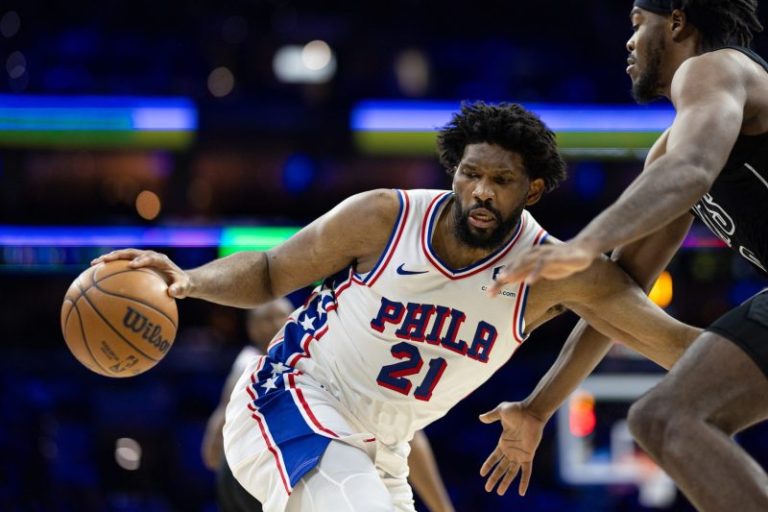
Philadelphia 76ers big man Joel Embiid will officially undergo surgery in the coming days.

He was officially ruled out for the rest of the season in late February.

“Following consultations with medical experts, it has been determined that Joel Embiid will undergo arthroscopic surgery next week to address his left knee,” according to a statement released by the team.

He had been dealing with a knee injury that had kept him sidelined earlier in the season.

It’s been an eventful 2024-25 season for Embiid off the court. It started with the NBA fining the Sixers $100,000 due to statements made about Embiid’s health. Embiid was also suspended for three games without pay after he shoved a columnist in the locker room during a confrontation over something the columnist wrote.

Joel Embiid’s last game of 2024-25 season

The 2022-23 MVP has not played since the 76ers’ loss to the Brooklyn Nets on Feb. 22. He had 14 points, seven rebounds and five assists in 31 minutes of play.

He experienced swelling after the game and had consulted with doctors to consider options about his knee.

The center averaged 23.8 points, 8.2 rebounds and 4.5 assists per game in just 19 games this season.

What is Joel Embiid’s injury history?

In December, Embiid suffered a sinus fracture when Pacers guard Bennedict Mathurin’s hand hit the 76ers’ center in the final seconds before halftime. Mathurin was collecting an offensive rebound and attempting to lay the ball back up.

Embiid has dealt with facial injuries before. He suffered a left orbital fracture in 2018 and a right orbital fracture in 2022.

He suffered a significant foot injury in 2014 that delayed his NBA debut by two full seasons. He’s dealt with knee injuries throughout his career, including a left knee injury in 2024 that derailed a potential MVP season.

This post appeared first on USA TODAY

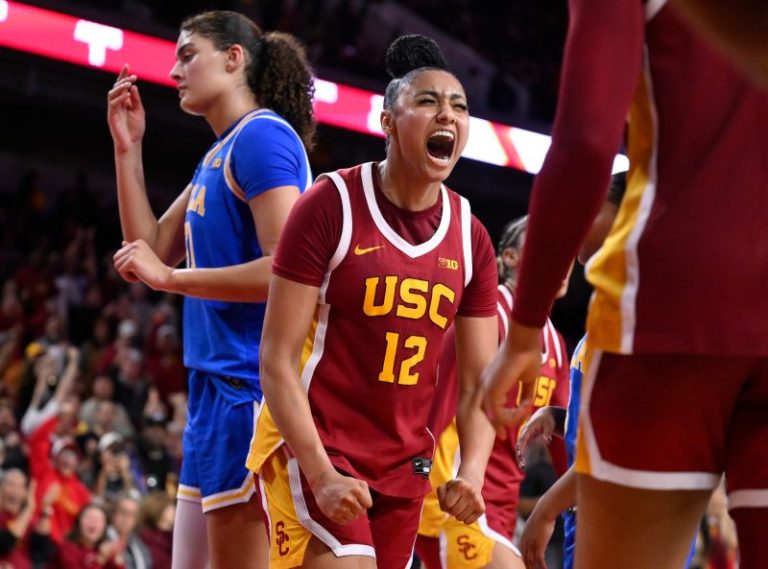
The 2024-25 season did not end the way USC women’s basketball star JuJu Watkins would have liked, but the talented sophomore proved herself over the course of it.

Watkins was named the women’s 2025 Naismith National Player of the Year on Wednesday. She averaged 23.9 points, 6.8 rebounds and 3.4 assists per game, leading the Trojans to a 31-4 record and 17-1 Big Ten conference mark. USC earned a No. 1 seed in the women’s NCAA Tournament but saw their season cut short in the Elite Eight after Watkins’ season ended due to a knee injury in the second round.

Paige Bueckers and UConn took down the Watkins-less Trojans 78-64 on Monday. Watkins was named the Player of the Year over Bueckers, Notre Dame’s Hannah Hidalgo, and cross-town rival Lauren Betts of UCLA.

Watkins was also named the Big Ten Player of the Year and was given unanimous first-team All-American honors. She saw her season end on March 24 against the Bulldogs in second-round action when she became entangled with a Bulldogs’ defender on a fastbreak attempt. According to ESPN’s Shams Charania, Watkins tore her ACL.

She addressed the injury for the first time on Tuesday.

‘Thank you for all the incredible love and support,’ Watkins posted to her Instagram story. ‘Seeing all your messages and kind words has meant the world to me — ya’ll have given me so much hope.

‘Right now, my heart is with my teammates — I wish I could have been out there battling, but I couldn’t be prouder of the fight we’ve fought together. Thank you all.’

JuJu Watkins stats at USC

Here’s a look at Watkins’ career stats at USC in her first two seasons:

2023-24: 27.1 points per game, 7.3 rebounds per game, 3.3 assists per game, 2.3 steals per game and 1.6 blocks per game while shooting 40.1% from the field (31.9% 3-point shooting)
2024-25: 23.9 points per game, 6.8 rebounds per game, 3.4 assists per game, 2.2 steals per game and 1.8 blocks per game while shooting 42.6% from the field (32.5% 3-point shooting)

This post appeared first on USA TODAY

One year after a record run on quarterbacks in the NFL draft, the prevailing theme around this year’s crop of college passers is uncertainty.

While Cam Ward appears to be solidifying his case to be the Tennessee Titans’ pick with the No. 1 overall selection, the upcoming group at the position hasn’t sparked the same excitement that Caleb Williams, Jayden Daniels and the four other signal-callers taken in the top 12 picks ignited last year. And in what’s viewed as a lackluster year for top-end talent behind center, some teams might be wary about the available choices – at least when the price tag is a premium pick.

Still, this class also has a chance to split from last year’s on Day 2 and beyond, with several developmental options in the mix after the 2024 group had a record 137 selections between the last first-round quarterback selection (Bo Nix) and the next pick at the position (Spencer Rattler in the fifth round).

Here’s USA TODAY Sports’ ranking of the top 10 quarterbacks available in the 2025 NFL draft:

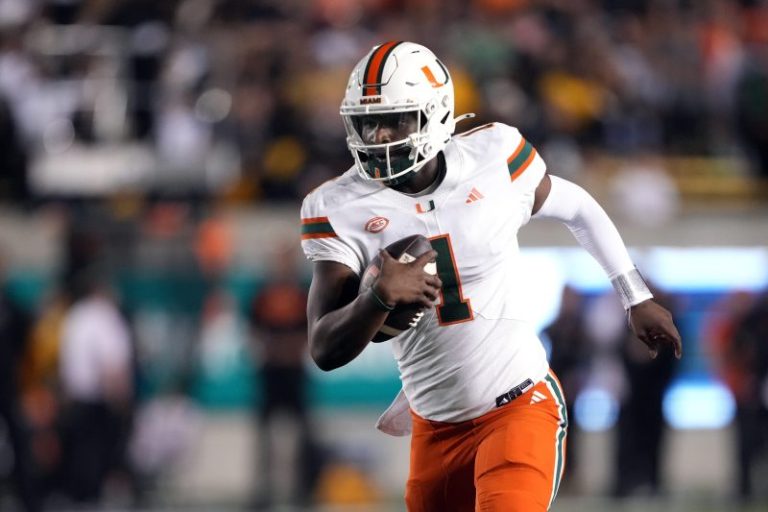
1. Cam Ward, Miami (Fla.)

Between his attacking mentality and an embrace of off-schedule plays, Ward again and again bets on himself to defy the odds. Maybe that should come as no surprise for a player who began his career at the Football Championship Subdivision level with Incarnate Word before transferring to Washington State and again to Miami. But even when his confidence veers into the territory of hubris, Ward more often than not finds a way to cash in on his sizable gambles.

At the next level, his devil-may-care approach might have to be dialed back at least a little bit, with defenses sure to test whether he’ll take the easier wins that he so far has frequently passed up. But given his comfort reading the entire field, making adjustments at the line of scrimmage and operating from within the pocket, Ward is far more than just an improvisational aficionado. So long as he is paired with a coaching staff prepared to ride out some early turbulence stemming from his playing style, Ward sizes up as an exciting offensive catalyst capable of elevating any group he joins.

2. Shedeur Sanders, Colorado

From the start of his career, Sanders has been defined by his ability to navigate pressure. The son of Hall of Famer Deion Sanders – as well as the coach’s star pupil – has conquered a singular set of challenges, as he delivered both Jackson State and Colorado to new heights above even his substantial celebrity. Through it all, he has exhibited a never-say-die mentality that has become both his foremost strength and most pressing concern.

Sanders’ toughness and confidence are unimpeachable after a career marked by insufficient protection. Yet while the 6-2, 212-pounder frequently overcame an unrelenting onslaught of pass rushers, he often exacerbated the issue by holding onto the ball too long and drifting backward in the pocket. With his margin of error getting considerably thinner at the next level, he will have to fine-tune his internal clock, especially given that he might not be able to replicate the off-platform and out-of-structure throws he grew accustomed to making for the Buffaloes. But as a precise pocket passer, Sanders could thrive as an efficient distributor if he lands in the right offense with sufficient support.

3. Jaxson Dart, Mississippi

As the triggerman for Lane Kiffin’s offense, Dart enjoyed a steady ascension over three years with Mississippi after transferring from USC. While an attack that affords plenty of easy decisions has left questions about how the 6-2, 223-pounder will adapt to much more challenging circumstances, Dart established a strong track record for executing within structure and making plays as a runner when things broke down.

Most of Dart’s physical attributes are merely solid rather than spectacular, and his inexperience throwing with anticipation looms as a potential stumbling block. But as a signal-caller who thrives attacking defenses in the intermediate level and over the middle, he can carve out a place for himself in an offense that accentuates his strengths.

4. Jalen Milroe, Alabama

As both a runner and deep thrower, Milroe stands out as this class’ pre-eminent big-play threat. The 6-2, 217-pounder is something to behold when he’s fully in sync, as he’s equally comfortable uncorking passes downfield as he is taking off for a long gain with his legs. But there’s still a wild variance in his play even from snap to snap, as the transition from Nick Saban’s staff to a Kalen DeBoer-orchestrated offense revealed Milroe still has plenty of work to do as a pocket passer.

Adapting to the short-to-intermediate game remains a challenge for Milroe, who too often rips passes with little regard for touch or timing. And after throwing for just four touchdowns and eight interceptions in his final seven regular-season games in 2024, he has to account for critical lapses in his footwork and decision-making. While his running ability should immediately translate to the next level and afford him some flexibility as he acclimates to an even faster game, Milroe can’t be counted on as much more than a developmental signal-caller early in his career unless he irons out his issues in short order.

5. Tyler Shough, Louisville

At 6-5 and 219 pounds, Shough is comfortable whipping throws or delivering touch strikes. He also can manipulate coverages more comfortably than many of his peers.

What’s the rub, then, for a Day 2 prospect with several key first-round traits? For one, Shough only has one year of consistent production in a nomadic career that featured him spending three years apiece at Oregon and Texas Tech before he landed at Louisville. Injuries also factor greatly into his evaluation, as he twice suffered a broken collarbone and then broke his fibula. And for a player who will turn 26 as a rookie, there’s significant concern about whether he still has room to grow and stick as a starter.

6. Quinn Ewers, Texas

The No. 1 overall recruit was a three-year starter who twice led the Longhorns to the College Football Playoff after transferring from Ohio State, but he never truly became the scintillating passer many envisioned. There were flashes of promise, to be sure, with his rapid release and deft touch on display at times in a promising 2023 campaign in which he completed 69% of his passes. But despite tossing 31 touchdowns last season, Ewers didn’t make the leap many envisioned. The 6-2, 214-pounder still gets stuck on his first read far too often, and he’s frequently robotic rather than instinctive in the face of pressure. Though his arm strength and ability to deliver off platform might have been his calling cards in high school, he’s not strong enough in either area to compensate for shortcomings with his footwork and decision-making,

7. Kyle McCord, Syracuse

For better or worse, every play has the potential to be an adventure with McCord, who’s never afraid to let it rip. The aggression has served him well in spots, with the Ohio State transfer reviving his career with 34 touchdown passes in his lone season at Syracuse. But his 12 interceptions highlighted that he often paid for his willingness to throw into tight coverage, and he lacks the upper-echelon arm strength to extend this style to the pros. His best bet to have a shot as a starter somewhere down the line might be to rely more on his touch passing while he also learns to manipulate coverages better.

8. Will Howard, Ohio State

In leading the Buckeyes to the national championship last season, Howard was tasked with getting the ball in the hands of Ohio State’s myriad playmakers while generating just enough on his own. Still, the Kansas State transfer repeatedly got the job done. Howard can mostly be described as passable in many elements of his game, including his arm strength and field vision. But at 6-4 and 243 pounds with admirable toughness, he could be a trustworthy second-stringer.

9. Dillon Gabriel, Oregon

A 5-11, 205-pound lefty who starred for three different schools, Gabriel is far from the picture of a typical quarterback prospect. But the Heisman Trophy finalist manages to mitigate some concerns about his physical limitations by operating quickly and with composure from the pocket. Attacking over the middle of the field is bound to be a problem for Gabriel, but he could fit as a backup for an offense that prizes his touch, anticipation and intelligence.

10. Max Brosmer, Minnesota

There’s nothing dazzling about the 6-2, 217-pound transfer from New Hampshire, who won’t threaten defenses deep or make many things happen on his own, particularly when a play breaks down. But he’s savvy and clean in his approach with a knack for making good decisions. That skill set could allow him to hang for a while as a backup.

This post appeared first on USA TODAY

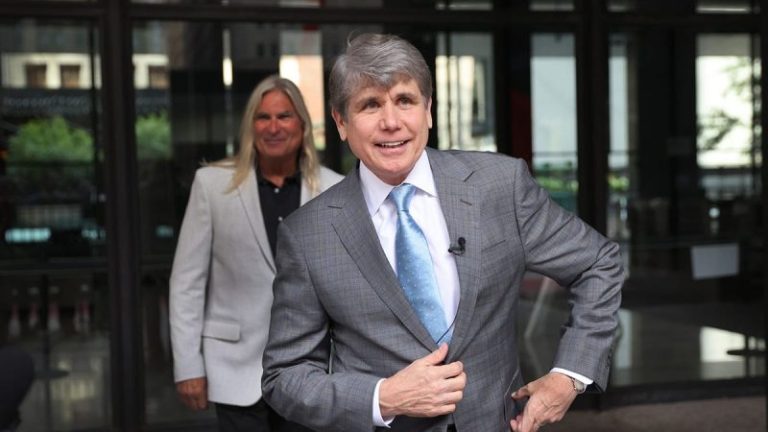
Former Illinois Gov. Rod Blagojevich, fresh off a pardon from President Donald Trump, has a new job representing the interests of a politician known as the ‘Bosnian Bear,’ who also has close ties to Russian President Vladimir Putin.

Blagojevich, who was pardoned by Trump in February, has agreed to lobby on behalf of the Republic of Srpska, a Serb-majority territory in Bosnia and Herzegovina, Politico reported. The region has long been mired in ethnic tension.

‘RRB Strategies LLC will provide communications and public affairs support on behalf of the Republic of Srpska,’ according to the registration statement filed by Blagojevich’s firm. 

Registration is required under the Foreign Agents Registration Act.

In a post on Wednesday, Blagojevich said Interpol, the global police organization, denied a request from ‘the unelected Bosnian High Representative to arrest Milorad Dodik, known as the ‘Bosnian Bear’ for his big physique, the duly elected President of the Republic of Srpska.’

Interpol’s denial came as Dodik traveled to Israel to meet with Israeli Prime Minister Benjamin Netanyahu and to attend a conference on how to combat antsemitism, the former governor said. 

Earlier this week, Blagojevich said left-wing courts, prosecutors and officials were trying to ‘jail populist conservative leaders elected by the people & bar them from holding office.’

He cited efforts to push back against Trump, Marine Le Pen in France and Dodik, who has long advocated for Srpska to separate from Bosnia and Herzegovina and join Serbia.

In February, he was sentenced to a year in prison for defying the country’s Constitutional Court. He has since fled to Moscow.

In March, Secretary of State Marco Rubio said Dodik was undermining Bosnia and Herzegovina’s institutions and threatening its security and stability. 

‘Our nation encourages political leaders in Bosnia and Herzegovina to engage in constructive and responsible dialogue,’ he said. ‘We call on our partners in the region to join us in pushing back against this dangerous and destabilizing behavior.’

Trump reportedly weighed tapping Blagojevich to serve as U.S. ambassador to Serbia before picking former Arizona Attorney General Mark Brnovich.

This post appeared first on FOX NEWS

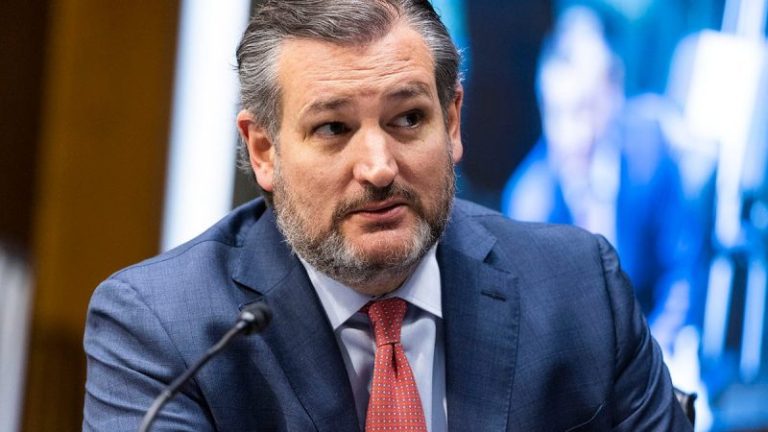
Sen. Ted Cruz, R-Texas, and Sen. Amy Klobuchar, D-Minn., sparred during a hearing on federal judges’ nationwide orders against the Trump administration, and the Democrat dismissed her colleague’s claims of ‘lawfare.’

‘Understand this is the second phase of lawfare,’ Cruz said during the Senate Judiciary Committee’s hearing, ‘Rule by District Judges II: Exploring Legislative Solutions to the Bipartisan Problem of Universal Injunctions.’ 

‘Now that their efforts to indict President Trump and stop the voters from re-electing him have failed, they’re going and seeking out individual radical judges,’ the Texas Republican claimed. 

Klobuchar disputed this, telling Cruz the injunctions from federal judges were a result of President Donald Trump ‘violating the Constitution.’

‘Why would Trump-appointed judges …,’ the Minnesota Democrat began before being interrupted by Cruz.

‘Why don’t you file them in red districts?’ Cruz asked. ‘Why are the Democrat attorneys general seeking out left-wing, blue swing districts?’

Klobuchar claimed the spike in nationwide injunctions from district judges halting Trump administration actions are not because ‘these judges are crooked or lunatics or evil.’ And she warned that making such claims could instigate threats and violence against them. 

Cruz criticized Democrats for not sufficiently denouncing threats against conservative Supreme Court justices in recent years. But Klobuchar called that a lie, explaining, ‘We came together and got more funding for the judges and changed things so that they had more protection.’

While multiple Democrats criticized ‘judge shopping’ during the hearing, they were careful not to get behind Republican bills to end all nationwide injunctions. 

‘It’s impossible to separate the hearing from President Trump’s record in office,’ said ranking member Dick Durbin, D-Ill.

But ending judge shopping, as Democrats have proposed in the past, wouldn’t completely address the issue, said majority witnesses John N. Matthews, a law professor at Notre Dame Samuel Bray, and Jesse Panuccio, partner at Boies Schiller Flexner. He was previously the acting associate attorney general at the Department of Justice (DOJ), chairman of the DOJ’s Regulatory Reform Task Force and vice chairman of the DOJ’s Task Force on Market Integrity and Consumer Fraud. 

‘I think the incentive for forum shopping is that you think you can get a judge who can be a ruler for the whole nation. So, fix the problem of judges overreaching,’ Panuccio. 

This post appeared first on FOX NEWS

WASHINGTON — Boeing CEO Kelly Ortberg told senators on Wednesday that he’s happy with the company’s progress improving manufacturing and safety practices following several accidents, including a near catastrophe last year.

Ortberg faced questioning from the Senate Commerce Committee about how the company will ensure that it doesn’t repeat past accidents or manufacturing defects, in his first hearing since he became CEO last August, tasked with turning the manufacturer around.

Sen. Ted Cruz, R.-Texas, the committee’s chairman, said he wants Boeing to succeed and invited company managers and factory workers to report to him their opinions on its turnaround plan. “Consider my door open,” he said.

Ortberg acknowledged the company still has more to do.

“Boeing has made serious missteps in recent years — and it is unacceptable. In response, we have made sweeping changes to the people, processes, and overall structure of our company,” Ortberg said in his testimony. “While there is still work ahead of us, these profound changes are underpinned by the deep commitment from all of us to the safety of our products and services.”

Boeing CEO Kelly Ortberg testifies on Capitol Hill on April 2.Brendan Smialowski / AFP – Getty Images

Boeing executives have worked for years to put the lasting impact of two fatal crashes of its best-selling Max plane behind it. 

Ortberg said Boeing is in discussions with the Justice Department for a revised plea agreement stemming from a federal fraud charge in the development of Boeing’s best-selling 737 Maxes. The previous plea deal, reached last July, was later rejected by a federal judge, who last month set a trial date for June 23 if a new deal isn’t reached.

Boeing had agreed to plead guilty to conspiring to defraud the U.S. government, pay up to $487.2 million and install a corporate monitor at the company for three years.

“We’re in the process right now of going back with the DOJ and coming up with an alternate agreement,” Ortberg said during the hearing. “I want this resolved as fast as anybody. We’re still in discussions and hopefully we’ll have a new agreement here soon.”

Asked by Sen. Maria Cantwell, the ranking Democrat on the committee, whether he had an issue with having a corporate monitor, Ortberg replied: “I don’t personally have a problem, no.”

Ortberg and other Boeing executives have recently outlined improvements across the manufacturer’s production lines, such as reducing defects and risks from so-called traveled works, or doing tasks out of sequence, in recent months, as well as wins like a contract worth more than $20 billion to build the United States’ next generation fighter jet.

But lawmakers and regulators have maintained heightened scrutiny on the company, a top U.S. exporter.

“Boeing has been a great American manufacturer and all of us should want to see it thrive,” Sen. Ted Cruz, a Texas Republican and chairman of the committee, said in a statement in February announcing the hearing. “Given Boeing’s past missteps and problems, the flying public deserves to hear what changes are being made to rehabilitate the company’s tarnished reputation.”

The Federal Aviation Administration last year capped Boeing’s production of its 737 Max planes at 38 a month following the January 2024 door plug blowout. The agency plans to keep that limit in place, though Boeing is producing below that level.

Ortberg said at the hearing Wednesday that the company could work up to production rate of 38 Max planes a month or even higher sometime this year, but said Boeing wouldn’t push it if the production line isn’t stable.

Acting FAA Administrator Chris Rocheleau said at a Senate hearing last week that the agency’s oversight of the company “extends to ongoing monitoring of Boeing’s manufacturing practices, maintenance procedures, and software updates.”

This post appeared first on NBC NEWS

The White House is taking a top-down approach in making sure Republicans are united on President Donald Trump’s sweeping tariffs plan.

U.S. trade representative Jamieson Greer briefed House Republican staffers on the administration’s strategy on Wednesday evening, Fox News Digital was told.

Greer opened the call stressing that Trump was ushering in a magnitude of economic change not seen since the post-World War II era.

He also said the U.S. had been subjected to unfair trade practices for decades since lowering its own tariffs against other countries in a bid to bolster global trade, Fox News Digital was told.

Examples Greer cited for Capitol Hill aides included both Brazil and the European Union, while stressing that exemptions would be made for foreign products already subject to U.S. penalties — rather than double up on the taxes.

While political communications offices often hold coordinated messaging calls on important issues, a source familiar with the matter told Fox News Digital that it was the first such communications policy call between this White House and House Republican staff.

It underscores tariffs’ importance in the Trump administration’s policy platform, as the White House works to ensure the GOP is in lock-step on its messaging.

When reached for comment by Fox News Digital, a White House official emphasized that the Trump administration has been the most transparent in history, and that the president wants to ensure his allies are armed with the most up-to-date information.

And while the vast majority of Republicans are praising Trump’s moves, some GOP lawmakers have conceded to at least some concerns.

‘I think tariffs that are equal to what they’re charging are defensible. We want a level playing field,’ Rep. Don Bacon, R-Neb., told Fox News Digital on Wednesday evening. ‘The automobile one can be messy because the parts are from all over.’

Meanwhile, Sen. Susan Collins, R-Maine., spoke out in support of a Democratic bid to exempt Canada from tariffs on the Senate floor Thursday, hours before Trump’s formal announcement.

‘The price hikes that will happen for Maine families, every time they go to the grocery store, they fill their gas tank, they fill their heating oil tank, if these tariffs go into effect, will be so harmful,’ Collins said of the Canada tariffs specifically.

‘And as price hikes always do, they will hurt those the most who can afford them the least. Therefore, I will support this resolution, and I urge my colleagues to do so likewise.’

Another GOP lawmaker who spoke with Fox News Digital on Thursday, however, downplayed any longstanding concerns. 

‘I think as long as it’s a short-term tool, folks will be OK with it,’ the GOP lawmaker said.

During the Thursday evening call rallying House GOP aides, first-term Rep. Julie Fedorchak, R-N.D., sent out a statement backing Trump’s move but conceding she understood the concerns.

‘The U.S. is taking action to address decades of unfair trade barriers that have put American manufacturers, producers, and businesses at a huge disadvantage. I support President Trump’s efforts to create a level playing field and his long-term strategy to strengthen our critical domestic supply chains,’ Fedorchak said.

‘At the same time, I recognize the challenges these tariffs create for North Dakota’s farmers and producers, and I will continue to advocate for expanding market opportunities for our products as well as other policies to help counter the negative impacts tariffs may create for producers.’

A number of Republican lawmakers were at the White House in support of the announcement on Thursday, including Speaker Mike Johnson, R-La.

‘President Trump is sending a clear message with Liberation Day: America will not be exploited by unfair trade practices anymore,’ Johnson said in a public statement. ‘These tariffs restore fair and reciprocal trade and level the playing field for American workers and innovators. The President understands that FREE trade ONLY works when it’s FAIR!’

Rep. Andy Biggs, R-Ariz., a close Trump ally, wrote on X, ‘President Trump’s reciprocal tariffs are a brilliant economic strategy. Joe Biden left the United States with a whopping $1.2 trillion trade deficit at the end of his regime.’

Fox News Digital also reached out to the Office of the U.S. Trade Representative for comment but did not immediately hear back.

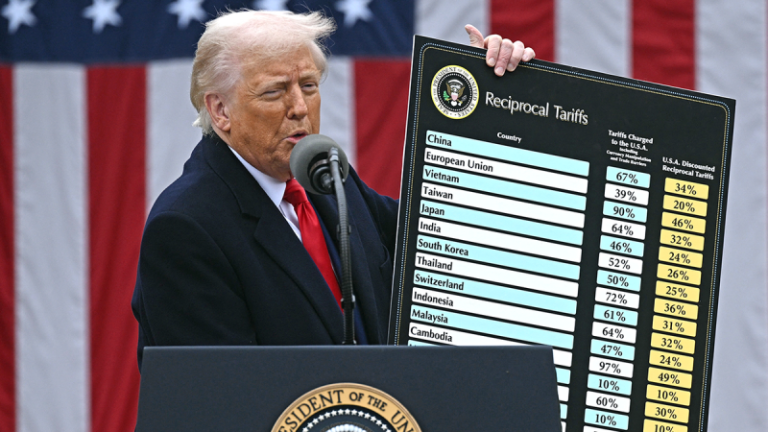
Trump’s plan involves a 10% blanket tariff on all foreign imports into the U.S., as well as tariffs up to 50% on both adversaries and allies.

It also introduces some level of reciprocal tariffs on countries that tax U.S. exports, though in most cases, the U.S. rate is lower than the foreign country’s.

This post appeared first on FOX NEWS

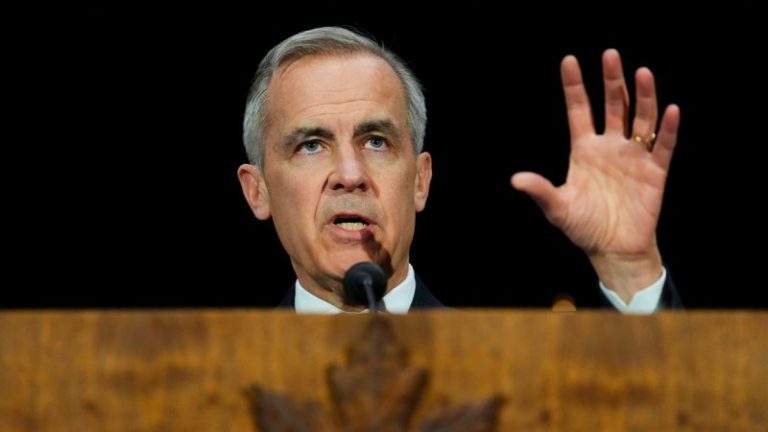
Canadian Prime Minister Mark Carney on Wednesday evening vowed to ‘fight’ the new round of tariffs announced by President Donald Trump, and said he would turn to other international partners to get through the rocky times ahead. 

‘President Trump has just announced a series of measures that are going to fundamentally change the international trading system,’ Carney told reporters following Trump’s Rose Garden announcement. ‘We’re in a situation where there’s going to be an impact on the U.S. economy, which will build with time.

‘In our judgment, it will be negative on the U.S. economy that will have an impact on us,’ he added, noting millions of Canadians will be impacted.

While Trump did not issue any additional tariffs against Canada following the 25% tariffs already in place on all Canadian imports, the 10% tariff on its energy exports and the blanket tariff on all aluminum and steel, he did announce a 25% tariff on all foreign vehicle imports. 

He also pointed out that Trump said there could be future targeted tariffs against pharmaceutical companies, lumber and semiconductors — tariffs that will have wide affect on U.S. trading partners beyond Canada and Mexico, but across Europe and Asia.

‘In a crisis, it’s important to come together,’ Carney said. ‘It’s essential to act with purpose and with force, and that’s what we will do.’

Before the tariff announcement, Canadian Conservative Leader Pierre Poilievre said at an election campaign event on Wednesday that he supports ‘targeted, reciprocal’ tariffs on American goods — and if his party wins the general election on April 28 and he becomes prime minister, he would like to sit down with President Donald Trump and create a new trade deal, replacing the United States-Mexico-Canada Agreement, which the president signed in 2020.
 

Poilievre also said that Canada must maintain control of its border and freshwater and protect both its automotive industry and supply-managed farm sectors.

David Adams, president and CEO of Global Automakers of Canada — a national trade association representing the Canadian interests of 16 automakers, including BMW Canada, Inc. and Nissan Canada Inc. — said in a statement, ‘Tariffs are taxes that hurt consumers by increasing costs, driving up inflation, and unfairly impacting workers on both sides of the border.’

‘Governments should look to long-term solutions to remove these tariffs, prioritizing the elimination of regulatory barriers to industry competitiveness and providing automakers with flexibilities to respond in these uncertain times.’

Reactions from European Union leaders began to emerge following Trump’s announcement that he will hit the EU with 20% tariffs on all imported goods, with disappointment, concern and commitments to continue negotiations with the U.S.

Italian Prime Minister Giorgia Meloni, generally seen as a Trump ally, said Trump’s tariffs were ‘wrong’ and warned they would not only harm American and European pocketbooks, but aid Western adversaries.

‘We will do everything we can to work towards an agreement with the United States, with the goal of avoiding a trade war that would inevitably weaken the West in favor of other global players,’ Meloni said in a statement on Facebook.

‘In any case, as always, we will act in the interest of Italy and its economy, also engaging with other European partners,’ she added.

Ireland’s Deputy Prime Minister, Simon Harris, said he ‘deeply regret[s]’ the new tariffs but said he is committed to working with Washington to end this tariff war. 

‘I must be honest tonight that a 20% blanket tariff on goods from all EU countries could have a significant effect on Irish investment and the wider economy,’ he said, noting the effects would ‘likely be felt for some time.’

Chairman of the European Parliament’s International Trade Committee Bernd Lange called for a united response from countries targeted by Trump.

‘While President Trump might call today ‘Liberation Day,’ from an ordinary citizen’s point of view this is ‘Inflation Day,’ he said, reported Reuters. ‘Because of this decision, U.S. consumers will be forced to carry the heaviest burden in a trade war.’

Lange said the EU will respond through ‘legal, legitimate, proportionate and decisive’ measures.

Swiss President Karin Keller-Sutter said her government would work to figure out the next steps.  

The U.K., along with the president of Mexico ahead of the announcement, said they would continue to work with the U.S. and would not rush to enforce reciprocal tariffs.

Similarly, Australian Prime Minister Anthony Albanese said that while Trump’s decision was ‘not the act of a friend,’ his country would not impose reciprocal tariffs, reported Reuters. 

He reportedly condemned the U.S. tariffs as totally unwarranted and said Australia will continue to negotiate to have the tariffs lifted. 

This post appeared first on FOX NEWS

A Democrat-led resolution undoing President Donald Trump’s tariffs against Canada advanced past the Senate on Wednesday after multiple Republicans joined their counterparts in support of it. 

Republican Sens. Susan Collins of Maine, Lisa Murkowski of Alaska and Mitch McConnell and Rand Paul of Kentucky supported the resolution, bucking the president to do so. The final vote was 51 to 48. 

‘As I have always warned, tariffs are bad policy, and trade wars with our partners hurt working people most. Tariffs drive up the cost of goods and services,’ former GOP Senate leader McConnell said in a statement afterward. 

Senate Majority Whip John Barrasso slammed the resolution’s passage, saying in a statement, ‘Senator Kaine’s goal was not to make law. It was simply an effort to undermine President Trump’s successful work to secure the Northern Border.’

 ‘Speaker Johnson already declared Senator Kaine’s resolution dead on arrival in the House of Representatives. It will never make it to President Trump’s desk,’ he explained. ‘This meaningless messaging resolution will not stop Senate Republicans from making America’s communities safer.’

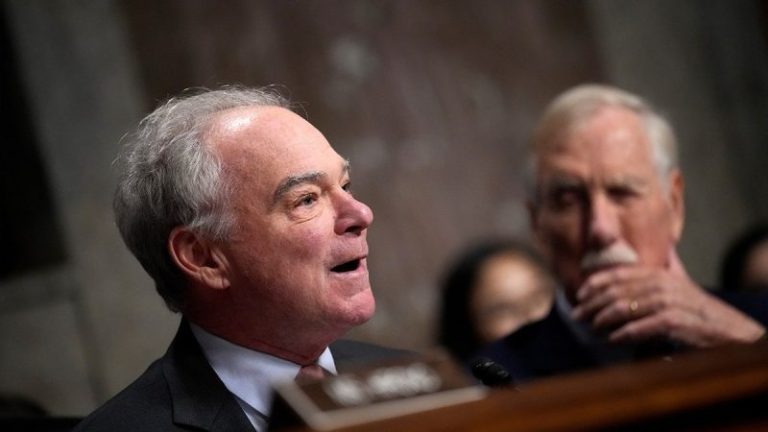
The privileged resolution was introduced by Sen. Tim Kaine, D-Va., and would end the emergency Trump declared at the northern border on Feb. 1. 

In a statement of administrative policy ahead of the vote, Trump’s White House said his advisors would urge the president to veto the resolution if it passed the Senate. 

‘President Trump promised to secure our borders and stop the scourge of fentanyl that’s poisoning our communities, and he’s delivering. Democrat Senator Tim Kaine is trying to undermine the President’s Emergency Declaration at our Northern Borders—a measure that prioritizes our national security—for reasons that defy logic,’ a White House official told Fox News Digital in an exclusive statement on Tuesday.

‘Under Joe Biden’s failed leadership, criminal networks, fentanyl, and terrorists ran rampant along the northern border. Today’s stunt by Tim Kaine proves once again how woefully out of touch the Democrat Party is with the American people as they use a matter of national security for political gamesmanship. The stakes are too high to reverse course; the declaration must stay in place,’ they continued. 

Kaine pushed back, telling Fox News Digital in a statement, ‘The Trump Administration’s own threat assessment report on fentanyl did not mention Canada—not even once. Trump’s order is a blatant abuse of his authority, and it is critical that Congress push back before he inflicts even more damage to our economy and to the relationship with one of our top trading partners and closest allies.’

The resolution was required to be brought to the floor for a vote, due to its privileged nature, and it only required a simple majority vote of 51 senators to pass.

Trump took to Truth Social on Wednesday to call out multiple Republicans he warned against voting in favor of the resolution.

‘Mitch McConnell of Kentucky, Susan Collins of Maine, Lisa Murkowski of Alaska, and Rand Paul, also of Kentucky, will hopefully get on the Republican bandwagon, for a change, and fight the Democrats wild and flagrant push to not penalize Canada for the sale, into our Country, of large amounts of Fentanyl, by Tariffing the value of this horrible and deadly drug in order to make it more costly to distribute and buy,’ he said in a post. 

Collins revealed in floor remarks earlier in the day that she would vote in favor of the resolution.

‘Mr. President, the price hikes that will happen for Maine families, every time they go to the grocery store, they fill their gas tank, they filled their heating oil tank, if these tariffs go into effect, will be so harmful. And as price hikes always do, they will hurt those the most who can afford them the least. Therefore, I will support this resolution, and I urge my colleagues to do so likewise,’ she said. 

Paul has been a vocal critic of tariffs during his entire tenure, including during the Trump administration. He is a co-sponsor of the Kaine resolution. 

He told reporters before the vote, ‘I think tariffs on trade between US and Canada will threaten our country with a recession. I think they’re a terrible idea economically and will lead to higher prices. Tariffs are simply taxes. Republicans used to be and conservatives, in particular, used to be against new taxes.’

This post appeared first on FOX NEWS