Archive

2025

Browsing

(Corrections and clarifications: A previous version of this story misstated how many people were on board the helicopter carrying Kobe and Gianna Bryant when it crashed. Nine people were on board.)

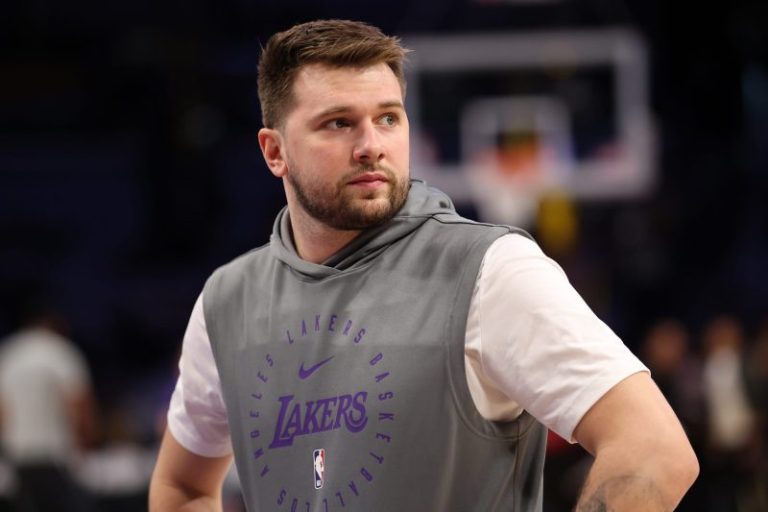
Los Angeles Lakers guard Luka Dončić continues to endear himself to the team’s fanbase after donating money to help restore a mural of Kobe Bryant and his daughter Gianna.

While he was a member of the Dallas Mavericks, Dončić was playing against the Lakers when he had an opportunity to interact and meet with Bryant and his daughter, who were watching the game.

Dončić shared mutual respect for Bryant and even spoke kindly of Bryant and his daughter when he was in Los Angeles for his introductory news conference after being traded to the Lakers earlier this year.

‘I remember the exact moment when that happened,’ Dončić said about meeting the Bryants. ‘It would always stay in my mind. It was an amazing moment just for Kobe to know my name. … I just wish Kobe and Gigi were here to see this moment.’

Bryant and his daughter were killed in a helicopter crash on Jan. 26, 2020, along with seven other people, including the pilot, while en route to Bryant’s Mamba Sports Academy in Newbury Park, California. He was scheduled to coach his daughter’s team that day.

Bryant has been memorialized across Southern California with several murals by various artists, including some that feature his daughter.

How much did Luka Dončić donate to restore the mural?

Luka Dončić is listed as the top donor with $5,000 on the GoFundMe page created to help fund the restoration. A GoFundMe representative confirmed with USA TODAY that the donation came from the Lakers star through the Luka Doncic Foundation.

What happened to the Kobe and Gigi Bryant mural?

A mural of Kobe giving a kiss on his daughter’s head was vandalized in downtown Los Angeles on Tuesday morning. Photographs have surfaced of graffiti over the mural. The mural is located on 112 W 14th Street.

The mural was one of several painted by Louie Palsino, who also goes by Sloe Motions.

This post appeared first on USA TODAY

It’s enough to put him in the Basketball Hall of Fame one day.

Love, from this vantage point, is a Hall of Fame Human Being.

On Monday, Love told the world his father, former NBA player Stan Love, the brother of Beach Boys Mike Love and one-time Beach Boys employee, died.

It was a touching tribute on Instagram. But it was more than that, too. In 408 words, Love encapsulated what it means to love in the face of life and death; what it means to mourn while appreciating the unpredictable arc of life; and he showed how openness and vulnerability are strengths, not weaknesses.

‘Dad, you fought for a long time,’ Love began. ‘The hardest stretch being these past 6 months. The most painful to witness being these last few weeks. And even at the end as you continued to deteriorate – I still saw you as a Giant. My Protector. My first Hero.

‘The words we continuously heard from you in your last chapter were how blessed you’ve been to have such a loving family. And in return how much you’ve loved your wife and kids. Your only wish was to be at home surrounded by your family when you took your dying breath.

‘That breath came. And now it’s time to rest.

‘You have undoubtedly been my greatest teacher. A role often served by a Father figure. You taught me admirable qualities like respect & kindness. Humor & wit. Ambition & work ethic. Grit & aggressive will. The insight that failure brings. And that time is our most precious commodity.’

Love continued: ‘Over the years my Dad and I had our differences. I mourn the times I felt angry and isolated – my heart weighs heavy knowing we lost that time and can’t get it back. But our division led to me finding myself. I was running from something but that time away provided the wisdoms of forgiveness and reconciliation. And an unwavering sense that he loved me through it all, in every moment. …

‘Like all of us, my Dad was imperfect. But despite his flaws, and my own, we are a successful story of father and son. A never ending bond, rooted in love, that will forever remain eternal.

‘Dad, I’m so proud to be your son. My only hope is that you’re proud of me. It was all I ever wanted. Thank you for everything.

‘I love you.

‘Your son,Kevin’

Beautiful, sad, profound, honest, compassionate. Everyone should read it.

An advocate for mental health in the NBA along with DeMar DeRozan, Love is one of the NBA’s gems. A father, husband, teammate and friend, Love is unafraid to reveal those aspects of his life. His meme game is a delight, whether he’s having fun with the Jimmy Butler-Miami Heat saga or the LeBron James-Stephen A. Smith quarrel.

The meaningful rumination of life and death, love, time, grief, forgiveness and reconciliation resonated. The post had more than 320,000 ‘hearts’ and more than 6,000 comments as of Tuesday morning. The NBA’s inner circle, from players to media to agents, commented. Strangers did too.

The long embrace with former teammate Tristan Thompson at Monday’s Miami-Cleveland playoff game was touching. Cavs star Donovan Mitchell made sure to acknowledge Love in his postgame interview.

I hope Love feels the love and support, and I believe that he does. That’s what we all need sometimes to help us find our way.

This post appeared first on USA TODAY

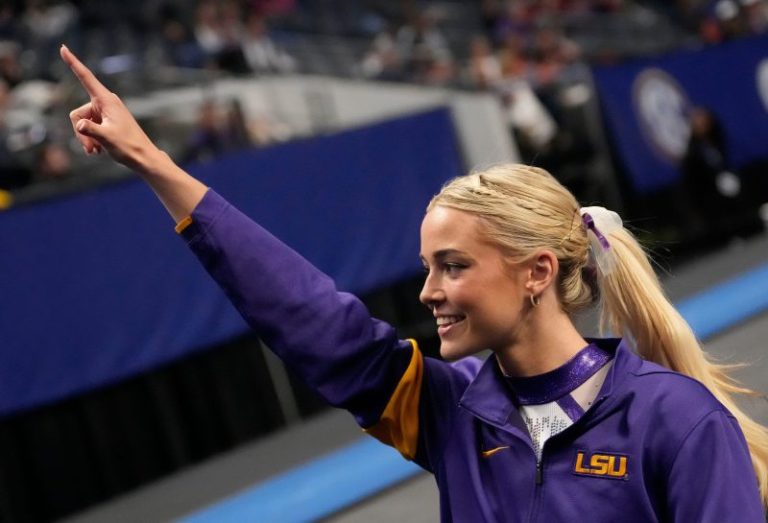
There have been thousands of athletes that became stars in college, but few ever did it like Olivia Dunne.

Not only did she emerge as a young gymnastic star at LSU, she became a pioneer in the Name, Image and Likeness era of college sports, quickly showing how hot the marketplace is for athletes to benefit from partnerships and deals.

She went from just a girl from Hillsdale, New Jersey to one of the most recognizable names – not just at the college level, but all of sports. Dunne has more than 13 million combined followers on Instagram and Tik Tok.

By the time her college career ended, she was the top-earning woman student-athlete with a $4.1 million valuation, according to On3, and near the top of all college sports. It wasn’t how Dunne expected her LSU career to go, but she’s left her mark on the NCAA.

‘I just wanted to leave my legacy that you’re more than your sport, and you can be a person beyond your sport and be a college athlete. It can be more than just sports,’ Dunne told USA TODAY Sports. ‘I never thought that it was gonna be what it is today.

‘It changed my life, and I’m so grateful.’

Besides all of the accomplishments off the mat, Dunne achieved success as part of the Tigers gymnastics team. LSU won the 2024 national championship as it continued to play in packed arenas, partly thanks to Dunne’s influence. With an extra year of eligibility to use, she decided to return to LSU for one last season to recapture some glory.

It didn’t go according to plan; Dunne only competed in the first four meets of the 2025 season before she missed the rest of the season due to an avulsion fracture on her patella (kneecap). Frustrating and not ideal for someone in their final year of eligibility.

Despite the disappointing end of her college career, Dunne said her entire time at LSU was ‘fulfilling,’ getting to live out her childhood dream of representing the school and winning a national title. After LSU’s season ended, Dunne announced her retirement from gymnastics.

She won’t be participating in the sport anymore, but she wants to stay around it. Thinking about her post-competing career, Dunne wants to be vocal about her support for gymnastics and women athletics.

‘I definitely would want to do something with sports and keep advocating for women’s sports, especially since I’m fortunate to have this platform,’ Dunne said. ‘It’s important to keep eyes on women’s sports and keep the hype around gymnastics especially.’

And don’t expect the partnerships and deals to stop. Even with all of the sponsorships she did during college, Dunne said her reach was limited because of her obligations with gymnastics. Now feeling more free, Dunne doesn’t want to restrict herself on the opportunities that await her. Case in point was she spoke to USA TODAY Sports through Raising Cane’s as she partnered with the fast food chain for a content shoot.

‘I can’t pinpoint what I want to do, but I want to try everything. I want to try new opportunities. I just want to explore what my options are going to be and just do everything and have fun with it,’ she said. ‘I’ll keep working with brands, and I’ll keep being a sports fan and staying involved with sports.’

Dunne already does have plenty to cheer for in sports thanks to boyfriend Paul Skenes. The No. 1 pick in the 2023 MLB Draft by the Pittsburgh Pirates, Skenes has been electric in his young career and earned the 2024 National League Rookie of the Year award.

Dunne admitted last year watching her beau has made her become ‘a crazy baseball girlfriend.’ Now the two are among the highest profile couples in sports, evident by their recent photoshoot in GQ, which called them Gen Z’s ‘it couple.’

It’s been a whirlwind the past few years for Dunne, and although it might be hard to even come close to having the type of college career she had, Dunne hopes her journey paves the way for future women athletes to make a name for themselves in more than one way.

‘You’re not just a gymnast, you’re not just an influencer, you’re not just a student,’ she said. ‘You can be more than one thing and find success in multiple areas.’

This post appeared first on USA TODAY

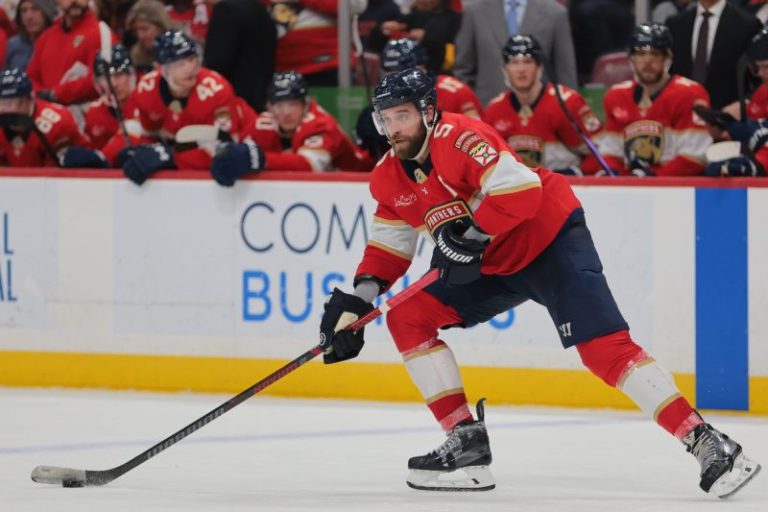
Florida Panthers defenseman Aaron Ekblad’s hit that knocked Tampa Bay Lightning forward Brandon Hagel out of Game 4 wasn’t penalized by the referees.

But the NHL Department of Player Safety had its say, suspending Ekblad two games for elbowing. The Tuesday announcement came in the wake of a hearing it had with Ekblad earlier in the day.

Hagel was playing his first game after serving a one-game interference suspension for knocking Panthers captain Aleksander Barkov out of Game 2 with a late, hard hit.

The Ekblad incident happened in the second period Monday when the defenseman skated toward Hagel and caught him up high with his arm. Hagel fell and hit his head on the ice and was woozy as he skated to the dressing room. He didn’t return and won’t play in Game 5, the team said.

Ekblad would later score in the third period to start a rally that gave the Panthers a 4-2 victory and a 3-1 lead in the best-of-seven series. Game 5 is Wednesday in Tampa.

Ekblad was playing his second game after returning from a 20-game PED suspension.

Niko Mikkola fined for boarding Zemgus Girgensons

Panthers defenseman Niko Mikkola was fined $5,000 for boarding Lightning forward Zemgus Girgensons in Game 4. Mikkola was ejected after hitting Girgensons into the boards while his opponent was on his knees.

The USA TODAY app gets you to the heart of the news — fast.Download for award-winning coverage, crosswords, audio storytelling, the eNewspaper and more.

This post appeared first on USA TODAY

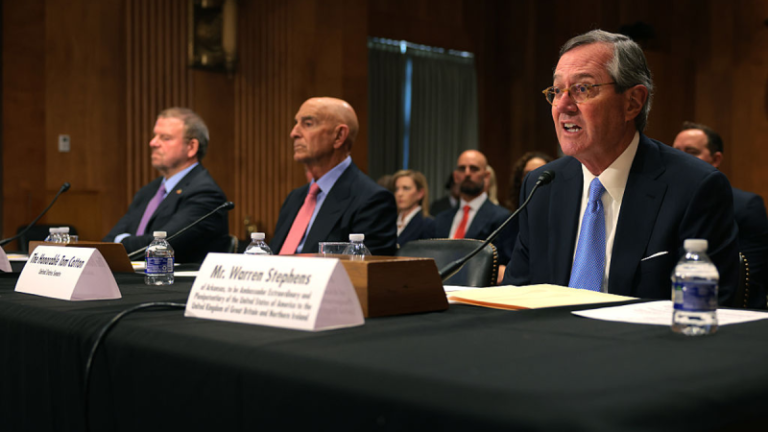
A prominent NBA team owner was among three of President Donald Trump’s diplomatic nominees confirmed by the Senate on Tuesday evening.

Tilman Fertitta, owner of the Houston Rockets and CEO of Landry’s Restaurants group was confirmed as the upper chamber to be Trump’s ambassador to Italy and San Marino by a margin of 83-14.

Investors Tom Barrack and Warren Stephens were also up for ambassadorship posts to Turkey, and the United Kingdom and Northern Ireland respectively.

Barrack’s nomination passedby 60-36 Stephens was confirmed 59-39.

Fertitta is a GOP donor and has spoken fondly of Trump’s business sense.

During Trump’s first term, Fertitta told CNBC the president was doing ‘a fantastic job for the economy.’

‘Businesses are booming, unemployment is low. He understands what drives this country,’ Fertitta said in 2018.

Fertitta’s praise of Trump often steers more toward business-focused than overtly-political, as in the CNBC interview.

Trump’s choice of Barrack played into two different aspects of the investor’s history.

Before he was a friend of the future president’s, Barrack served as an undersecretary in the Reagan Interior Department, focusing on energy policy including Middle East oil.

Barrack, who is fluent in Arabic, would therefore fit well with a Turkish ambassadorship.

Later in that decade, Barrack helped Trump secure financing for his short-lived ownership of the Plaza Hotel – during which time the future president famously told a lost Kevin McCallister its lobby was ‘Down the hall, and to the left’ in 1992’s Home Alone 2: Lost in New York.

The two real estate moguls remained friends in the years after Trump ultimately gave up the Midtown landmark.

Barrack was a strong supporter of Trump’s first presidential campaign and raised millions for his first inauguration’s events.

Stephens’ family bank has a footprint in London, and he is a noted fan of the Tottenham Hotspurs Premier League soccer team, which draw parallels to his ambassadorship nomination.

The billionaire will be the eyes and ears for Trump in London, where the president has a cordial relationship, albeit one wherein lies a politically contrasting view of global politics, with Prime Minister Keir Starmer of the Labour Party.

Stephens has a history of donations to Republican causes and many Arkansas candidates, per OpenSecrets.

Recipients have included former Sens. Mark Pryor, D-Ark., Mitt Romney, R-Utah, Bob Dole, R-Kan., ex-Arkansas Govs. Asa Hutchinson and Mike Huckabee, and media executive Steve Forbes’ presidential run in 1995.

This post appeared first on FOX NEWS

The Department of Agriculture (USDA) terminad $2.5 billion in ‘wasteful’ grants that went toward gender-based causes, the Department of Government Efficiency (DOGE) said Tuesday. 

The USDA got rid of 420 grants for a savings of $2.3 billion, according to DOGE. 

Among the programs the money was used for, $361,000 went toward ‘gender non-conforming, non-binary, two-spirit’ BIPOC (Black, Indigenous, and people of color) farmers in New York.

Another $150,000 was used for ‘gender-lensed curricula designed to be transdisciplinary in the food, agriculture, natural resources and human sciences.’

Even Ghana benefited, with $100,000 earmarked for ‘climate resilience and sustainable agriculture’ in the African nation. 

In addition, federal agencies eliminated 179 contracts with a ceiling value of $1.87 billion and savings of $280 million. 

The federal government spent $207,000 on a U.S. Department of Health and Human Services consulting contract for a ‘grant writing workshop’ and an $89,000 Treasury Department contract for a ‘country program manager in Namibia.’

Another $1.8 million Trade & Development contract was spent on ‘energy and climate advisory services.’

This post appeared first on FOX NEWS

The U.S. Treasury Department and the Department of Government Efficiency (DOGE) discovered that hundreds of millions of dollars in improper payment requests were identified after going live with its first automated payment system last week.

In fact, the system found $334 million in improper payment requests that were flagged because of missing budget codes, invalid budget codes and budget codes without authorization.

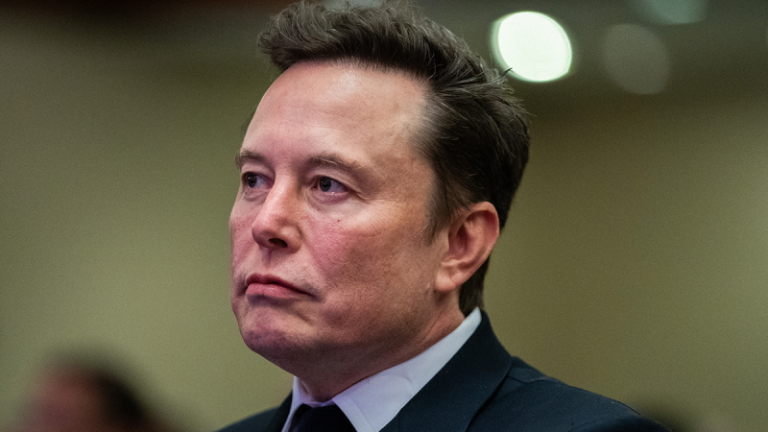
DOGE, which is led by billionaire Elon Musk, announced the discovery in a post on X.

In the post, DOGE said an example of an invalid budget code was if the payment was not linked to the budget. It also provided an example of a budget code without authorization, saying the budget had already been fully spent.

The news comes months after DOGE learned about an identification code linking U.S. Treasury payments to a budget line item that accounted for nearly $4.7 trillion in payments, which was oftentimes left blank.

‘The Treasury Access Symbol (TAS) is an identification code linking a Treasury payment to a budget line item (standard financial process),’ DOGE wrote in a post on X in February. ‘In the Federal Government, the TAS field was optional for ~$4.7 Trillion in payments and was often left blank, making traceability almost impossible. As of Saturday, this is now a required field, increasing insight into where money is actually going.’

DOGE thanked the U.S. Treasury for its work in identifying the optional field.

According to the Bureau of the Fiscal Service, which is under the Treasury, TAS codes are used to describe any one of the account identification codes assigned by the Treasury and are also referred to as the ‘account.’

All financial transactions made by the federal government are classified by TAS when reporting to the Treasury and the Office of Management and Budget.

DOGE’s announcement on Tuesday comes as it continues to find savings and fraud across all aspects of the government.

On the department’s site, it says $160 billion in savings have been discovered, equating to $993.70 in savings per taxpayer.

DOGE has been aggressive in its mission to root out wasteful spending and to downsize the scope of the federal government. 

This post appeared first on FOX NEWS

Washington Nationals infielder Paul DeJong has watched the video dozens of times, but not once has he dared to do so with sound.

Maybe one day.

But not now.

DeJong, lying in a hospital bed Monday recovering from 2 ½ hours of sinus, orbital plate and nose surgery, isn’t ready to even watch baseball games again, much less hear the gruesome sound of a 92.7-mph fastball hitting him in the face.

It happened on April 15. DeJong was battling flu symptoms, was taking antibiotics for a respiratory infection, and wasn’t sure he could even play on the cool and wet 46-degree night. He likely would have taken the game off any other night, but this was Jackie Robinson Day and he was playing in Roberto Clemente’s Pittsburgh. No way he was going to sit this one out. It was too important for him to wear No. 42.

The Nationals were trailing 1-0 with a runner on first base in the top of the sixth inning at PNC Park when DeJong stepped to the plate. The count reached 2-and-1 when Pirates starter Mitch Keller threw a 93-mph fastball. It sailed directly towards DeJong’s head. He had no chance to get out of the way.

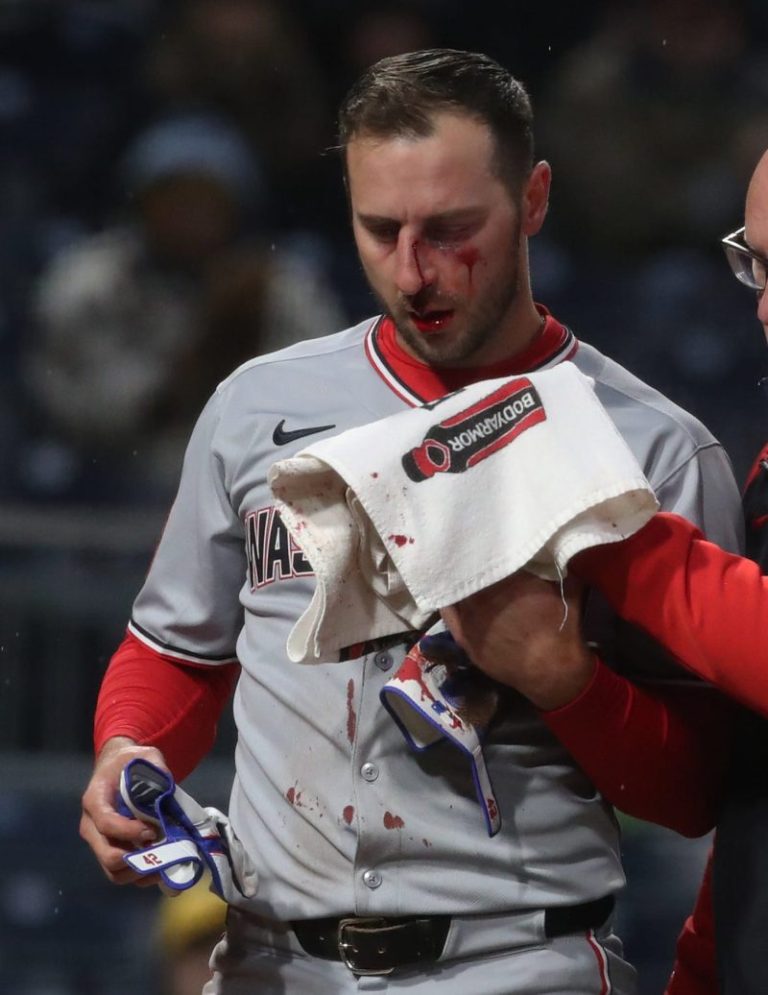
The ball hit him flush in the face, immediately breaking his nose and leaving a gash below his left eye.

DeJong fell to the ground, his face began bleeding profusely, and Nationals manager Davey Martinez and trainer Paul Lessard rushed from the dugout.

Keller dropped to his knees, his face in anguish, unable to even look.

“The only reason I even looked at the videotape,’ DeJong told USA TODAY Sports, “was to make sure I wasn’t leaning over the plate. I wasn’t. Really, that makes me feel better because I know there was nothing I could do.

“Nothing.’

DeJong, 31, was rushed to the emergency room where they closed the bleeding with stitches in his cheek, nose and his eye. His left eye was filled with blood. He could barely breathe. It was difficult to even talk when he telephoned his mother, Andrea, and agent, Burton Rocks.

He lay in fear wondering if his career was over.

“I was never in too much pain, surprisingly,’ DeJong said. “It was so strange. It was the most uncomfortable feeling without pain. I couldn’t breathe through my nose. My eyes were swollen shut. I had that ringing in my ears. But I didn’t have pain.

“I was lucky. If I had gotten hit straight into my jaw, my eye, or my mouth, there could have been real problems.’

He was kept overnight for observation and underwent a battery of tests with doctors and ophthalmologists. Nationals executives, trainers, coaches, teammates and former teammates called and texted him. Keller reached out twice to let him know it was an accident and see how he was doing.

DeJong was released in the early afternoon. He went back to the team hotel and departed the following morning for a four-hour ride home in a private car arranged by the Nationals.

“Thank God we weren’t playing in LA or out west,’ DeJong said. “I couldn’t get on a plane, so I don’t know I would have gotten home.’

DeJong arrived at his home in Falls Church, Va. and waiting at the door was Steve Whipple, his 79-year-old grandfather, who took the first flight out of Orlando. The two have always been close, hunting and fishing together in Wisconsin, and never did Whipple, a retired information technology specialist with Dow Chemical, miss watching his grandson’s games on TV.

“We always thought Paul was going to be a basketball player growing up,’ Whipple said. “When he got his degree in honors in biochemistry [from Illinois State], we thought he’d go to med school. We didn’t know about his secret passion with baseball.’

‘What’s the damage?’

Whipple and his wife, Sharon, were in Orlando with DeJong’s mother, watching the game together. Andrea had just been released from the hospital two weeks earlier after intestinal surgery, and her parents were at her Orlando home to help. They watched in horror when DeJong was his, saying prayers when they saw him get up, and slowly walk off the field holding a towel to cover the blood.

DeJong has been to the plate 3,349 times in his career, hit 58 times, but had already twice suffered injuries from being plunked. He broke his left hand when he was hit by Philadelphia Phillies pitcher Luis Garcia on a slider in 2018, and he suffered a broken rib in 2021 hit by Milwaukee Brewers pitcher Freddy Peralta.

DeJong, however, had personally witnessed a few gruesome incidents. He was there when Phillies All-Star Bryce Harper was hit in the face by Cardinals reliever Genesis Cabrera in 2021. He was on the field when Memphis teammate Daniel Poncedeleon was hit in the head by a line drive in 2017, resulting in emergency brain surgery. Still, he never thought something drastic would happen to him, having never even broken his nose growing up. Several times over the years he was asked if he wanted to use a C-flap protector on his helmet to protect his face, but he always declined.

“I think you have so many other things to worry about hitting the ball,’ DeJong said, “that you just don’t worry about being hit by a pitch. If you start thinking about anything like that, you’ll never have a chance to hit. It would release fear. I figured it was just part of the game.’

In the aftermath of being hit, with blood streaming from his nose and unable to see, DeJong feared that his vision could be permanently damaged.

“I was pretty concerned what was wrong,’ he said. “I asked the doctors, ‘How bad is it? What is the damage?’ But I also had some calmness about it because of my lack of control. It was like, wow, whatever happens is what it will be.

“But once the doctors reassured me the next morning that there really wasn’t a ton of damage to the eyeball, I felt better. That was my bigger concern. I knew they could fix my nose.’

DeJong spent the next 10 days with his grandfather in his Falls Church home. He was unable to drive, so his grandfather was suddenly in charge of driving his Ford Raptor truck, buying groceries, filling prescriptions and running errands.

“I’m used to driving this little Tesla, and Paul drives a big truck,’ Whipple said. “And there’s all of this traffic. I remember the first day I saw a merge sign on the highway, and then right below it, it said no merge area.’

Once they resolved the driving element, the deal was for DeJong to cook with skirt steak, caramelized onions, parmesan fries and broccoli being his specialty. Grandpa would do the dishes and clean. And they would take turns each day choosing a movie to watch.

They are both huge Clint Eastwood fans, so they quickly went through the Man with No Name Trilogy with “A Fistful of Dollars,’ “For a Few Dollars More,’ and “The Good, the Bad and the Ugly.’ Grandpa watched “Goodfellas’ for the first time. And they sat back and watched halfway through ‘Casino’ on Sunday night, ‘munching on some cheeseburgers,’ before going to bed having to get up at 4:30 a.m. to get to the hospital.

“We’ve always been so close,’ said DeJong, who spends time with his grandfather in Wisconsin hunting and ice fishing in the winter. “We’ve been able to relax and enjoy our time together. He’s been really helpful with stuff around the house, and making sure, honestly, I that feel pretty close to normal.’

While DeJong and his grandfather were at the hospital at 5:30 a.m., with DeJong wheeled into the operating room at 7:30, Rocks and his 91-year-old father were getting up at 3 a.m. in New York City. They took a car to Penn Station, boarded the 6:27 a.m. Amtrak Acela, arrived at 9:28 a.m. at Union Station in Washington, D.C., and then immediately headed to the hospital to wait alongside Whipple while DeJong was in surgery.

The surgery was a bit more extensive than envisioned, repairing his nose, sinuses and inserting a titanium orbital plate. DeJong woke up with splints in his nose, a band-aid above his left eye and his left eye swollen. When he opened his right eye, he saw his grandfather, and Burton and Lawrence Rocks in his room. He warmly greeted them and called in a nurse to take a group photo.

‘I don’t think I’ll have any fear coming back’

It still will be at least two more months, if not longer, for DeJong to be able to play. But for now, he’s looking forward to simply working out again. Once he does, he’ll be ready to sit down and watch games in their entirety. Oh, he’s taken peeks from time-to-time on his cell phone at scores, but it’s been too hard to watch games, reminding him that he’s not even close to playing.

The biggest challenge, DeJong believes, will simply be stepping back into the batter’s box and face live pitching again. He knows he’s not the first to endure something like this, recalling Giancarlo Stanton, Jason Heyward, Kevin Pillar and Harper being hit in the face. He likely will reach out to Pillar, his former teammate with the Chicago White Sox who was hit in the face by a 94-mph fastball in 2021, but certainly is open to any and all advice.

“I will start using the C-flap helmets now to give me protection,’ DeJong said. “I know [Yankees first baseman] Paul Goldschmidt wears just about every protective piece of equipment to make sure he doesn’t miss any games. I found that’s smart.

“But I think I’ll be fine. What makes me feel better is that I wasn’t hunched over, or in a bad position at the plate. If I was, I might be afraid of inside pitches. But I can go and take my at-bats like I normally would, and play the game the way I’m used to playing.

“I hope Keller is, too. He reached out to me a couple of times, so I hope that he can get back to pitching the way he was before, too. It was just a freak thing.’

DeJong plans to return back to Nationals Park and start seeing his teammates again when they begin their next homestand May 5. He has appreciated the hundreds of calls and text messages around the country. Nationals pitcher Trevor Williams even stopped by one day to bring over DeJong’s paycheck, and then went out and shut down the Orioles over five innings the next day.

The workouts will being in about a month, DeJong says, and his goal is to be playing again before the All-Star break.

“I don’t think I’ll have any fear coming back,’ DeJong said. “But until you go through something like this, you don’t know. You don’t realize the struggle guys go through just to get back to normal. Just sleeping with your head up. Trying to breathe through your nose. Taking a shower. You miss all of these day-by-day tasks because you’re in a total vulnerable state.

“But you know something, I miss it. I really do.

“I can’t wait to get back, and it’s going to be special when I do.’’

Follow Nightengale on X: @Bnightengale

This post appeared first on USA TODAY

Into Mischief had an unremarkable racing record of three wins in six starts but he has become one of the top sires in Thoroughbred history.
His stud fee was set at a modest $12,500 when he was starting out but has now climbed to $250,000.
The stallion has sired 13 horses that have raced in the Kentucky Derby, with two more expected in Saturday’s race barring a last-minute scratch.

LEXINGTON, Ky. — The main courtyard at Spendthrift Farm is like a monument to horse racing history. Look straight ahead and you’ll see a statue honoring Nashua, a two-time champion in the 1950s, positioned over his final resting place. Walk through the U-shaped barn a few feet beyond his grave and you’ll see plaques commemorating where all-time greats like Seattle Slew and Affirmed once lived. A little further out, there’s a row of gravestones marking some of the farm’s former residents, including a horse named Caro, who sired the filly Winning Colors that beat the boys in the 1988 Kentucky Derby.

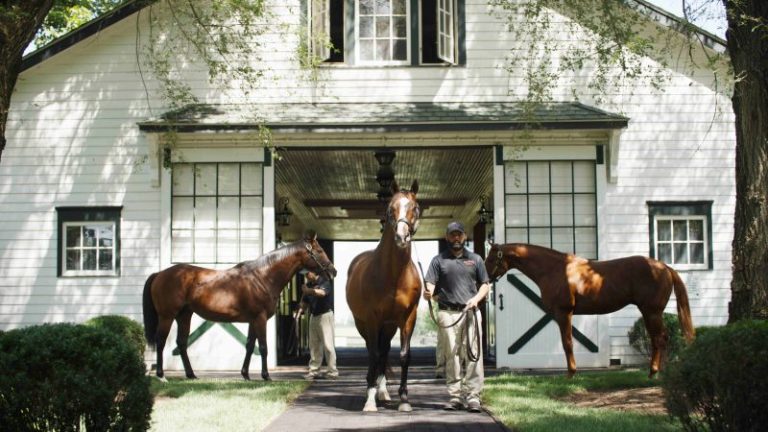
Even now, these idyllic, cupola-topped stallion barns with white columns and olive-colored roofs are one of horse country’s top attractions. Nearly every day, tour groups will file in to catch a glimpse of the powerful Thoroughbreds they once watched run for glory.

Among the current residents parading through the grounds are two recent Belmont winners, a Preakness winner, a Breeders’ Cup Classic winner and the most accomplished of all: 2020 Kentucky Derby winner Authentic, who went on to be named Horse of the Year. All 29 of the farm’s stallions live here, each getting a 16-by-16 foot stall with a window and luxurious straw bed − plus a private paddock across the way to exercise and graze. And all of this is just a short walk to the breeding shed where they’ll do their job as many as two or three times a day during peak season.

But the true star of the farm — the animal that, in many ways, is the single most valuable commodity in the sport — is a horse barely anyone would remember from the racetrack. 

Shortly after running second in a Dec. 26, 2008 stakes race at Santa Anita, Into Mischief retired with an unremarkable record of three wins in six starts. He never participated in the Triple Crown, running just once beyond seven furlongs and sitting out most of his 3-year old season due to nagging injuries.

When he was brought home to Spendthrift to begin his second career, Into Mischief was such an afterthought that his stud fee — the price mare owners pay for a mating — was set at a modest $12,500. Even then, he didn’t attract much interest from breeders and the price dropped further. Whether it was his own pedigree, his indifferent race record or his compactly-muscled, Olympic sprinter-like physique that didn’t suggest success at the 1 1/4-mile Kentucky Derby distance, there wasn’t a ton to get excited about. 

“We had to come up with incentive programs,” Ned Toffey, the farm’s general manager, said. “There are plenty of horses up there that you’d say, ‘I like this one. I like that one.’ But he’ll come out, and if you didn’t know who he was, you’d go, ‘Oh OK, there’s a horse.’ He’s not spectacular.” 

After a few years, though, the thoroughbred racing and breeding world discovered that what met the eye had no real correlation to the genetic impact Into Mischief was making on his female counterparts. For whatever reason, his offspring — even those produced with the lesser-regarded mares being bred to him — were consistently running and winning at higher rates than the baseline. 

Though Into Mischief’s contribution to the thoroughbred industry is now evident at practically every racetrack or horse sale across the country as North America’s leading sire for six consecutive years, he has put his stamp on the Kentucky Derby specifically in a way that no other stallion this century can match. 

Two of his sons, Authentic in 2020 and Mandaloun in 2021, have won America’s most important race. Barring a last-minute scratch, two more of his progeny — Citizen Bull and Sovereignty — will give him a 14th and 15th Derby starter, making him the most prolific Derby sire in the last 20 years. Another one of Into Mischief’s sons, Goldencents, sired last year’s Derby winner Mystik Dan. And this year Authentic has his first Derby starter in Rodriguez, the Bob Baffert-trainee who won the Wood Memorial Stakes. 

Even if Into Mischief stopped breeding today, his impact on the Derby will be felt for generations. But he’s not stopping, even at age 20. As we speak, Into Mischief is in the midst of a breeding season that will bring him roughly 200 mares at $250,000 per mating, making him a $50 million business on his own. Given his track record, any of those resulting foals could be a candidate to win the 2029 Derby.

The question, given how much money is being spent every year for his reproductive capabilities, is why Into Mischief’s DNA has cracked the code of the race everybody in the world wants to win. 

“Horses like this just don’t come along very often,” Toffey said. “I get asked quite a bit: What is it that makes Into Mischief such a great sire? And the only answer I can give you is, ‘I don’t know.’”

What makes a successful Kentucky Derby sire?

A decade ago, American Pharoah became horse racing’s 12th Triple Crown winner, ending a 37-year drought. Naturally, breeders were excited because of the horse’s exceptional balance and fluid movement, which allowed him to carry his natural speed over the classic distances of the Derby, Preakness and Belmont Stakes. As a result, he was valued at more than $20 million in a deal that sent him to international powerhouse Coolmore, which initially set his stud fee at $200,000.

There was just one problem: American Pharoah’s early offspring didn’t perform much like him. In fact, the top runners from his initial crops seemed to do better on grass than dirt. His desirability as a stallion declined, to the point where it now costs just $45,000 to breed to him. This year, finally, American Pharoah will be represented by his first Derby runners: Japan-based Luxor Cafe and longshot Publisher. 

“We’ve been waiting for one like that, and proud of the fact he’s got (two) in there,” said Bob Baffert, who trained American Pharoah to glory in 2015. “Some of them, it takes awhile.”

How is it that a horse like American Pharoah, with all the right traits on paper to reproduce Derby contenders, has underperformed relative to expectations while Into Mischief can come out of nowhere and rewrite the history of the race through his progeny?

That’s both the mystery and the beauty of a sport where only 20 horses out of roughly 18,000 foals born in America will end up in the starting gate on Derby Day. And it’s why there’s an entire sub-industry devoted to studying pedigrees and bloodlines in hopes of producing a fast horse, or at least one that will turn a huge profit at the sales ring.

“There are two things happening genetically in any breeding situation: accumulation of positive genetic attributes or dilution of positive genetic attributes,” said Dr. Edward Messina, a longtime New York-based pedigree consultant and breeder. “And that’s where the puzzle is.”

Around the racetrack, they like to say a good horse can come from anywhere. That’s true. A horse named Flower Alley, for example, was a bust as a sire and eventually sold to a farm in South Africa. But he did produce one exceptional colt in I’ll Have Another, who won the 2012 Derby and Preakness. 

Those outliers exist all over the sport. But the reason pedigree analysis is such big business is that patterns do emerge over time, both with particular sires and the types of mares they are bred to. 

There are roughly 1,200 active sires in North America. Over the past 20 years, 197 sires have been represented in the Kentucky Derby. Out of those 197, just 14 have sired five or more Derby starters. These names seem show up year after year in Derby pedigrees: Tapit, whose 14 starters over the last 20 years actually exceeds Into Mischief’s 13, Candy Ride (10), Curlin (9), Tiznow (8), Malibu Moon (7) and Scat Daddy (7).

Then there’s a group of younger sires who have already shown a propensity to produce Derby runners led by Good Magic (sire of 2023 winner Mage) and 2018 Triple Crown winner Justify, who will have his fourth starter already this year in American Promise. 

That’s not an accident, but trying to figure out the why − and, most importantly, how to do it again − is art as much as science. Similar to human children of great athletes who grow up to also succeed in sports, there is most likely a genetic predisposition, an environmental component and a whole lot of apparent randomness we don’t have the capability to fully explain. 

Thus, myriad theories are put to work every year in the breeding industry. Some rely on so-called ‘nicks,’ which is essentially mixing specific families that have proven to have some compatibility in the past. Some breeders look to magnify specific traits through inbreeding of certain sire lines that would show up within three or four generations on both the mother and father’s side of the pedigree; others try to avoid too much inbreeding because of the genetic infirmities it tends to create.

It’s complicated, heavy stuff with rabbit holes that can occupy lifetimes for those who choose to study it. 

But for the layman, it’s probably easiest to understand through the lens of a horse like Into Mischief, who makes a lot more sense as a great Derby sire now in retrospect than he did when he came off the racetrack back in 2008. 

Start with his own pedigree, which tilts toward the high cruising speed type horse that has become dominant in the Derby while also getting stamina influences from the sire line of Northern Dancer, the 1964 Derby winner who became arguably the most important stallion of the 20th century.  

Sprinters are imbued through the female side of Into Mischief’s pedigree, but the potency of those bloodlines only revealed itself years later when his mother, Leslie’s Lady, produced champion mare Beholder and then the colt Mendelssohn, who ran in the 2018 Derby. For one mare to produce three Grade 1-winning runners is almost unheard of, but underscores the quality of animal that Into Mischief passes on to his offspring.

The second factor necessary for the Derby is precociousness, since even qualifying for the race necessitates a high level of performance early in a horse’s career. Though Into Mischief did not have a notable race record, his biggest win came in the  1 1/16th-mile Hollywood Futurity, which at the time was one of the most prestigious races for 2-year olds. You can see that in his sons and daughters, who tend to mature early.

“Into Mischief is an outlier in as much as he had a solid pedigree, but it wasn’t anywhere near as good as we subsequently realized it to be,” said Alan Porter of Pedigree Consultants. “And even though he wasn’t an obvious (Triple Crown) horse, I suspect the truth is he was a much, much better racehorse than we got to see.” 

But here’s where the guess work really begins. 

To put it in the simplest possible terms, mating two horses will not necessarily produce a foal that blends the characteristics of both parents. Think of it more like a genetic wrestling match, where the traits from one side or the other will prevail.  

“A lot of people think you can take big and small and you’re going to get medium,” said bloodstock agent and pedigree analyst Clark Shepherd. “More times than not you’re going to get one or the other.”

So the most consistently successful stallions, in a sense, are the ones whose genes most often win that competition. 

That’s why Into Mischief’s offspring are generally like him: Very fast early in their careers, with the ability to carry speed around two turns, characteristics that lend themselves to Derby success. That’s why Tapit’s sons tend to be gray in color, grinding in running style and rambunctious to the point of being difficult. It’s also most likely why four of them have won the 1 1/2-mile Belmont while none have won the speed-favoring Derby.

Though different in what traits they pass on, Into Mischief and Tapit are hugely successful stallions because their genes tend to dominate, which helps produce good runners regardless of which traits the mare is bringing to the table.

“With Into Mischief, you can accidentally breed a good horse — because of him,” Shepherd said.  

Conversely, it points to why American Pharoah was an early disappointment in the breeding shed. His traits would seem to not be as dominant in that cosmic dance of science and mystery. One possible explanation for his early progeny’s affinity for grass would be the affiliation with Coolmore, which is headquartered in Ireland, thus giving him access to more mares with European bloodlines. American Pharoah siring two Derby starters this year for the first time could be luck, but it could also be the product of smarter matings after several years of data. 

“What you’ll see sometimes is people adjust the kind of mares they’ll breed to a stallion,” Porter said. “They see what they’re getting and then make adjustments and you’ll see a career trajectory change.”

This means multi-million dollar bets are constantly being made on potential stallions based not just on a projection of whether they’ll produce future Derby contenders but also without any scientific way to project what matings would optimize a farm’s investment. Even with the industry inevitably turning to AI and advancements in genome testing, it’s still mostly a guessing game — for now. 

“It’s in its infancy, but its going to be a very important factor for the future,” Messina said. “People that don’t pay attention to it will be left behind without a doubt. A lot of the wealthy people are trying to figure out where the speed genes are and whatnot and do that genomic type study of animals that were successful and see where the elements are genetically and try to do that kind of testing. But not everybody can afford it.”

Inside the breeding shed at Spendthrift Farm

As one can imagine given that their job is to run an assembly line of coital encounters during the 4 1/2-month breeding season − sometimes as many as 60 per day − the vocabulary used on a minute-by-minute basis in the Spendthrift breeding shed might make even a sex ed student a little squeamish. 

But it is, if nothing else, an impressively straightforward, professional and labor-intensive operation; a step-by-step process necessitated by the fact that artificial insemination is against the rules of The Jockey Club. Given that you’re dealing with 1,000-pound animals in the grips of their natural urges, the process is remarkably quick and easy when it’s time for the stallion to do his part. After five or 10 minutes from beginning to end, the horse is back in his stall, preparing to do it all over again while another group of mares gets prepared for a mating.

It is here, though, where talking about Into Mischief’s — shall we say, enthusiasm for the job — that evokes memories of giggling in the eighth grade lunchroom.

In fact, they say, the only time Into Mischief ever acts up is when he knows that his counterparts in the stallion barn have left to go breed. Scratches and dents in the paneling of Into Mischief’s stall are the product of pure horse jealousy. 

“He’s such a fertile horse and has such a great libido. His mares get in foal almost…right away,” Toffey said, pausing to snap his fingers as he explained why Into Mischief actually accomplishes more while working less than his counterparts who need — ahem — multiple tries to impregnate a mare.

“He’s so efficient. He’s always been able to breed a lot of mares with relative ease. He considers himself − and rightly so, just how stallion behavior is − the one who rules the roost here. And from our judgment, he’s right.”

It’s easy to see why. 

When the tour groups come to Spendthrift, they start at the B. Wayne Hughes Visitor Center, where the blanket of roses won by Authentic — as dried-up and faded as it might be — is laid into the floor of the entrance under glass casing. It is one of many trophies and mementos belonging to Hughes, the founder of Public Storage, who passed away in 2021 and left the operation of the farm to his daughter and son-in-law. 

And in some ways, the mystique of this place is possible only because Into Mischief came along when he did.

After Hughes bought Spendthrift in 2004 and decided to get into the stallion game, he was so eager to build a marketable roster with horses he already owned that he actually retired Into Mischief against the desires of trainer Richard Mandella, who thought he might become one of the best horses in the country as a 4-year old. 

That was actually quite a risky bet on Hughes’ part. If Into Mischief had won big races at 4, he would have been instantly desirable as a stallion. Instead, he came out of his racing career with zero fanfare and not much more interest from breeders.

But Hughes ultimately won that bet in a major way.  

Not only did the racing world notice that Into Mischief’s early runners were winning at a higher clip than normal, he backed it up when two members of his first crop were in the Kentucky Derby field. Interest rose, leading to better quality mares, which begat a historic run of dominance over the stallion rankings. Now, he has a chance to join just a handful of other sires — none since the 1950s — to have three Derby winners. And along the way, he’s become a $50 million per year economy unto himself, undergirding a business that supports 50 employees and requires 1,200 acres of Kentucky bluegrass. 

“A horse like Into Mischief pays for a lot of the ones that don’t work out as well,” Toffey said. ‘Branch Rickey said, ‘Speed is the great eraser.’ Well, Into Mischief is our great eraser.”

But, of course, that cash machine doesn’t ring forever. He’s 20 now, past middle aged for a Thoroughbred. Into Mischief’s contribution to the gene pool will go on for centuries, but his $250,000 stud fee payable to Spendthrift Farm will not. Even for an animal with such legendary libido, there’s nowhere to go but…down.

That’s why the search for the next Into Mischief never ends and hope springs eternal. Maybe Authentic, who’s off to a bit of a slow start, will turn things around. Maybe Forte, the 2023 Derby favorite who was scratched the morning of the race due to a foot injury, will live up to his potential in the breeding shed instead of the racetrack much like Into Mischief. There’s a lot of early buzz about Taiba, a brilliantly fast horse who was probably best at a mile but will perhaps be the conduit to pass on the stamina of his great-grandfather, A.P. Indy. 

Only the passage of time will allow breeders to figure any of that out. But when it comes to finding another stallion like Into Mischief with DNA so dominant that it changed Kentucky Derby history? He may be a once-in-a-lifetime phenomenon.

‘We don’t know, and we can’t know,’ Toffey said. ‘We’re playing genetic roulette here.’

This post appeared first on USA TODAY

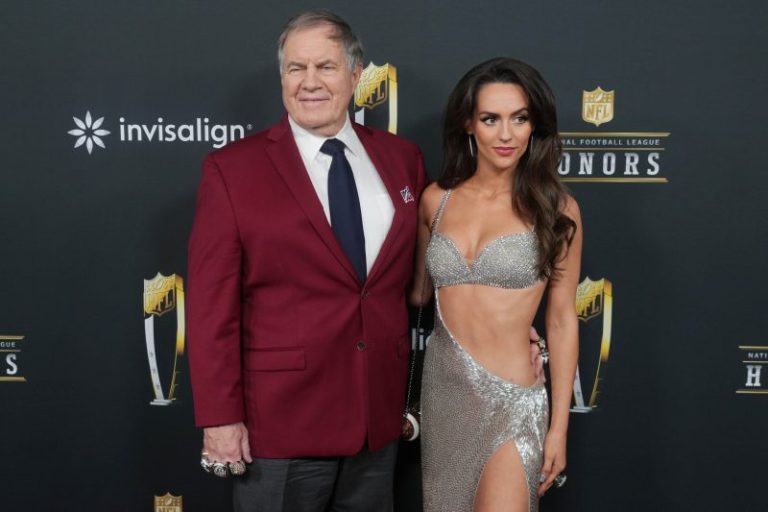
The girlfriend of North Carolina head coach Bill Belichick posted a statement on social media days after the CBS interview featuring the six-time Super Bowl winner was criticized after she interrupted several times and shut down a question about how the couple met.

Jordon Hudson shared a screenshot of an email from Belichick, seemingly to members of his camp, accompanied by the Taylor Swift song ‘Look What You Made Me Do.’

‘I don’t think this is fantastic, but it probably will hype the book, which is clearly the ongoing theme here,’ Belichick’s email starts. ‘This is about what I expected from the media.’

Belichick appeared on the network to promote his new book, ‘The Art of Winning: Lessons from My Life in Football.’

‘We went through how important it was for me to put ‘I (expletive) up’ in the book, and of course, that is the feature of this article – which is mostly about admitting mistakes and talking about a Super Bowl mistake. I am fine with putting mistakes in the book, but I am certainly not surprised that of 260+ pages, that is what they would highlight.’ the email said.

The 73-year-old Belichick seemed to have a problem with the promotion of the book and how the media is covering it.

‘I will say again, that I want this book to be presented as a look at my professional life and how I did my job on the way up to, and as the leader of an organization that grew from a $500 m franchise to an $8 b organization that played in 10 and won 6 Super Bowls over 25 years. This book is about how I did my job, and lessons from my 50 years in and around the NFL – not a bathroom book that highlights my mistakes.

“I have, at times reluctantly, gone along with the title, cover, and language in the book. I am not going to be the conductor of a hype train in the book promotion — we have enough hype to work with.

“I hope we can get on the same page in promoting the book authentically.”

Hudson said she will release a full statement on Tuesday.

The USA TODAY app gets you to the heart of the news — fastDownload for award-winning coverage, crosswords, audio storytelling, the eNewspaper and more.

This post appeared first on USA TODAY