Archive

2024

Browsing

PARIS — The two press conferences were separated by just one floor and 90 minutes Wednesday in the Main Press Center, but they might as well have been worlds apart.

In one, Katie Ledecky, the greatest female swimmer the world has seen, was once again speaking out on behalf of clean athletes in the wake of the Chinese doping controversy, which is headed right to the pool deck in the Olympic swimming competition that begins Saturday.

“I hope everyone here (in Paris) is going to be competing clean this week,” she said. “But what really matters also is were they training clean? Hopefully, that’s been the case. Hopefully, there’s been even testing around the world. I think everyone’s heard what the athletes think. They want transparency. They want further answers to the questions that still remain.”

In the other press conference, U.S. officials including Utah Gov. Spencer Cox and Sarah Hirshland, U.S. Olympic & Paralympic Committee CEO, were trying to explain the inexplicable: how they caved to the demands of International Olympic Committee members who apparently are afraid of being subpoenaed or even arrested when they enter the United States due to an FBI investigation into the suspected cover-up of the Chinese doping that is top of mind for swimmers here.

Ledecky and so many others — including Michael Phelps, who testified at a Congressional hearing last month on the issue — are looking to the leaders of the Olympic movement for help and transparency at this crucial time.

But instead of vowing to fight for the athletes by holding the World Anti-Doping Agency accountable for keeping the positive drug tests of 23 Chinese swimmers a secret for more than three years, those American leaders instead vowed to fight on behalf of the IOC and WADA by agreeing to work to try to shut down the FBI investigation in exchange for the IOC’s selection of Salt Lake City to be the host of the 2034 Winter Olympic Games.

What a terrible look this is for the Salt Lake City organizers and for the USOPC. Instead of standing firm for the rule of law in the United States and our nation’s ability to investigate what it wants, when it wants — including the doping that has stolen medals from deserving athletes, Americans and others — they went all in with the people who would rather deprive honest answers to Ledecky, Phelps and dozens of others.

Even more shockingly, the USOPC and Salt Lake City officials didn’t have to fall in line with this ridiculous agreement. They had everything going for them. They could have told the IOC no. There was no other candidate city for 2034 after other locations dropped out, and certainly there is none more desirable to the IOC than Salt Lake City, which successfully hosted the 2002 Winter Games after a notorious bribery scandal. 

The IOC needs Salt Lake City more than Salt Lake City needs the IOC. So who blinked? Not the IOC. 

This messy ending to what should have been a day of triumph for Salt Lake City emanates from the Rodchenkov Act, a 2020 law that allows U.S. authorities to pursue criminal charges in doping cases that affect U.S. athletes.

The IOC despises the Rodchenkov Act, named for the whistle-blower who exposed Russia’s state-sponsored doping scheme, so on Wednesday, it added an amendment to Salt Lake City’s host contract to address the matter. According to long-time IOC member John Coates, the organization can terminate the host contract it has with Salt Lake City if “the supreme authority of the World Anti-Doping Agency in the fight against doping is not fully respected.”

Instead of telling the IOC it could never agree to such a demand, the Americans wilted. They folded because they so desperately want to host the Olympic Games that they were willing to allow the high and mighty IOC to dictate to them, a group of Americans, what one of our laws should and should not do. 

Listen to Gene Sykes, chair of the USOPC: “We certainly accept the obligations and responsibility inherent in the amendment to the Olympic host contract. So from our perspective, we take very seriously to heart all of your comments, and we pledge to you that we will be good partners and we will support, with you, this very, very important institution.”

Oh my. Here’s hoping Sykes had his fingers and toes crossed when he said that.

U.S. Anti-Doping Agency CEO Travis Tygart, who has been a magnificent thorn in the side of WADA since the revelation that the 23 Chinese swimmers were allowed to compete at the 2021 Tokyo Olympics and win three gold medals, with 11 of those swimmers competing here, blasted the IOC-Salt Lake City deal later Wednesday. 

“It is shocking to see the IOC itself stooping to threats in an apparent effort to silence those seeking answers to what are now known as facts. It seems more apparent than ever that WADA violated the rules and needs accountability and reform to truly be the global watchdog that clean athletes need. Today’s demonstration further showed that as it stands today, WADA is just a sport lapdog, and clean athletes have little chance.”

Tygart continued: “If WADA has nothing to hide, they would welcome the chance to answer questions, not run and hide.”

The USA TODAY app gets you to the heart of the news — fast. Download for award-winning coverage, crosswords, audio storytelling, the eNewspaper and more.

This post appeared first on USA TODAY

PARIS — Casey Kaufhold’s ambition far exceeds her sport’s following in the United States.

She wants to be to archery what Simone Biles has been for gymnastics or Michael Phelps to swimming. She’s said that before, and the 20-year-old lefty from Lancaster, Pennsylvania, isn’t backing down from such a bold statement now. Not when she’s close, having arrived at the Paris Games as the world’s No. 1 and one of the favorites to claim an Olympic gold medal that has eluded American female archers for 48 years.

‘My goal is to inspire others, and that’s what those athletes do,’ said Kaufhold, referencing Biles and Phelps. ‘My goal is to just be a good representation of the sport.

‘Of course, winning is part of that.’

Get Olympics updates in your texts! Join USA TODAY Sports’ WhatsApp Channel

Meet Team USA: See which athletes made the U.S. Olympic team and where they are from

And a difficult part, too. How much? In this sport, it’d be groundbreaking.

The pecking order in women’s archery has been cemented for decades. For this Olympics, like many that preceded it, the storyline is obvious: Who out there might actually be able to beat the South Koreans? Of the past 10 individual gold medalists in women’s archery, nine were from South Korea. Of nine Olympic women’s team competitions, South Korea won all nine.

The USA TODAY app gets you to the heart of the news — fast. Download for award-winning coverage, crosswords, audio storytelling, the eNewspaper and more.
And while Thursday’s preliminary ranking round at Les Invalides didn’t damper medal hopes for Kaufhold, it did even less to dissuade anyone from thinking the sport’s power balance was about to shift away from South Korea.

While Kaufhold was shooting a respectable 672 (out of 720) to finish fourth among 64 archers, barely a dozen spots to her left, South Korea’s archers were crushing it.

Lim Si-hyeon (694) set a new world record. Right behind her: teammate Nam Su-hyeon (688). The top two Koreans finished 15 points clear of the rest of the field after 72 arrows. Scores won’t carry over into the next round, but nonetheless …

‘It was amazing,’ Kaufhold said. ‘The conditions today made for some really good shooting. What Lim shot is very impressive. It just sets new heights for everybody.’

Kaufhold’s preliminary score means she’ll be the No. 4 overall seed in a single-elimination, head-to-head March Madness-like bracket that makes archery one of the more compelling sports to watch in any Olympics. She’ll face No. 61 – Fatoumata Sylla of Guinea – in the opening round next Thursday.

Among Kaufhold’s USA teammates, Catalina Gnoriega (648) will be the No. 38 seed and Jennifer Mucino (625) will be No. 57. Collectively, the U.S. women’s team ranked eighth of 12 countries Thursday, which was disappointing because it meant the No. 8 seed in Sunday’s team competition. And as the No. 8 seed, the Americans would draw the top seed in the quarterfinals: South Korea.

Even if such a pairing spells doom for the U.S. women’s team, Kaufhold could still bring home two medals. She’ll partner with USA’s Brady Ellison – one of the world’s best on the men’s side – for the mixed competition. And of course, she’s expected to make a run in the individual bracket.

For that big-picture goal, Thursday wasn’t a bad start.

‘Qualifying fourth is a good place to be,’ USA coach Chris Webster said. ‘It’s not quite what she wanted, because obviously, she wants to shoot better than everybody. But it’s still a very respectable score to start off the Games.’

Kaufhold has a big challenge ahead of her, but she’ll have support. She’s expecting a 12-person contingent of friends and family to land in Paris on Friday morning.

And despite her young age, she isn’t in her first Olympics, having competed in 2021 in Tokyo.

So she knows better what to expect this time, and she’s embracing it. Which matters in a sport where ‘The biggest thing that separates archers is just the mental game,’ she said.

‘You feel pressure unless you don’t have a pulse,’ Kaufhold said. ‘Something like this, it’s the Olympic Games. Everybody is going to feel a little bit of something. But to me, when I feel pressure, it’s not because it’s a bad thing. To me, pressure is excitement. It means I’m excited. I’m ready to go. I want to get in that field and shoot. So when I feel pressure, it means it’s a good thing.’

Kaufhold sounds confident. And on Thursday, she was very good.

If there was a resounding theme, however, to the opening act for women’s archery at the Paris Olympics, it was that she’ll need to be great.

Reach Gentry Estes at gestes@gannett.com and on the X platform (formerly known as Twitter) @Gentry_Estes.

This post appeared first on USA TODAY

Vice President Kamala Harris is beginning to vet her list of potential running mates for 2024, according to sources familiar with the campaign.

The presumptive Democratic Party nominee has been moving quickly to formalize a campaign ticket after President Biden stepped down Sunday afternoon.

Harris’s team has requested information on approximately a dozen individuals, according to anonymous sources speaking to the Associated Press.

Sen. Mark Kelly of Arizona, Gov. Andy Beshear of Kentucky, Gov. Josh Shapiro of Pennsylvania, and Gov. Roy Cooper of North Carolina are among the most-discussed prospects for the Democratic vice-presidential nomination.

Her selection will set the tone for her last-minute presidential campaign launched with an endorsement of Biden following his sudden and unexpected withdrawal from the race.

Fox News Digital reached out to the Harris campaign for comment on the reports.

The campaign of former President Donald Trump, the Republican nominee in the 2024 election, has dismissed Harris’s eventual vice-presidential pick as inconsequential. 

‘There is a short list of governors and senators. They are all interchangeable,’ Trump campaign spokesman Steven Cheung told reporters on Wednesday. ‘It doesn’t matter.’

Many top Democrats have fallen in line behind Harris, receiving endorsements from the Clintons, former Speaker Nancy Pelosi and Senate Majority Leader Chuck Schumer and House Minority Leader Hakeem Jeffries.

Harris and Trump are locked in an extremely close contest, according to a new national poll conducted entirely after Biden announced he was suspending his campaign and endorsing his vice president.

Trump, who last week was formally nominated as the Republican Party’s 2024 presidential candidate, stands at 46% support among registered voters in an NPR/PBS News/Marist Poll.

Harris, who on Monday night said she had locked up the Democratic nomination thanks to verbal commitments from delegates at next month’s Democratic National Convention, stood at 45% support. Trump’s one point edge is well within the survey’s sampling error. Nine percent of those questioned were undecided.

Fox News Digital’s Paul Steinhauser contributed to this report.

This post appeared first on FOX NEWS

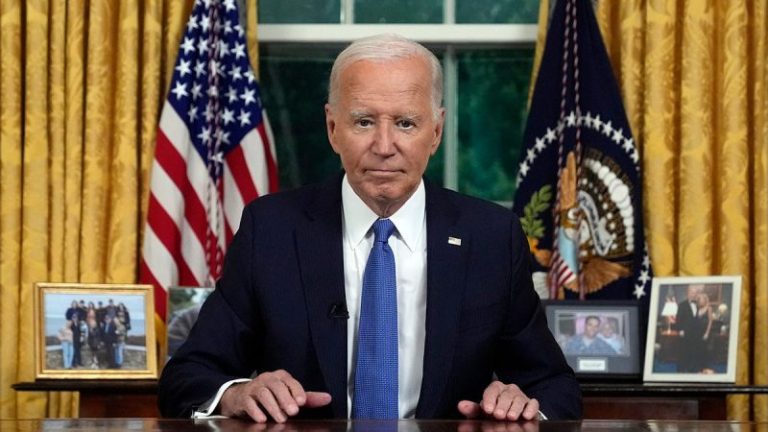
President Biden delivered an approximately 11-minute address to the nation from the Oval Office on Wednesday. 

While sitting behind the Resolute Desk, surrounded by portraits of American presidents, Biden spoke of his decision to discontinue his re-election campaign and laid out his plan for the remainder of his term. 

The 81-year-old president, after recovering from a reported COVID-19 case last week, also spoke repeatedly about ‘defending democracy.’ 

Here are five key takeaways from the address that comes at a pivotal moment of the election cycle as Vice President Harris, with Biden’s endorsement, vies to become the Democratic nominee for president. 

The president said that when he was elected to office, he promised to ‘always level with you, to tell you the truth.’ 

That truth, Biden said, is that the ‘sacred cause of this country is larger than any one of us,’ and those dedicated to the ’cause of American democracy must unite to protect it.’ 

‘In recent weeks, it’s become clear to me that I need to unite my party in this critical endeavor. I believed my record as president, my leadership in the world, my vision for America’s future all merited a second term. But nothing, nothing can come in the way of saving our democracy,’ Biden said. ‘That includes personal ambition. So I’ve decided the best way forward is to pass the torch to a new generation. It’s the best way to unite our nation. You know, there is a time and a place for long years of experience in public life. There’s also a time and place for new voices. Fresh voices. Yes, younger voices. And that time and place is now.’ 

The president laid out his plan for the remaining six months of his first term. 

‘I’m going to call for Supreme Court reform because this is critical to our democracy, Supreme Court reform,’ Biden said, without elaborating. 

He also vowed to ‘continue to lower costs for hard-working families,’ grow the economy, defend personal freedoms and civil rights ‘from the right to vote to the right to choose.’ The president said he would continue work on the ‘cancer moonshot,’ which was part of his 2020 campaign promise to end cancer as we know it and mobilize the federal government to speed progress in cancer research.  

‘I’ll keep calling out hate and extremism. Make it clear [that] there is no place, no place in America for political violence or any violence that ever. Period,’ Biden said, while listing priorities for the rest of his term. 

Trump survived an assassination attempt on July 13 at a rally in Butler, Pennsylvania, sending a unifying shock wave throughout the Republican Party, which formally named him their nominee the following week. 

‘I’d like to thank our great Vice President, Kamala Harris. She’s experienced. She’s tough. She’s capable. She’s been an incredible partner to me and a leader for our country. Now the choice is up to you, the American people. When you make that choice, remember the words of Benjamin Franklin’s hanging on my wall here in the Oval Office, alongside the busts of Doctor King and Rosa Parks and Cesar Chavez,’ Biden said. 

The president recalled how, when Franklin emerged from the Constitutional Convention in Philadelphia, he was asked whether the country would be a monarchy or a republic. 

Franklin famously was quoted as responding, ‘a republic, if you can keep it.’ 

Biden also touted his more than 50 years of service to the nation. 

‘The great thing about America is here, kings and dictators do not rule. The people do,’ he said. Biden has previously accused Trump of wanting to be a dictator.

Biden noted the country emerged from the ‘worst pandemic in a century, the worst economic crisis since the Great Depression, [and] the worst attack on our democracy since the Civil War.’ 

‘I will keep working to ensure America remains strong, secure in the leader of the free world. I’m the first president of this century to report to the American people that the United States is not a war anywhere in the world,’ Biden said. The claim comes as the Biden administration received heavy criticism over its botched withdrawal from Afghanistan. 

During his debate against Trump last month, Biden made the stunning omission of the 13 U.S. service members killed at Abbey Gate when claiming no U.S. troops were killed while he was in office. 

Biden in his Oval Office address also vowed to ‘keep rallying a coalition of proud nations’ to prevent Russian President Vladimir Putin from taking over Ukraine, promised to make NATO ‘more powerful and more united than any time in all of our history’ and said he would support allies in the Pacific, claiming that it is no longer ‘conventional wisdom’ that China would surpass the United States. 

Regarding the Israel-Hamas conflict, Biden vowed to ‘end the war in Gaza, bring home all the hostages to bring peace and security to the Middle East.’ 

This post appeared first on FOX NEWS

A newly formed election watchdog nonprofit organization has started paying out tens of thousands of dollars in ‘bounties’ to election whistleblowers as part of its unique goal of promoting election integrity by encouraging whistleblowers to come forward. 

The Fair Election Fund, a recently formed national election integrity watchdog group, is announcing this week it is awarding an initial $50,000 in ‘bounties’ to whistleblowers who have reported first-hand knowledge of voter fraud or irregularities across four states, including North Carolina and Michigan.

The Fair Election fund was set up earlier this year pledging millions of dollars to promote election integrity by paying and protecting whistleblowers on the front lines who are able to identify issues at polling places and election offices.

The group says it has heard from numerous whistleblowers across the country reporting issues receiving multiple ballots, delayed ballots, mailing address errors, independent parties blocked from overseeing counting, receiving ballots without requesting one and other issues.

‘The Fair Election Fund is thrilled that our incentives are working and we’re learning more about systemic problems with our election system, but this is just the beginning,’ Doug Collins, former congressman from Georgia and Fair Election Fund Senior Advisor, said in the press release.

‘The Fair Election Fund today is sharing the stories of the first brave whistleblowers who stepped up and exposed the wrongdoing they saw in the election process and we are grateful for their contribution. We must shine a light on these abuses and root out election fraud before Americans head to the polls this November.’

The group says in the press release that the ‘success’ of the ‘initial bounties’ shows the need for the group to expand, which it will do into key swing states in a six-figure digital ad buy during the Olympics. 

The new ad, titled ‘We’re Watching,’ will run in the swing states of Arizona, Nevada, Wisconsin, Michigan, Pennsylvania, Georgia and North Carolina and tells the story of a Connecticut Democratic operative recently charged in an absentee ballot stuffing investigation.

Voting is our most sacred right as Americans, And when the stakes are this high,’ the ad states. ‘We can’t afford to let our guard down. When bad actors try to mess with our elections, they should know we’re watching, and they will be caught.’

This post appeared first on FOX NEWS

Renewable energy demand will triple over the next seven years as data center growth accelerates to facilitate the proliferation of artificial intelligence, NextEra Energy CEO John Ketchum said Wednesday.

NextEra added 3,000 megawatts of renewable and storage projects to its order backlog in the second quarter. Of those, 860 megawatts — or 28% — come from agreements with Google to power the tech company’s data centers.

“This marks our second best origination quarter ever,” Ketchum told analysts on the company’s earnings call Wednesday. “These results support our belief that the bulk of the growth demand will be met by a combination of renewables and battery storage.”

NextEra’s business with tech and data center customers currently stands at seven gigawatts of renewable assets in operation and in backlog, said Brian Bolster, NextEra’s chief financial officer.

NextEra stock was up 3.5% in early afternoon trading. It is the largest power company in the S&P utilities sector by market capitalization and operates the largest renewable portfolio in the U.S.

Shares have gained 24% year to date and 12% over the last three months, as investor enthusiasm over the company’s position to meet growing U.S. power demand.

NextEra expects power demand to grow four times faster over the next decades compared to the prior 20 years on demand from data center, manufacturing and the electrification of the economy, Ketchum said.

Consulting firm Rystad Energy recently forecast that data centers and the adoption of electric vehicles alone will result in additional 290 terawatt hours of electricity demand in the U.S. by 2030. That’s equivalent to the entire power demand of Turkey, according to Rystad.

Executives at some of the biggest utilities in the U.S. have warned that failure to meet this demand will jeopardize the nation’s economic growth. Rebecca Kujawa, CEO of NextEra Energy Resources, a subsidiary NextEra Energy, said it will take time to nail down concrete numbers on exactly how much demand is coming from data centers in particular.

“But there is no escaping the fact that these are very large numbers and numbers that I don’t think any utility across the industry has seen before,” Kujawa said Wednesday. “From a practical standpoint, it’s going to take a couple of years for this really to materialize and utilities to be able to absorb it and serve it.”

Natural gas is also expected to play a key role in meeting power demand, though there is an ongoing debate about how the power mix will break down between gas and renewables. Producers and pipeline operators have argued that renewables, which are dependent on sun and wind conditions, will need gas as backup to ensure reliable power.

Alan Armstrong, CEO of pipeline operator Williams Companies, told CNBC last week the U.S. risks falling behind in the AI race if it doesn’t embrace natural gas as a power source.

Ketchum said natural gas has an important role to play as a bridge fuel during the energy transition. NextEra owns and operates a natural gas fleet in Florida. But the CEO said renewables come at a lower cost and are faster to deploy.

Building new natural gas generation is “more expensive in most states, is subject to fuel price volatility, and takes considerable time to deploy given the need to get gas delivered to the generating unit and the three- to four-year waiting period for gas turbines,” Ketchum said.

With power demand expected to surge, there is growing interest in nuclear energy as a source of reliable, carbon free energy. Ketchum indicated Wednesday that NextEra is considering restarting the Duane Arnold nuclear plant in Palo, Iowa, though it would require a thorough assessment. The plant ceased operations in 2020.

“We would only do it if we could do it in a way that is is essentially risk free with plenty of mitigants around the approach,” Ketchum said Wednesday. “There are a few things that we would have to work through but yes — we are we are looking at it.”

NextEra is rated as a buy equivalent by 70% of Wall Street analysts, with an average price target of $79.12 per share, suggesting nearly 10% upside from Tuesday’s close of $72.11.

This post appeared first on NBC NEWS

Wall Street’s favorite recession signal started flashing red in 2022 and hasn’t stopped — and thus far has been wrong every step of the way.

The yield on the 10-year Treasury note has been lower than most of its shorter-dated counterparts since that time — a phenomenon known as an inverted yield curve which has preceded nearly every recession going back to the 1950s.

However, while conventional thinking holds that a downturn is supposed to occur within a year, or at most two years, of an inverted curve, not only did one not occur but there’s also nary a red number in sight for U.S. economic growth.

The situation has many on Wall Street scratching their heads about why the inverted curve — both a signal and, in some respects, a cause of recessions — has been so wrong this time, and whether it’s a continuing sign of economic danger.

“So far, yeah, it’s been a bald-faced liar,” Mark Zandi, chief economist at Moody’s Analytics, said half-jokingly. “It’s the first time it’s inverted and a recession didn’t follow. But having said that, I don’t think we can feel very comfortable with the continued inversion. It’s been wrong so far, but that doesn’t mean it’s going to be wrong forever.”

Depending on which duration point you think is most relevant, the curve has been inverted either since July 2022, as gauged against the 2-year yield, or October of the same year, as measured against the 3-month note. Some even prefer to use the federal funds rate, which banks charge each other for overnight lending. That would take the inversion to November 2022.

Whichever point you pick, a recession should have arrived by now. The inversion had been wrong only once, in the mid-1960s, and has foretold every retrenchment since.

According to the New York Federal Reserve, which uses the 10-year/3-month curve, a recession should happen about 12 months later. In fact, the central bank still assigns about a 56% probability of a recession by June 2025 as indicated by the current gap.

“It’s been such a long time, you have to start to wonder about its usefulness,” said Joseph LaVorgna, chief economist SMBC Nikko Securities. “I just don’t see how a curve can be this wrong for this long. I’m leaning toward it being broken, but I haven’t fully capitulated yet.”

Making the situation even more complicated is that the yield curve isn’t the only indicator showing reason for caution about how long the post-Covid recovery can last.

Gross domestic product, a tally of all the goods and services produced across the sprawling U.S. economy, has averaged about 2.7% annualized real quarterly growth since the third quarter of 2022, a fairly robust pace well above what is considered trend gains of around 2%.

Prior to that, GDP was negative for two straight quarters, meeting a technical definition though few expect the National Bureau of Economic Research to declare an official recession.

The Commerce Department on Thursday is expected to report that GDP accelerated 2.1% in the second quarter of 2024.

However, economists have been watching several negative trends.

The so-called Sahm Rule, a fail-safe gauge that posits that recessions happen when the unemployment rate averaged across three months is half a percentage point higher than its 12-month low, is close to being triggered. On top of that, money supply has been on a steady downward trajectory since peaking in April 2022, and the Conference Board’s index of leading economic indicators has long been negative, suggesting substantial headwinds to growth.

“So many of these measures are being questioned,” said Quincy Krosby, chief global strategist at LPL Financial. “At some point, we’re going to be in recession.”

Yet no recession has appeared on the horizon.

“We’ve got a number of different indicators that just haven’t panned out,” said Jim Paulsen, a veteran economist and strategist who has worked at Wells Fargo among other firms. “We’ve had a number of things that were recession-like.”

Paulsen, who now writes a Substack blog called Paulsen Perspectives, points out some anomalous occurrences over the past few years that could account for the disparities.

For one, he and others note that the economy actually experienced that technical recession prior to the inversion. For another, he cites the unusual behavior by the Federal Reserve during the current cycle.

Faced with runaway inflation at its highest rate in more than 40 years, the Fed started raising rates gradually in March 2022, then much more aggressively by the middle part of that year — after the inflation peak of June 2022. That’s counter to the way central banks have operated in the past. Historically, the Fed has raised rates early in the inflation cycle then started cutting later.

“They waited until inflation peaked, and then they tightened all the way down. So the Fed’s been completely out of synch,” Paulsen said.

But the rate dynamics have helped companies escape what usually happens in an inverted curve.

One reason why inverted curves can contribute to a recession as well as signal that one is occurring is that they make shorter-term money more expensive. That’s hard on banks, for instance, that borrow short and lend long. With an inverted curve hitting their net interest margins, banks may opt to lend less, causing a pullback in consumer spending that can lead to recession.

But companies this time around were able to lock in at low long-term rates before the central bank starting hiking, providing a buffer against the higher short-term rates.

However, the trend raises the stakes for the Fed, as much of that financing is about to come due.

Companies needing to roll over their debt could face a much harder time if the prevailing high rates stay in effect. This could provide something of a self-fulfilling prophecy for the yield curve. The Fed has been on hold for a year, with its benchmark rate at a 23-year high.

“So it could very well be the case that the curve’s been lying to us up until now. But it could decide to start telling the truth here pretty soon,” said Zandi, the Moody’s economist. “It makes me really uncomfortable that the curve is inverted. This is one more reason why the Fed should be lowering interest rates. They’re taking a chance here.”

This post appeared first on NBC NEWS

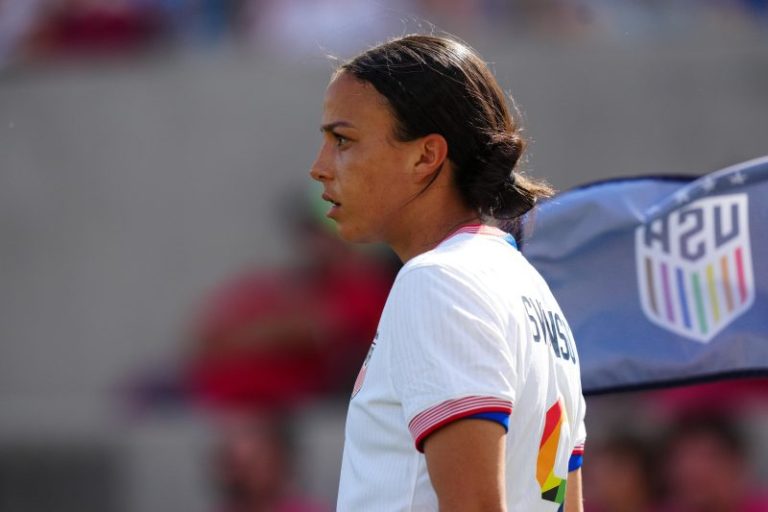
The United States women’s soccer team had a rather disappointing showing at the Tokyo Olympics when it took home a bronze medal. The roster is set for the squad that is looking for its first Olympic gold since 2012.

Emma Hayes hasn’t been the head coach for very long, but she has her first major test at the helm of the USWNT with the 2024 Paris Olympics opener Thursday against Zambia (3 p.m. ET).

The big news coming from the roster selection was the omission of Alex Morgan, who had appeared in the past three Olympics for the national team. Still, there are other veterans on the roster with plenty of Olympic experience, including Alyssa Naeher, Lindsey Horan and Crystal Dunn.

Get Olympics updates in your texts! Join USA TODAY Sports’ WhatsApp Channel

USWNT Olympic roster

There is a blend of seasoned and new Olympians on the roster chosen by Hayes. Ten players have played in the Games before, while eight will be making their Olympic debut. The team also gets four alternates that will travel with the team and could be added to the roster should someone sustain an injury.

Meet Team USA: See which athletes made the U.S. Olympic team and where they are from

*Each asterisk represents an Olympic appearance, including 2024 Paris.

***Alyssa Naeher, goalkeeper
*Casey Murphy, goalkeeper
*Naomi Girma, defender
**Tierna Davidson, defender
*Emily Fox, defender
*Jenna Nighswonger, defender
**Casey Krueger, defender
**Emily Sonnett, defender
*Sam Coffey, midfielder
***Lindsey Horan, midfielder
**Rose Lavelle, midfielder
*Korbin Albert, midfielder
**Catarina Macario, forward
***Crystal Dunn, forward
*Trinity Rodman, forward
*Jaedyn Shaw, forward
 *Sophia Smith, forward
**Mallory Swanson, forward
Alternates: Jane Campbell (goalkeeper), Hal Hershfelt (midfielder), Croix Bethune (midfielder) and Lynn Williams (forward)

The USA TODAY app gets you to the heart of the news — fast. Download for award-winning coverage, crosswords, audio storytelling, the eNewspaper and more.

Who is the head coach of USWNT?

U.S. Soccer hired Hayes in November, but she didn’t coach her first match until June 1 due to her job as head coach of Chelsea. She’s an accomplished coach, as she recently led Chelsea to its fifth consecutive, and seventh overall, Super League title. Hayes also led Chelsea to the Champions League final in 2021, she’s a six-time WSL manager of the year and was FIFA’s coach of the year in 2021.

When U.S. Soccer announced the hiring of Emma Hayes, it announced she would become the highest-paid coach in women’s soccer.

USWNT schedule at 2024 Paris Olympics

The USWNT will begin group play of the 2024 Paris Olympics in Nice. The team is in Group B. Here is the schedule for the USWNT group stage matches:

Thursday, July 25: USA vs. Zambia (3 p.m. ET)
Sunday, July 28: USA vs. Germany (3 p.m. ET)
Wednesday, July 31: USA vs. Australia (1 p.m. ET)

USWNT Olympic history

It’s been more than a decade since the USWNT won a gold medal at the Olympics, the last coming in the 2012 London Games. The national team has participated in every Olympics since 1996, and it’s won a medal in every tournament except in 2016. Here is the history of the USWNT in the Olympics:

2020, Tokyo: Bronze (defeated Australia 4-3 in bronze medal game)
2016, Rio: None (lost to Sweden 2-1 in penalties in quarterfinals)
2012, London: Gold (defeated Japan 2-1)
2008, Beijing: Gold (defeated Brazil 1-0 in extra time)
2004, Athens: Gold (defeated Brazil 2-1 in extra time)
2000, Sydney: Silver (lost to Norway 3-2 in penalties)
1996, Atlanta: Gold (defeated China 2-1)

This post appeared first on USA TODAY

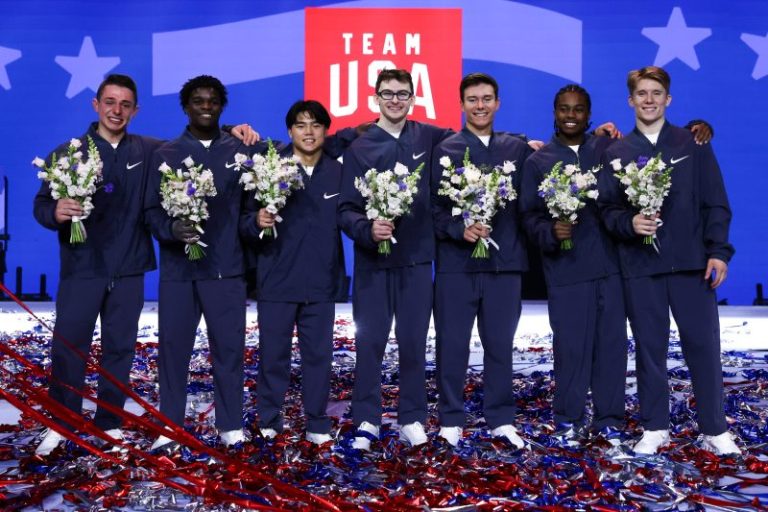
PARIS — Winning an Olympic team medal is difficult.

Difficulty doesn’t have to be what keeps the U.S. men’s gymnastics team from winning one, however.

Since the Tokyo Olympics, where they finished fifth for a third straight Games, the Americans have prioritized making their routines harder in hopes of breaking what is now a 16-year medal drought. You can do the most beautiful gymnastics in the world and it won’t matter if your skills aren’t as difficult as what the top teams are doing.

“I hate to say that about Tokyo but yeah, that was kind of what that was,” said Brody Malone, referring to the 7-point gap between the U.S. men and China, the bronze medalists.

Get Olympics updates in your texts! Join USA TODAY Sports’ WhatsApp Channel

In the gymnastics scoring system, there is one score for the difficulty value of a routine and another for how well it’s executed. The Americans still lag well behind Japan and China, perennial favorites in men’s gymnastics. But with no Russia, which won the team title both in Tokyo and at the world championships before it, the bronze medal is there for the taking.

According to neutraldeductions.com, a website devoted to men’s gymnastics, the U.S. men have a potential difficulty score of 105.60 in the team final, where three gymnasts compete on each event and all three scores. That’s exactly one point less than Ukraine and 0.60 points ahead of Britain.

“It’s just scoring,” Frederick Richard said. “You can see our scores are much higher as a team scenario than they ever have been in the past.”

The fifth-place finishes in London and Rio were disappointing because the U.S. men had finished first and second, respectively, in qualifying. By Tokyo, however, it was clear they were no longer in the same class as China, Japan and Russia.

The difficulty disadvantage was so great, in fact, the U.S. men were already 6.5 points behind before a single routine was done.

“Walking in, it was like, they’re going to have to fall six times AND we’re going to have to have the meet of our life if we’re going to get on the podium,” said Thom Glielmi, who coaches Olympian Asher Hong at Stanford.

It wasn’t as if this was a big secret. The men’s team had been talking for several years about needing more difficulty to keep pace with the powerhouses. But it wasn’t so easy to do. It takes time to upgrade routines and the results in the interim aren’t always pretty. That’s problematic for both the gymnasts still competing in college, where all scores are counted, as well as those who are done and rely on national team funding to pay their bills.

So post-Tokyo, the men’s team instituted a bonus program that gave more credit for more difficult skills. Or, rather, didn’t punish gymnasts for attempting more difficult skills.

“This bonus system would basically eliminate a fall, for example. If you fell attempting a certain whatever, it would still be OK and you could maintain your national team spot,” said Brett McClure, a silver medalist with the U.S. men in 2004 and now the team’s high-performance director.

“It was a tool that kind of helped coaches buy into it a little bit more and say it is beneficial for us to continue to push this.”

It led to some skewed results — why is this gymnast who won this event at the national championships finishing eighth at worlds? — but it had the desired effect.

At last year’s world championships, the U.S. men won their first team medal since 2014, a bronze. Additionally, Richard was the bronze medalist in the all-around and Khoi Young, an alternate on the Paris squad, was the silver medalist on both pommel horse and vault.

“If you look at the past two world championships, we were in the mix to medal. And it was because we had pushed the difficulty,” said Glielmi, who also coaches Young at Stanford. “The difficulty bonus that was incorporated into the scoring system, those athletes got onto world teams.”

Of course it helps that Russia hasn’t been at a major international meet since Tokyo. But there’s no denying the mindset of the men’s team has changed. No elite athlete wants to go to an event knowing they have no shot at a medal, and the U.S. men have seen firsthand the difference in their results with the big skills and without.

There’s still work to do to catch up to Japan and China. But the climb isn’t nearly as steep as it was three years ago.

Now the goal is for it to be completely gone by Los Angeles in 2028.

“Give everything this Olympics and show that we have the potential to bring home medals. Then it’s go everything to the wall to make sure it’s not about medals anymore, it’s about gold medals for 2028,” Richard said.

That doesn’t sound so difficult.

Tom Schad contributed.

Follow USA TODAY Sports columnist Nancy Armour on social media @nrarmour.

This post appeared first on USA TODAY

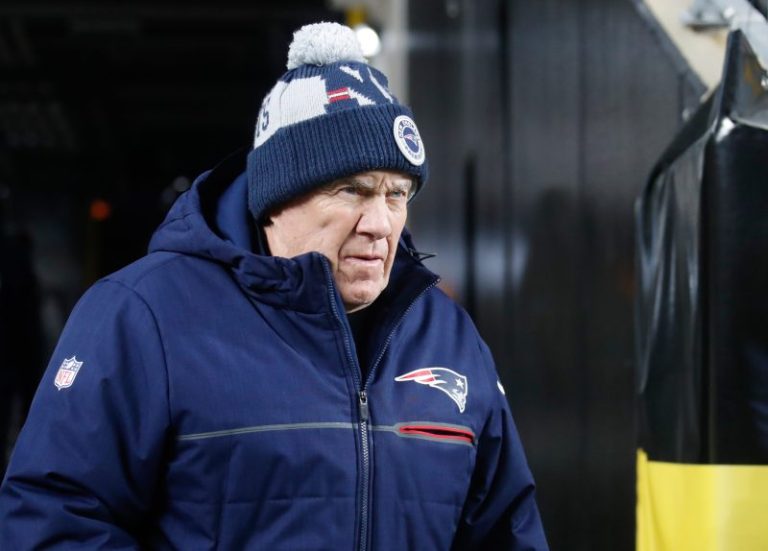
Nice try, Kyle Shanahan.

It surely would have been a coup if Bill Belichick took Shanahan up on his offer to “do whatever he wanted to do” in joining the San Francisco 49ers coaching staff. Shanahan, despite blowing the decision on the overtime coin toss that enabled the Kansas City Chiefs to win a repeat crown in Super Bowl 58, is one of the NFL’s sharpest offensive minds. Belichick, despite the decline of the New England Patriots under his watch since Tom Brady’s departure, is still a whiz when it comes to designing defenses.

Putting those two heads together might have been some kind of special.

“I threw it out to him,” Shanahan told The Athletic’s Tim Kawakami on “The TK Show” podcast. “He loves football so much that you never know what he…I can’t believe that he’s not a head coach of a team right now.

“I know what I would do if I was an owner, so that shocks me, and the last thing you want to do is insult someone like Bill Belichick. But I know he just loves ball in its simplest form, so I threw it all out to him, whatever he wanted to do.”

NFL STATS CENTRAL: The latest NFL scores, schedules, odds, stats and more.

At the time, Shanahan was searching for his third defensive coordinator in as many years. The opening was ultimately filled by Nick Sorensen. Even if Belichick was the first choice, the process still would have had to comply with the Rooney Rule. Yet Shanahan can’t be blamed for swinging for the fences.

“I was like, ‘Would you be interested?’ “ Shanahan added. “And he was very nice and appreciative, but he politely turned me down.”

Undoubtedly, as Shanahan alluded to, it is rather weird that as the remainder of NFL teams opened training camps this week, Belichick is absent from the coaching mix after mutually parting ways with the Patriots following the 4-13 finish last season that marked his worst season as a head coach.

Call it one of the biggest surprises from another crazy NFL offseason, even with the personnel stumbles in recent years that Belichick oversaw and the blunder in turning over his offense (and young quarterback Mac Jones) to Matt Patricia and Joe Judge.

Aside from the Patriots, seven NFL teams had an opening for coach and only one team – the Atlanta Falcons – saw fit to even interview Belichick, 72, who is 15 victories from surpassing Don Shula’s record of 347 triumphs and becoming the winningest coach in NFL history. The Falcons, though, picked Raheem Morris over Belichick and others. And the buzz about Belichick during the last coaching cycle was flush with questions about how much control he’d want over personnel, given the autonomy he maintained in Foxborough. And some may also wonder how well he meshes with a younger generation of athletes.

Sure, it’s true, too, that Belichick’s tally of losses is historic. His 165 regular-season setbacks ties with Dan Reeves and Jeff Fisher for most ever, and his 178 losses, including playoffs, leaves him in a dead heat with Tom Landry. Without Brady, Belichick went 29-38 in his final four years in New England, with zero division titles and zero playoff wins.

Take your pick about what apparently scared off so many teams needing a coach. My guess is that it came down to the threat of power plays, with most teams structured to roll with GMs making the call on personnel decisions.

Anyway, rising young coaches including Mike Macdonald (Seattle Seahawks), Antonio Pierce (Las Vegas Raiders) and Dave Canales (Carolina Panthers), and second-shot coaches including Morris and Dan Quinn (Washington Commanders), are running teams this summer instead of the coach who won six Super Bowls during his 24-year Patriots reign. Still a stunner.

Belichick declined an interview request this week from USA TODAY Sports, indicating during a text-message exchange that he’s received more than 100 such requests.

“And if I do one…” he replied.

It would have been ideal to capture Belichick’s thoughts about his sabbatical – and how much his body clock has been thrown off without a camp to run – directly from the source.

Instead, he graciously apologized for being an “inconvenience” for this particular column theme.

Yes, Belichick, does have his sense of humor.

Do you realize the last time this noted historian wasn’t in camp with an NFL team? It was 1974. Kids, that’s the year Derek Jeter was born, Richard Nixon resigned from the White House after the Watergate scandal and Muhammad Ali and George Foreman engaged in “The Rumble in the Jungle.’ In other words, it was a long time ago.

Make no mistake. Belichick is still hungry to coach again – but hardly so desperate to take on a complementary role with the 49ers. Talk about giving up power. He’s now positioned to recharge his batteries and, well, undoubtedly sharpen his NFL intel from another vantage point, conceivably for use at a later date. His presence on the NFL landscape will still be huge, given the three high-profile media roles he’s signed on for – weekly appearances on “The Pat McAfee Show” that airs on ESPN, the “ManningCast” that provides an alternative on ESPN2 for “Monday Night Football” games and a slot on the “Inside the NFL” show that now airs on The CW Network.

Ironically, the TV gigs might also provide Belichick – nobody’s media darling – an opportunity to display another side of himself that just might appeal to particular fan bases…and perhaps to particular team owners.

In any event, it’s on to must-see TV for NFL fans. And a reminder that Belichick – whose name will pop up as hot-seat speculation emerges – is probably not done yet.

This post appeared first on USA TODAY