Archive

2024

Browsing

VILLENEUVE-D’ASCQ, France — Limit LeBron James. Limit Steph Curry. Limit Kevin Durant. And Anthony Davis and Joel Embiid and Anthony Edwards and Devin Booker and Jayson Tatum. And on and on and on.

When put that way, the idea of beating the U.S. men’s 5×5 basketball team at the 2024 Paris Olympics seems daunting if not impossible.

Beating the U.S. team loaded with All-Stars won’t be easy, but it’s doable. South Sudan and Germany proved that in exhibition games in the past week – South Sudan lost 101-100 (with a chance to win on the game’s final shot) and Germany fell 92-88.

Both teams provided a blueprint for upsetting the heavy gold-medal favorite. Serbia will be first up when the U.S. opens its group play Sunday.

How a team can beat the U.S. at the 2024 Paris Games:

Meet Team USA: See which athletes made the U.S. Olympic team and where they are from

3-point shooting is a major factor

Germany and South Sudan made enough 3-pointers to keep it close. The U.S. will put up points with its elite scorers even if it’s not shooting great, so an opponent will need to keep up. Hitting 3s is one way to do that.

Germany shot just 44.4% from the field and just 28.9% on 3-pointers. However, it made seven more 3s than the U.S. South Sudan shot 42.4% on 3s, making 14 – also seven more than the U.S. In five exhibition games, the U.S. was even in 3s made against Canada, Serbia, Australia, South Sudan and Germany at 48 apiece.

Getting hot from 3 will give a medal contender an avenue to victory against the U.S.

Rely on continuity the U.S. lacks

The U.S. assembled 12 players who have not played together as a full squad. Sure, Kevin Durant and Steph Curry were teammates with Golden State, and Durant and Devin Booker are teammates with Phoenix, and Jayson Tatum, Jrue Holiday and Derrick White are teammates with Boston.

Teams like Germany, Australia, Serbia and France have important players who have played in multiple international competitions together such as last summer’s FIBA World Cup which Germany won. Several players from Germany’s gold-medal team, including Dennis Schroder, Franz Wagner, Mo Wagner, Daniel Theis, Andreas Obst, Johannes Voigtmann and Isaac Bonga, are back for the Olympics.

Australia has a roster of players who have played together (Joe Ingles, Matthew Dellavedova, Patty Mills, Dante Exum, Josh Giddey, Josh Green) and are in the NBA. Canada beat the U.S. for bronze at the 2023 World Cup, and Shai Gilgeous-Alexander, RJ Barrett, Dillon Brooks, Lu Dort, Kelly Olynyk, Dwight Powell and Nickeil Alexander-Walker are in Paris from that team.

The U.S. relies on a team coming together quickly and incredible talent to compensate for a lack of chemistry. It works most of the time − the U.S. is going for its fifth consecutive Olympic gold. But as other national teams improve the quality of their rosters with more NBA players, the talent gap isn’t as wide and continuity has an impact. Just two players (Edwards and Tyrese Haliburton) played on the U.S. 2023 FIBA World Cup team.

‘If you look on paper, obviously they’re the most talented team, it’s not a secret to anybody,” Australia’s Giddey said. “The difference is these guys (on the U.S.), they’ve never played together, whereas a lot of these other countries have a core and have been together for years. I think those type of things really do (have) an effect.” 

Force U.S. turnovers

In the exhibition games, the U.S. had more turnovers than its opponents (72-62) and posted a mediocre assist-to-turnover ratio. Sometimes, it was sloppy play. Sometimes, it was that lack of continuity with one U.S. player passing to where he thinks a teammate should be but isn’t. Or trying to make a fancy play when the basic will do.

If an opponent can limit its turnovers and get extra scoring chances from U.S. turnovers, that gives a team a chance to keep pace with U.S. scoring. The fewer turnovers by a U.S. opponent also means fewer transition opportunities for the U.S., which thrives in the open court on fastbreak chances.

Expose U.S. rotations

U.S. coach Steve Kerr has 11 All-Stars plus All-Defense selection Derrick White. In pre-Olympic contests, Kerr has tried to play the entire roster as much as possible, including wholesale, five in, five out substitutions. But in highly competitive events, including the NBA playoffs, rotations tighten and coaches rely on eight players, maybe nine tops, so the best players play a majority of the game.

Yes, it’s a luxury that Kerr can replace James with Tatum or Embiid with Davis or Curry with Edwards and right on down the bench.

Trying to figure out the right five-man combinations in short time isn’t easy. There’s an art and science to it, and there may be situations when Kerr has to sit an All-NBA player for long stretches and/or limit minutes. Is he willing to do that? Can he do that without hurting egos?

Maximize FIBA rules against the U.S.

In FIBA, it’s a 40-minute game compared to 48 in the NBA. That means fewer possessions per game and less time to come back from a large deficit. Defensive three seconds is allowed so teams can pack the paint and cut off driving lanes to the rim, especially with zone defenses.

It can be a more physical game, too, with referees allowing significant contact and not making the game a parade to the free throw line.

“We have seen that when the United States struggles in recent years, whether they win in a close game or lose like we did in the World Cup, in part it’s because I don’t think they understand the difference in the rules in terms of how fast the game goes,” international basketball expert Fran Fraschilla said.

Other factors

Great point guard play is important, and while the U.S. has playmakers, it doesn’t have a dedicated point guard. Can teams take advantage there?

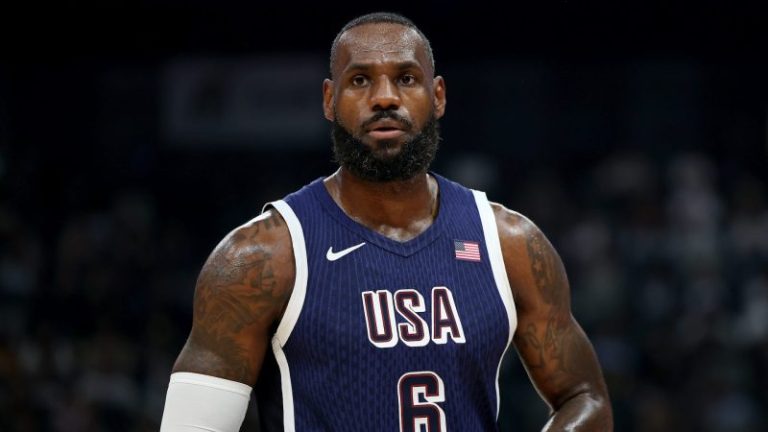
Make someone other than James beat you. He was unstoppable against South Sudan and Germany with the game on the line. That task is easier said than done, as are all the other components.

It’s going to take a sub-par game by the U.S. and near-perfect game by an opponent. But in a one-game scenario – like the NCAA tournament and not a best-of-7 – it’s possible.

Follow NBA reporter Jeff Zillgitt on social media @JeffZillgitt

The USA TODAY app gets you to the heart of the news — fast. Download for award-winning coverage, crosswords, audio storytelling, the eNewspaper and more.

This post appeared first on USA TODAY

Editor’s note: FollowOlympic opening ceremony live updates.

Rain clouds covered most of Paris on Friday morning as the weather threatened to, quite literally, rain on Olympic organizers’ parade.

As of midday Friday, the forecast in Paris called for mild temperatures of around 68 degrees but plenty of clouds and a high probability of rain through the evening. According Météo-France, which is akin to the National Weather Service in the United States, the rain ‘will be continuous and sometimes moderate in intensity until the middle of the night.’

Paris organizers have previously said the opening ceremony would go on as planned in the event of rain, though Paris Mayor Anne Hidalgo suggested in an interview with CNN on Thursday that poor weather could pose some problems.

‘I think the rain will be a problem if we have rain (during the opening ceremony) because many moments in this show need to be very safe for the dancer and without rain and without water,’ Hidalgo told CNN.

Meet Team USA: See which athletes made the U.S. Olympic team and where they are from

Get Olympics updates in your texts! Join USA TODAY Sports’ WhatsApp Channel

The USA TODAY app gets you to the heart of the news — fast. Download for award-winning coverage, crosswords, audio storytelling, the eNewspaper and more.

Opening ceremony on the Seine

This year’s ceremony will break from tradition as the parade of nations will take place on Paris’ River Seine. This year will be the first time the opening ceremony will be held outside of a stadium in the history of the modern Games. 

From a technical, television perspective, the extravaganza will be the most complicated event that has ever been produced. The Olympic Broadcasting Service will operate 100 cameras along the parade route and each delegation will have access to a live mobile phone camera on the boat. NBC will be tracking Team USA’s route, and the Americans will be second-to-last down the river because the U.S. will host the 2028 Games in Los Angeles.

This post appeared first on USA TODAY

Editor’s note: FollowOlympic opening ceremony live updates.

In addition to her record number of medals — she has 37 at the world championships and Olympics, more than any other gymnast, male or female — Biles has five skills named after her in the Code of Points, gymnastics’ scoring systems. Skills are named after the first gymnast to do them in a major international competition, like the world championships or Olympics. This means that long after Biles is done with gymnastics, her presence will remain.

How many gymnastics skills are named after Simone Biles?

Five total: Two on vault, two on floor exercise and one on balance beam. Here’s a closer look at each one.

Meet Team USA: See which athletes made the U.S. Olympic team and where they are from

The Biles I on floor exercise

What the move is: It’s a double layout with a half-twist, which means a double somersault in the stretched position, with a half-twist. Once considered one of the hardest passes to do, it’s now the third pass in her floor routine. In other words, she’s perfected it so well she can do it well into her floor routine, even after she’s already expended a lot of energy.

When Biles first did it: This was the first skill Biles had named after her, back in 2013.

Has anyone else done it? A handful of other gymnasts have since done this skill.

The Biles II on floor exercise

What the move is: It’s a triple-double, which means it’s a triple-twisting, double somersault. It’s now her first pass in her floor routine.

When Biles first did it: This was first done in 2019.

The Biles I on vault

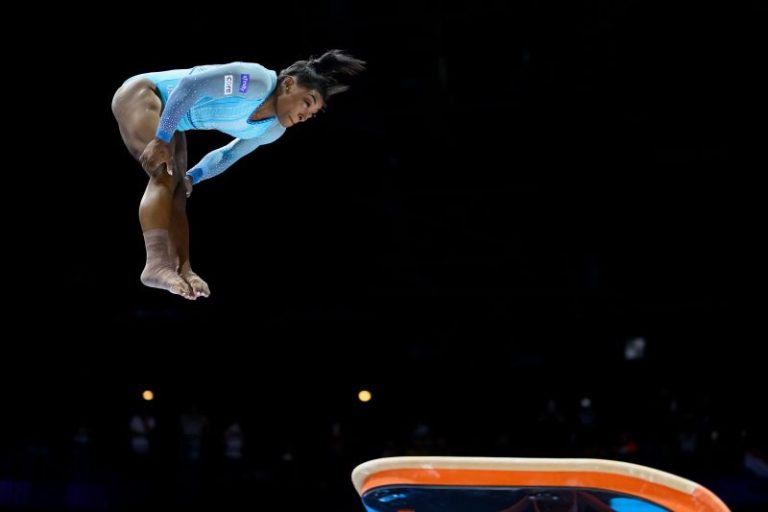
What the move is: It’s a roundoff onto the takeoff board, a back handspring with a half-turn onto the table, followed by a double-twisting somersault in a stretched position.

When Biles first did it: When Biles had this named after her in 2018, it matched the Produnova for most difficult vault in the women’s code. But the Biles II has since surpassed them both, so she no longer does the Biles I on vault.

The Biles II on vault

What the move is: The Biles II is also known as the Yurchenko double pike. Vaults are categorized by “families,” which are based on the entry. On Yurchenko vaults, a gymnast does a roundoff onto the takeoff board and a back handspring onto the table. Biles then follows it with a double somersault in the piked position.

Has anyone else done it? Few men even try this vault, which is so difficult because of the power it takes to get two somersaults as well as its lack of a bailout. If something goes awry, more likely to land on her head or neck than her knees.

When Biles first did it: Biles began doing this vault in 2021 but didn’t do it at a worlds or Olympics until the 2023 world championships. With a 6.4 difficulty value, it is the hardest vault in the women’s code.

When Biles did the vault last year, she took a half-point deduction for having coach Laurent Landi standing on the landing mat, ready to step in and redirect her into a safe position if it looked as if she was headed for a scary landing. But neither Biles nor Landi feel the need for him to do that anymore.

The most difficult vault commonly executed by other gymnasts is valued at 5.6, eight-tenths lower than the Biles II, so doing it gives Biles a huge scoring advantage

The Biles on balance beam

What the move is: It’s the double-double dismount, which means it’s a double-twisting, double somersault.

When Biles first did it: She first did it in 2019. Biles no longer does this skill because it isn’t worth it score-wise.

Has anyone else done it? The international gymnastics federation (FIG) undervalued the dismount because it didn’t want to encourage less-competent gymnasts trying it. Which is silly. The whole point of an open-ended code is to push the boundaries of the sport. If the FIG was really that concerned, it would tell judges to use the execution mark to hammer gymnasts who try skills they have no business doing. One 10, when everyone else is scoring in the 14s, would have gotten the message across equally well.

How do you get a gymnastics move named after you?

Skills are named after the first gymnast to do them in a major international competition, like the world championships or Olympics.

This post appeared first on USA TODAY

A recent poll indicates voters in the United States almost universally approve of President Biden’s decision to end his 2024 re-election campaign. 

According to a New York Times/Siena College Poll released Thursday, a staggering 87% of registered voters said they approved of the president’s decision to forego a second term. 

Only 9% of respondents said they disapproved of the decision.

The New York Times reported that the 87% agreement statistic is among the highest levels of agreement on a Times/Siena polling question in years.

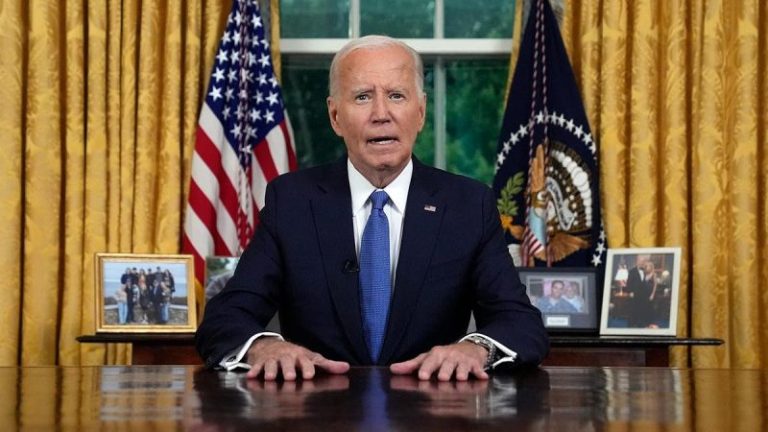
The president gave a short Oval Office address on Wednesday in which he conveyed his decision to step down and endorsement of Vice President Kamala Harris.

‘In just a few months, the American people will choose the course of America’s future. I made my choice. I’ve made my views known,’ Biden said from the White House. ‘I would like to thank our great vice president, Kamala Harris. She is experienced, she is tough, she is capable. She’s been an incredible partner to me and a leader for our country.

He continued, ‘Now the choice is up to you, the American people. When you make that choice, remember the words of Benjamin Franklin hanging on my wall here in the Oval Office, alongside the busts of Dr. King and Rosa Parks and Cesar Chavez.’

Biden’s decision to give up on re-election shocked the public and even Democratic Party insiders close to the president — his campaign had planned fundraising events well into August and repeatedly told Democratic lawmakers he had no intention of giving up the race.

Critics and allies alike had called for Biden to stand down from the Democratic Party ticket following his disastrous first presidential debate performance and years of increasingly concerning behavior that seemed to show mental decline.

The speech lasted roughly 11 minutes, with the president sitting at the Resolute desk in the Oval Office while touting his years in political office and decision to bow out.

Members of the president’s family were in attendance for the speech, including first lady Jill Biden, daughter Ashley Biden, son Hunter Biden and others. 

Former President Donald Trump slammed the Oval Office address, calling it a ‘terrible’ speech while accusing Democrats of staging a coup against the president.

‘I knew there was a palace coup going on, and I assumed that she’d be probably getting it,’ Trump said of Harris. ‘She had the advantage.’

Fox News Digital’s Scott McDonald contributed to this report.

This post appeared first on FOX NEWS

Two weeks ago, a U.S. intelligence official — commenting on the recent Election Security Update issued by the Office of the Director of National Intelligence (DNI) — suggested that Russia prefers former President Trump to win the presidency in November. 

As a former Defense Intelligence Agency officer who specializes in Russia and Putin, I totally disagree. Like many other pronouncements made by spy agencies, this one is also dead wrong. But now that Biden is out of the race, whom would Vladimir Putin favor, Trump or Vice President Kamala Harris? 

Kamala, of course. Here’s why. 

Putin is almost certainly terrified of another Trump presidency, but Kamala not so much. The Russians have assessed her to be vapid, unintelligent and incompetent, and can be unbalanced and manipulated in Moscow’s view.

The Russian media, which is almost exclusively under state control, speculated on Monday whether Harris’s ‘cackling and giggling,’ ‘nervous, out-of-place clapping,’ ‘exaggerated gesticulation,’ nonsensical statements like ‘the passage of time,’ and ‘strange’ facial expressions are a result of a psychiatric disorder or being constantly ‘inebriated.’ 

Russian analysts expect Harris to continue Biden’s policies seeking to transform America from a society that’s based on meritocracy and competence to the one that is hyper-focused on forced equality and government regulation, typical of a socialist system. Since socialism destroyed the USSR, Moscow believes that someone like Harris leading America on the path of destruction is a good thing for Russia, which views the U.S. as its top security threat.

Harris, like Biden, who called Putin all sorts of derogatory names such aswar criminal’killeramurderous dictator’ and a ‘pure thug’ — a sign that Putin’s actions got under his skin – also can be rattled by the former KGB operative, the Russians believe. Harris previously slammed Putin, accusing him of brutality and being responsible for the death of Alexei Navalny, his political opponent.

To the contrary, a talented statesman and astute businessman, former President Trump, always acted respectfully to Putin, realizing the Russian isn’t afraid of words. Instead, Trump pursued the most formidable anti-Russia policy since former President Reagan, having taken actions to counter Moscow’s anti-U.S. strategy.

Trump founded in December 2019 America’s first entirely new armed service since 1947, the U.S. Space Force. This was 18 years after Putin established Russia’s space force, whose mission is to attack U.S. satellites, on which our military depends for every aspect of war fighting — missile warning, navigation, reconnaissance, targeting, command-and-control and precision strike efforts. 

The key mission of the U.S. Space Force is to safeguard our spacecraft and target enemies’ space assets with offensive operations. 

In September 2018, Trump authorized offensive cyber operations against adversaries, enabling the U.S. military to ramp-up cyber operations targeting Russia’s power grid. This was direct retaliation against Russia, which had been hacking American networks for more than two decades and had compromised every major federal agency, including the electrical grid and nuclear facilities.

In 2018, as part of the modernization of the U.S.’ nuclear arsenal, Trump ordered the development of a low-yield, nuclear-armed, sea-launched cruise missile. This was a direct counter to Putin’s ‘escalate-to-de-escalate’ atomic strategy, which seeks to detonate a low-yield tactical nuclear warhead in the theater of combat operations — such as in Ukraine — to deter the U.S. from intervening. 

The Biden-Harris administration canceled Trump’s program. Now, Washington goes into a frenzy every time Putin issues a nuclear threat. 

Putin is acutely aware that Trump wouldn’t hesitate to spill Russian blood to protect U.S. forces. In 2018, a small group of U.S. forces stationed in Syria were attacked by hundreds of Bashar al-Assad loyalists, which included Russian members of the Wagner group. Some 300, including Wagnerites, were killed as a small force of some 30-40 U.S. special forces heroically fought off the attack with the help of local allies. 

There was no direct retaliation by Putin. 

Similarly, Trump didn’t blink before directing U.S. forces to eliminate Iran’s Qassem Soleimani, the murderous commander of the Islamic Revolutionary Guard Corps, who was killed on Jan. 3, 2020, outside Baghdad International Airport. For this, the Ayatollahs placed Trump on the target list for assassination, on which he remains today.

Putin knows that Trump isn’t easily fooled. 

In 2017, the then-president signed into law the U.S. government’s ban on Kaspersky Lab, a Moscow-based anti-virus software firm owned by Eugene Kaspersky, a former KGB intelligence officer-turned-cybersecurity expert. 

This was a Russian cyber espionage platform that U.S. federal agencies — who famously award contracts to the lowest bidder — voluntarily installed on civilian and military networks, having paid the Russian ‘businessman’ for ‘protection’ against malware. It takes a street-smart New York real estate mogul to understand how shysters like Putin operate. 

Contrast this with Team Biden-Harris, who begged Iran to halt its nuclear program — having gifted the ayatollahs billions which they almost certainly re-directed toward anti-U.S. campaigns.

When it comes to Ukraine, Trump has claimed that if elected president, he would settle the Ukraine war ‘in 24 hours,’ sparking concerns that he would give Putin everything he wants. The Russians are in a strong bargaining position, having prepared its military and economy for a multi-year war, while the U.S. and Europe are not postured to support Ukraine in a protracted conflict against Russia, having no industrial capacity to replenish the rapidly depleting weapons arsenal. 

Putin knows this, and he will almost certainly drive a hard bargain on Ukraine, no matter who sits on the other side of the negotiating table. This being said, if there is a U.S. politician who could possibly intimidate and outsmart the Russian dictator, Trump has the best chance to do so.

Putin is not afraid of hysterical declarations made about him. What he fears is a truly strong NATO, whose military might was hollowed out during the Obama administration. Unlike Biden, who has made America carry the burden of funding Ukraine – the policy that Harris will almost certainly continue – Trump will likely compel every NATO member to cough up some euros to pay for their security. Ask an ordinary American if Germany, the richest country in Europe but who fails to pitch in 2% of its GDP toward NATO, deserves to be protected by U.S. taxpayers. 

When it comes to gangsters like Putin, the choice between Teflon Don and cackling Kamala is an easy one.

This post appeared first on FOX NEWS

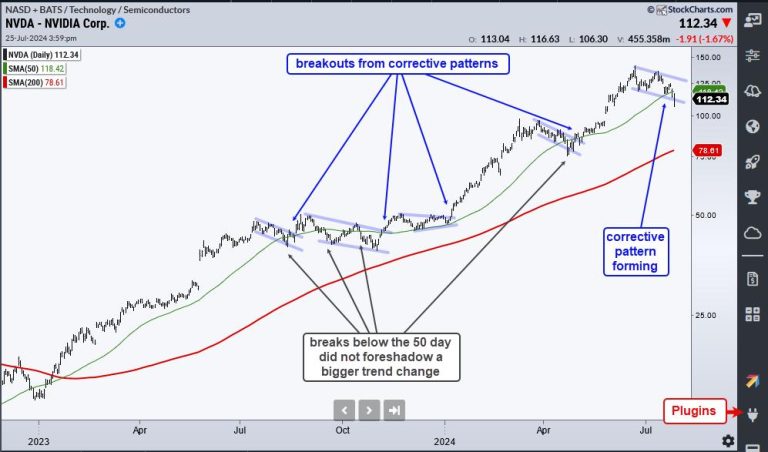
After a big run this year, Nvidia (NVDA) fell over 15% from its high and broke its 50-day simple moving average (SMA). On the face of it, a break below this “key” moving average seems like a short-term bearish signal. Such a view, however, would ignore the long-term trend, which is the dominant force at work.

The first job is to define the long-term trend because this provides perspective and sets the trading bias. Nvidia is clearly in a long-term uptrend because it is well above the rising 200-day SMA, and recorded a new high a month ago. During a long-term uptrend, declines are viewed as corrections that provide opportunities. Therefore, the break below the 50-day SMA is more of an opportunity than a threat. Our reports and videos this week suggest the same for QQQ.

Corrections come in all shapes and sizes. We could get a short pullback, an extended pullback, or a trading range. Nobody really knows. The decline into April broke the 50-day SMA, but this correction was short-lived as the stock broke out in early May. The decline in September-October 2023 was longer because NVDA broke the 50-day SMA twice. These breaks did not lead to a bigger trend reversal.

Looking at the current break, the decline over the last four weeks looks like a normal correction after a big advance. NVDA was up 78% from mid-April to mid-June. A correction that retraces a portion of this advance is perfectly normal. The long-term trend is still up, and I view this correction as an opportunity, not a threat.  

ChartTrader will cover the declines in leading tech and AI stocks on Tuesday, July 30th. We will put these declines into perspective, identify potential reversal zones and mark corrective patterns when possible. This report and video will include Nvidia (NVDA), Broadcom (AVGO), Dell Technologies (DELL), Pure Storage (PSTG) and more. Click here to learn more.

//////////////////////////////////////////////////

Among the multitudinous reasons for the NFL’s widespread popularity is the perpetual sense that new contenders will annually emerge to vie for the Super Bowl throne.

Every year since 1990, when the playoff field expanded from 10 teams to 12 – two more postseason slots were added in 2020 – at least four teams that didn’t reach the Super Bowl tournament in the prior season have qualified annually. In 2023, six made it after failing to do so in 2022. Over the past four years, the average has been nearly seven with a minimum of six new entries each time. The average year-over-year since 1990 is 5.85.

(For whatever it’s worth, six newcomers are projected to emerge in USA TODAY Sports’ recently released 2024 NFL regular-season record projections – including the Jets and Jaguars.)

Asked Wednesday if the Super Bowl is a realistic expectation following his disastrous, four-snap 2023 season, NYJ QB Aaron Rodgers didn’t hesitate.

‘It has to be the goal,’ said the four-time league MVP, who believes New York’s roster is even better than last year’s highly touted one.

NFL STATS CENTRAL: The latest NFL scores, schedules, odds, stats and more.

‘I mean, the beauty is, every single year there’s eight to 12 teams maybe – probably less – but eight to 12 teams that could actually do it. And we are one of those eight to 12.’

A year removed from an AFC South title, they’re not shying from expectations in Duval County, either.

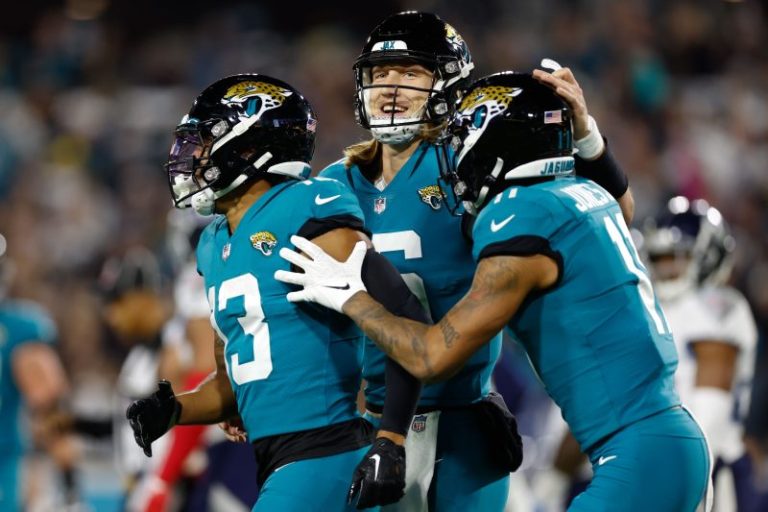
‘We expect to win, and the time’s now,’ Jacksonville QB Trevor Lawrence said Wednesday.

‘We’ve kind of been lingering around a little bit the last couple of years, but this is our opportunity. And we need to take advantage of it.’

Like the J-E-T-S and Jags, everyone has a clean slate in ’24. Here’s a ranking of the 18 teams that fell short of the playoffs last season – from most likely to least – in terms of their capability to crack the field this time:

1. New York Jets

A team that shares the longest playoff drought (13 seasons) in North America’s major pro sports leagues with the NHL’s Buffalo Sabres most definitely has the horsepower to summarily end it. The AFC East is arguably as wide open as it’s been this century, New York possessing as much (or more) talent as any team in the division … or outside of it. Did you know Breece Hall (1,585 yards) trailed only All-Pro Christian McCaffrey in yards from scrimmage by a running back in 2023 despite toiling for an offense without even subpar quarterback play? Despite the same hindrance, did you know only one team has allowed fewer yards than the Jets over the past two seasons? Or that WR Garrett Wilson is one of 18 players to have 1,000-yard receiving seasons each of the past two years despite the chaos he’s dealt with behind center? It’s a long – yet still limited – way of saying that if Rodgers can simply stabilize this offense, the Jets should enjoy an extended flight. If he can produce something close to even an average Rodgers effort, the sky could be no limit.

2. Cincinnati Bengals

Joe Burrow is back … even if his hair isn’t. But his return from wrist surgery is highly suggestive that a team which finished 9-8 in 2023, despite losing its quarterback for nearly half the season, is well positioned to chase its third division crown since 2021. Cincy again has to emerge from what’s probably the league’s toughest divisional pack while adjusting to life without departed OC Brian Callahan. But the weapons remain tip top, and DC Lou Anarumo has a reputation for flustering some of the NFL’s best passers.

3. Indianapolis Colts

With rookie HC Shane Steichen calling the shots – and plays – the offense took a quantum leap forward in 2023, scoring at least 20 points in nine consecutive games at one point … despite the extended absences of QB Anthony Richardson and 2021 All-Pro RB Jonathan Taylor. If the defense follows the lead of its deep and potentially dominant front, no one will want to face it. And with Steichen dialing in with all of his studs, the outlook seems low-key rosy for a team that was 9-8 last season and finished one win shy of the AFC South summit.

4. Atlanta Falcons

Once again, the NFC South appears to project as the league’s weakest, i.e. most winnable, division. And this time, the Falcons seem to have its strongest complement of quarterbacks after years of being deficient at football’s most critical position. Expect Kirk Cousins (and/or rookie Michael Penix Jr.?) to extract increased production from the first-round talent already stocked into the lineup … and simply pushing this group to nine wins might be enough to stick around a bit longer into January.

5. Jacksonville Jaguars

Perceived as the AFC South’s rising power a year ago, they collapsed after an encouraging 8-3 start – undermined by turnovers and injuries – yet, like Indy, still finished just a game back of the first-place Houston Texans in the divisional standings. Owner Shad Khan expects to be back in the playoffs and shelled out, somewhat to his chagrin, more than $350 million in new guaranteed money to nine players … while admitting he wants the franchise to be more into the draft-and-develop business. Regardless, whether or not Khan overpaid for players like WR Gabe Davis, DT Arik Armstead and even the hefty extension for Lawrence, this team has enough firepower to be back atop the division.

6. Chicago Bears

Following a 5-3 finish to last season, when the defense really surged, this has the look of a team that’s built to win immediately – the hotshot rookie quarterback with cost-controlled contract dropped into a roster that’s fairly well resourced with veterans in several key areas. Are expectations for No. 1 pick Caleb Williams a bit outsized? Perhaps. But another two or three wins seem perfectly reasonable given, since 2021, Mac Jones, Brock Purdy and C.J. Stroud all led teams to postseason as rookie signal-callers.

7. New Orleans Saints

Though they haven’t been to postseason since 2020, it’s worth noting they’ve fallen short of qualifying by virtue of tiebreakers in two of the past three seasons. The biggest difference between this year’s team and the 2023 edition – on or off the field – is probably new OC Klint Kubiak, who plans to emphasize play-action and the run game now that former Sean Payton lieutenant and longtime OC Pete Carmichael Jr. has left the building after 15 seasons. That’s going to require far more production from RBs Alvin Kamara, Jamaal Williams and Co. But if it materializes, this division should be in play.

8. Los Angeles Chargers

New HC Jim Harbaugh is arguably the biggest addition any organization made this offseason. He comes with a reputation for quick turnarounds and inherits a team that’s underachieved relative to its talent for … ever? Jumping from 5-12 to wild-card team isn’t out of the question. But it’s highly unlikely the Bolts end the Super Bowl champion Kansas City Chiefs eight-year (currently) reign atop the AFC West, and it will be only marginally easier to reach the playoffs in such a loaded conference.

9. Arizona Cardinals

Last season’s results, namely a 4-13 record, weren’t pretty. But the Cards were highly competitive most weeks and, after a 1-8 start, won three of their final eight games with QB Kyler Murray back in the lineup. With highly acclaimed first-round WR Marvin Harrison Jr. aboard, this offense could erupt – if the blocking holds up – and may need to frequently if the defense continues to lag behind. If things break right, a wild-card berth doesn’t seem outrageously far-fetched.

10. Washington Commanders

Though it happened in Houston last year, it’s rare for a first-year coach and rookie quarterback to drive a team into the playoffs. New HC Dan Quinn is a winner, insomuch as he’s consistently been affiliated with strong NFL teams in Seattle, Atlanta and Dallas for most of the past decade. But he’s going to need OC Kliff Kingsbury to get first-round QB Jayden Daniels up to speed quickly for Washington to survive its challenging early schedule.

11. Seattle Seahawks

The 12s don’t want to hear it – trust me – but this could be a one-step-back season before the ‘Hawks take two steps forward under rookie HC Mike Macdonald down the road. Defensively, they don’t have nearly the caliber of linebackers and safeties Macdonald relied on so heavily in Baltimore. And despite his desire that OC Ryan Grubb – he has no NFL experience – run the ball effectively, this team is currently built to throw … even though Geno Smith probably ranks fourth among the NFC West’s quarterbacks. None of this is to say that optimism and talent are lacking in the Pacific Northwest, but maybe let’s give it some time?

12. Minnesota Vikings

They might have the best non-quarterback in the league – and certainly the highest paid – in Justin Jefferson. But last season was a reminder that even All-Pro receivers are heavily dependent on quarterbacks who can deliver the ball consistently … and a team resetting behind center with journeyman Sam Darnold (59.7% career completion rate) and rookie J.J. McCarthy has plenty to prove offensively, especially so in a what’s shaping up as a brutal NFC North.

13. Tennessee Titans

New coach (Callahan), newish QB1 (Will Levis), new culture and new players – many of them pricey free agents. They’ll have to tune up quickly in Music City in Year 1 post-Vrabel/Henry/Tannehill in order to leapfrog any of the divisional rivals who seem superior – on paper – to the Titans. But be careful before discounting Callahan, who oversaw an offensive renaissance in Cincinnati, or his dad, legendary O-line coach Bill Callahan, who might not need all that many breaks to get the family business up and running in postseason.

14. Las Vegas Raiders

New QB Gardner Minshew II nearly guided the Colts to a division title in 2023. Second-year QB Aidan O’Connell was up and down in 2023, as many rookies tend to be. Whoever emerges as the starter likely won’t be sufficiently supported to lift a team in transition – once again – to its third playoff trip in the past two decades.

15. New York Giants

Their turn on the offseason edition of “Hard Knocks” might be the most compelling chapter about the 2024 G-Men. And as much as this year is clearly about re-evaluating QB Daniel Jones, who’s coming off ACL reconstruction, how fair will the assessment be after stripping him of RB Saquon Barkley? And how many victories are realistic for a team that’s exceeded six in a season twice in the past decade?

16. Carolina Panthers

Over the past three years, new HC Dave Canales has gotten something close to the best out of QBs Russell Wilson and Smith in Seattle and Baker Mayfield in Tampa Bay. His new charge, Bryce Young, could hardly be worse than he was as an overmatched rookie last year in Charlotte. But even if Young is orders of magnitude better in 2024, the most compelling argument for the Panthers as a potential playoff outfit is that they’re members of what still appears to be the league’s least impressive division.

17. Denver Broncos

As expensive as it was financially and otherwise, cutting the cord with Wilson was the move that had to happen so Payton can try to propel this franchise forward on his terms. That now starts at Square One, a rookie quarterback (Bo Nix) likely to be charged with taking quite a few lumps amid extensive on-the-job training in 2024. A third-place finish would seem like a moral victory.

18. New England Patriots

As expensive as it was from a draft perspective, cutting the cord with Mac Jones was the move that had to happen so a new regime (and quarterback) can try to propel this franchise forward on its non-Belichick-ian terms. That now starts at Square One (or Two), a rookie quarterback (Drake Maye) likely to his lumps whenever his 2024 OJT commences. A third-place finish would seem like a moral victory.

***

Follow USA TODAY Sports’ Nate Davis on X, formerly Twitter, @ByNateDavis.

This post appeared first on USA TODAY

The best gymnasts don’t always get the chance to contend for Olympic medals. Why?

“Fairness.”

The top 24 gymnasts after qualifying advance to the all-around final while the top eight on each apparatus make the event final. But there’s a catch. It’s called the “two-per-country” rule, and it will no doubt keep some Americans — and some Chinese and Japanese — on the sidelines to prevent the powerhouse countries from scooping up all the medals.

Except the rule doesn’t really do that, leading to no shortage of outrage every time someone gets “two per countried.”  

“It’s just stupid. I think the two-per-country rule is the dumbest thing ever,” Aly Raisman said in 2016, after Simone Biles, Raisman and Gabby Douglas, the reigning Olympic champion and world silver medalist at the time, went 1-2-3 in qualifying but only Biles and Raisman made the all-around final.

Meet Team USA: See which athletes made the U.S. Olympic team and where they are from

“Who cares if there’s five Chinese girls in the finals? If they’re the best, they should compete.”

Wise words.

So how did this come to be? Back in 1973, the International Olympic Committee was concerned that the top countries were winning everything, to the exclusion of countries with less depth. According to gymnastics-history.com, a site that is exactly what its name implies, four Soviet women made the six-person vault final at the 1972 Olympics while Japan had all but one of the high-bar finalists.

The IOC suggested the International Gymnastics Federation do something about this and the FIG settled on limiting countries to three gymnasts in the all-around final and two gymnasts in each event final. No matter if the gymnasts who got into the final because someone above them was two-per-countried had a realistic shot at a medal or not. It at least would no longer look like the best countries were hogging all the medals.

The changes took effect at the 1976 Olympics, according to gymnastics-history.com. The rules were again changed after the 2000 Games, when Romania had the top three finishers in the women’s all-around.

Andreea Raducan was stripped of her gold medal after testing positive for a banned substance, pseudoephedrine, that was in cold medicine she’d been given by the team doctor, but no matter. Going forward, countries were allowed only two athletes in the all-around final.

At every Olympics since then, the United States has had at least one gymnast finish in the top 24 in all-around qualifying and not make the final because of the two-per-country rule. In 2016, Raisman and Douglas both missed the balance beam final despite having the seventh- and eighth-best scores in qualifying because Simone Biles and Laurie Hernandez had finished ahead of them.

And it’s not just the Americans! Russia had three of the top six in all-around qualifying in Tokyo. China could have had three in the uneven bars final in 2012.

Aside from the participation trophy feel of this, the top countries have found workarounds when they’ve needed. Say their top gymnast had a rough day and wound up behind two of his or her teammates. One of those two would usually find themselves with a sudden “injury” or other reason they were unable to compete.

Tatiana Gutsu was the reigning European champion in 1992, but a fall in qualifying left her behind three other gymnasts on the Unified Team. One was forced to withdraw from the all-around final with a knee injury, and Gutsu went on to win the gold medal over Shannon Miller.

The USA TODAY app gets you to the heart of the news — fast. Download for award-winning coverage, crosswords, audio storytelling, the eNewspaper and more.
This post appeared first on USA TODAY

The opening ceremony of the 2024 Paris Olympic Games will air live on NBC and stream live on Peacock on July 26. Live coverage begins at 12 p.m. ET with primetime starting at 7:30 p.m. ET.

This year’s ceremony will break from tradition as the parade of nations will take place on Paris’ River Seine. This year will be the first time the opening ceremony will be held outside of a stadium in the history of the modern Games. 

NBC Olympics president and executive producer Molly Solomon credited Paris 2024 organizers for throwing out the ‘tradition playbook.’

“When people ask, ‘What are you most excited about?’ It has to be the opening ceremonies because something like this has never been done before,” Solomon told USA TODAY Sports in June. 

Watch the Opening Ceremonies FREE on Fubo

Meet Team USA: See which athletes made the U.S. Olympic team and where they are from

“It’s audacious, it’s bold, it’s daring, and it’s going to be unforgettable,’ Solomon added. 

From a technical, television perspective, the extravaganza will be the most complicated event that has ever been produced. The Olympic Broadcasting Service (OBS) will operate 100 cameras along the parade route and each delegation will have access to a live mobile phone camera on the boat. NBC will be tracking Team USA’s route, and the Americans will be second-to-last down the river because the U.S. will host the 2028 Games in Los Angeles.

NBC will have an additional 40 cameras on the scene. Reporter Maria Taylor will be embedded with Team USA interviewing athletes from the river. “Today” show hosts Savannah Guthrie and Hoda Kotb will be stationed on a bridge over the Seine.

Kelly Clarkson and Peyton Manning will also join Mike Tirico as hosts on the broadcast. 

“France is throwing the world’s biggest party,” Solomon said, ‘and we get to be there.”

Watch the entirety of the 2024 Paris Olympics on Peacock

We occasionally recommend interesting products and services. If you make a purchase by clicking one of the links, we may earn an affiliate fee. USA TODAY Network newsrooms operate independently, and this doesn’t influence our coverage.

The USA TODAY app gets you to the heart of the news — fast. Download for award-winning coverage, crosswords, audio storytelling, the eNewspaper and more.

This post appeared first on USA TODAY

The Canadian Olympic Committee removed women’s national team coach Bev Priestman at the 2024 Paris Olympics on Thursday amid stunning allegations of using drone surveillance to spy on the opposition.

Canada, the reigning gold medalist, beat New Zealand 2-1 on Thursday in its Olympic opener. Priestman, Mander and Lombardi did not coach in the game.

‘The Canadian Olympic Committee has removed the Canadian Women’s National Soccer Team Head Coach Bev Priestman from the Canadian Olympic Team due to her suspension by Canada Soccer,’ the COC statement said. ‘Assistant coach Andy Spence will lead the Women’s National Soccer Team for the remainder of the Paris 2024 Olympic Games.’

Here’s what to know about the drone allegations:

Canada drone surveillance surfaces at the Olympics

According to TSN, Lombardi was caught by French police retrieving a drone that had been flying over the training facility for the New Zealand national team. French police investigated and found additional video of New Zealand’s practices, as well as text messages between Lombardi and Mander indicating that Mander was aware of Lombardi’s actions.

Canada Olympic drone timeline, investigations

It’s unclear when the surveillance started. TSN reported it could trace back prior to a match against the United States on Nov. 15, 2019. The U.S. won the game, 4-1.

The spying has been consistent ever since, according to the report published Thursday, with instances in 2021, ’22 and ’23. That includes the buildup to the 2021 CONCACAF match between the men’s team and Honduras, which stopped practice in Toronto after noticing a drone flying overhead, the report said.

‘I’d imagine there’s probably a lot of people in Canada that fly drones,’ John Herdman, then the coach of Canada’s men’s national team, said at the time.

‘When a big team like Honduras turn up, I’m sure people are probably interested in what they’re doing when they come into our country,’ Herdman continued. ‘So I know for sure we won’t be heading into people’s countries too early because with drones these days, people can obviously capture footage. You’ve got to be really careful.’

Jesse Marsch, current coach for the men’s national team, was not implicated in the reporting.

What Bev Priestman said about Canada drone scandal

It wasn’t immediately clear how much Priestman knew about the scandal.

FIFA and Canada Soccer launched investigations into the spying allegations Wednesday. Canada Soccer intends to make its findings public.

‘I am ultimately responsible for conduct in our program,’ Priestman said Thursday in a statement, announcing the decision to voluntarily withdraw from coaching against New Zealand, prior to the COC decision. ‘In the spirit of accountability, I do this with the interests of both teams in mind and to ensure everyone feels that the sportsmanship of this game is upheld.’

When does Canada play next?

Canada’s next game is scheduled for Sunday, July 28 against France. Canada and France are both 1-0 in Group A play.

This post appeared first on USA TODAY