Archive

2024

Browsing

Equestrian is a sport of two hearts: the rider and the horse. 

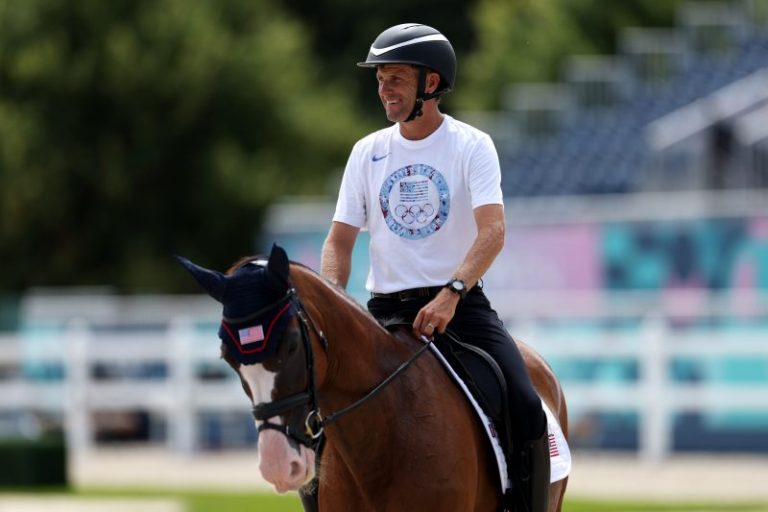
Although Annie Goodwin’s heart stopped beating three years ago, Bruno, her beloved horse, will realize her dream by competing at the 2024 Paris Olympics. 

“It’s a tragic story,” said Boyd Martin, a Team USA eventing rider who will be on top of Bruno at the Games. “Maybe with a little bit of a happy-ish ending.” 

Goodwin died during a training accident while riding Bruno at her farm in South Carolina in 2021. Martin, her friend and former coach, took Bruno into his ownership. Together, they have reached the sport’s biggest stage and made Goodwin’s highest wishes a reality.  

“I hope Boyd does realize that he’s already won, you know what I mean?” said Tara Stoker Bostwick, chief operating officer at the Aiken Horse Park Foundation, where Goodwin trained. “He’s already got Annie’s horse to the Olympics.” 

2024 Olympic medals: Who is leading the medal count? Follow along as we track the medals for every sport.

‘She was such an amazing rider’

The smile is what they remember. Even on the bad days, it was there. Martin recalled Goodwin’s “absolute dedication and obsessiveness” of becoming a better rider. 

“This sport is lots of early mornings and cold days and rainy days, and there’s hours and hours and hours of practice when no one’s cheering and no one’s watching,” Martin told USA TODAY Sports. “And I’d say the thing that I admired most about her is how resilient she was and how much she loved her horses.” 

Goodwin died on July 14, 2021 following a schooling accident while trying to jump over a training-level obstacle. She succumbed to her injuries shortly after the accident at Aiken Regional Medical Centers. Bruno was not injured. 

Martin, a four-time Olymipan, was about to depart for the Tokyo Games when he heard the news. He carried the combination of shock and devastation through that competition. 

“The horse is such a good jumper and she was such an amazing rider,” Martin said. “You think accidents happen with untalented horses and riders that don’t know what they’re doing. I just didn’t ever think that this could happen.”

A Wyoming native, Goodwin stayed true to her roots after moving to South Carolina. She grew up on a family-owned dude ranch called Rafter Y Ranch & Outfitters.  Her business’ name was an homage to that: Rafter Y South. 

She catered primarily to clients in the competitive eventing industry. Goodwin gave lessons and boarded her students’ horses at her farm. She had a small staff and did most of the work herself. A covered arena on the farm allowed people to ride in rain or extreme heat. 

“She was a hard worker and just a wonderful person that always had a smile on her face,” Martin said. “And the sport’s such a hard sport to make a business out of. 

“She was just at the point in her career where it was about to really crack on for her.” 

Outside of work, Goodwin played polo and show jumped along with her eventing, which combines jumping, cross-country and dressage into one competition. 

“She was, if there ever was, a Renaissance woman,” said Bostwick, who helps run the Annie Goodwin Rising Star Fund & Grant, which financially supports aspiring equestrian athletes.

Clients supported Goodwin when she competed in major events; she was doing her final training session before a four-star (five is the top level) event in Montana when the accident happened. 

He’s turned into one of the best horses in the world

Goodwin had purchased Bruno from Europe as a three-year-old and was passionate about developing him into a champion-level horse. Goodwin’s father, Putter, was responsible for distributing his daughter’s horses upon her death. He asked if Martin would take on Bruno, and Martin and his wife Sylvia, also a rider, welcomed him into their syndicate. 

Bruno is an eye-catching horse, Martin said. He has a big, white face and white legs. 

“He’s a lovely laid back character, but he’s hard to catch,” Martin said. “And so you’ve got to ride him first thing in the morning before you put him out in the paddock because sometimes it takes six or seven hours to catch him to bring him in at night.” 

The beginning of the partnership between Martin and Bruno did not begin on the right hoof. Bruno didn’t understand the way Martin rode. The horse was suspicious. Bonds between riders and horses take a long time to form. 

“I think my ego got to me as well, as I tried to basically start at the level that Annie was at,” Martin said, “and I had a quick realization that I had to go back a couple steps.” 

For the first six months, they were all over the place. Bruno would refuse jumps. They were disqualified multiple times. 

“It was a real mess,” said Martin, who was born in Australia – and has the accent to prove it – but has American citizenship. 

Eventually, something clicked. The understanding between human and horse took off. 

“The last 18 months, he’s turned into one of the best horses in the world,” Martin said. 

Riders and their horses qualify separately, and the U.S. Equestrian Federation named Martin with the 14-year-old Dutch Warmblood. Commando 3, an 11-year-old, is the rider’s direct reserve.

Jumping is part of Bruno’s DNA, Martin likes to say. 

“He just pounces off the ground and flies over the fences higher than any of the other horses that I’ve ever sat on – and that’s not me doing something special,” Martin said. “That’s something he was born with. And every jump’s the same where he comes to the jump and he’s almost got springs on his feet. He just has got amazing power and push off the ground.” 

#RideForAnnie is the sentiment at Paris Olympics

In May 2022, Bruno and Martin rode to their first victory at a four-star event in North Carolina. They were victorious at the Aiken Horse Park Foundation four-star event, home turf for Bruno and Goodwin, a year later.

Martin sits on the application committee for the grant in Goodwin’s name. But he had mixed feelings while experiencing that initial success aboard Bruno. 

“I almost felt a bit guilty like Annie had put in all the hard work and the training and, I’m sure with Annie’s parents watching me, they would’ve – I’m sure deep down – they were thinking that really should be their daughter in the saddle,” Martin said. 

He continued: “This horse is amazing in our small sport, our small bubble. I think everyone’s sort of cheering for this horse rather than me just because of his story and he’s almost like a living monument for Annie’s hard work and dedication and love for the sport.”  

Putter Goodwin (whose father, Wally Goodwin, coached some guy named Tiger Woods on the Stanford men’s golf team in the 1990s) will be in Paris to watch Bruno and Martin. 

Martin and members of Aiken will often tag their social media posts with #RideForAnnie, especially the photos that feature Bruno. 

Bostwick wants Martin to know that everyone who loved Annie Goodwin already holds him in the highest esteem. 

“I think he’s carrying a lot on his back and he knows it,” Bostwick said. “And so my hat’s off to Boyd for not only seeking his personal destiny in terms of an Olympic medal, but knowing what this means to everyone back home. So we’re fortunate that with Annie being gone, we do have something to continue to hold onto. Between the Rising Star Grant and Bruno, we have these memories to cherish.” 

Two hearts. Both beating for the person who brought them together.
This post appeared first on USA TODAY

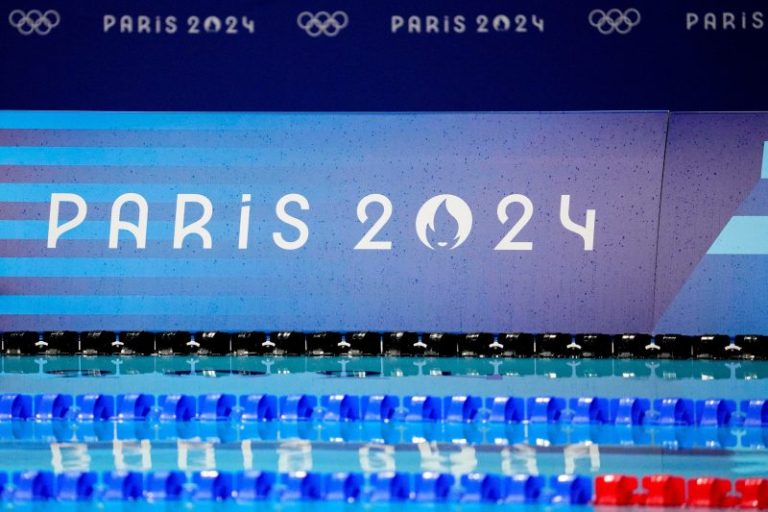
Swimming will be a major part of the 2024 Olympic schedule in its opening week with the events taking place at Paris La Défense Arena.

Europe’s largest indoor arena, it opened in 2017 as the home of rugby union club Racing 92. Its movable seating configurations also allow it to be used for concerts, basketball and, for the Paris Games, aquatic sports such as swimming, water polo and artistic swimming.

The two temporary Olympic pools inside the arena were constructed by the same Italian company (Piscine Castiglione) that built pools for the Summer Games in Atlanta, Beijing, London, Rio and Tokyo.

How big is an Olympic swimming pool?

World Aquatics regulations require an Olympic-sized swimming pool to be 50 meters, or approximately 164 feet, long. This measurement is taken from end to end of the pool, including the touch pads used for timing. It must have a minimum depth of two meters.

2024 Olympic medals: Who is leading the medal count? Follow along as we track the medals for every sport.

The eight lanes used in Olympic competition have to be at least 2.5 meters wide.

How deep is the Olympic swimming pool in Paris?

The pool at Paris La Défense Arena is 2.15 meters deep, slightly less than the depth of the pool at the 2020 Tokyo Games. Swimmers tend to prefer a deeper pool because it generally results in calmer waters and faster times.

How many gallons are in an Olympic swimming pool?

There’s no exact requirement, but Olympic swimming pools generally have 660,000 gallons of water. Residential pools, for comparison, typically only contain 15,000 to 48,000 gallons.

How many laps is 1,500 meters?

In a standard 50-meter pool such as the one at the Paris Olympics, a 1500-meter race will take 30 laps.

How many feet is 1,500 meters?

A 1500-meter race is equivalent to just over 4921 feet – or 0.932 miles.

This post appeared first on USA TODAY

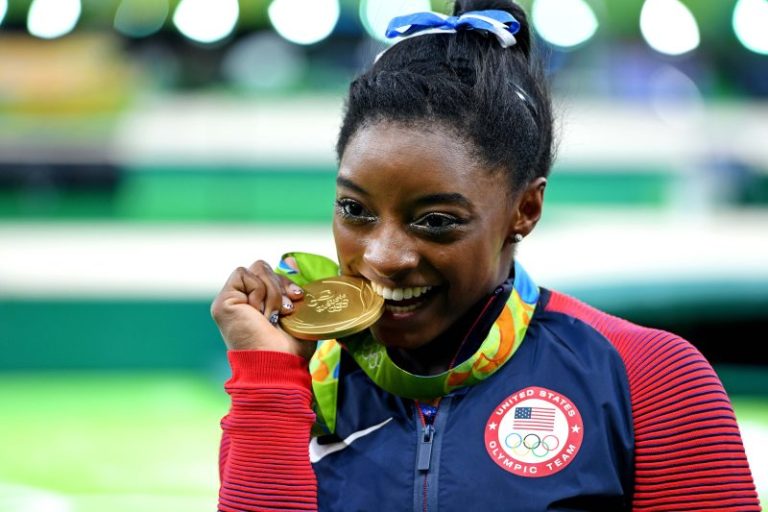
We’ve all seen iconic photos of athletes biting into their Olympic gold medals, an age-old tradition at medal ceremonies. Think of Simone Biles, Michael Phelps and Usain Bolt. Although Olympic gold medals are not made out of actual gold – pure gold medals haven’t been awarded since 1912 – there’s no higher prize in sports.

Team USA dominated the medal count at the Tokyo Olympics in 2021 with 113 total, but the Americans narrowly came out on top of the gold medal count with 39, only one more gold medal than China (38). Team USA has led the gold medal count at five of the past six Summer games, including Rio 2016 (46), London 2012 (48), Athens 2004 (36) and Sydney 2000 (37).

As the 2024 Summer Games get underway in Paris, USA TODAY Sports will keep track of just how many gold medals each nation has earned throughout the competition.

Get Olympics updates in your texts! Join USA TODAY Sports’ WhatsApp Channel

2024 Olympic medals: Who is leading the medal count? Follow along as we track the medals for every sport.

The USA TODAY app gets you to the heart of the news — fast. Download for award-winning coverage, crosswords, audio storytelling, the eNewspaper and more.

Total gold medals by country at Paris Olympics

Totals will be updated as medals are awarded.

China — 2

This post appeared first on USA TODAY

PARIS — Allegations of match-fixing left top U.S. fencers pitted against each other in arbitration less than six weeks before the Paris Olympics were set to begin, according to documents obtained by USA TODAY Sports.

Maia Chamberlain, an alternate on the U.S. Olympic team, argued that teammate Tatiana Nazlymov benefited from bout manipulation and referee misconduct in qualifying for the squad, according to the documents.

Nora Burke, an elite American fencer not on the Olympic team, joined Chamberlain as a claimant in the case.

An arbitrator rejected their claim, which would have propelled Chamberlain to starter from alternate, jeopardized Nazlymov’s spot on the team and opened the door for Burke to join as an alternate. A hearing was held via Zoom on June 22 and the decision was issued the next day, according to the documents.

In a similar arbitration case, elite American fencer Andrew Doddo faced off against U.S. Olympian Mitchell Saron, according to documents obtained by USA TODAY.

2024 Olympic medals: Who is leading the medal count? Follow along as we track the medals for every sport.

The arbitrator rejected Doddo’s claim, which would have resulted in Doddo making the Olympic team and jeopardizing Saron’s spot. A hearing was held June 21 and the decision was issued three days later, according to the documents.

Chamberlain and Nazlymov are among the four American women who compete in saber, potentially leaving them in close quarters as the team has prepared for the Olympics − and as USA Fencing conducts an ongoing investigation into bout manipulation. Fans and fencers raised concerns on the Internet about potential match mixing for several months leading up to the naming of the team. Some in the sport warned of a ‘cloud of suspicion’ hanging over the Olympics due to the match fixing concerns.

2024 Olympic medals: Who is leading the medal count? Follow along as we track the medals for every sport.

“Our commitment to transparency and integrity in our sport remains steadfast,” Phil Andrews, CEO of USA Fencing, said in a statement. ‘That’s why we launched this independent investigation, and we’re grateful for the cooperation of our community throughout.

‘The investigation has to date not found statistically significant proof implicating any USA athlete or referee in deliberate manipulation during the Olympic qualifying period, and we are told to expect a full and final report from the investigators in late August or September. In the meantime, our focus remains on supporting our athletes as they prepare for the Olympic Games Paris 2024.”

Why the arbitration cases were heard

The athletes – Chamberlain, Burke and Doddo – filed what are known as Section 9 complaints. They are available through the United States Olympic and Paralympic Committee (USOPC) to athletes alleging they have been denied the right to participate.

Some cases, such as these, end up in arbitration.

USA Fencing, the sport’s national governing body, was listed as the respondent. The arbitrators in each case upheld USA Fencing’s decision to award Nazlymov and Saron a spot on the Olympic team.

Decisions from the arbitrators helped set the lineups for Saturday, when the U.S. fencers will begin competition – but it’s unlikely to quiet concerns about match-fixing.

In May, 55 retired fencers, coaches and officials from the American saber fencing community signed an open letter to the Board of US Fencing. It addressed the ‘urgent issue of saber fencing bout manipulations at US and international levels which have impacted US Olympic selection egregiously and demoralized our saber fencers.’’

Two of the retired fencers who signed the letter are Monica Aksamit, who won a bronze medal in the team competition at the 2016 Olympics, and Andrew Mackiewicz, who competed in the 2021 Tokyo Olympics.

What do the fencers say?

USA Fencing held a press conference Wednesday with eight of its 20 team members. Nazlymov and Saron, the Olympians named in the arbitration cases, did not attend.

Chamberlain, who named Nazlymov in her arbitration case, did attend. She watched two veteran fencers decline to comment about investigations into alleged cheating before she addressed the issue.

“Right now there’s currently an investigation that’s going on,” Chamberlain replied. ‘But as of now we’re focused on just competing in the Games and trying our best and having a fantastic…Olympic Games.’’

After the press conference, Chamberlain told USA TODAY Sports the fencers are restricted in what they can say publicly about the matter.

On Thursday, Nazlymov and Saron declined a request for comment from USA TODAY Sports made through Bryan Wendell, Director of Communication for USA Fencing. By email, Wendell said, “they both are passing — too close to their competition dates and they’re fully locked in.’’

Doddo, a member of the U.S. team that won gold at the 2023 Pan Am Games, did not respond to a request for comment.

What else do the documents show?

On Dec. 18, 2023, according to documents obtained by USA TODAY Sports, USA Fencing sent Nazlymov a letter stating it was “in possession of data that show, more likely than not, preferential calls being made by two particular referees in international competition.’’

The letter also states data showed a statistically “improbable volume’’ of allocations of the same referees in Nazlymov’s bouts.

USA Fencing, according to the letter, had brought those issues to the attention of FIE, the international governing body of fencing.

But the letter also states, “We have no reason at this time to believe that you are personally responsible, or even aware of these actions being taken by others to favor your intentional performance.’’

An arbitrator last month supported the notion that Nazlymov was not involved in bout manipulation, saying there was no evidence offered to show that was the case. ‘Multiple witnesses admitted that certain referee calls could have gone either way, that contests could not be re-scored after the contests, and reasonable and welltrained referees often differ on calls especially those made in real time without the assistance of video replay,’ the arbitrator wrote, according to the documents.

Six months later, USA Fencing says, it’s in the same place – with no evidence its athletes were aware of bout manipulation, no evidence of match-fixing and, at the same time, no indication everyone is satisfied with the situation.

In April, American fencers warned a ‘cloud of suspicion’ might overshadow performances at the Olympics unless USA Fencing and the International Fencing Federation enacted tough sanctions against match fixing, according to a copy of a letter obtained by USA TODAY Sports.

The letter was released on behalf of eight members of the USA Fencing team through Global Athlete, an international athletes advocacy group, to avoid retribution, according to Global Athlete director general Rob Koehler.

“As athletes into the Paris Olympic Games, USA Fencing and the International Fencing Federation have a responsibility to clean up the sports and enact tough sanctions on match manipulation,’’ the letter read, “to not only avoid a cloud of suspicion overshadowing the performances in Paris but to ensure that all fencers in Paris have fairly earnt their position.”

This post appeared first on USA TODAY

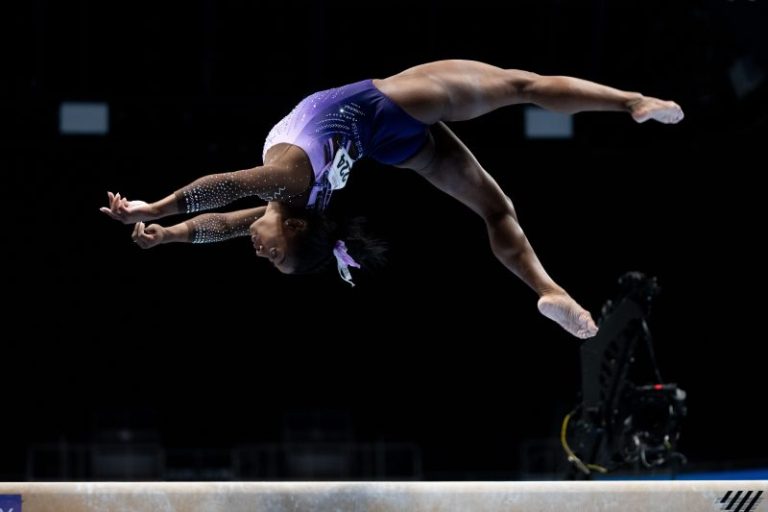
A balance beam Olympic gold medal has evaded Simone Biles. Will she finally capture it at the 2024 Paris Olympics?

Biles withdrew from several events at the Tokyo Olympics in 2021 after developing ‘the twisties,’ a sensation where a gymnast loses awareness in the air while performing twisting elements. But Biles returned to compete in the balance beam final at the Tokyo Games, with a scaled-back dismount, and earned an Olympic bronze medal, her second in balance beam after finishing with a bronze at the 2016 Rio de Janeiro Games.

‘I’m pretty happy. I didn’t expect to medal,’ Biles said in 2021 in Tokyo. ‘I was just trying to go out there and hit a good beam set and compete one more time at these Olympic Games.’

Biles returned to international competition last October at the 2023 World Championships in Antwerp, Belgium, and earned a gold medal in balance beam, her fourth World gold medal in that discipline. China’s Zhou Yaqin finished with silver and Brazil’s Rebeca Andrade earned bronze.

Get Olympics updates in your texts! Join USA TODAY Sports’ WhatsApp Channel

2024 Olympic medals: Who is leading the medal count? Follow along as we track the medals for every sport.

Here’s everything you need to know about the women’s balance beam final:

When is gymnastics balance beam final?

The women’s balance beam final is Monday, Aug. 5, at 6:36 a.m. ET at the Bercy Arena in Paris. 

How to watch gymnastics balance beam final

The women’s balance beam final will be broadcast live on NBC, USA Network and E! Network. It can also be streamed on Peacock, NBCOlympics.com, NBC.com and the NBC Sports app.

Who is the reigning women’s Olympic balance beam champion?

China’s Guan Chenchen is the reigning Olympic balance beam champion after winning gold at the Tokyo Games in 2021. Simone Biles finished with an Olympic bronze medal. Here’s how the rest of the podium rounded out:

Gold: China’s Guan Chenchen – 14.633

Silver: China’s Tang Xijing – 14.233

Bronze: USA’s Simone Biles – 14.000

This post appeared first on USA TODAY

PARIS — The opening ceremony of the Summer Olympics can often come across as a little stuffy, or purposefully sophisticated — with every movement and camera angle perfectly choreographed.

Maybe that’s what the opening ceremony of the 2024 Paris Games looked like on TV, too. But what it felt like, in reality, was a wild international music festival — or maybe even a disco rave in the rain.

Along the southern bank of the Seine River, near the start of the parade of nations, and at the Trocadéro, which served as its end, USA TODAY Sports reporters saw a jovial cacophony of fans and athletes from around the world. They waved flags. They cheered and chanted. They danced to the pop, metal and electronic music that blared through speakers dotted along the 3.7 miles of river. 

Some of that, of course, was visible in NBC’s television broadcast of the opening ceremony. But a lot of things were not.

The party atmosphere started hours before the ceremony itself did, as spectators passed through security checkpoints and sprinted into cordoned-off portions of land along the Seine, attempting to find the perfect view of both the river itself and the jumbotrons that had been erected on the opposite bank. 

2024 Olympic medals: Who is leading the medal count? Follow along as we track the medals for every sport.

A lucky few spectators had reserved seats. The vast majority did not. Some found standing room where they could; others later climbed on top of barriers or, in at least one case, up into the branches of a tree.

About 30 minutes before the start of the ceremony, jets of water started spraying under the archway of the Pont d’Austerlitz — the first clue at the start of the river course of what was to come. People lined up on rooftops and balconies along the river. Helicopters hovered overhead, high enough to not be heard by those below. Police boats waited on the outskirts of the Seine, where they would be close but out of sight of TV cameras.

When the parade of nations began, spectators on the easternmost part of the river saw each country’s delegation long before it was announced over the loudspeakers or seen on TV. Those fans also got to see little hidden moments, like a Team USA athlete appearing to drop their rain poncho overboard. 

While international broadcasts made the parade appear as if it took place in different stages, the actual spectacle ran continuously with few, if any, significant gaps. Call it a little bit of TV magic.

Ditto for some of the more striking visual elements of the opening ceremony — like the mystery torch-bearer galloping down the Seine on a metallic horse. On TV, some of those moments appeared to be relatively brief, allowing for interviews or commercial breaks. In person, these were lengthy shots spanning perhaps 15 or 20 minutes.

One extended dance sequence, titled ‘A Celebration of Diversity,’ had been scheduled to last nine minutes, and it might’ve run longer. But only glimpses of it were shown on NBC.

By that point in the night, the boats of athletes had long since landed at the Trocadéro, and the light rain escalated to a downpour. 

Draped in ponchos and hidden under umbrellas, Olympians with their respective delegations crowded around the Eiffel Tower-shaped stage. But it seemed some didn’t stick around — though it was unclear if they simply left that area or the ceremony altogether, possibly fearing pneumonia or another pre-Olympics illness. 

As for Team USA in its Ralph Lauren apparel, it certainly didn’t seem like every athlete on the boat made it to the stage, which was understandable given the inclement weather.

For spectators, rather than leave, large swaths huddled under umbrellas to watch the rest of the ceremony on a jumbotron. Many just gave up on any hope of staying dry — athletes included — jumping up and down and dancing to songs like ‘D.I.S.C.O.’ by French pop duo Ottawan. 

The athletes who stayed largely kept the party going. Though some looked frigid, soggy and a little miserable, many others danced to the ceremony’s soundtrack and took selfies against the nearby backdrop of the glowing Eiffel Tower. Perhaps no one noticed when the Olympic flag was raised upside down.

The French delegation in particular turned the volume up when football legend Zinedine Zidane appeared on stage to pass the Olympic flame to Rafael Nadal, the Roland Garros king, who headed back toward a boat on the Seine to continue the torch relay, which ended at the Jardin des Tuileries.

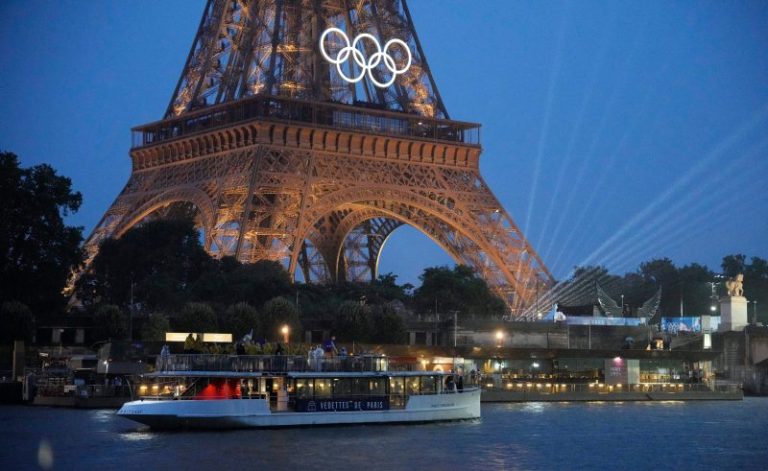
As the torch — guarded by Nadal, Serena Williams, Carl Lewis, and Nadia Comaneci — advanced on the Seine, those near the Trocadéro were treated to a stunning light show out of the Eiffel Tower. It was a scene out of Hollywood. Bright red and green and turquoise lights soared through the sky like an EDM rave, illuminating the iconic landmark in a quintessential ‘City of Lights’ way. 

It was all leading up to the grand finale of the approximately four-hour show. 

After a procession of French athletes carried the torch to the Olympic cauldron, all eyes turned back to the Eiffel Tower, where a distant and tiny Céline Dion made her triumphant return to the microphone. 

Performing for the first time since 2020 — she revealed in 2022 that she received a rare diagnosis of stiff person syndrome — the French-Canadian singer stood elevated in the tower below the glowing Olympic rings and stunned as if she never left the stage. The Trocadéro crowd erupted when she began, and some sang along to her magical rendition of “Hymne à l’amour.” 

Dion’s performance was the rumored moment fans were waiting for, and she delivered, capping off a uniquely French opening ceremony, complete with an ode to French literature with the ‘Les Misérables’ anthem “Do You Hear the People Sing?” and a decapitated-but-performing Marie Antoinette. Even with the rain, it ended up being a pretty wild and entertaining party.

This post appeared first on USA TODAY

Team USA basketball has dominated the competition at the Olympics.

Basketball was first introduced at the Olympics at the 1904 Games in St. Louis, solely as a demonstration. More than three decades later, men’s basketball made its official Olympic debut at the 1936 Berlin Games. Women’s basketball made its debut at the Games 40 years later, at the 1976 Montreal Olympics.

Just how dominant are the Americans? The U.S. men’s national team was undefeated at the Olympics from 1936 to 1968, while the American women have not lost an Olympic game since 1992.

The U.S. men have the most gold medals out of any country, winning the tournament in 16 of the 20 Olympic Games featuring men’s basketball. The Soviet Union (2), Yugoslavia (1) and Argentina (1) are the only other countries to top the Olympic podium in men’s basketball.

The U.S. women also have the most gold medals, winning the tournament in nine of 12 Olympic Games. The Soviet Union (2) and the Unified Team (1) — which was a delegation made up of athletes from the former Soviet states that competed at the 1992 Barcelona Games — are the only other squads to win gold in women’s basketball.

2024 Olympic medals: Who is leading the medal count? Follow along as we track the medals for every sport.

Team USA’s Diana Taurasi can break her tie with Sue Bird for the most Olympic gold medals in basketball if the American women win the tournament in Paris.  

Olympic men’s basketball gold medal winners

Here’s every Olympic gold medalist since men’s basketball debuted as a medal event at the Games in 1936:

2020, Tokyo: U.S. (87–82 win over France in final); Australia bronze
2016, Rio: U.S. (96–66 win over Serbia); Spain bronze
2012, London: U.S. (107–100 win over Spain); Russia bronze
2008, Beijing: U.S. (118–107 win over Spain); Argentina bronze

‘Redeem Team’: After the U.S. men had a disappointing bronze medal finish in 2004, captain Kobe Bryant led the U.S. men back to international prominence. The roster featured four Hall of Famers – Bryant, Jason Kidd, Dwyane Wade and Chris Bosh – in addition to several future Hall of Famers like LeBron James, Chris Paul and Carmelo Anthony.

2004, Athens: Argentina (84–69 win over Italy); U.S. bronze
2000, Sydney: U.S. (85–75 win over France); Lithuania bronze
1996, Atlanta: U.S. (95–69 win over Yugoslavia); Lithuania bronze
1992, Barcelona: U.S. (117–85 win over Croatia); Lithuania bronze

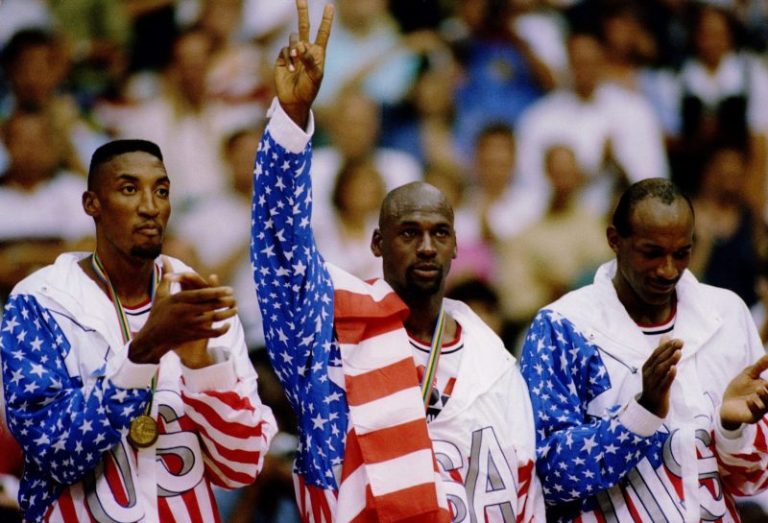
‘Dream Team’: The 1992 U.S. men’s Olympic team was the first to feature NBA players. The Dream Team, often hailed as the greatest team ever assembled, dominated the competition and defeated every opponent by an average of 44 points en route to gold. All but one player on the roster (soon-to-be rookie Christian Laettner) was inducted into the Naismith Memorial Basketball Hall of Fame. The rest of the lineup: Charles Barkley, Larry Bird, Clyde Drexler, Patrick Ewing, Magic Johnson, Michael Jordan, Karl Malone, Chris Mullin, Scottie Pippen, David Robinson, John Stockton.

1988, Seoul: Soviet Union (76–63 win over Yugoslavia); U.S. bronze
1984, Los Angeles: U.S. (96–65 win over Spain); Yugoslavia bronze
1980, Moscow: Yugoslavia (86–77 win over Italy); Soviet Union bronze

The United States, in addition to 64 other countries, boycotted the 1980 Moscow Olympics following the Soviet Union’s invasion of Afghanistan in 1979.

1976, Montreal: U.S. (95–74 win over Yugoslavia); Soviet Union bronze
1972, Munich: Soviet Union (51-50 win over U.S.); Cuba bronze

The U.S. men’s basketball team experienced its first Olympic defeat in the controversial gold medal game that was marred by questionable calls and allegations of cheating. The last three seconds of the game was replayed three times, ending with the Soviet Union winning by one point. The U.S filed a formal protest, but the Soviet Union was awarded gold. The 1972 U.S. men’s basketball team didn’t accept the silver medal and still haven’t claimed it.

1968, Mexico City: U.S. (95–69 win over Yugoslavia); Soviet Union bronze
1964, Tokyo: U.S. (73–59 win over Soviet Union); Brazil bronze
1960, Rome: U.S. (Winner determined by pool play); Soviet Union silver; Brazil bronze
1956, Melbourne: U.S. (89–55 win over Soviet Union); Uruguay bronze
1952, Helsinki: U.S. (36–25 win over Soviet Union); Uruguay bronze
1948, London: U.S. (65–21 win over France); Brazil bronze
1936, Berlin: U.S. (19–8 win over Canada); Mexico bronze

Olympic women’s basketball gold medal winners

Here’s every Olympic gold medalist since women’s basketball debuted as a medal event at the Games in 1976:

2020, Tokyo: U.S. (90-75 win over Japan in final); France bronze

American basketball stars Sue Bird and Diana Taurasi won their fifth straight Olympic gold medal in Tokyo to become the all-time leaders for Olympic gold medals in basketball.

2016, Rio: U.S. (101–72 win over Spain); Serbia bronze
2012, London: U.S. (86–50 win over France); Australia bronze
2008, Beijing: U.S. (92–65 win over Australia); Russia bronze
2004, Athens: U.S. (74–63 win over Australia); Russia bronze
2000, Sydney: U.S. (76–54 win over Australia); Brazil bronze
1996, Atlanta: U.S. (111–87 win over Brazil); Australia bronze
1992, Barcelona: Unified Team (76–66 win over China); U.S. bronze

The United States suffered just its third loss in Olympic history during a semifinal match against the Unified Team, a delegation that represented the Commonwealth of Independent States (CIS). The 1992 Olympic semifinal loss is the U.S. women’s last loss in the Games.

1988, Seoul: U.S. (77–70 win over Yugoslavia); Soviet Union bronze
1984, Los Angeles: U.S. (85–55 win over South Korea); China bronze
1980, Moscow: Soviet Union (104–73 win over Bulgaria); Yugoslavia bronze

The United States, in addition to 64 other countries, boycotted the 1980 Moscow Olympics following the Soviet Union’s invasion of Afghanistan in 1979.

1976, Montreal: Soviet Union (winner determined by pool play); U.S. silver; Bulgaria bronze

This post appeared first on USA TODAY

For the past few seasons, the Baltimore Orioles organization has boasted some of the game’s top prospects; homegrown standouts including Adley Rutschman and Gunnar Henderson who are currently excelling on the major league level, and Jackson Holliday and Samuel Basallo who are knocking on the door in the minors.

The O’s are loaded, earning the club widespread praise for its deft draft selections and exceptional player development.

That’s something the Boston Red Sox are hoping to replicate – with a trio of elite prospects likely heading to Beantown in the not-too-distant future.

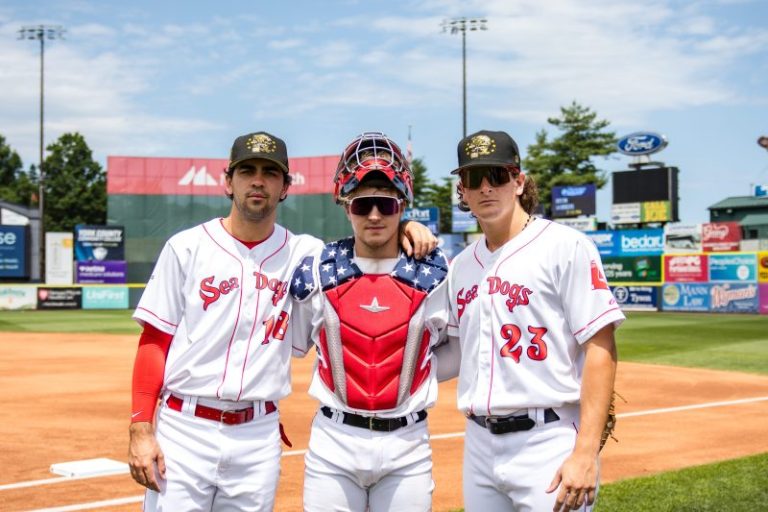
Shortstop Marcelo Mayer, outfielder Roman Anthony and catcher Kyle Teel – all ranked in baseball’s top 25 prospects by MLB.com – are all currently raking for Double-A Portland and could soon be knocking on Fenway’s door.

The group doesn’t have a catchy nickname – yet.

Follow every MLB game: Latest MLB scores, stats, schedules and standings.

“We can maybe put something out on social media,” said team broadcaster Emma Tiedemann. “People are pretty creative. We can see what they come up.”

They do possess a variety of skills, a boatload of potential and according to manager Chad Epperson they “all have passion to play.”

Mayer, widely regarded as the top ranked shortstop prospect in baseball, is 21 years old and has hit for a high average this season and his stellar defense has been a source of excitement for those within the organization.

“He makes some incredible plays at shortstop that you think – well that’s definitely not Double-A, that is way higher than the level he is currently at,” said Tiedemann.

“He’s butter at shortstop,” added Teel. “He’s just an all-around great ball player.”

Anthony is in only his third professional season and Tiedemann says the outfielder’s game already is “major league-esque.” Mayer also marvels at his teammate.

“Talk about someone who is polished – the kid just turned 20-years-old, and it looks like he is 25 – the way he plays, the way he carries himself on and off the field,” Mayer said of Anthony..

Teel is equally impressed with Anthony, especially his ability to drive the ball.

“He’s a Florida guy that hits tanks,” said the Sea Dogs backstop.

Teel, who was Boston’s 2023 first round pick after starring at Virginia, is perhaps the most unique of the group.

His offensive numbers have been elite, and the staff loves throwing to him.

“You talk to our starting pitchers, and they love having Kyle behind the plate because he always knows what to say,” said Tiedemann. “Whenever the pitcher is having a rough outing, he is a calm presence to them.”

The 22-year-old is a native of Mahwah, N.J. and the son of Garrett Teel, a former minor league catcher and third baseman who currently runs a baseball training center near his hometown. The catcher has hit north of .300 for a significant portion of the season.

“It’s super rare,” Mayer said of Teel’s offensive output. “For him to be as good as he is behind the dish and to hit the way he does, it’s super rare and obviously it’s not taken for granted in this organization.”

Epperson, in his third year as Portland’s skipper, credits Teel’s intense desire to improve every day.

“You see the guy put in the work non-stop – there’s no question it’s translating onto the field,” said Epperson.

There has been talk of soon elevating one, two, or all three of the trio to Triple-A Worcester.

And while, the group is close, which according to Tiedemann has allowed each to “always have two people they can lean on,” Epperson isn’t concerned about breaking up the group as they continue to rise through the system.

“I don’t think that the plan, by any means, is to call them up to Triple-A as a package deal and to the big leagues as a package deal,” said Epperson.

Still, there is a strong chance Mayer, Anthony, and Teel will at some point team up again – in Boston. And that’s something that Epperson said should get Sox fans pumped.

“They are athletes – they are guys that genuinely love to play the game, respect the game, and play the game the right way,’ Epperson said.

If all goes to plan, Boston will soon be fielding quite a young and exciting team – with a core comprised of homegrown talent.

It’s a recipe that has paid dividends for the division rival Orioles, an organization which may soon face stiff competition AL East from the Red Sox’s ascendant group of prospects.

“What you are going to see is a finished product when they get there,” said Epperson.

This post appeared first on USA TODAY

With the Russians not welcome at the 2024 Paris Olympics, that could mean even more medals for the U.S. gymnastics team.

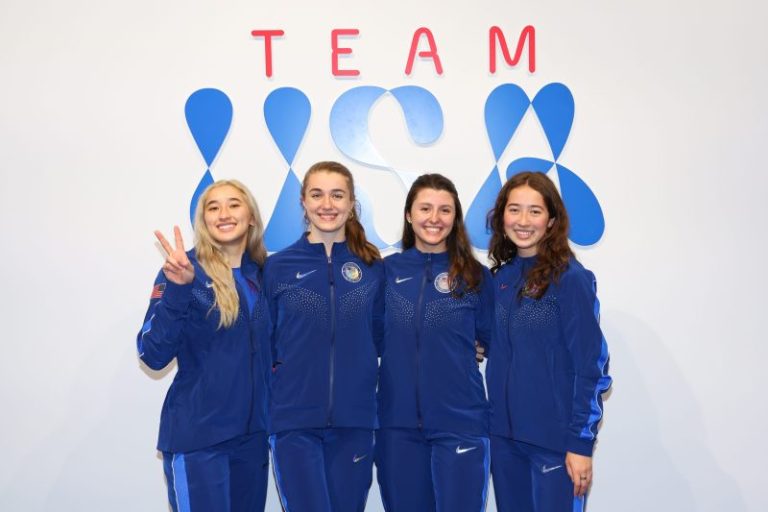
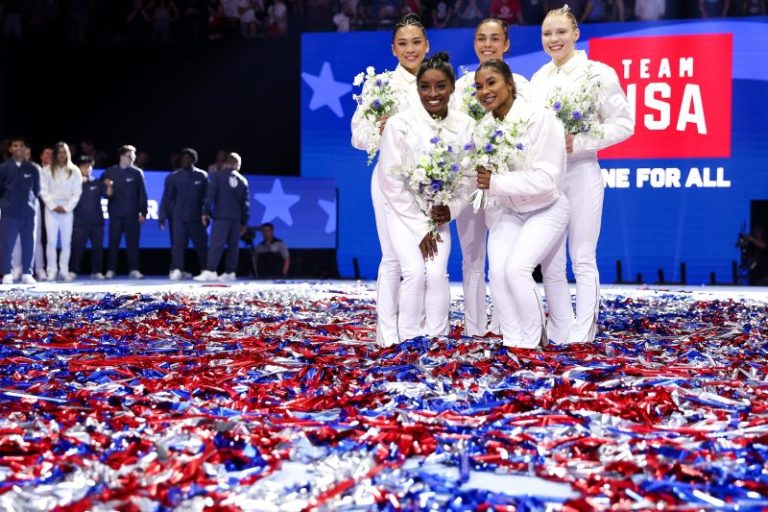
Simone Biles is back and better than ever, and she’s likely to add a few more gold medals to her collection before she leaves the Paris Olympics. The U.S. women’s gymnastics team is stacked with four returning Olympians, each of whom feels she has something to prove.

The U.S. men’s gymnastics team, meanwhile, has a good chance to end a 16-year Olympics medal drought. It won its first team medal at the world championships in nine years last fall and, with Brody Malone back, the guys see no reason they can’t snap another streak in Paris.

Here’s a look at the competition schedule for gymnastics at the Paris Olympics. NBC and Peacock will carry the action live and will re-air it in primetime in the U.S.

Get Olympics updates in your texts! Join USA TODAY Sports’ WhatsApp Channel

2024 Olympic medals: Who is leading the medal count? Follow along as we track the medals for every sport.

When is gymnastics qualifying at Olympics?

Men’s qualifying is on Saturday, July 27, and the women follow a day later on Sunday, July 28. The top eight teams advance to the team finals.

The U.S. men drew the first subdivision, which means they’ll begin competition at 5 a.m. ET (11 a.m. Paris time). Britain, Canada and Germany are the other teams in the session. The U.S. men will begin on pommel horse, traditionally their weakest event.

The U.S. women are in the second division, so they’ll begin competition at 5:40 a.m. ET (11:40 a.m. Paris time). China and Italy are also in the group. The Americans begin on balance beam.

The USA TODAY app gets you to the heart of the news — fast. Download for award-winning coverage, crosswords, audio storytelling, the eNewspaper and more.

When are gymnastics team finals at Olympics?

The men’s team final is Monday, July 29, at 11:30 a.m. ET (5:30 p.m. Paris time), and will last 2.5 hours. The women’s team final follows on Tuesday, July 30, at 12:15 p.m. ET (at 6:15 p.m. Paris time), and will last about two hours.

When is gymnastics all-around final at Olympics?

The men’s all-around final is Wednesday, July 31, at 11:30 a.m. ET (at 5:30 p.m. Paris time), and is scheduled to last for 2.5 hours. The women’s all-around final is Thursday, Aug. 1, at 12:15 p.m. ET (6:15 p.m. Paris time), and should last a little less than two hours.

When are gymnastics individual event finals at Olympics?

Event finals are Aug. 3-5.

Saturday, Aug. 3: Day 1 opens with the men’s floor exercise final, beginning at or 9:30 a.m. ET (3:30 p.m. Paris time). After a victory ceremony for that event, it’s the women’s vault final at 10:20 a.m. ET (4:20 p.m. Paris time). After another medals presentation, the first day wraps up with the pommel horse final, which starts at 11:10 a.m. ET (5:10 p.m. Paris time).

Sunday, Aug. 4: Day 2 begins with the still rings final, beginning at 9 a.m. ET (at 3 p.m. Paris time). Next is uneven bars at 9:40 a.m. ET (3:40 p.m. Paris time), followed by the men’s vault final at 10:25 a.m. ET (4:24 p.m Paris time). Medals for all three events will be presented after the vault final.

Monday, Aug. 5: Day 3 is a big one, with four event finals, two for the women and two for the men. Competition begins at 5:45 a.m. ET (11:45 a.m. Paris time), with the men’s parallel bars. There will be a medals ceremony and then it’s balance beam at 6:36 a.m. ET (12:36 p.m. Paris time). There’ll be a victory ceremony after.

The men’s high bar final is scheduled to begin at 7:31 a.m. ET (1:31 p.m. Paris time), and there’ll be a medals ceremony right after. The last gymnastics event at the Paris Games is the women’s floor final, which begins at 8:20 a.m. ET (2:20 p.m. Paris time). There’ll be one last presentation of medals and then it’s a wrap on gymnastics in Paris.

This post appeared first on USA TODAY

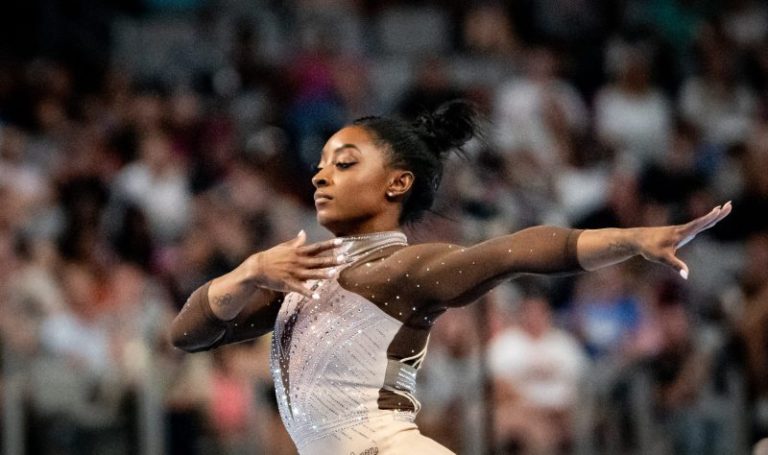
Since the age of 16, Simone Biles, now 27, has been known for her ability to win — and keep on winning. 

After taking a two-year mental health break from the sport after the pandemic-delayed Tokyo Olympics in 2021, Biles is now back and better than ever. 

From 37 World and Olympic medals to the Presidential Medal of Freedom — the highest civilian honor in the U.S., Biles has won it all. Here is a look at all her wins and records thus far.

How many Olympic medals does Simone Biles have?

Biles has won seven Olympic medals, four of which are gold. At the 2016 Rio Olympics, Biles won three individual golds in the all-around, vault and floor exercise and led Team USA’s “Final Five” to the team gold. She also added a bronze medal on the balance beam. 

2024 Olympic medals: Who is leading the medal count? Follow along as we track the medals for every sport.

At the 2020 Tokyo Olympics, Biles added a silver medal in the team event and an additional bronze medal in the balance beam to her hardware collection. Heading into the Games, Biles was the favorite to win gold in the all-around, vault, and floor finals, but she withdrew from competition after suffering from a case of the “twisties,” a term used by gymnasts to describe losing their sense of space and direction in the air. 

Biles currently has the ninth most Olympic medals in women’s artistic gymnastics, but she will undoubtedly look to add to this figure in Paris.  

How many World Championship medals does Simone Biles have?

Biles has earned a record-breaking 30 World Championship medals – 23 gold, four silver, and three bronze — making her the most decorated gymnast in World Championships history by both a total medal and gold medal count. At the 2013 World Championships in Antwerp, a then-16-year-old Biles won her first four World Championships medals, including gold in the all-around and floor competitions. A decade of dominating, gravity-defying performances later, Biles returned to the 2023 World Championships, also in Antwerp, where she won her five most recent World Championship medals: four gold medals in the team, all-around, beam, and floor finals and one silver medal in vault. 

Biles’ World Championship accolades include six all-around gold medals — the most of any woman in gymnastics history. She is also the only American gymnast to win a World Championship medal in each of the six events: the all-around, team, balance beam, uneven bars, vault, and floor exercise competitions. 

When was the last time Simone Biles lost an all-around competition?

Biles has not lost an all-around competition in over 11 years. Her last defeat came at the hands of American teammate and 2012 Olympic gold medallist Kyla Ross at the 2013 Chemnitz Friendly in Germany.

This post appeared first on USA TODAY