Archive

2024

Browsing

Companies are offering deep discounts this summer, and consumers are cashing in on them.

From Amazon to McDonald’s and Best Buy to JetBlue, major brands are ramping up efforts to get price-pressured customers to keep opening their wallets, and recent data shows it’s working.

The U.S. economy grew a solid 2.8% in the second quarter, according to government estimates released Thursday. Federal researchers pinned much of that unexpectedly strong jump on consumer spending on goods and services alike — from cars and furniture to vacations.

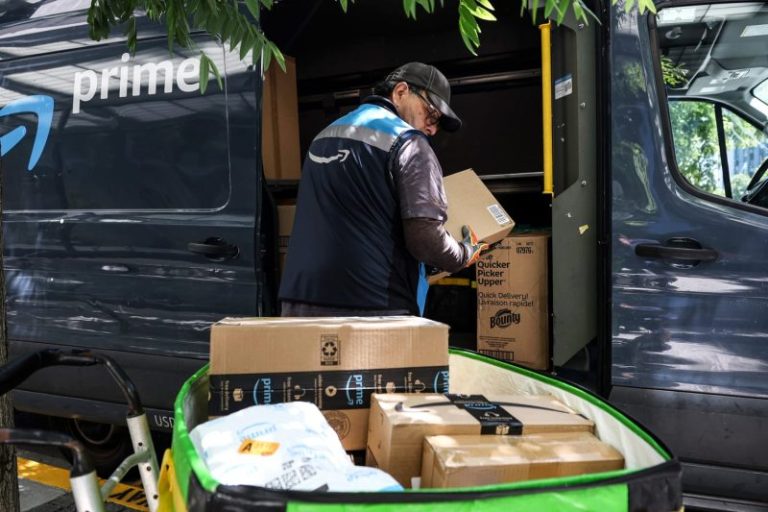
During the tenth anniversary of Amazon’s two-day Prime Day summer sales event last week, shoppers spent a record $14.2 billion across U.S. online retailers, up 11% since last year’s Prime Day, according to Adobe Analytics. And the higher sales totals weren’t due to higher prices, according to Adobe. Instead, the analytics firm’s data shows e-commerce prices have fallen for 22 months straight, and those discounts have helped juice demand.

For the first time in a long time, we’re seeing order volumes turn positive and discounting is high.

Caila Schwartz, director of consumer insights, Salesforce

“You have a heightened level of promotion, heightened levels of discounts, and that makes for a perfect storm where the consumer feels like, ‘This is a really great opportunity for me to buy. I’m excited about spending,’” said Vivek Pandya, Adobe’s lead insights analyst.

Cooling prices throughout the consumer economy are helping inflation continue trending downward. A closely watched inflation gauge fell, to 2.5% in June from 2.6% in May, according to data released Friday.

Retailers like Best Buy and Nordstrom also ran sales during Prime Day. Salesforce, which tracked online spending across retailers other than Amazon during the shopping event, found more generous promotions on offer elsewhere, too. Discounts jumped 10% since Prime Day last year to an average of 22% off of list prices, and U.S. sales grew 3%.

“For the first time in a long time, we’re seeing order volumes turn positive and discounting is high,” said Caila Schwartz, director of consumer insights at Salesforce. “The lesson is a simple one: If retailers deliver on discounting and providing true value, they will release that pressure valve of built-up demand and see incredible success. If they don’t, retailers may risk losing out as shoppers will go elsewhere.”

While consumer spending has powered the economy out of the pandemic — and held up under inflation pressures better than many economists expected — there are signs of distress under the surface.

Citigroup flagged “an overall resilient U.S. consumer” in its latest earnings call, but Chief Financial Officer Mark Mason noted the strength is mainly among those with solid finances and credit.

“When we look across our consumer clients, only the highest-income quartile has more savings than they did at the beginning of 2019, and it is the over-740-FICO-score customers that are driving the spend growth and maintaining high payment rates” he said. Those with lower credit scores “are seeing sharper drops in payment rates and borrowing more, as they are more acutely impacted by high inflation and interest rates,” he said.

Philadelphia Federal Reserve officials found credit card delinquency rates hit their highest level in nearly 12 years as of the first quarter this year. While both the total number of accounts past due and the size of card balances ticked down a bit, the researchers noted that “account holders who are behind have larger balances left unpaid.”

This and other consumer credit data in recent months highlights “the struggle that millions of households are engaged in just trying to make ends meet,” Bankrate Chief Financial Analyst Greg McBride told NBC News Wednesday.

Companies have been taking note of these pressures and dangling promotions to reverse or forestall rebellions over price.

In May, Target announced price cuts on 5,000 popular items like meat, breads and paper products, and Walgreens made a similar move of its own. Walmart launched a low-cost private-label food brand this spring, with prices ranging from $2 to $15 for fridge and pantry staples.

The discounting has gone well beyond grocery aisles. JetBlue and Southwest airlines are also rolling out limited-time deals, with some domestic flights starting at $49 during certain weeks this summer. After racing to add capacity to meet soaring demand, many airlines now have more seats than they can fill, and fliers are benefiting from cheaper tickets.

Restaurant chains are getting in on the action, too. McDonald’s is extending a $5 value meal that was originally planned to last just four weeks, as rivals dangle offers like Burger King’s $5 “Your Way Meal” and Starbucks’ pairing menu starting at $5.

Data that the location analytics firm Placer.ai released this month suggests these gambits are working. Foot traffic at McDonald’s jumped 8% on June 25, the day the value meal launched, compared to an average Tuesday up to that point this year, and stayed at least 5% higher for each subsequent day that week.

Weekly visits to Chili’s have been elevated since the chain updated its “3 for Me” deal this spring, Placer.ai found, jumping as much as 27.7% at one point in the middle of May compared to 2023.

Younger consumers are fueling some of the spending, according to American Express, which said millennial and Gen Z cardholders boosted their spending by 13% in the second quarter.

“These younger card members continue to demonstrate strong engagement, and we see that they transact over 25% more, on average, than our older customers,” Chief Financial Officer Christophe Le Caillec told investors last week. “In some categories like dining, they transact almost twice as much.”

After the last few years’ inflation rollercoaster, many shoppers are paying closer attention to price swings, Adobe’s Pandya said.

“They understand how quickly the winds can change,” he said. “They’re going to really take advantage of these moments to spend when the value is good.”

This post appeared first on NBC NEWS

Tired of measly Chipotle bowls? The company’s CEO said Wednesday all restaurants will serve bigger portions following social media complaints against the Mexican grill chain over smaller servings. 

Brian Niccol, the head of the company, said during an earnings call to investors that “there was never a directive to provide less to our customers,” but the company noticed the concerns about portion size on social media. 

“Getting the feedback caused us to relook at our execution across our entire system,” he said. “We have focused in on those outlier portion scores based on consumer surveys.”

He noted about 10% of restaurants were outliers that needed to be retrained up to the “right standards.” The chain has about 3,500 locations in the U.S.

“We are re-emphasizing training and coaching round ensuring we are consistently making bowls and burritos correct. We have also leaned in and re-emphasized generous portions across all of our restaurants,” he added, noting that “it is a core brand equity of Chipotle.” 

He said the company is already beginning to see those actions “positively reflected” in consumer scores. 

Earlier this year, several people posted videos to TikTok complaining about Chipotle portions.

Food influencer Keith Lee made a video for his 16.3 million followers in May doing a taste test review of three items on the menu. In that clip, he complained about a lack of chicken in his bowl. 

Another TikToker, who goes by Jack’s Dining Room, said in a video also in May: “When I get a bowl and they give me two pieces of chicken, I’m like, ‘Can you just add one more scoop?’ and they’re like, ‘You want double meat?’ and I’m like, ‘No, I just want the chicken I asked for.’ … Like, am I crazy? Is that not fair?”

Following a flurry of critical videos, some TikTok users began posting videos showing themselves recording Chipotle workers as they were making their food, insinuating the pressure of the camera yields bigger portions. However, that too faced backlash for harassing workers.

But the complaints do not appear to have hurt the company’s business. Chipotle reported quarterly earnings and revenue Wednesday that topped analysts’ expectations as it saw higher traffic at its restaurants, bucking an industry slowdown.

Shares of the company rose about 13% in extended trading before losing most of those gains and settling around 3% higher. As of Wednesday’s close, Chipotle’s stock had slid 17% this month, hurt by investor concerns about the health of the restaurant industry. In late June, the company executed a 50-for-1 stock split.

Demand for its food peaked in April, Niccol said on CNBC’s “Closing Bell: Overtime” on Wednesday. Same-store sales settled around 6% higher in June.

Traffic to its restaurants increased 8.7% despite the backlash on social media.

This post appeared first on NBC NEWS

In the pool, the USA versus Australia rivalry runs deep. While no country has historically dominated the modern Olympic Games like the U.S., Australia is a massive swimming powerhouse, producing some of the best to ever compete.

“It is a rivalry that is pretty healthy for the most part,” now-two-time Olympian Regan Smith told For The Win. “I think some people always like to turn things into something ugly, and me personally, I’m not interested in that. Most of the people I’m close with on the USA and on Australia have a lot of healthy, mutual respect for each other.

“I think that’s what produces the best, rivalries, I’d say. And overall, I think the rivalry between USA and Australia just makes the sport more entertaining to watch. And at the end of the day, that’s what we all want. We just want more viewership in swimming, we want more people talking about it. And the way to do that is to have really, really exciting races that come down to the very last meter.”

With several superstar swimmers at the Paris Olympics, particularly on the women’s side, Australia is looking to dethrone the U.S. and win more Olympic medals — a feat that hasn’t happened since the 1956 Melbourne Games, per the Australian Associated Press.

So before these two teams go up against each other and the rest of the world in Paris, here’s a breakdown of the history and what’s at stake.

2024 Olympic medals: Who is leading the medal count? Follow along as we track the medals for every sport.

Brief history of the swimming rivalry between Team USA and Australia

On the Olympic stage, the U.S. and Australia are historically the two strongest delegations with the most hardware, by a long shot. And both sides have traded jabs and trash-talking quotes with each other over the decades.

Overall, Team USA swimming has earned 257 gold medals and 579 total, while Australia is second with 69 gold and 212 total, as NBC Sports noted. For perspective, East Germany has 92 total medals, Japan is fourth with 83 and Great Britain is fifth with 79.

However, at 2023 world championships in Fukuoka, Australia won 13 swimming gold medals to Team USA’s seven. But the Americans still won more medals than the Aussies, 38-35.

On repeating that success in Paris, Swimming Australia head coach Rohan Taylor recently said the Australian Olympic team “is going to give it a good shake”.

More from Taylor, via the Australian Associated Press: “[T]he Americans, there’s a reason they haven’t been beaten since 1956 – they’re just extremely competent when it comes to the Olympics, this is where they step up.

“They have got the depth, they’ve got the numbers, they’ve got the experience.

“We’re going to go there and do everything we can to create an environment for these (Australian) athletes, first and foremost, to do their best.”

USA vs. Australia and the Duel in the Pool

While the rivalry between Team USA and Australia spans decades, it produced one of the best swimming competitions ever outside of the Games.

A must-watch event for diehard swimming fans, the Duel in the Pool was a bi-annual meet pitting the best swimmers against each other just for fun. First, it was just Team USA against Australia in 2003, 2005 and 2007, but from 2009 to 2015, the event was expanded to Team USA versus Europe. And the Americans dominated.

After an unfortunate hiatus, Duel in the Pool returned in 2022 and went back to its roots with USA-Australia in Sydney, and the Americans continued to come out on top. The U.S. won every Duel in the Pool and has an 8-0 record.

Bring. This. Event. Back.

How the USA-Australian swimming rivalry was reignited before the Paris Olympics

Last summer for swimming world championships, NBC broadcast a graphic of the medal count, highlighting the overall medal total with the U.S. in the lead, rather than gold-medal rankings, which would have had Australia at No. 1.

Four-time Olympian and eight-time Olympic medalist Cate Campbell — who at 32 years old missed qualifying for Paris — took issue with the graphic. Talking to a local Australian TV station, she called Americans “such sore losers” in response to the medal count graphic.

More from Campbell’s 2023 interview: “Australia coming out on top is one thing, but it is just so much sweeter beating America. There were a couple of nights, particularly the first night of competition, where we did not have to hear [the] ‘Star Spangled Banner’ ring out through the stadium, and I cannot tell you how happy that made me. If I never hear that song again, it will be too soon. And so, bring on Paris, that’s all I have to say: U.S., stop being sore losers.”

Campbell also slammed Team USA’s frequent use of a cowbell — sometimes heard on Olympic and international competition broadcasts — before an American swimmer races.

She added: “When we’re right next to each other in the warm-up areas, the U.S. [has] this infernal cowbell that they ring, and as someone leaves to go to the competition pool, they ring out ‘U-S-A, U-S-A!’ And I have never wanted to punch someone more and steal that cowbell.”

Unsurprisingly, outspoken Team USA swimmer and five-time Olympic medalist Lilly King responded to Campbell at the time:

But Cate Campbell’s ‘sore losers’ and anti-cowbell comments were in 2023. What does that have to do with the Paris Olympics?

Well, that’s where Olympic broadcaster NBC comes into play again. Seemingly reigniting the rivalry right before the 2024 Games, NBC showed a clip of Campbell’s comments to 23-time Olympic gold medalist Michael Phelps and shared his reaction on social media.

“I appreciate your comments, Cate,” Phelps said in response with a smirk.

He added: “If somebody said that to me, I would lose it. I would literally make them eat every word they just said about me. Because people have done it; Chad Le Clos, [Ian] Thorpe — you guys have all talked [expletive] about me, and I had the last laugh.

“So for the Americans, if you see what I just saw — that’s the first time I saw it — I would watch that thing every single day to give me that little extra bit of just oomph.”

Clips of Campbell’s nearly year-old interview and Phelps’ recent reaction have been circulating around social media since June, intensifying the USA-Australia rivalry.

Team USA has since responded with promises of more cowbell

After the men’s 100-meter freestyle final at U.S. Olympic trials in June, Hunter Armstrong — who qualified for the 4×100 freestyle relay — said: “We do want that [relay] world record, but most importantly, we need more cowbell.”

While the Indianapolis crowd loved his comment, he wasn’t the only Team USA swimmer to chime in about the cowbell. Now-three-time Olympian and Team USA captain Abbey Weitzeil was asked at trials about Campbell’s comments resonating with the team, and she said: “We’re all bringing the cowbell. Whenever comments are made about your country or your jobs, it’s all competitive, and I think we all are competitive, our competitive side comes out, so we’re all bringing the cowbell, extra loud!”

So, expect more cowbell from Team USA at the Paris Olympics.

Has Team USA said anything about Campbell’s comments or the USA-Australian rivalry at the Paris Olympics?

Yes, but they didn’t say much. Here’s more from Weitzeil in Paris on Wednesday, basically saying Campbell’s comments kind of work as bulletin-board material, but only so much.

Top USA-Australia Olympic swimming races to watch in Paris

While relays are always must-see events at the Olympics, there are a few individual races that will really highlight the USA-Australian rivalry.

One is Katie Ledecky versus Australia’s Ariarne Titmus in the 400-meter and 800-meter freestyle events. Titmus won gold at the 2021 Tokyo Games in the 200 free and 400 free, beating Ledecky in the latter. But in the 800 three years ago, Ledecky topped Titmus for gold and silver, respectively. Ledecky is favored to win her fourth straight Olympic gold in the 800, but Titmus is the world record holder in the 400 and has the fastest time in the world this year, about three seconds ahead of Ledecky.

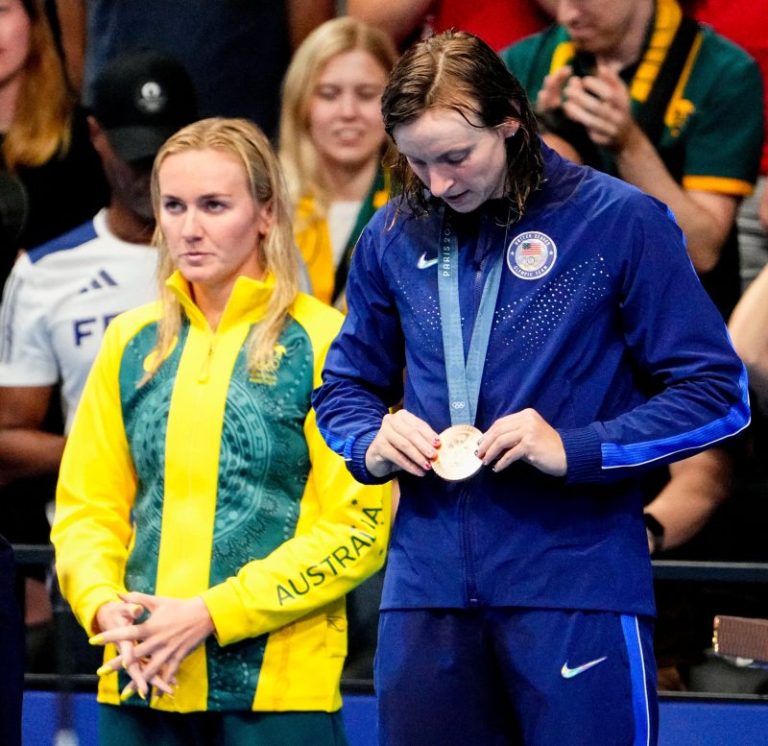
In the 400 free final on Saturday just outside Paris, Titmus defended her Olympic title and won gold, while Canada’s Summer McIntosh won silver and Ledecky won bronze.

Other rivalry events to watch include women’s backstroke with American Regan Smith and Australian Kaylee McKeown, as the two have been trading world records for years. Since 2019, both swimmers have broken the women’s 100-meter backstroke world record twice, and they combine to have the top-10 fastest times ever in the event. Smith broke the 100 back world record in 2019 before McKeown stole it in 2021 and lowered it in 2023. But at U.S. trials, Smith took it back.

About her individual rivalry with McKeown, Smith said she’s “proud” it exists.

“She’s been an absolutely stellar competitor for years,” Smith told For The Win. “The first time competed against her, we were like 15 and 16 years old, so I’ve known her and have grown with her for, gosh, like seven years now, which is really crazy to say. So I’d say, when it, when you boil it down, it’s just a very healthy respect that we both have for each other.”

In Tokyo, McKeown swept the 100 and 200 backstroke while Smith took bronze in the 100 — she didn’t swim the 200 — and they’ll race each other in both events in Paris.

Other top Australian swimmers to watch include Kyle Chalmers (100 free), Mollie O’Callaghan (100 free, 200 free), Emma McKeon (100 butterfly) and Zac Stubblety-Cook (200 breaststroke).

The USA TODAY app gets you to the heart of the news — fast. Download for award-winning coverage, crosswords, audio storytelling, the eNewspaper and more.

This post appeared first on USA TODAY

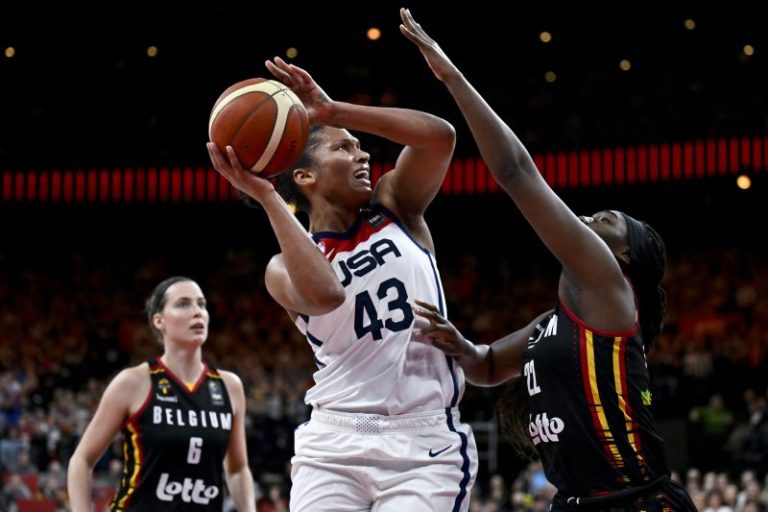
PARIS — Alyssa Thomas doesn’t like to spend time thinking about “what if?” 

What if arguably the most versatile, balanced player in the world didn’t have two torn labrums in her shoulders? What if she hadn’t suffered an Achilles injury that kept her out of the last Olympic cycle? What if she’d won 2023 WNBA MVP honors after a career-best season? 

That’s mostly a useless thought exercise for Thomas. Instead, the 32-year-old forward, who will make her Olympic debut for Team USA Monday, is focused on the fact that finally, after years of waiting and wondering, she’s here. 

That she’s set to be a major contributor as the American women go for their eighth consecutive basketball gold over the next few weeks at the 2024 Paris Games makes the waiting that much sweeter. In many ways it feels like it’s happening right on time because Thomas, bafflingly, seems to keep getting better with age. 

Get Olympics updates in your texts! Join USA TODAY Sports’ WhatsApp Channel

2024 Olympic medals: Who is leading the medal count? Follow along as we track the medals for every sport.

In her 11th season as a pro, all with the Connecticut Sun, Thomas is averaged 11.9 points, 9.2 rebounds and 7.6 assists thorugh 24 games. She is second in the league in the last category, and has recorded more triple doubles (12) than anyone else in WNBA history, including four through 24 games this season. That she does it all without shooting much outside 12 feet — her shoulder injuries have forced her into an unconventional shooting motion, and it often looks like she’s heaving a shotput — is that much more impressive. 

“I think this is just normal for me,” Thomas told USA TODAY Sports. “I’ve played this way my whole career, but now more people are paying attention. When you have an injury like I did (with my Achilles) a few years ago, you don’t think you’re going to be the same, but I’ve found a way to keep playing at a high level.” 

Talk about an understatement. 

How Alyssa Thomas’ injuries and versatility power her

At 6-foot-2, 203 pounds with terrific court vision and a tremendous basketball IQ, Thomas is often called “a point guard in a forward’s body.” She can play, and defend, multiple positions. That versatility is a perfect fit for USA Basketball coach Cheryl Reeve’s system. 

Jenn Rizzotti, the selection committee chair for this quadrennial, has had a front row seat to Thomas’ dominance on the floor as the president of the Connecticut Sun. 

“How much better would she be if she was totally healthy? It’s funny because I always joke about how I got gipped on height, right?” said the 5-foot-6 Rizzotti, a Hall of Famer. “But people are like, ‘Would you have been as tough if you were taller?’ Sometimes I think A.T. has a chip on her shoulder because of those injuries and because she’s not as tall.” 

Yes, the injuries. There was the Achilles tear in January 2021, but that’s not the career-defining injury most people associate with Thomas.

The USA TODAY app gets you to the heart of the news — fast. Download for award-winning coverage, crosswords, audio storytelling, the eNewspaper and more.

It’s impossible to talk with or about Thomas and not bring up the torn labrums. She tore the right one in 2015, her second WNBA season, and sat out 10 games. Less than two years later, while playing overseas, she tore the left one. At that point she decided she’d just play through the pain. 

That Thomas care barely lift her hands above her head isn’t an excuse she’s interested in using, ever. She can still dominate on the court and still detail her Mercedes, her preferred decompression pastime. She’s learned to play with a baseline of discomfort. Asked if there’s anything her shoulders limit her from doing — can she pull something off the highest shelf? — she just shook her head. 

“I wouldn’t be denied anything,” she said. “I’ll find a way to do it.” 

She does plan to get surgery, but not until her career is over (it’s a brutal recovery, she said). For now, if she needs a distraction or a pain-free activity, she’ll head to the beach with her fiancée and Sun teammate DeWanna Bonner. 

It’s true that if Thomas didn’t have the shoulder issues, she’d likely be a 3-point shooter by now. But she’s proven she can stuff a stat sheet without that skill. 

“There’s an edge that she has and it’s like, ‘I’m just gonna be really good at everything else and be impossible to guard anyway. Whether you sag off me or pressure me, I’m gonna have an answer,’” Rizzotti said. “I think she loves getting triple doubles because it shows her balance.” 

How Alyssa Thomas proved her USA Basketball worth

Reeve in particular knew that balance could be a weapon in international play.  

But it did work out — maybe even better than anyone could have imagined. Thomas was part of the 2022 FIBA World Cup team that took home gold in Australia, averaging 9.9 points, 7.0 rebounds, 4.3 assists and 2.4 steals in eight games, shooting 64.7% from the field. Given her play there, Thomas’ inclusion on the Olympics roster might not have been a surprise, but it was still rewarding, for both Thomas and those around her. 

“We’re just really proud of her for sticking with the process,” Connecticut coach Stephanie White said. “Cheryl understands the value of a plug-and-play player, someone you can use in multiple positions, who will do the dirty work, doesn’t necessarily have to have the ball in her hands or shoot to be effective, and who can guard the other team’s best player. When you have a team made up of prolific scorers, to have that person who can put it all together and doesn’t care about getting her own shots, that’s huge.” 

Thomas also has tons of international experience, another plus. Although many WNBA players — especially the higher paid ones — have stopped playing overseas in the winter, Thomas has continued. She joked that it’s partially because “I am not the type of person who wants to come into the gym and just work out every day, that repetitiveness is not for me. I need more game action.” She loves, too, that international ball has “taken me a lot of cool places,” including South Korea, China and Turkey.

And now, after years of waiting her turn, it’ll take her to France and the Olympics. 

This post appeared first on USA TODAY

Ben Hallock spoke zero Italian and, even worse, couldn’t figure out the intricacies of the produce section at his new, local grocery store in Liguria, Italy. The employee trying to assist the foreigner spoke no English. All Hallock could do was hoist the limes in his hand and look helpless. 

No matter how Hallock felt in that moment or the other instances he adjusted to life abroad while playing professional water polo for Pro Recco, the best club team in the sport, Hallock was just a phone call or text message away from someone – teammates on the U.S. men’s national team – who could understand.

“What stupid thing did you do at the grocery store today?” Hallock said. A more common inquiry is: “How’s your tutoring going?” 

That type of conversation between members of the national team leading into the Tokyo Games seldom occurred. During that cycle, Alex Bowen said, the former veterans had retired and stopped their pro careers in Europe, while the next generation had not yet gone abroad for pro opportunities. 

2024 Olympic medals: Who is leading the medal count? Follow along as we track the medals for every sport.

Past national team members such as Tony Azevedo, Merrill Moses, John Mann, Jesse Smith and Josh Samuels all had lengthy careers overseas. But Bowen was the only national team player abroad in 2016 and 2017. 

Since then, the entire team – plus anybody who wants to have a chance to make the Olympic roster – plays abroad. It was a recognition on the players’ part that it’s necessary for them to remain competitive internationally, Bowen said. 

“Because while we do have a national league here, it’s not competitive compared to the European model,” he told USA TODAY Sports. 

The competition in college is sufficient for that level. Top players from around the world attend schools in the United States. The issue is going up against 21-year-olds after graduation.

“There’s a difference between going against college-aged guys and going against guys trying to put food on the table,” Bowen said. “So that’s immediately obvious when you go to Europe to play. 

“There’s that extra motivation over there. These guys are trying to stay relevant and stay on the team for as long as they can.” 

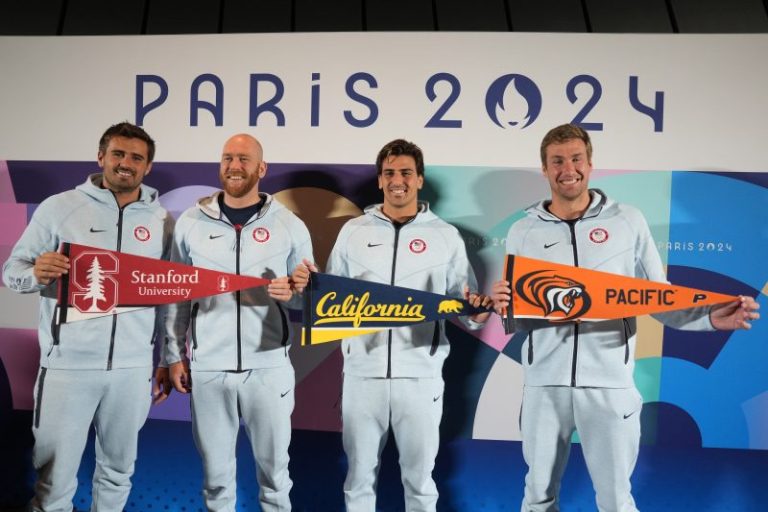
For Dylan Woodhead, playing in Europe was a borderline necessity. He was part of the crop of younger national team players going abroad as the COVID-19 pandemic surged in 2020. He’d been struggling to find pool time in northern California and was driving nearly an hour to the East Bay to get into the water. 

“Maybe the best way to go train and prepare is to go play in Europe,” he thought. 

So Woodhead and another 10 national squad teammates made their debuts in Europe that year and picked up some valuable experience before the Tokyo Games. Woodhead finished his Master’s degree in mechanical engineering while playing his first season for Vouliagmeni in Greece. 

“For me, I had never really made that big move,” said Woodhead, who grew up about an hour from Stanford. 

It took 23 hours for him and his two suitcases to reach Greece. He landed at 10 p.m. local time and as a car drove him across his new country, he thought to himself, “Where am I in the world right now?” 

“It was very daunting. I was a little apprehensive,” Woodhead told USA TODAY Sports. 

Within a week, though, his teammates made him feel welcomed to the point he felt comfortable. Signing that first pro contract was “an interesting, life-altering experience,” he said. 

“But is something I’ve grown to be thankful for,” Woodhead said. 

 The American proves himself

Nobody on the Olympic roster is as well-traveled over the course of his career than Bowen. Next season will be his 10th abroad, and he’s played in (in chronological order) Romania, Hungary, Croatia, Greece, Serbia, France and, soon, Spain. He announced his transfer from Noise-le-Sec (France) to CN Sabadell (Spain) earlier this year. In 2023, the Olympic roster played in Spain, France, Italy, Germany and Croatia. Improvement in the national team’s quality of play leading into the Paris Games, Bowen said, is “100 percent” evident because of his teammates’ commitments to spend most of their year playing in Europe. 

Bowen singled out Hallock, who has won three Champions League titles with Recco – and played key roles during the team’s run of dominance. 

Hallock is one of seven U.S. players who play in Serie A, the top level in Italy and arguably the premier league in the world. The challenges in the pool have forced him to grow as a player. The scouting aspect of other countries’ best comes into play during the Olympics. 

“Knowing your opponents, knowing how they think – just the little tendencies that you might pick up on by playing someone twice a year,” Hallock said. “It could be the difference in one game in the Olympics.” 

In European club water polo, the best players sign with teams as teenagers – similar to the European soccer model. 

“You see them with all the responsibility on their shoulders,” Bowen said. “When they play for their national team, there’s a little more sacrifice.”  

Because those elite players have to showcase more skill throughout a season, Bowen said he can pick up on a fake a player does with his club team but may not have shown up previously during international competition. 

Olympic gold medals by country: Who has won the most golds at Paris Olympics?

The variety of tactics and style that the Americans are exposed to thanks to their club teams have let them broaden their water-polo horizons, Woodhead said. 

“That increases your thinking, your decision-making, the way you find solutions in the game,” Woodhead said. “I think that all-encompassing experience has helped our team grow a lot and mature a lot.” 

Hallock became the first American to play for Recco when he arrived in 2020. 

“There was sort of a lack of – I don’t know if trust is the right word – but maybe confidence from all my teammates,” Hallock said. 

He needed to prove himself – without knowing how to communicate with his new teammates. 

“It was definitely an insane experience, for me, at 22 years old, not knowing what anyone was saying,” Hallock said. 

Offering demonstrative body language helped in the beginning. 

2024 Paris Olympic Games: Full schedule with TV, time and streaming for every event

“Just showing up and proving to them that I belong there and I was good enough,’ he said. ‘Eventually, they sort of bought in and believed in (me) as well, which is again, confidence-building on my part. 

As time went on, Hallock poured his efforts into learning Italian. He wanted his teammates to be friends and build relationships outside of the pool.

Bowen has had the tough task of learning a new language every couple of years. He only becomes comfortable enough to get by or at least ask the other person to speak in English. But wherever he’s been, his teammates have embraced him. 

“Water polo, even internationally, is a really tight-knit community,” Bowen said. 

Teammates have given him rides to doctor’s appointments and let him borrow their cars to pick up his fiancée from the airport. 

Woodhead’s gratefulness to his teammates in Greece has yielded bonds that will last forever. He’s also received a different perspective outside of his northern California bubble.

“That relationship with my teammates is what makes (playing) abroad so special,” Woodhead said. 

‘Hey, this isn’t a vacation’

Hallock is not fluent in Italian but he can definitely get by conversationally. He’s comfortable enough to conduct media interviews in Italian. In Genoa, he consumes plenty of pesto, and “it’s amazing.” But food in Italy is regionalized fare and he misses the variety available back home sometimes. 

What helps prevent homesickness is seeing American teammates throughout the year. If they play each other during the regular season or Champions Cup, they will make plans to hang out or stay over each other’s apartments the day after games.

“We definitely make an effort,” Hallock said. 

Hallock counsels his teammates to have good relationships with the manager of their club team and to have an understanding of expectations before arriving. He also says to be ready for discomfort – at practice, in the pool, in the city.

“It sets in after a couple of weeks. You’re like ‘Hey this isn’t a vacation,’” Hallock said. 

The U.S. men open Olympic play against Italy on July 28, and Hallock is familiar with the Italian roster. Serbia, Montenegro and Greece are other powerhouses the U.S. will have to contend with to medal, which the men have not done since the 2008 Beijing Games (silver).

Most European teams have the advantage in that the top club team or two in each country will roster 50-70% of the national team. Naturally, they spend more time in the pool together. 

“The U.S. is coming from all around Europe and we’re meshing all of these styles back to our identity,” said Woodhead, whose younger brother Quinn is also on the team, and plays for Telimar in Italy. 

It’s a different challenge than what other teams face, but Woodhead said it will be up to the Americans to use it as an advantage “if we organize it well and we plan well and are thoughtful in our training.” 

After their seasons, the U.S. team gathered for six weeks of training before departing for Europe on July 6 for tune-ups in Greece, Slovenia and Croatia. 

“It’s just fitting the puzzle pieces together,” Bowen said.

For a roster that has uprooted their lives to go abroad and pursue their professional passion, the growth that comes with doing such a thing should make that process easier. 

“Through that growing process comes a lot of maturity,” Woodhead said, “and that maturity helps us in the pool a lot.” 

This post appeared first on USA TODAY

NANTERRE, France — With two medals in the two fastest swimming relays, Team USA closed the first day of competition Saturday at the Paris Olympics with a couple thrilling performances in the women’s and men’s 4×100-meter freestyle events.

Both relay teams had a mix of 21-year-old, first-time Olympians and a couple decorated 27-year-olds, perhaps symbolizing the future of American sprinters while showing the vets still got it.

Three-time Olympian Simone Manuel, 27, reminded the world she’s one of the best in the final few meters when she out-touched China’s Wu Qingfeng by .10 seconds on the anchor leg to secure a silver medal for the Americans at the Paris La Défense Arena. It is Manuel’s sixth Olympic medal.

Australia won the gold while setting an Olympic record with a time of 3:28.92. Team USA finished with a time of 3:30.20, while China’s 3:30.30 earned it bronze.

The American team of Kate Douglass, Gretchen Walsh, Torri Huske and Manuel also set a new American record, which was a goal dating back to training camp earlier this summer and even going back to the Tokyo Olympics, for those who competed, Manuel said.

2024 Olympic medals: Who is leading the medal count? Follow along as we track the medals for every sport.

“These three women set me up well,” Manuel said, adding she was unaware of how close it was with China. “It’s been a while since I’ve been in the anchor position, so I definitely was a bit more nervous for that race than I would have liked to be. But hopefully, I can build from that.”

Halfway through the tight relay, Team USA making the podium was in question. Leadoff swimmer Douglass, 22, and Walsh, 21, posted respectable splits but both hit the wall in fourth. Huske, 21, swam the fastest leg for the squad with a 52.06 split to move them into second, and then it was Manuel’s turn to bring it home. 

And she quite literally did. By the 50-meter mark, she had the Americans in third, and although Wu had a .30-second faster split, Manuel hit the wall first in a jaw-dropping finish. 

Then it was the men’s turn for the last final of the night — though their victory was hardly in doubt.

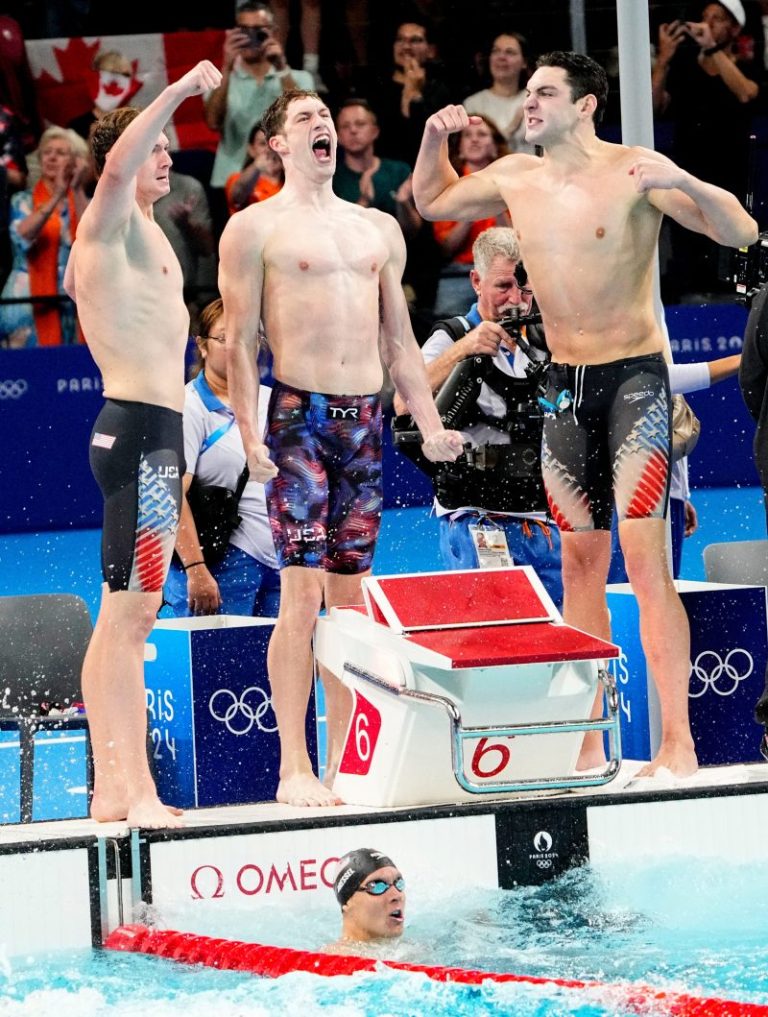
Three-time Olympian Caeleb Dressel, 27, won his eighth Olympic gold while anchoring the men’s 4×100 free relay, which the Americans dominated nearly the entire way, finishing with a time of 3:09.28. Despite predictions to the contrary, the team finished 1.04 seconds off world-record pace — the oldest long-course swimming world record set by Michael Phelps and Team USA at the 2008 Beijing Olympics.

“Relays are a little more special, to be honest,” Dressel said. “So doing it with these guys has been awesome. It takes me right back to my first gold (at the 2016 Rio Games). It really doesn’t get old.”

Jack Alexy opened with a 47.67 split, hitting the wall second to China’s 100-meter freestyle world record holder, Pan Zhanle. But Chris Guiliano’s second leg bumped the Americans into first, Hunter Armstrong’s blistering 46.75 gave Team USA a sizable lead, and Dressel just had to hold on. 

“I definitely didn’t expect it,” Armstrong, 23, said about seeing his split afterward. “I will give my entire body and soul up for these boys, and I knew I had to give Caeleb everything I had. And so I’m glad I was able to get my job done.”

The foursome topped silver medal-winning Australia by 1.07 seconds, while Italy won the bronze. 

First-time Olympians Alexy, 21, and Guiliano, 21, won their first Olympic medals, while two-time Olympian Armstrong won his second gold.

For both Manuel and Dressel, their respective medals signify successful comeback attempts, as both took time away from the sport following the Tokyo Games. 

“It just feels good to be back here, honestly,” Manuel said. “I didn’t know if I would ever be performing at this level again. And so just to kind of have the full-circle moment of being on this relay again from 2021 to now, but just in a happier and healthier place, I think it’s really special.”

Back for their second Olympic Games, Huske and Douglass each earned their second Olympic medals, while Walsh won her first in her Olympic debut. 

Walsh — who also swam the 100-meter butterfly prelims and broke the Olympic record in the semifinals Saturday — said getting her first race out of the way helped her “leave the nerves in the pool.”

“I was able to come out tonight and use my front-end speed and just get to the wall and put up a really good time for myself,” she said. 

“It set me up really well for the relay and for tomorrow night.”

This post appeared first on USA TODAY

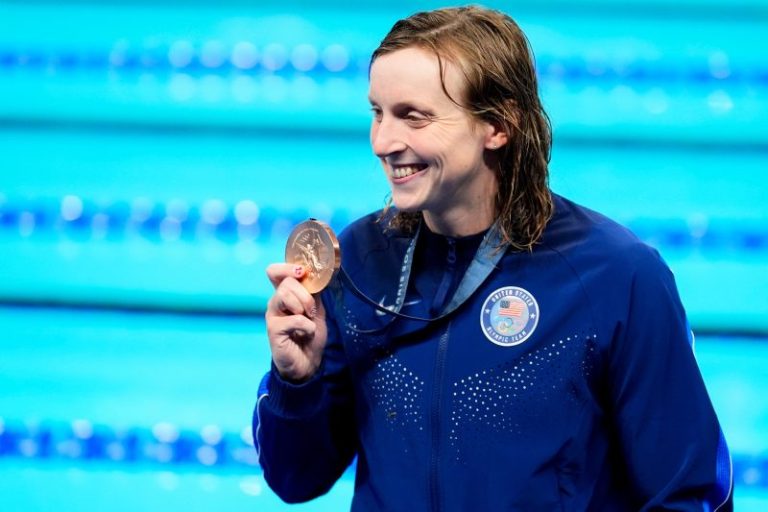
NANTERRE, France — The color of the medal was expected. For Katie Ledecky, there was absolutely no shame in winning the first bronze of her storied Olympic career in what has become her most competitive international race, the 400-meter freestyle. 

But how it happened — what did and did not occur over four intense minutes on Saturday night at the 2024 Paris Olympic Games — was something Ledecky wasn’t expecting at all.

Ledecky, 27, the greatest female swimmer in history, added an 11th medal to her remarkable resume stretching back to the 2012 London Olympics, but when she went to kick into another gear to finish the race, it wasn’t there.

“I looked at my splits, there was nothing that was horrible about it,” she said afterward. “I just didn’t have it on the last 200, 250, the way I wanted to. I felt like my first 150 was pretty good, went out with the field or felt like I was within striking distance. I just couldn’t kick into that next gear that I would have wanted to, to finish it out.”

But Ledecky being Ledecky, as grounded as any American sports superstar, she saw the silver lining, even if this time it was bronze. 

2024 Olympic medals: Who is leading the medal count? Follow along as we track the medals for every sport.

“It’s a medal,” she said. “I know it was such a good field that there was a chance I could have not gotten a medal. I’m grateful for that. Grateful for the effort that I put in, happy with the medal and looking forward to my next races.” 

For the second Olympics in a row, Australia’s Ariarne Titmus won the 400, which has become one of the marquee events in the sport. Three years ago in Tokyo, Ledecky was second. This time, it was Canadian 17-year-old Summer McIntosh who won the silver. 

The two of them, Titmus and McIntosh, traded the world record last year, with Titmus now owning it, but neither swam anything close to their fastest time Saturday night. Titmus’ winning time of 3:57.49 was more than two seconds off her world record of 3:55.38, and McIntosh was almost a second behind Titmus. 

Ledecky, who held the 400 world record for nearly six years before Titmus broke it in May 2022, swam 4:00.86. That she failed to break four minutes was another surprise, perplexing to her and to just about everyone else. Little more than a month ago, she swam 3:58.35 at the U.S. Olympic trials. 

“Yeah, it felt a little faster than that,” she said. “I mean the top three, we probably all would say we would have liked to have been a little faster. … I’ve been faster a few times this season but you can’t complain with the medal. The Olympics is all about racing, it’s all about getting your hand to the wall for a gold, a silver, a bronze. I’m happy I got my hand to the wall for a medal. That wasn’t my best performance of the season but I still was able to get a medal.” 

In her three previous Olympic Games, Ledecky won seven gold medals and three silvers. She is favored to win the gold medal in both the 800 and 1,500 freestyle events later in these Olympics, and will likely win a medal as a member of the U.S. women’s 4×200 freestyle relay team.

“I don’t think there’s a lot that I can, or any of us should, read from this race going into the 800 and 1,500,” Ledecky said. “They’re pretty different from the 400. I do get two days off, which I don’t think I’ve ever really had at a meet like this.”

Ledecky will meet Titmus, 23, again in the 800 freestyle, the race Ledecky has won at the last three Olympic Games, including a victory over the silver-medal-winning Titmus in Tokyo three years ago. 

Ledecky was asked about their rivalry after Saturday’s race. Her reply was swift. 

“I wouldn’t consider it a rivalry. I think it’s a friendship if anything. We have a lot of respect for each other and we love competing against each other. It brings the best out of each of us. Competing against the best in the world is something special and something that we enjoy.”

A quirky moment occurred between the two just before they dove into the pool. Ledecky turned in the fastest time in the morning preliminaries, so she was announced last and was swimming in lane 4. Titmus came out next to last and was in lane 5 — except that she put her warmups and shoes in the bin at lane 4. 

Ledecky noticed immediately as she approached lane 4. 

“I had to tell her, you’re in lane 5,” Ledecky said. “I told her, ‘all good, all good,’ because she was freaking out. I didn’t want her to feel bad or anything.”

Then, as they came back out for the medal ceremony, Ledecky had a little fun with Titmus. “I joked with her before the medals, you’re getting a little comfortable there in lane 4.”

Ledecky smiled. “That was no big deal. I didn’t want either of us to get disqualified for swimming in the wrong lane. We got it taken care of.”

This post appeared first on USA TODAY

Simone Biles has been a very visible presence at husband Jonathan Owens’ NFL games. Now it’s his turn to lead the cheering section.

The NFL safety will be at the Paris Olympics for the team and all-around finals, despite the Chicago Bears being in the middle of training camp. Biles said after the Olympic trials that the Bears had given Owens permission to be absent for ‘a couple of days’ so he could go to Paris.

‘He’ll be there, yes,’ she said. ‘For just a short little time.’

Biles and the U.S. women begin competition July 28 with qualifying, and the team final is two days later. The all-around final, where Biles is heavily favored to become just the third woman to win a second Olympic title, is Aug. 1.

Here are more details:

2024 Olympic medals: Who is leading the medal count? Follow along as we track the medals for every sport.

When might Jonathan Owens be in Paris?

The Bears are giving Owens off from July 29 to Aug. 3. That includes their first preseason game: Aug. 1 against the Houston Texans, Owens’ old team. That means he’ll be able to watch her in both the team final, on July 30, and the all-around final, on Aug. 1.

While this is Owens’ first season with the Bears, it’s his seventh in the NFL and many teams rest their veterans for some or all preseason games, anyway.

‘We respect the Olympics. That’s a big deal,’ Bears coach Matt Eberflus said on July 22. ‘He’s supporting the one he loves the most. I think that’s so cool that he gets to do that, we welcome that and it’s going to be awesome.

‘Go USA,’ Eberflus said, drawing laughter.

Owens will miss Biles in the event finals, which are Aug. 3-5. The vault final is Aug. 3, the uneven bars final is Aug. 4 and the balance beam and floor exercise finals are Aug. 5. Biles is the reigning world champion on beam and floor exercise, and won an Olympic gold medal on vault at the Rio Games in 2016.

Has Jonathan Owens seen Simone Biles compete before?

Owens was a fixture at Biles’ competitions this summer, attending the U.S. Classic, U.S. championships and Olympic trials. He was even seen keeping score at nationals, which Biles said he picked up from her parents.

“My Mom and Dad — (meet organizers) never used to display scores from everybody, so they would take notes and scores of every athlete. At the last meet, Jonathan saw my parents doing it and he was like, `Where’d you get that? I need one of those!’ Because whenever he learns about something, he wants to really dive in,” Biles said after the U.S. championships in June.

“He’s kind of a nerd in that respect. In the best way!” she added. “So if he’s gonna learn about gymnastics, he’s gonna learn about it.”

This will be the first time Owens sees Biles compete internationally, however. The couple met in March 2020, and friends and family were not allowed at the delayed Tokyo Olympics in 2021 because of severe COVID protocols. Biles did not compete again internationally until last year’s world championships, which occurred in late September and early October, during the NFL’s regular season.

Does Simone Biles go to Jonathan Owens’ NFL games?

As many as she can.

Biles and Owens met when he was with her hometown Houston Texans, so it was relatively easy for her to at least get to his home games. (She does not typically train on Sundays.) When she was taking time off after Tokyo, she would also go to occasional road games.

It got a little more difficult last season, when Owens was with the Green Bay Packers. With no direct flights, Green Bay is an almost five-hour trip from Houston — and that’s if there are no weather delays!

Still, after she cleaned up at worlds, where she won her sixth all-around title and led the U.S. women to gold, Biles got to as many games as she could. She also traveled to some away games.

‘Anytime we can show up for one another in support, we just get super excited because our schedules don’t align that much,’ Biles said. ‘So whenever it does, it’s really important for the both of us to show up in support.’

Will Simone Biles have other family members cheering her on in Paris?

Yes. Lots of them. Biles’ mother, Nellie, said there will be 16 people in their cheering section in Paris.

Biles’ parents, Ron and Nellie Biles, are famous for never having missed one of their daughter’s meets. (Tokyo doesn’t count. They didn’t have a choice.) They’re usually joined by Biles’ younger sister, Adria, and one or both of her older brothers, Ron Jr. and Adam.

The youngest member of Biles’ cheering section is Ronnie, her adorable, 18-month-old niece. The daughter of Ron Biles Jr. and his wife, Sammi, Ronnie often wears replicas of her aunt’s leotards.

This post appeared first on USA TODAY

PARIS — When more than 91,000 fans packed Memorial Stadium last August to set a women’s sporting event attendance record, Jordan Larson couldn’t help but feel a twinge of jealousy. 

Larson, one of the best volleyball players in American history, helped build five-time national champion Nebraska into the college volleyball powerhouse it is now. And though the Midwest, and Nebraska in particular, is known for its stellar support of volleyball, Larson never got to play in front of that many people in her home country, let alone her home state. 

“Just talking about it gives me goosebumps,” Larson, USA Volleyball captain who’s charged with helping the Americans defend their gold medal when Olympic volleyball pool play starts on July 29, told USA TODAY Sports. “It’s amazing to me, when you put it in front of people, what they’ll watch. That attention and exposure — like, my (professional) teammates overseas were talking about it. That’s something I never had.”

But she’s hopeful that could change soon. 

The Paris Games, which are expected to be dominated by female athletes, arrive at a terrific time for women’s sports. There has never been more interest and investment, evidenced by the record-breaking TV ratings, booming media deals and popular conversation.

2024 Olympic medals: Who is leading the medal count? Follow along as we track the medals for every sport.

This has been particularly true in women’s basketball, which has capitalized on the popularity of WNBA rookies Caitlin Clark and Angel Reese, whose college rivalry sparked a rabid following that’s come with them to the pros. 

Now the question is will indoor volleyball be the next women’s sport to take off? 

The signs are positive: Volleyball is already the most popular team sport among high school girls, according to the National Federation of High Schools, churning out tons of Division I-caliber athletes every year. For the first time last season the NCAA championship — where Texas swept Nebraska for its second consecutive title — was broadcast on ABC, drawing 1.7 million viewers.

ESPN has committed to continuing to put the championship game, and potentially earlier rounds of the NCAA volleyball tournament, on network TV in the coming year. The Big Ten has been a big driver in volleyball attendance in particular, and will become even more influential next season when it adds four schools.  

And by this time next year, the U.S. will be home to not one but two professional leagues, finally giving the best American players a post-college option that doesn’t involve months of living overseas. 

Larson likes the odds of her sport exploding in popularity soon — and in people tuning into it. 

“Volleyball is definitely on the rise, and the Olympics is going to elevate all of us,” Larson said, joking that to her, the reason to sign up for volleyball is obvious: “I mean, it’s a lot less running than basketball and soccer, that’s huge I think. It makes it more appealing.” 

In all seriousness, Larson thinks volleyball has universal appeal not only because of the jaw-dropping athleticism displayed regularly by its athletes but because of something else often preached by everyone from successful business people to parents: Teamwork is the name of the game. Volleyball is the ultimate team game because in most instances, three players on the receiving team touch the ball nearly every time it crosses the net. 

Ironically, when it comes to growing the sport, Paul Sunderland thinks that might be part of what’s holding it back. 

“By the nature of the sport, it’s not very star driven,” Sunderland said. “Three players touch the ball every time it’s put in play, which means there are very few opportunities for a (volleyball) version of Caitlin Clark or A’ja Wilson or Angel Reese to absolutely dominate the game.

“Everybody who’s a sports fan loves stars, and it’s hard to create those in our sport.”

Sunderland, who won gold at the 1984 Los Angeles Games as an outside hitter for the American men, will call his ninth Olympics from the NBC broadcast booth this Games. He has had a front row seat — literally — to the game he loves never getting the recognition stateside he said it deserves.  

“Volleyball on the women’s side exclusively has been incredibly popular for a long time, but it’s really just now that the public and media are catching on,” Sunderland said. 

Sunderland likes to tell a story about how, at a speaking engagement one time, he asked a group of American kids to name the starting lineup for the U.S. women’s Olympic volleyball team. They looked at him dumbfounded. 

“If I’d been in Belgrade or Moscow or Beijing or Tokyo, they could all do it, they could name the American team, because those international matches that happen every summer with the Volleyball Nations League, those matches are all on television in those country,” Sunderland said. “Over here, it’s on ESPN, Fox Sports, etc. to set up and buy volleyball rights. 

“I just think it’s an absolute travesty that our U.S. women win their first ever gold in Tokyo, and since then, the U.S. women’s Olympic team, and those athletes, have not been on television. That was 2021!”

But Katlyn Gao has a plan to change that. 

Gao, a Harvard Business School grad whose work history includes management stints at Lululemon, Sephora and Walgreens, co-founded and became the CEO of League One Volleyball (LOVB), a new professional league, in November 2019. 

She has big plans for LOVB, which will begin play in 2025. Like, really big. Gao can imagine a future where pro volleyball in America isn’t just popular but a major pro sport. 

“Volleyball is a very easy sport to get excited about,” said Gao, who grew up in China in the 1980s where Jenny Lang Ping, better known as “The Iron Hammer” for her thundering kills as an outside hitter, was “just as iconic as Michael Jordan was in Chicago.” 

LOVB is slated to start play on Jan. 8, 2025 with six inaugural teams. Its model is somewhat like European soccer, with youth clubs serving as the foundation for each pro team. Gao believes this model will help LOVB become ‘the next major pro sports league in the U.S.’

LOVB will partner with ESPN to broadcast its games, a key part of growing the new league even though Gao said part of the skyrocketing interest in women’s sports is directly related to the democratization of media, as streaming platforms make all sports more accessible (theoretically). 

“You don’t watch basketball at the Olympics and then say, oh I wonder where they are the rest of the year? No, you’re watching them because you watched them all season,” said Gao, who is committed to doing the same with the Olympic volleyball team. “That’s why our ESPN partnership is incredibly important; they’re an anchor for us. The exposure between quads and beyond quads really matters.” 

LOVB comes on the heels of another professional league, the Pro Volleyball Federation (PVF), which just wrapped up its first season in May, crowning the Omaha Supernovas the first champions in the seven-team league. More than 11,600 fans showed up for the first PVF match, and the league drew impressively in its first season; it plans to add three more teams in 2025.

One edge LOVB has over PVF: 17 Paris Olympians are already committed to play for LOVB, including nine of the 12 members of Team USA. (Salary amounts and structure have not been announced yet, but those details are expected in the coming months.)

Gao described having two American pro leagues, after decades of not having any, as “fantastic.” 

“Nothing gets built in a big way if you have a scarcity mindset,” she said. “What’s good for the sport overall is just more awareness and more attention paid to it.” 

Sunderland is thrilled by this, too. But he is adamant that only one pro league can survive and is convinced that at some point, the two will merge. 

There’s precedent for his concern: The WNBA launched during the ABL’s second season and only the W, which is financially backed by the NBA, survived. It is now in its 28th season. 

Meanwhile, while pro women’s soccer has seen the creation and downfall of multiple leagues — the NWSL, now in its 12th season, is the third league since the historic 1999 World Cup — that have never been in direct competition with each other. 

Another positive that Gao argues sets volleyball apart from other women’s pro sports: It’s never compared to the men’s equivalent. There’s a reason, Gao said, that LOVB doesn’t have the word “women’s” anywhere in its league name: It’s not needed. Women already dominate this sport. 

But given everything that’s percolating under the surface, can volleyball dominate the American sports landscape? 

To know for sure, check back in six months. 

The USA TODAY app gets you to the heart of the news — fast.Download for award-winning coverage, crosswords, audio storytelling, the eNewspaper and more.

This post appeared first on USA TODAY

Former President Donald Trump is on his way. President Joe Biden has collapsed and been pushed out of office before our very eyes.  The first man in history to be bluffed out of a pot when he was holding four aces. He had money in the bank. He was the incumbent. He was competitive in the polls. Who’d want to go to the mattresses with this quitter? 

Now he is replaced by Vice President Kamala Harris, who is so light, she’d float away if she was not tied down by DEI blimp lines. 

Let’s not buy the dishonesties that Biden stepped down from power like George Washington or Cincinnatus. That is just another liberal canard. Biden was pushed and he panicked and jumped. His fundraising had dried up, his internal polls had gotten shaky, and he was revealed to all the American people to be a decrepit and frail old man with memory issues in his one debate with Trump. 

Comparing Biden to Washington is akin to comparing Albert Einstein to a one-cell Amoeba. 

Politics is motion and Trump has been in motion for months while Biden has been as stalled as his EV charger mandate. Trump has broken free, running to daylight as Vince Lombardi used to say. 

We all know the phrase Make America Great Again started with the 1980 Reagan campaign, but Trump has done a good job stamping it indelibly as his own to great effect. 

And Trump, like Reagan, is running a joyous and fun campaign. They both enjoy and enjoyed the crowds. They both know the seriousness of their movements, but both have conveyed a deft sense of humor all the while making their case to the American people. 

Both have the sun in their faces. Reagan used to tweak Carter by telling crowds, ‘A man who tells you he enjoys a cold shower in the morning will lie about other things.’ Trump tweaks his opponents likewise. 

Both have shown public bravery after being shot and nearly killed. President John F. Kennedy called it, ‘grace under pressure.’ He got it from a book by Ernest Hemingway, ‘The Old Man and the Sea.’ When Reagan was shot, he was cracking jokes in the operating theater. When Robert Kennedy was shot in the head and lay dying, he whispered to an attending aide, ‘Is everyone all right?’ Trump, after being shot in the head, looked at the massive crowd and raised his right fist shouting, ‘Fight! Fight! Fight!’ 

All showed their own grace under pressure. 

Reagan was his own man too, but both he and Trump ran and are running from the same issue cluster, a gift to the Republican Party by Reagan in 1980. Before the 1980 campaign, the GOP had been all over the lot as a sometimes-big-government party, a sometimes-high-tariffs party, as a sometimes-high-tax party. That all changed after 1980. 

Both men believe in federalism, who want to send power and authority back to the states. Both are prolife. Both support the Strategic Defense Initiative as now embodied by Israel’s Iron Dome. Both are populists, suspicious of the concentration of power by corporations or governments. 

Both are confronted by an out-of-control Kremlin, bent on power, ready to invade Afghanistan or Ukraine.  

Both Trump and Reagan are pro-Israel. Both their opponents, Presidents Jimmy Carter and Biden were dour Arabists who were not trusted by Israel. Both were confronted by high inflation and national malaise. 

Tax cuts are and were important to both men. For Reagan, tax cuts were important as a means to lessen people’s dependence on government. For Trump, because they stimulate the economy. Both are commendable reasons. 

We all know the phrase Make America Great Again started with the 1980 Reagan campaign, but Trump has done a good job stamping it indelibly as his own to great effect. 

In the most important sense though, both Reagan and Trump are their own men. Biden has often implied over the years, ‘I want to be like FDR,’ or ‘I want to govern like JFK.’ This screams self-doubt. 

Not Reagan or Trump. Both were too inner-directed, both too centered, too secure to ever be so self-doubting as to want to be other men rather than just themselves. 

This post appeared first on FOX NEWS