Archive

2024

Browsing

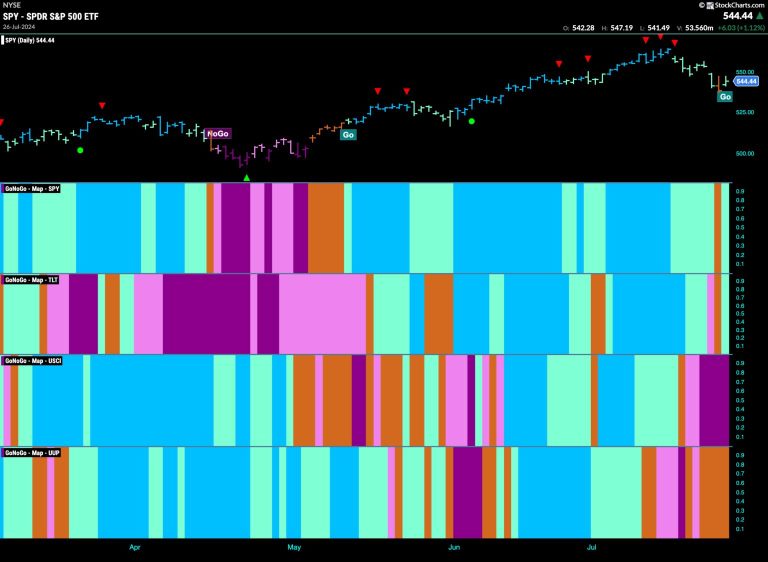
Good morning and welcome to this week’s Flight Path. Equities had another tough week last week and we saw an amber “Go Fish” bar for the first time since this latest “Go” trend began. Encouragingly, GoNoGo Trend painted a weak aqua “Go” bar on the last day of the week but has the damage been done? Treasury bond prices also fell briefly out of the “Go” trend but also ended the week with an aqua “Go” bar. U.S. commodities fell deeper into a “NoGo” as the indicator painted strong purple bar. The dollar still cannot make up its mind and we saw a string of “Go Fish” this past week.

$SPY Manages to Maintain a “Go” for Now

Price has fallen further since the Go Countertrend Correction Icons that we saw at the top. This week a “Go Fish” bar was painted as the market expressed its uncertainty. This comes as GoNoGo Oscillator crashed through the zero line into positive territory on heavy volume. We know that in a healthy trend the oscillator should find support at that level and so we know now that momentum is out of step with the “Go” trend. We will be wary here of more price deterioration.

A hint of weakness on the weekly chart. For the first time in almost three months we did not close in a strong blue bar. We also note the Go Countertrend Correction Icon (red arrow) that appeared at the top. This suggests that price may struggle to move higher in the short term because momentum has waned. We will look to see if the oscillator finds support at zero as it gets closer.

Treasury Rates in “NoGo” but Paint Weak Pink Bars

This week we saw a week of uninterrupted pink “NoGo” bars. Price seems to have set a new lower high as we ended the week lower. If we turn our eye to the GoNoGo Oscillator we can see that it is testing the zero line from below. If this NoGo trend is to remain in place we expect to see this level act as resistance. If GoNoGo Oscillator is turned away into negative territory we will look for price to make an attempt at new lows.

Continued Uncertainty for the U.S. dollar

Its been a few weeks now that we’ve been talking about uncertainty in the U.S. dollar. This week we saw “Go Fish” bars dominate as price moved mostly sideways. GoNoGo Oscillator is riding the zero line after rising to it from below. We see a GoNoGo Squeeze climbing to its Max. We will pay close attention to the direction of the break. If the oscillator breaks back into negative territory then we will look for price to move lower.

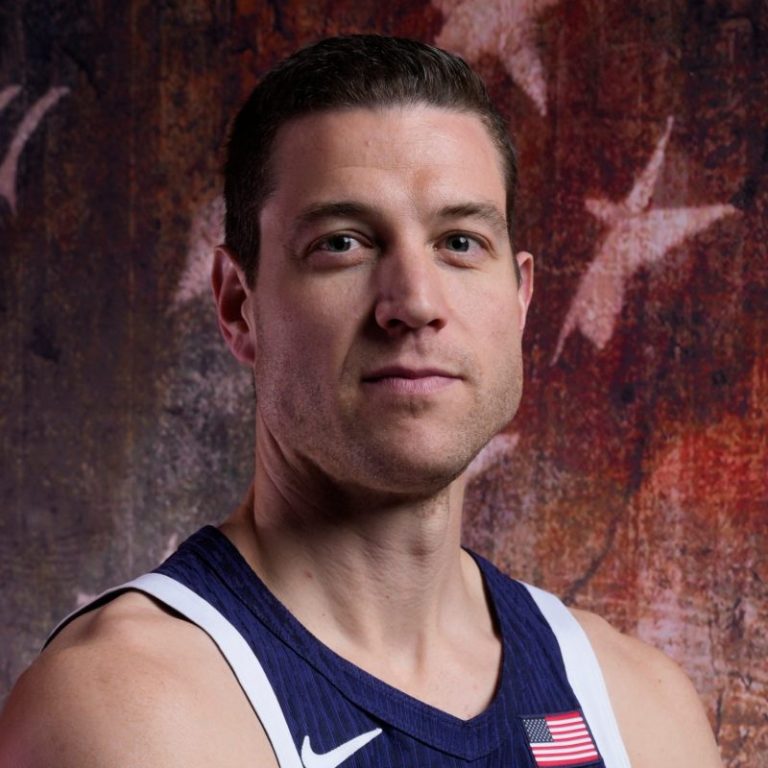
A little more than 12 years after he was college basketball’s biggest star, Jimmer Fredette found himself in the back of a vehicle in Kosovo, driven by a man he barely knew, careening deep into the woods of a remote national park.

Let him explain.

Fredette said he and his 3-on-3 basketball teammates were in Kosovo for a tournament, but they didn’t have a place to practice. Then they learned about three public courts that were nestled in the middle of a national park — dotted with graffiti, with cracks in the pavement, but otherwise perfectly serviceable. So off they went.

‘This guy drove us out there, and we’re like, ‘Listen, we’ll give you $100 if you stay here to make sure you don’t leave,’ ‘ Fredette recalled at a media roundtable earlier this year. ‘Because if you leave, we can’t get home.’

Fortunately, Fredette continued, the guy didn’t leave. And it all worked out fine.

2024 Olympic medals: Who is leading the medal count? Follow along as we track the medals for every sport.

It’s just one of the wild basketball stories he’s amassed — and unique places he’s seen — over the course of a remarkable but unorthodox career.

Over the past 15 years, Fredette has been the unanimous college basketball player of the year, an NBA lottery pick, a borderline NBA bust, a Chinese Basketball Association legend − and, most recently and perhaps finally, a 2024 Olympian. After effectively retiring from 5-on-5 basketball in 2021, he has found a second home in the niche world of 3-on-3, where he will lead Team USA into its first pool play game Tuesday against Serbia.

‘You never know where life is going to take you, right?’ Fredette said. ‘For me, it’s just the way that it worked out. There’s no rhyme or reason for it.’

Fredette’s path to Paris has included pit stops on five continents, with tournaments in a far-flung assortment of places including Mongolia, the Philippines, the United Arab Emirates and Santiago, Chile. Between his 3-on-3 travels and professional stints in China and Greece, he figures he’s been to most of the countries in both Asia and Europe.

‘We call it passport stamp rich,’ he said with a smile. ‘We’re stamp rich.’

Most basketball fans will remember Fredette, now 35, from his time in college at BYU. He was not just a consensus all-American but also a transformative shooter, becoming a bit of a cultural phenomenon whose name was recognizable even among casual sports fans. The Sacramento Kings drafted him 10th overall in the 2011 NBA draft, in between future NBA all-stars Kemba Walker and Klay Thompson.

Fredette’s time in the NBA, however, did not go as smoothly as theirs. He spent parts of three seasons in Sacramento before getting cut, then moved on to brief stints with Chicago and New Orleans. By 2015, Fredette had dropped into the NBA’s D-League. And by the end of 2016, he had left the U.S. altogether, signing a contract with the Shanghai Sharks.

‘I think I was a little ahead of my time,’ Fredette said, when asked about his NBA career. ‘I was shooting from really long ranges in college, where it wasn’t really like that in the NBA at that point. I came in with that type of skillset, and if I don’t have that type of green light to be able to do that, you’re taking away half of my skillset.’

In China, though, Fredette did have that green light − and he used it. Over his first three seasons with the Sharks, he put up nearly 27 shots per game and averaged more than 37 points, with two games in which he scored 70 or more. Yet after a brief return to the NBA, then to Greece, then back to China during the COVID-19 pandemic, Fredette decided that he wanted to spend more time with his family and focus on a second career in venture capitalism.

And that’s where Fran Fraschilla comes in.

In the spring of 2022, the ESPN analyst and former college basketball coach joined USA Basketball as a senior advisor to the men’s 3×3 basketball program, tasked with helping the program bounce back from its failure to qualify for the Olympics in 2021. He heard that Fredette had stepped away from 5-on-5 basketball and thought 3-on-3 might appeal to him, offering a chance for him to continue playing but with less of a time commitment.

After a two-hour lunch in Denver that summer, Fraschilla said, Fredette was in.

‘Jimmer is the poster child for USA 3×3,’ Fraschilla said in an interview. ‘He has had a great career. He was available because of his retirement. … He’s really perfect for the sport.’

To Fraschilla, it wasn’t just that Fredette is ‘a basketball icon, in many ways,’ but also a terrific shooter who’s in great shape − the type of profile that he thought would translate well to the 3-on-3 game, where teams play to 21 with few breaks.

‘It’s just such a different game,’ Fredette explained. ‘Obviously faster pace, quick shot clock, you have to be in a different type of shape. It’s not as much vertical, sprinting up and down. It’s more horizontal, quick bursts.’

It’s also a much more physical game, Fredette said − which, as a former high school football player, he enjoyed.

He also found that it gave him the sort of balance he was looking for, allowing him to drop his kids off at school, work out and then shift his focus to the venture capital work in the afternoon. He quickly became a key player for Team USA, helping lead the Americans to a Pan American Games title last year and second-place finish in the 2023 FIBA 3×3 World Cup.

‘His talent is such that he’s very much, if not the best player on the 3×3 world tour, he’s probably one of the three best players,’ Fraschilla said. ‘So he gave USA Basketball a tremendous lift.’

In return, 3-on-3 basketball gave Fredette a second crack at an opportunity that he thought had long since passed: The Summer Olympics. He knows he’s taken an unorthodox path to Paris. And he acknowledged that his life in basketball has not exactly gone according to plan. Instead of a 15-year career in the NBA, he spent the past year traveling to 15 different countries playing 3-on-3 basketball.

When asked if he envisioned the nomadic lifestyle he now lives, Fredette just said ‘no’ and laughed.

“I’ve had awesome times in my career and I’ve had some tough times in my career – much like many people in their lives, whether it’s in athletics or something else,’ he said. ‘The biggest thing for me is just once a door closes, another one opens. And being able to go all-in on that door.’

Contact Tom Schad at tschad@usatoday.com or on social media @Tom_Schad.

The USA TODAY app gets you to the heart of the news — fast.Download for award-winning coverage, crosswords, audio storytelling, the eNewspaper and more.

This post appeared first on USA TODAY

In the 2024 Paris Olympics, as was the case in Tokyo, women are leading Team USA’s charge atop the Olympics’ medal count.

Of the USA’s 113 medals in the Tokyo Games, most of any country in Tokyo, 66 were won by female athletes and 41 by men (six were in mixed events). The 58.4% of medals won by U.S. women in Tokyo was their highest-ever percentage.

Early trends in Paris suggest that mark could be threatened in 2024.

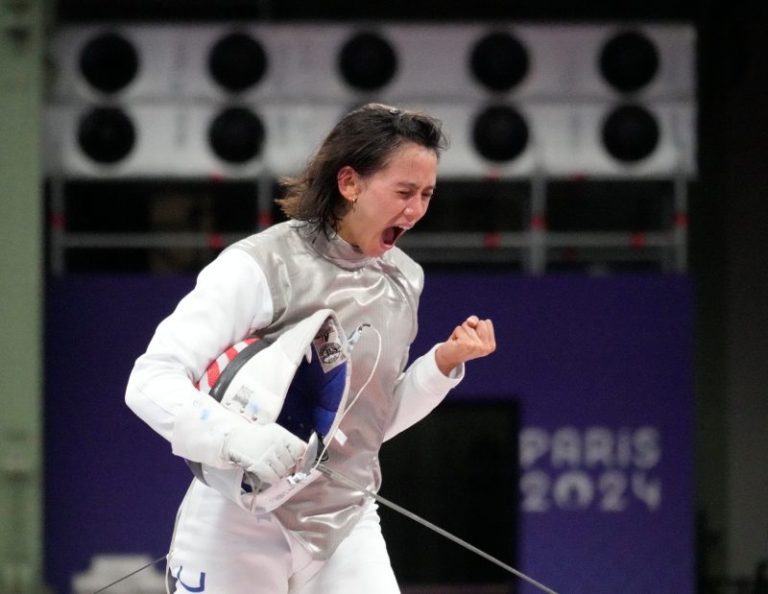
Of the 12 American medals as of early Monday, nine were won by female athletes. The U.S. has already had fencing (Lee Kiefer, gold, and Lauren Scruggs, silver), diving (Sarah Bacon & Kassidy Cook, silver), mountain biking (Haley Batten, silver) and cycling (Chloe Dygert, bronze) as well as a growing haul of medals from Olympic swimming (with Torri Huske winning gold in the 100 butterfly).

Get Olympics updates in your texts! Join USA TODAY Sports’ WhatsApp Channel

2024 Olympic medals: Who is leading the medal count? Follow along as we track the medals for every sport.

More could be on the way in the pool Monday evening, with Emma Weyant and Katie Grimes (400 individual medley), Lilly King (100 breaststroke) and Claire Weinstein (200 freestyle) set to race for medals.

The 12 medals for the U.S. during the first two full days of competition in Paris were the most of any country.

The USA TODAY app gets you to the heart of the news — fast.Download for award-winning coverage, crosswords, audio storytelling, the eNewspaper and more.

This post appeared first on USA TODAY
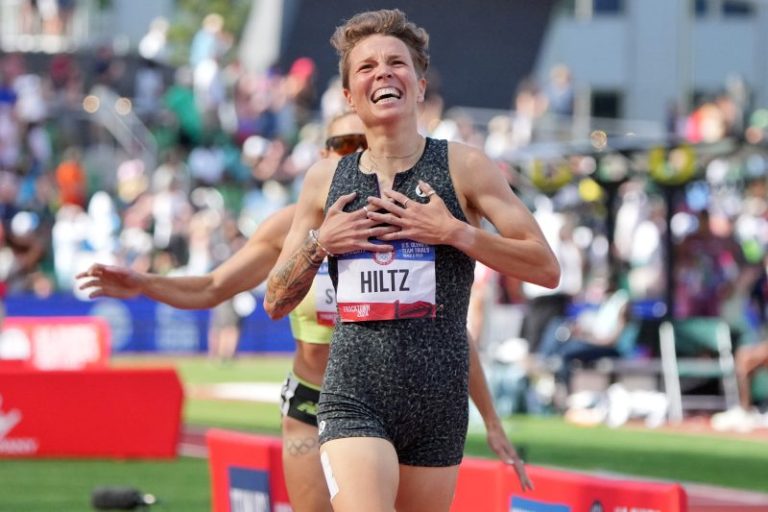
If I turned on the television to watch Olympic runner Nikki Hiltz competing for Team USA when I was a teenager growing up in the 1990s, I don’t know how I would have reacted. But I do know I would have been glued to the screen. Competing in their first-ever Olympics this summer, Hiltz has already run in some of the world’s most watched races, all of which are categorically split into “men’s” and “women’s,” while they – openly and bravely – identify as a transgender and nonbinary athlete.

As someone who is nonbinary myself, I am ecstatic to watch Hiltz compete as one of the world’s best runners, and to see them do so as their full, authentic self. I also know what Hiltz’s presence in Paris means to LGBTQ+ young people – and transgender and nonbinary youth in particular.

Right now, all across the United States, this group of young people is facing a near-constant barrage of politically motivated misinformation and demeaning rhetoric that questions their very identities. The Trevor Project’s advocacy team has tracked that already in 2024, more than 500 anti-LGBTQ+ bills have been considered in state legislatures, most targeting transgender and nonbinary folks. These bills, and the ugly rhetoric surrounding them, take a toll on the mental health of LGBTQ+ young people.

An overwhelming 90% of LGBTQ+ young people said that recent politics negatively impacted their mental health in the past year, and nearly 2 in 5 LGBTQ+ young people also said that they or their families considered moving to a different state because of anti-LGBTQ+ laws. Three years ago, I relocated my family from Texas, and the anti-LGBTQ+ policies that jeopardized my family’s safety played a major factor in that decision.

This context makes Hiltz’s impact all the more important – both on and off the track. The Trevor Project’s research found that a vast majority of LGBTQ+ young people (67%) said seeing athletes come out as LGBTQ+ made them feel good about their own identities. Hiltz is a possibility model. They’ve shown young people everywhere that you can thrive in your favorite sport, and you can do so while standing proudly and firmly in your truth.

2024 Olympic medals: Who is leading the medal count? Follow along as we track the medals for every sport.

This representation matters, especially among Olympic athletes. The 2024 Paris Olympic Games is on track to make history for queer representation, with more than 150 out LGBTQ+ athletes reported to be participating from all over the world.

For transgender and nonbinary folks in the United States, much of the discourse on our participation in sports has been dangerously politicized. This year alone, The Trevor Project found that 67 state-wide transgender sports bans have been considered, and three have been passed into law to prevent transgender and nonbinary young people from participation. However, these bans are rooted in misinformation and untrue stereotypes, not in reality. 

While Hiltz deserves to celebrate their success and focus on preparing for the games ahead like any Olympian, it’s sadly not surprising to see they have received some backlash, simply because they are a transgender and nonbinary person. Anti-LGBTQ+ special interest groups have long pushed strong and coordinated misinformation campaigns to isolate our community. This misinformation banks on the fact that most people say they don’t personally know someone who is transgender or nonbinary. Fewer than 1 in 3 adults in the U.S. say they know someone who is transgender, and only 1 in 6 say they know someone who is nonbinary.

Thanks to Hiltz, Olympic fans across the world have the opportunity to put a face to a community that has been unfairly dehumanized for far too long. Many people have genuine questions or misunderstandings about what it means to be transgender or nonbinary, and that is valid. I encourage those folks to use Hiltz’s story as a starting point to help unlearn stereotypes and politically motivated misinformation. Get to know us as Nikki. Get to know us as Jaymes. Get to know us as individuals, not as some monolithic entity you only hear about on the news.

The Olympics has become a tradition for my family and me. We’ve been watching together as a family since my boys were about 6 years old. Just as we did during the trials, we will abandon our normal dinner table routine, and head to the living room to have our meal in front of the TV to cheer on Nikki, and the historic number of LGBTQ+ athletes competing in Paris. I hope Hiltz’s Olympic experience is everything they dreamed it would be. Their impact – both on and off the track – is momentous. Before Hiltz even begins their first race, they have already made this world a better and more hopeful place for transgender and nonbinary people everywhere.

Jaymes Black (they/she/he) is the Chief Executive Officer atThe Trevor Project, the leading suicide prevention and crisis intervention organization for LGBTQ+ young people.

This post appeared first on USA TODAY

PARIS — The U.S. women’s gymnastics team used to joke about a non-Simone Biles division, an acknowledgement that Biles is so much better than everyone else that no one could beat her.

The same still applies — and then some. Biles had the top score in Olympics qualifying, her 59.566 almost two points ahead of Brazil’s Rebeca Andrade, who was runner-up to Biles at the 2023 world championships. This despite a flare-up of a calf injury that had Biles limping visibly between events. So as long as Biles is healthy and in a good place mentally, a second Olympic all-around title is hers Thursday night.

It would make her only the third woman, and first since 1968, to win gymnastics’ most prestigious prize twice. Biles also would be the oldest woman to win Olympic gold since 30-year-old Maria Gorokhovskaya in 1952.

Get Olympics updates in your texts! Join USA TODAY Sports’ WhatsApp Channel

“The fact her gymnastics just keeping better the older she gets, it’s a testament to her drive of wanting to be the best,” said Alicia Sacramone Quinn, a silver medalist at the 2008 Olympics who is now the strategic lead for the women’s program.

2024 Olympic medals: Who is leading the medal count? Follow along as we track the medals for every sport.

“I’m so impressed by her,” added Sacramone Quinn, whose 10 medals at the world championships and Olympics made her the most-decorated U.S. gymnast until Biles came along. “Every time she goes, I just joke, ‘Stop being so good at gymnastics! Let everybody else catch up.’ She’s like, ‘Yeah. OK.’”

Here’s a look at the best of the rest. Or should we say who are the contenders in the “non-Simone division”?

Rebeca Andrade, Brazil

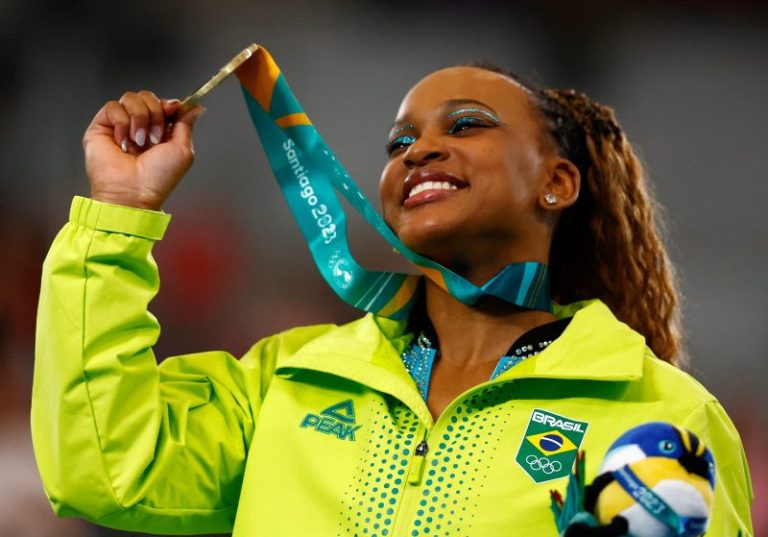
Rebeca Andrade finished second to Biles after qualifying, albeit almost two points behind.

Andrade has been the best gymnast not named Simone Biles since the Tokyo Olympics. She won the all-around title at the 2022 world championships, when Biles was taking a break from gymnastics. She was the silver medalist in 2023 after Biles returned, and beat Biles for the world vault title.

She was second to Suni Lee at the Tokyo Olympics, and also won the vault title. She has nine medals overall at the world championships, winning five last year alone. That included a historic silver medal in the team competition, the best finish ever by Brazil’s men or women at either a worlds or Olympics.

Andrade was the first Brazilian woman to win a Olympic medal in gymnastics and an Olympic gold medal. Making her recent success all the more remarkable is that it’s come after three ACL tears.

Suni Lee, United States

Lee went to Auburn after Tokyo and competed for two years before a kidney ailment cut her final season short. Lee said she actually has two kidney issues — the second was discovered while the first was being treated — and they caused swelling so severe there were days she couldn’t even put her grips on. Her training was disrupted for almost a year, and she wasn’t sure if she’d even make it back to the Olympics.

But Lee returned to competition in February and has been making steady progress since, finishing second to Biles at the Olympic trials in July.

Kaylia Nemour, Algeria

Kaylia Nemour finished fifth after qualifying. Though Nemour is best known for her ridiculous difficulty on uneven bars, where she’s the reigning world silver medalist, she’s also very good in the all-around. She is the reigning African champion and was eighth at 2023 worlds.

Nemour was born in France but chose to compete for Algeria, where her father is from, after a dispute with the French federation. Bet officials there are regretting that right about now, given France missed the team final and got no one into any individual event finals.

Manila Esposito, Italy

Manila Esposito finished sixth after qualifying. Esposito is the reigning European champion, edging teammate Alice D’Amato at the meet earlier this spring. She also won golds on balance beam and floor exercise. Esposito was ninth at the 2023 world championships.

Alice D’Amato, Italy

Alice D’Amato finished seventh after qualifying. She was runner-up to teammate Manila Esposito at European championships earlier this spring, and fifth at the world championships in 2023.

Qiu Qiyuan, China

Qiu Qiyuan was eighth after qualifying. Qiu was fourth in the all-around at the 2023 world championships, her first at the senior level. She also won gold on uneven bars. Qiu was a three-time gold medalist at the 2023 Asian Games, winning in the team competition, all-around and uneven bars.

Jordan Chiles, United States

Chiles should be in the all-around final after finishing fourth in qualifying but won’t be because of the International Gymnastics Federation’s silly two-per-country rule. She should also be in the vault final but won’t be for the same reason.

The USA TODAY app brings you every Team USA medal — right when it happens. Download for full Olympics coverage, crosswords, audio storytelling, the eNewspaper and much more.

This post appeared first on USA TODAY

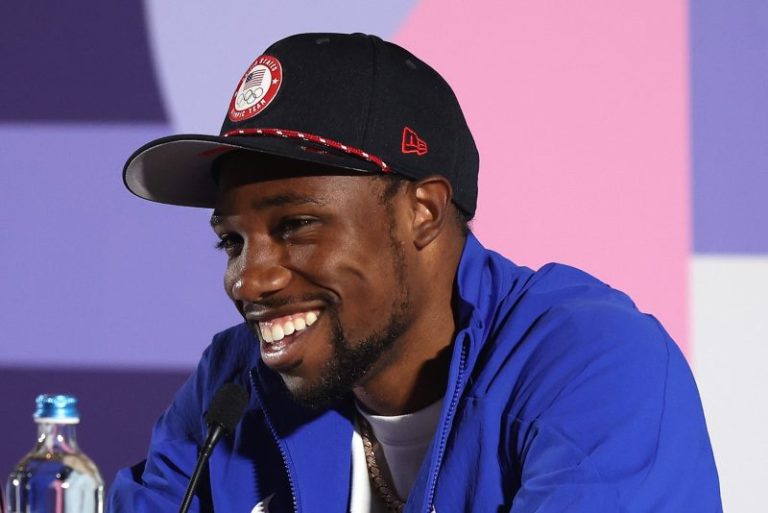
PARIS – Noah Lyles isn’t lacking in confidence ahead of the Paris Olympic track and field competition. The U.S. sprinter doubled down on his belief that he’s the fastest man in the world amid some backlash.

‘It’s me. It’s always going to be me,’ Lyles said with a smile at the Team USA track and field Paris Olympics introductory press conference. ‘Everybody knows that the title goes to the Olympic champion and the world champion, which I am one of and soon to be another one of.’

Lyles is the reigning world champion in the 100 and 200. He also won the U.S. Olympic track and field trials in both sprint events. The criticism he’s receiving is from some fans, past and current athletes who claim the ‘fastest man in the world’ title belongs to retired Jamaican track and field superstar Usain Bolt, who owns world records in both the 100 (9.58) and 200 (19.19).

There are others who believe the fastest man in the world is currently Jamaica’s Kishane Thompson who has the No. 1 100 time in the world this year at 9.77. Lyles’ season-best and personal-best 100 time of 9.81 ranks No. 3 in the world this year.

Get Olympics updates in your texts! Join USA TODAY Sports’ WhatsApp Channel

2024 Olympic medals: Who is leading the medal count? Follow along as we track the medals for every sport.

Lyles thinks that the ‘fastest man in the world’ title is awarded annually to the individual who wins the 100 at world championships, or in this year’s case, the Olympic champion in the 100.

Whether people agree with Lyles or not, the U.S. sprinter has a chance to silence a lot of his naysayers when track and field begins at the Paris Olympics. The men’s 100 final is on Aug. 4 and the 200 final is Aug. 8. Lyles is set to run in the 100, 200 and 4×100-relay. He’s aiming to collect his first ever Olympic gold medal, and possibly more, after what he described as a disappointing bronze medal in the 200 at the Tokyo Games.

‘I’m excited. As a lot of people know the last Olympics didn’t go according to plan. There were a lot of ups and downs,’ Lyles said. ‘I can finally say I’m showing up for an Olympic games not depressed. It feels amazing. A lot of joy. … I can always think back to the last Olympics and be like, ‘No, this one is not the same. This one is way better and I’m ready to show it.’’

Follow USA TODAY Sports’ Tyler Dragon on X @TheTylerDragon.

The USA TODAY app gets you to the heart of the news — fast.Download for award-winning coverage, crosswords, audio storytelling, the eNewspaper and more.

This post appeared first on USA TODAY
PARIS — Why would some Olympic surfers wear helmets during the Paris Games?

Well, now we know.

Johanne Defray of France needed four stiches for a head wound Saturday, underscoring the danger of surfing at the famous Teahupo’o break in Tahiti. It’s not just the powerful wave. It’s the shallow, sharp coral reef.

No helmet, no mercy.

2024 Olympic medals: Who is leading the medal count? Follow along as we track the medals for every sport.

‘Yesterday on my first wave I had a fall,’ Defay said. ‘It just went so big, I went straight into the coral with my head, I had four stitches.

‘They made me go through the concussion protocols and the results were so-so, so they made me go through them all again this morning. … There’s no trauma, so we’re happy.’

Before the Olympics started, American surfer Griffin Colapinto told USA TODAY he’d experimented with wearing a helmet during practice sessions at Teahupo’o. He said thought the equipment would be a common sight when the Games began.

This post appeared first on USA TODAY

Yes, the Philadelphia Phillies remain the top-ranked team in USA TODAY Sports’ power rankings.

But that’s only because every other elite team has been as bad – or worse – as them.

The Phillies have lost eight of 12 games and suffered four consecutive series losses, yet still hold a nine-game lead in the National League East and a 3 ½-game lead for the best NL record. You might say the sting was blunted this weekend since they lost two of three to the best team in the American League, the Cleveland Guardians.

Yet the Guardians came into the series on their own 4-8 skid; simply, someone was going to record two wins in Philly this weekend.

The Baltimore Orioles, No. 2 in the AL? They’ve lost 10 of 15. The New York Yankees, lurking just a game behind them in the East? They’re 11-23 since June 15 and have lost 13 of 21.

Follow every MLB game: Latest MLB scores, stats, schedules and standings.

It is no way for these juggernauts to go into Tuesday’s trade deadline, where only so much can be done to patch whatever holes have been exposed in recent days, weeks, months. Tread lightly, trade wisely.

A look at this week’s rankings:

1. Philadelphia Phillies (-)

Carlos Estévez acquistion means Rob Thomson can play the hot hand in playoff bullpen.

2. Cleveland Guardians (+1)

Emmanuel Clase now 33-of-36 (91.6%) in save opportunities.

3. Baltimore Orioles (-1)

Gunnar Henderson with five errors in past four games, 16 overall (second in majors).

4. Los Angeles Dodgers (-)

With young and injury-recovering starters in rotation, bullpen now absolutely gassed.

5. New York Yankees (-)

Aaron Boone says Jazz Chisholm Jr. (.309 career OBP) will probably hit in middle of the lineup.

6. Milwaukee Brewers

Devin Williams is back in the bullpen – and the division lead is six games.

7. Atlanta Braves (-)

Reynaldo Lopez latest All-Star starter headed to MRI tube.

8. Minnesota Twins (+1)

Bailey Ober’s last seven starts: 1.48 ERA, 0.77 WHIP, 56 strikeouts in 48 ⅓ innings.

9. Boston Red Sox (-1)

Hopefully James Paxton isn’t their final answer to upgrading the staff.

10. Kansas City Royals (-)

MVP? Bobby Witt Jr. has 18 homers, 1.107 OPS in last 30 games.

11. Houston Astros (-)

Weak farm, luxury-tax concerns will make rotation enhancements challenging.

12. San Diego Padres (+3)

Since coming off the IL, Xander Bogaerts is 22 for 45 (.489) with 1.169 OPS.

13. Arizona Diamondbacks (+1)

A.J. Puk strikes out four of first seven batters he faces as a D-back.

14. Seattle Mariners (-1)

Good news: Tied for first again. Bad news: All done with the White Sox.

15. New York Mets (+1)

Kodai Senga’s likely season-ending calf injury in debut a major blow to nascent wild-card bid.

16. St. Louis Cardinals (-4)

Dropped from second to fifth in wild-card derby.

17. Tampa Bay Rays (-)

Have won nine of 14 since sell-off began. Weird team!

18. Texas Rangers (+1)

Seriously, don’t let them get hot.

19. Pittsburgh Pirates (-1)

Rowdy Tellez Watch: .251, .705 OPS. The man is solidly league average.

20. San Francisco Giants (-)

He’s made just 10 starts but Giants have reached Choose Your Own Adventure (Trade? Keep? Opt out?) phase with Blake Snell.

21. Detroit Tigers (+1)

Pretty inspiring stretch of nine wins in 15 games to maybe ensure they don’t totally blow it up.

22. Cincinnati Reds (+1)

Their trade-deadline epitaph could read: ‘9-20 in one-run games.’

23. Chicago Cubs (-)

From lovable losers to streak busters to four years of utterly nondescript product.

24. Toronto Blue Jays (+1)

The sell-off is a drag, but biggest deal this week is losing prospect Ricky Tiedemann to Tommy John surgery.

25. Washington Nationals (-1)

MacKenzie Gore struggling in second half, with 15 walks, 1.93 WHIP in his last 20 ⅔ innings.

26. Los Angeles Angels (-)

Carlos Estévez brings back a pretty decent return from Phillies.

27. Oakland Athletics (-)

Literally can’t have nice things, not even Mason Miller.

28. Miami Marlins (+1)

The Jazz Chisholm Era, such as it was, now a historic footnote.

29. Colorado Rockies (-1)

The plan? Apparently to build around Ryan McMahon, once again untouchable.

30. Chicago White Sox (-)

Might be next decade by the time they’re buyers again.

This post appeared first on USA TODAY

Four PGA Tour golfers – each a past or current major champion – will tee it up for the United States when the men’s Olympic tournament begins Thursday at Le Golf National near Paris.

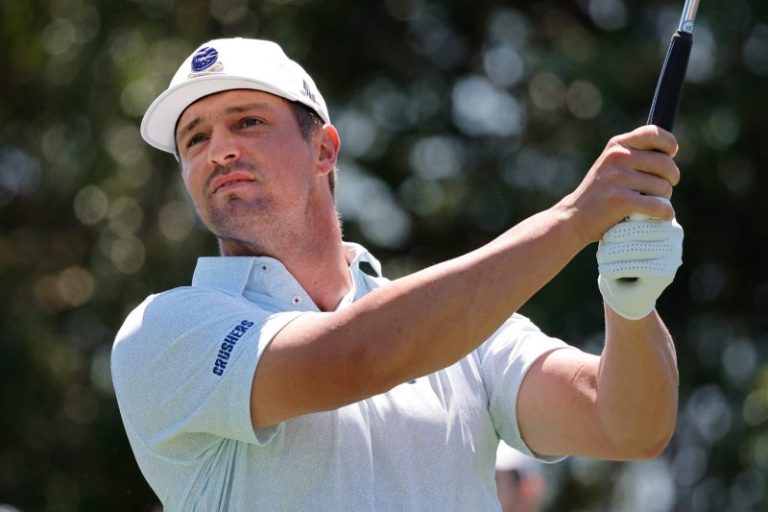
But this year’s U.S. Open champion Bryson DeChambeau won’t be one of them.

DeChambeau failed to earn enough points to qualify for the 2024 Paris Olympics last month ahead of fellow Americans Scottie Scheffler (No. 1 in the final rankings list), Xander Schauffele (No. 3), Wyndham Clark (No. 5) and Collin Morikawa (No. 7). With a maximum of only four spots per country available in both the men’s and women’s Olympic golf competition, DeChambeau (No. 10) missed out.

Why?

Get Olympics updates in your texts! Join USA TODAY Sports’ WhatsApp Channel

2024 Olympic medals: Who is leading the medal count? Follow along as we track the medals for every sport.

Because he joined LIV Golf, basically.

It’s not that LIV golfers aren’t eligible to play in the Olympics. They are, and they will. Seven LIV golfers are in the field: Abraham Ancer (Mexico), Adrian Meronk (Poland), Joaquin Niemann (Chile), Carlos Ortiz (Mexico), Mito Pereira (Chile), David Puig (Spain) and Jon Rahm (Spain).

Those players, however, were able to qualify for countries that lacked as many top players vying for spots. For DeChambeau and American LIV players like Brooks Koepka, the qualifying format – the Olympics selects its field based on the official world golf rankings – cripples their chances, since they primarily play three-round LIV events that are not recognized by the OWGR.

Even prior to his U.S. Open victory in June, DeChambeau stood no chance to make the Olympic team.

After winning, he said he wanted to represent Team USA at the Olympics, and it was ‘frustrating and disappointing’ that he wouldn’t be able.

“But I understand the decisions I made,’ said DeChambeau, according to Golfweek, ‘and the way things have played out has not been necessarily perfectly according to plan. … It hurts, but you know what, there’s another one four years later. Hopefully, 2028 will be a little different situation, and it will make it that much sweeter.’

The USA TODAY app gets you to the heart of the news — fast.Download for award-winning coverage, crosswords, audio storytelling, the eNewspaper and more.

This post appeared first on USA TODAY
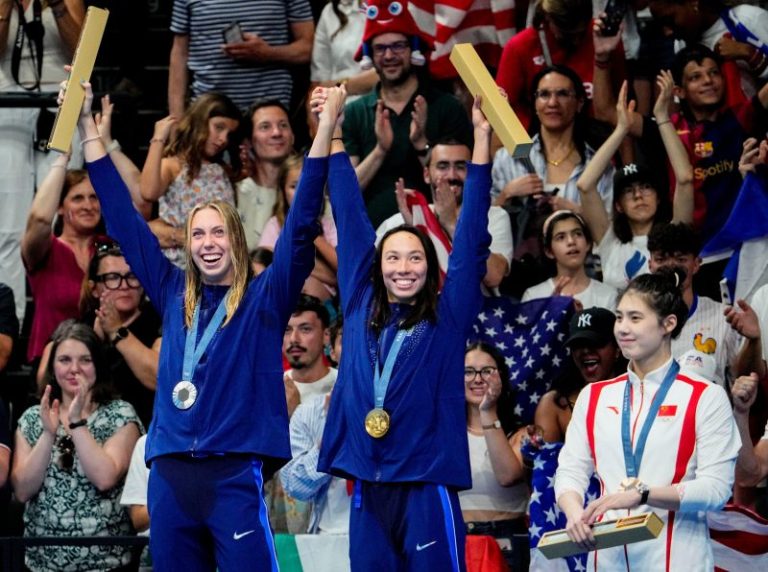
Medals are being handed out left and right with the 2024 Paris Olympics in full swing, but hardware isn’t the only thing Olympians are getting on the podium.

From footage and photos taken at medal ceremonies, winners can be seen receiving a slim, mysterious box in addition to the medals they receive. It’s an intriguing item, leaving viewers pondering as to what could be inside.

So what’s in the box?

It’s the official Olympic poster for this year’s Summer Game, according to the International Olympic Committee. The posters are designed by French artist Ugo Gattoni. He reportedly spent 2,000 hours in four months designing it, and fans can even buy it online or in Paris.

What else do Olympic medalist get?

Winning Olympians also get another gift in addition to their medal and the official Olympic poster. They receive a plushie off the 2024 Paris Olympics official mascot, the Phryges. It’s based off Phrygian caps, or liberty caps, which are soft conical hats with the top curled forward that are synonymous with the French revolution.

2024 Olympic medals: Who is leading the medal count? Follow along as we track the medals for every sport.

The special part of the Phryges winners get is it includes a gold, silver or bronze medal emblem on the mascot’s belly for whatever medal the Olympian won. On the back of the plushie is the word ‘Bravo’ in French.

For winners in the Paralympic Games, they get the official event poster as well as the Paralympic Phryge plushie.

This post appeared first on USA TODAY